Organizational Culture: Analysis, Characteristics, and Impact

Verified

Added on  2020/05/11

|4
|449
|38
Report
AI Summary
This report delves into the concept of organizational culture, exploring its significance and impact on various aspects of a company. The report emphasizes that organizational culture, encompassing shared values, beliefs, and practices, significantly influences employee behavior, innovation, and teamwork. It highlights key characteristics such as innovation, attention to detail, outcome orientation, emphasis on people, teamwork, and stability. The report stresses the importance of aligning employees with a specific culture to enhance organizational performance, referencing the work of Alvesson, Chatman & Jehn, and Watkins to support its claims. It underscores how culture shapes the way employees act, interact, and contribute to the overall success of the organization. The report concludes by reinforcing the critical role of organizational culture in guiding employee behavior and achieving strategic goals.
Document Page
Running head: ORGANIZATIONAL CULTURE 1
Organizational Culture
Name
Institution
tabler-icon-diamond-filled.svg

Paraphrase This Document

Need a fresh take? Get an instant paraphrase of this document with our AI Paraphraser
Document Page
ORGANIZATIONAL CULTURE 2
Organizational Culture
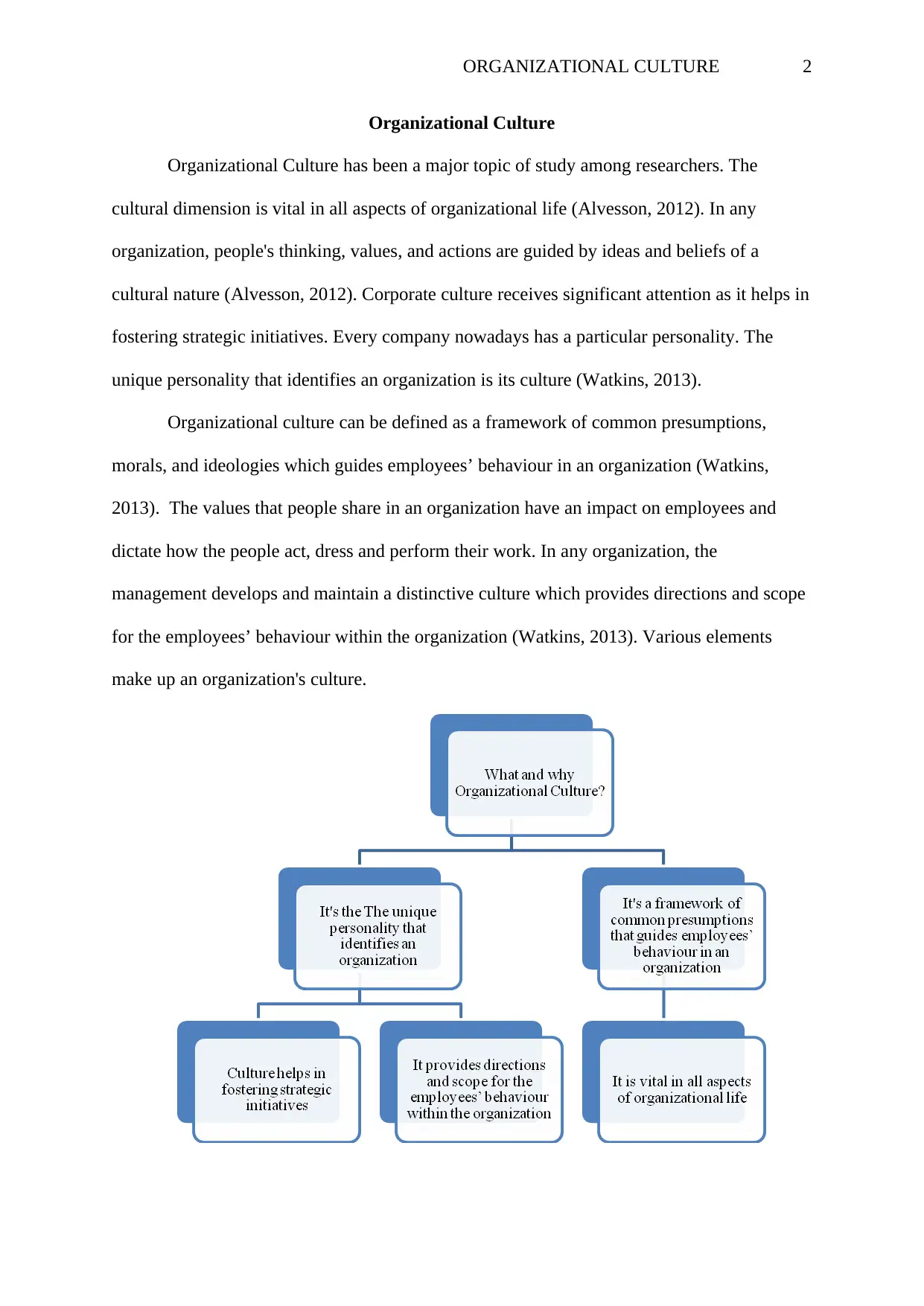
Organizational Culture has been a major topic of study among researchers. The
cultural dimension is vital in all aspects of organizational life (Alvesson, 2012). In any
organization, people's thinking, values, and actions are guided by ideas and beliefs of a
cultural nature (Alvesson, 2012). Corporate culture receives significant attention as it helps in
fostering strategic initiatives. Every company nowadays has a particular personality. The
unique personality that identifies an organization is its culture (Watkins, 2013).
Organizational culture can be defined as a framework of common presumptions,
morals, and ideologies which guides employees’ behaviour in an organization (Watkins,
2013). The values that people share in an organization have an impact on employees and
dictate how the people act, dress and perform their work. In any organization, the
management develops and maintain a distinctive culture which provides directions and scope
for the employees’ behaviour within the organization (Watkins, 2013). Various elements
make up an organization's culture.
Document Page
ORGANIZATIONAL CULTURE 3
Characteristics of Organizational Culture
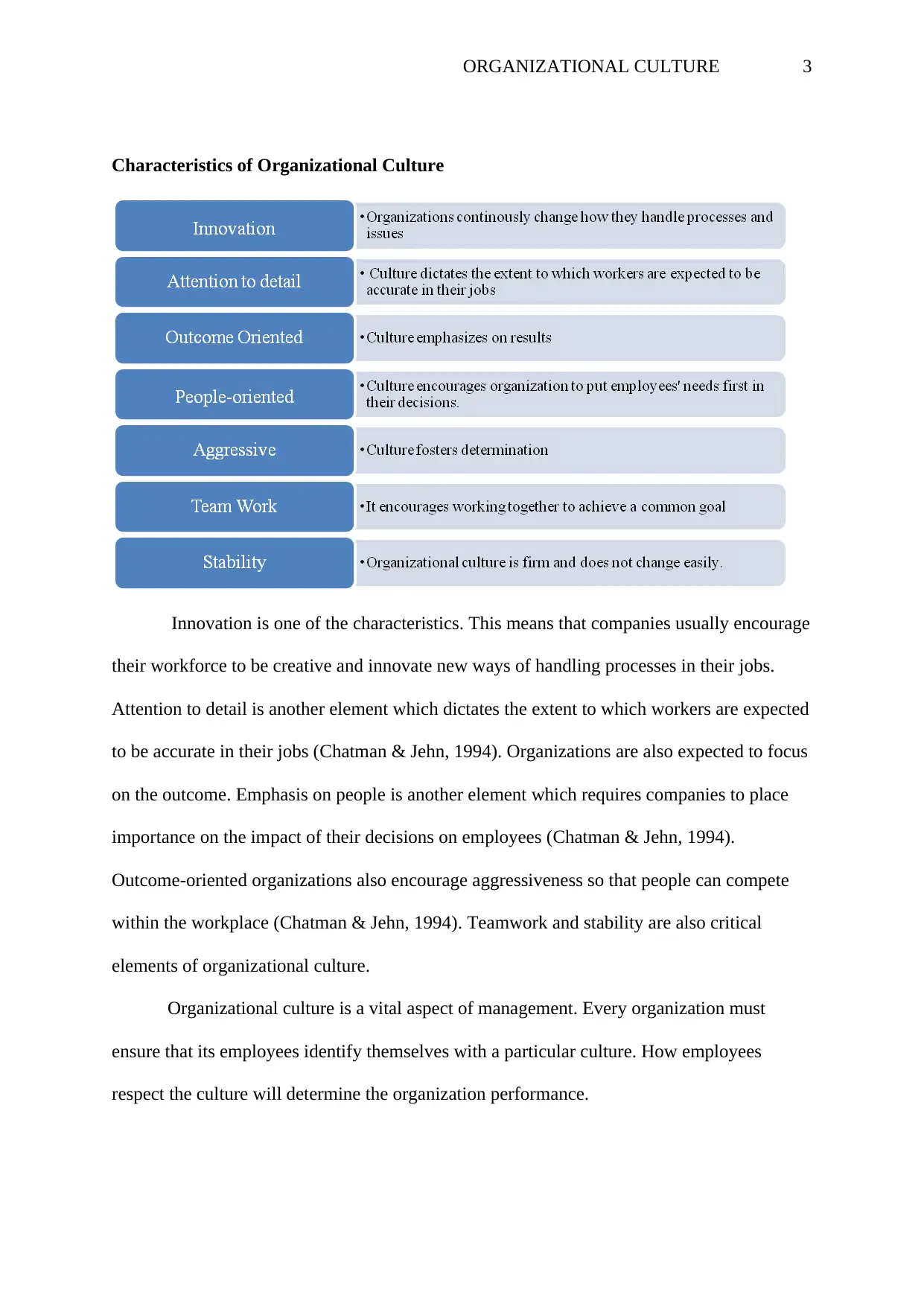
Innovation is one of the characteristics. This means that companies usually encourage
their workforce to be creative and innovate new ways of handling processes in their jobs.
Attention to detail is another element which dictates the extent to which workers are expected
to be accurate in their jobs (Chatman & Jehn, 1994). Organizations are also expected to focus
on the outcome. Emphasis on people is another element which requires companies to place
importance on the impact of their decisions on employees (Chatman & Jehn, 1994).
Outcome-oriented organizations also encourage aggressiveness so that people can compete
within the workplace (Chatman & Jehn, 1994). Teamwork and stability are also critical
elements of organizational culture.
Organizational culture is a vital aspect of management. Every organization must
ensure that its employees identify themselves with a particular culture. How employees
respect the culture will determine the organization performance.
Document Page
ORGANIZATIONAL CULTURE 4
References
Alvesson, M. (2012). Understanding organizational culture. Sage.
Chatman, J. A., & Jehn, K. A. (1994). Assessing the relationship between industry
characteristics and organizational culture: how different can you be?. Academy of
management journal, 37(3), 522-553.
Watkins, M. (2013). What is Organizational Culture? And Why Should We Care?. Harvard
Business Review.
chevron_up_icon
1 out of 4
circle_padding
hide_on_mobile
zoom_out_icon
[object Object]