Annotated Bibliography: Contextual Factors in Decision Making

Verified

Added on  2023/01/10

|8
|2116
|60
Annotated Bibliography
AI Summary
This annotated bibliography explores the multifaceted nature of organizational decision-making by analyzing five peer-reviewed journal articles published between 2014 and 2018. The introduction sets the stage by highlighting the significance of contextual factors in shaping managerial choices. The first article examines how leadership styles, particularly transformational leadership, influence innovation within organizations. The second article investigates the role of knowledge management in fostering a learning culture, crucial for effective decision-making, especially in emerging market contexts. The third article delves into the impact of risk management strategies, leadership styles, and employee participation on organizational performance. The fourth article focuses on stakeholder collaboration and social responsibility within construction projects, emphasizing the importance of clear roles and equitable participation for sound decision-making. Finally, the fifth article examines the impact of affective diversity on managerial decision performance, highlighting the potential strengths of diverse perspectives. The bibliography concludes by emphasizing the importance of these contextual factors, particularly for the banking industry. The assignment adheres to the specified word count and includes all required elements, such as DOIs, and provides a comprehensive overview of the selected articles and their implications for organizational decision-making.
Document Page
Running head: ORGANIZATIONAL DECISION MAKING
Organizational Decision Making
Name of Student:
Name of the University:
Author note:
tabler-icon-diamond-filled.svg

Paraphrase This Document

Need a fresh take? Get an instant paraphrase of this document with our AI Paraphraser
Document Page
1ORGANIZATIONAL DECISION MAKING
Introduction:
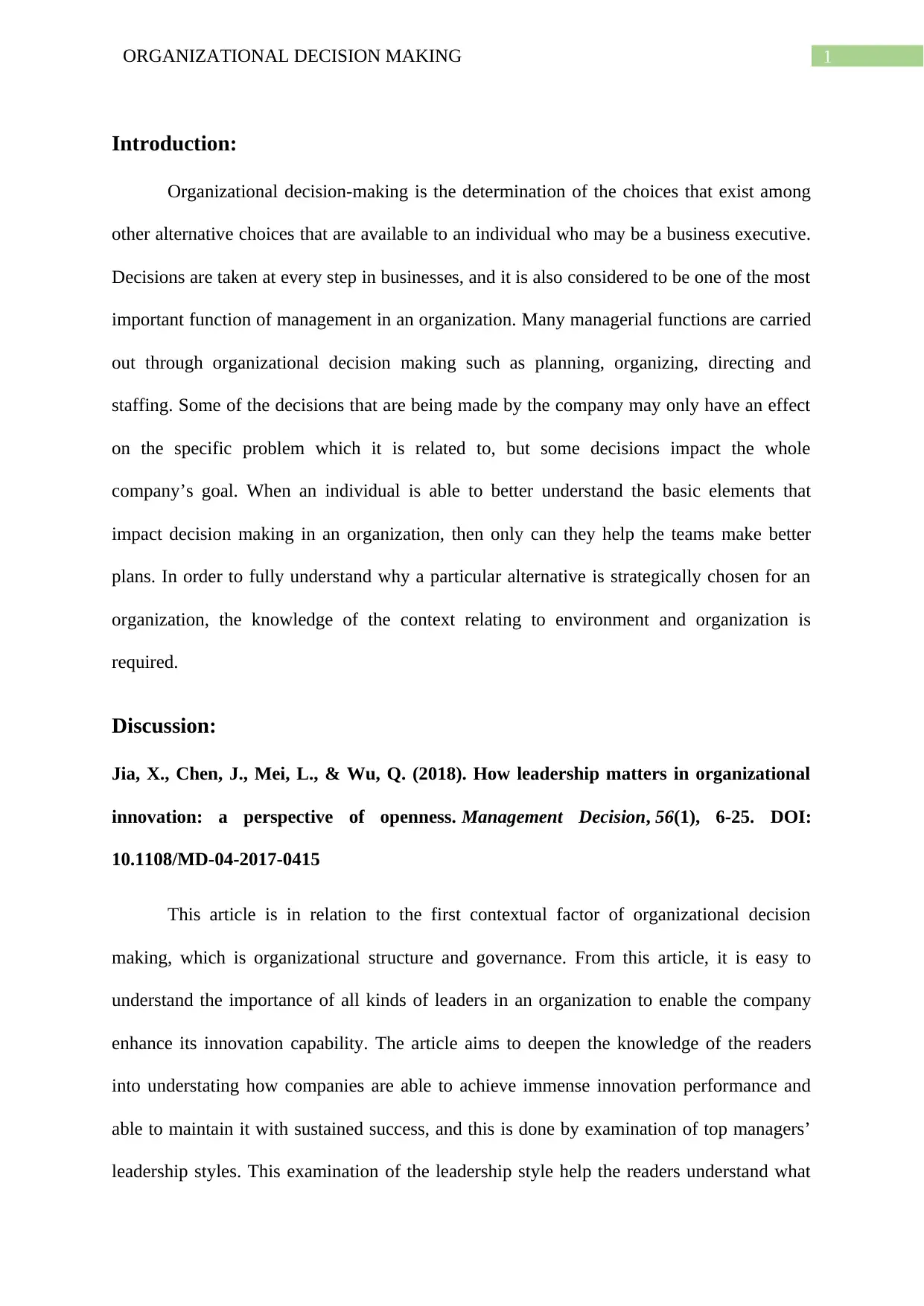
Organizational decision-making is the determination of the choices that exist among
other alternative choices that are available to an individual who may be a business executive.
Decisions are taken at every step in businesses, and it is also considered to be one of the most
important function of management in an organization. Many managerial functions are carried
out through organizational decision making such as planning, organizing, directing and
staffing. Some of the decisions that are being made by the company may only have an effect
on the specific problem which it is related to, but some decisions impact the whole
company’s goal. When an individual is able to better understand the basic elements that
impact decision making in an organization, then only can they help the teams make better
plans. In order to fully understand why a particular alternative is strategically chosen for an
organization, the knowledge of the context relating to environment and organization is
required.
Discussion:
Jia, X., Chen, J., Mei, L., & Wu, Q. (2018). How leadership matters in organizational
innovation: a perspective of openness. Management Decision, 56(1), 6-25. DOI:
10.1108/MD-04-2017-0415
This article is in relation to the first contextual factor of organizational decision
making, which is organizational structure and governance. From this article, it is easy to
understand the importance of all kinds of leaders in an organization to enable the company
enhance its innovation capability. The article aims to deepen the knowledge of the readers
into understating how companies are able to achieve immense innovation performance and
able to maintain it with sustained success, and this is done by examination of top managers’
leadership styles. This examination of the leadership style help the readers understand what
Document Page
2ORGANIZATIONAL DECISION MAKING
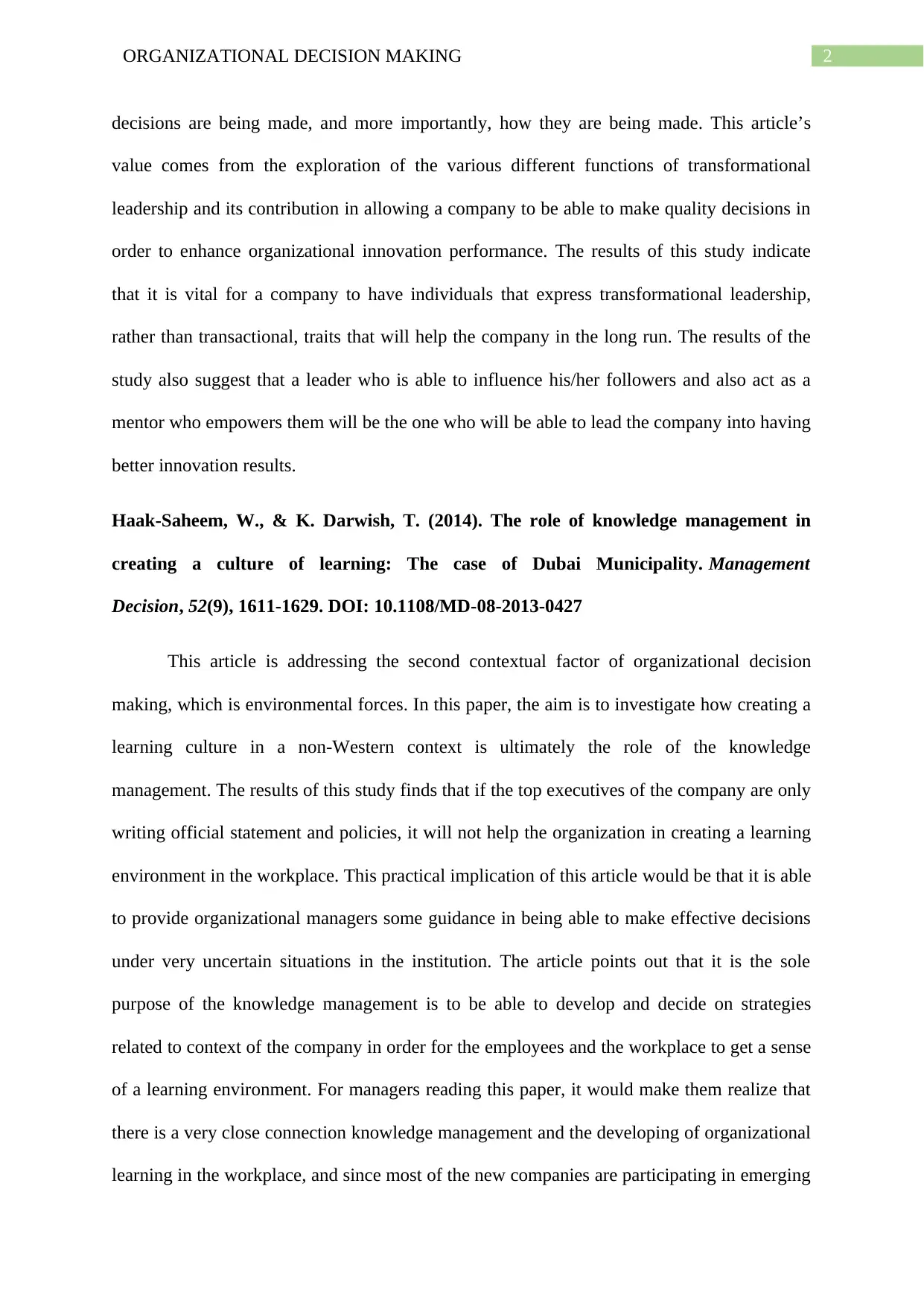
decisions are being made, and more importantly, how they are being made. This article’s
value comes from the exploration of the various different functions of transformational
leadership and its contribution in allowing a company to be able to make quality decisions in
order to enhance organizational innovation performance. The results of this study indicate
that it is vital for a company to have individuals that express transformational leadership,
rather than transactional, traits that will help the company in the long run. The results of the
study also suggest that a leader who is able to influence his/her followers and also act as a
mentor who empowers them will be the one who will be able to lead the company into having
better innovation results.
Haak-Saheem, W., & K. Darwish, T. (2014). The role of knowledge management in
creating a culture of learning: The case of Dubai Municipality. Management
Decision, 52(9), 1611-1629. DOI: 10.1108/MD-08-2013-0427
This article is addressing the second contextual factor of organizational decision
making, which is environmental forces. In this paper, the aim is to investigate how creating a
learning culture in a non-Western context is ultimately the role of the knowledge
management. The results of this study finds that if the top executives of the company are only
writing official statement and policies, it will not help the organization in creating a learning
environment in the workplace. This practical implication of this article would be that it is able
to provide organizational managers some guidance in being able to make effective decisions
under very uncertain situations in the institution. The article points out that it is the sole
purpose of the knowledge management is to be able to develop and decide on strategies
related to context of the company in order for the employees and the workplace to get a sense
of a learning environment. For managers reading this paper, it would make them realize that
there is a very close connection knowledge management and the developing of organizational
learning in the workplace, and since most of the new companies are participating in emerging
Document Page
3ORGANIZATIONAL DECISION MAKING
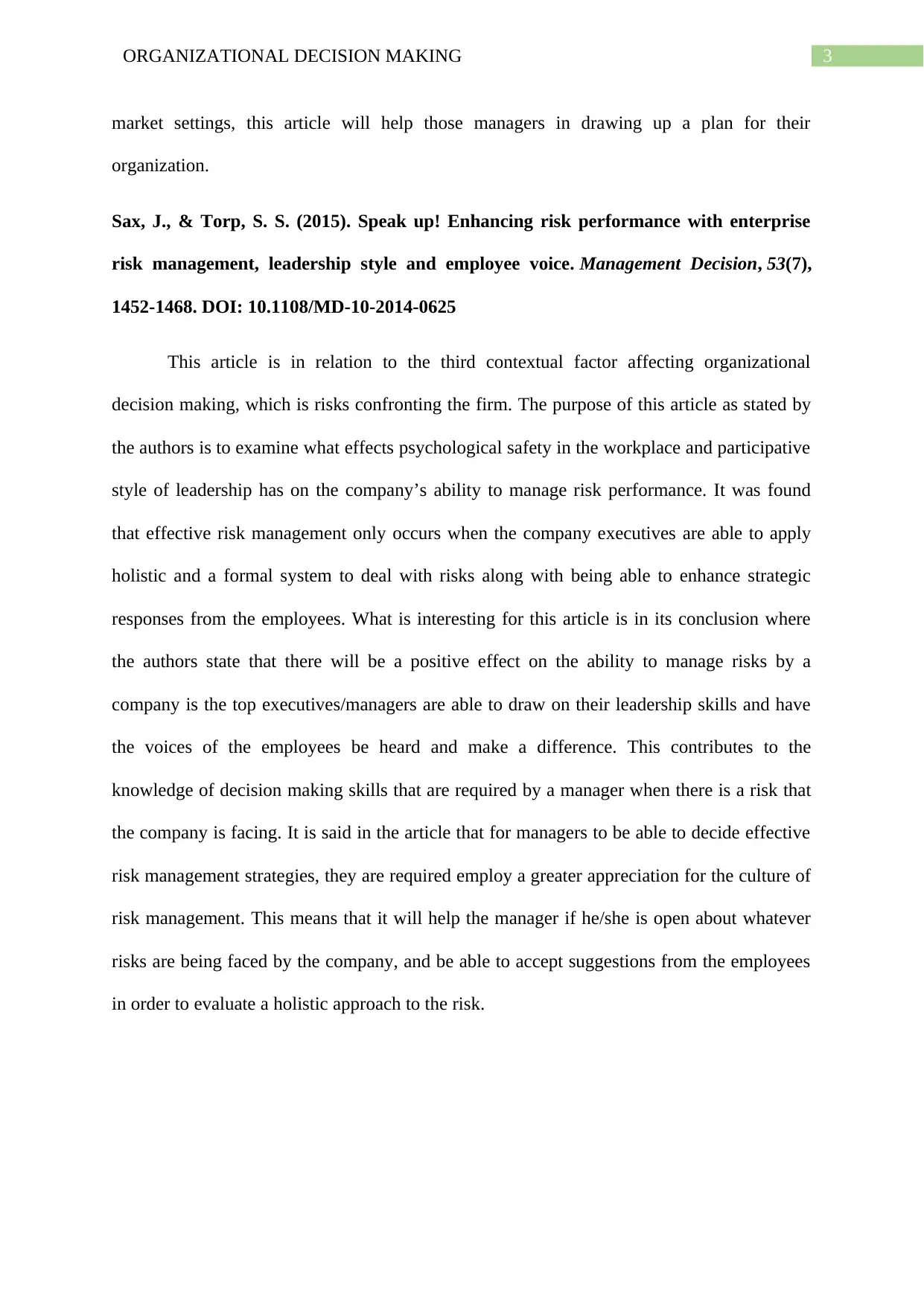
market settings, this article will help those managers in drawing up a plan for their
organization.
Sax, J., & Torp, S. S. (2015). Speak up! Enhancing risk performance with enterprise
risk management, leadership style and employee voice. Management Decision, 53(7),
1452-1468. DOI: 10.1108/MD-10-2014-0625
This article is in relation to the third contextual factor affecting organizational
decision making, which is risks confronting the firm. The purpose of this article as stated by
the authors is to examine what effects psychological safety in the workplace and participative
style of leadership has on the company’s ability to manage risk performance. It was found
that effective risk management only occurs when the company executives are able to apply
holistic and a formal system to deal with risks along with being able to enhance strategic
responses from the employees. What is interesting for this article is in its conclusion where
the authors state that there will be a positive effect on the ability to manage risks by a
company is the top executives/managers are able to draw on their leadership skills and have
the voices of the employees be heard and make a difference. This contributes to the
knowledge of decision making skills that are required by a manager when there is a risk that
the company is facing. It is said in the article that for managers to be able to decide effective
risk management strategies, they are required employ a greater appreciation for the culture of
risk management. This means that it will help the manager if he/she is open about whatever
risks are being faced by the company, and be able to accept suggestions from the employees
in order to evaluate a holistic approach to the risk.
tabler-icon-diamond-filled.svg

Paraphrase This Document

Need a fresh take? Get an instant paraphrase of this document with our AI Paraphraser
Document Page
4ORGANIZATIONAL DECISION MAKING
Lin, X., Ho, C. M. F., & Shen, G. Q. (2018). For the balance of stakeholders’ power and
responsibility: A collaborative framework for implementing social responsibility issues
in construction projects. Management Decision, 56(3), 550-569. DOI: 10.1108/MD-05-
2016-0275
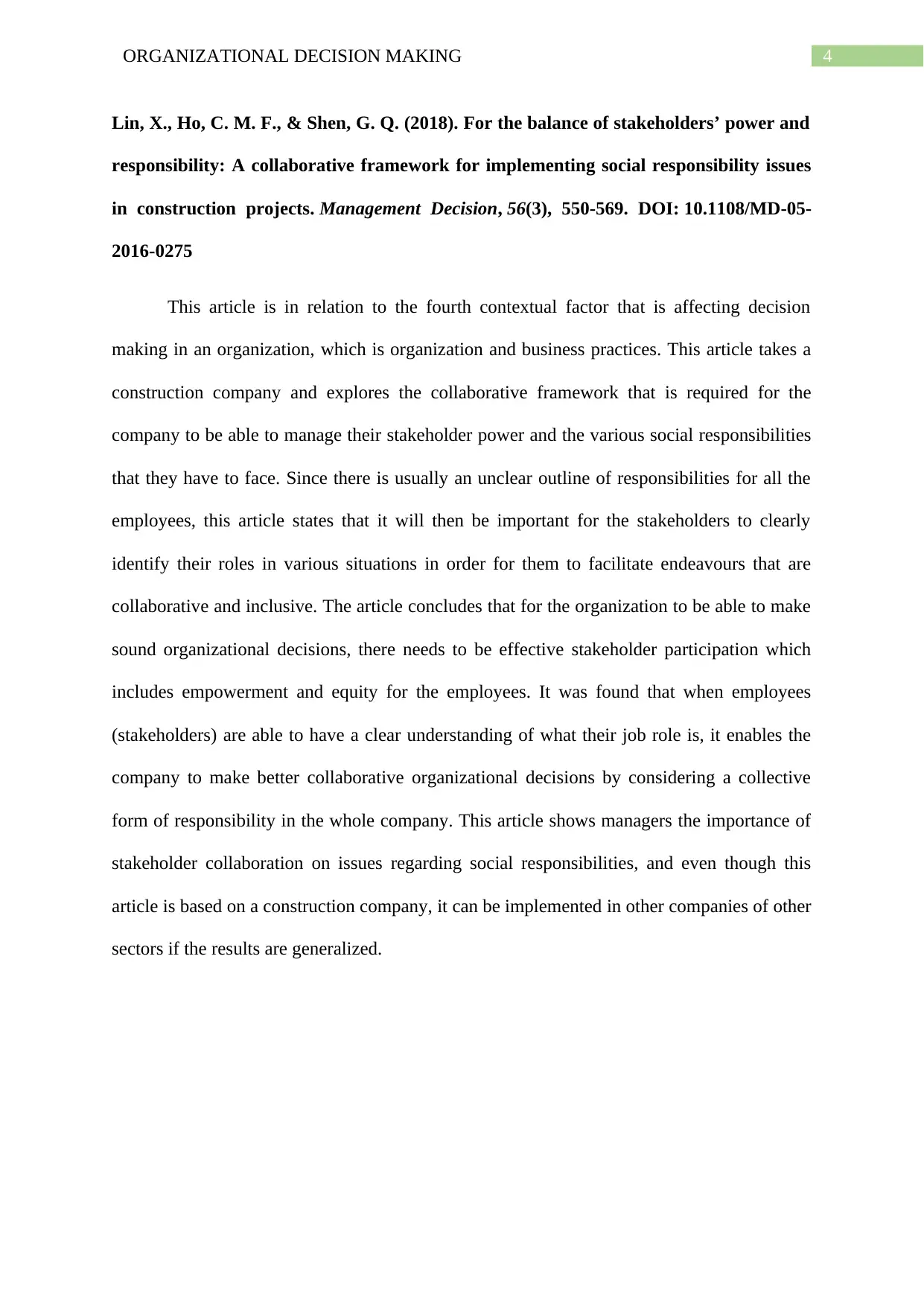
This article is in relation to the fourth contextual factor that is affecting decision
making in an organization, which is organization and business practices. This article takes a
construction company and explores the collaborative framework that is required for the
company to be able to manage their stakeholder power and the various social responsibilities
that they have to face. Since there is usually an unclear outline of responsibilities for all the
employees, this article states that it will then be important for the stakeholders to clearly
identify their roles in various situations in order for them to facilitate endeavours that are
collaborative and inclusive. The article concludes that for the organization to be able to make
sound organizational decisions, there needs to be effective stakeholder participation which
includes empowerment and equity for the employees. It was found that when employees
(stakeholders) are able to have a clear understanding of what their job role is, it enables the
company to make better collaborative organizational decisions by considering a collective
form of responsibility in the whole company. This article shows managers the importance of
stakeholder collaboration on issues regarding social responsibilities, and even though this
article is based on a construction company, it can be implemented in other companies of other
sectors if the results are generalized.
Document Page
5ORGANIZATIONAL DECISION MAKING
Kouamé, S., Oliver, D., & Poisson-de-Haro, S. (2015). Can emotional differences be a
strength? Affective diversity and managerial decision performance. Management
Decision, 53(8), 1662-1676. DOI: 10.1108/MD-08-2014-0540
This article is in relations to the last contextual factor that is effecting organizational
decision making, which is the functions of the diverse firms. The purpose of the paper is
stated as identifying the earlier findings which states that diversity is always a negative factor
for group performance, as it influences the performance of managerial decisions in a
controlled environment. It was found that that both negative and positive types of affective
diversity will only positively affect the standard of managerial decisions that will be made in
the organization. It concludes that affective diversity is more often than not, a strength in
managers being able to make efficient managerial decisions. This study, if read by any
manager, will enable the managers in accepting more diverse employees so that organizations
are able to make better organizational decisions, instead of being bogged down by the
cultural difference among the employees. It is stated in the article that when managerial
decisions are made based on the diversity of ideas from the people in the workforce, the
decisions are usually always more effective. An interesting aspect of the paper is in its
addressing of the negative effects of affective diversity on an organization’s ability to make
effective decisions, where the authors point out that if there is a presence of negative diversity
then the companies have been seen to be taking strategic decisions which were relatively a lot
less riskier.
Conclusion:
As seen from all the articles cited above, all the contextual factors mentioned have
significant impact on a manager’s ability to make effective decisions for their organizations.
The Big Four Banks in Australia include the Commonwealth Bank of Australia, Westpac, the
Document Page
6ORGANIZATIONAL DECISION MAKING
Australia and New Zealand Banking Group and the National Australia Bank. For banks, it is
usually always important for them to keep in mind the risks that are confronting the firm
along with external environmental forces because the performances of these banks are highly
dependent on the performance of the economy it is present in. It will be important for all the
stakeholder in each of the banks to be prepared for risks that may come about, and have a list
of appropriate decisions to be made in these kinds of situations. One of the other most
important strategy that should be adopted by these big banks is to be able to recruit and
retrain talent since the banking industry is changing very quickly, and it will be essential for
the recruitment force to meet the requirements of the evolving digital customer. The banking
industry must be able to win talent wars, and this would mean making the executive decision
to change their hiring process so that they are able to attract the best and brightest of the
candidates.
tabler-icon-diamond-filled.svg

Paraphrase This Document

Need a fresh take? Get an instant paraphrase of this document with our AI Paraphraser
Document Page
7ORGANIZATIONAL DECISION MAKING
Bibliography:
Haak-Saheem, W., & K. Darwish, T. (2014). The role of knowledge management in creating
a culture of learning: The case of Dubai Municipality. Management Decision, 52(9),
1611-1629. DOI: 10.1108/MD-08-2013-0427
Jia, X., Chen, J., Mei, L., & Wu, Q. (2018). How leadership matters in organizational
innovation: a perspective of openness. Management Decision, 56(1), 6-25. DOI:
10.1108/MD-04-2017-0415
Kouamé, S., Oliver, D., & Poisson-de-Haro, S. (2015). Can emotional differences be a
strength? Affective diversity and managerial decision performance. Management
Decision, 53(8), 1662-1676. DOI: 10.1108/MD-08-2014-0540
Lin, X., Ho, C. M. F., & Shen, G. Q. (2018). For the balance of stakeholders’ power and
responsibility: A collaborative framework for implementing social responsibility
issues in construction projects. Management Decision, 56(3), 550-569.
DOI: 10.1108/MD-05-2016-0275
Sax, J., & Torp, S. S. (2015). Speak up! Enhancing risk performance with enterprise risk
management, leadership style and employee voice. Management Decision, 53(7),
1452-1468. DOI: 10.1108/MD-10-2014-0625
chevron_up_icon
1 out of 8
circle_padding
hide_on_mobile
zoom_out_icon
[object Object]