Contributing to Organizational Development: Conference Strategy Report
VerifiedAdded on 2021/10/13
|8
|1387
|41
Report
AI Summary
This report delves into the multifaceted aspects of organizational development, focusing on the strategic planning and management of conferences as a tool for employee training and skill enhancement. The report outlines the benefits of organizing conferences, including improved employee motivation, increased partnership opportunities, and enhanced organizational visibility. It details the requirements for training and development, such as logistical arrangements, technical resources, and promotional strategies to attract participants. Furthermore, the report covers essential elements like accommodation, catering, documentation, and equipment. Contingency plans, financial follow-up procedures, and relevant legislative considerations are also discussed. The report provides a detailed framework for building an online conference registration portal, measuring conference outcomes, and utilizing historical data for future predictions. It also includes practical tools like budget planning and critical path analysis. Finally, the report presents a scenario-based analysis of a workshop-cum-conference organized by the Bing Lee Company, highlighting the importance of soft skills training and the selection of presenters. The report concludes with a comprehensive list of references to support the information presented.

CONTRIBUTE TO ORGANIZATIONAL DEVELOPMENT
Paraphrase This Document
Need a fresh take? Get an instant paraphrase of this document with our AI Paraphraser

Table of Contents
Part A...............................................................................................................................................2
Part B...............................................................................................................................................5
References........................................................................................................................................7
1
Part A...............................................................................................................................................2
Part B...............................................................................................................................................5
References........................................................................................................................................7
1

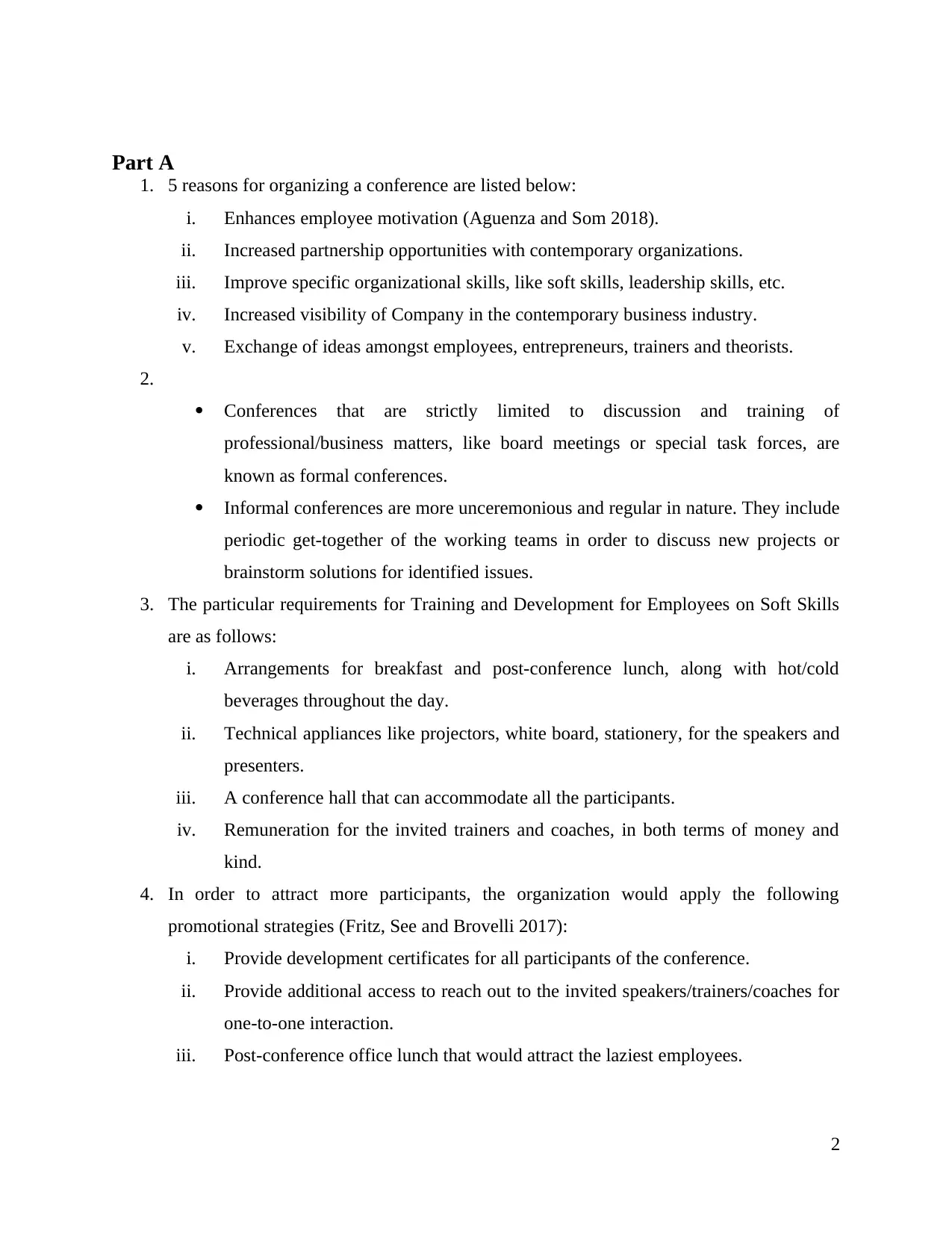
Part A
1. 5 reasons for organizing a conference are listed below:
i. Enhances employee motivation (Aguenza and Som 2018).
ii. Increased partnership opportunities with contemporary organizations.
iii. Improve specific organizational skills, like soft skills, leadership skills, etc.
iv. Increased visibility of Company in the contemporary business industry.
v. Exchange of ideas amongst employees, entrepreneurs, trainers and theorists.
2.
Conferences that are strictly limited to discussion and training of
professional/business matters, like board meetings or special task forces, are
known as formal conferences.
Informal conferences are more unceremonious and regular in nature. They include
periodic get-together of the working teams in order to discuss new projects or
brainstorm solutions for identified issues.
3. The particular requirements for Training and Development for Employees on Soft Skills
are as follows:
i. Arrangements for breakfast and post-conference lunch, along with hot/cold
beverages throughout the day.
ii. Technical appliances like projectors, white board, stationery, for the speakers and
presenters.
iii. A conference hall that can accommodate all the participants.
iv. Remuneration for the invited trainers and coaches, in both terms of money and
kind.
4. In order to attract more participants, the organization would apply the following
promotional strategies (Fritz, See and Brovelli 2017):
i. Provide development certificates for all participants of the conference.
ii. Provide additional access to reach out to the invited speakers/trainers/coaches for
one-to-one interaction.
iii. Post-conference office lunch that would attract the laziest employees.
2
1. 5 reasons for organizing a conference are listed below:
i. Enhances employee motivation (Aguenza and Som 2018).
ii. Increased partnership opportunities with contemporary organizations.
iii. Improve specific organizational skills, like soft skills, leadership skills, etc.
iv. Increased visibility of Company in the contemporary business industry.
v. Exchange of ideas amongst employees, entrepreneurs, trainers and theorists.
2.
Conferences that are strictly limited to discussion and training of
professional/business matters, like board meetings or special task forces, are
known as formal conferences.
Informal conferences are more unceremonious and regular in nature. They include
periodic get-together of the working teams in order to discuss new projects or
brainstorm solutions for identified issues.
3. The particular requirements for Training and Development for Employees on Soft Skills
are as follows:
i. Arrangements for breakfast and post-conference lunch, along with hot/cold
beverages throughout the day.
ii. Technical appliances like projectors, white board, stationery, for the speakers and
presenters.
iii. A conference hall that can accommodate all the participants.
iv. Remuneration for the invited trainers and coaches, in both terms of money and
kind.
4. In order to attract more participants, the organization would apply the following
promotional strategies (Fritz, See and Brovelli 2017):
i. Provide development certificates for all participants of the conference.
ii. Provide additional access to reach out to the invited speakers/trainers/coaches for
one-to-one interaction.
iii. Post-conference office lunch that would attract the laziest employees.
2
⊘ This is a preview!⊘
Do you want full access?
Subscribe today to unlock all pages.

Trusted by 1+ million students worldwide

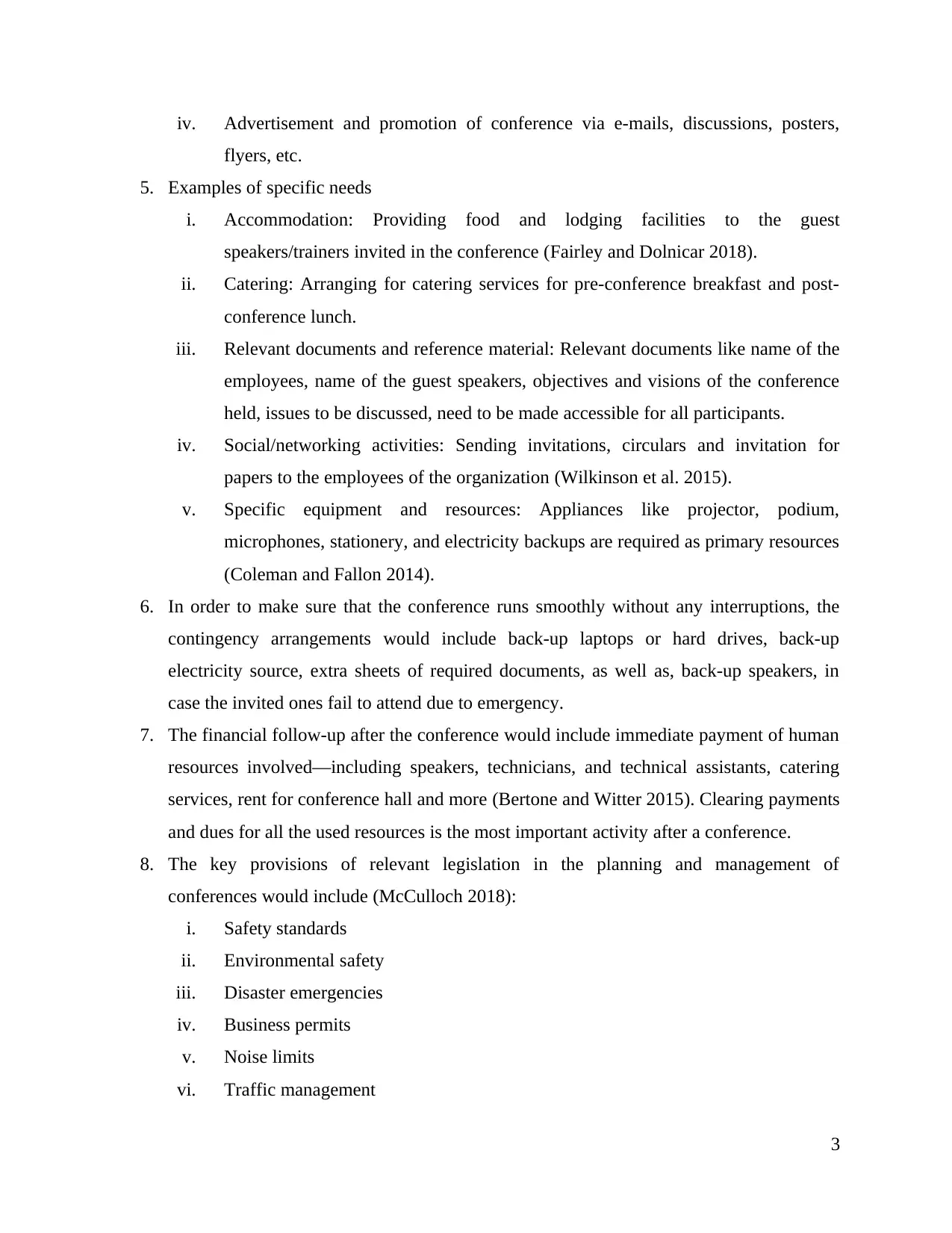
iv. Advertisement and promotion of conference via e-mails, discussions, posters,
flyers, etc.
5. Examples of specific needs
i. Accommodation: Providing food and lodging facilities to the guest
speakers/trainers invited in the conference (Fairley and Dolnicar 2018).
ii. Catering: Arranging for catering services for pre-conference breakfast and post-
conference lunch.
iii. Relevant documents and reference material: Relevant documents like name of the
employees, name of the guest speakers, objectives and visions of the conference
held, issues to be discussed, need to be made accessible for all participants.
iv. Social/networking activities: Sending invitations, circulars and invitation for
papers to the employees of the organization (Wilkinson et al. 2015).
v. Specific equipment and resources: Appliances like projector, podium,
microphones, stationery, and electricity backups are required as primary resources
(Coleman and Fallon 2014).
6. In order to make sure that the conference runs smoothly without any interruptions, the
contingency arrangements would include back-up laptops or hard drives, back-up
electricity source, extra sheets of required documents, as well as, back-up speakers, in
case the invited ones fail to attend due to emergency.
7. The financial follow-up after the conference would include immediate payment of human
resources involved—including speakers, technicians, and technical assistants, catering
services, rent for conference hall and more (Bertone and Witter 2015). Clearing payments
and dues for all the used resources is the most important activity after a conference.
8. The key provisions of relevant legislation in the planning and management of
conferences would include (McCulloch 2018):
i. Safety standards
ii. Environmental safety
iii. Disaster emergencies
iv. Business permits
v. Noise limits
vi. Traffic management
3
flyers, etc.
5. Examples of specific needs
i. Accommodation: Providing food and lodging facilities to the guest
speakers/trainers invited in the conference (Fairley and Dolnicar 2018).
ii. Catering: Arranging for catering services for pre-conference breakfast and post-
conference lunch.
iii. Relevant documents and reference material: Relevant documents like name of the
employees, name of the guest speakers, objectives and visions of the conference
held, issues to be discussed, need to be made accessible for all participants.
iv. Social/networking activities: Sending invitations, circulars and invitation for
papers to the employees of the organization (Wilkinson et al. 2015).
v. Specific equipment and resources: Appliances like projector, podium,
microphones, stationery, and electricity backups are required as primary resources
(Coleman and Fallon 2014).
6. In order to make sure that the conference runs smoothly without any interruptions, the
contingency arrangements would include back-up laptops or hard drives, back-up
electricity source, extra sheets of required documents, as well as, back-up speakers, in
case the invited ones fail to attend due to emergency.
7. The financial follow-up after the conference would include immediate payment of human
resources involved—including speakers, technicians, and technical assistants, catering
services, rent for conference hall and more (Bertone and Witter 2015). Clearing payments
and dues for all the used resources is the most important activity after a conference.
8. The key provisions of relevant legislation in the planning and management of
conferences would include (McCulloch 2018):
i. Safety standards
ii. Environmental safety
iii. Disaster emergencies
iv. Business permits
v. Noise limits
vi. Traffic management
3
Paraphrase This Document
Need a fresh take? Get an instant paraphrase of this document with our AI Paraphraser

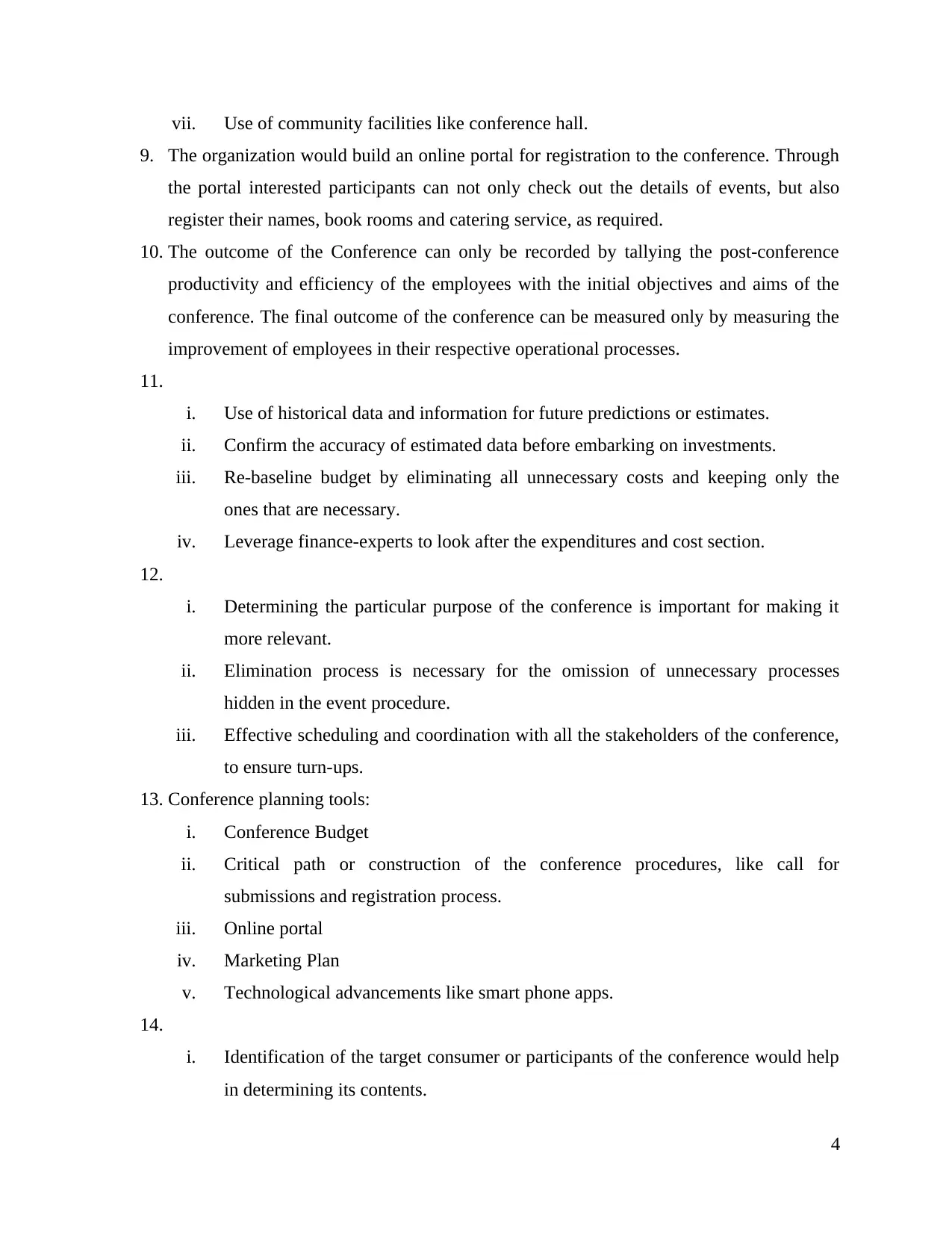
vii. Use of community facilities like conference hall.
9. The organization would build an online portal for registration to the conference. Through
the portal interested participants can not only check out the details of events, but also
register their names, book rooms and catering service, as required.
10. The outcome of the Conference can only be recorded by tallying the post-conference
productivity and efficiency of the employees with the initial objectives and aims of the
conference. The final outcome of the conference can be measured only by measuring the
improvement of employees in their respective operational processes.
11.
i. Use of historical data and information for future predictions or estimates.
ii. Confirm the accuracy of estimated data before embarking on investments.
iii. Re-baseline budget by eliminating all unnecessary costs and keeping only the
ones that are necessary.
iv. Leverage finance-experts to look after the expenditures and cost section.
12.
i. Determining the particular purpose of the conference is important for making it
more relevant.
ii. Elimination process is necessary for the omission of unnecessary processes
hidden in the event procedure.
iii. Effective scheduling and coordination with all the stakeholders of the conference,
to ensure turn-ups.
13. Conference planning tools:
i. Conference Budget
ii. Critical path or construction of the conference procedures, like call for
submissions and registration process.
iii. Online portal
iv. Marketing Plan
v. Technological advancements like smart phone apps.
14.
i. Identification of the target consumer or participants of the conference would help
in determining its contents.
4
9. The organization would build an online portal for registration to the conference. Through
the portal interested participants can not only check out the details of events, but also
register their names, book rooms and catering service, as required.
10. The outcome of the Conference can only be recorded by tallying the post-conference
productivity and efficiency of the employees with the initial objectives and aims of the
conference. The final outcome of the conference can be measured only by measuring the
improvement of employees in their respective operational processes.
11.
i. Use of historical data and information for future predictions or estimates.
ii. Confirm the accuracy of estimated data before embarking on investments.
iii. Re-baseline budget by eliminating all unnecessary costs and keeping only the
ones that are necessary.
iv. Leverage finance-experts to look after the expenditures and cost section.
12.
i. Determining the particular purpose of the conference is important for making it
more relevant.
ii. Elimination process is necessary for the omission of unnecessary processes
hidden in the event procedure.
iii. Effective scheduling and coordination with all the stakeholders of the conference,
to ensure turn-ups.
13. Conference planning tools:
i. Conference Budget
ii. Critical path or construction of the conference procedures, like call for
submissions and registration process.
iii. Online portal
iv. Marketing Plan
v. Technological advancements like smart phone apps.
14.
i. Identification of the target consumer or participants of the conference would help
in determining its contents.
4

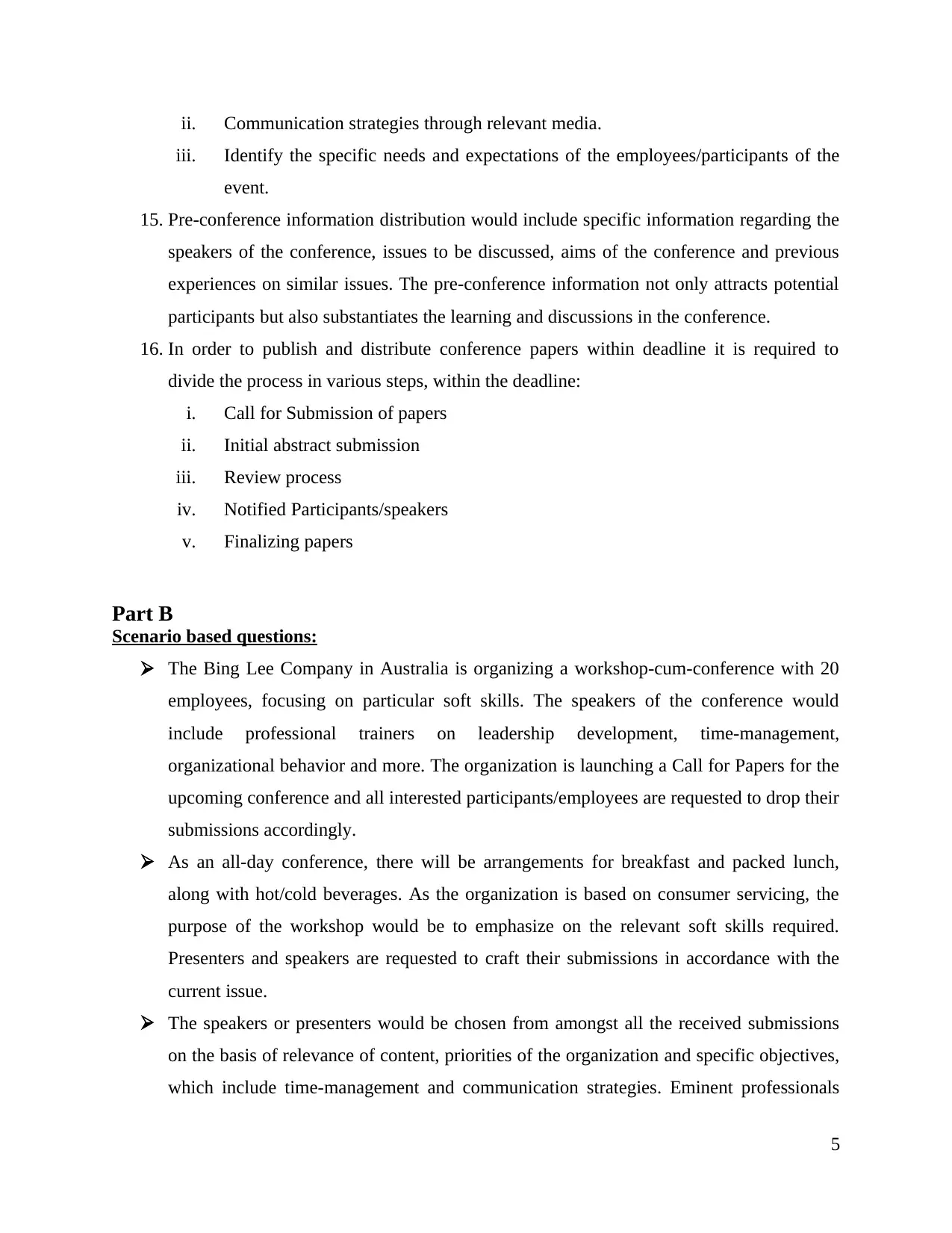
ii. Communication strategies through relevant media.
iii. Identify the specific needs and expectations of the employees/participants of the
event.
15. Pre-conference information distribution would include specific information regarding the
speakers of the conference, issues to be discussed, aims of the conference and previous
experiences on similar issues. The pre-conference information not only attracts potential
participants but also substantiates the learning and discussions in the conference.
16. In order to publish and distribute conference papers within deadline it is required to
divide the process in various steps, within the deadline:
i. Call for Submission of papers
ii. Initial abstract submission
iii. Review process
iv. Notified Participants/speakers
v. Finalizing papers
Part B
Scenario based questions:
The Bing Lee Company in Australia is organizing a workshop-cum-conference with 20
employees, focusing on particular soft skills. The speakers of the conference would
include professional trainers on leadership development, time-management,
organizational behavior and more. The organization is launching a Call for Papers for the
upcoming conference and all interested participants/employees are requested to drop their
submissions accordingly.
As an all-day conference, there will be arrangements for breakfast and packed lunch,
along with hot/cold beverages. As the organization is based on consumer servicing, the
purpose of the workshop would be to emphasize on the relevant soft skills required.
Presenters and speakers are requested to craft their submissions in accordance with the
current issue.
The speakers or presenters would be chosen from amongst all the received submissions
on the basis of relevance of content, priorities of the organization and specific objectives,
which include time-management and communication strategies. Eminent professionals
5
iii. Identify the specific needs and expectations of the employees/participants of the
event.
15. Pre-conference information distribution would include specific information regarding the
speakers of the conference, issues to be discussed, aims of the conference and previous
experiences on similar issues. The pre-conference information not only attracts potential
participants but also substantiates the learning and discussions in the conference.
16. In order to publish and distribute conference papers within deadline it is required to
divide the process in various steps, within the deadline:
i. Call for Submission of papers
ii. Initial abstract submission
iii. Review process
iv. Notified Participants/speakers
v. Finalizing papers
Part B
Scenario based questions:
The Bing Lee Company in Australia is organizing a workshop-cum-conference with 20
employees, focusing on particular soft skills. The speakers of the conference would
include professional trainers on leadership development, time-management,
organizational behavior and more. The organization is launching a Call for Papers for the
upcoming conference and all interested participants/employees are requested to drop their
submissions accordingly.
As an all-day conference, there will be arrangements for breakfast and packed lunch,
along with hot/cold beverages. As the organization is based on consumer servicing, the
purpose of the workshop would be to emphasize on the relevant soft skills required.
Presenters and speakers are requested to craft their submissions in accordance with the
current issue.
The speakers or presenters would be chosen from amongst all the received submissions
on the basis of relevance of content, priorities of the organization and specific objectives,
which include time-management and communication strategies. Eminent professionals
5
⊘ This is a preview!⊘
Do you want full access?
Subscribe today to unlock all pages.

Trusted by 1+ million students worldwide

would be present to train the chosen employees in the areas of critical thinking,
employee-motivation, creative problem-solving and more.
Eminent professionals like People Development Specialists, coach/trainer of work ethic
development and business theorists on organizational behavior and excellence would be
invited to speak on the particular issues.
6
employee-motivation, creative problem-solving and more.
Eminent professionals like People Development Specialists, coach/trainer of work ethic
development and business theorists on organizational behavior and excellence would be
invited to speak on the particular issues.
6
Paraphrase This Document
Need a fresh take? Get an instant paraphrase of this document with our AI Paraphraser

References
Aguenza, B.B. and Som, A.P.M., 2018. Motivational factors of employee retention and
engagement in organizations. IJAME.
Bertone, M.P. and Witter, S., 2015. The complex remuneration of human resources for health in
low-income settings: policy implications and a research agenda for designing effective financial
incentives. Human resources for health, 13(1), p.62.
Coleman, D.M. and Fallon, J.A., 2014. Advancing the Use of Streaming Media and Digital
Media Technologies at the Connecticut Department of Transportation (No. CT-2254-F-12-2).
Connecticut Department of Transportation, Bureau of Enginering and Construction, Division of
Design Services.
Fairley, S. and Dolnicar, S., 2018. 10 Supporting Events. PEER-TO-PEER ACCOMMODATION
NETWORKS, p.109.
Fritz, S., See, L. and Brovelli, M., 2017. Motivating and sustaining participation in VGI.
McCulloch, A., 2018. Dress codes and the academic conference: Mcculloch's iron laws of
conferences. Australian Universities' Review, The, 60(1), p.50.
Wilkinson, S.E., Basto, M.Y., Perovic, G., Lawrentschuk, N. and Murphy, D.G., 2015. The
social media revolution is changing the conference experience: analytics and trends from eight
international meetings. BJU international, 115(5), pp.839-846.
7
Aguenza, B.B. and Som, A.P.M., 2018. Motivational factors of employee retention and
engagement in organizations. IJAME.
Bertone, M.P. and Witter, S., 2015. The complex remuneration of human resources for health in
low-income settings: policy implications and a research agenda for designing effective financial
incentives. Human resources for health, 13(1), p.62.
Coleman, D.M. and Fallon, J.A., 2014. Advancing the Use of Streaming Media and Digital
Media Technologies at the Connecticut Department of Transportation (No. CT-2254-F-12-2).
Connecticut Department of Transportation, Bureau of Enginering and Construction, Division of
Design Services.
Fairley, S. and Dolnicar, S., 2018. 10 Supporting Events. PEER-TO-PEER ACCOMMODATION
NETWORKS, p.109.
Fritz, S., See, L. and Brovelli, M., 2017. Motivating and sustaining participation in VGI.
McCulloch, A., 2018. Dress codes and the academic conference: Mcculloch's iron laws of
conferences. Australian Universities' Review, The, 60(1), p.50.
Wilkinson, S.E., Basto, M.Y., Perovic, G., Lawrentschuk, N. and Murphy, D.G., 2015. The
social media revolution is changing the conference experience: analytics and trends from eight
international meetings. BJU international, 115(5), pp.839-846.
7
1 out of 8
Related Documents
Your All-in-One AI-Powered Toolkit for Academic Success.
+13062052269
info@desklib.com
Available 24*7 on WhatsApp / Email
Unlock your academic potential
Copyright © 2020–2025 A2Z Services. All Rights Reserved. Developed and managed by ZUCOL.