Leadership and Positivity: An Analysis of Articles in Organizations
VerifiedAdded on 2023/05/30
|9
|2606
|157
Essay
AI Summary
This essay provides an analysis of several articles focusing on the impact of leadership and positivity within organizations. It explores the significance of transformational leadership, highlighting its influence on employee identification, efficacy beliefs, and overall job performance. The essay discusses the role of psychological capital, positive emotions, and mindfulness in fostering employee engagement and mitigating cynicism towards organizational change. Furthermore, it examines the importance of leader-member exchange, proactive asset management, and organizational culture in driving performance and innovation. The analysis also touches upon authentic and sustainable leadership models, along with the integration of social network and leader-member exchange theories to promote innovative behavior. The essay concludes by emphasizing the benefits of leadership development initiatives and the positive impact of leaders on organizational profitability and societal well-being.
Running head: LEADERSHIP IN ORGANIZATION
Leadership in Organization
Name of the student
Name of the University
Author note
Leadership in Organization
Name of the student
Name of the University
Author note

Paraphrase This Document
Need a fresh take? Get an instant paraphrase of this document with our AI Paraphraser
1LEADERSHIP IN ORGANIZATION
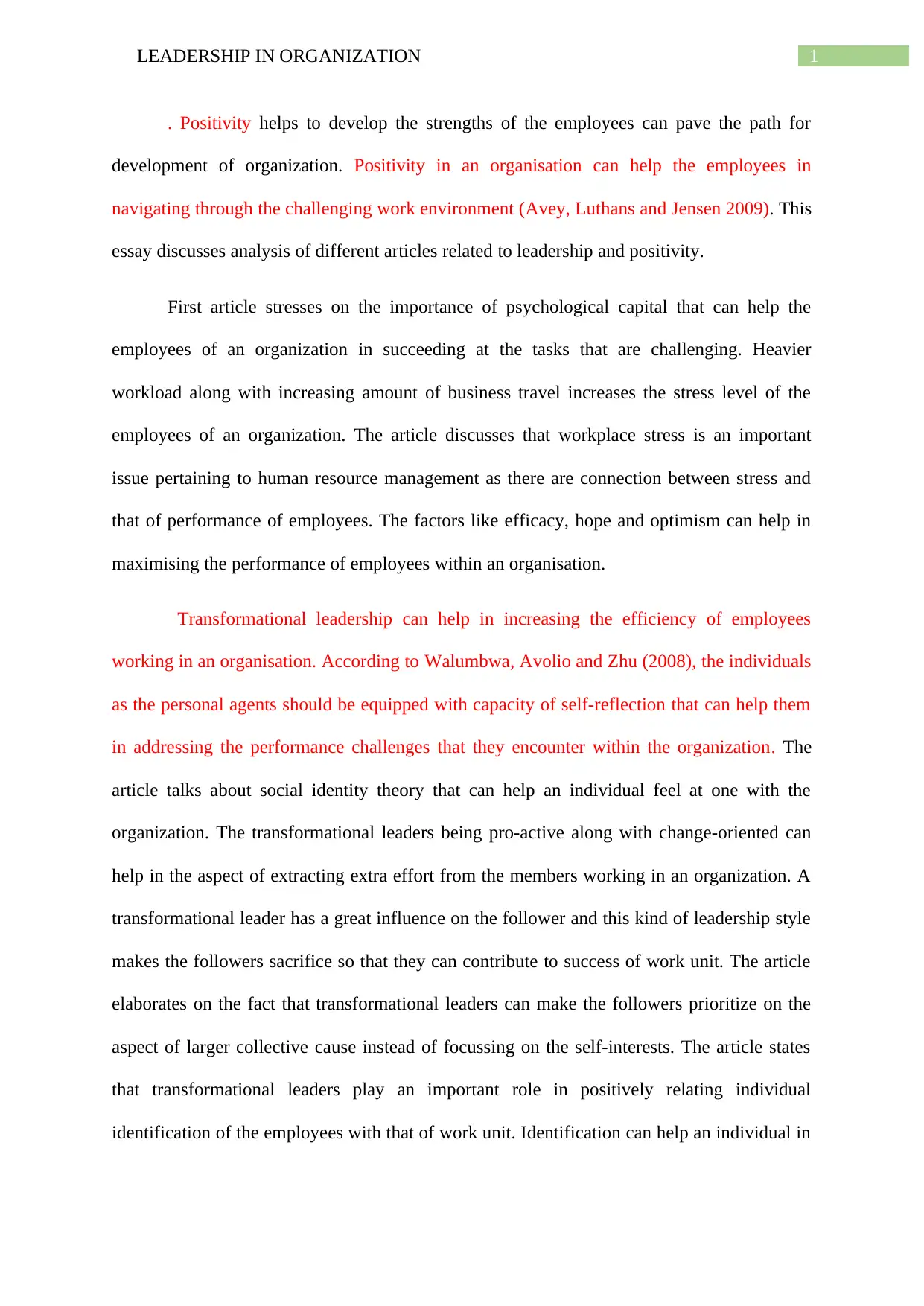
. Positivity helps to develop the strengths of the employees can pave the path for
development of organization. Positivity in an organisation can help the employees in
navigating through the challenging work environment (Avey, Luthans and Jensen 2009). This
essay discusses analysis of different articles related to leadership and positivity.
First article stresses on the importance of psychological capital that can help the
employees of an organization in succeeding at the tasks that are challenging. Heavier
workload along with increasing amount of business travel increases the stress level of the
employees of an organization. The article discusses that workplace stress is an important
issue pertaining to human resource management as there are connection between stress and
that of performance of employees. The factors like efficacy, hope and optimism can help in
maximising the performance of employees within an organisation.
Transformational leadership can help in increasing the efficiency of employees
working in an organisation. According to Walumbwa, Avolio and Zhu (2008), the individuals
as the personal agents should be equipped with capacity of self-reflection that can help them
in addressing the performance challenges that they encounter within the organization. The
article talks about social identity theory that can help an individual feel at one with the
organization. The transformational leaders being pro-active along with change-oriented can
help in the aspect of extracting extra effort from the members working in an organization. A
transformational leader has a great influence on the follower and this kind of leadership style
makes the followers sacrifice so that they can contribute to success of work unit. The article
elaborates on the fact that transformational leaders can make the followers prioritize on the
aspect of larger collective cause instead of focussing on the self-interests. The article states
that transformational leaders play an important role in positively relating individual
identification of the employees with that of work unit. Identification can help an individual in
. Positivity helps to develop the strengths of the employees can pave the path for
development of organization. Positivity in an organisation can help the employees in
navigating through the challenging work environment (Avey, Luthans and Jensen 2009). This
essay discusses analysis of different articles related to leadership and positivity.
First article stresses on the importance of psychological capital that can help the
employees of an organization in succeeding at the tasks that are challenging. Heavier
workload along with increasing amount of business travel increases the stress level of the
employees of an organization. The article discusses that workplace stress is an important
issue pertaining to human resource management as there are connection between stress and
that of performance of employees. The factors like efficacy, hope and optimism can help in
maximising the performance of employees within an organisation.
Transformational leadership can help in increasing the efficiency of employees
working in an organisation. According to Walumbwa, Avolio and Zhu (2008), the individuals
as the personal agents should be equipped with capacity of self-reflection that can help them
in addressing the performance challenges that they encounter within the organization. The
article talks about social identity theory that can help an individual feel at one with the
organization. The transformational leaders being pro-active along with change-oriented can
help in the aspect of extracting extra effort from the members working in an organization. A
transformational leader has a great influence on the follower and this kind of leadership style
makes the followers sacrifice so that they can contribute to success of work unit. The article
elaborates on the fact that transformational leaders can make the followers prioritize on the
aspect of larger collective cause instead of focussing on the self-interests. The article states
that transformational leaders play an important role in positively relating individual
identification of the employees with that of work unit. Identification can help an individual in
2LEADERSHIP IN ORGANIZATION
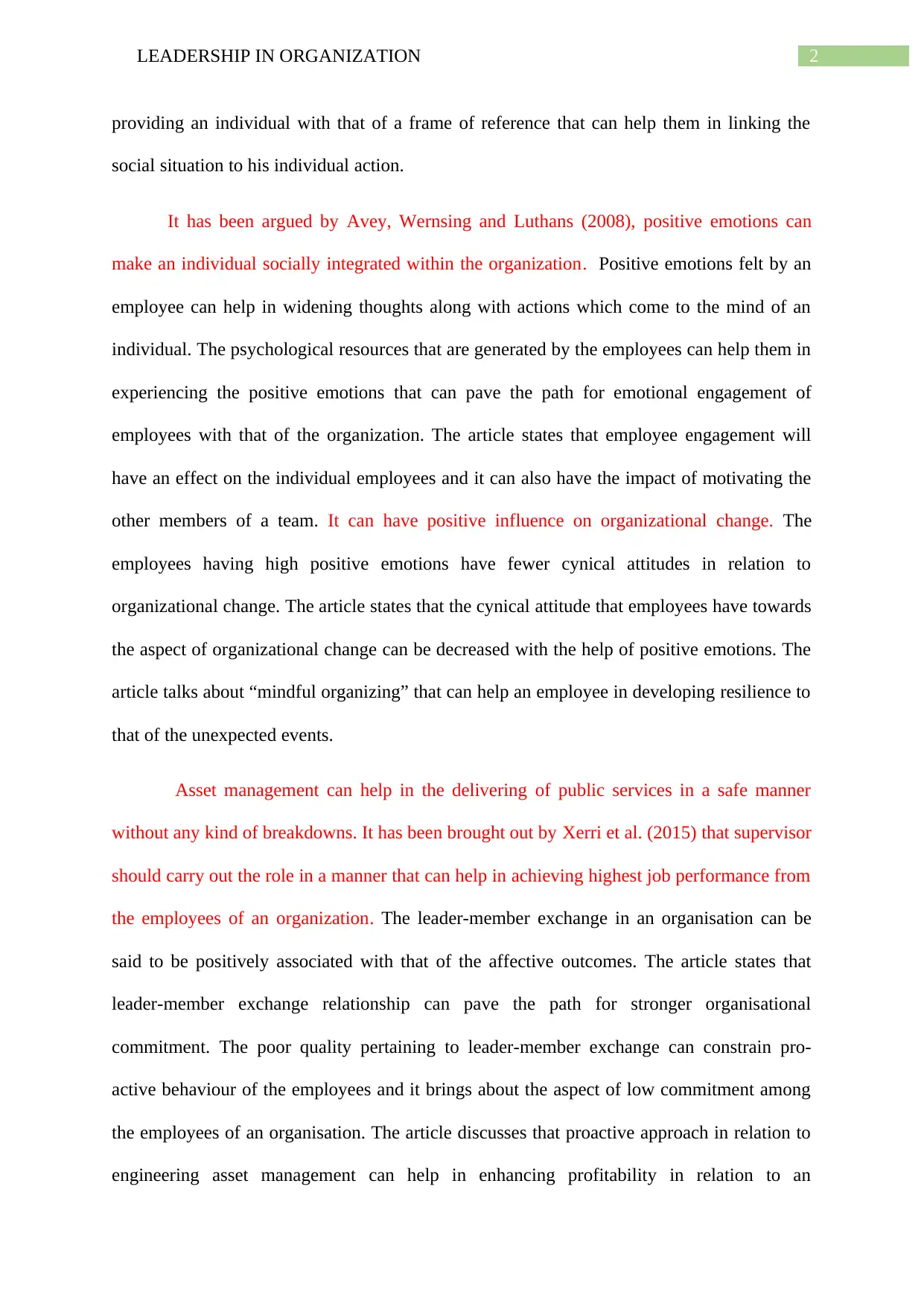
providing an individual with that of a frame of reference that can help them in linking the
social situation to his individual action.
It has been argued by Avey, Wernsing and Luthans (2008), positive emotions can
make an individual socially integrated within the organization. Positive emotions felt by an
employee can help in widening thoughts along with actions which come to the mind of an
individual. The psychological resources that are generated by the employees can help them in
experiencing the positive emotions that can pave the path for emotional engagement of
employees with that of the organization. The article states that employee engagement will
have an effect on the individual employees and it can also have the impact of motivating the
other members of a team. It can have positive influence on organizational change. The
employees having high positive emotions have fewer cynical attitudes in relation to
organizational change. The article states that the cynical attitude that employees have towards
the aspect of organizational change can be decreased with the help of positive emotions. The
article talks about “mindful organizing” that can help an employee in developing resilience to
that of the unexpected events.
Asset management can help in the delivering of public services in a safe manner
without any kind of breakdowns. It has been brought out by Xerri et al. (2015) that supervisor
should carry out the role in a manner that can help in achieving highest job performance from
the employees of an organization. The leader-member exchange in an organisation can be
said to be positively associated with that of the affective outcomes. The article states that
leader-member exchange relationship can pave the path for stronger organisational
commitment. The poor quality pertaining to leader-member exchange can constrain pro-
active behaviour of the employees and it brings about the aspect of low commitment among
the employees of an organisation. The article discusses that proactive approach in relation to
engineering asset management can help in enhancing profitability in relation to an
providing an individual with that of a frame of reference that can help them in linking the
social situation to his individual action.
It has been argued by Avey, Wernsing and Luthans (2008), positive emotions can
make an individual socially integrated within the organization. Positive emotions felt by an
employee can help in widening thoughts along with actions which come to the mind of an
individual. The psychological resources that are generated by the employees can help them in
experiencing the positive emotions that can pave the path for emotional engagement of
employees with that of the organization. The article states that employee engagement will
have an effect on the individual employees and it can also have the impact of motivating the
other members of a team. It can have positive influence on organizational change. The
employees having high positive emotions have fewer cynical attitudes in relation to
organizational change. The article states that the cynical attitude that employees have towards
the aspect of organizational change can be decreased with the help of positive emotions. The
article talks about “mindful organizing” that can help an employee in developing resilience to
that of the unexpected events.
Asset management can help in the delivering of public services in a safe manner
without any kind of breakdowns. It has been brought out by Xerri et al. (2015) that supervisor
should carry out the role in a manner that can help in achieving highest job performance from
the employees of an organization. The leader-member exchange in an organisation can be
said to be positively associated with that of the affective outcomes. The article states that
leader-member exchange relationship can pave the path for stronger organisational
commitment. The poor quality pertaining to leader-member exchange can constrain pro-
active behaviour of the employees and it brings about the aspect of low commitment among
the employees of an organisation. The article discusses that proactive approach in relation to
engineering asset management can help in enhancing profitability in relation to an
⊘ This is a preview!⊘
Do you want full access?
Subscribe today to unlock all pages.

Trusted by 1+ million students worldwide
3LEADERSHIP IN ORGANIZATION
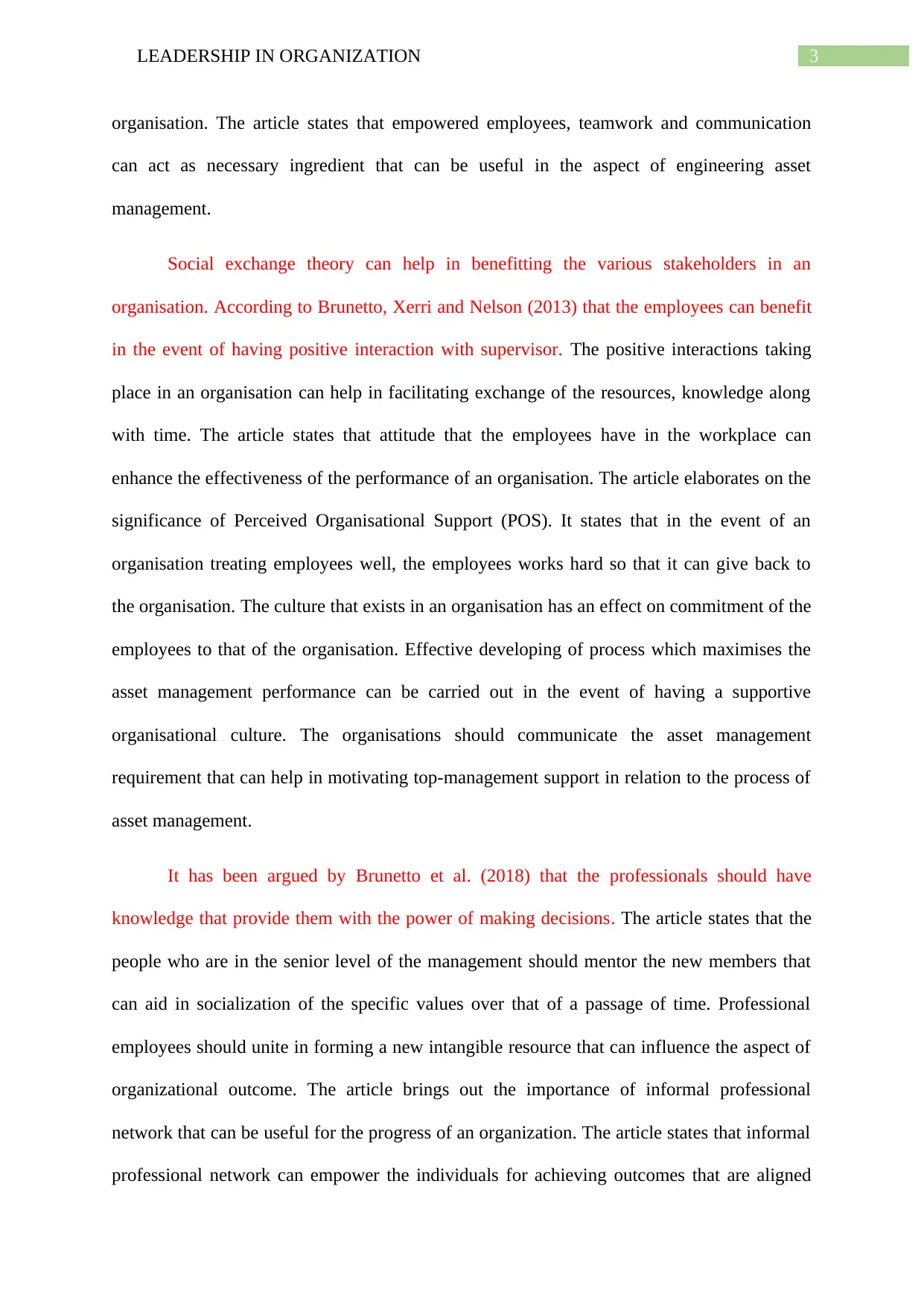
organisation. The article states that empowered employees, teamwork and communication
can act as necessary ingredient that can be useful in the aspect of engineering asset
management.
Social exchange theory can help in benefitting the various stakeholders in an
organisation. According to Brunetto, Xerri and Nelson (2013) that the employees can benefit
in the event of having positive interaction with supervisor. The positive interactions taking
place in an organisation can help in facilitating exchange of the resources, knowledge along
with time. The article states that attitude that the employees have in the workplace can
enhance the effectiveness of the performance of an organisation. The article elaborates on the
significance of Perceived Organisational Support (POS). It states that in the event of an
organisation treating employees well, the employees works hard so that it can give back to
the organisation. The culture that exists in an organisation has an effect on commitment of the
employees to that of the organisation. Effective developing of process which maximises the
asset management performance can be carried out in the event of having a supportive
organisational culture. The organisations should communicate the asset management
requirement that can help in motivating top-management support in relation to the process of
asset management.
It has been argued by Brunetto et al. (2018) that the professionals should have
knowledge that provide them with the power of making decisions. The article states that the
people who are in the senior level of the management should mentor the new members that
can aid in socialization of the specific values over that of a passage of time. Professional
employees should unite in forming a new intangible resource that can influence the aspect of
organizational outcome. The article brings out the importance of informal professional
network that can be useful for the progress of an organization. The article states that informal
professional network can empower the individuals for achieving outcomes that are aligned
organisation. The article states that empowered employees, teamwork and communication
can act as necessary ingredient that can be useful in the aspect of engineering asset
management.
Social exchange theory can help in benefitting the various stakeholders in an
organisation. According to Brunetto, Xerri and Nelson (2013) that the employees can benefit
in the event of having positive interaction with supervisor. The positive interactions taking
place in an organisation can help in facilitating exchange of the resources, knowledge along
with time. The article states that attitude that the employees have in the workplace can
enhance the effectiveness of the performance of an organisation. The article elaborates on the
significance of Perceived Organisational Support (POS). It states that in the event of an
organisation treating employees well, the employees works hard so that it can give back to
the organisation. The culture that exists in an organisation has an effect on commitment of the
employees to that of the organisation. Effective developing of process which maximises the
asset management performance can be carried out in the event of having a supportive
organisational culture. The organisations should communicate the asset management
requirement that can help in motivating top-management support in relation to the process of
asset management.
It has been argued by Brunetto et al. (2018) that the professionals should have
knowledge that provide them with the power of making decisions. The article states that the
people who are in the senior level of the management should mentor the new members that
can aid in socialization of the specific values over that of a passage of time. Professional
employees should unite in forming a new intangible resource that can influence the aspect of
organizational outcome. The article brings out the importance of informal professional
network that can be useful for the progress of an organization. The article states that informal
professional network can empower the individuals for achieving outcomes that are aligned
Paraphrase This Document
Need a fresh take? Get an instant paraphrase of this document with our AI Paraphraser
4LEADERSHIP IN ORGANIZATION
with his professional values. The article states that every organization has a dominant
organizational culture along with various subcultures that depends on the kind of employees.
Proactive asset maintenance organizational culture can help in detection of potential issues in
relation to critical physical assets. This article argues that quality informal professional
relationship can make the employees feel autonomous at the workplace.
According to Banks et al. (2017) that transformational leadership can help in meeting
higher-order needs of that of the followers. The article illuminates on the importance of
idealized influence that causes an individual to involve themselves in behaviours that can
encourage the followers for identification with him or with her. The primary focus of
transformational leadership is that of performance and thus it can be said that
transformational leadership has a strong relationship with that of leader effectiveness.
Alternate leadership can enable both the leaders and the followers in staying true in relation
to values along with identity. This article states that authentic leaders are confident and
hopeful and they prioritize the aspect of developing the associates so that they can evolve to
become leaders. Authentic leader remains true to his own self and this helps in inspiring the
employees working within a company.
It has been stated by Bolman and Deal (2017) that optimizing the organizational
culture can help in building a positive environment in an organization. The article discusses
that strategy suggests the planning and the positioning of an organization. Mintzberg
elaborates on the five P’s that can help in managing an organization. The five P’s are Plan,
Perspective, Pattern, Position and Ploy. All these five elements help in the establishing of a
coherent strategy that can help in maximising the performance of an organization. The article
states that structural logic requires the aligning of the strategy, structure along with
environment. Good structure should be specific that can help in providing direction to an
organisation but at the same time it should be elastic that can help it in adapting to that of
with his professional values. The article states that every organization has a dominant
organizational culture along with various subcultures that depends on the kind of employees.
Proactive asset maintenance organizational culture can help in detection of potential issues in
relation to critical physical assets. This article argues that quality informal professional
relationship can make the employees feel autonomous at the workplace.
According to Banks et al. (2017) that transformational leadership can help in meeting
higher-order needs of that of the followers. The article illuminates on the importance of
idealized influence that causes an individual to involve themselves in behaviours that can
encourage the followers for identification with him or with her. The primary focus of
transformational leadership is that of performance and thus it can be said that
transformational leadership has a strong relationship with that of leader effectiveness.
Alternate leadership can enable both the leaders and the followers in staying true in relation
to values along with identity. This article states that authentic leaders are confident and
hopeful and they prioritize the aspect of developing the associates so that they can evolve to
become leaders. Authentic leader remains true to his own self and this helps in inspiring the
employees working within a company.
It has been stated by Bolman and Deal (2017) that optimizing the organizational
culture can help in building a positive environment in an organization. The article discusses
that strategy suggests the planning and the positioning of an organization. Mintzberg
elaborates on the five P’s that can help in managing an organization. The five P’s are Plan,
Perspective, Pattern, Position and Ploy. All these five elements help in the establishing of a
coherent strategy that can help in maximising the performance of an organization. The article
states that structural logic requires the aligning of the strategy, structure along with
environment. Good structure should be specific that can help in providing direction to an
organisation but at the same time it should be elastic that can help it in adapting to that of
5LEADERSHIP IN ORGANIZATION
changing circumstances. The managers should know how to group the people into that of
working units that can help in augmenting the performance of employees within an
organization.
Authentic leadership can occur in the event of individuals enacting true selves in that
of the role of a leader. According to Leroy et al. (2015) authentic leadership can help in the
fostering of self-determined motivation and hence the aspect of work role performance. The
article makes use of self-determination theory that can act as a framework in relation to
leadership of an organization. The inter-play taking place between authentic leadership and
that of authentic followership can play a positive role in relation to satisfaction of basic needs
of followers. The article concludes that cross-level interaction can help in strengthening
relationship between that of authentic followership and that of follower basic need
satisfaction. Basic need satisfaction can help in mediating interaction of the aspect of
authentic leadership on that of follower work role performance.
Great leaders can help an organization in making great amount of profits. According
to Sosik and Jung (2018) leadership development initiative can help an organization in
showing consistent improvement in relation to productivity. The article discusses that
organizations should develop leadership development model that can help them in defining
right competencies that can help in bringing about a difference in an organization. God
leaders can create more amount of economic value as compared to the poor leaders. A good
leader can help in devising sustainable practices for an organization that can ultimately be
useful for the planet. It can help a company in the aspect of corporate social responsibility
that can help them in surviving within competitive environment. Sustainable leadership can
play an important role in ending the poverty that exists in the world.
changing circumstances. The managers should know how to group the people into that of
working units that can help in augmenting the performance of employees within an
organization.
Authentic leadership can occur in the event of individuals enacting true selves in that
of the role of a leader. According to Leroy et al. (2015) authentic leadership can help in the
fostering of self-determined motivation and hence the aspect of work role performance. The
article makes use of self-determination theory that can act as a framework in relation to
leadership of an organization. The inter-play taking place between authentic leadership and
that of authentic followership can play a positive role in relation to satisfaction of basic needs
of followers. The article concludes that cross-level interaction can help in strengthening
relationship between that of authentic followership and that of follower basic need
satisfaction. Basic need satisfaction can help in mediating interaction of the aspect of
authentic leadership on that of follower work role performance.
Great leaders can help an organization in making great amount of profits. According
to Sosik and Jung (2018) leadership development initiative can help an organization in
showing consistent improvement in relation to productivity. The article discusses that
organizations should develop leadership development model that can help them in defining
right competencies that can help in bringing about a difference in an organization. God
leaders can create more amount of economic value as compared to the poor leaders. A good
leader can help in devising sustainable practices for an organization that can ultimately be
useful for the planet. It can help a company in the aspect of corporate social responsibility
that can help them in surviving within competitive environment. Sustainable leadership can
play an important role in ending the poverty that exists in the world.
⊘ This is a preview!⊘
Do you want full access?
Subscribe today to unlock all pages.
Trusted by 1+ million students worldwide
6LEADERSHIP IN ORGANIZATION
The integration of social network theory along with that of leader member exchange
theory can help in bringing about innovative behaviour in an individual. It has been made use
of for exploring effects of three kinds of social relationships on that of employee innovative
behaviour. The article concludes that leader member exchange is related positively to that of
innovative behaviour. According to Adil et al. (2018), the leaders can influence the
innovative behaviour of the employees with the help of their deliberate action. A leader can
stimulate the aspect of idea generation by taking recourse to their daily behaviour. The article
discusses that perception of the workers of helpfulness of supervisor can be said to be
positively related to their showing discretionary behaviour. The article elaborates that low-
quality exchange relationship can be said to be characterized by that of formal interactions
which can pave the path for increasing the distance that exist in between the parties.
Leaders having social relationship exchange that is unique can pave the path for
engagement of the employees (Breevaart et al. 2015). High-quality exchange that is built on
trust along with mutual obligation can result into affective attachment. Quality pertaining to
leader-member exchange can help in determining degree to which the leaders reciprocate to
the job demands. The article argues that high leader-member exchange relationship can be
said to be characterized by that of high expectations in regard to the performance of the
employees that is in return of investment that is made by the leader.
However, it can be concluded that several researches have brought out the fact that
the members within that of high-quality leader-member exchange relationship can perform
better. The leaders being in the position of power can act as a crucial source of support. The
article states that social support can be said to be related in a positive manner to that of work
engagement.
The integration of social network theory along with that of leader member exchange
theory can help in bringing about innovative behaviour in an individual. It has been made use
of for exploring effects of three kinds of social relationships on that of employee innovative
behaviour. The article concludes that leader member exchange is related positively to that of
innovative behaviour. According to Adil et al. (2018), the leaders can influence the
innovative behaviour of the employees with the help of their deliberate action. A leader can
stimulate the aspect of idea generation by taking recourse to their daily behaviour. The article
discusses that perception of the workers of helpfulness of supervisor can be said to be
positively related to their showing discretionary behaviour. The article elaborates that low-
quality exchange relationship can be said to be characterized by that of formal interactions
which can pave the path for increasing the distance that exist in between the parties.
Leaders having social relationship exchange that is unique can pave the path for
engagement of the employees (Breevaart et al. 2015). High-quality exchange that is built on
trust along with mutual obligation can result into affective attachment. Quality pertaining to
leader-member exchange can help in determining degree to which the leaders reciprocate to
the job demands. The article argues that high leader-member exchange relationship can be
said to be characterized by that of high expectations in regard to the performance of the
employees that is in return of investment that is made by the leader.
However, it can be concluded that several researches have brought out the fact that
the members within that of high-quality leader-member exchange relationship can perform
better. The leaders being in the position of power can act as a crucial source of support. The
article states that social support can be said to be related in a positive manner to that of work
engagement.
Paraphrase This Document
Need a fresh take? Get an instant paraphrase of this document with our AI Paraphraser
7LEADERSHIP IN ORGANIZATION
References
Adil, M.S., Khan, M.N., Khan, I. and Qureshi, M.A., 2018. Impact of leader creativity
expectations on employee creativity: assessing the mediating and moderating role of creative
self-efficacy. International Journal of Management Practice, 11(2), pp.171-189.
Avey, J.B., Luthans, F. and Jensen, S.M., 2009. Psychological capital: A positive resource for
combating employee stress and turnover. Human resource management, 48(5), pp.677-693.
Avey, J.B., Wernsing, T.S. and Luthans, F., 2008. Can positive employees help positive
organizational change? Impact of psychological capital and emotions on relevant attitudes
and behaviors. The journal of applied behavioral science, 44(1), pp.48-70.
Banks, G.C., Engemann, K.N., Williams, C.E., Gooty, J., McCauley, K.D. and Medaugh,
M.R., 2017. A meta-analytic review and future research agenda of charismatic
leadership. The Leadership Quarterly, 28(4), pp.508-529.
Bolman, L.G. and Deal, T.E., 2017. Reframing organizations: Artistry, choice, and
leadership. John Wiley & Sons.
Breevaart, K., Bakker, A.B., Demerouti, E. and van den Heuvel, M., 2015. Leader-member
exchange, work engagement, and job performance. Journal of Managerial Psychology, 30(7),
pp.754-770.
Brunetto, Y., Xerri, M. and Nelson, S., 2013. Building a proactive, engagement culture in
asset management organizations. Journal of Management in Engineering, 30(4), p.04014014.
Brunetto, Y., Xerri, M., Farr-Wharton, B. and Nelson, S., 2018. The importance of informal
professional networks in developing a proactive organizational culture: a public value
perspective. Public Money & Management, 38(3), pp.203-212.
References
Adil, M.S., Khan, M.N., Khan, I. and Qureshi, M.A., 2018. Impact of leader creativity
expectations on employee creativity: assessing the mediating and moderating role of creative
self-efficacy. International Journal of Management Practice, 11(2), pp.171-189.
Avey, J.B., Luthans, F. and Jensen, S.M., 2009. Psychological capital: A positive resource for
combating employee stress and turnover. Human resource management, 48(5), pp.677-693.
Avey, J.B., Wernsing, T.S. and Luthans, F., 2008. Can positive employees help positive
organizational change? Impact of psychological capital and emotions on relevant attitudes
and behaviors. The journal of applied behavioral science, 44(1), pp.48-70.
Banks, G.C., Engemann, K.N., Williams, C.E., Gooty, J., McCauley, K.D. and Medaugh,
M.R., 2017. A meta-analytic review and future research agenda of charismatic
leadership. The Leadership Quarterly, 28(4), pp.508-529.
Bolman, L.G. and Deal, T.E., 2017. Reframing organizations: Artistry, choice, and
leadership. John Wiley & Sons.
Breevaart, K., Bakker, A.B., Demerouti, E. and van den Heuvel, M., 2015. Leader-member
exchange, work engagement, and job performance. Journal of Managerial Psychology, 30(7),
pp.754-770.
Brunetto, Y., Xerri, M. and Nelson, S., 2013. Building a proactive, engagement culture in
asset management organizations. Journal of Management in Engineering, 30(4), p.04014014.
Brunetto, Y., Xerri, M., Farr-Wharton, B. and Nelson, S., 2018. The importance of informal
professional networks in developing a proactive organizational culture: a public value
perspective. Public Money & Management, 38(3), pp.203-212.
8LEADERSHIP IN ORGANIZATION
Leroy, H., Anseel, F., Gardner, W.L. and Sels, L., 2015. Authentic leadership, authentic
followership, basic need satisfaction, and work role performance: A cross-level
study. Journal of Management, 41(6), pp.1677-1697.
Sosik, J.J. and Jung, D., 2018. Full range leadership development: Pathways for people,
profit, and planet. Routledge.
Walumbwa, F.O., Avolio, B.J. and Zhu, W., 2008. How transformational leadership weaves
its influence on individual job performance: The role of identification and efficacy
beliefs. Personnel Psychology, 61(4), pp.793-825.
Xerri, M.J., Nelson, S.A., Brunetto, Y. and Reid, S.R., 2015. NPM and change management
in asset management organisations. Journal of Organizational Change Management, 28(4),
pp.641-655.
Leroy, H., Anseel, F., Gardner, W.L. and Sels, L., 2015. Authentic leadership, authentic
followership, basic need satisfaction, and work role performance: A cross-level
study. Journal of Management, 41(6), pp.1677-1697.
Sosik, J.J. and Jung, D., 2018. Full range leadership development: Pathways for people,
profit, and planet. Routledge.
Walumbwa, F.O., Avolio, B.J. and Zhu, W., 2008. How transformational leadership weaves
its influence on individual job performance: The role of identification and efficacy
beliefs. Personnel Psychology, 61(4), pp.793-825.
Xerri, M.J., Nelson, S.A., Brunetto, Y. and Reid, S.R., 2015. NPM and change management
in asset management organisations. Journal of Organizational Change Management, 28(4),
pp.641-655.
⊘ This is a preview!⊘
Do you want full access?
Subscribe today to unlock all pages.
Trusted by 1+ million students worldwide

1 out of 9


Related Documents


Your All-in-One AI-Powered Toolkit for Academic Success.
+13062052269
info@desklib.com
Available 24*7 on WhatsApp / Email
![[object Object]](/_next/static/media/star-bottom.7253800d.svg)
Unlock your academic potential
Copyright © 2020–2026 A2Z Services. All Rights Reserved. Developed and managed by ZUCOL.