Impact of Management Style on People and Organizational Performance
VerifiedAdded on 2021/06/16
|15
|1486
|39
Report
AI Summary
This report delves into the influence of specific management styles on organizational performance, emphasizing the importance of effective managerial practices in achieving goals. It explores various management theories, including bureaucratic, humanistic, and scientific approaches, providing insights into their strengths and limitations. The report analyzes real-world examples, such as Facebook and UPS, to illustrate the application of these theories. Furthermore, it incorporates a personal experience of event management, reflecting on the practical application of management functions like planning, organizing, leading, and controlling. The report concludes with a critical evaluation of the event, highlighting areas for improvement in future endeavors, particularly in conflict management. The references provide a comprehensive list of sources for further reading on management theories and practices.
MANAGING PEOPLE AND ORGANISATION
Name:
Department:
School:
Date:
Name:
Department:
School:
Date:
Paraphrase This Document
Need a fresh take? Get an instant paraphrase of this document with our AI Paraphraser

Specific management style can influence on the performance
Effective managerial is important for the results of plans to be achieved.
Organising is required to implement plans and accomplish goals.
Controlling and monitoring aspect of management is the supervision of tasks
Management style with great analysis numerous organisation such as Facebook.
Paper also gives a real description of event I encountered in my high school level so
as to relate the management functions with real time occurrence.
Effective managerial is important for the results of plans to be achieved.
Organising is required to implement plans and accomplish goals.
Controlling and monitoring aspect of management is the supervision of tasks
Management style with great analysis numerous organisation such as Facebook.
Paper also gives a real description of event I encountered in my high school level so
as to relate the management functions with real time occurrence.

Introduction
A historic viewpoint on management (Alexander 2013, pp. 34).
Social, political and economic synergies that have impacted firms
Ideal and morals of generation X and Y workers (Bausch 2012, pp. 57).
Focus on the work- life equilibrium (Grunig 2013, pp. 62).
Political forces denote the impact of legal and political institutes
People are requesting participating, empowerment and responsibility (Chhokar,
Brodbeck and House 2013, pp. 15).
Economic forces relate to the production, availability and spreading of
New emerging technology is centred on the information.
A historic viewpoint on management (Alexander 2013, pp. 34).
Social, political and economic synergies that have impacted firms
Ideal and morals of generation X and Y workers (Bausch 2012, pp. 57).
Focus on the work- life equilibrium (Grunig 2013, pp. 62).
Political forces denote the impact of legal and political institutes
People are requesting participating, empowerment and responsibility (Chhokar,
Brodbeck and House 2013, pp. 15).
Economic forces relate to the production, availability and spreading of
New emerging technology is centred on the information.
⊘ This is a preview!⊘
Do you want full access?
Subscribe today to unlock all pages.

Trusted by 1+ million students worldwide

Bureaucratic theory
The bureaucratic organisation tactics is a subsection of the classic viewpoint
The Max Weber presented the management on a rational and impersonal foundation
through well-defined responsibility on power, formed recordkeeping and the
separating of ownership and management (Niskanen 2017, pp. 17).
Weber’s notion of organisation as the bureaucracy
In a bureaucracy, leaders do not rely on character for effectively giving instructions,
instead on the legitimate power capitalized in their ranks (Barnes 2014, pp. 11).
The bureaucratic organisation tactics is a subsection of the classic viewpoint
The Max Weber presented the management on a rational and impersonal foundation
through well-defined responsibility on power, formed recordkeeping and the
separating of ownership and management (Niskanen 2017, pp. 17).
Weber’s notion of organisation as the bureaucracy
In a bureaucracy, leaders do not rely on character for effectively giving instructions,
instead on the legitimate power capitalized in their ranks (Barnes 2014, pp. 11).
Paraphrase This Document
Need a fresh take? Get an instant paraphrase of this document with our AI Paraphraser

The following are the strengths of the theory: Severe rules and guideline concerning
labour , behaviour and worker code of conduct, Objective alignment, definite circle
of proficiency, Steadiness in consistency of processes, Less influence of any
variations to the organisational assembly, Rational apportionment of
responsibilities, Division of labour grounded on numerous focused roles,
Membership institutes a vocation, Promotions are founded on skill and practical
understanding and capability, credentials tried, limited choice of officers, legally
established tenure, Informative and technical succeeds are tested occasionally, and
Set chain of power and legal submissions (March 2013, pp. 37).
labour , behaviour and worker code of conduct, Objective alignment, definite circle
of proficiency, Steadiness in consistency of processes, Less influence of any
variations to the organisational assembly, Rational apportionment of
responsibilities, Division of labour grounded on numerous focused roles,
Membership institutes a vocation, Promotions are founded on skill and practical
understanding and capability, credentials tried, limited choice of officers, legally
established tenure, Informative and technical succeeds are tested occasionally, and
Set chain of power and legal submissions (March 2013, pp. 37).

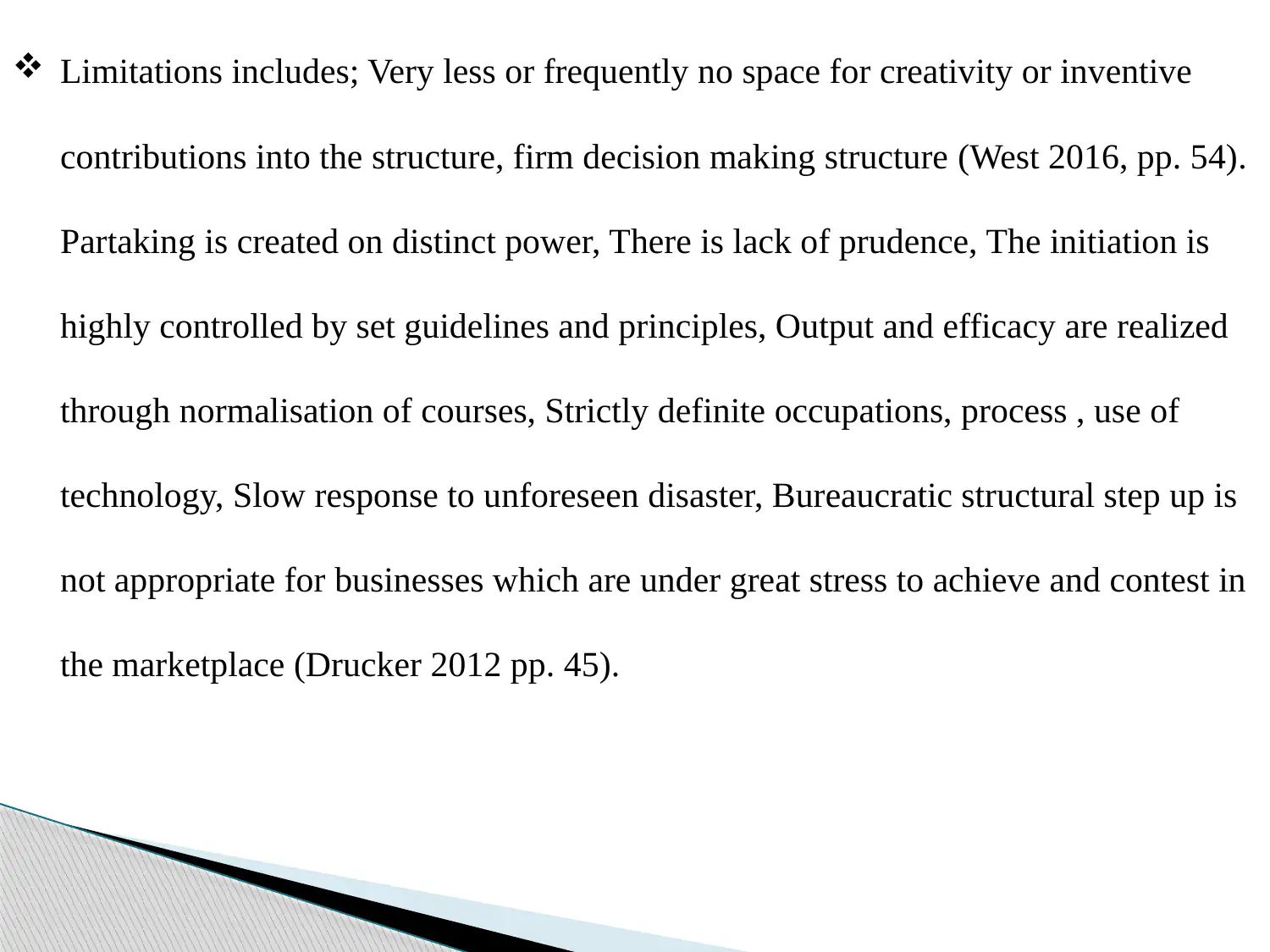
Limitations includes; Very less or frequently no space for creativity or inventive
contributions into the structure, firm decision making structure (West 2016, pp. 54).
Partaking is created on distinct power, There is lack of prudence, The initiation is
highly controlled by set guidelines and principles, Output and efficacy are realized
through normalisation of courses, Strictly definite occupations, process , use of
technology, Slow response to unforeseen disaster, Bureaucratic structural step up is
not appropriate for businesses which are under great stress to achieve and contest in
the marketplace (Drucker 2012 pp. 45).
contributions into the structure, firm decision making structure (West 2016, pp. 54).
Partaking is created on distinct power, There is lack of prudence, The initiation is
highly controlled by set guidelines and principles, Output and efficacy are realized
through normalisation of courses, Strictly definite occupations, process , use of
technology, Slow response to unforeseen disaster, Bureaucratic structural step up is
not appropriate for businesses which are under great stress to achieve and contest in
the marketplace (Drucker 2012 pp. 45).
⊘ This is a preview!⊘
Do you want full access?
Subscribe today to unlock all pages.

Trusted by 1+ million students worldwide

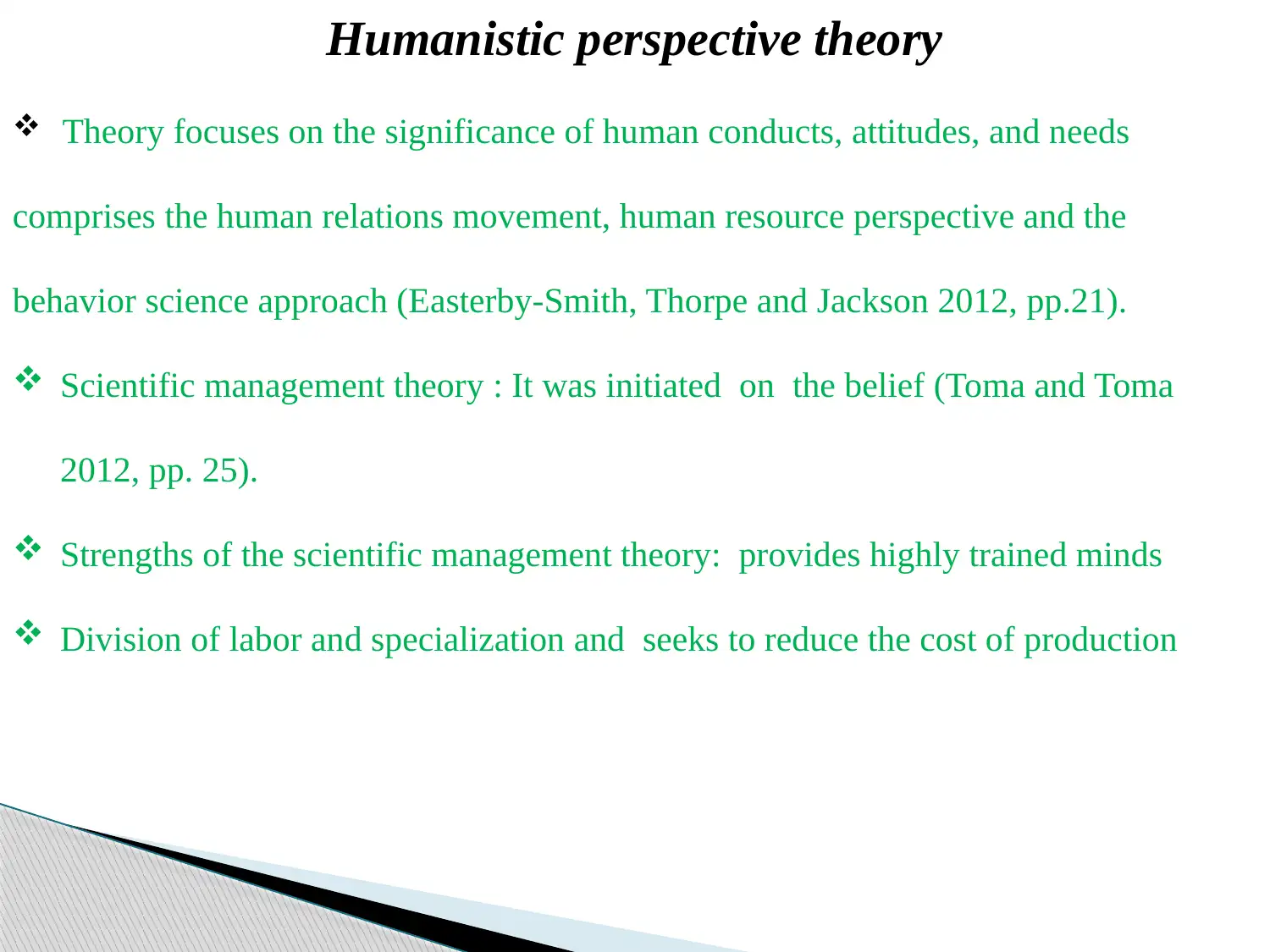
Humanistic perspective theory
Theory focuses on the significance of human conducts, attitudes, and needs
comprises the human relations movement, human resource perspective and the
behavior science approach (Easterby-Smith, Thorpe and Jackson 2012, pp.21).
Scientific management theory : It was initiated on the belief (Toma and Toma
2012, pp. 25).
Strengths of the scientific management theory: provides highly trained minds
Division of labor and specialization and seeks to reduce the cost of production
Theory focuses on the significance of human conducts, attitudes, and needs
comprises the human relations movement, human resource perspective and the
behavior science approach (Easterby-Smith, Thorpe and Jackson 2012, pp.21).
Scientific management theory : It was initiated on the belief (Toma and Toma
2012, pp. 25).
Strengths of the scientific management theory: provides highly trained minds
Division of labor and specialization and seeks to reduce the cost of production
Paraphrase This Document
Need a fresh take? Get an instant paraphrase of this document with our AI Paraphraser

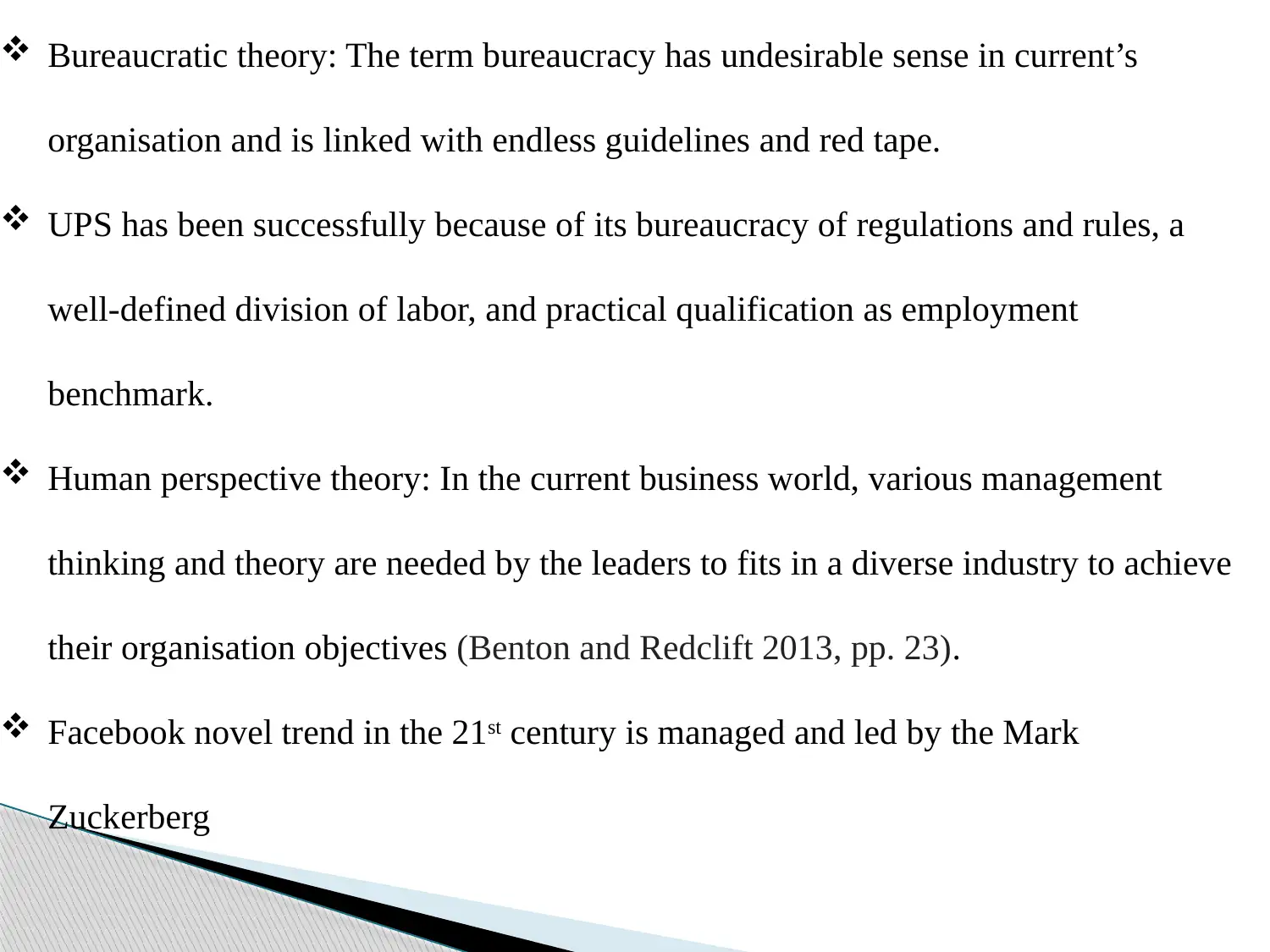
Bureaucratic theory: The term bureaucracy has undesirable sense in current’s
organisation and is linked with endless guidelines and red tape.
UPS has been successfully because of its bureaucracy of regulations and rules, a
well-defined division of labor, and practical qualification as employment
benchmark.
Human perspective theory: In the current business world, various management
thinking and theory are needed by the leaders to fits in a diverse industry to achieve
their organisation objectives (Benton and Redclift 2013, pp. 23).
Facebook novel trend in the 21st century is managed and led by the Mark
Zuckerberg
organisation and is linked with endless guidelines and red tape.
UPS has been successfully because of its bureaucracy of regulations and rules, a
well-defined division of labor, and practical qualification as employment
benchmark.
Human perspective theory: In the current business world, various management
thinking and theory are needed by the leaders to fits in a diverse industry to achieve
their organisation objectives (Benton and Redclift 2013, pp. 23).
Facebook novel trend in the 21st century is managed and led by the Mark
Zuckerberg

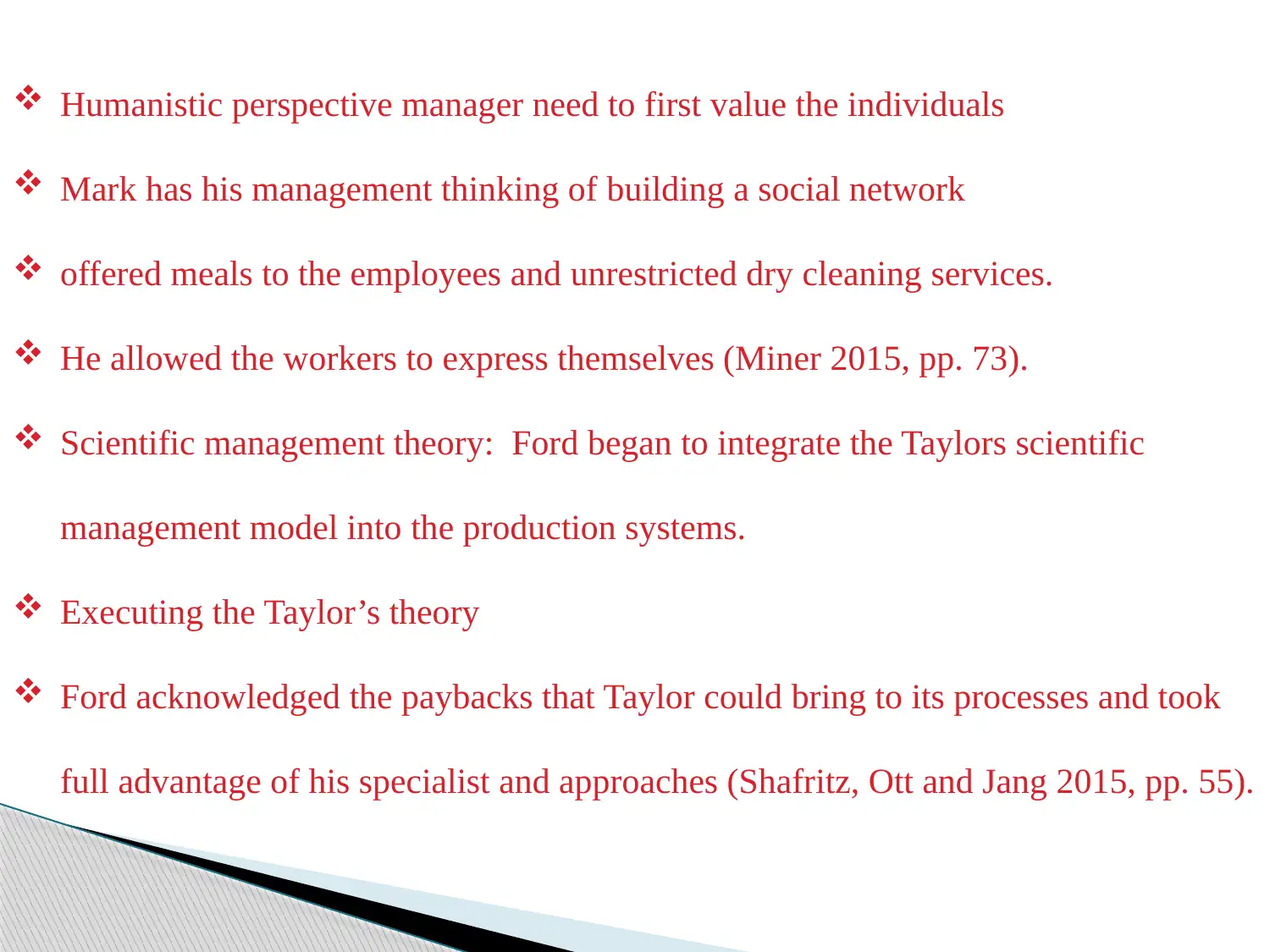
Humanistic perspective manager need to first value the individuals
Mark has his management thinking of building a social network
offered meals to the employees and unrestricted dry cleaning services.
He allowed the workers to express themselves (Miner 2015, pp. 73).
Scientific management theory: Ford began to integrate the Taylors scientific
management model into the production systems.
Executing the Taylor’s theory
Ford acknowledged the paybacks that Taylor could bring to its processes and took
full advantage of his specialist and approaches (Shafritz, Ott and Jang 2015, pp. 55).
Mark has his management thinking of building a social network
offered meals to the employees and unrestricted dry cleaning services.
He allowed the workers to express themselves (Miner 2015, pp. 73).
Scientific management theory: Ford began to integrate the Taylors scientific
management model into the production systems.
Executing the Taylor’s theory
Ford acknowledged the paybacks that Taylor could bring to its processes and took
full advantage of his specialist and approaches (Shafritz, Ott and Jang 2015, pp. 55).
⊘ This is a preview!⊘
Do you want full access?
Subscribe today to unlock all pages.

Trusted by 1+ million students worldwide

Summary
The fundamental purpose of management is controlling individuals or a condition
for accomplishment of specific objectives.
From the implementation and functional standpoint, management is a course that
comprises planning, organising, resourcing, directing and controlling various
processes for the realisation of preferred objectives.
Management is also loomed as a mechanism of innovative problem resolving.
The creative problematic solving is attained through four processes; Planning,
leading, organizing and controlling
The fundamental purpose of management is controlling individuals or a condition
for accomplishment of specific objectives.
From the implementation and functional standpoint, management is a course that
comprises planning, organising, resourcing, directing and controlling various
processes for the realisation of preferred objectives.
Management is also loomed as a mechanism of innovative problem resolving.
The creative problematic solving is attained through four processes; Planning,
leading, organizing and controlling
Paraphrase This Document
Need a fresh take? Get an instant paraphrase of this document with our AI Paraphraser

Part A
Event management
Selected incident: I was tasked with organising the sport events during my fourth
year The event attracted so many viewers
Tasked with getting the volunteers and organising event committee.
choose the tournaments and clarify the date.
Prior to tournament, I made listing of thing like studying the medal, awards,
posters, score sheets and temporal order clocks.
Two months before the event, I made listing of thing such as tournament and
booking officers.
Event management
Selected incident: I was tasked with organising the sport events during my fourth
year The event attracted so many viewers
Tasked with getting the volunteers and organising event committee.
choose the tournaments and clarify the date.
Prior to tournament, I made listing of thing like studying the medal, awards,
posters, score sheets and temporal order clocks.
Two months before the event, I made listing of thing such as tournament and
booking officers.

Secured the venue and ordered the things
had responsibility to communicate with the group attending the event.
The decision to supply food, refreshment was left to my selections.
Tasked in ensuring that team tournament played at minimum two
Arrange the photo session and ensure the sports events
Material and local jeweler was also to ready to offer trophies to winner.
strived to contact and acquire to the neighboring high school
had responsibility to communicate with the group attending the event.
The decision to supply food, refreshment was left to my selections.
Tasked in ensuring that team tournament played at minimum two
Arrange the photo session and ensure the sports events
Material and local jeweler was also to ready to offer trophies to winner.
strived to contact and acquire to the neighboring high school
⊘ This is a preview!⊘
Do you want full access?
Subscribe today to unlock all pages.

Trusted by 1+ million students worldwide
1 out of 15
Related Documents
Your All-in-One AI-Powered Toolkit for Academic Success.
+13062052269
info@desklib.com
Available 24*7 on WhatsApp / Email
Unlock your academic potential
Copyright © 2020–2025 A2Z Services. All Rights Reserved. Developed and managed by ZUCOL.