Berry Street's Stand By Me Program: Organizational Report
VerifiedAdded on 2021/09/15
|20
|4420
|44
Report
AI Summary
This report provides an in-depth analysis of Berry Street's Stand By Me (SBM) program, designed to support young Australians transitioning from Out-of-Home Care (OHC). The report evaluates the program's goals, objectives, and implementation plan, focusing on the UK Personal Advisor (PA) Model. It examines the project's needs analysis, action strategies, and resource allocation, including financial and human resources. The communication strategy and strategies for project evaluation are also discussed. The SBM program aims to reduce care problems and improve outcomes for care leavers by providing flexible, holistic, and intensive care support. The report highlights the importance of establishing collaborations, providing post-care support, and coordinating housing options. The program's success relies on strong human resources, material resources, technology, and effective communication to ensure positive outcomes for vulnerable young adults.
Running head: ORGANIZATIONAL CULTURE AND MANAGEMENT 1
Organizational Culture and Management
Student’s Name
Institutional Affiliation
Date of Submission
Organizational Culture and Management
Student’s Name
Institutional Affiliation
Date of Submission

Paraphrase This Document
Need a fresh take? Get an instant paraphrase of this document with our AI Paraphraser
ORGANIZATIONAL CULTURE AND MANAGEMENT 2
Table of Contents
Agency and Proposal Introduction..................................................................................................3
Project Needs Analysis (Conceptual Phase)....................................................................................4
Project Goals and Objectives (Definition Phase)............................................................................5
Implementation Plan (Commencement and Performance Phase)...................................................9
1. Action Strategy.....................................................................................................................9
2. Strategy for Project Resourcing..........................................................................................10
3. Communication strategy.....................................................................................................11
Strategies for Project Evaluation (Closure Phase).........................................................................13
Conclusion.....................................................................................................................................15
Reference.......................................................................................................................................17
Table of Contents
Agency and Proposal Introduction..................................................................................................3
Project Needs Analysis (Conceptual Phase)....................................................................................4
Project Goals and Objectives (Definition Phase)............................................................................5
Implementation Plan (Commencement and Performance Phase)...................................................9
1. Action Strategy.....................................................................................................................9
2. Strategy for Project Resourcing..........................................................................................10
3. Communication strategy.....................................................................................................11
Strategies for Project Evaluation (Closure Phase).........................................................................13
Conclusion.....................................................................................................................................15
Reference.......................................................................................................................................17
ORGANIZATIONAL CULTURE AND MANAGEMENT 3
Berry Street Organization Australia
Stand-By-Me Program
Agency and Proposal Introduction
This organizational management report will evaluate Berry Street’s Stand By Me (SBM)
Program under the umbrella of Leaving Care Sustainability Projects which will be launched in
the Southern regions of the country by December 2018. This program’s aim is to provide
flexible, holistic, and intensive care support to a group of young Australians that transition from
OHC (Out-of-Home Care). According to research performed by Berry Street, youths that leave
care centres are disadvantaged and most marginalized as a result of their periodic, variable care
experiences; pre-care experiences; as well as accelerated and compressed transitions to
adulthood. The children in Victoria, for instance, are provided with care by Health and Human
Services Department and in line with the Youth and Families Act of 2005. Such care also
extends to young adults leaving OHC up to the age of 21 (Australian Institute of Health and
Welfare, 2016). Although the care systems in Victoria have functional for more than five years
now, their general impacts are unevaluated. Apart from that, though the sector of care provision
has realized advances, there is research evidence suggesting that there are relatively poor
outcomes that care leavers experience from time to time. Otherwise, in terms of young adults’
transition from care centres outcomes, those who have faced the poorest outcomes are them with
worse or adverse experiences on pre-care (Miller, 2012). The youth who are highly risked and
falling into this category are presented with complex and multiple needs and wants from mental
health and cognitive disabilities examinations to violence, substance abuse, and sexual
vulnerability examinations. Such individuals are also regarded as cohort not likely to receive or
access services while transitioning from care since their challenging behaviour and complex
Berry Street Organization Australia
Stand-By-Me Program
Agency and Proposal Introduction
This organizational management report will evaluate Berry Street’s Stand By Me (SBM)
Program under the umbrella of Leaving Care Sustainability Projects which will be launched in
the Southern regions of the country by December 2018. This program’s aim is to provide
flexible, holistic, and intensive care support to a group of young Australians that transition from
OHC (Out-of-Home Care). According to research performed by Berry Street, youths that leave
care centres are disadvantaged and most marginalized as a result of their periodic, variable care
experiences; pre-care experiences; as well as accelerated and compressed transitions to
adulthood. The children in Victoria, for instance, are provided with care by Health and Human
Services Department and in line with the Youth and Families Act of 2005. Such care also
extends to young adults leaving OHC up to the age of 21 (Australian Institute of Health and
Welfare, 2016). Although the care systems in Victoria have functional for more than five years
now, their general impacts are unevaluated. Apart from that, though the sector of care provision
has realized advances, there is research evidence suggesting that there are relatively poor
outcomes that care leavers experience from time to time. Otherwise, in terms of young adults’
transition from care centres outcomes, those who have faced the poorest outcomes are them with
worse or adverse experiences on pre-care (Miller, 2012). The youth who are highly risked and
falling into this category are presented with complex and multiple needs and wants from mental
health and cognitive disabilities examinations to violence, substance abuse, and sexual
vulnerability examinations. Such individuals are also regarded as cohort not likely to receive or
access services while transitioning from care since their challenging behaviour and complex
⊘ This is a preview!⊘
Do you want full access?
Subscribe today to unlock all pages.

Trusted by 1+ million students worldwide
ORGANIZATIONAL CULTURE AND MANAGEMENT 4
needs are not compatible with care system associated with mainstream care leaving (Baldry, Et
al., 2015).
Project Needs Analysis (Conceptual Phase)
According to research performed by Berry Street on care provision within the Southern
parts of Australia, adult youth leaving care outcomes are poor (particularly for adolescents faced
with high-risk, complex and multiple needs) because they go through services system that is
complicated. Such is the reason why Berry Street plans to develop an SBM project for the
Southern Region Care Systems. The project design will ensure that significant care problems are
reduced (Australian Government, 2008).
Before the inception of this program, Berry Street performed a research activity under the
Leaving Care Sustainability Projects umbrella in Victoria on leaving care systems within the
state. Within the study period, several poor long-term outcomes were noted particularly for
individuals who transition from state-provided care. The young adults were reported to be
incompatible with limited state offered resources and existing designs of mainstream care
leaving services (Calligeros, 2015). However, the paradox in this study is that young adults
transiting from care provision systems in the State of Victoria were still in need of post-care and
support. According to such analysis, Berry Street established that the individuals who
experienced volatile pathways in relation to post-care actually included youths who did not
properly access care. Afterwards, Berry Street decided that it would go with the UK PA Model
since it is a potential, transformative model and would help SBM Program achieve its
operational objectives by helping the youth adequately navigate through a complicated care
services system (Cashmore & Paxman, 2006, pg. 238).
needs are not compatible with care system associated with mainstream care leaving (Baldry, Et
al., 2015).
Project Needs Analysis (Conceptual Phase)
According to research performed by Berry Street on care provision within the Southern
parts of Australia, adult youth leaving care outcomes are poor (particularly for adolescents faced
with high-risk, complex and multiple needs) because they go through services system that is
complicated. Such is the reason why Berry Street plans to develop an SBM project for the
Southern Region Care Systems. The project design will ensure that significant care problems are
reduced (Australian Government, 2008).
Before the inception of this program, Berry Street performed a research activity under the
Leaving Care Sustainability Projects umbrella in Victoria on leaving care systems within the
state. Within the study period, several poor long-term outcomes were noted particularly for
individuals who transition from state-provided care. The young adults were reported to be
incompatible with limited state offered resources and existing designs of mainstream care
leaving services (Calligeros, 2015). However, the paradox in this study is that young adults
transiting from care provision systems in the State of Victoria were still in need of post-care and
support. According to such analysis, Berry Street established that the individuals who
experienced volatile pathways in relation to post-care actually included youths who did not
properly access care. Afterwards, Berry Street decided that it would go with the UK PA Model
since it is a potential, transformative model and would help SBM Program achieve its
operational objectives by helping the youth adequately navigate through a complicated care
services system (Cashmore & Paxman, 2006, pg. 238).
Paraphrase This Document
Need a fresh take? Get an instant paraphrase of this document with our AI Paraphraser
ORGANIZATIONAL CULTURE AND MANAGEMENT 5
Otherwise, the SBM Program is in line with Berry Street’s Leaving Care Sustainability
Projects guidelines. The SBM, therefore, intends to provide responses towards the needs of
transitioning care leavers with complex and multiple needs. The program’s operational nature
will be tested within a three-year phase during which program analysts will engage six
transitioning care leavers. For its operation during the testing period and throughout its
employment, the program will adopt the UK Personal Advisor Model in which analysts are
required to begin engaging the identified children in care as soon as they hit their 16th birthdays
while they prepare for their future independence (Cook, 2014). The analysts, otherwise known as
PAs (Personal Advisors) according to the UK PA Model, will coordinate activities, review
leaving care plans, implement them, and maintain contact with care leavers. They will also be in
charge of information provided to the leavers, advice provision, and referral till they hit the age
of 21. Apart from that, the SBM program will incorporate a period for pre-exit engagement in
which analysts, care teams, and care leavers will develop positive relationships for work and
efficiency as well as assure adequate planning for children to leave care units in proper time
(Commission for Children and Young People, 2015).
Project Goals and Objectives (Definition Phase)
SBM Program’s objectives and goals are developed in line with core study elements
within the guidelines of the UK PA Model as well as the study assumptions in line with the basic
principles of care provision (Department of Child Safety, 2008). Alongside the goals and
objectives of this project, some of the associated benefits are:
- Provision of support and continuity
- Reduction of post-care anxiety and leaving care
- Increased flexibility
Otherwise, the SBM Program is in line with Berry Street’s Leaving Care Sustainability
Projects guidelines. The SBM, therefore, intends to provide responses towards the needs of
transitioning care leavers with complex and multiple needs. The program’s operational nature
will be tested within a three-year phase during which program analysts will engage six
transitioning care leavers. For its operation during the testing period and throughout its
employment, the program will adopt the UK Personal Advisor Model in which analysts are
required to begin engaging the identified children in care as soon as they hit their 16th birthdays
while they prepare for their future independence (Cook, 2014). The analysts, otherwise known as
PAs (Personal Advisors) according to the UK PA Model, will coordinate activities, review
leaving care plans, implement them, and maintain contact with care leavers. They will also be in
charge of information provided to the leavers, advice provision, and referral till they hit the age
of 21. Apart from that, the SBM program will incorporate a period for pre-exit engagement in
which analysts, care teams, and care leavers will develop positive relationships for work and
efficiency as well as assure adequate planning for children to leave care units in proper time
(Commission for Children and Young People, 2015).
Project Goals and Objectives (Definition Phase)
SBM Program’s objectives and goals are developed in line with core study elements
within the guidelines of the UK PA Model as well as the study assumptions in line with the basic
principles of care provision (Department of Child Safety, 2008). Alongside the goals and
objectives of this project, some of the associated benefits are:
- Provision of support and continuity
- Reduction of post-care anxiety and leaving care
- Increased flexibility
ORGANIZATIONAL CULTURE AND MANAGEMENT 6
- Increasing strength of housing assistance; and
- Use of holistic approach towards person-centred care
The impacts of the strengths of this program will then be discussed while highlighting how SBM
elements address deficiencies of care systems. The benefits highlighted above are intertwined
otherwise, establishing holistic support concerning worker-client relationship in SBM
(Australian Bureau of Statistics, 2013). The objectives of this SBM program in relation worker
roles include:
- Establishing collaborations between care teams and managers in the identification of
young adults that require support in their transitions.
- Helping case managers to assess young adults in the promotion of assessments, skill
development, and planning.
- Provision of post-care within the framework of providing a role that is more assertive for
young adults up to 21 years of age.
- Provision of a contact point that is key for care leavers that are vulnerable
- Having key referrals coordinated while advocating for service support
- Coordination of housing options information while establishing criteria for eligibility of
the program within the identified geographic area.
According to the stipulated roles, the analysists will be required to visit care leavers in whatever
places of accommodation (McDowall, 2013). In line with the same, SBM model will help in
establishing a strong relationship between the analysts or assistants with care leavers. Otherwise,
the goals of associating UK PA Model include:
- Creating an SBM problem- solving model for care leavers
- Increasing strength of housing assistance; and
- Use of holistic approach towards person-centred care
The impacts of the strengths of this program will then be discussed while highlighting how SBM
elements address deficiencies of care systems. The benefits highlighted above are intertwined
otherwise, establishing holistic support concerning worker-client relationship in SBM
(Australian Bureau of Statistics, 2013). The objectives of this SBM program in relation worker
roles include:
- Establishing collaborations between care teams and managers in the identification of
young adults that require support in their transitions.
- Helping case managers to assess young adults in the promotion of assessments, skill
development, and planning.
- Provision of post-care within the framework of providing a role that is more assertive for
young adults up to 21 years of age.
- Provision of a contact point that is key for care leavers that are vulnerable
- Having key referrals coordinated while advocating for service support
- Coordination of housing options information while establishing criteria for eligibility of
the program within the identified geographic area.
According to the stipulated roles, the analysists will be required to visit care leavers in whatever
places of accommodation (McDowall, 2013). In line with the same, SBM model will help in
establishing a strong relationship between the analysts or assistants with care leavers. Otherwise,
the goals of associating UK PA Model include:
- Creating an SBM problem- solving model for care leavers
⊘ This is a preview!⊘
Do you want full access?
Subscribe today to unlock all pages.
Trusted by 1+ million students worldwide
ORGANIZATIONAL CULTURE AND MANAGEMENT 7
- Encouraging the facilitation of community connections
- Creating a proper framework in processes of care provision and relationship
establishment
- Helping analysts to adapt to the wants and needs of care leavers.
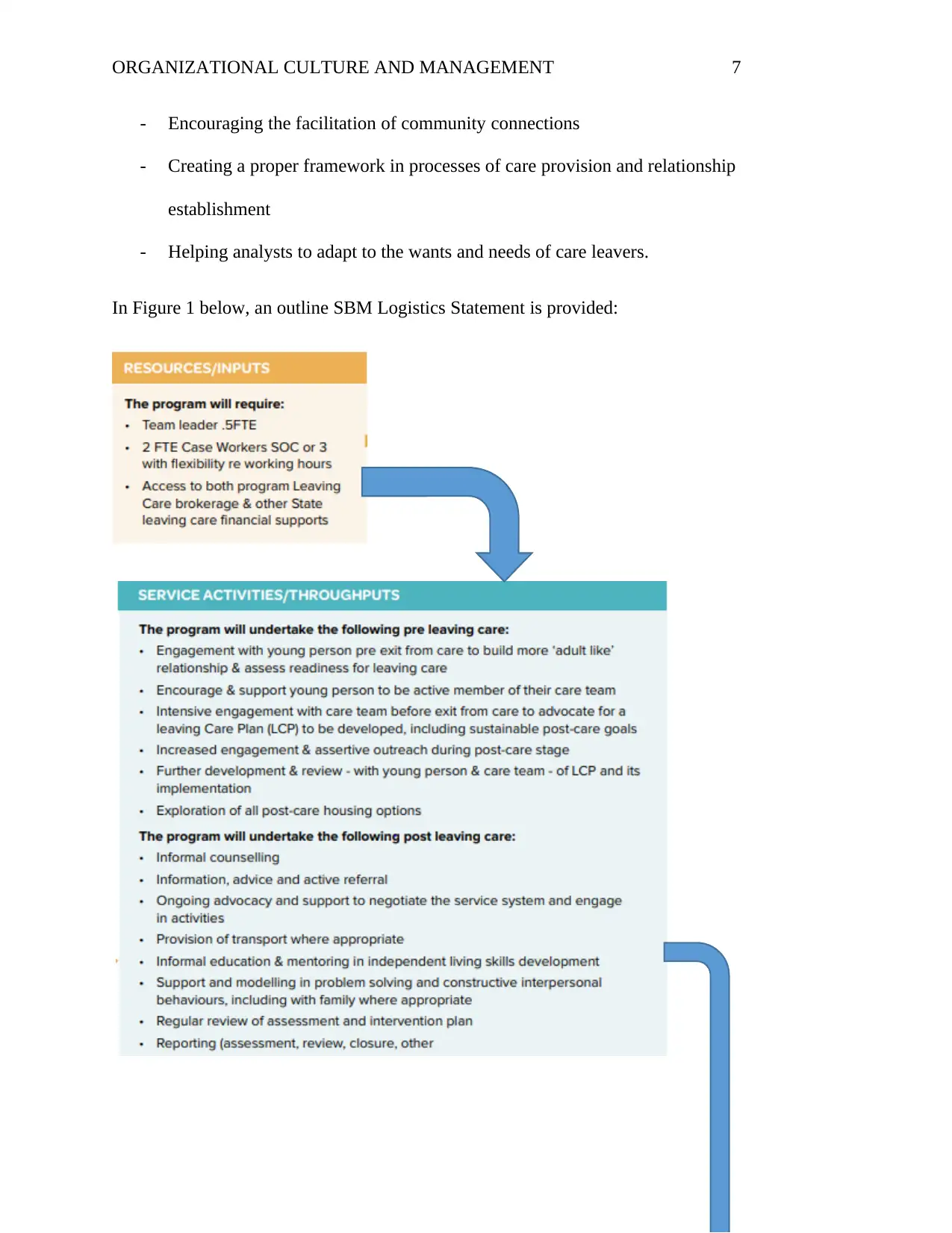
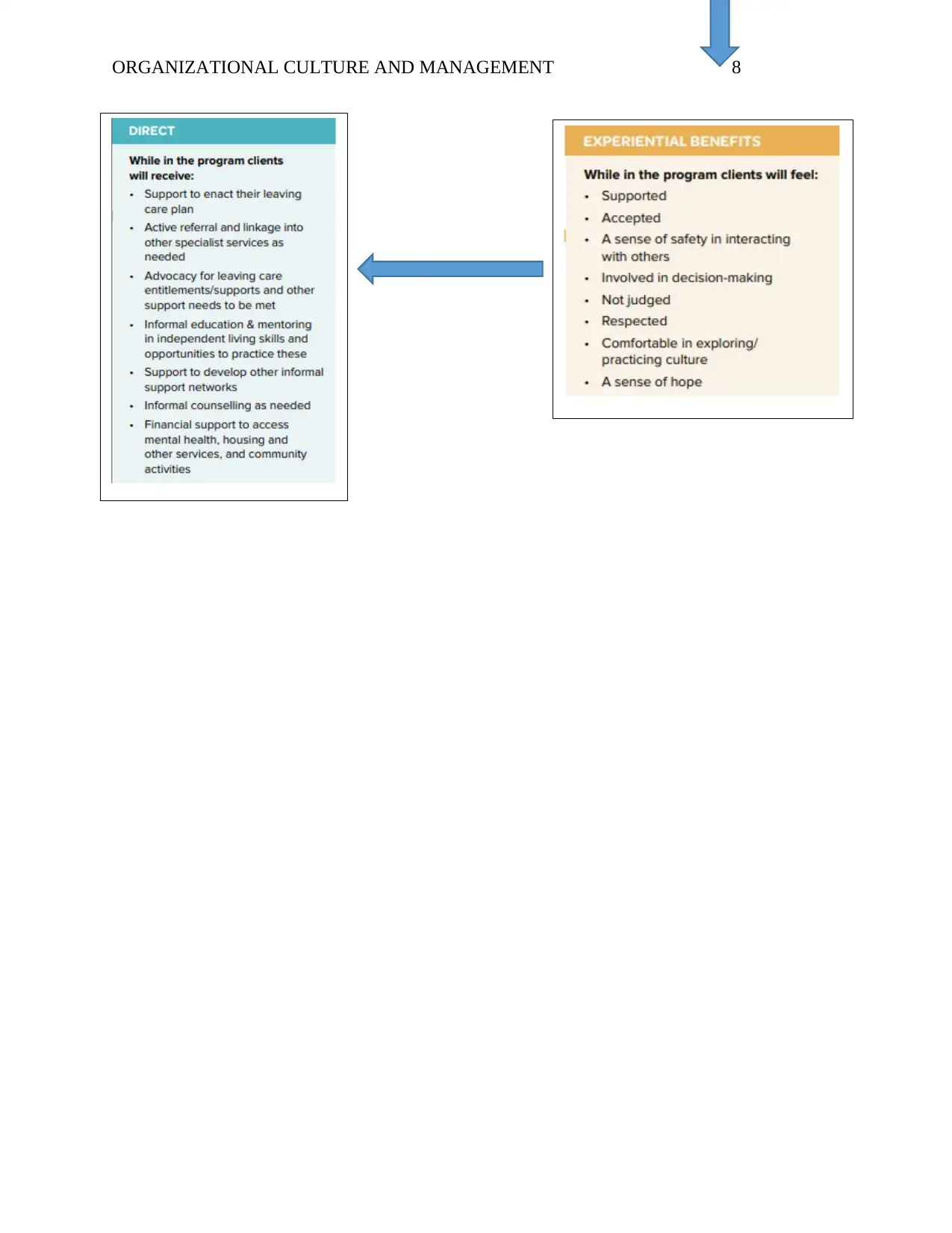
In Figure 1 below, an outline SBM Logistics Statement is provided:
- Encouraging the facilitation of community connections
- Creating a proper framework in processes of care provision and relationship
establishment
- Helping analysts to adapt to the wants and needs of care leavers.
In Figure 1 below, an outline SBM Logistics Statement is provided:
Paraphrase This Document
Need a fresh take? Get an instant paraphrase of this document with our AI Paraphraser
ORGANIZATIONAL CULTURE AND MANAGEMENT 8
ORGANIZATIONAL CULTURE AND MANAGEMENT 9
Implementation Plan (Commencement and Performance
Phase)
1. Action Strategy
The previous phases, conceptual and definition were but a set foundation for the SBM
Program and subsequent phases. Otherwise, the objectives of the project are important in
establishing the program’s action strategies (Department of Health, 2013). Otherwise, the action
strategies for this program include:
a) Maintenance and development of agreements and partnerships with NGOs and
government agencies providing care. Herein, such external stakeholders will help in
engaging care leavers. In this case, formed partnerships will be able to:
i) Help in the development of project templates that would be employed in all care
provision centres.
ii) Help in negotiations between stakeholders to come up with operational policies and
protocols for proper care delivery.
b) Implementation of SBM and related operational frameworks. Herein related activities
include but are not limited to engaging new and existing stakeholders such as NGOs in
the advocacy for SBM use in major care service delivery units countrywide and
establishing eligibility criteria for the services offered in relation to the objectives and
goals of SBM (Department for Education and Skills, 2007). Otherwise, this section
requires:
i) Court approval to legalize and establish the national use of SBM in care provision
centres.
Implementation Plan (Commencement and Performance
Phase)
1. Action Strategy
The previous phases, conceptual and definition were but a set foundation for the SBM
Program and subsequent phases. Otherwise, the objectives of the project are important in
establishing the program’s action strategies (Department of Health, 2013). Otherwise, the action
strategies for this program include:
a) Maintenance and development of agreements and partnerships with NGOs and
government agencies providing care. Herein, such external stakeholders will help in
engaging care leavers. In this case, formed partnerships will be able to:
i) Help in the development of project templates that would be employed in all care
provision centres.
ii) Help in negotiations between stakeholders to come up with operational policies and
protocols for proper care delivery.
b) Implementation of SBM and related operational frameworks. Herein related activities
include but are not limited to engaging new and existing stakeholders such as NGOs in
the advocacy for SBM use in major care service delivery units countrywide and
establishing eligibility criteria for the services offered in relation to the objectives and
goals of SBM (Department for Education and Skills, 2007). Otherwise, this section
requires:
i) Court approval to legalize and establish the national use of SBM in care provision
centres.
⊘ This is a preview!⊘
Do you want full access?
Subscribe today to unlock all pages.
Trusted by 1+ million students worldwide
ORGANIZATIONAL CULTURE AND MANAGEMENT 10
ii) Ensuring that care leavers are given the best needs by service providers and
therefore, enhance outcomes that are positive
iii) Advocating for the involvement of care leavers as stipulated in the UK PA Model.
2. Strategy for Project Resourcing
According to the financial budget plan for this project (yet to be released though), Berry
Streets in association with the Victorian Government and associated national government
policies and reforms on the same, the organization has stipulated that it will receive a total of
$200 million from its stakeholders to meet the objectives of the SBM program. Apart from that,
the organization has put aside $140 million to help to carry out the logistics of the project. The
project intends to strengthen communities by ensuring that care leavers are given the right post-
care attention and basic lifelines to continue with their own lives without feeling aligned or
neglected (McDowall, 2008). Apart from that, the implementation of this program will help care
provision centres to increase the level of efficiency associated with care provision and help care
leavers establish productive living styles after leaving care centres. As mentioned earlier in this
section, the government of Australia and stakeholders have accepted to fund the project with
much of their concerns directed to the improvement of the existing care provision policies as
well as establishing new procedures and policies in the sector (Meade & Mendes, 2014). Apart
from monetary resources, other resources that will help in integrating effective SBM in line with
UK PA model and ensure care provision sustainability include:
a) Human Resources: - Since the project will take an estimated study phase of around three
years, having a strong human resource is vital. In such a case, a number of positions will
be established inclusion of a manager for the project, one senior coordinator for the
project alongside two other coordinators, two project officers, and one hundred team
ii) Ensuring that care leavers are given the best needs by service providers and
therefore, enhance outcomes that are positive
iii) Advocating for the involvement of care leavers as stipulated in the UK PA Model.
2. Strategy for Project Resourcing
According to the financial budget plan for this project (yet to be released though), Berry
Streets in association with the Victorian Government and associated national government
policies and reforms on the same, the organization has stipulated that it will receive a total of
$200 million from its stakeholders to meet the objectives of the SBM program. Apart from that,
the organization has put aside $140 million to help to carry out the logistics of the project. The
project intends to strengthen communities by ensuring that care leavers are given the right post-
care attention and basic lifelines to continue with their own lives without feeling aligned or
neglected (McDowall, 2008). Apart from that, the implementation of this program will help care
provision centres to increase the level of efficiency associated with care provision and help care
leavers establish productive living styles after leaving care centres. As mentioned earlier in this
section, the government of Australia and stakeholders have accepted to fund the project with
much of their concerns directed to the improvement of the existing care provision policies as
well as establishing new procedures and policies in the sector (Meade & Mendes, 2014). Apart
from monetary resources, other resources that will help in integrating effective SBM in line with
UK PA model and ensure care provision sustainability include:
a) Human Resources: - Since the project will take an estimated study phase of around three
years, having a strong human resource is vital. In such a case, a number of positions will
be established inclusion of a manager for the project, one senior coordinator for the
project alongside two other coordinators, two project officers, and one hundred team
Paraphrase This Document
Need a fresh take? Get an instant paraphrase of this document with our AI Paraphraser
ORGANIZATIONAL CULTURE AND MANAGEMENT 11
workers or care analysts. Sourcing for individuals in the identified positions will be done
externally and internally with prior project management experience required across the
named positions. Otherwise, right candidates must possess administrative and technical
skills. From the selected team, another team in the name of the HR Management Team
will be chosen to ensure that workers are properly engaged, vacant positions are
advertised, and retention services provided.
b) Material Resources and Facilities: - Within the stipulated study phase and beyond
gazettement, Berry Street has recognized that workers will need physical locations for
their operations, computer machines, transportation means, as well as office supplies. On
facilities, however, workers will be working departmentally in different locations and
thus, will require operational equipment in the nature of meeting rooms.
c) Technology and Training: Since the program is open to improvements, workers will need
to be trained occasionally with Berry Street recognizing the need for workshops during
the research phase. On technology, however, every employee will be required to have a
smartphone, be able to access the internet, tele or video conference.
d) Knowledge resource: Before beginning operations, workers will be needed to hold formal
induction on the aspects of operational procedures, policies, as well as legislated
responsibilities in terms of developing specific operational requirements.
3. Communication strategy
Before coming up with the plan, Berry Street conducted a number of consultative forums
to determine communication frameworks in line with the proposed organizational model. The
proposed communication channels and modes, both direct and indirect, will ensure that care
support feedback or comments will be channelled to the management through social platforms
workers or care analysts. Sourcing for individuals in the identified positions will be done
externally and internally with prior project management experience required across the
named positions. Otherwise, right candidates must possess administrative and technical
skills. From the selected team, another team in the name of the HR Management Team
will be chosen to ensure that workers are properly engaged, vacant positions are
advertised, and retention services provided.
b) Material Resources and Facilities: - Within the stipulated study phase and beyond
gazettement, Berry Street has recognized that workers will need physical locations for
their operations, computer machines, transportation means, as well as office supplies. On
facilities, however, workers will be working departmentally in different locations and
thus, will require operational equipment in the nature of meeting rooms.
c) Technology and Training: Since the program is open to improvements, workers will need
to be trained occasionally with Berry Street recognizing the need for workshops during
the research phase. On technology, however, every employee will be required to have a
smartphone, be able to access the internet, tele or video conference.
d) Knowledge resource: Before beginning operations, workers will be needed to hold formal
induction on the aspects of operational procedures, policies, as well as legislated
responsibilities in terms of developing specific operational requirements.
3. Communication strategy
Before coming up with the plan, Berry Street conducted a number of consultative forums
to determine communication frameworks in line with the proposed organizational model. The
proposed communication channels and modes, both direct and indirect, will ensure that care
support feedback or comments will be channelled to the management through social platforms
ORGANIZATIONAL CULTURE AND MANAGEMENT 12
and traditional channels of communication (Mendes, 2014, pg. 71). The program intends to
create a client support centre and hotline through which claims and ideas are taken and
forwarded to management for analysis or follow up. The project will ensure that stakeholders
practice both formal and informal approaches to communication depending on the context of use
within the organization. For the management, project supervisors would be required to use
formal communication modes when working with internal stakeholders as well as passing vital
information across the departments (Marpsata & Razafindratsimab, 2010, pg. 15). In relation to
the same, this project’s strategy for communication entails providing progress reports to care
analysts, informing senior managers on project progress through reports as well as the problems
and identified deficiencies, as well as using meetings to implement project resolutions as well as
other established actions (Department for Education and Skills, 2007). Every report on the
progress of the project will be projected to be able to meet the expected study outcomes as well
as curb issues associated care provision and those that affect care leavers. Otherwise, SBM’s
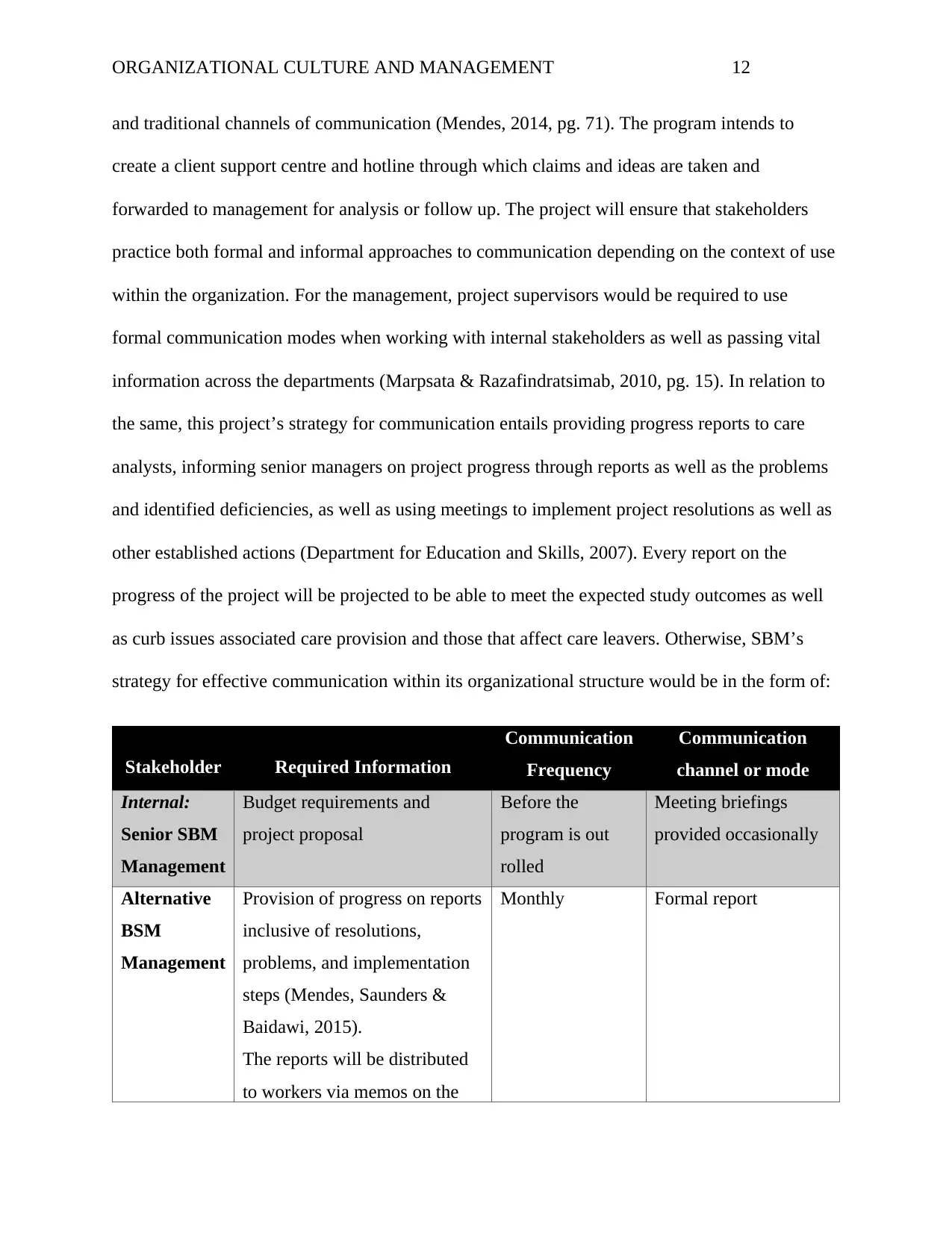
strategy for effective communication within its organizational structure would be in the form of:
Stakeholder Required Information
Communication
Frequency
Communication
channel or mode
Internal:
Senior SBM
Management
Budget requirements and
project proposal
Before the
program is out
rolled
Meeting briefings
provided occasionally
Alternative
BSM
Management
Provision of progress on reports
inclusive of resolutions,
problems, and implementation
steps (Mendes, Saunders &
Baidawi, 2015).
The reports will be distributed
to workers via memos on the
Monthly Formal report
and traditional channels of communication (Mendes, 2014, pg. 71). The program intends to
create a client support centre and hotline through which claims and ideas are taken and
forwarded to management for analysis or follow up. The project will ensure that stakeholders
practice both formal and informal approaches to communication depending on the context of use
within the organization. For the management, project supervisors would be required to use
formal communication modes when working with internal stakeholders as well as passing vital
information across the departments (Marpsata & Razafindratsimab, 2010, pg. 15). In relation to
the same, this project’s strategy for communication entails providing progress reports to care
analysts, informing senior managers on project progress through reports as well as the problems
and identified deficiencies, as well as using meetings to implement project resolutions as well as
other established actions (Department for Education and Skills, 2007). Every report on the
progress of the project will be projected to be able to meet the expected study outcomes as well
as curb issues associated care provision and those that affect care leavers. Otherwise, SBM’s
strategy for effective communication within its organizational structure would be in the form of:
Stakeholder Required Information
Communication
Frequency
Communication
channel or mode
Internal:
Senior SBM
Management
Budget requirements and
project proposal
Before the
program is out
rolled
Meeting briefings
provided occasionally
Alternative
BSM
Management
Provision of progress on reports
inclusive of resolutions,
problems, and implementation
steps (Mendes, Saunders &
Baidawi, 2015).
The reports will be distributed
to workers via memos on the
Monthly Formal report
⊘ This is a preview!⊘
Do you want full access?
Subscribe today to unlock all pages.
Trusted by 1+ million students worldwide

1 out of 20


Your All-in-One AI-Powered Toolkit for Academic Success.
+13062052269
info@desklib.com
Available 24*7 on WhatsApp / Email
![[object Object]](/_next/static/media/star-bottom.7253800d.svg)
Unlock your academic potential
Copyright © 2020–2026 A2Z Services. All Rights Reserved. Developed and managed by ZUCOL.