Organizational Behavior: Motivation in Continuous Improvement
VerifiedAdded on 2020/04/15
|15
|3585
|381
Report
AI Summary
This report examines the critical role of motivation in organizational behavior, specifically within continuous improvement environments. It identifies and analyzes key issues that can hinder employee performance and engagement, including micromanagement, lack of progress, job insecurity, lack of confidence in leadership, poor communication, and unpleasant co-workers. The report delves into the content and process motivation theories, offering a comprehensive understanding of factors that influence employee behavior. Furthermore, it provides actionable recommendations for maximizing motivation, such as recognizing employee achievements, promoting high performers, and fostering open communication. The report emphasizes the importance of understanding employee needs and creating a supportive work environment to achieve organizational goals and maintain a competitive edge. It also highlights the importance of transparency and employee involvement in decision-making processes, particularly during times of uncertainty or change.
Running head: ORGANIZATIONAL BEHAVIOUR 1
.
Motivation Issues of Working in a Continuous Improvement Environment
Name:
Institution:
.
Motivation Issues of Working in a Continuous Improvement Environment
Name:
Institution:

Paraphrase This Document
Need a fresh take? Get an instant paraphrase of this document with our AI Paraphraser
ORGANIZATIONAL BEHAVIOUR 2
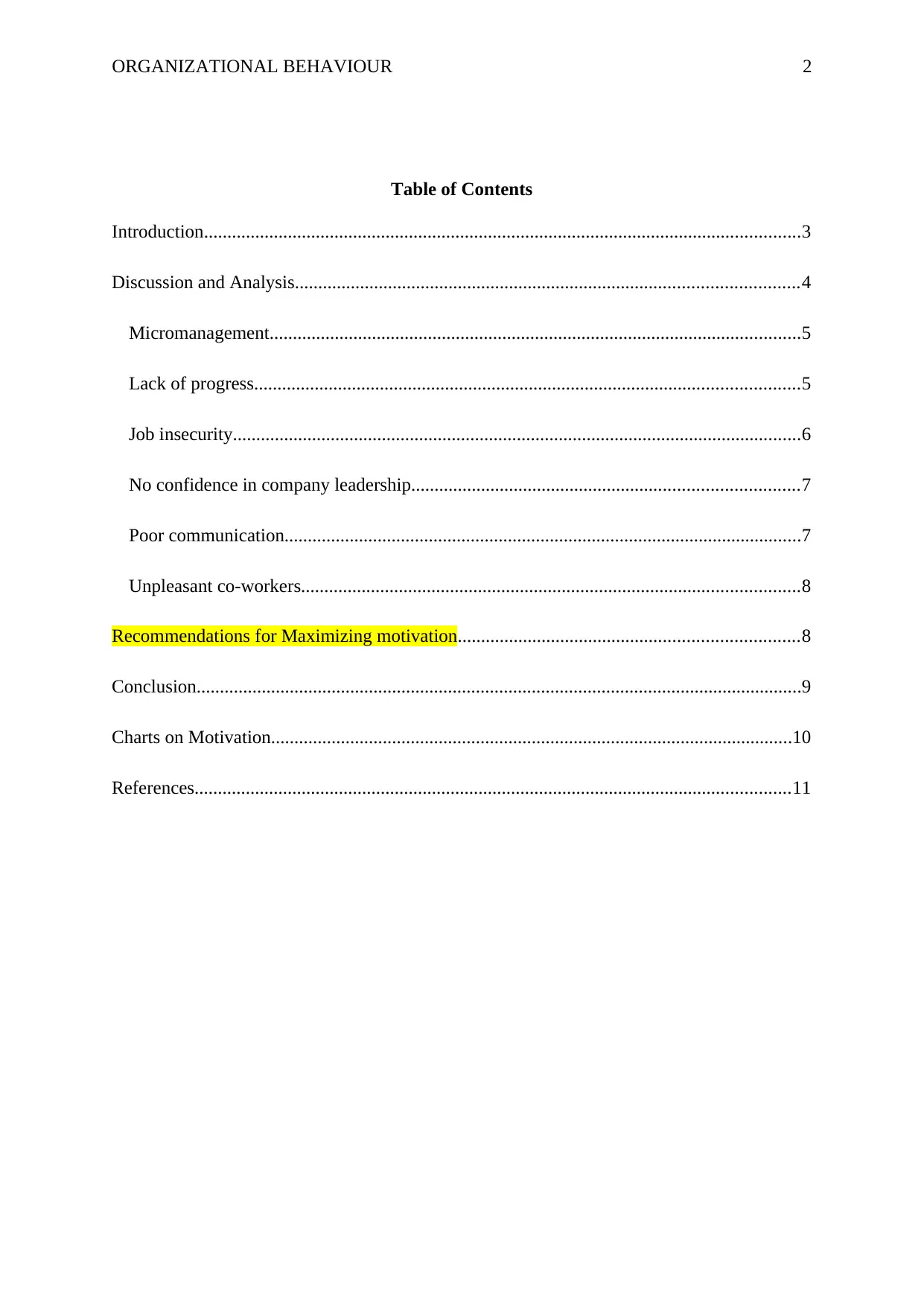
Table of Contents
Introduction................................................................................................................................3
Discussion and Analysis............................................................................................................4
Micromanagement..................................................................................................................5
Lack of progress.....................................................................................................................5
Job insecurity..........................................................................................................................6
No confidence in company leadership...................................................................................7
Poor communication...............................................................................................................7
Unpleasant co-workers...........................................................................................................8
Recommendations for Maximizing motivation.........................................................................8
Conclusion..................................................................................................................................9
Charts on Motivation................................................................................................................10
References................................................................................................................................11
Table of Contents
Introduction................................................................................................................................3
Discussion and Analysis............................................................................................................4
Micromanagement..................................................................................................................5
Lack of progress.....................................................................................................................5
Job insecurity..........................................................................................................................6
No confidence in company leadership...................................................................................7
Poor communication...............................................................................................................7
Unpleasant co-workers...........................................................................................................8
Recommendations for Maximizing motivation.........................................................................8
Conclusion..................................................................................................................................9
Charts on Motivation................................................................................................................10
References................................................................................................................................11
ORGANIZATIONAL BEHAVIOUR 3
Introduction
In every organization, the performance of the employees is essential to the
success of the organization. According to Yanfei, Yangliu, and Yu (2018), motivation is the
energizing factor that maintains effective performance and behavior control for the
employees. However, its role is difficult to accurately measure but is often straight forward.
Even though salary is a motivation factor to push employee performance, it is not sufficient
to push them towards meeting their full potential in the professionalism. This paper evaluates
the motivation issues of working in a continuous improvement environment and suggests
effective recommendations that can be adopted to improve performance through motivation.
The idea and application motivational strategies in an organization revolve around
some basic concepts of the organizational culture. According to Bodie, Keaton, and Jones
(2018), the organization can adopt different motivational strategies with the aim of boosting
the moral of the employees in working towards meeting the goals of the organization with
zeal and confidence. The experiences one has after birth makes the difference gap wider and
the management can use the differences to improve their performance in the workplace. The
changing perception among workers in an organization can also be used as a concept of
motivation. Motivated behavior which refers to the needs in an individual that needs to be
fulfilled (Bechter, Dimmock, Howard, Whipp, & Jackson, 2018). The desire to fulfill such
personal needs can motivate the employee to work harder, and the employer can capitalize on
them by creating incentives that promote the desired requirements. Some other concepts of
organizational behavior include human dignity, mutuality of interest, the value of an
individual, holistic concept and the view of an organization as a social system (Zhang, Wang,
Introduction
In every organization, the performance of the employees is essential to the
success of the organization. According to Yanfei, Yangliu, and Yu (2018), motivation is the
energizing factor that maintains effective performance and behavior control for the
employees. However, its role is difficult to accurately measure but is often straight forward.
Even though salary is a motivation factor to push employee performance, it is not sufficient
to push them towards meeting their full potential in the professionalism. This paper evaluates
the motivation issues of working in a continuous improvement environment and suggests
effective recommendations that can be adopted to improve performance through motivation.
The idea and application motivational strategies in an organization revolve around
some basic concepts of the organizational culture. According to Bodie, Keaton, and Jones
(2018), the organization can adopt different motivational strategies with the aim of boosting
the moral of the employees in working towards meeting the goals of the organization with
zeal and confidence. The experiences one has after birth makes the difference gap wider and
the management can use the differences to improve their performance in the workplace. The
changing perception among workers in an organization can also be used as a concept of
motivation. Motivated behavior which refers to the needs in an individual that needs to be
fulfilled (Bechter, Dimmock, Howard, Whipp, & Jackson, 2018). The desire to fulfill such
personal needs can motivate the employee to work harder, and the employer can capitalize on
them by creating incentives that promote the desired requirements. Some other concepts of
organizational behavior include human dignity, mutuality of interest, the value of an
individual, holistic concept and the view of an organization as a social system (Zhang, Wang,
⊘ This is a preview!⊘
Do you want full access?
Subscribe today to unlock all pages.

Trusted by 1+ million students worldwide
ORGANIZATIONAL BEHAVIOUR 4
Lin, & Tai 2015). The management of an organization may take advantage of the above ideas
and formulate some incentives that lure workers and motivate them to work harder.
Discussion and Analysis
The structure of the company also determines the nature of motivation the
company adopts for its employees. This element shows how the company is organized and
the various layers of managerial levels. An organization with dense layers of management
usually becomes bureaucratic and demoralizes the workers while a generally flat organization
with a few layers of management give workers freedom and opportunity to implement
personal ideas (Conner & Norman 2017). However, it should be noted that every type of
company structure has its advantages and disadvantages. Finally, the methods of
communication used in an organization become the last element of organizational behaviour
(Garn, Ping, & Haichun 2017). The nature of communication in an organization can either
motivate or demoralize the efforts of workers in the workplace. Effective communication
within a workplace makes the production process more efficient and motivates the
employees. This type of communication is vital for organizations that experience continuous
developments as the new ideas are quickly passed down to the implementers.
The application and admissibility of organizational behavior operate under the
content motivation theory and process motivation theory (Soonhwan, Seungmo, & Suosheng
2017). According to the psychologists like David McClelland and Abraham Maslow who did
research work to develop the argument, the content motivation tries to explain the reason
behind the need for change in people over some period. The theory focuses on the factors that
motivate some specific behavior among people. On the other hand, the process theory tries to
illustrate how the process of change takes place in human beings (Gray, Wharf Higgins, &
Lin, & Tai 2015). The management of an organization may take advantage of the above ideas
and formulate some incentives that lure workers and motivate them to work harder.
Discussion and Analysis
The structure of the company also determines the nature of motivation the
company adopts for its employees. This element shows how the company is organized and
the various layers of managerial levels. An organization with dense layers of management
usually becomes bureaucratic and demoralizes the workers while a generally flat organization
with a few layers of management give workers freedom and opportunity to implement
personal ideas (Conner & Norman 2017). However, it should be noted that every type of
company structure has its advantages and disadvantages. Finally, the methods of
communication used in an organization become the last element of organizational behaviour
(Garn, Ping, & Haichun 2017). The nature of communication in an organization can either
motivate or demoralize the efforts of workers in the workplace. Effective communication
within a workplace makes the production process more efficient and motivates the
employees. This type of communication is vital for organizations that experience continuous
developments as the new ideas are quickly passed down to the implementers.
The application and admissibility of organizational behavior operate under the
content motivation theory and process motivation theory (Soonhwan, Seungmo, & Suosheng
2017). According to the psychologists like David McClelland and Abraham Maslow who did
research work to develop the argument, the content motivation tries to explain the reason
behind the need for change in people over some period. The theory focuses on the factors that
motivate some specific behavior among people. On the other hand, the process theory tries to
illustrate how the process of change takes place in human beings (Gray, Wharf Higgins, &
Paraphrase This Document
Need a fresh take? Get an instant paraphrase of this document with our AI Paraphraser
ORGANIZATIONAL BEHAVIOUR 5
Rhodes 2018). Process theory helps in explaining the process of how some factors make an
individual behave the way they act. The content theory focuses on what motivates an
individual to behave the way he or she behaves while the process theory explains how that
motivation takes place. A proper understanding of these theories makes the managers of an
organization make informed decisions when formulating the incentives to motivate workers
in an organization (Hashim, Jawis, Wahat, & Grove 2014). With such theories well
understood, there are high chances of an organization operating in a continuously developing
environment to grow and develop.
Some issues tend to demoralize the efforts made by individuals to improve the
performance of workers in an organization (Yanfei, Yangliu, & Yu, 2018). Such motivational
problems can be corrected to allow smooth development among companies that operate
continuously developing environments as illustrated below.
Micromanagement
Micromanagement makes employees feel that their works do not meet the
required standards and that there is a constant push from the management. It should be noted
that micromanagement may be implemented in a company with good, but the interpretation
among workers may be harmful (Jaehoon, Xiaofei, In, & Choonghyun 2017). Some previous
studies have shown that most employees in organizations throughout the world believe that a
consistent reminder from the management to improve makes the workers bored and lack
confidence in them. At this stage, some employees opt to quit their jobs in search of more
freedom. This boredom leads to lowered performance and productivity among workers. This
motivational issue can be improved by implementing an effective communication structure to
make nonperforming employees that they need to improve their performance.
Rhodes 2018). Process theory helps in explaining the process of how some factors make an
individual behave the way they act. The content theory focuses on what motivates an
individual to behave the way he or she behaves while the process theory explains how that
motivation takes place. A proper understanding of these theories makes the managers of an
organization make informed decisions when formulating the incentives to motivate workers
in an organization (Hashim, Jawis, Wahat, & Grove 2014). With such theories well
understood, there are high chances of an organization operating in a continuously developing
environment to grow and develop.
Some issues tend to demoralize the efforts made by individuals to improve the
performance of workers in an organization (Yanfei, Yangliu, & Yu, 2018). Such motivational
problems can be corrected to allow smooth development among companies that operate
continuously developing environments as illustrated below.
Micromanagement
Micromanagement makes employees feel that their works do not meet the
required standards and that there is a constant push from the management. It should be noted
that micromanagement may be implemented in a company with good, but the interpretation
among workers may be harmful (Jaehoon, Xiaofei, In, & Choonghyun 2017). Some previous
studies have shown that most employees in organizations throughout the world believe that a
consistent reminder from the management to improve makes the workers bored and lack
confidence in them. At this stage, some employees opt to quit their jobs in search of more
freedom. This boredom leads to lowered performance and productivity among workers. This
motivational issue can be improved by implementing an effective communication structure to
make nonperforming employees that they need to improve their performance.
ORGANIZATIONAL BEHAVIOUR 6
Lack of progress
It should be noted that in as much as employees work to earn money to settle their
bills and do personal growth, there is a feeling among workers that they need to feel the
worth of that salary they receive. Most employees like personal growth whether
professionally or just a personal level (Jin, 2015). An organization with numerous layers of
management tends to discourage innovation among the employees who find it difficult to
present and implement their studies. The company should be flexible to listen and test the
innovations from within developed by the staffs (Bubeck, Wouter Botzen, Laudan, Aerts, &
Thieken 2018). This motivates and encourages the workers to come up with new ideas that
would play essential roles in the operations and development of firms that operate in
environments with constant growth (Russell & Molina 2018). Company management needs
to be very careful with how they implement restrictive policies that aim at reducing wastage
in the company. If the use of company internet is prohibited, then the employees cannot do
any research in their places of work.
Job insecurity
People working in companies with unclear future feel demotivated and may not
invest their resources in any research that would improve the wellbeing of the company (Li,
Yang & Eryue, 2017). Just as the saying, goes that people prepare to jump when the ship is
sinking, employees would invest much of their time and other resources in planning their
next move now that their employment security is not guaranteed.
The managers in such institutions with uncertain future or companies that have
confirmed closure need to be open and transparent with the employees and keep updating
them on the status of the company. One of the main advantages of being transparent and
Lack of progress
It should be noted that in as much as employees work to earn money to settle their
bills and do personal growth, there is a feeling among workers that they need to feel the
worth of that salary they receive. Most employees like personal growth whether
professionally or just a personal level (Jin, 2015). An organization with numerous layers of
management tends to discourage innovation among the employees who find it difficult to
present and implement their studies. The company should be flexible to listen and test the
innovations from within developed by the staffs (Bubeck, Wouter Botzen, Laudan, Aerts, &
Thieken 2018). This motivates and encourages the workers to come up with new ideas that
would play essential roles in the operations and development of firms that operate in
environments with constant growth (Russell & Molina 2018). Company management needs
to be very careful with how they implement restrictive policies that aim at reducing wastage
in the company. If the use of company internet is prohibited, then the employees cannot do
any research in their places of work.
Job insecurity
People working in companies with unclear future feel demotivated and may not
invest their resources in any research that would improve the wellbeing of the company (Li,
Yang & Eryue, 2017). Just as the saying, goes that people prepare to jump when the ship is
sinking, employees would invest much of their time and other resources in planning their
next move now that their employment security is not guaranteed.
The managers in such institutions with uncertain future or companies that have
confirmed closure need to be open and transparent with the employees and keep updating
them on the status of the company. One of the main advantages of being transparent and
⊘ This is a preview!⊘
Do you want full access?
Subscribe today to unlock all pages.
Trusted by 1+ million students worldwide
ORGANIZATIONAL BEHAVIOUR 7
share the challenges the company is that there may be an employee with a better idea on how
to rescue the sinking ship (Ni & Li, 2017). It may be difficult to convince the decided
employees to stay, but being transparent makes them sure of their next move and if there are
some chances of the company being revived.
No confidence in company leadership
The company leadership should always do the right thing and give the best
available directive to the employees even if the policies are not popular among the workforce.
Being a firm makes the employees loyal and has faith in the management. Rainear and
Christensen (2017) illustrated that when the employees of a company start feeling that the
administration is incompetent, there would be very minimal motivation among the workers
given that they would be against the policies generated by the management team. As
illustrated by George Anders, management that shows faith in their workers, and instills
confidence in their employees is deemed competent and are rewarded with a team ready to
implement the company policies.
Poor communication
Lacks of effective and efficient communication within an organization makes the
employees frustrated, confused, and end up guessing the next move. It should be noted that
there is always miscommunication within a group, but this situation becomes worse when
there are no channels and avenues of communicating back to the management to seek
clarification on matters that are not clear (Sevil, Sánchez-Miguel, Pulido, Práxedes, &
Sánchez 2018). In such cases, workers feel less motivated; a fact that works against
companies that do business in industries experiencing constant growth. Management can
correct this situation by becoming open and clear to employees and setting up simple and
share the challenges the company is that there may be an employee with a better idea on how
to rescue the sinking ship (Ni & Li, 2017). It may be difficult to convince the decided
employees to stay, but being transparent makes them sure of their next move and if there are
some chances of the company being revived.
No confidence in company leadership
The company leadership should always do the right thing and give the best
available directive to the employees even if the policies are not popular among the workforce.
Being a firm makes the employees loyal and has faith in the management. Rainear and
Christensen (2017) illustrated that when the employees of a company start feeling that the
administration is incompetent, there would be very minimal motivation among the workers
given that they would be against the policies generated by the management team. As
illustrated by George Anders, management that shows faith in their workers, and instills
confidence in their employees is deemed competent and are rewarded with a team ready to
implement the company policies.
Poor communication
Lacks of effective and efficient communication within an organization makes the
employees frustrated, confused, and end up guessing the next move. It should be noted that
there is always miscommunication within a group, but this situation becomes worse when
there are no channels and avenues of communicating back to the management to seek
clarification on matters that are not clear (Sevil, Sánchez-Miguel, Pulido, Práxedes, &
Sánchez 2018). In such cases, workers feel less motivated; a fact that works against
companies that do business in industries experiencing constant growth. Management can
correct this situation by becoming open and clear to employees and setting up simple and
Paraphrase This Document
Need a fresh take? Get an instant paraphrase of this document with our AI Paraphraser
ORGANIZATIONAL BEHAVIOUR 8
clear avenues of communicating back to the leaders in case an employee fails to understand
some concepts in the operations of the company.
Unpleasant co-workers
The environment one workers may have either motivating factors or demoralizing
effects on an individual. Working among friends motivates an employee, and this encourages
innovations during their interpersonal discussions (Arnautovska, Fleig, & Hamilton, 2017).
There are instances where people tolerate the low pay in a job just due to the conducive
working environment created by pleasant co-workers (Sibley & Bergman 2016). On the other
hand, one may opt to quit a well-paying job, not for health reasons but the type of people he
or she is forced to cope with at work.
Recommendations for Maximizing motivation
According to Warburton and Spray (2017), every organization with a focus to
achieve its mandate and remain competitive needs to ensure the desires of the employees are
met and their focus toward duty is motivated. The desire to fulfill personal needs can
motivate an employee to work harder, and the employer can capitalize on them by creating
incentives that promote the desired need. Motivating the workers require understanding and
creativity in areas their performance exceeds the expectation of the company. Yanfei,
Yangliu, and Yu (2018) denote that motivation can also be adopted by addressing the areas
that need improvement within the organization before they develop into major problems.
Either of the strategies shows that human capital is valuable, an aspect that should motivate
the company to help the employees achieve their desire with excellence. Therefore, the
following strategies are recommended;
clear avenues of communicating back to the leaders in case an employee fails to understand
some concepts in the operations of the company.
Unpleasant co-workers
The environment one workers may have either motivating factors or demoralizing
effects on an individual. Working among friends motivates an employee, and this encourages
innovations during their interpersonal discussions (Arnautovska, Fleig, & Hamilton, 2017).
There are instances where people tolerate the low pay in a job just due to the conducive
working environment created by pleasant co-workers (Sibley & Bergman 2016). On the other
hand, one may opt to quit a well-paying job, not for health reasons but the type of people he
or she is forced to cope with at work.
Recommendations for Maximizing motivation
According to Warburton and Spray (2017), every organization with a focus to
achieve its mandate and remain competitive needs to ensure the desires of the employees are
met and their focus toward duty is motivated. The desire to fulfill personal needs can
motivate an employee to work harder, and the employer can capitalize on them by creating
incentives that promote the desired need. Motivating the workers require understanding and
creativity in areas their performance exceeds the expectation of the company. Yanfei,
Yangliu, and Yu (2018) denote that motivation can also be adopted by addressing the areas
that need improvement within the organization before they develop into major problems.
Either of the strategies shows that human capital is valuable, an aspect that should motivate
the company to help the employees achieve their desire with excellence. Therefore, the
following strategies are recommended;
ORGANIZATIONAL BEHAVIOUR 9
Observing the performance of the employees throughout an evaluation period helps
the management to point out the areas in their performance that need improvement.
The management should then use positive strokes in recommending them for the job
done.
The management needs to schedule public announcement to recognize the effort of
the employees whose performance exceeds the expectation of everyone. /// denotes
that this strategy is a tremendous motivator irrespective of the industry the company
operates.
Promoting employees with good performance records is essential. These can include
leadership roles that can allow them to showcase their talents and further develop
their skills. Promotion will also improve the retention rate of employees, an aspect
that reduces the cost of replacing workers within the organization.
It is also necessary to obtain their opinions regularly to ensure the strategies adopted
are satisfactory to their needs.
Conclusion
The management of every organization should try to create efficiency in an
organization by applying the scientific method of managing employees through motivation.
This study helps the management of an organization to understand the behaviors of
individuals in an organization which in turn helps in understanding the needs of workers in
the business workplace. If interpreted well, the managers can use the employees' needs to
boost the workers' performance and productivity by trying to fulfill their needs through
motivation. This goal can be achieved by coming up with incentives that aim at solving the
challenges the workers face and improving what they want as a motivational strategy.
Observing the performance of the employees throughout an evaluation period helps
the management to point out the areas in their performance that need improvement.
The management should then use positive strokes in recommending them for the job
done.
The management needs to schedule public announcement to recognize the effort of
the employees whose performance exceeds the expectation of everyone. /// denotes
that this strategy is a tremendous motivator irrespective of the industry the company
operates.
Promoting employees with good performance records is essential. These can include
leadership roles that can allow them to showcase their talents and further develop
their skills. Promotion will also improve the retention rate of employees, an aspect
that reduces the cost of replacing workers within the organization.
It is also necessary to obtain their opinions regularly to ensure the strategies adopted
are satisfactory to their needs.
Conclusion
The management of every organization should try to create efficiency in an
organization by applying the scientific method of managing employees through motivation.
This study helps the management of an organization to understand the behaviors of
individuals in an organization which in turn helps in understanding the needs of workers in
the business workplace. If interpreted well, the managers can use the employees' needs to
boost the workers' performance and productivity by trying to fulfill their needs through
motivation. This goal can be achieved by coming up with incentives that aim at solving the
challenges the workers face and improving what they want as a motivational strategy.
⊘ This is a preview!⊘
Do you want full access?
Subscribe today to unlock all pages.
Trusted by 1+ million students worldwide
ORGANIZATIONAL BEHAVIOUR 10
Charts on Motivation
Charts on Motivation
Paraphrase This Document
Need a fresh take? Get an instant paraphrase of this document with our AI Paraphraser
ORGANIZATIONAL BEHAVIOUR 11
References
Arnautovska, U., Fleig, L., O, C. F., & Hamilton, K. (2017). A longitudinal investigation of
older adults’ physical activity: Testing an integrated dual-process model. Psychology
& Health, 32(2), 166–185. Retrieved from http://search.ebscohost.com/login.aspx?
direct=true&db=s3h&AN=120431504&site=ehost-live
Bechter, B. E., Dimmock, J. A., Howard, J. L., Whipp, P. R., & Jackson, B. (2018). Student
Motivation in High School Physical Education: A Latent Profile Analysis
Approach. Journal of Sport & Exercise Psychology, 40(4), 206–216. Retrieved from
http://search.ebscohost.com/login.aspx?
direct=true&db=s3h&AN=131776340&site=ehost-live
Bodie, G. D., Keaton, S. A., & Jones, S. M. (2018). Individual Listening Values Moderate the
Impact of Verbal Person Centeredness on Helper Evaluations: A Test of the Dual-
Process Theory of Supportive Message Outcomes. International Journal of
Listening, 32(3), 127–139. https://doi.org/10.1080/10904018.2016.119420
Bubeck, P., Wouter Botzen, W. J., Laudan, J., Aerts, J. C. J. H., & Thieken, A. H. (2018).
Insights into Flood‐Coping Appraisals of Protection Motivation Theory: Empirical
Evidence from Germany and France. Risk Analysis: An International Journal, 38(6),
1239–1257. Retrieved from http://search.ebscohost.com/login.aspx?
direct=true&db=s3h&AN=130056095&site=ehost-live
Cece, V., Lienhart, N., Nicaise, V., Guillet-Descas, E., Martinent, G., Cece, V., & Lienhart,
N. (2018). Longitudinal Sport Motivation Among Young Athletes in Intensive
Training Settings: The Role of Basic Psychological Needs Satisfaction and Thwarting
in the Profiles of Motivation. Journal of Sport & Exercise Psychology, 40(4), 186–
References
Arnautovska, U., Fleig, L., O, C. F., & Hamilton, K. (2017). A longitudinal investigation of
older adults’ physical activity: Testing an integrated dual-process model. Psychology
& Health, 32(2), 166–185. Retrieved from http://search.ebscohost.com/login.aspx?
direct=true&db=s3h&AN=120431504&site=ehost-live
Bechter, B. E., Dimmock, J. A., Howard, J. L., Whipp, P. R., & Jackson, B. (2018). Student
Motivation in High School Physical Education: A Latent Profile Analysis
Approach. Journal of Sport & Exercise Psychology, 40(4), 206–216. Retrieved from
http://search.ebscohost.com/login.aspx?
direct=true&db=s3h&AN=131776340&site=ehost-live
Bodie, G. D., Keaton, S. A., & Jones, S. M. (2018). Individual Listening Values Moderate the
Impact of Verbal Person Centeredness on Helper Evaluations: A Test of the Dual-
Process Theory of Supportive Message Outcomes. International Journal of
Listening, 32(3), 127–139. https://doi.org/10.1080/10904018.2016.119420
Bubeck, P., Wouter Botzen, W. J., Laudan, J., Aerts, J. C. J. H., & Thieken, A. H. (2018).
Insights into Flood‐Coping Appraisals of Protection Motivation Theory: Empirical
Evidence from Germany and France. Risk Analysis: An International Journal, 38(6),
1239–1257. Retrieved from http://search.ebscohost.com/login.aspx?
direct=true&db=s3h&AN=130056095&site=ehost-live
Cece, V., Lienhart, N., Nicaise, V., Guillet-Descas, E., Martinent, G., Cece, V., & Lienhart,
N. (2018). Longitudinal Sport Motivation Among Young Athletes in Intensive
Training Settings: The Role of Basic Psychological Needs Satisfaction and Thwarting
in the Profiles of Motivation. Journal of Sport & Exercise Psychology, 40(4), 186–
ORGANIZATIONAL BEHAVIOUR 12
195. Retrieved from http://search.ebscohost.com/login.aspx?
direct=true&db=s3h&AN=131776337&site=ehost-live
Chapman, J. R., & Rich, P. J. (2018). Does educational gamification improve students’
motivation? If so, which game elements work best? Journal of Education for
Business, 93(7), 314–321. https://doi.org/10.1080/08832323.2018.1490687
Chiao-Ling Huang, Shu Ching Yang, & An-Sing Chen. (2015). Motivations and Gratification
in an Online Game: Relationships among Players’ Self-Esteem, Self-Concept, and
Interpersonal Relationships. Social Behavior & Personality: An International
Journal, 43(2), 193–203. Retrieved from http://search.ebscohost.com/login.aspx?
direct=true&db=s3h&AN=101675986&site=ehost-live
Conner, M., & Norman, P. (2017). Health behaviour: Current issues and
challenges. Psychology & Health, 32(8), 895–906. Retrieved from
http://search.ebscohost.com/login.aspx?
direct=true&db=s3h&AN=123589800&site=ehost-live
Garn, A., Ping Xiang, & Haichun Sun. (2017). JTPE Special Issue on Student
Motivation. Journal of Teaching in Physical Education, 36(3), 249–251. Retrieved
from http://search.ebscohost.com/login.aspx?
direct=true&db=s3h&AN=124311158&site=ehost-live
Gray, S. M., Wharf Higgins, J., & Rhodes, R. E. (2018). Understanding Physical Activity
Motivation and Behavior Through Self-Determination and Servant Leadership
Theories in a Feasibility Study. Journal of Aging & Physical Activity, 26(3), 419–429.
Retrieved from http://search.ebscohost.com/login.aspx?
direct=true&db=s3h&AN=130892974&site=ehost-live
195. Retrieved from http://search.ebscohost.com/login.aspx?
direct=true&db=s3h&AN=131776337&site=ehost-live
Chapman, J. R., & Rich, P. J. (2018). Does educational gamification improve students’
motivation? If so, which game elements work best? Journal of Education for
Business, 93(7), 314–321. https://doi.org/10.1080/08832323.2018.1490687
Chiao-Ling Huang, Shu Ching Yang, & An-Sing Chen. (2015). Motivations and Gratification
in an Online Game: Relationships among Players’ Self-Esteem, Self-Concept, and
Interpersonal Relationships. Social Behavior & Personality: An International
Journal, 43(2), 193–203. Retrieved from http://search.ebscohost.com/login.aspx?
direct=true&db=s3h&AN=101675986&site=ehost-live
Conner, M., & Norman, P. (2017). Health behaviour: Current issues and
challenges. Psychology & Health, 32(8), 895–906. Retrieved from
http://search.ebscohost.com/login.aspx?
direct=true&db=s3h&AN=123589800&site=ehost-live
Garn, A., Ping Xiang, & Haichun Sun. (2017). JTPE Special Issue on Student
Motivation. Journal of Teaching in Physical Education, 36(3), 249–251. Retrieved
from http://search.ebscohost.com/login.aspx?
direct=true&db=s3h&AN=124311158&site=ehost-live
Gray, S. M., Wharf Higgins, J., & Rhodes, R. E. (2018). Understanding Physical Activity
Motivation and Behavior Through Self-Determination and Servant Leadership
Theories in a Feasibility Study. Journal of Aging & Physical Activity, 26(3), 419–429.
Retrieved from http://search.ebscohost.com/login.aspx?
direct=true&db=s3h&AN=130892974&site=ehost-live
⊘ This is a preview!⊘
Do you want full access?
Subscribe today to unlock all pages.
Trusted by 1+ million students worldwide

1 out of 15


Related Documents


Your All-in-One AI-Powered Toolkit for Academic Success.
+13062052269
info@desklib.com
Available 24*7 on WhatsApp / Email
![[object Object]](/_next/static/media/star-bottom.7253800d.svg)
Unlock your academic potential
Copyright © 2020–2026 A2Z Services. All Rights Reserved. Developed and managed by ZUCOL.