Organizational Theory: Exploring Paradigm Wars Analysis
VerifiedAdded on 2023/01/18
|11
|2798
|77
Essay
AI Summary
This essay delves into the realm of organizational theory, specifically exploring the contrasting perspectives of strategic choice and determinist theories. It begins by defining organizational theories as frameworks that explain how enterprises function, develop, and expand, and then focuses on comparing strategic choice theories, which emphasize leadership, with determinist theories, which highlight the influence of external factors. The essay then systematically analyzes the resource dependency theory, institutional theory, and population ecology as key components of the determinist perspective. It examines how strategic choice theories prioritize leadership in determining organizational performance, contrasting this with the determinist view of external control. The analysis incorporates empirical research to assess the effectiveness of each theory, considering factors such as dynamic capabilities, transformational leadership, and the impact of external environments. The essay also explores the implications of these theories, including the increasing importance of strategic choice in the modern corporate world, the role of managers in task allocation, and the influence of institutional factors and population ecology on organizational performance. The conclusion emphasizes the relevance of strategic choice theory in contemporary organizations and its ability to enhance leadership effectiveness in navigating external challenges.
Running head: ORGANIZATIONAL THEORY: EXPLORING PARADIGM WARS
ORGANIZATIONAL THEORY: EXPLORING PARADIGM WARS
Name of the Student
Name of the University
Author Note
ORGANIZATIONAL THEORY: EXPLORING PARADIGM WARS
Name of the Student
Name of the University
Author Note

Paraphrase This Document
Need a fresh take? Get an instant paraphrase of this document with our AI Paraphraser
1ORGANIZATIONAL THEORY: EXPLORING PARADIGM WARS
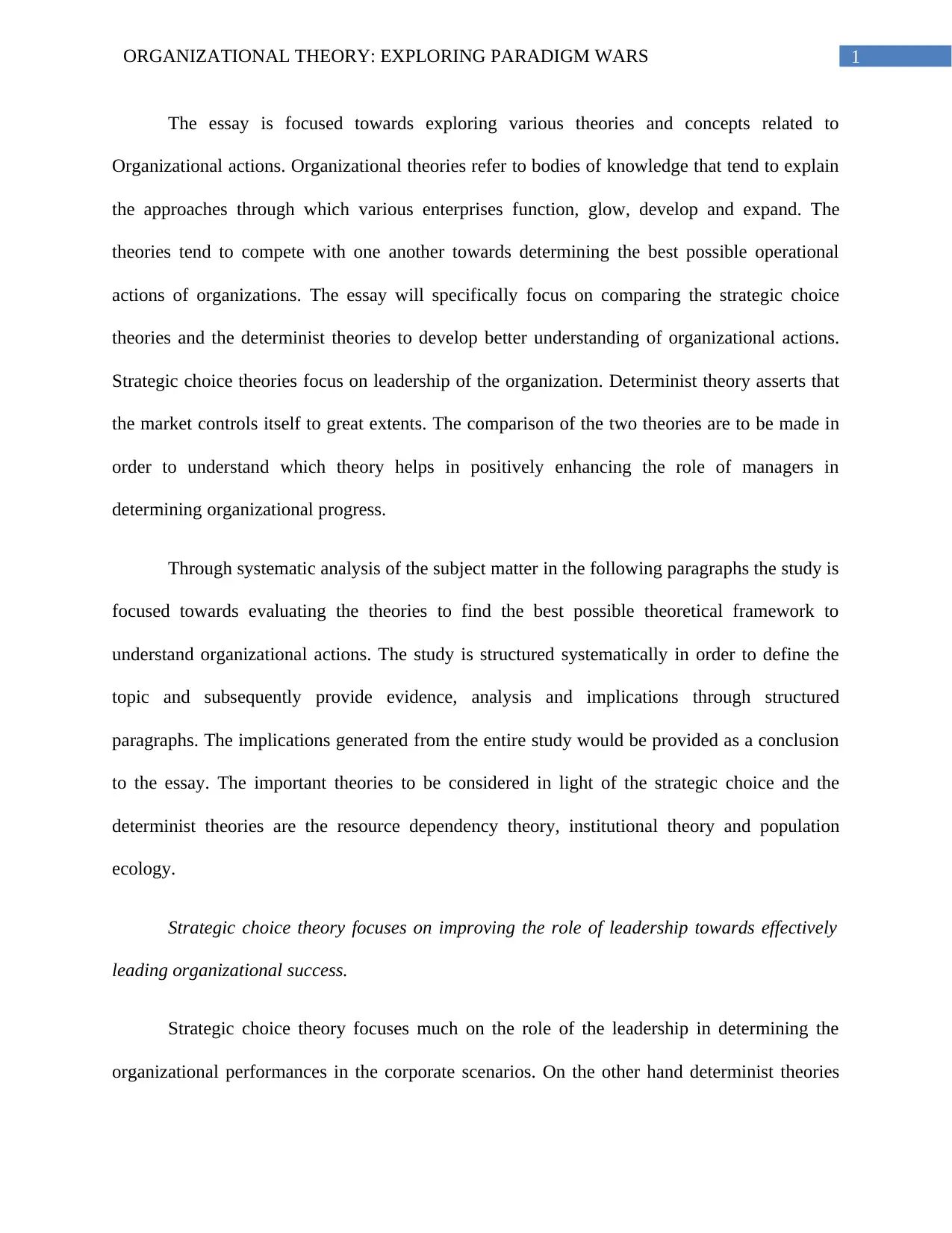
The essay is focused towards exploring various theories and concepts related to
Organizational actions. Organizational theories refer to bodies of knowledge that tend to explain
the approaches through which various enterprises function, glow, develop and expand. The
theories tend to compete with one another towards determining the best possible operational
actions of organizations. The essay will specifically focus on comparing the strategic choice
theories and the determinist theories to develop better understanding of organizational actions.
Strategic choice theories focus on leadership of the organization. Determinist theory asserts that
the market controls itself to great extents. The comparison of the two theories are to be made in
order to understand which theory helps in positively enhancing the role of managers in
determining organizational progress.
Through systematic analysis of the subject matter in the following paragraphs the study is
focused towards evaluating the theories to find the best possible theoretical framework to
understand organizational actions. The study is structured systematically in order to define the
topic and subsequently provide evidence, analysis and implications through structured
paragraphs. The implications generated from the entire study would be provided as a conclusion
to the essay. The important theories to be considered in light of the strategic choice and the
determinist theories are the resource dependency theory, institutional theory and population
ecology.
Strategic choice theory focuses on improving the role of leadership towards effectively
leading organizational success.
Strategic choice theory focuses much on the role of the leadership in determining the
organizational performances in the corporate scenarios. On the other hand determinist theories
The essay is focused towards exploring various theories and concepts related to
Organizational actions. Organizational theories refer to bodies of knowledge that tend to explain
the approaches through which various enterprises function, glow, develop and expand. The
theories tend to compete with one another towards determining the best possible operational
actions of organizations. The essay will specifically focus on comparing the strategic choice
theories and the determinist theories to develop better understanding of organizational actions.
Strategic choice theories focus on leadership of the organization. Determinist theory asserts that
the market controls itself to great extents. The comparison of the two theories are to be made in
order to understand which theory helps in positively enhancing the role of managers in
determining organizational progress.
Through systematic analysis of the subject matter in the following paragraphs the study is
focused towards evaluating the theories to find the best possible theoretical framework to
understand organizational actions. The study is structured systematically in order to define the
topic and subsequently provide evidence, analysis and implications through structured
paragraphs. The implications generated from the entire study would be provided as a conclusion
to the essay. The important theories to be considered in light of the strategic choice and the
determinist theories are the resource dependency theory, institutional theory and population
ecology.
Strategic choice theory focuses on improving the role of leadership towards effectively
leading organizational success.
Strategic choice theory focuses much on the role of the leadership in determining the
organizational performances in the corporate scenarios. On the other hand determinist theories
2ORGANIZATIONAL THEORY: EXPLORING PARADIGM WARS
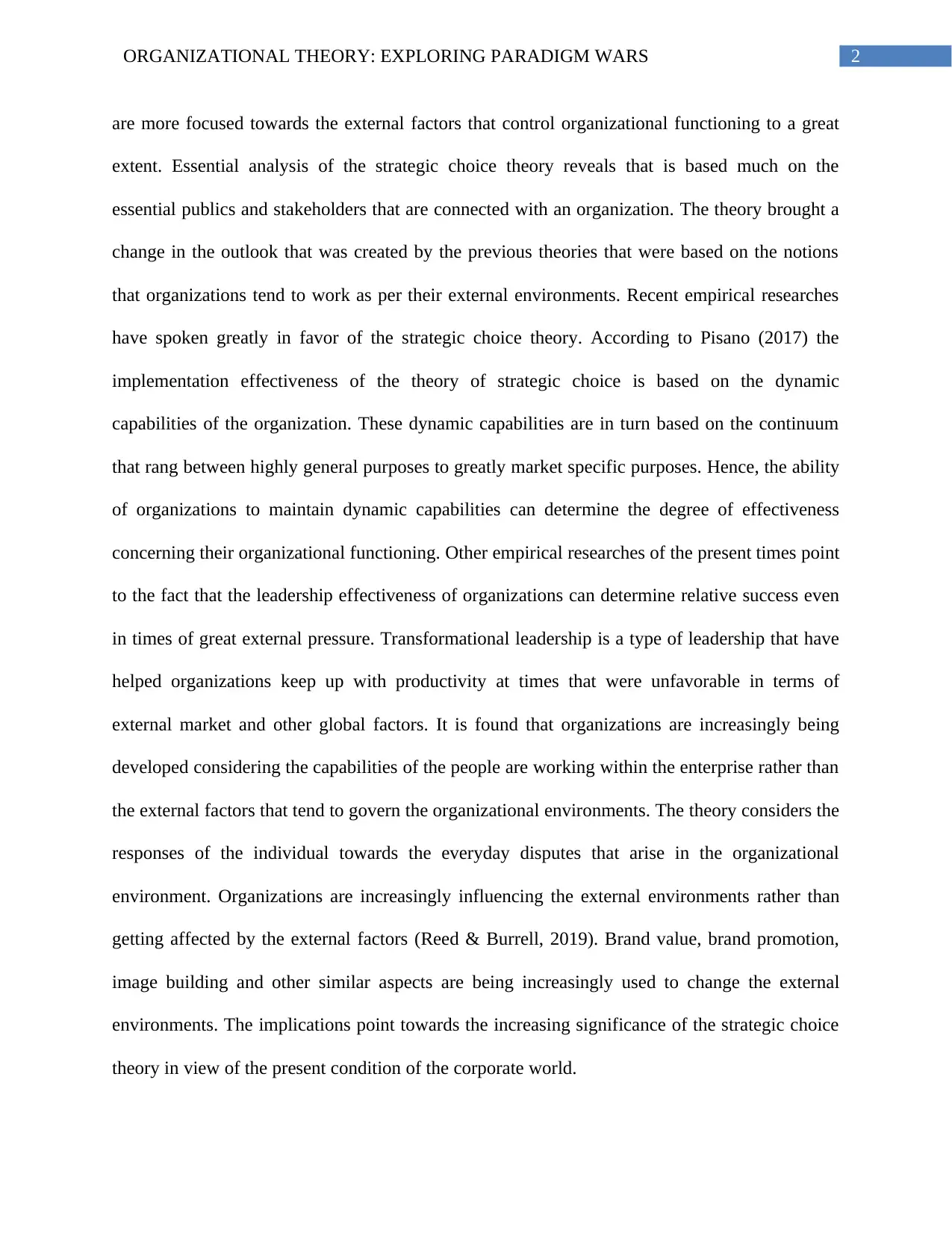
are more focused towards the external factors that control organizational functioning to a great
extent. Essential analysis of the strategic choice theory reveals that is based much on the
essential publics and stakeholders that are connected with an organization. The theory brought a
change in the outlook that was created by the previous theories that were based on the notions
that organizations tend to work as per their external environments. Recent empirical researches
have spoken greatly in favor of the strategic choice theory. According to Pisano (2017) the
implementation effectiveness of the theory of strategic choice is based on the dynamic
capabilities of the organization. These dynamic capabilities are in turn based on the continuum
that rang between highly general purposes to greatly market specific purposes. Hence, the ability
of organizations to maintain dynamic capabilities can determine the degree of effectiveness
concerning their organizational functioning. Other empirical researches of the present times point
to the fact that the leadership effectiveness of organizations can determine relative success even
in times of great external pressure. Transformational leadership is a type of leadership that have
helped organizations keep up with productivity at times that were unfavorable in terms of
external market and other global factors. It is found that organizations are increasingly being
developed considering the capabilities of the people are working within the enterprise rather than
the external factors that tend to govern the organizational environments. The theory considers the
responses of the individual towards the everyday disputes that arise in the organizational
environment. Organizations are increasingly influencing the external environments rather than
getting affected by the external factors (Reed & Burrell, 2019). Brand value, brand promotion,
image building and other similar aspects are being increasingly used to change the external
environments. The implications point towards the increasing significance of the strategic choice
theory in view of the present condition of the corporate world.
are more focused towards the external factors that control organizational functioning to a great
extent. Essential analysis of the strategic choice theory reveals that is based much on the
essential publics and stakeholders that are connected with an organization. The theory brought a
change in the outlook that was created by the previous theories that were based on the notions
that organizations tend to work as per their external environments. Recent empirical researches
have spoken greatly in favor of the strategic choice theory. According to Pisano (2017) the
implementation effectiveness of the theory of strategic choice is based on the dynamic
capabilities of the organization. These dynamic capabilities are in turn based on the continuum
that rang between highly general purposes to greatly market specific purposes. Hence, the ability
of organizations to maintain dynamic capabilities can determine the degree of effectiveness
concerning their organizational functioning. Other empirical researches of the present times point
to the fact that the leadership effectiveness of organizations can determine relative success even
in times of great external pressure. Transformational leadership is a type of leadership that have
helped organizations keep up with productivity at times that were unfavorable in terms of
external market and other global factors. It is found that organizations are increasingly being
developed considering the capabilities of the people are working within the enterprise rather than
the external factors that tend to govern the organizational environments. The theory considers the
responses of the individual towards the everyday disputes that arise in the organizational
environment. Organizations are increasingly influencing the external environments rather than
getting affected by the external factors (Reed & Burrell, 2019). Brand value, brand promotion,
image building and other similar aspects are being increasingly used to change the external
environments. The implications point towards the increasing significance of the strategic choice
theory in view of the present condition of the corporate world.
⊘ This is a preview!⊘
Do you want full access?
Subscribe today to unlock all pages.

Trusted by 1+ million students worldwide
3ORGANIZATIONAL THEORY: EXPLORING PARADIGM WARS
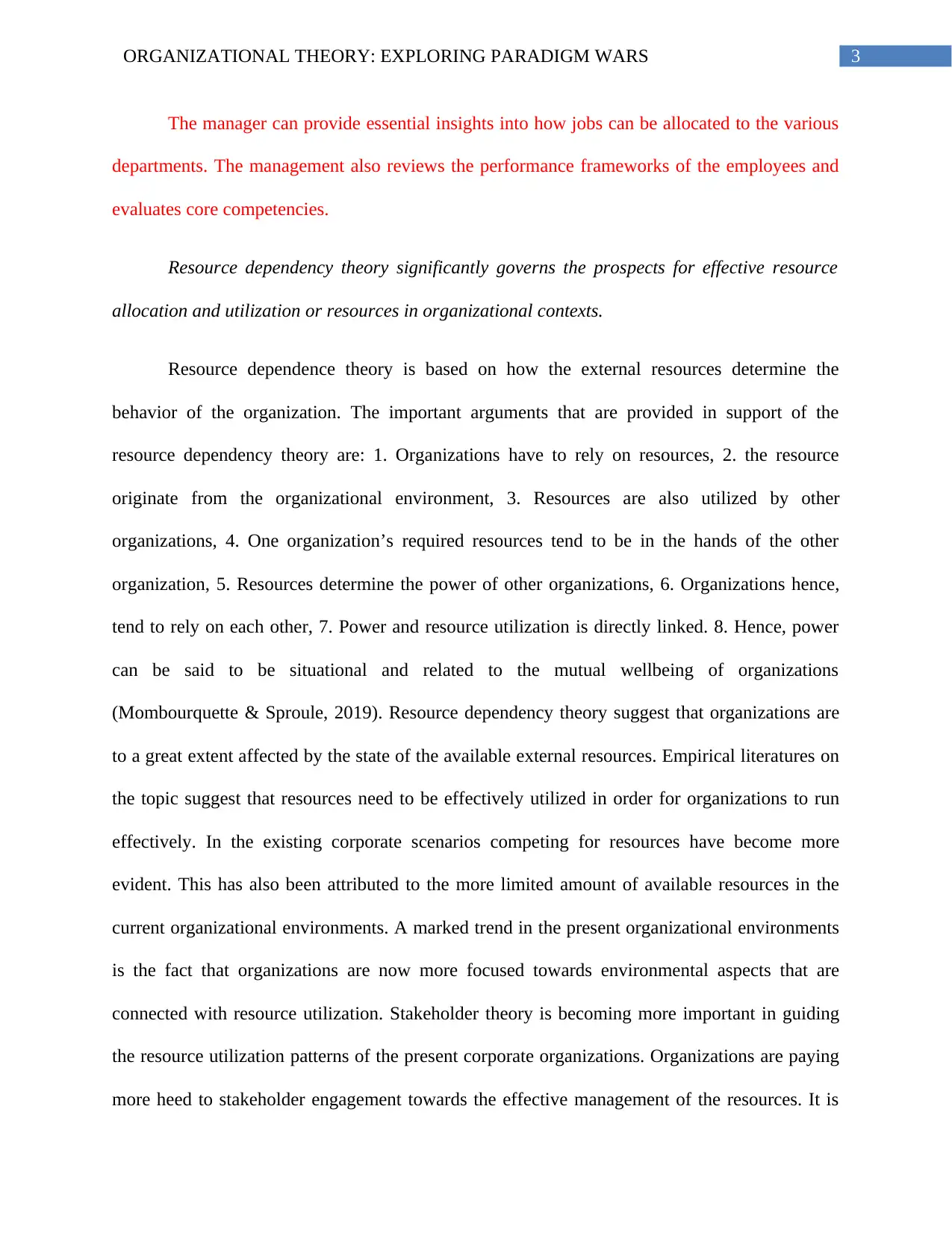
The manager can provide essential insights into how jobs can be allocated to the various
departments. The management also reviews the performance frameworks of the employees and
evaluates core competencies.
Resource dependency theory significantly governs the prospects for effective resource
allocation and utilization or resources in organizational contexts.
Resource dependence theory is based on how the external resources determine the
behavior of the organization. The important arguments that are provided in support of the
resource dependency theory are: 1. Organizations have to rely on resources, 2. the resource
originate from the organizational environment, 3. Resources are also utilized by other
organizations, 4. One organization’s required resources tend to be in the hands of the other
organization, 5. Resources determine the power of other organizations, 6. Organizations hence,
tend to rely on each other, 7. Power and resource utilization is directly linked. 8. Hence, power
can be said to be situational and related to the mutual wellbeing of organizations
(Mombourquette & Sproule, 2019). Resource dependency theory suggest that organizations are
to a great extent affected by the state of the available external resources. Empirical literatures on
the topic suggest that resources need to be effectively utilized in order for organizations to run
effectively. In the existing corporate scenarios competing for resources have become more
evident. This has also been attributed to the more limited amount of available resources in the
current organizational environments. A marked trend in the present organizational environments
is the fact that organizations are now more focused towards environmental aspects that are
connected with resource utilization. Stakeholder theory is becoming more important in guiding
the resource utilization patterns of the present corporate organizations. Organizations are paying
more heed to stakeholder engagement towards the effective management of the resources. It is
The manager can provide essential insights into how jobs can be allocated to the various
departments. The management also reviews the performance frameworks of the employees and
evaluates core competencies.
Resource dependency theory significantly governs the prospects for effective resource
allocation and utilization or resources in organizational contexts.
Resource dependence theory is based on how the external resources determine the
behavior of the organization. The important arguments that are provided in support of the
resource dependency theory are: 1. Organizations have to rely on resources, 2. the resource
originate from the organizational environment, 3. Resources are also utilized by other
organizations, 4. One organization’s required resources tend to be in the hands of the other
organization, 5. Resources determine the power of other organizations, 6. Organizations hence,
tend to rely on each other, 7. Power and resource utilization is directly linked. 8. Hence, power
can be said to be situational and related to the mutual wellbeing of organizations
(Mombourquette & Sproule, 2019). Resource dependency theory suggest that organizations are
to a great extent affected by the state of the available external resources. Empirical literatures on
the topic suggest that resources need to be effectively utilized in order for organizations to run
effectively. In the existing corporate scenarios competing for resources have become more
evident. This has also been attributed to the more limited amount of available resources in the
current organizational environments. A marked trend in the present organizational environments
is the fact that organizations are now more focused towards environmental aspects that are
connected with resource utilization. Stakeholder theory is becoming more important in guiding
the resource utilization patterns of the present corporate organizations. Organizations are paying
more heed to stakeholder engagement towards the effective management of the resources. It is
Paraphrase This Document
Need a fresh take? Get an instant paraphrase of this document with our AI Paraphraser
4ORGANIZATIONAL THEORY: EXPLORING PARADIGM WARS
important to understand that organizations in present corporate scenarios tend to also use IT
systems like ERP that help them to effectively plan their resource allocation. That help them to
utilize resources better as the stakeholders are always focused towards working in mutually
beneficial ways. It is interesting to note that resource management has become a more
channelized and multifaceted functions of organizations. Organizations tend to be more rigorous
in the resource management practices by getting into important partnerships with a large number
of similar organizations. The implications point to a shift towards more coordinated and
cooperative resource management systems optimized further through technology usage.
The managers assign and allocate tasks based on the resources that are available.
Institutional theory can guide the performances of organizations in the present corporate
scenarios
Institutional theory of organization proposes that organizations are constantly affected by
normative pressures from the outside forces. The factors such as the government rules, legal
dimensions, routines and norms tend to greatly affect the organizational development of various
enterprises. This affects the development of the organizations and at times leads to the
mismanagement of the organizational functions. The institutional factors are much complex to
understand. These factors range from relation systems, routines and many other factors. In
accordance with the theory organizations need to conform to some important belief systems that
affect their environment. Both procedural and structural institutional isomorphism earns
legitimacy for any organizations. Factors like social, economic and political, in accordance with
the theory affect the performances of the organizations. The institutional theory of organization
is an important part of the determinist theories. Recently, many organizations have found
important to understand that organizations in present corporate scenarios tend to also use IT
systems like ERP that help them to effectively plan their resource allocation. That help them to
utilize resources better as the stakeholders are always focused towards working in mutually
beneficial ways. It is interesting to note that resource management has become a more
channelized and multifaceted functions of organizations. Organizations tend to be more rigorous
in the resource management practices by getting into important partnerships with a large number
of similar organizations. The implications point to a shift towards more coordinated and
cooperative resource management systems optimized further through technology usage.
The managers assign and allocate tasks based on the resources that are available.
Institutional theory can guide the performances of organizations in the present corporate
scenarios
Institutional theory of organization proposes that organizations are constantly affected by
normative pressures from the outside forces. The factors such as the government rules, legal
dimensions, routines and norms tend to greatly affect the organizational development of various
enterprises. This affects the development of the organizations and at times leads to the
mismanagement of the organizational functions. The institutional factors are much complex to
understand. These factors range from relation systems, routines and many other factors. In
accordance with the theory organizations need to conform to some important belief systems that
affect their environment. Both procedural and structural institutional isomorphism earns
legitimacy for any organizations. Factors like social, economic and political, in accordance with
the theory affect the performances of the organizations. The institutional theory of organization
is an important part of the determinist theories. Recently, many organizations have found
5ORGANIZATIONAL THEORY: EXPLORING PARADIGM WARS
themselves engrossed in legal issues. These have greatly contributed to lower levels of
performances of the organizations. Political and social factors tend to affect organizations in
varied frequencies and volumes. This essentially depends on the amount of political and
economic stability in a given area or country where an organization is operating. Organizations
tend to become more influenced by the political or socio-economic factors depending on their
corporate positions (Lok & Willmott, 2018). Increasingly political agendas have come to be
associated with large corporations. In some cases mutually beneficial relationships are created
between governments and enterprises. It has also been found that organizations that are owned
by the leadership rooted in the same culture as the society perform well and tend to manage its
global organization through the culture of its base country. The implications point to the fact that
the institutional theory can essentially determine the level of performance that an organization
can provide in the market. This helps to form proper notions about succeeding in given social,
political, economic and other dimensions of the organizational environment.
The managers have to form strategies taking into consideration the society and politics of
the place where the organization operates.
Population ecology theory determines the factors that govern the people and
sustainability of organizations
The theory of population ecology of organizations or the organizational ecology theory is
another significant branch of the Deterministic theory. According to this theory, the
organizational ecology is determined through the essential consideration of economics, biology
and sociology. The insights from these subjects are utilized towards the formation of statistical
analysis of the conditions that surround companies. The ecology of population is divided into
themselves engrossed in legal issues. These have greatly contributed to lower levels of
performances of the organizations. Political and social factors tend to affect organizations in
varied frequencies and volumes. This essentially depends on the amount of political and
economic stability in a given area or country where an organization is operating. Organizations
tend to become more influenced by the political or socio-economic factors depending on their
corporate positions (Lok & Willmott, 2018). Increasingly political agendas have come to be
associated with large corporations. In some cases mutually beneficial relationships are created
between governments and enterprises. It has also been found that organizations that are owned
by the leadership rooted in the same culture as the society perform well and tend to manage its
global organization through the culture of its base country. The implications point to the fact that
the institutional theory can essentially determine the level of performance that an organization
can provide in the market. This helps to form proper notions about succeeding in given social,
political, economic and other dimensions of the organizational environment.
The managers have to form strategies taking into consideration the society and politics of
the place where the organization operates.
Population ecology theory determines the factors that govern the people and
sustainability of organizations
The theory of population ecology of organizations or the organizational ecology theory is
another significant branch of the Deterministic theory. According to this theory, the
organizational ecology is determined through the essential consideration of economics, biology
and sociology. The insights from these subjects are utilized towards the formation of statistical
analysis of the conditions that surround companies. The ecology of population is divided into
⊘ This is a preview!⊘
Do you want full access?
Subscribe today to unlock all pages.
Trusted by 1+ million students worldwide
6ORGANIZATIONAL THEORY: EXPLORING PARADIGM WARS
three essential levels. The level of community, the level of population and the level of
organization. The community considers the local interacting populations. The population refers
to the other organization that engage in same activities as a given organization (Lomnicki, 2018).
The level of organization considers organizations individually. All these factors tend to affect
organizations. It affects the rate of creation, rates of organizational demise and rates of
organizational change of form. All te levels are considered important for an organizational
process. This process helps to understand the actions of organizations. In recent times
organizational sustainability is considered an essential aspect that can be improved through this
theory. Organizations are engaging more in interactive processes with their surrounding
environments. This means that the organizational processes are being optimized in accordance
with the required changes that are needed to enhance all the three identified factors towards
improving their long term growth. The theory has contributed towards a holistic understanding of
the organizational environment. It needs to be said that organizations have increasingly worked
towards improving their CSR activities in relation to the theory. Companies have come forward
to take better care of their publics to improve this activity. The implications of the population
ecology theory point to the fact that the larger ecological concepts that encompass the
communities, organizational systems and the internal systems within which organizations
operate are increasingly affecting the ways in which they approach their organizational actions
(Lomnicki, 2018). It is important for further enhancing organizational performances.
The manager assigns job roles based on the sustainability value in the future of the
organization.
Strategic choice theory provides better edge over the deterministic theory
three essential levels. The level of community, the level of population and the level of
organization. The community considers the local interacting populations. The population refers
to the other organization that engage in same activities as a given organization (Lomnicki, 2018).
The level of organization considers organizations individually. All these factors tend to affect
organizations. It affects the rate of creation, rates of organizational demise and rates of
organizational change of form. All te levels are considered important for an organizational
process. This process helps to understand the actions of organizations. In recent times
organizational sustainability is considered an essential aspect that can be improved through this
theory. Organizations are engaging more in interactive processes with their surrounding
environments. This means that the organizational processes are being optimized in accordance
with the required changes that are needed to enhance all the three identified factors towards
improving their long term growth. The theory has contributed towards a holistic understanding of
the organizational environment. It needs to be said that organizations have increasingly worked
towards improving their CSR activities in relation to the theory. Companies have come forward
to take better care of their publics to improve this activity. The implications of the population
ecology theory point to the fact that the larger ecological concepts that encompass the
communities, organizational systems and the internal systems within which organizations
operate are increasingly affecting the ways in which they approach their organizational actions
(Lomnicki, 2018). It is important for further enhancing organizational performances.
The manager assigns job roles based on the sustainability value in the future of the
organization.
Strategic choice theory provides better edge over the deterministic theory
Paraphrase This Document
Need a fresh take? Get an instant paraphrase of this document with our AI Paraphraser
7ORGANIZATIONAL THEORY: EXPLORING PARADIGM WARS
It can be said that Strategic Choice theory is becoming increasingly relevant despite the
various factors that are present in regards to the deterministic structures of contemporary
organizations. All the significant factors that were identified in regards to the various
deterministic theories like the resource dependency theory, institutional theory and population
ecology point towards the fact that organizational effectiveness can help to enhance the
identified factors. It should be understood that without proper internal optimization, the
organization cannot tackle the outward forces that affect the operations of any company.
Strategic choice theory has been more preferred in organizational contexts than the other
theories. This is because the same has been effective in determining the roles of the leaders on
the basis of improving the prospects of the organization in view of the external environments that
are present. Organizations presently focus on controlling the external market factor. As an
example it can be said that a better stakeholder and supplier network creation can help
organizations tackle the availability for resources. Organizations are creating market demands for
products through effective brand promotion exercises. Additionally, organizational structures are
being created in innovative approaches. These approaches are actually helping organizations
tackle even rapidly changing market environments. Hence, factors such as organizational
sustainability, ecology or political issues are not able to govern organizational environments
(Mombourquette & Sproule, 2019). Better availability and utilization of information with the
help of ICTs, ERM and other similar IT infrastructures help organizations to perform better even
in formidable external environments (Wu, Straub & Liang, 2015). The implications point
towards the fact that the strategic choice theory is more compelling than the determinist theory.
This is because this approach helps organizations to plan and implement their organizational
actions in better ways.
It can be said that Strategic Choice theory is becoming increasingly relevant despite the
various factors that are present in regards to the deterministic structures of contemporary
organizations. All the significant factors that were identified in regards to the various
deterministic theories like the resource dependency theory, institutional theory and population
ecology point towards the fact that organizational effectiveness can help to enhance the
identified factors. It should be understood that without proper internal optimization, the
organization cannot tackle the outward forces that affect the operations of any company.
Strategic choice theory has been more preferred in organizational contexts than the other
theories. This is because the same has been effective in determining the roles of the leaders on
the basis of improving the prospects of the organization in view of the external environments that
are present. Organizations presently focus on controlling the external market factor. As an
example it can be said that a better stakeholder and supplier network creation can help
organizations tackle the availability for resources. Organizations are creating market demands for
products through effective brand promotion exercises. Additionally, organizational structures are
being created in innovative approaches. These approaches are actually helping organizations
tackle even rapidly changing market environments. Hence, factors such as organizational
sustainability, ecology or political issues are not able to govern organizational environments
(Mombourquette & Sproule, 2019). Better availability and utilization of information with the
help of ICTs, ERM and other similar IT infrastructures help organizations to perform better even
in formidable external environments (Wu, Straub & Liang, 2015). The implications point
towards the fact that the strategic choice theory is more compelling than the determinist theory.
This is because this approach helps organizations to plan and implement their organizational
actions in better ways.
8ORGANIZATIONAL THEORY: EXPLORING PARADIGM WARS
Strategic choice theory helps the managers to better utilize the potential of the employees
towards achieving targets.
In conclusion, it can be said that the four theories have contributed effectively towards
the greater understanding of the organizational actions. The determinist theories and the strategic
action theories both help towards the essential integration of the organizational processes.
However, strategic choice helps to plan better and take precautionary actions against future
market challenges. Strategic choice theory helps to form essential leadership roles in terms of
capabilities. Resource dependency theory was found to govern the stakeholders and essential
resource cooperation among organizations. The institutional theory was found to define the
relationships between the government, society and the organization. Population ecology was
found to be a factor that can govern the long term sustainable growth of organization
(Mombourquette & Sproule, 2019). It can be said that in the era of global corporate
organizations the ever stronger strategic choice theory can help to better understand the
organizational actions.
Strategic choice theory helps the managers to better utilize the potential of the employees
towards achieving targets.
In conclusion, it can be said that the four theories have contributed effectively towards
the greater understanding of the organizational actions. The determinist theories and the strategic
action theories both help towards the essential integration of the organizational processes.
However, strategic choice helps to plan better and take precautionary actions against future
market challenges. Strategic choice theory helps to form essential leadership roles in terms of
capabilities. Resource dependency theory was found to govern the stakeholders and essential
resource cooperation among organizations. The institutional theory was found to define the
relationships between the government, society and the organization. Population ecology was
found to be a factor that can govern the long term sustainable growth of organization
(Mombourquette & Sproule, 2019). It can be said that in the era of global corporate
organizations the ever stronger strategic choice theory can help to better understand the
organizational actions.
⊘ This is a preview!⊘
Do you want full access?
Subscribe today to unlock all pages.
Trusted by 1+ million students worldwide
9ORGANIZATIONAL THEORY: EXPLORING PARADIGM WARS
References
Deci, E. L., Olafsen, A. H., & Ryan, R. M. (2017). Self-determination theory in work
organizations: The state of a science. Annual Review of Organizational Psychology and
Organizational Behavior, 4, 19-43.
Gond, J. P., Cabantous, L., Harding, N., & Learmonth, M. (2016). What do we mean by
performativity in organizational and management theory? The uses and abuses of
performativity. International Journal of Management Reviews, 18(4), 440-463.
Hsu, C. C., Tan, K. C., & Mohamad Zailani, S. H. (2016). Strategic orientations, sustainable
supply chain initiatives, and reverse logistics: Empirical evidence from an emerging
market. International Journal of Operations & Production Management, 36(1), 86-110.
Lok, J., & Willmott, H. (2018). Embedded Agency in Institutional Theory: Problem or
Paradox?. Academy of Management Review, (ja).
Lomnicki, A. (2018). Population ecology from the individual perspective. In Individual-based
models and approaches in ecology (pp. 3-17). Chapman and Hall/CRC.
Mombourquette, C. P., & Sproule, L. (2019). Review of Scott Eacott’s book Beyond Leadership:
A Relational Approach to Organizational Theory in Education. Canadian Journal of
Educational Administration and Policy, (188).
Pisano, G. P. (2017). Toward a prescriptive theory of dynamic capabilities: connecting strategic
choice, learning, and competition. Industrial and Corporate Change, 26(5), 747-762.
References
Deci, E. L., Olafsen, A. H., & Ryan, R. M. (2017). Self-determination theory in work
organizations: The state of a science. Annual Review of Organizational Psychology and
Organizational Behavior, 4, 19-43.
Gond, J. P., Cabantous, L., Harding, N., & Learmonth, M. (2016). What do we mean by
performativity in organizational and management theory? The uses and abuses of
performativity. International Journal of Management Reviews, 18(4), 440-463.
Hsu, C. C., Tan, K. C., & Mohamad Zailani, S. H. (2016). Strategic orientations, sustainable
supply chain initiatives, and reverse logistics: Empirical evidence from an emerging
market. International Journal of Operations & Production Management, 36(1), 86-110.
Lok, J., & Willmott, H. (2018). Embedded Agency in Institutional Theory: Problem or
Paradox?. Academy of Management Review, (ja).
Lomnicki, A. (2018). Population ecology from the individual perspective. In Individual-based
models and approaches in ecology (pp. 3-17). Chapman and Hall/CRC.
Mombourquette, C. P., & Sproule, L. (2019). Review of Scott Eacott’s book Beyond Leadership:
A Relational Approach to Organizational Theory in Education. Canadian Journal of
Educational Administration and Policy, (188).
Pisano, G. P. (2017). Toward a prescriptive theory of dynamic capabilities: connecting strategic
choice, learning, and competition. Industrial and Corporate Change, 26(5), 747-762.
Paraphrase This Document
Need a fresh take? Get an instant paraphrase of this document with our AI Paraphraser
10ORGANIZATIONAL THEORY: EXPLORING PARADIGM WARS
Reed, M., & Burrell, G. (2019). Theory and organization studies: The need for
contestation. Organization Studies, 40(1), 39-54.
Wu, S. P. J., Straub, D. W., & Liang, T. P. (2015). How information technology governance
mechanisms and strategic alignment influence organizational performance: Insights from
a matched survey of business and IT managers. Mis Quarterly, 39(2), 497-518.
Reed, M., & Burrell, G. (2019). Theory and organization studies: The need for
contestation. Organization Studies, 40(1), 39-54.
Wu, S. P. J., Straub, D. W., & Liang, T. P. (2015). How information technology governance
mechanisms and strategic alignment influence organizational performance: Insights from
a matched survey of business and IT managers. Mis Quarterly, 39(2), 497-518.

1 out of 11


Related Documents


Your All-in-One AI-Powered Toolkit for Academic Success.
+13062052269
info@desklib.com
Available 24*7 on WhatsApp / Email
![[object Object]](/_next/static/media/star-bottom.7253800d.svg)
Unlock your academic potential
Copyright © 2020–2026 A2Z Services. All Rights Reserved. Developed and managed by ZUCOL.