Organization Behaviour: Performance Management Analysis and Solutions
VerifiedAdded on 2023/06/11
|7
|1487
|327
Essay
AI Summary
This essay analyzes the performance management strategies of a manufacturing company, focusing on the challenges posed by high employee turnover. The company relies on external recruitment, which, despite introducing new skills, leads to employee dissatisfaction and knowledge leakage to competitors. The essay explores workforce motivation theories and the benefits of internal recruitment, including increased employee engagement, loyalty, and productivity through training and promotion opportunities. It argues that adopting internal recruitment can address the company's turnover problem, enhance its competitive edge, and improve overall profitability by fostering a more motivated and stable workforce. The essay concludes that a shift towards internal recruitment, coupled with employee development initiatives, is crucial for the company's long-term success in a competitive market.

ORGANIZATION BEHAVIOUR
Student’s Name
Course
Date
Student’s Name
Course
Date
Paraphrase This Document
Need a fresh take? Get an instant paraphrase of this document with our AI Paraphraser

1
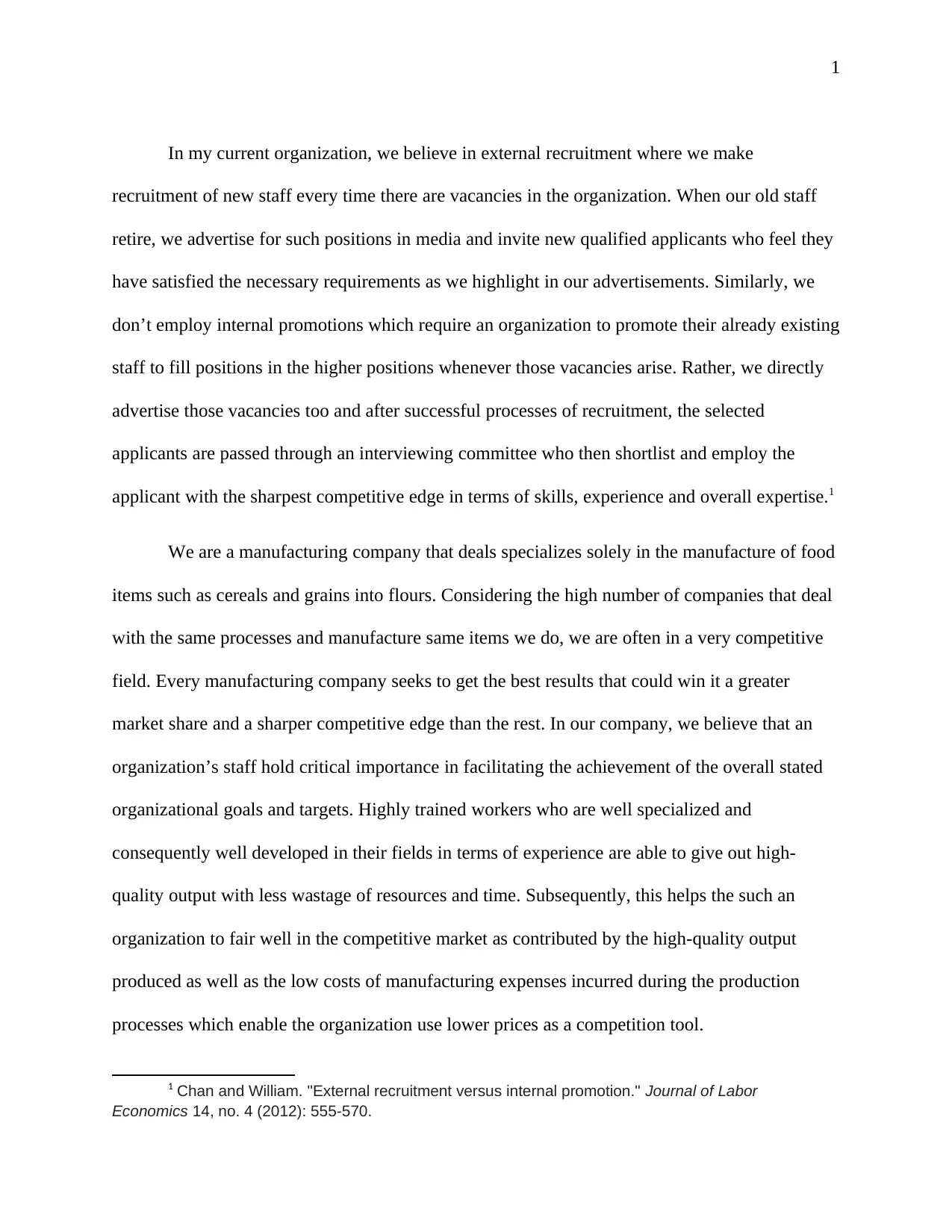
In my current organization, we believe in external recruitment where we make
recruitment of new staff every time there are vacancies in the organization. When our old staff
retire, we advertise for such positions in media and invite new qualified applicants who feel they
have satisfied the necessary requirements as we highlight in our advertisements. Similarly, we
don’t employ internal promotions which require an organization to promote their already existing
staff to fill positions in the higher positions whenever those vacancies arise. Rather, we directly
advertise those vacancies too and after successful processes of recruitment, the selected
applicants are passed through an interviewing committee who then shortlist and employ the
applicant with the sharpest competitive edge in terms of skills, experience and overall expertise.1
We are a manufacturing company that deals specializes solely in the manufacture of food
items such as cereals and grains into flours. Considering the high number of companies that deal
with the same processes and manufacture same items we do, we are often in a very competitive
field. Every manufacturing company seeks to get the best results that could win it a greater
market share and a sharper competitive edge than the rest. In our company, we believe that an
organization’s staff hold critical importance in facilitating the achievement of the overall stated
organizational goals and targets. Highly trained workers who are well specialized and
consequently well developed in their fields in terms of experience are able to give out high-
quality output with less wastage of resources and time. Subsequently, this helps the such an
organization to fair well in the competitive market as contributed by the high-quality output
produced as well as the low costs of manufacturing expenses incurred during the production
processes which enable the organization use lower prices as a competition tool.
1 Chan and William. "External recruitment versus internal promotion." Journal of Labor
Economics 14, no. 4 (2012): 555-570.
In my current organization, we believe in external recruitment where we make
recruitment of new staff every time there are vacancies in the organization. When our old staff
retire, we advertise for such positions in media and invite new qualified applicants who feel they
have satisfied the necessary requirements as we highlight in our advertisements. Similarly, we
don’t employ internal promotions which require an organization to promote their already existing
staff to fill positions in the higher positions whenever those vacancies arise. Rather, we directly
advertise those vacancies too and after successful processes of recruitment, the selected
applicants are passed through an interviewing committee who then shortlist and employ the
applicant with the sharpest competitive edge in terms of skills, experience and overall expertise.1
We are a manufacturing company that deals specializes solely in the manufacture of food
items such as cereals and grains into flours. Considering the high number of companies that deal
with the same processes and manufacture same items we do, we are often in a very competitive
field. Every manufacturing company seeks to get the best results that could win it a greater
market share and a sharper competitive edge than the rest. In our company, we believe that an
organization’s staff hold critical importance in facilitating the achievement of the overall stated
organizational goals and targets. Highly trained workers who are well specialized and
consequently well developed in their fields in terms of experience are able to give out high-
quality output with less wastage of resources and time. Subsequently, this helps the such an
organization to fair well in the competitive market as contributed by the high-quality output
produced as well as the low costs of manufacturing expenses incurred during the production
processes which enable the organization use lower prices as a competition tool.
1 Chan and William. "External recruitment versus internal promotion." Journal of Labor
Economics 14, no. 4 (2012): 555-570.

2
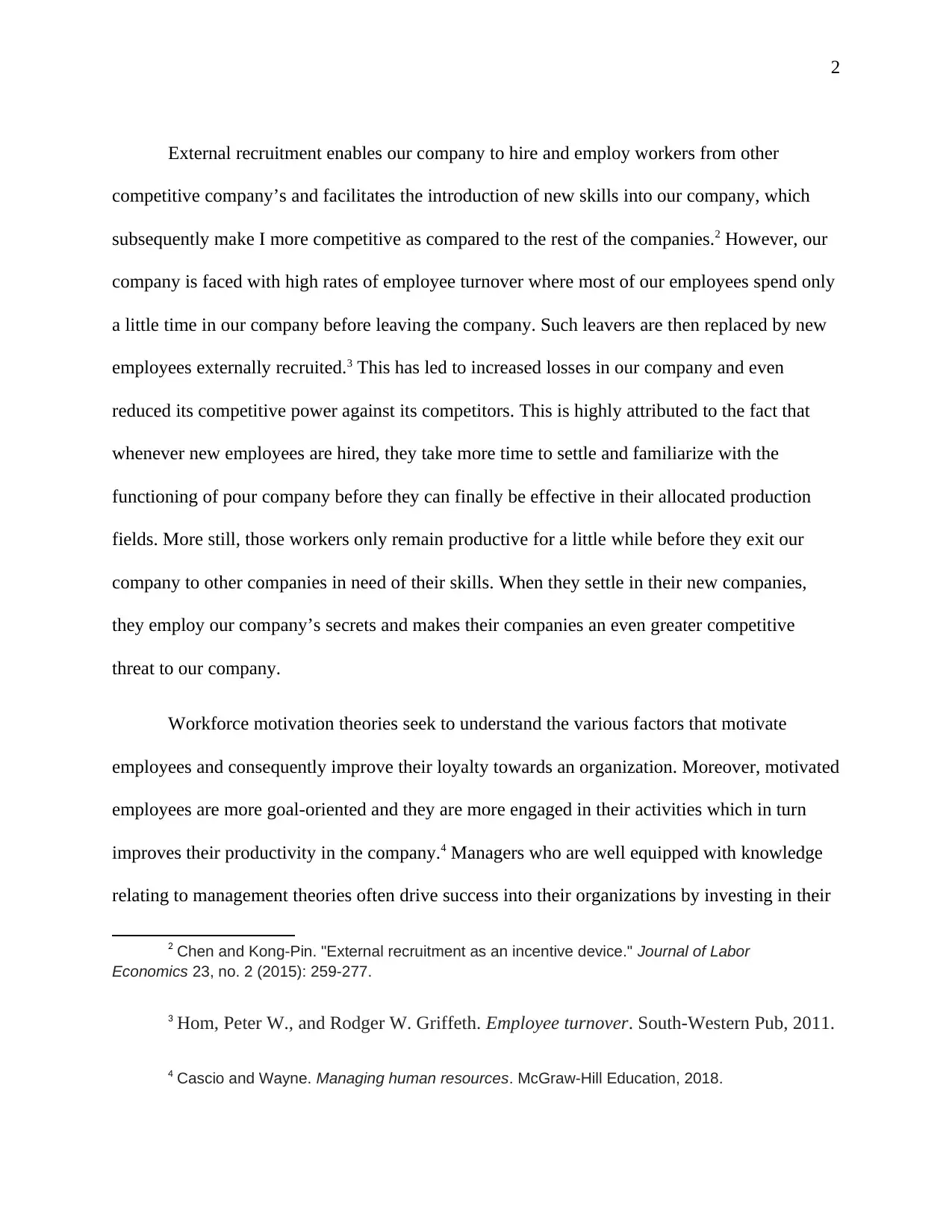
External recruitment enables our company to hire and employ workers from other
competitive company’s and facilitates the introduction of new skills into our company, which
subsequently make I more competitive as compared to the rest of the companies.2 However, our
company is faced with high rates of employee turnover where most of our employees spend only
a little time in our company before leaving the company. Such leavers are then replaced by new
employees externally recruited.3 This has led to increased losses in our company and even
reduced its competitive power against its competitors. This is highly attributed to the fact that
whenever new employees are hired, they take more time to settle and familiarize with the
functioning of pour company before they can finally be effective in their allocated production
fields. More still, those workers only remain productive for a little while before they exit our
company to other companies in need of their skills. When they settle in their new companies,
they employ our company’s secrets and makes their companies an even greater competitive
threat to our company.
Workforce motivation theories seek to understand the various factors that motivate
employees and consequently improve their loyalty towards an organization. Moreover, motivated
employees are more goal-oriented and they are more engaged in their activities which in turn
improves their productivity in the company.4 Managers who are well equipped with knowledge
relating to management theories often drive success into their organizations by investing in their
2 Chen and Kong-Pin. "External recruitment as an incentive device." Journal of Labor
Economics 23, no. 2 (2015): 259-277.
3 Hom, Peter W., and Rodger W. Griffeth. Employee turnover. South-Western Pub, 2011.
4 Cascio and Wayne. Managing human resources. McGraw-Hill Education, 2018.
External recruitment enables our company to hire and employ workers from other
competitive company’s and facilitates the introduction of new skills into our company, which
subsequently make I more competitive as compared to the rest of the companies.2 However, our
company is faced with high rates of employee turnover where most of our employees spend only
a little time in our company before leaving the company. Such leavers are then replaced by new
employees externally recruited.3 This has led to increased losses in our company and even
reduced its competitive power against its competitors. This is highly attributed to the fact that
whenever new employees are hired, they take more time to settle and familiarize with the
functioning of pour company before they can finally be effective in their allocated production
fields. More still, those workers only remain productive for a little while before they exit our
company to other companies in need of their skills. When they settle in their new companies,
they employ our company’s secrets and makes their companies an even greater competitive
threat to our company.
Workforce motivation theories seek to understand the various factors that motivate
employees and consequently improve their loyalty towards an organization. Moreover, motivated
employees are more goal-oriented and they are more engaged in their activities which in turn
improves their productivity in the company.4 Managers who are well equipped with knowledge
relating to management theories often drive success into their organizations by investing in their
2 Chen and Kong-Pin. "External recruitment as an incentive device." Journal of Labor
Economics 23, no. 2 (2015): 259-277.
3 Hom, Peter W., and Rodger W. Griffeth. Employee turnover. South-Western Pub, 2011.
4 Cascio and Wayne. Managing human resources. McGraw-Hill Education, 2018.
⊘ This is a preview!⊘
Do you want full access?
Subscribe today to unlock all pages.

Trusted by 1+ million students worldwide

3
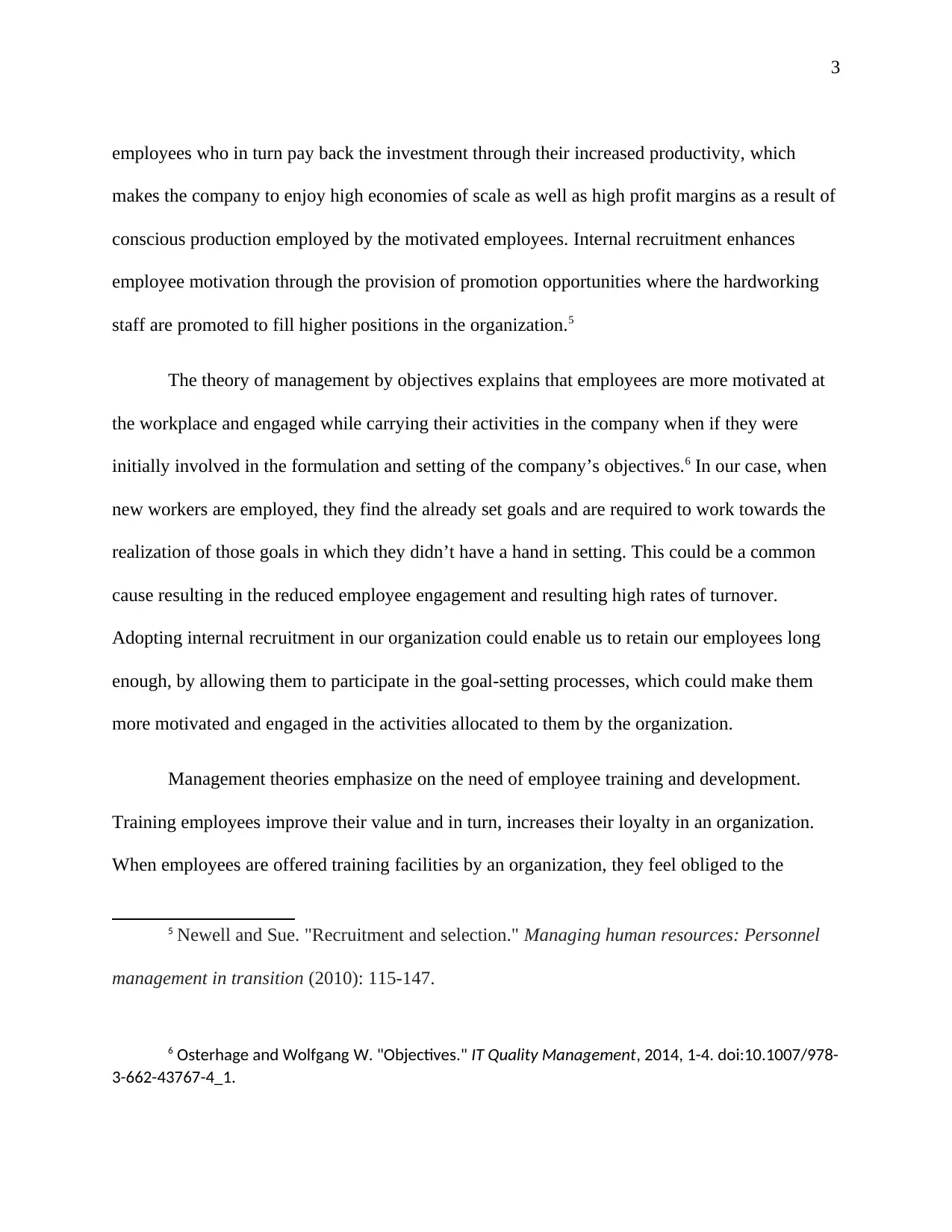
employees who in turn pay back the investment through their increased productivity, which
makes the company to enjoy high economies of scale as well as high profit margins as a result of
conscious production employed by the motivated employees. Internal recruitment enhances
employee motivation through the provision of promotion opportunities where the hardworking
staff are promoted to fill higher positions in the organization.5
The theory of management by objectives explains that employees are more motivated at
the workplace and engaged while carrying their activities in the company when if they were
initially involved in the formulation and setting of the company’s objectives.6 In our case, when
new workers are employed, they find the already set goals and are required to work towards the
realization of those goals in which they didn’t have a hand in setting. This could be a common
cause resulting in the reduced employee engagement and resulting high rates of turnover.
Adopting internal recruitment in our organization could enable us to retain our employees long
enough, by allowing them to participate in the goal-setting processes, which could make them
more motivated and engaged in the activities allocated to them by the organization.
Management theories emphasize on the need of employee training and development.
Training employees improve their value and in turn, increases their loyalty in an organization.
When employees are offered training facilities by an organization, they feel obliged to the
5 Newell and Sue. "Recruitment and selection." Managing human resources: Personnel
management in transition (2010): 115-147.
6 Osterhage and Wolfgang W. "Objectives." IT Quality Management, 2014, 1-4. doi:10.1007/978-
3-662-43767-4_1.
employees who in turn pay back the investment through their increased productivity, which
makes the company to enjoy high economies of scale as well as high profit margins as a result of
conscious production employed by the motivated employees. Internal recruitment enhances
employee motivation through the provision of promotion opportunities where the hardworking
staff are promoted to fill higher positions in the organization.5
The theory of management by objectives explains that employees are more motivated at
the workplace and engaged while carrying their activities in the company when if they were
initially involved in the formulation and setting of the company’s objectives.6 In our case, when
new workers are employed, they find the already set goals and are required to work towards the
realization of those goals in which they didn’t have a hand in setting. This could be a common
cause resulting in the reduced employee engagement and resulting high rates of turnover.
Adopting internal recruitment in our organization could enable us to retain our employees long
enough, by allowing them to participate in the goal-setting processes, which could make them
more motivated and engaged in the activities allocated to them by the organization.
Management theories emphasize on the need of employee training and development.
Training employees improve their value and in turn, increases their loyalty in an organization.
When employees are offered training facilities by an organization, they feel obliged to the
5 Newell and Sue. "Recruitment and selection." Managing human resources: Personnel
management in transition (2010): 115-147.
6 Osterhage and Wolfgang W. "Objectives." IT Quality Management, 2014, 1-4. doi:10.1007/978-
3-662-43767-4_1.
Paraphrase This Document
Need a fresh take? Get an instant paraphrase of this document with our AI Paraphraser

4
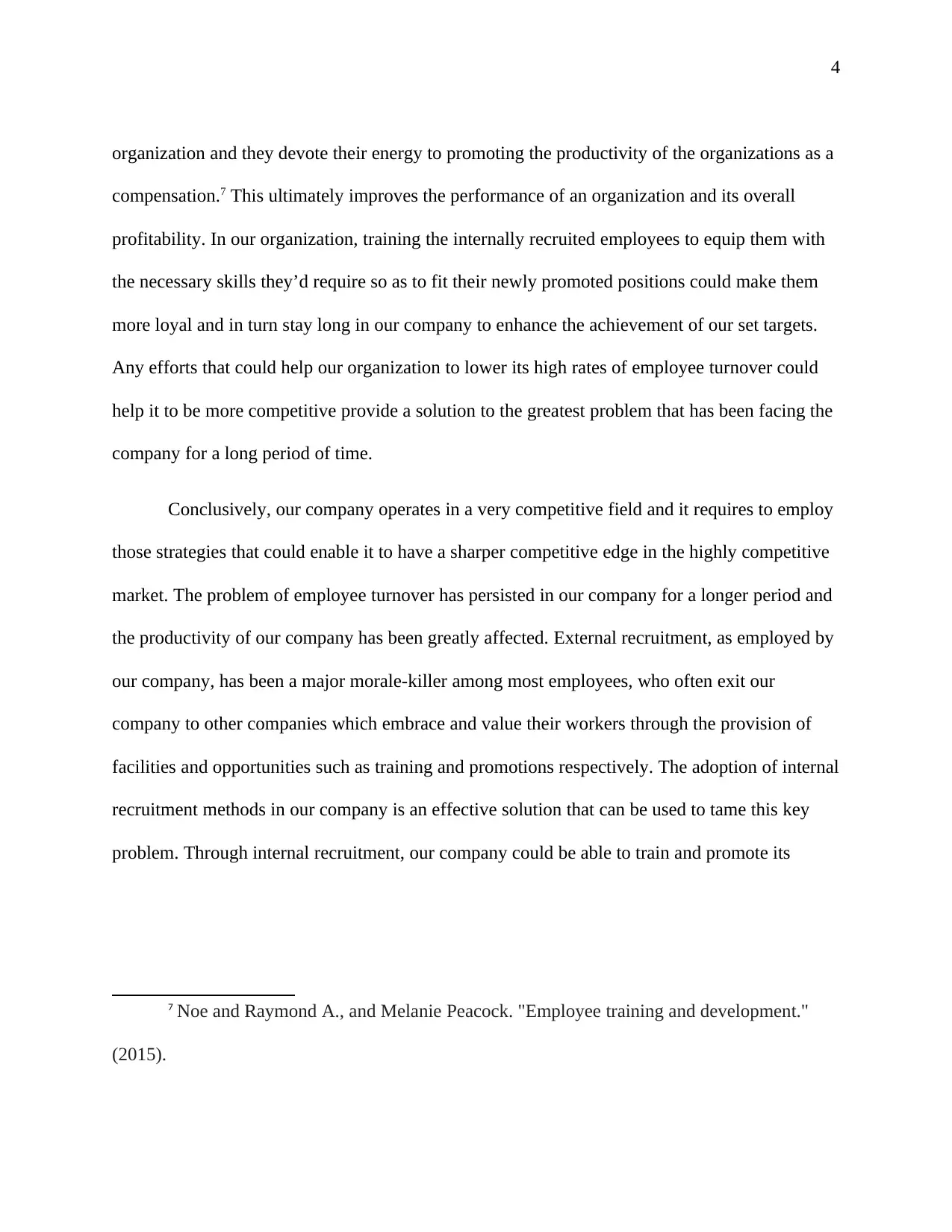
organization and they devote their energy to promoting the productivity of the organizations as a
compensation.7 This ultimately improves the performance of an organization and its overall
profitability. In our organization, training the internally recruited employees to equip them with
the necessary skills they’d require so as to fit their newly promoted positions could make them
more loyal and in turn stay long in our company to enhance the achievement of our set targets.
Any efforts that could help our organization to lower its high rates of employee turnover could
help it to be more competitive provide a solution to the greatest problem that has been facing the
company for a long period of time.
Conclusively, our company operates in a very competitive field and it requires to employ
those strategies that could enable it to have a sharper competitive edge in the highly competitive
market. The problem of employee turnover has persisted in our company for a longer period and
the productivity of our company has been greatly affected. External recruitment, as employed by
our company, has been a major morale-killer among most employees, who often exit our
company to other companies which embrace and value their workers through the provision of
facilities and opportunities such as training and promotions respectively. The adoption of internal
recruitment methods in our company is an effective solution that can be used to tame this key
problem. Through internal recruitment, our company could be able to train and promote its
7 Noe and Raymond A., and Melanie Peacock. "Employee training and development."
(2015).
organization and they devote their energy to promoting the productivity of the organizations as a
compensation.7 This ultimately improves the performance of an organization and its overall
profitability. In our organization, training the internally recruited employees to equip them with
the necessary skills they’d require so as to fit their newly promoted positions could make them
more loyal and in turn stay long in our company to enhance the achievement of our set targets.
Any efforts that could help our organization to lower its high rates of employee turnover could
help it to be more competitive provide a solution to the greatest problem that has been facing the
company for a long period of time.
Conclusively, our company operates in a very competitive field and it requires to employ
those strategies that could enable it to have a sharper competitive edge in the highly competitive
market. The problem of employee turnover has persisted in our company for a longer period and
the productivity of our company has been greatly affected. External recruitment, as employed by
our company, has been a major morale-killer among most employees, who often exit our
company to other companies which embrace and value their workers through the provision of
facilities and opportunities such as training and promotions respectively. The adoption of internal
recruitment methods in our company is an effective solution that can be used to tame this key
problem. Through internal recruitment, our company could be able to train and promote its
7 Noe and Raymond A., and Melanie Peacock. "Employee training and development."
(2015).

5
workers to fill higher organizations, thus improving their loyalty and making them to stay in the
organization so as to facilitate the achievement of our stated objectives.8
Bibliography
8 Doeringer, Peter B., and Michael J. Piore. Internal labor markets and manpower analysis. ME
Sharpe, 2012.
workers to fill higher organizations, thus improving their loyalty and making them to stay in the
organization so as to facilitate the achievement of our stated objectives.8
Bibliography
8 Doeringer, Peter B., and Michael J. Piore. Internal labor markets and manpower analysis. ME
Sharpe, 2012.
⊘ This is a preview!⊘
Do you want full access?
Subscribe today to unlock all pages.

Trusted by 1+ million students worldwide

6
Cascio, Wayne. Managing human resources. McGraw-Hill Education, 2018.
Chan, William. "External recruitment versus internal promotion." Journal of Labor
Economics 14, no. 4 (2012): 555-570.
Chen, Kong-Pin. "External recruitment as an incentive device." Journal of Labor Economics 23,
no. 2 (2015): 259-277.
Doeringer, Peter B., and Michael J. Piore. Internal labor markets and manpower analysis. ME
Sharpe, 2012.
Hom, Peter W., and Rodger W. Griffeth. Employee turnover. South-Western Pub, 2011.
Newell, Sue. "Recruitment and selection." Managing human resources: Personnel management
in transition (2010): 115-147.
Noe, Raymond A., and Melanie Peacock. "Employee training and development." (2015).
Osterhage, Wolfgang W. "Objectives." IT Quality Management, 2014, 1-4. doi:10.1007/978-3-
662-43767-4_1.
Cascio, Wayne. Managing human resources. McGraw-Hill Education, 2018.
Chan, William. "External recruitment versus internal promotion." Journal of Labor
Economics 14, no. 4 (2012): 555-570.
Chen, Kong-Pin. "External recruitment as an incentive device." Journal of Labor Economics 23,
no. 2 (2015): 259-277.
Doeringer, Peter B., and Michael J. Piore. Internal labor markets and manpower analysis. ME
Sharpe, 2012.
Hom, Peter W., and Rodger W. Griffeth. Employee turnover. South-Western Pub, 2011.
Newell, Sue. "Recruitment and selection." Managing human resources: Personnel management
in transition (2010): 115-147.
Noe, Raymond A., and Melanie Peacock. "Employee training and development." (2015).
Osterhage, Wolfgang W. "Objectives." IT Quality Management, 2014, 1-4. doi:10.1007/978-3-
662-43767-4_1.
1 out of 7
Related Documents
Your All-in-One AI-Powered Toolkit for Academic Success.
+13062052269
info@desklib.com
Available 24*7 on WhatsApp / Email
Unlock your academic potential
Copyright © 2020–2025 A2Z Services. All Rights Reserved. Developed and managed by ZUCOL.