Graduate School of Business: BUSM4590 People and Organizations Report
VerifiedAdded on 2022/09/30
|10
|2192
|175
Report
AI Summary
This report examines organizational structures, focusing on Mintzberg's five types (Entrepreneurial, Machine, Professional, Divisional, and Innovative), and analyzes the appropriateness of holacracy as a management strategy. It explores the impact of organizational structure on business operations, highlighting the suitability of holacracy for fast-changing environments. The report also discusses how HR managers can support employee psychological needs (autonomy, competence, and relatedness) using strategies like providing training, decision-making freedom, and fostering a diverse workplace. The analysis includes real-world examples and concludes with recommendations for effective people management within organizations, offering insights into how to improve organizational performance.

Running head: PEOPLE AND ORGANIZATIONS
People and Organizations
Name of the Student
Name of the University
Author’s Note
People and Organizations
Name of the Student
Name of the University
Author’s Note

Paraphrase This Document
Need a fresh take? Get an instant paraphrase of this document with our AI Paraphraser
1PEOPLE AND ORGANIZATIONS
Executive Summary
The findings of the report state that adoption of the optimal structure of business depends on
the types of the companies. Organizational structures create impact on the business
operations. It can be seen that companies operating in fast changing business environment are
appropriate for adopting holacracy as a strategy. The findings also show that appropriate
strategies are required to be developed and implemented by the HR managers for supporting
the psychological needs of the employees.
Executive Summary
The findings of the report state that adoption of the optimal structure of business depends on
the types of the companies. Organizational structures create impact on the business
operations. It can be seen that companies operating in fast changing business environment are
appropriate for adopting holacracy as a strategy. The findings also show that appropriate
strategies are required to be developed and implemented by the HR managers for supporting
the psychological needs of the employees.
2PEOPLE AND ORGANIZATIONS
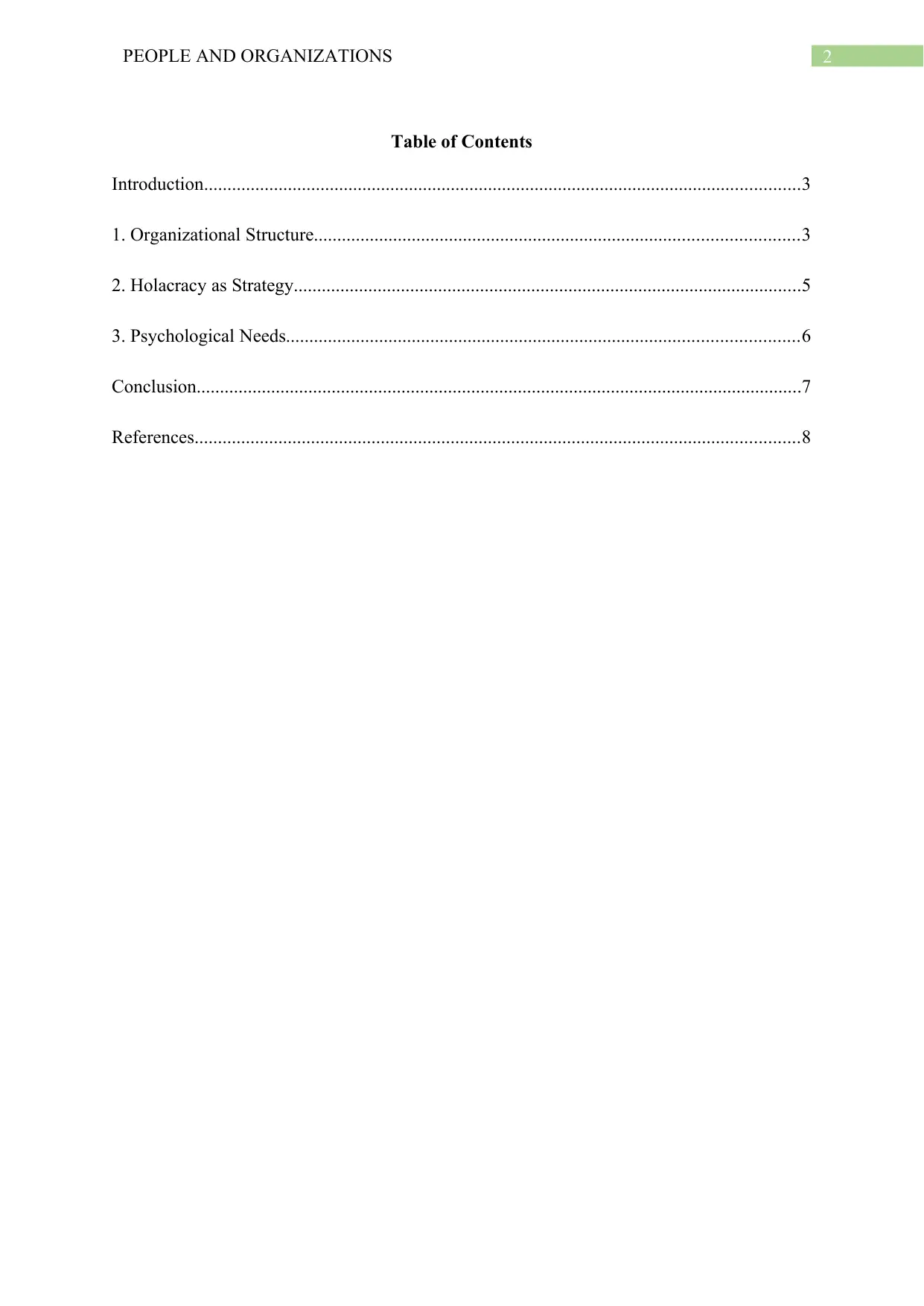
Table of Contents
Introduction................................................................................................................................3
1. Organizational Structure........................................................................................................3
2. Holacracy as Strategy.............................................................................................................5
3. Psychological Needs..............................................................................................................6
Conclusion..................................................................................................................................7
References..................................................................................................................................8
Table of Contents
Introduction................................................................................................................................3
1. Organizational Structure........................................................................................................3
2. Holacracy as Strategy.............................................................................................................5
3. Psychological Needs..............................................................................................................6
Conclusion..................................................................................................................................7
References..................................................................................................................................8
⊘ This is a preview!⊘
Do you want full access?
Subscribe today to unlock all pages.

Trusted by 1+ million students worldwide
3PEOPLE AND ORGANIZATIONS
Introduction
Organizational structure can be considered as a system used for defining a hierarchy
of an organization. Business organizations tend to adopt different types of organizational
structures based on the nature of business. The same is applicable in case of management
structure. There are three objectives of this report. The first part of the report discusses about
two or more organizational structure using real life example. The second part of the report
aims at analysing the appropriateness and inappropriateness of holacracy as an organizational
strategy. The aim of the last part of the report is to discuss about three psychological needs as
per the self-determination theory and the processes that can be used for supporting
psychological needs in the workplace while maintaining the organizational productivity.
1. Organizational Structure
Henry Mintzberg is a famous management theorist who has discussed about five types
of organizational structures; they are Entrepreneurial structure, Machine structure,
Professional structure, Divisional structure and Innovative Structure (Albitz 2013). The
following discussion discusses about four of the organizational structure of Henry Mintzberg.
Entrepreneurial structure – The presence of simple and flat structure can be seen under
entrepreneurial structure. There is only one large unit with one of a few senior managers.
These types of companies are comparatively unstructured and casual as compared to other
companies and they are flexible as well due to the absence of standardized system (Kumar
2015). For example, some of the successful start-up businesses of Australia can be mentioned
such as Canva, Campaign Monitor, Shippit and Afterpay. Since these companies are start-
ups, they do not have any formal and standardized organizational structure, but they are run
by one or a few managers who are the founders as well.
Introduction
Organizational structure can be considered as a system used for defining a hierarchy
of an organization. Business organizations tend to adopt different types of organizational
structures based on the nature of business. The same is applicable in case of management
structure. There are three objectives of this report. The first part of the report discusses about
two or more organizational structure using real life example. The second part of the report
aims at analysing the appropriateness and inappropriateness of holacracy as an organizational
strategy. The aim of the last part of the report is to discuss about three psychological needs as
per the self-determination theory and the processes that can be used for supporting
psychological needs in the workplace while maintaining the organizational productivity.
1. Organizational Structure
Henry Mintzberg is a famous management theorist who has discussed about five types
of organizational structures; they are Entrepreneurial structure, Machine structure,
Professional structure, Divisional structure and Innovative Structure (Albitz 2013). The
following discussion discusses about four of the organizational structure of Henry Mintzberg.
Entrepreneurial structure – The presence of simple and flat structure can be seen under
entrepreneurial structure. There is only one large unit with one of a few senior managers.
These types of companies are comparatively unstructured and casual as compared to other
companies and they are flexible as well due to the absence of standardized system (Kumar
2015). For example, some of the successful start-up businesses of Australia can be mentioned
such as Canva, Campaign Monitor, Shippit and Afterpay. Since these companies are start-
ups, they do not have any formal and standardized organizational structure, but they are run
by one or a few managers who are the founders as well.
Paraphrase This Document
Need a fresh take? Get an instant paraphrase of this document with our AI Paraphraser
4PEOPLE AND ORGANIZATIONS
Machine structure – Business organizations under machine structure are defined by its
standardization where work is majorly formalized in the presence of many routines and
procedures. Centralization is there in the decision-making process where functional
departments group the tasks. Jobs are well-defined in the presence of formal planning
process, budget and audits; and regular analysis is undertaken for increasing efficiency
(Oluwatayo and Amole 2014). The presence of this structure can be seen in the government
agencies and large corporations. Australian Federal Police (AFP) is a major example of
machine structure where standardized and formalized processes and procedures can be seen.
Professional structure – Companies under professional structure is very bureaucratic and
these organizations have large reliance on highly trained professional who want control on
their own work. There is high degree of specialization, but the decision-making process is
decentralized. In this case, the example of Woolworths Limited can be provided due to its
professional structure (Chiva 2017). It can be seen in case of Woolworths that the top
management of the company delegates the decision-making responsibilities related to daily
operations to the middle level management. In addition, the board of directors of Woolworths
consists of highly skilled professionals who established control over their own work.
Divisional structure – The presence of divisional structure can be seen within the
organizations having different product lines and business units. In this structure, a central
headquarter provides support to a number of autonomous divisions for making their own
decisions and to have their own unique structure (Albitz 2013). The presence of centralized
control can be seen in divisional structure and divisional managers are there in order to
oversee all surfaces of the works within the respective divisions. The example of Wesfarmers
can be provided in this case since the company has many business divisions divided between
two broad categories which are retail and industrial and other businesses. The name of some
of the business divisions of the company are Coles, Target and Kmart.
Machine structure – Business organizations under machine structure are defined by its
standardization where work is majorly formalized in the presence of many routines and
procedures. Centralization is there in the decision-making process where functional
departments group the tasks. Jobs are well-defined in the presence of formal planning
process, budget and audits; and regular analysis is undertaken for increasing efficiency
(Oluwatayo and Amole 2014). The presence of this structure can be seen in the government
agencies and large corporations. Australian Federal Police (AFP) is a major example of
machine structure where standardized and formalized processes and procedures can be seen.
Professional structure – Companies under professional structure is very bureaucratic and
these organizations have large reliance on highly trained professional who want control on
their own work. There is high degree of specialization, but the decision-making process is
decentralized. In this case, the example of Woolworths Limited can be provided due to its
professional structure (Chiva 2017). It can be seen in case of Woolworths that the top
management of the company delegates the decision-making responsibilities related to daily
operations to the middle level management. In addition, the board of directors of Woolworths
consists of highly skilled professionals who established control over their own work.
Divisional structure – The presence of divisional structure can be seen within the
organizations having different product lines and business units. In this structure, a central
headquarter provides support to a number of autonomous divisions for making their own
decisions and to have their own unique structure (Albitz 2013). The presence of centralized
control can be seen in divisional structure and divisional managers are there in order to
oversee all surfaces of the works within the respective divisions. The example of Wesfarmers
can be provided in this case since the company has many business divisions divided between
two broad categories which are retail and industrial and other businesses. The name of some
of the business divisions of the company are Coles, Target and Kmart.
5PEOPLE AND ORGANIZATIONS
2. Holacracy as Strategy
Holacracy refers to a new way to structure and run the business organizations that
substitutes the conventional hierarchy of management. Rather than operating based on top-
down approach, distribution of power can be seen throughout the organization providing
individuals and teams the freedom while keeping the alignment with the organizational
purpose. In the current business environment, holacracy has been promoted as a revolutionary
approach for the management structure (Robertson 2015). There are certain areas where
holacracy can be used as a strategy and there are areas where there is not any appropriateness
of holacracy.
In the current scenario, massive changes can be seen in the business environment and
the operations of the companies are largely exposed to these changes. In order to ensure
survival in this ever-changing business environment, business organizations are required to
adopt quickly. Holacracy can be implemented in the business organizations operating in ever-
changing business environments since this approach makes everyone act as a sensor of the
organizations and provides a pathway for turning their challenges and opportunities into
improvements for the overall business (Robertson 2015). Holacracy promotes smaller as well
as incremental decisions that replace large scale re-orgs so that the business organizations can
respond quickly to an ever-changing business environment for maintaining the liveliness as it
grows. This contributes towards the reduction in in efficiencies and weakens hidden power
dynamics throughout the organization. For example, holacracy can be used within the
companies operating in the e-commerce industry; such as online retailers and others. These
companies have to adopt quickly since this particular industry is changing quickly. In this
situation, the implementation of holacracy as a strategy in these organizations enhances
transparency, reduces conflicts and makes these companies able in surviving in the changing
business environment (Bernstein et al. 2016).
2. Holacracy as Strategy
Holacracy refers to a new way to structure and run the business organizations that
substitutes the conventional hierarchy of management. Rather than operating based on top-
down approach, distribution of power can be seen throughout the organization providing
individuals and teams the freedom while keeping the alignment with the organizational
purpose. In the current business environment, holacracy has been promoted as a revolutionary
approach for the management structure (Robertson 2015). There are certain areas where
holacracy can be used as a strategy and there are areas where there is not any appropriateness
of holacracy.
In the current scenario, massive changes can be seen in the business environment and
the operations of the companies are largely exposed to these changes. In order to ensure
survival in this ever-changing business environment, business organizations are required to
adopt quickly. Holacracy can be implemented in the business organizations operating in ever-
changing business environments since this approach makes everyone act as a sensor of the
organizations and provides a pathway for turning their challenges and opportunities into
improvements for the overall business (Robertson 2015). Holacracy promotes smaller as well
as incremental decisions that replace large scale re-orgs so that the business organizations can
respond quickly to an ever-changing business environment for maintaining the liveliness as it
grows. This contributes towards the reduction in in efficiencies and weakens hidden power
dynamics throughout the organization. For example, holacracy can be used within the
companies operating in the e-commerce industry; such as online retailers and others. These
companies have to adopt quickly since this particular industry is changing quickly. In this
situation, the implementation of holacracy as a strategy in these organizations enhances
transparency, reduces conflicts and makes these companies able in surviving in the changing
business environment (Bernstein et al. 2016).
⊘ This is a preview!⊘
Do you want full access?
Subscribe today to unlock all pages.
Trusted by 1+ million students worldwide
6PEOPLE AND ORGANIZATIONS
However, holacracy can always not be used as a strategy because of certain situations.
It needs to be mentioned that the application of holacracy comes with large responsibilities
which ultimately increases the responsibilities of the employees and forces them to bring
changes in their regular acuities. In the organizations where the employees are not
empowering enough to take these extra responsibilities and bring changes, the application of
holacracy will not be fruitful in there. This raises concern regarding the sustainability of this
approach within these organizations (Velinov, Vassilev and Denisov 2018). In these kinds of
situations, the implementation of holacracy as a strategy would be inappropriate.
3. Psychological Needs
Self-determination theory states that there are three types of psychological needs of
the individuals; they are Autonomy, Competence and Relatedness (Van den Broeck et al.
2016). The following discussion shows the ways to support these psychological needs in the
workplace while maintain productivity.
Autonomy – People have a need of feeling that they are the masters of their own destiny and
they have control over their lives to some extent; they also have the need to feel that they are
in control of their own behaviour. In order to manger this need while maintaining the
productivity, the HR managers are required to allow the employees to take their own job
related decisions to certain extent while including them in the decisions-making process. This
will make them feel the control on their own jobs and responsibilities while providing them a
sense of control on their own behaviour. However, the HR managers need to keep eye on
them and their works (Ryan and Deci 2017).
Competence – This need of the individuals is concerned with personal achievements,
knowledge and skills. People have the need of building their competence so that they can
develop mastery over the important tasks. The main strategy of the HR mangers to support
However, holacracy can always not be used as a strategy because of certain situations.
It needs to be mentioned that the application of holacracy comes with large responsibilities
which ultimately increases the responsibilities of the employees and forces them to bring
changes in their regular acuities. In the organizations where the employees are not
empowering enough to take these extra responsibilities and bring changes, the application of
holacracy will not be fruitful in there. This raises concern regarding the sustainability of this
approach within these organizations (Velinov, Vassilev and Denisov 2018). In these kinds of
situations, the implementation of holacracy as a strategy would be inappropriate.
3. Psychological Needs
Self-determination theory states that there are three types of psychological needs of
the individuals; they are Autonomy, Competence and Relatedness (Van den Broeck et al.
2016). The following discussion shows the ways to support these psychological needs in the
workplace while maintain productivity.
Autonomy – People have a need of feeling that they are the masters of their own destiny and
they have control over their lives to some extent; they also have the need to feel that they are
in control of their own behaviour. In order to manger this need while maintaining the
productivity, the HR managers are required to allow the employees to take their own job
related decisions to certain extent while including them in the decisions-making process. This
will make them feel the control on their own jobs and responsibilities while providing them a
sense of control on their own behaviour. However, the HR managers need to keep eye on
them and their works (Ryan and Deci 2017).
Competence – This need of the individuals is concerned with personal achievements,
knowledge and skills. People have the need of building their competence so that they can
develop mastery over the important tasks. The main strategy of the HR mangers to support
Paraphrase This Document
Need a fresh take? Get an instant paraphrase of this document with our AI Paraphraser
7PEOPLE AND ORGANIZATIONS
this need while maintaining productivity is to provide the employees with adequate training
so that they can advance their skills and knowledge for performing crucial tasks of the
organizations. These training programs will provide the employees with advanced skills and
knowledge so that they can earn the mastery of their tasks. This will also make the employees
competent enough to perform the tasks (Silva, Marques and Teixeira 2014).
Relatedness – People need to have a sense of belonging as well as connectedness with
others; each of the people needs other people to some extent. This is a crucial need of the
employees that the HR managers are needed to consider while maintaining the productivity.
The HR managers need to establish proper communication channel so that they can promote
clear communication among the employees. The employees are needed to be offered with
diverse opportunities for engaging with each other through formal as well as informal
gatherings. Moreover, the HR managers need to create diversity-friendly workforce policies.
All these will develop a connection between the employees that will lead to the development
of a sense of belonging (Webb et al. 2013).
Conclusion
The above discussion indicates towards the fact that there are five types of
organizational structure which are Entrepreneurial structure, Machine structure, Professional
structure, Divisional structure and Innovative Structure. It can also be seen from the above
that holacracy strategy can be implemented in the organizations that need to quickly adopt to
the changing business organizations; but this is inappropriate in case of the companies where
people are against changes and taking responsibilities. Lastly, HR managers can support the
psychological needs of the employees through the strategies like providing adequate training,
giving the freedom to take decisions and developing a diverse as well as friendly workplace.
this need while maintaining productivity is to provide the employees with adequate training
so that they can advance their skills and knowledge for performing crucial tasks of the
organizations. These training programs will provide the employees with advanced skills and
knowledge so that they can earn the mastery of their tasks. This will also make the employees
competent enough to perform the tasks (Silva, Marques and Teixeira 2014).
Relatedness – People need to have a sense of belonging as well as connectedness with
others; each of the people needs other people to some extent. This is a crucial need of the
employees that the HR managers are needed to consider while maintaining the productivity.
The HR managers need to establish proper communication channel so that they can promote
clear communication among the employees. The employees are needed to be offered with
diverse opportunities for engaging with each other through formal as well as informal
gatherings. Moreover, the HR managers need to create diversity-friendly workforce policies.
All these will develop a connection between the employees that will lead to the development
of a sense of belonging (Webb et al. 2013).
Conclusion
The above discussion indicates towards the fact that there are five types of
organizational structure which are Entrepreneurial structure, Machine structure, Professional
structure, Divisional structure and Innovative Structure. It can also be seen from the above
that holacracy strategy can be implemented in the organizations that need to quickly adopt to
the changing business organizations; but this is inappropriate in case of the companies where
people are against changes and taking responsibilities. Lastly, HR managers can support the
psychological needs of the employees through the strategies like providing adequate training,
giving the freedom to take decisions and developing a diverse as well as friendly workplace.
8PEOPLE AND ORGANIZATIONS
References
Albitz, R.S., 2013. Copyright information management and the university library: Staffing,
organizational placement and authority. The Journal of Academic Librarianship, 39(5),
pp.429-435.
Bernstein, E., Bunch, J., Canner, N. and Lee, M., 2016. Beyond the holacracy hype. Harvard
business review, 94(7), p.8.
Chiva, R., 2017. The learning organization and the level of consciousness. The Learning
Organization, 24(3), pp.150-158.
Kumar, P., 2015. An analytical study on mintzberg’s framework: Managerial
roles. International Journal of Research in Management and Business Studies, 2 (3), pp.1-19.
Oluwatayo, A.A. and Amole, D., 2014. Organizational structure of architectural firms and
their performances. International Journal of Construction Engineering and
Management, 3(1), pp.1-12.
Robertson, B.J., 2015. Holacracy: The new management system for a rapidly changing world.
Henry Holt and Company.
Robertson, B.J., 2015. Holacracy: The revolutionary management system that abolishes
hierarchy. Penguin UK.
Ryan, R.M. and Deci, E.L., 2017. Self-determination theory: Basic psychological needs in
motivation, development, and wellness. Guilford Publications.
Silva, M.N., Marques, M.M. and Teixeira, P.J., 2014. Testing theory in practice: The
example of self-determination theory-based interventions. European Health
Psychologist, 16(5), pp.171-180.
References
Albitz, R.S., 2013. Copyright information management and the university library: Staffing,
organizational placement and authority. The Journal of Academic Librarianship, 39(5),
pp.429-435.
Bernstein, E., Bunch, J., Canner, N. and Lee, M., 2016. Beyond the holacracy hype. Harvard
business review, 94(7), p.8.
Chiva, R., 2017. The learning organization and the level of consciousness. The Learning
Organization, 24(3), pp.150-158.
Kumar, P., 2015. An analytical study on mintzberg’s framework: Managerial
roles. International Journal of Research in Management and Business Studies, 2 (3), pp.1-19.
Oluwatayo, A.A. and Amole, D., 2014. Organizational structure of architectural firms and
their performances. International Journal of Construction Engineering and
Management, 3(1), pp.1-12.
Robertson, B.J., 2015. Holacracy: The new management system for a rapidly changing world.
Henry Holt and Company.
Robertson, B.J., 2015. Holacracy: The revolutionary management system that abolishes
hierarchy. Penguin UK.
Ryan, R.M. and Deci, E.L., 2017. Self-determination theory: Basic psychological needs in
motivation, development, and wellness. Guilford Publications.
Silva, M.N., Marques, M.M. and Teixeira, P.J., 2014. Testing theory in practice: The
example of self-determination theory-based interventions. European Health
Psychologist, 16(5), pp.171-180.
⊘ This is a preview!⊘
Do you want full access?
Subscribe today to unlock all pages.
Trusted by 1+ million students worldwide
9PEOPLE AND ORGANIZATIONS
Van den Broeck, A., Ferris, D.L., Chang, C.H. and Rosen, C.C., 2016. A review of self-
determination theory’s basic psychological needs at work. Journal of Management, 42(5),
pp.1195-1229.
Velinov, E., Vassilev, V. and Denisov, I., 2018. Holacracy and obliquity: contingency
management approaches in organizing companies. Problems and Perspectives in
Management, 16(1), pp.330-335.
Webb, D., Soutar, G.N., Mazzarol, T. and Saldaris, P., 2013. Self-determination theory and
consumer behavioural change: Evidence from a household energy-saving behaviour
study. Journal of Environmental Psychology, 35, pp.59-66.
Van den Broeck, A., Ferris, D.L., Chang, C.H. and Rosen, C.C., 2016. A review of self-
determination theory’s basic psychological needs at work. Journal of Management, 42(5),
pp.1195-1229.
Velinov, E., Vassilev, V. and Denisov, I., 2018. Holacracy and obliquity: contingency
management approaches in organizing companies. Problems and Perspectives in
Management, 16(1), pp.330-335.
Webb, D., Soutar, G.N., Mazzarol, T. and Saldaris, P., 2013. Self-determination theory and
consumer behavioural change: Evidence from a household energy-saving behaviour
study. Journal of Environmental Psychology, 35, pp.59-66.

1 out of 10


Related Documents


Your All-in-One AI-Powered Toolkit for Academic Success.
+13062052269
info@desklib.com
Available 24*7 on WhatsApp / Email
![[object Object]](/_next/static/media/star-bottom.7253800d.svg)
Unlock your academic potential
Copyright © 2020–2025 A2Z Services. All Rights Reserved. Developed and managed by ZUCOL.