Process Management and Analysis: A3 Reports and Enterprise Maturity
VerifiedAdded on 2022/09/07
|11
|2045
|19
Report
AI Summary
This report provides a comprehensive analysis of process management, focusing on the application of A3 reports and enterprise maturity models for organizational transformation. It begins by defining process management and exploring the concept of a process audit, highlighting the importance of process design and redesign. The report then delves into enterprise capabilities and the enterprise maturity model, providing a framework for assessing and improving business processes. The core of the analysis centers on A3 reports, detailing their origins in Toyota's problem-solving methodology and their adaptation for healthcare settings. The report outlines the steps involved in the A3 problem-solving process, from identifying the problem to implementing and following up on solutions. The conclusion emphasizes the importance of understanding enterprise capabilities, utilizing the maturity model, and leveraging A3 reports for achieving successful business performance and continuous improvement.
Running Head: PROCESS MANAGEMENT AND ANALYSIS
PROCESS MANAGEMENT AND ANALYSIS
Name of the Student
Name of the University
Author Note
PROCESS MANAGEMENT AND ANALYSIS
Name of the Student
Name of the University
Author Note

Paraphrase This Document
Need a fresh take? Get an instant paraphrase of this document with our AI Paraphraser
1PROCESS MANAGEMENT AND ANALYSIS
Executive Summary
The purpose of this report is to do an analysis of the process management of a company. The
study is supported by revaluating the process audit of a company and evaluating the article on
A3 reports as a tool for organisational transformation. It is found that an A3 report is a
potential tool for organisational improvement. It is also found that an organisation can use
enterprise maturity model to understand their strengths and improve their business
performance.
Executive Summary
The purpose of this report is to do an analysis of the process management of a company. The
study is supported by revaluating the process audit of a company and evaluating the article on
A3 reports as a tool for organisational transformation. It is found that an A3 report is a
potential tool for organisational improvement. It is also found that an organisation can use
enterprise maturity model to understand their strengths and improve their business
performance.
2PROCESS MANAGEMENT AND ANALYSIS
Table of Contents
Introduction................................................................................................................................3
Discussions.................................................................................................................................3
Process Management..............................................................................................................3
Process Audit.........................................................................................................................3
Enterprise Capabilities...........................................................................................................4
Enterprise Maturity Model.....................................................................................................4
Tools for Organisational Transformation...............................................................................7
Steps of A3 Problem-solving process....................................................................................8
Conclusion..................................................................................................................................9
References................................................................................................................................10
Table of Contents
Introduction................................................................................................................................3
Discussions.................................................................................................................................3
Process Management..............................................................................................................3
Process Audit.........................................................................................................................3
Enterprise Capabilities...........................................................................................................4
Enterprise Maturity Model.....................................................................................................4
Tools for Organisational Transformation...............................................................................7
Steps of A3 Problem-solving process....................................................................................8
Conclusion..................................................................................................................................9
References................................................................................................................................10
⊘ This is a preview!⊘
Do you want full access?
Subscribe today to unlock all pages.

Trusted by 1+ million students worldwide
3PROCESS MANAGEMENT AND ANALYSIS
Introduction
Organisational transformational change is a process which includes underlying the
business process and strategy used in the past and implement a change in the business system.
The first part of this paper is discussed in the process management concept. The next part is
discussed in the enterprise maturity model. The last part is discussed in the A3 report as a
problem solving tool. The intense of this paper is to do an analysis of the process
management of a company.
Discussions
Process Management
Process Management includes the implementation of all the process and establishment
of process systems for proper management of the business process (Rosemann and vom
Brocke 2015). Process management is aligned with organisational goals.
Process Audit
The business process can deliver high performance by proper process design in an
organisation. The process design includes the specialisation of all the tasks in a specialised
location with relevant information (Lin 2019). But, process design is no longer used by most
of the organisation. Most of the companies are focused on process redesigning for enhancing
performance. This includes employee engagement in narrow functional goals, retraining of
employees for the new process work, proper leadership in the process. Hence, the most
important factors for business process sustainability are:
A well-specified process design
The performers who execute the process with appropriate skills and knowledge for
implementing the design.
Introduction
Organisational transformational change is a process which includes underlying the
business process and strategy used in the past and implement a change in the business system.
The first part of this paper is discussed in the process management concept. The next part is
discussed in the enterprise maturity model. The last part is discussed in the A3 report as a
problem solving tool. The intense of this paper is to do an analysis of the process
management of a company.
Discussions
Process Management
Process Management includes the implementation of all the process and establishment
of process systems for proper management of the business process (Rosemann and vom
Brocke 2015). Process management is aligned with organisational goals.
Process Audit
The business process can deliver high performance by proper process design in an
organisation. The process design includes the specialisation of all the tasks in a specialised
location with relevant information (Lin 2019). But, process design is no longer used by most
of the organisation. Most of the companies are focused on process redesigning for enhancing
performance. This includes employee engagement in narrow functional goals, retraining of
employees for the new process work, proper leadership in the process. Hence, the most
important factors for business process sustainability are:
A well-specified process design
The performers who execute the process with appropriate skills and knowledge for
implementing the design.
Paraphrase This Document
Need a fresh take? Get an instant paraphrase of this document with our AI Paraphraser
4PROCESS MANAGEMENT AND ANALYSIS
A senior executive is needed for taking the responsibility to ensure flexibility in the
process for better result.
A company must have a proper infrastructure with proper support of the information
technology system.
Use of right metrics to measure business performance.
Enterprise Capabilities
1. Leadership- The senior executives are supporting the execution of the process.
2. Culture- Organisational values focus on teamwork, accountability, customers and
willingness to change.
3. Expertise- Experts in the process, have skills and knowledge in process redesign.
4. Governance- Companies can use their capabilities to plan and assess the process
redesign. They manage various complex projects.
Enterprise Maturity Model
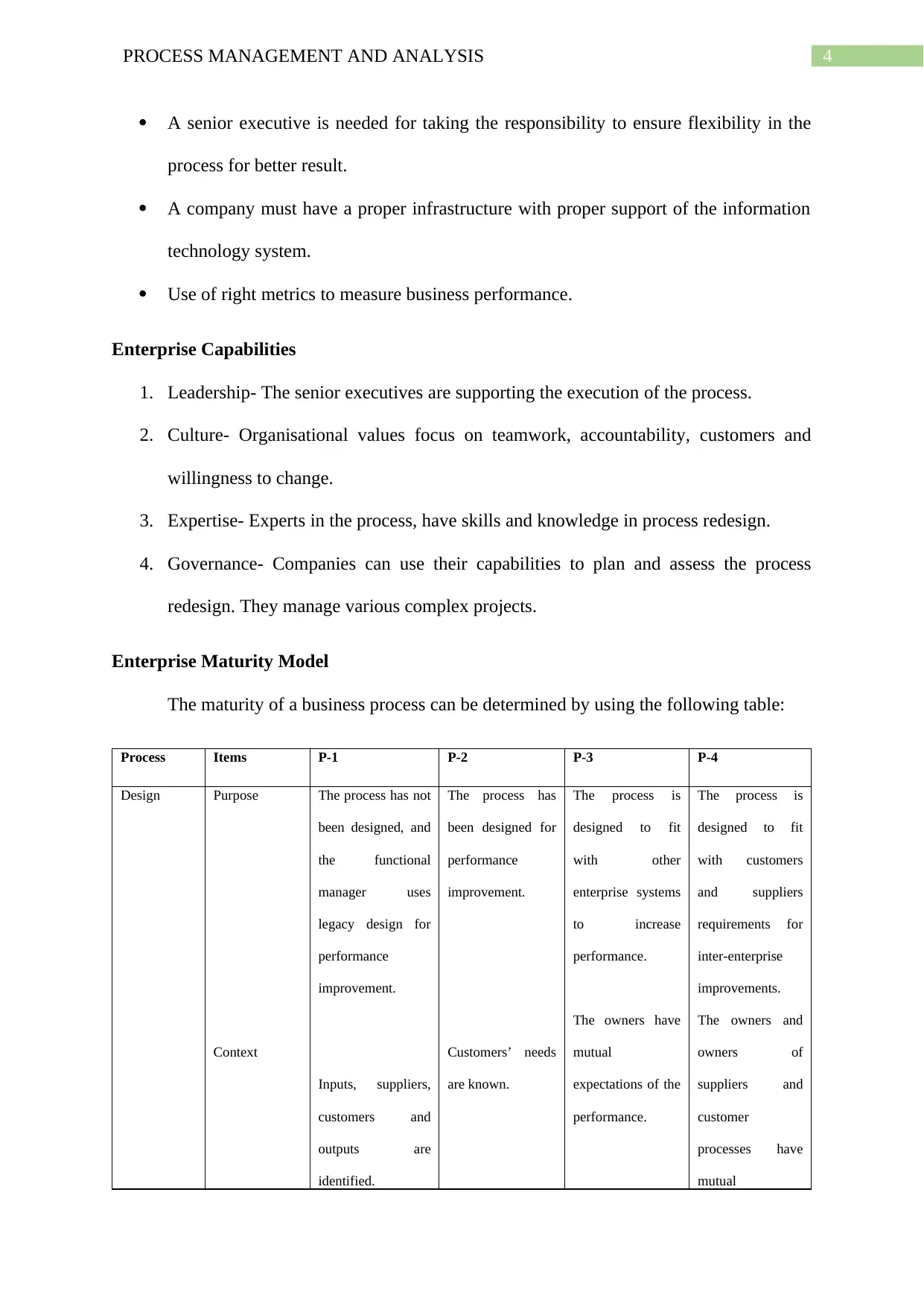
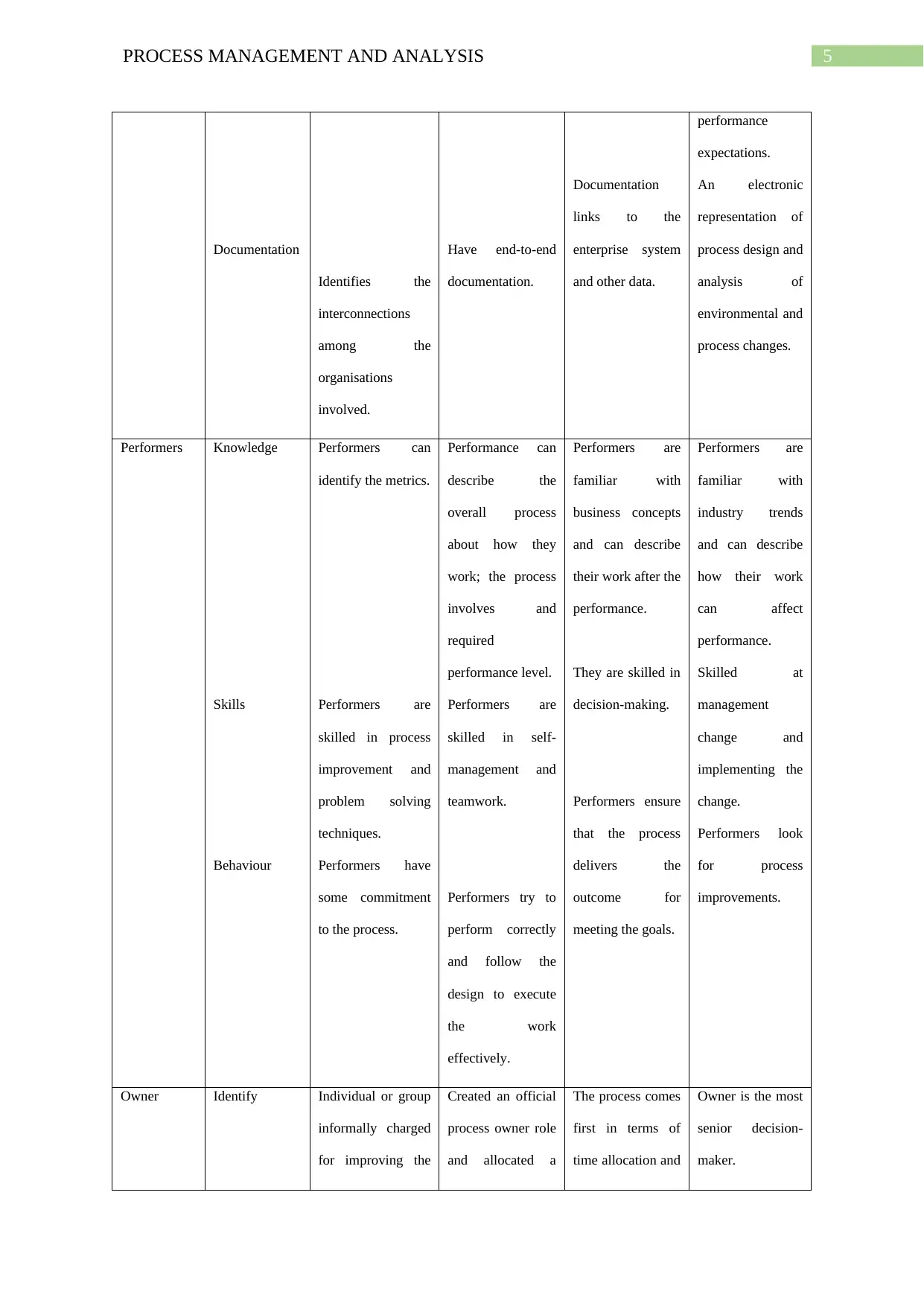
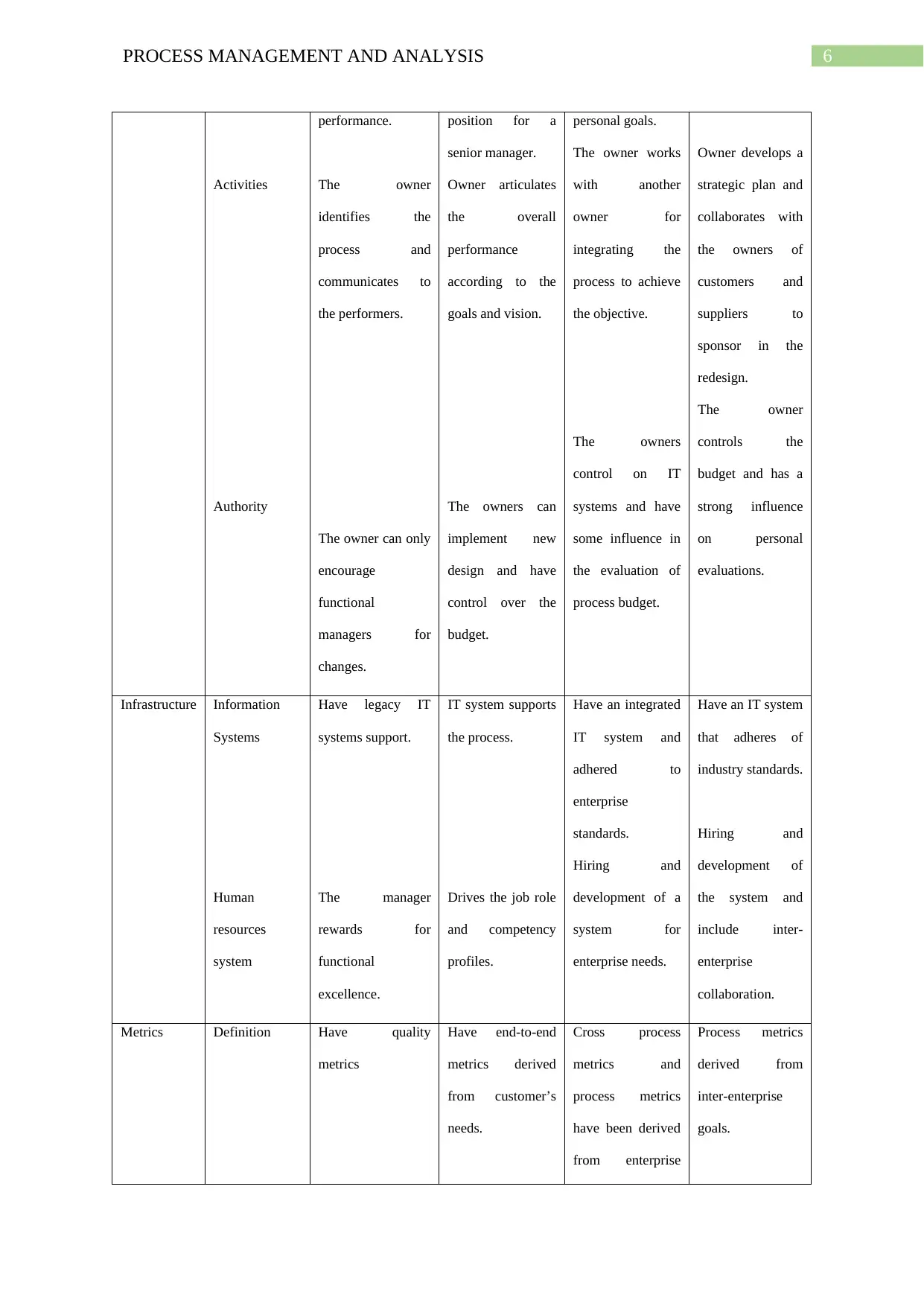
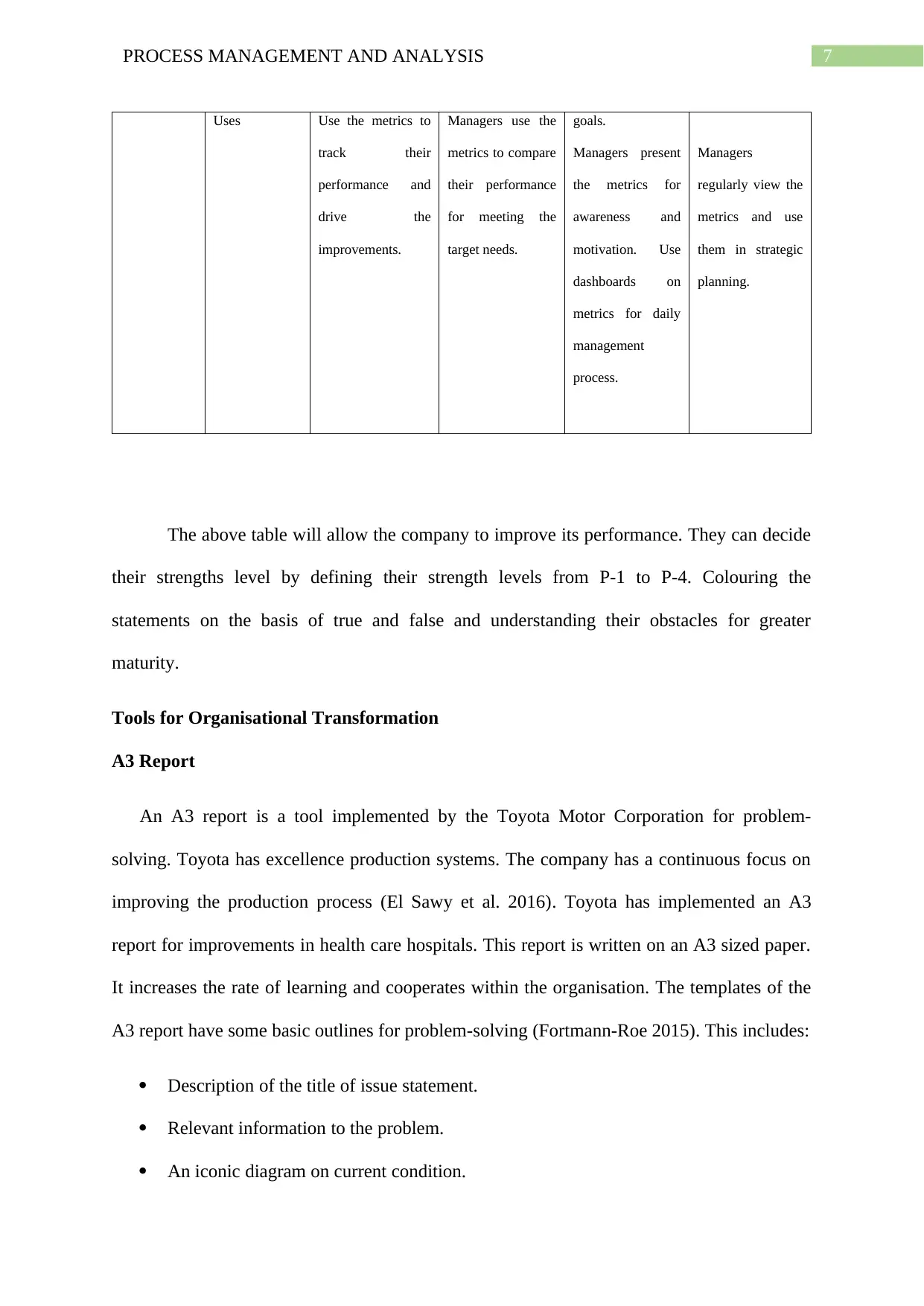
The maturity of a business process can be determined by using the following table:
Process Items P-1 P-2 P-3 P-4
Design Purpose
Context
The process has not
been designed, and
the functional
manager uses
legacy design for
performance
improvement.
Inputs, suppliers,
customers and
outputs are
identified.
The process has
been designed for
performance
improvement.
Customers’ needs
are known.
The process is
designed to fit
with other
enterprise systems
to increase
performance.
The owners have
mutual
expectations of the
performance.
The process is
designed to fit
with customers
and suppliers
requirements for
inter-enterprise
improvements.
The owners and
owners of
suppliers and
customer
processes have
mutual
A senior executive is needed for taking the responsibility to ensure flexibility in the
process for better result.
A company must have a proper infrastructure with proper support of the information
technology system.
Use of right metrics to measure business performance.
Enterprise Capabilities
1. Leadership- The senior executives are supporting the execution of the process.
2. Culture- Organisational values focus on teamwork, accountability, customers and
willingness to change.
3. Expertise- Experts in the process, have skills and knowledge in process redesign.
4. Governance- Companies can use their capabilities to plan and assess the process
redesign. They manage various complex projects.
Enterprise Maturity Model
The maturity of a business process can be determined by using the following table:
Process Items P-1 P-2 P-3 P-4
Design Purpose
Context
The process has not
been designed, and
the functional
manager uses
legacy design for
performance
improvement.
Inputs, suppliers,
customers and
outputs are
identified.
The process has
been designed for
performance
improvement.
Customers’ needs
are known.
The process is
designed to fit
with other
enterprise systems
to increase
performance.
The owners have
mutual
expectations of the
performance.
The process is
designed to fit
with customers
and suppliers
requirements for
inter-enterprise
improvements.
The owners and
owners of
suppliers and
customer
processes have
mutual
5PROCESS MANAGEMENT AND ANALYSIS
Documentation
Identifies the
interconnections
among the
organisations
involved.
Have end-to-end
documentation.
Documentation
links to the
enterprise system
and other data.
performance
expectations.
An electronic
representation of
process design and
analysis of
environmental and
process changes.
Performers Knowledge
Skills
Behaviour
Performers can
identify the metrics.
Performers are
skilled in process
improvement and
problem solving
techniques.
Performers have
some commitment
to the process.
Performance can
describe the
overall process
about how they
work; the process
involves and
required
performance level.
Performers are
skilled in self-
management and
teamwork.
Performers try to
perform correctly
and follow the
design to execute
the work
effectively.
Performers are
familiar with
business concepts
and can describe
their work after the
performance.
They are skilled in
decision-making.
Performers ensure
that the process
delivers the
outcome for
meeting the goals.
Performers are
familiar with
industry trends
and can describe
how their work
can affect
performance.
Skilled at
management
change and
implementing the
change.
Performers look
for process
improvements.
Owner Identify Individual or group
informally charged
for improving the
Created an official
process owner role
and allocated a
The process comes
first in terms of
time allocation and
Owner is the most
senior decision-
maker.
Documentation
Identifies the
interconnections
among the
organisations
involved.
Have end-to-end
documentation.
Documentation
links to the
enterprise system
and other data.
performance
expectations.
An electronic
representation of
process design and
analysis of
environmental and
process changes.
Performers Knowledge
Skills
Behaviour
Performers can
identify the metrics.
Performers are
skilled in process
improvement and
problem solving
techniques.
Performers have
some commitment
to the process.
Performance can
describe the
overall process
about how they
work; the process
involves and
required
performance level.
Performers are
skilled in self-
management and
teamwork.
Performers try to
perform correctly
and follow the
design to execute
the work
effectively.
Performers are
familiar with
business concepts
and can describe
their work after the
performance.
They are skilled in
decision-making.
Performers ensure
that the process
delivers the
outcome for
meeting the goals.
Performers are
familiar with
industry trends
and can describe
how their work
can affect
performance.
Skilled at
management
change and
implementing the
change.
Performers look
for process
improvements.
Owner Identify Individual or group
informally charged
for improving the
Created an official
process owner role
and allocated a
The process comes
first in terms of
time allocation and
Owner is the most
senior decision-
maker.
⊘ This is a preview!⊘
Do you want full access?
Subscribe today to unlock all pages.
Trusted by 1+ million students worldwide
6PROCESS MANAGEMENT AND ANALYSIS
Activities
Authority
performance.
The owner
identifies the
process and
communicates to
the performers.
The owner can only
encourage
functional
managers for
changes.
position for a
senior manager.
Owner articulates
the overall
performance
according to the
goals and vision.
The owners can
implement new
design and have
control over the
budget.
personal goals.
The owner works
with another
owner for
integrating the
process to achieve
the objective.
The owners
control on IT
systems and have
some influence in
the evaluation of
process budget.
Owner develops a
strategic plan and
collaborates with
the owners of
customers and
suppliers to
sponsor in the
redesign.
The owner
controls the
budget and has a
strong influence
on personal
evaluations.
Infrastructure Information
Systems
Human
resources
system
Have legacy IT
systems support.
The manager
rewards for
functional
excellence.
IT system supports
the process.
Drives the job role
and competency
profiles.
Have an integrated
IT system and
adhered to
enterprise
standards.
Hiring and
development of a
system for
enterprise needs.
Have an IT system
that adheres of
industry standards.
Hiring and
development of
the system and
include inter-
enterprise
collaboration.
Metrics Definition Have quality
metrics
Have end-to-end
metrics derived
from customer’s
needs.
Cross process
metrics and
process metrics
have been derived
from enterprise
Process metrics
derived from
inter-enterprise
goals.
Activities
Authority
performance.
The owner
identifies the
process and
communicates to
the performers.
The owner can only
encourage
functional
managers for
changes.
position for a
senior manager.
Owner articulates
the overall
performance
according to the
goals and vision.
The owners can
implement new
design and have
control over the
budget.
personal goals.
The owner works
with another
owner for
integrating the
process to achieve
the objective.
The owners
control on IT
systems and have
some influence in
the evaluation of
process budget.
Owner develops a
strategic plan and
collaborates with
the owners of
customers and
suppliers to
sponsor in the
redesign.
The owner
controls the
budget and has a
strong influence
on personal
evaluations.
Infrastructure Information
Systems
Human
resources
system
Have legacy IT
systems support.
The manager
rewards for
functional
excellence.
IT system supports
the process.
Drives the job role
and competency
profiles.
Have an integrated
IT system and
adhered to
enterprise
standards.
Hiring and
development of a
system for
enterprise needs.
Have an IT system
that adheres of
industry standards.
Hiring and
development of
the system and
include inter-
enterprise
collaboration.
Metrics Definition Have quality
metrics
Have end-to-end
metrics derived
from customer’s
needs.
Cross process
metrics and
process metrics
have been derived
from enterprise
Process metrics
derived from
inter-enterprise
goals.
Paraphrase This Document
Need a fresh take? Get an instant paraphrase of this document with our AI Paraphraser
7PROCESS MANAGEMENT AND ANALYSIS
Uses Use the metrics to
track their
performance and
drive the
improvements.
Managers use the
metrics to compare
their performance
for meeting the
target needs.
goals.
Managers present
the metrics for
awareness and
motivation. Use
dashboards on
metrics for daily
management
process.
Managers
regularly view the
metrics and use
them in strategic
planning.
The above table will allow the company to improve its performance. They can decide
their strengths level by defining their strength levels from P-1 to P-4. Colouring the
statements on the basis of true and false and understanding their obstacles for greater
maturity.
Tools for Organisational Transformation
A3 Report
An A3 report is a tool implemented by the Toyota Motor Corporation for problem-
solving. Toyota has excellence production systems. The company has a continuous focus on
improving the production process (El Sawy et al. 2016). Toyota has implemented an A3
report for improvements in health care hospitals. This report is written on an A3 sized paper.
It increases the rate of learning and cooperates within the organisation. The templates of the
A3 report have some basic outlines for problem-solving (Fortmann-Roe 2015). This includes:
Description of the title of issue statement.
Relevant information to the problem.
An iconic diagram on current condition.
Uses Use the metrics to
track their
performance and
drive the
improvements.
Managers use the
metrics to compare
their performance
for meeting the
target needs.
goals.
Managers present
the metrics for
awareness and
motivation. Use
dashboards on
metrics for daily
management
process.
Managers
regularly view the
metrics and use
them in strategic
planning.
The above table will allow the company to improve its performance. They can decide
their strengths level by defining their strength levels from P-1 to P-4. Colouring the
statements on the basis of true and false and understanding their obstacles for greater
maturity.
Tools for Organisational Transformation
A3 Report
An A3 report is a tool implemented by the Toyota Motor Corporation for problem-
solving. Toyota has excellence production systems. The company has a continuous focus on
improving the production process (El Sawy et al. 2016). Toyota has implemented an A3
report for improvements in health care hospitals. This report is written on an A3 sized paper.
It increases the rate of learning and cooperates within the organisation. The templates of the
A3 report have some basic outlines for problem-solving (Fortmann-Roe 2015). This includes:
Description of the title of issue statement.
Relevant information to the problem.
An iconic diagram on current condition.
8PROCESS MANAGEMENT AND ANALYSIS
Analysis of cause and effects on the problem.
Iconic diagram of how new process will work.
Implementation of plan and actions (Iuga and Rosca 2017).
Follow the plan and predict the results.
The actual results.
Steps of A3 Problem-solving process
1. Identification of the problem- management tends to identify the problems. The
supervisors and workers see the problems that are manageable and can be solved
within a shorter period.
2. Studying the current situation- This involves gathering the data and observation of the
current situation. After observations, the data’s are documented in the A3 report.
3. Identification of the Root cause- Understanding and addressing the root cause of poor
performance in the A3 report (Meiste et al. 2018).
4. Confirmation of current condition- This is done on face-to-face meetings in the
affected areas. This meeting ensures that all the elements are covered and provides
necessary suggestions for successful performance.
5. Visualising the Future State- Brainstorming the possible circumstances and creating a
diagram of how the new process will work. On the basis of work systems, the future
performance of the business and expected changes can be predicted and documented
on the A3 report.
6. Follow the plans- This involves training of personnel and assigning job
responsibilities. After implementing the plan, the problem-solver needs to verify the
activities (Svendsen and Haskins 2016).
7. Create Consensus- Revisions of previous steps is done.
8. Obtain approval- Approve the proposed change from the appropriate authority.
Analysis of cause and effects on the problem.
Iconic diagram of how new process will work.
Implementation of plan and actions (Iuga and Rosca 2017).
Follow the plan and predict the results.
The actual results.
Steps of A3 Problem-solving process
1. Identification of the problem- management tends to identify the problems. The
supervisors and workers see the problems that are manageable and can be solved
within a shorter period.
2. Studying the current situation- This involves gathering the data and observation of the
current situation. After observations, the data’s are documented in the A3 report.
3. Identification of the Root cause- Understanding and addressing the root cause of poor
performance in the A3 report (Meiste et al. 2018).
4. Confirmation of current condition- This is done on face-to-face meetings in the
affected areas. This meeting ensures that all the elements are covered and provides
necessary suggestions for successful performance.
5. Visualising the Future State- Brainstorming the possible circumstances and creating a
diagram of how the new process will work. On the basis of work systems, the future
performance of the business and expected changes can be predicted and documented
on the A3 report.
6. Follow the plans- This involves training of personnel and assigning job
responsibilities. After implementing the plan, the problem-solver needs to verify the
activities (Svendsen and Haskins 2016).
7. Create Consensus- Revisions of previous steps is done.
8. Obtain approval- Approve the proposed change from the appropriate authority.
⊘ This is a preview!⊘
Do you want full access?
Subscribe today to unlock all pages.
Trusted by 1+ million students worldwide
9PROCESS MANAGEMENT AND ANALYSIS
9. Implementation- After approval of the A3 report, implement the plan. This includes
the implementation of PDCA or plan-do-check-act cycle.
10. Follow up- Check the PDCA cycle and follow-up the implementation.
Conclusion
Therefore, it can be deferred that, for successful business performance, companies
need to understand their enterprise capabilities. They can deliver high performance by
redesigning the business process. The new process must have a well-specified design,
appropriates skills and knowledge of performers, a senior executive, proper infrastructure and
right metrics to measure the performance. The business process can use Maturity Model for
understanding the strengths of their business process. A company can use the A3 report as a
problem-solving tool to understand the problems. This tool is implemented by Toyota Motors
for continuous improvements in the organisation. It is a documented report which shows the
results of the problem-solving in a very concise manner. The proper-solver implements this
report to improve performance.
9. Implementation- After approval of the A3 report, implement the plan. This includes
the implementation of PDCA or plan-do-check-act cycle.
10. Follow up- Check the PDCA cycle and follow-up the implementation.
Conclusion
Therefore, it can be deferred that, for successful business performance, companies
need to understand their enterprise capabilities. They can deliver high performance by
redesigning the business process. The new process must have a well-specified design,
appropriates skills and knowledge of performers, a senior executive, proper infrastructure and
right metrics to measure the performance. The business process can use Maturity Model for
understanding the strengths of their business process. A company can use the A3 report as a
problem-solving tool to understand the problems. This tool is implemented by Toyota Motors
for continuous improvements in the organisation. It is a documented report which shows the
results of the problem-solving in a very concise manner. The proper-solver implements this
report to improve performance.
Paraphrase This Document
Need a fresh take? Get an instant paraphrase of this document with our AI Paraphraser
10PROCESS MANAGEMENT AND ANALYSIS
References
Baker-Shelley, A., van Zeijl-Rozema, A. and Martens, P., 2017. A conceptual synthesis of
organisational transformation: How to diagnose, and navigate, pathways for sustainability at
universities?. Journal of Cleaner Production, 145, pp.262-276.
El Sawy, O.A., Kræmmergaard, P., Amsinck, H. and Vinther, A.L., 2016. How LEGO Built
the Foundations and Enterprise Capabilities for Digital Leadership. MIS Quarterly Executive,
15(2).
Fortmann-Roe, S., 2015. Consistent and clear reporting of results from diverse modeling
techniques: the A3 method. Journal of Statistical Software, 66(7), pp.1-23.
Iuga, M.V. and Rosca, LI, 2017. Comparison of problem solving tools in lean organisations.
In MATEC Web of Conferences (Vol. 121, p. 02004). EDP Sciences.
Lin, R., 2019, April. Research on Supply Chain Audit Strategy of Industrial Enterprises. In
3rd International Conference on Culture, Education and Economic Development of Modern
Society (ICCESE 2019). Atlantis Press.
Meister, M., Böing, T., Batz, S. and Metternich, J., 2018. Problem-solving process design in
production: Current progress and action required. Procedia CIRP, 78, pp.376-381.
Rosemann, M. and vom Brocke, J., 2015. The six core elements of business process
management. In Handbook on business process management 1 (pp. 105-122). Springer,
Berlin, Heidelberg.
Svendsen, A. and Haskins, C., 2016, July. Applying A3 problem resolution to new system
design to improve performance and reduce rework. In INCOSE International Symposium
(Vol. 26, No. 1, pp. 1161-1175).
References
Baker-Shelley, A., van Zeijl-Rozema, A. and Martens, P., 2017. A conceptual synthesis of
organisational transformation: How to diagnose, and navigate, pathways for sustainability at
universities?. Journal of Cleaner Production, 145, pp.262-276.
El Sawy, O.A., Kræmmergaard, P., Amsinck, H. and Vinther, A.L., 2016. How LEGO Built
the Foundations and Enterprise Capabilities for Digital Leadership. MIS Quarterly Executive,
15(2).
Fortmann-Roe, S., 2015. Consistent and clear reporting of results from diverse modeling
techniques: the A3 method. Journal of Statistical Software, 66(7), pp.1-23.
Iuga, M.V. and Rosca, LI, 2017. Comparison of problem solving tools in lean organisations.
In MATEC Web of Conferences (Vol. 121, p. 02004). EDP Sciences.
Lin, R., 2019, April. Research on Supply Chain Audit Strategy of Industrial Enterprises. In
3rd International Conference on Culture, Education and Economic Development of Modern
Society (ICCESE 2019). Atlantis Press.
Meister, M., Böing, T., Batz, S. and Metternich, J., 2018. Problem-solving process design in
production: Current progress and action required. Procedia CIRP, 78, pp.376-381.
Rosemann, M. and vom Brocke, J., 2015. The six core elements of business process
management. In Handbook on business process management 1 (pp. 105-122). Springer,
Berlin, Heidelberg.
Svendsen, A. and Haskins, C., 2016, July. Applying A3 problem resolution to new system
design to improve performance and reduce rework. In INCOSE International Symposium
(Vol. 26, No. 1, pp. 1161-1175).

1 out of 11


Related Documents


Your All-in-One AI-Powered Toolkit for Academic Success.
+13062052269
info@desklib.com
Available 24*7 on WhatsApp / Email
![[object Object]](/_next/static/media/star-bottom.7253800d.svg)
Unlock your academic potential
Copyright © 2020–2026 A2Z Services. All Rights Reserved. Developed and managed by ZUCOL.