Understanding Business Environment: Organizations and Macro Analysis
VerifiedAdded on 2024/05/29
|16
|4302
|391
Report
AI Summary
This report provides a comprehensive analysis of the business environment, focusing on different types of organizations (public, private, and voluntary sectors) and their legal structures. It examines the size and scope of various organizations, highlighting the relationship between organizational functions (marketing, finance, HR, and operations) and their alignment with organizational objectives and structure. The report utilizes PESTLE analysis to identify the positive and negative impacts of the macro environment on businesses, followed by a SWOT analysis to assess the external and internal factors affecting an organization. The interrelation between strengths and weaknesses with external factors is also explored, using Unilever Limited as a primary example, with comparisons to Procter & Gamble and Mondelez UK Limited. Desklib provides this and other solved assignments to help students.
University
Business and Business environment Assignment
Name
Business and Business environment Assignment
Name

Paraphrase This Document
Need a fresh take? Get an instant paraphrase of this document with our AI Paraphraser
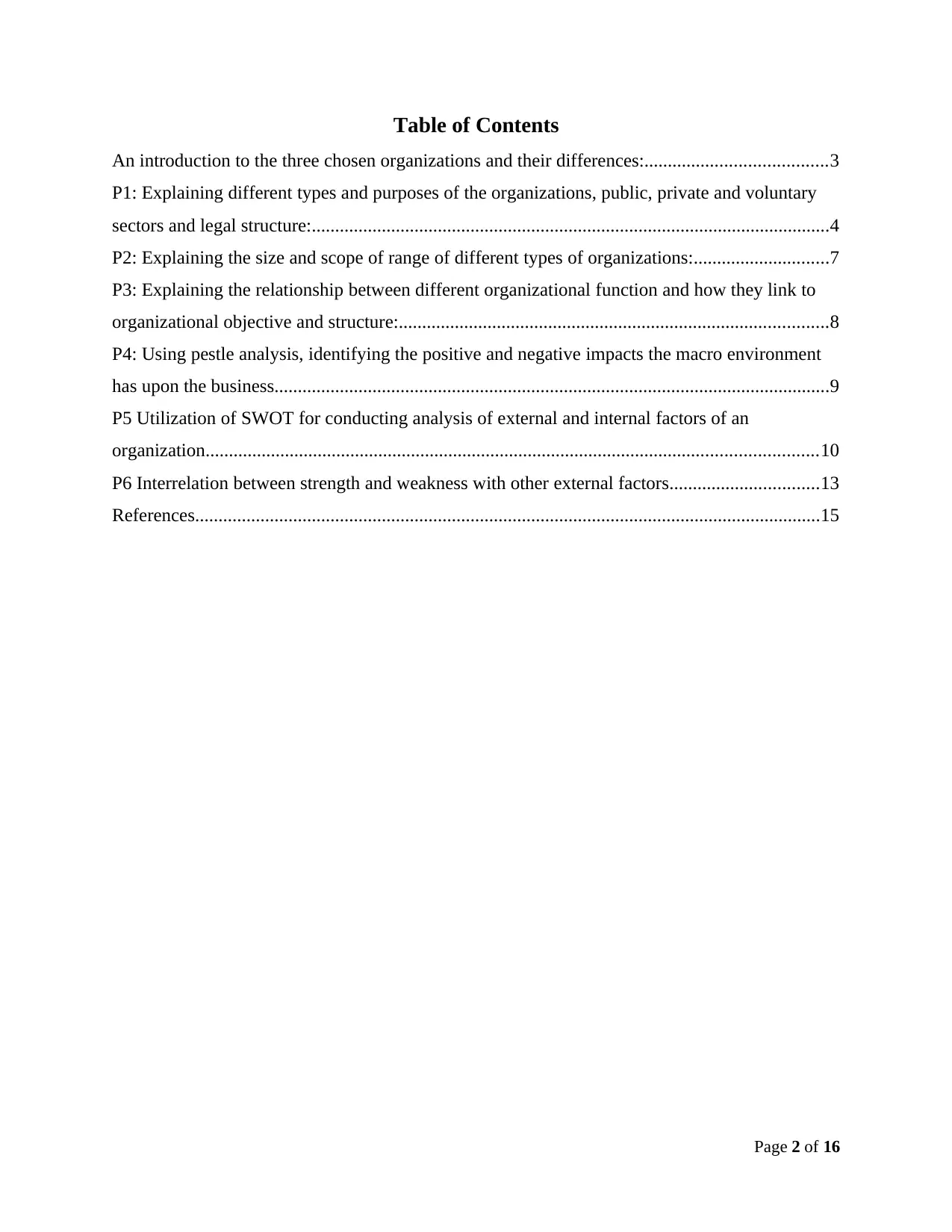
Table of Contents
An introduction to the three chosen organizations and their differences:.......................................3
P1: Explaining different types and purposes of the organizations, public, private and voluntary
sectors and legal structure:...............................................................................................................4
P2: Explaining the size and scope of range of different types of organizations:.............................7
P3: Explaining the relationship between different organizational function and how they link to
organizational objective and structure:............................................................................................8
P4: Using pestle analysis, identifying the positive and negative impacts the macro environment
has upon the business.......................................................................................................................9
P5 Utilization of SWOT for conducting analysis of external and internal factors of an
organization...................................................................................................................................10
P6 Interrelation between strength and weakness with other external factors................................13
References......................................................................................................................................15
Page 2 of 16
An introduction to the three chosen organizations and their differences:.......................................3
P1: Explaining different types and purposes of the organizations, public, private and voluntary
sectors and legal structure:...............................................................................................................4
P2: Explaining the size and scope of range of different types of organizations:.............................7
P3: Explaining the relationship between different organizational function and how they link to
organizational objective and structure:............................................................................................8
P4: Using pestle analysis, identifying the positive and negative impacts the macro environment
has upon the business.......................................................................................................................9
P5 Utilization of SWOT for conducting analysis of external and internal factors of an
organization...................................................................................................................................10
P6 Interrelation between strength and weakness with other external factors................................13
References......................................................................................................................................15
Page 2 of 16
An introduction to the three chosen organizations and their differences:
Introducing the companies briefly: A brief introduction can be provided for the company. The
company that has been chosen here in order to carry on with the main part of the study is the
Unilever Limited of UK. The organization has been one of the prominent houses in the consumer
products industry and the manufacturing for daily usable items and commodities. They range
from different kind of products and have a huge share over the daily lives of their consumers. It
has its headquarters in the city of London and it was formed out because of merger in the year of
1930. As founders, there were eminent entrepreneurs such as William Lever, James Darcy Lever
and Singrose (Burrell and Morgan, 2017). The other two companies that shall be compared with
that of the various things in relation to the Unilever are the companies such as Procter and
Gamble Company and the Mondelez UK Limited. The two of the organizations are also the giant
houses that are in the consumer product business England as well as that of the many parts and
the countries of the whole world. The Three organizational are large sized companies in the
consumer products business.
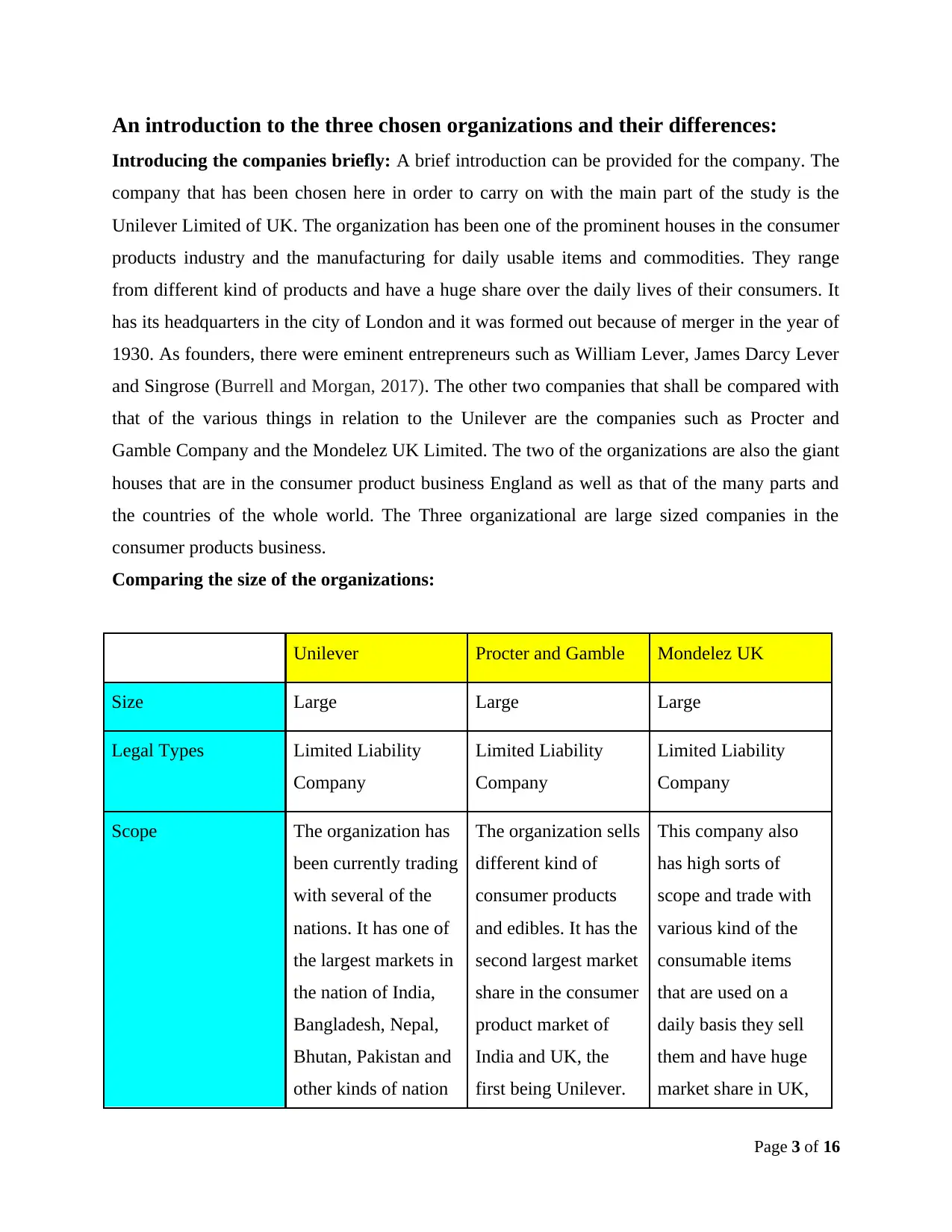
Comparing the size of the organizations:
Unilever Procter and Gamble Mondelez UK
Size Large Large Large
Legal Types Limited Liability
Company
Limited Liability
Company
Limited Liability
Company
Scope The organization has
been currently trading
with several of the
nations. It has one of
the largest markets in
the nation of India,
Bangladesh, Nepal,
Bhutan, Pakistan and
other kinds of nation
The organization sells
different kind of
consumer products
and edibles. It has the
second largest market
share in the consumer
product market of
India and UK, the
first being Unilever.
This company also
has high sorts of
scope and trade with
various kind of the
consumable items
that are used on a
daily basis they sell
them and have huge
market share in UK,
Page 3 of 16
Introducing the companies briefly: A brief introduction can be provided for the company. The
company that has been chosen here in order to carry on with the main part of the study is the
Unilever Limited of UK. The organization has been one of the prominent houses in the consumer
products industry and the manufacturing for daily usable items and commodities. They range
from different kind of products and have a huge share over the daily lives of their consumers. It
has its headquarters in the city of London and it was formed out because of merger in the year of
1930. As founders, there were eminent entrepreneurs such as William Lever, James Darcy Lever
and Singrose (Burrell and Morgan, 2017). The other two companies that shall be compared with
that of the various things in relation to the Unilever are the companies such as Procter and
Gamble Company and the Mondelez UK Limited. The two of the organizations are also the giant
houses that are in the consumer product business England as well as that of the many parts and
the countries of the whole world. The Three organizational are large sized companies in the
consumer products business.
Comparing the size of the organizations:
Unilever Procter and Gamble Mondelez UK
Size Large Large Large
Legal Types Limited Liability
Company
Limited Liability
Company
Limited Liability
Company
Scope The organization has
been currently trading
with several of the
nations. It has one of
the largest markets in
the nation of India,
Bangladesh, Nepal,
Bhutan, Pakistan and
other kinds of nation
The organization sells
different kind of
consumer products
and edibles. It has the
second largest market
share in the consumer
product market of
India and UK, the
first being Unilever.
This company also
has high sorts of
scope and trade with
various kind of the
consumable items
that are used on a
daily basis they sell
them and have huge
market share in UK,
Page 3 of 16
⊘ This is a preview!⊘
Do you want full access?
Subscribe today to unlock all pages.

Trusted by 1+ million students worldwide
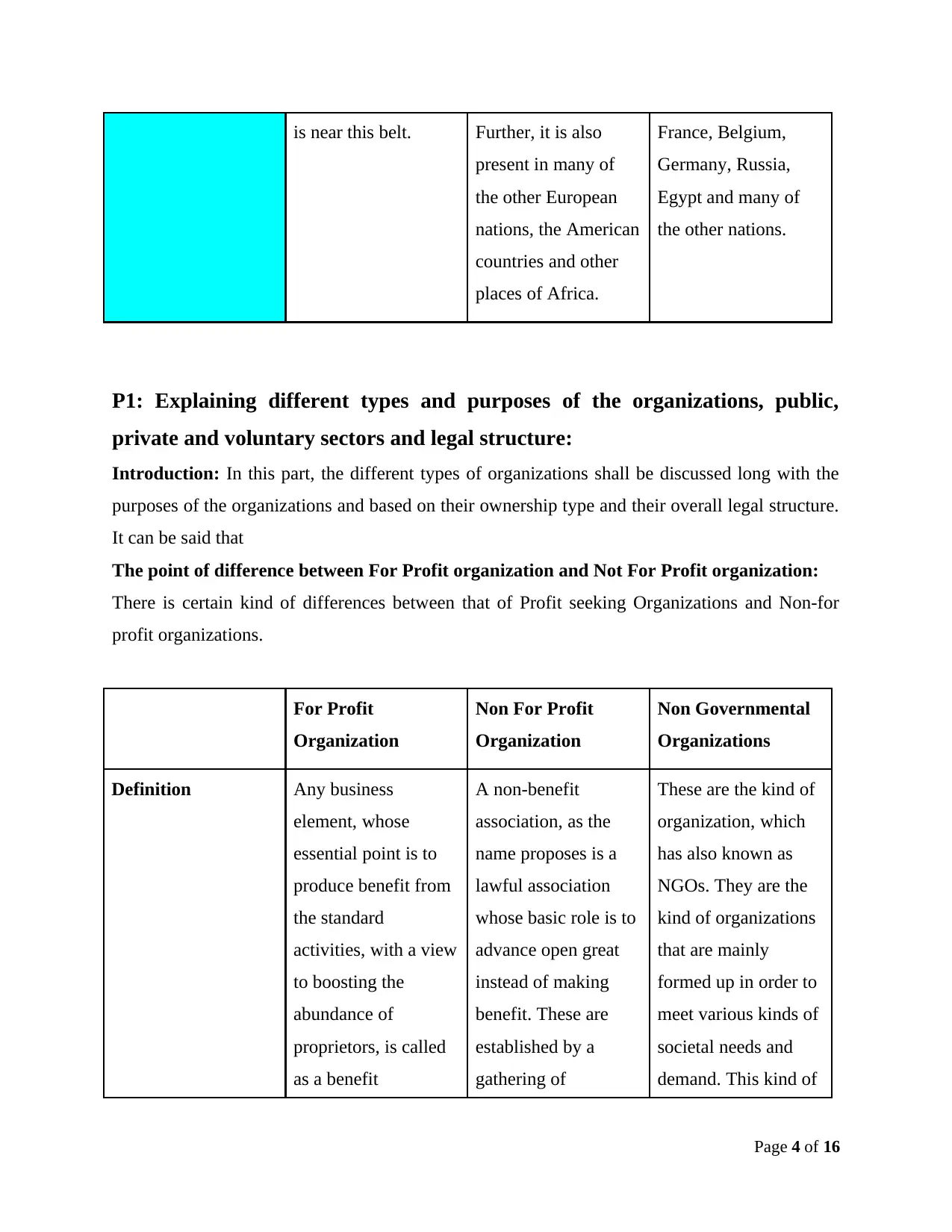
is near this belt. Further, it is also
present in many of
the other European
nations, the American
countries and other
places of Africa.
France, Belgium,
Germany, Russia,
Egypt and many of
the other nations.
P1: Explaining different types and purposes of the organizations, public,
private and voluntary sectors and legal structure:
Introduction: In this part, the different types of organizations shall be discussed long with the
purposes of the organizations and based on their ownership type and their overall legal structure.
It can be said that
The point of difference between For Profit organization and Not For Profit organization:
There is certain kind of differences between that of Profit seeking Organizations and Non-for
profit organizations.
For Profit
Organization
Non For Profit
Organization
Non Governmental
Organizations
Definition Any business
element, whose
essential point is to
produce benefit from
the standard
activities, with a view
to boosting the
abundance of
proprietors, is called
as a benefit
A non-benefit
association, as the
name proposes is a
lawful association
whose basic role is to
advance open great
instead of making
benefit. These are
established by a
gathering of
These are the kind of
organization, which
has also known as
NGOs. They are the
kind of organizations
that are mainly
formed up in order to
meet various kinds of
societal needs and
demand. This kind of
Page 4 of 16
present in many of
the other European
nations, the American
countries and other
places of Africa.
France, Belgium,
Germany, Russia,
Egypt and many of
the other nations.
P1: Explaining different types and purposes of the organizations, public,
private and voluntary sectors and legal structure:
Introduction: In this part, the different types of organizations shall be discussed long with the
purposes of the organizations and based on their ownership type and their overall legal structure.
It can be said that
The point of difference between For Profit organization and Not For Profit organization:
There is certain kind of differences between that of Profit seeking Organizations and Non-for
profit organizations.
For Profit
Organization
Non For Profit
Organization
Non Governmental
Organizations
Definition Any business
element, whose
essential point is to
produce benefit from
the standard
activities, with a view
to boosting the
abundance of
proprietors, is called
as a benefit
A non-benefit
association, as the
name proposes is a
lawful association
whose basic role is to
advance open great
instead of making
benefit. These are
established by a
gathering of
These are the kind of
organization, which
has also known as
NGOs. They are the
kind of organizations
that are mainly
formed up in order to
meet various kinds of
societal needs and
demand. This kind of
Page 4 of 16
Paraphrase This Document
Need a fresh take? Get an instant paraphrase of this document with our AI Paraphraser
association or a Profit
seeking Organization
(Church and
Waclawski, 2017).
The benefit earned by
such substances is
either held in
business, for future
possibilities, as stores
or conveyed to the
proprietors as the
profit.
individuals who meet
up for a typical
reason
organization are
generally formed and
managed by private
hands.
Source of revenue Sales of different
goods and services
Donation, members
and their
subscriptions.
Funding and
investments done by
large organizations.
They are also
managed by religious
institutions, which get
public grants and
donations.
Public Sector, Private Sector and Voluntary sector and their differences:
● Public Sector: Public sector can be defined to be the one that is mainly managed and run
by the state and the Government of any place. The state has all the discretion regarding
the organization and can take up any decision that they please. The public sectors mainly
take up the bigger projects and the bigger responsibilities related to a country. These
kinds of organizations are responsible for public investment in the economy and bringing
an all round development and welfare for the economy. It shall help in decreasing the
issues related to employment and other things (Qureshi and Kang, 2015). For example
Page 5 of 16
seeking Organization
(Church and
Waclawski, 2017).
The benefit earned by
such substances is
either held in
business, for future
possibilities, as stores
or conveyed to the
proprietors as the
profit.
individuals who meet
up for a typical
reason
organization are
generally formed and
managed by private
hands.
Source of revenue Sales of different
goods and services
Donation, members
and their
subscriptions.
Funding and
investments done by
large organizations.
They are also
managed by religious
institutions, which get
public grants and
donations.
Public Sector, Private Sector and Voluntary sector and their differences:
● Public Sector: Public sector can be defined to be the one that is mainly managed and run
by the state and the Government of any place. The state has all the discretion regarding
the organization and can take up any decision that they please. The public sectors mainly
take up the bigger projects and the bigger responsibilities related to a country. These
kinds of organizations are responsible for public investment in the economy and bringing
an all round development and welfare for the economy. It shall help in decreasing the
issues related to employment and other things (Qureshi and Kang, 2015). For example
Page 5 of 16
the British Railways. It is a publicly owned organization and managed by the
Government.
● Private Sector: The Private sectors are those kinds of organizations that are solely
managed and run by the private hands. In this kind of organization they help in raising
the overall level of employability bus as contrary to Public sector organizations, they take
a large part of their profit to be taken away by the CEOs or the owners of the
organization. The Unilever Company can here be held to be the best example suited for
the whole study in here.
● Voluntary Sector: The Voluntary sectors are also known as not for profit organizations.
They are the kinds of organizations that mostly run by the state or else by private hands.
These kind of organization have various kind of contribution and work towards the
society like educating them, providing with healthcare and other things (Grant, 2016).
Examples, the school and the hospitals fall under this category.
Different kind of organizations:
● Sole trader: Sole trader is the kind of organization that is managed and made by a single
owner. This kind of organization can be seen to be generally of smaller size and structure.
An example shall be the small cafes along the streets of London, which are owned and
managed by a single person. One of the forest advantages of this kind of establishment
from the perspective of owner is that they have full autonomy over the organization and
can independently function in that organization. Further, they take the whole share of the
profits they earn. On the other hand as form of disadvantages, they have to face all losses
by themselves and are wholly responsible for the risk of running the organization.
● Partnership: Partnership is a kind of business organization that is run and managed by
two or more people coming into the business with a general and simple kind of legal
basis. These kinds of organizations are run and funded by the partners and they have
different kind of roles to be played. An example is the Dentones is one of the eminent
partnership firms in England. They have the biggest advantage for the owners are that a
single owner does not have to take the risks and burden and things are divided among all
(Brunswicker and Vanhaverbeke, 2015). However, as disadvantage this kind of
Page 6 of 16
Government.
● Private Sector: The Private sectors are those kinds of organizations that are solely
managed and run by the private hands. In this kind of organization they help in raising
the overall level of employability bus as contrary to Public sector organizations, they take
a large part of their profit to be taken away by the CEOs or the owners of the
organization. The Unilever Company can here be held to be the best example suited for
the whole study in here.
● Voluntary Sector: The Voluntary sectors are also known as not for profit organizations.
They are the kinds of organizations that mostly run by the state or else by private hands.
These kind of organization have various kind of contribution and work towards the
society like educating them, providing with healthcare and other things (Grant, 2016).
Examples, the school and the hospitals fall under this category.
Different kind of organizations:
● Sole trader: Sole trader is the kind of organization that is managed and made by a single
owner. This kind of organization can be seen to be generally of smaller size and structure.
An example shall be the small cafes along the streets of London, which are owned and
managed by a single person. One of the forest advantages of this kind of establishment
from the perspective of owner is that they have full autonomy over the organization and
can independently function in that organization. Further, they take the whole share of the
profits they earn. On the other hand as form of disadvantages, they have to face all losses
by themselves and are wholly responsible for the risk of running the organization.
● Partnership: Partnership is a kind of business organization that is run and managed by
two or more people coming into the business with a general and simple kind of legal
basis. These kinds of organizations are run and funded by the partners and they have
different kind of roles to be played. An example is the Dentones is one of the eminent
partnership firms in England. They have the biggest advantage for the owners are that a
single owner does not have to take the risks and burden and things are divided among all
(Brunswicker and Vanhaverbeke, 2015). However, as disadvantage this kind of
Page 6 of 16
⊘ This is a preview!⊘
Do you want full access?
Subscribe today to unlock all pages.
Trusted by 1+ million students worldwide
organization provided with various rather disputed and mismanagement among the
partners which finally affect the organization badly.
● Limited companies: Limited companies are one, which have artificial existence and are
owned by shareholders, the people who buy their shares in the companies. The main form
of advantage for this kind of organization is that it has huge existence and it is not ceased
with the death of any owners and it is perpetual. Another thing is it does not have to
suffer from shortage of resources and many are there to take responsibilities. The
disadvantage is that managing of such kind of organization is much tough. In addition, it
has to be noted that internal disputes and politics are present in these kinds of
organizations (Forés and Camisón, 2016).
● Cooperatives: Cooperatives are the ones, which are run and managed, by a group of
people in order to serve smoke of their common needs. It can be said that this kind of
structure provides autonomy to the members and provides them with every kind of helps
needed b y them. Will, a major shortfall is that this kind of organization fails in the lack
of proper resources. An example is the Central England Co Operative.
Conclusion:
It can be said that this part has played a role in discussing about the various kind of business
organizations that exist and arriving on with detailed analysis of them. The benefits and
limitations of each one of them have also been projected here.
P2: Explaining the size and scope of range of different types of organizations:
Introduction: This section will deal with studying of the size, range and scope of different kind
of organizations.
Types of organizations and their details:
● Micro organization: These kinds of organizations are the smallest of all. Example small
teashops. The objective of this kind of organization is just to sustain. They are not able to
earn such kind of hue profits.
● Small organization: These kind of organizations are relatively a bigger than the micro
ones. They are mainly the small concerns manufacturing any small spare parts of a large
industry. This kind of organization has the objective to grow and earn more profits.
Page 7 of 16
partners which finally affect the organization badly.
● Limited companies: Limited companies are one, which have artificial existence and are
owned by shareholders, the people who buy their shares in the companies. The main form
of advantage for this kind of organization is that it has huge existence and it is not ceased
with the death of any owners and it is perpetual. Another thing is it does not have to
suffer from shortage of resources and many are there to take responsibilities. The
disadvantage is that managing of such kind of organization is much tough. In addition, it
has to be noted that internal disputes and politics are present in these kinds of
organizations (Forés and Camisón, 2016).
● Cooperatives: Cooperatives are the ones, which are run and managed, by a group of
people in order to serve smoke of their common needs. It can be said that this kind of
structure provides autonomy to the members and provides them with every kind of helps
needed b y them. Will, a major shortfall is that this kind of organization fails in the lack
of proper resources. An example is the Central England Co Operative.
Conclusion:
It can be said that this part has played a role in discussing about the various kind of business
organizations that exist and arriving on with detailed analysis of them. The benefits and
limitations of each one of them have also been projected here.
P2: Explaining the size and scope of range of different types of organizations:
Introduction: This section will deal with studying of the size, range and scope of different kind
of organizations.
Types of organizations and their details:
● Micro organization: These kinds of organizations are the smallest of all. Example small
teashops. The objective of this kind of organization is just to sustain. They are not able to
earn such kind of hue profits.
● Small organization: These kind of organizations are relatively a bigger than the micro
ones. They are mainly the small concerns manufacturing any small spare parts of a large
industry. This kind of organization has the objective to grow and earn more profits.
Page 7 of 16
Paraphrase This Document
Need a fresh take? Get an instant paraphrase of this document with our AI Paraphraser
● Medium Organization: This kind of organization is bigger than the small ones. They
consist of organizations such as a medium scale soap manufacturing concern in London.
They have the motive to grow into big corporate houses (Booth, 2018).
● Large organizations: This kind of organization mainly has the objectives to spread their
business throughout the world. They have huge area of operation and are huge in size as
well as range of operations.
Transnational Corporation is the one, which is a mix of private and public. Organizations such as
the Telecommunication organizations owned by the state are mainly also run and managed by
some share of private concerns. These are this kind of organizations
Industry can be said to be the kind of sect in which all the organization get into a particular kind
of activity and earn lump sum amount of profits. Supply is the force that is related to selling up
of goods and services in the market by the seller. While demands can be said to be the need
expressed by consumer for any kind of good or service. When Demand increases in the
consumer goods industry, naturally the supply is raised by the organization in order to earn
profits.
Conclusion: This part has dealt with study of different organization and explaining demand
supply and its relation in industries.
P3: Explaining the relationship between different organizational function and
how they link to organizational objective and structure:
Introduction: This shall cover the relationship between different organizational function and
how they link to organizational objective and structure.
Marketing, finance and Human Resource and operations: Marketing plays a role in helping
the organization in spelling of the several of the goods and the services. On the other hand, the
finance helps in keeping the records of the events and helping the organization in getting
different kind of resources in order to run their concern. The Human resources play their role in
training and motivating the employees and keeping track of their attentiveness and performance
made by them. Whole operations concern the series of different kind of activities that are carried
on by the organization in order to earn profits solely. It can be said that all these departments are
interrelated. It can be said that the marketing department cannot carry on with the advertisements
of any product without knowing about the whereabouts from the Finance, operations as well as
HR department. Thus, it can be said that all of them are related (Forés and Camisón, 2016).
Page 8 of 16
consist of organizations such as a medium scale soap manufacturing concern in London.
They have the motive to grow into big corporate houses (Booth, 2018).
● Large organizations: This kind of organization mainly has the objectives to spread their
business throughout the world. They have huge area of operation and are huge in size as
well as range of operations.
Transnational Corporation is the one, which is a mix of private and public. Organizations such as
the Telecommunication organizations owned by the state are mainly also run and managed by
some share of private concerns. These are this kind of organizations
Industry can be said to be the kind of sect in which all the organization get into a particular kind
of activity and earn lump sum amount of profits. Supply is the force that is related to selling up
of goods and services in the market by the seller. While demands can be said to be the need
expressed by consumer for any kind of good or service. When Demand increases in the
consumer goods industry, naturally the supply is raised by the organization in order to earn
profits.
Conclusion: This part has dealt with study of different organization and explaining demand
supply and its relation in industries.
P3: Explaining the relationship between different organizational function and
how they link to organizational objective and structure:
Introduction: This shall cover the relationship between different organizational function and
how they link to organizational objective and structure.
Marketing, finance and Human Resource and operations: Marketing plays a role in helping
the organization in spelling of the several of the goods and the services. On the other hand, the
finance helps in keeping the records of the events and helping the organization in getting
different kind of resources in order to run their concern. The Human resources play their role in
training and motivating the employees and keeping track of their attentiveness and performance
made by them. Whole operations concern the series of different kind of activities that are carried
on by the organization in order to earn profits solely. It can be said that all these departments are
interrelated. It can be said that the marketing department cannot carry on with the advertisements
of any product without knowing about the whereabouts from the Finance, operations as well as
HR department. Thus, it can be said that all of them are related (Forés and Camisón, 2016).
Page 8 of 16
The business needs to survive and earn profits. Surgical is the basic survival while earning
profits related to acting hard to earn. Increasing the sales leads to growth in satisfaction of
customers and profit maximization.
Function based structures work on with the tax that is given to them. While Geography based
structures function particularly based on location features of the place. The Product based is
related to designing of product and customers based structure is done in order to keep customers
happy. All the elements seem to be important in the Function based structure.
Conclusion: All the details related to Hr, operations finance and marketing has been studied
here.
P4: Using pestle analysis, identifying the positive and negative impacts the
macro environment has upon the business
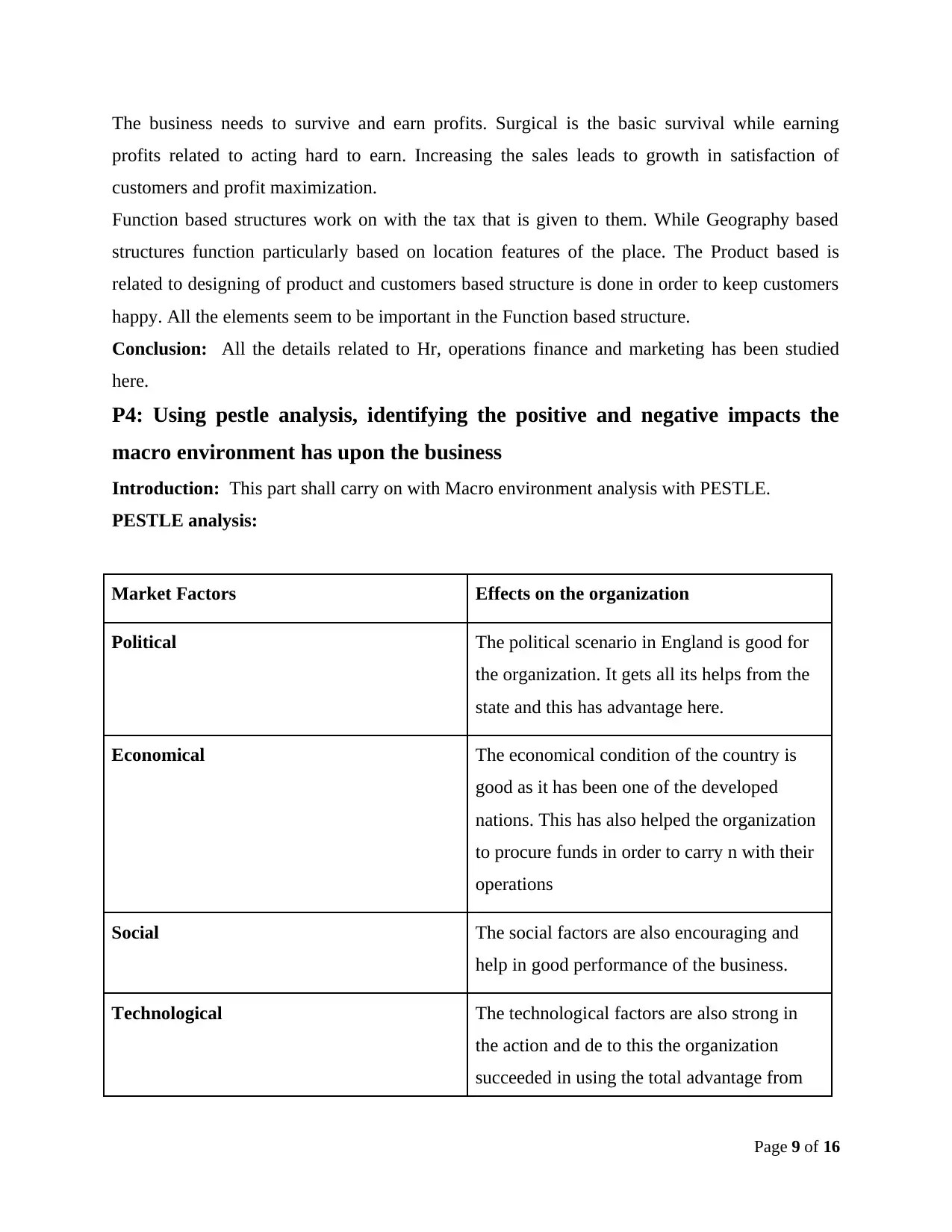
Introduction: This part shall carry on with Macro environment analysis with PESTLE.
PESTLE analysis:
Market Factors Effects on the organization
Political The political scenario in England is good for
the organization. It gets all its helps from the
state and this has advantage here.
Economical The economical condition of the country is
good as it has been one of the developed
nations. This has also helped the organization
to procure funds in order to carry n with their
operations
Social The social factors are also encouraging and
help in good performance of the business.
Technological The technological factors are also strong in
the action and de to this the organization
succeeded in using the total advantage from
Page 9 of 16
profits related to acting hard to earn. Increasing the sales leads to growth in satisfaction of
customers and profit maximization.
Function based structures work on with the tax that is given to them. While Geography based
structures function particularly based on location features of the place. The Product based is
related to designing of product and customers based structure is done in order to keep customers
happy. All the elements seem to be important in the Function based structure.
Conclusion: All the details related to Hr, operations finance and marketing has been studied
here.
P4: Using pestle analysis, identifying the positive and negative impacts the
macro environment has upon the business
Introduction: This part shall carry on with Macro environment analysis with PESTLE.
PESTLE analysis:
Market Factors Effects on the organization
Political The political scenario in England is good for
the organization. It gets all its helps from the
state and this has advantage here.
Economical The economical condition of the country is
good as it has been one of the developed
nations. This has also helped the organization
to procure funds in order to carry n with their
operations
Social The social factors are also encouraging and
help in good performance of the business.
Technological The technological factors are also strong in
the action and de to this the organization
succeeded in using the total advantage from
Page 9 of 16
⊘ This is a preview!⊘
Do you want full access?
Subscribe today to unlock all pages.
Trusted by 1+ million students worldwide
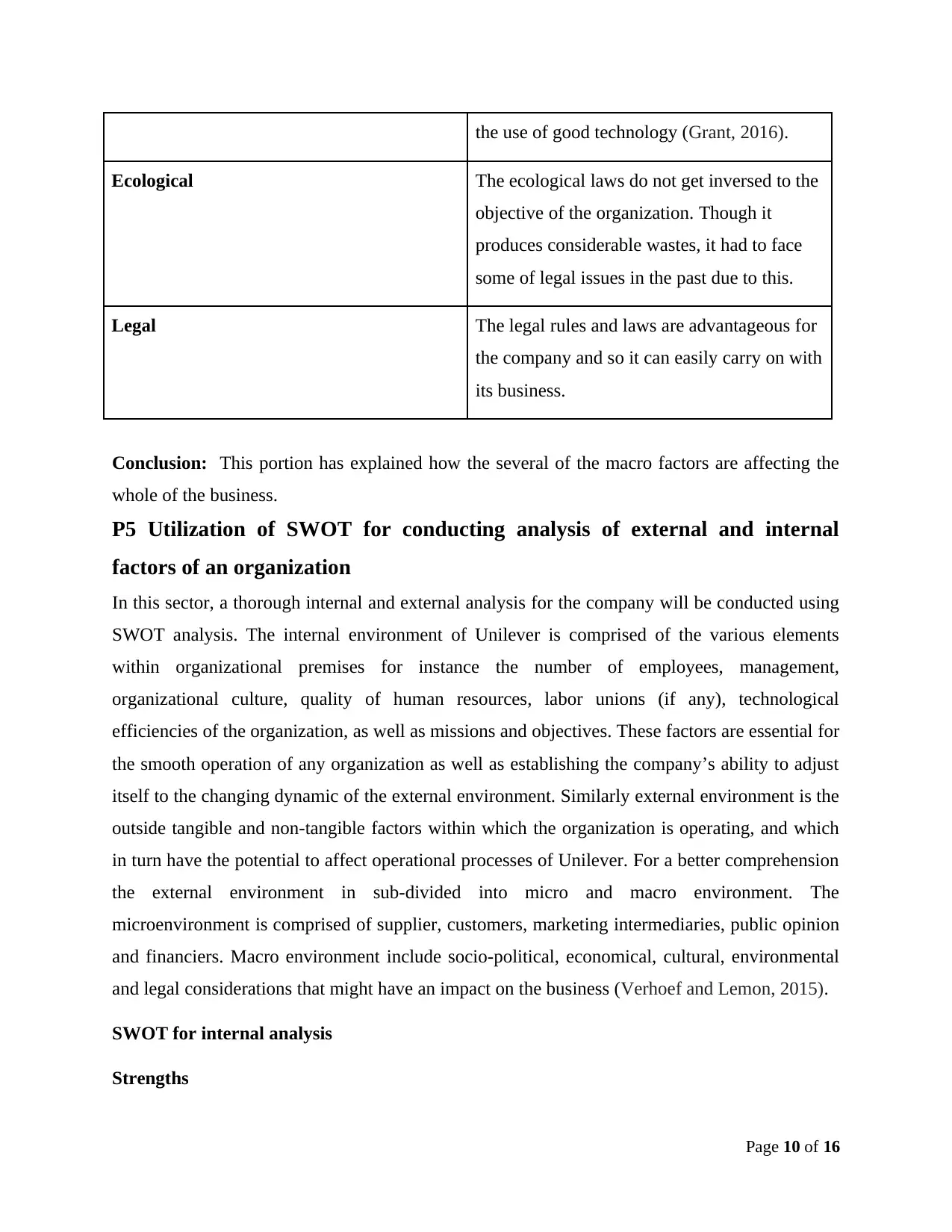
the use of good technology (Grant, 2016).
Ecological The ecological laws do not get inversed to the
objective of the organization. Though it
produces considerable wastes, it had to face
some of legal issues in the past due to this.
Legal The legal rules and laws are advantageous for
the company and so it can easily carry on with
its business.
Conclusion: This portion has explained how the several of the macro factors are affecting the
whole of the business.
P5 Utilization of SWOT for conducting analysis of external and internal
factors of an organization
In this sector, a thorough internal and external analysis for the company will be conducted using
SWOT analysis. The internal environment of Unilever is comprised of the various elements
within organizational premises for instance the number of employees, management,
organizational culture, quality of human resources, labor unions (if any), technological
efficiencies of the organization, as well as missions and objectives. These factors are essential for
the smooth operation of any organization as well as establishing the company’s ability to adjust
itself to the changing dynamic of the external environment. Similarly external environment is the
outside tangible and non-tangible factors within which the organization is operating, and which
in turn have the potential to affect operational processes of Unilever. For a better comprehension
the external environment in sub-divided into micro and macro environment. The
microenvironment is comprised of supplier, customers, marketing intermediaries, public opinion
and financiers. Macro environment include socio-political, economical, cultural, environmental
and legal considerations that might have an impact on the business (Verhoef and Lemon, 2015).
SWOT for internal analysis
Strengths
Page 10 of 16
Ecological The ecological laws do not get inversed to the
objective of the organization. Though it
produces considerable wastes, it had to face
some of legal issues in the past due to this.
Legal The legal rules and laws are advantageous for
the company and so it can easily carry on with
its business.
Conclusion: This portion has explained how the several of the macro factors are affecting the
whole of the business.
P5 Utilization of SWOT for conducting analysis of external and internal
factors of an organization
In this sector, a thorough internal and external analysis for the company will be conducted using
SWOT analysis. The internal environment of Unilever is comprised of the various elements
within organizational premises for instance the number of employees, management,
organizational culture, quality of human resources, labor unions (if any), technological
efficiencies of the organization, as well as missions and objectives. These factors are essential for
the smooth operation of any organization as well as establishing the company’s ability to adjust
itself to the changing dynamic of the external environment. Similarly external environment is the
outside tangible and non-tangible factors within which the organization is operating, and which
in turn have the potential to affect operational processes of Unilever. For a better comprehension
the external environment in sub-divided into micro and macro environment. The
microenvironment is comprised of supplier, customers, marketing intermediaries, public opinion
and financiers. Macro environment include socio-political, economical, cultural, environmental
and legal considerations that might have an impact on the business (Verhoef and Lemon, 2015).
SWOT for internal analysis
Strengths
Page 10 of 16
Paraphrase This Document
Need a fresh take? Get an instant paraphrase of this document with our AI Paraphraser
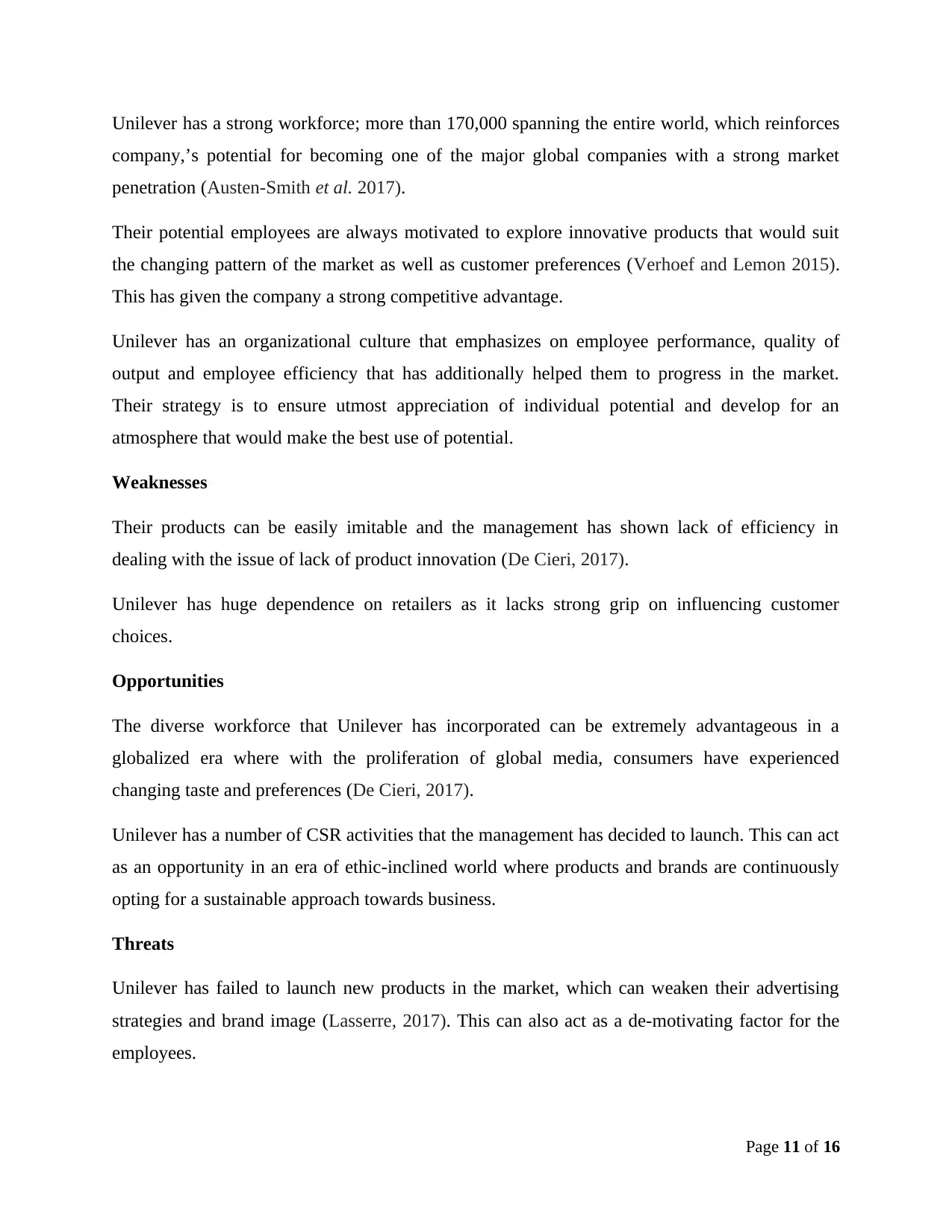
Unilever has a strong workforce; more than 170,000 spanning the entire world, which reinforces
company,’s potential for becoming one of the major global companies with a strong market
penetration (Austen-Smith et al. 2017).
Their potential employees are always motivated to explore innovative products that would suit
the changing pattern of the market as well as customer preferences (Verhoef and Lemon 2015).
This has given the company a strong competitive advantage.
Unilever has an organizational culture that emphasizes on employee performance, quality of
output and employee efficiency that has additionally helped them to progress in the market.
Their strategy is to ensure utmost appreciation of individual potential and develop for an
atmosphere that would make the best use of potential.
Weaknesses
Their products can be easily imitable and the management has shown lack of efficiency in
dealing with the issue of lack of product innovation (De Cieri, 2017).
Unilever has huge dependence on retailers as it lacks strong grip on influencing customer
choices.
Opportunities
The diverse workforce that Unilever has incorporated can be extremely advantageous in a
globalized era where with the proliferation of global media, consumers have experienced
changing taste and preferences (De Cieri, 2017).
Unilever has a number of CSR activities that the management has decided to launch. This can act
as an opportunity in an era of ethic-inclined world where products and brands are continuously
opting for a sustainable approach towards business.
Threats
Unilever has failed to launch new products in the market, which can weaken their advertising
strategies and brand image (Lasserre, 2017). This can also act as a de-motivating factor for the
employees.
Page 11 of 16
company,’s potential for becoming one of the major global companies with a strong market
penetration (Austen-Smith et al. 2017).
Their potential employees are always motivated to explore innovative products that would suit
the changing pattern of the market as well as customer preferences (Verhoef and Lemon 2015).
This has given the company a strong competitive advantage.
Unilever has an organizational culture that emphasizes on employee performance, quality of
output and employee efficiency that has additionally helped them to progress in the market.
Their strategy is to ensure utmost appreciation of individual potential and develop for an
atmosphere that would make the best use of potential.
Weaknesses
Their products can be easily imitable and the management has shown lack of efficiency in
dealing with the issue of lack of product innovation (De Cieri, 2017).
Unilever has huge dependence on retailers as it lacks strong grip on influencing customer
choices.
Opportunities
The diverse workforce that Unilever has incorporated can be extremely advantageous in a
globalized era where with the proliferation of global media, consumers have experienced
changing taste and preferences (De Cieri, 2017).
Unilever has a number of CSR activities that the management has decided to launch. This can act
as an opportunity in an era of ethic-inclined world where products and brands are continuously
opting for a sustainable approach towards business.
Threats
Unilever has failed to launch new products in the market, which can weaken their advertising
strategies and brand image (Lasserre, 2017). This can also act as a de-motivating factor for the
employees.
Page 11 of 16
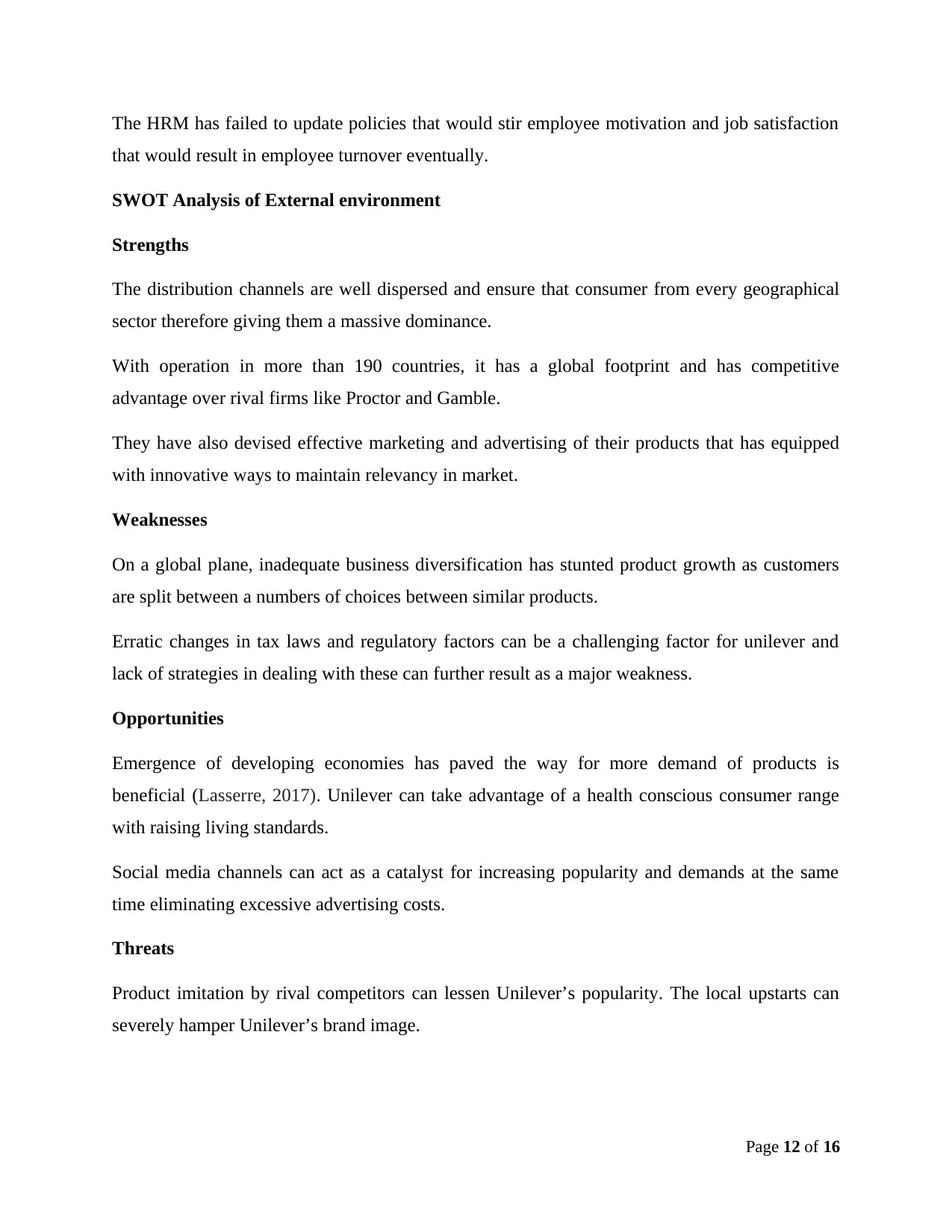
The HRM has failed to update policies that would stir employee motivation and job satisfaction
that would result in employee turnover eventually.
SWOT Analysis of External environment
Strengths
The distribution channels are well dispersed and ensure that consumer from every geographical
sector therefore giving them a massive dominance.
With operation in more than 190 countries, it has a global footprint and has competitive
advantage over rival firms like Proctor and Gamble.
They have also devised effective marketing and advertising of their products that has equipped
with innovative ways to maintain relevancy in market.
Weaknesses
On a global plane, inadequate business diversification has stunted product growth as customers
are split between a numbers of choices between similar products.
Erratic changes in tax laws and regulatory factors can be a challenging factor for unilever and
lack of strategies in dealing with these can further result as a major weakness.
Opportunities
Emergence of developing economies has paved the way for more demand of products is
beneficial (Lasserre, 2017). Unilever can take advantage of a health conscious consumer range
with raising living standards.
Social media channels can act as a catalyst for increasing popularity and demands at the same
time eliminating excessive advertising costs.
Threats
Product imitation by rival competitors can lessen Unilever’s popularity. The local upstarts can
severely hamper Unilever’s brand image.
Page 12 of 16
that would result in employee turnover eventually.
SWOT Analysis of External environment
Strengths
The distribution channels are well dispersed and ensure that consumer from every geographical
sector therefore giving them a massive dominance.
With operation in more than 190 countries, it has a global footprint and has competitive
advantage over rival firms like Proctor and Gamble.
They have also devised effective marketing and advertising of their products that has equipped
with innovative ways to maintain relevancy in market.
Weaknesses
On a global plane, inadequate business diversification has stunted product growth as customers
are split between a numbers of choices between similar products.
Erratic changes in tax laws and regulatory factors can be a challenging factor for unilever and
lack of strategies in dealing with these can further result as a major weakness.
Opportunities
Emergence of developing economies has paved the way for more demand of products is
beneficial (Lasserre, 2017). Unilever can take advantage of a health conscious consumer range
with raising living standards.
Social media channels can act as a catalyst for increasing popularity and demands at the same
time eliminating excessive advertising costs.
Threats
Product imitation by rival competitors can lessen Unilever’s popularity. The local upstarts can
severely hamper Unilever’s brand image.
Page 12 of 16
⊘ This is a preview!⊘
Do you want full access?
Subscribe today to unlock all pages.
Trusted by 1+ million students worldwide

1 out of 16


Related Documents


Your All-in-One AI-Powered Toolkit for Academic Success.
+13062052269
info@desklib.com
Available 24*7 on WhatsApp / Email
![[object Object]](/_next/static/media/star-bottom.7253800d.svg)
Unlock your academic potential
Copyright © 2020–2025 A2Z Services. All Rights Reserved. Developed and managed by ZUCOL.