Psychology Report: Organized Sports, Mental Health in Adolescents

Verified

Added on  2023/04/10

|6
|969
|96
Report
AI Summary
This psychology report investigates the correlation between participation in organized sports and mental health outcomes in adolescent females (aged 15-21) in Canada. The report begins by highlighting the popularity of sports in Canada and the varying levels of female participation compared to males in organized sports, citing data from CAAWS and Statistics Canada. It explores trends in sports involvement from 1992 to 2016, revealing shifts in participation rates. The report then delves into the relationship between physical activity, mental health, and statistics on self-reported mental wellbeing among adolescent girls. However, it also acknowledges the rising rates of suicide among Canadian teenage girls, prompting a discussion on factors beyond sports, such as stigmatization and social pressures. The report references sources like BBC News, CAAWS, Statistics Canada, and the Faculty of Sports and Exercise Medicine UK to support its claims, providing a comprehensive overview of the complex relationship between sports, mental health, and adolescent wellbeing.
Document Page
Running head: PSYCHOLOGY
Statics indicating past and present of Participating in Organized Sports on the Mental Health
on Adolescents Population - Adolescent females (aged 15 - 21)
Name of the Student
Name of the University
Author Note
tabler-icon-diamond-filled.svg

Paraphrase This Document

Need a fresh take? Get an instant paraphrase of this document with our AI Paraphraser
Document Page
1
PSYCHOLOGY
Organised Sports in Canada
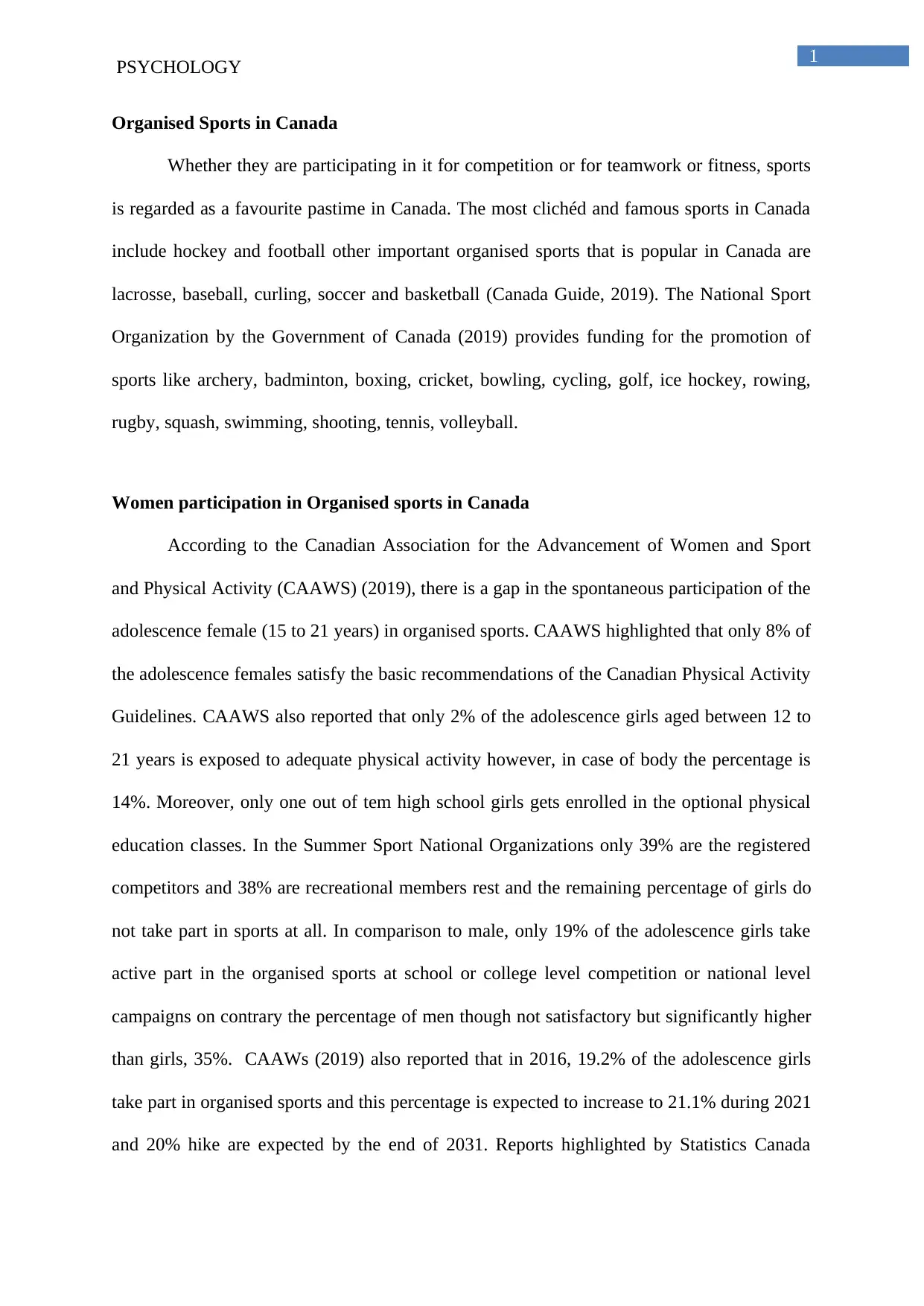
Whether they are participating in it for competition or for teamwork or fitness, sports
is regarded as a favourite pastime in Canada. The most clichéd and famous sports in Canada
include hockey and football other important organised sports that is popular in Canada are
lacrosse, baseball, curling, soccer and basketball (Canada Guide, 2019). The National Sport
Organization by the Government of Canada (2019) provides funding for the promotion of
sports like archery, badminton, boxing, cricket, bowling, cycling, golf, ice hockey, rowing,
rugby, squash, swimming, shooting, tennis, volleyball.
Women participation in Organised sports in Canada
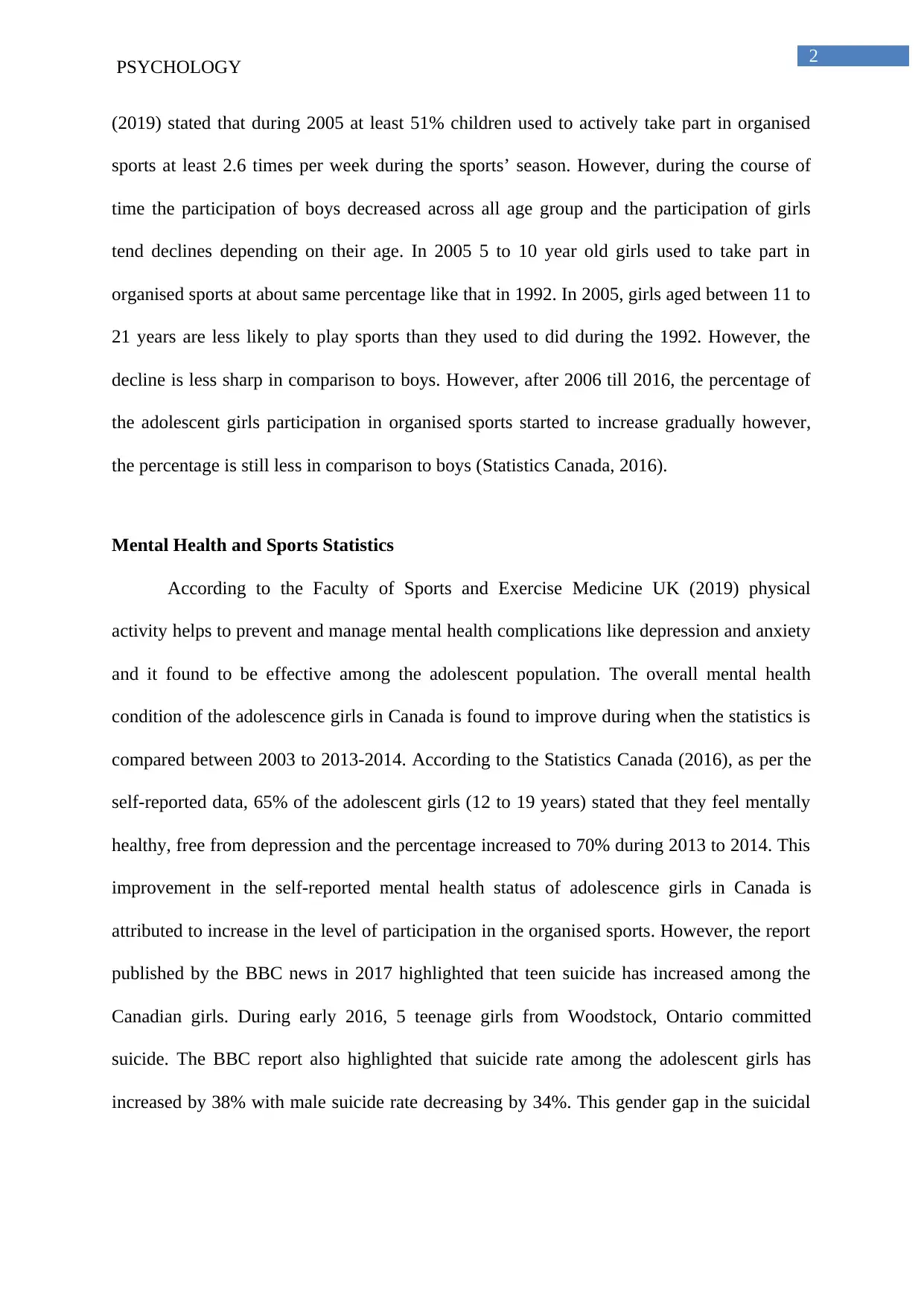
According to the Canadian Association for the Advancement of Women and Sport
and Physical Activity (CAAWS) (2019), there is a gap in the spontaneous participation of the
adolescence female (15 to 21 years) in organised sports. CAAWS highlighted that only 8% of
the adolescence females satisfy the basic recommendations of the Canadian Physical Activity
Guidelines. CAAWS also reported that only 2% of the adolescence girls aged between 12 to
21 years is exposed to adequate physical activity however, in case of body the percentage is
14%. Moreover, only one out of tem high school girls gets enrolled in the optional physical
education classes. In the Summer Sport National Organizations only 39% are the registered
competitors and 38% are recreational members rest and the remaining percentage of girls do
not take part in sports at all. In comparison to male, only 19% of the adolescence girls take
active part in the organised sports at school or college level competition or national level
campaigns on contrary the percentage of men though not satisfactory but significantly higher
than girls, 35%. CAAWs (2019) also reported that in 2016, 19.2% of the adolescence girls
take part in organised sports and this percentage is expected to increase to 21.1% during 2021
and 20% hike are expected by the end of 2031. Reports highlighted by Statistics Canada
Document Page
2
PSYCHOLOGY
(2019) stated that during 2005 at least 51% children used to actively take part in organised
sports at least 2.6 times per week during the sports’ season. However, during the course of
time the participation of boys decreased across all age group and the participation of girls
tend declines depending on their age. In 2005 5 to 10 year old girls used to take part in
organised sports at about same percentage like that in 1992. In 2005, girls aged between 11 to
21 years are less likely to play sports than they used to did during the 1992. However, the
decline is less sharp in comparison to boys. However, after 2006 till 2016, the percentage of
the adolescent girls participation in organised sports started to increase gradually however,
the percentage is still less in comparison to boys (Statistics Canada, 2016).
Mental Health and Sports Statistics
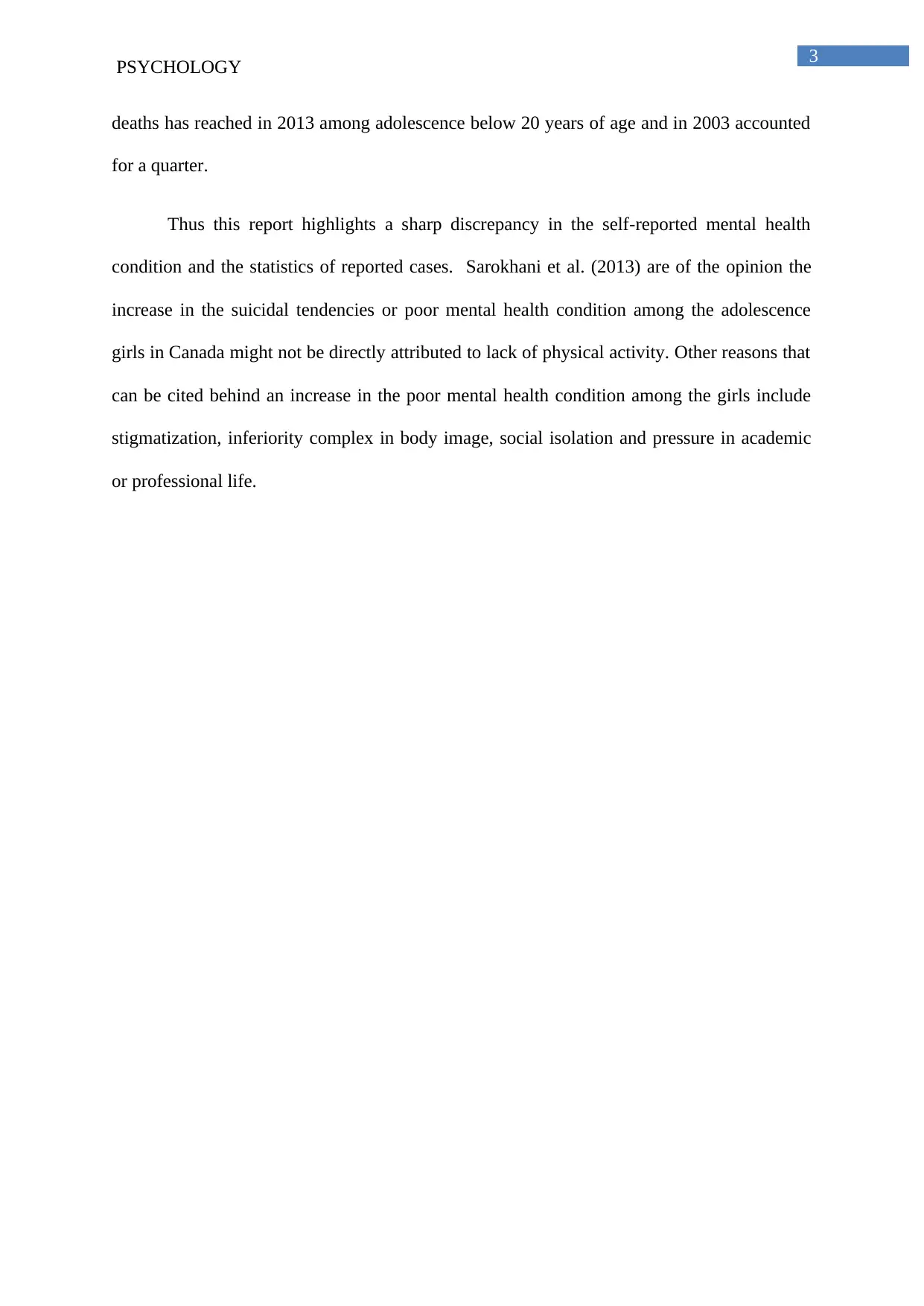
According to the Faculty of Sports and Exercise Medicine UK (2019) physical
activity helps to prevent and manage mental health complications like depression and anxiety
and it found to be effective among the adolescent population. The overall mental health
condition of the adolescence girls in Canada is found to improve during when the statistics is
compared between 2003 to 2013-2014. According to the Statistics Canada (2016), as per the
self-reported data, 65% of the adolescent girls (12 to 19 years) stated that they feel mentally
healthy, free from depression and the percentage increased to 70% during 2013 to 2014. This
improvement in the self-reported mental health status of adolescence girls in Canada is
attributed to increase in the level of participation in the organised sports. However, the report
published by the BBC news in 2017 highlighted that teen suicide has increased among the
Canadian girls. During early 2016, 5 teenage girls from Woodstock, Ontario committed
suicide. The BBC report also highlighted that suicide rate among the adolescent girls has
increased by 38% with male suicide rate decreasing by 34%. This gender gap in the suicidal
Document Page
3
PSYCHOLOGY
deaths has reached in 2013 among adolescence below 20 years of age and in 2003 accounted
for a quarter.
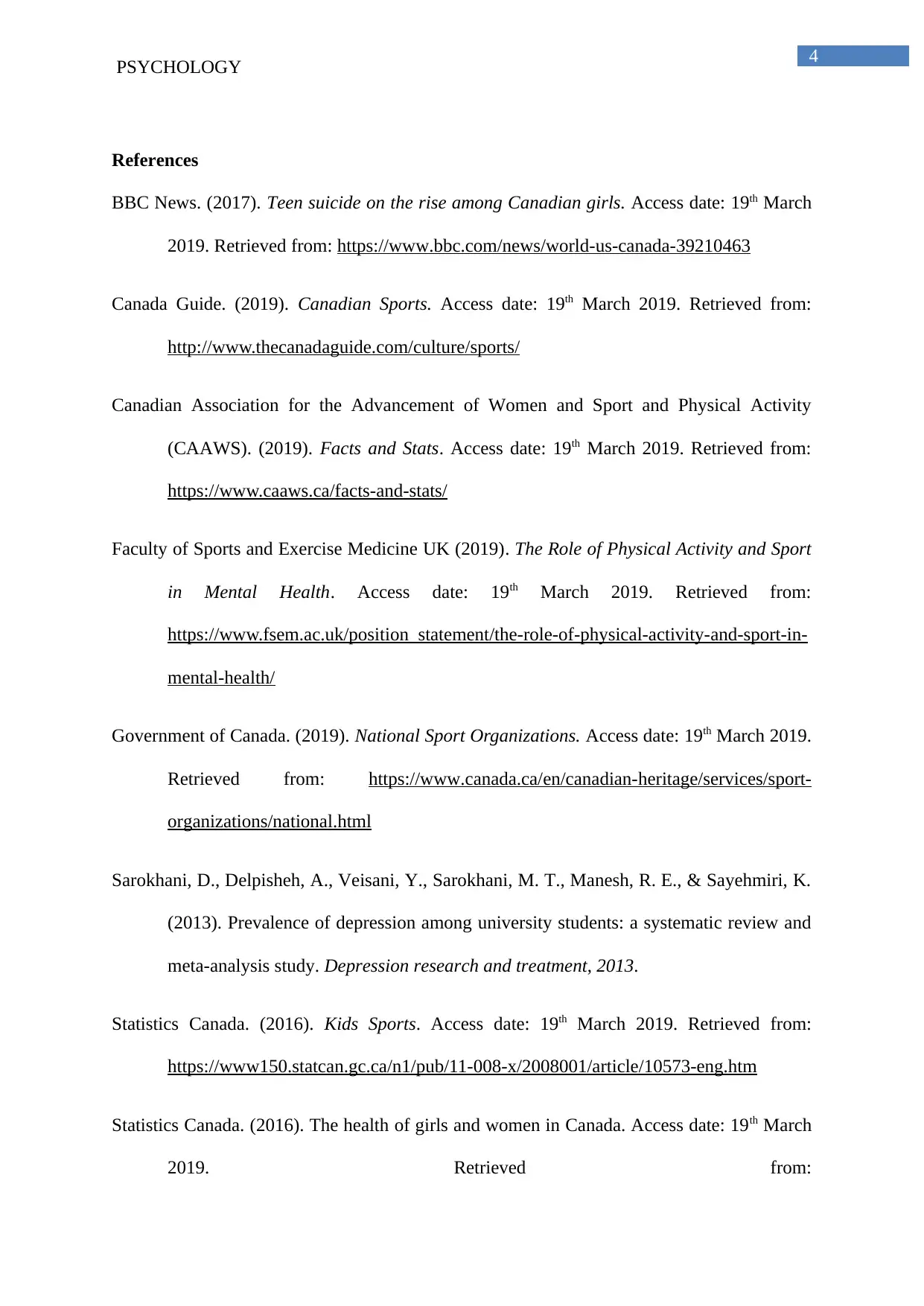
Thus this report highlights a sharp discrepancy in the self-reported mental health
condition and the statistics of reported cases. Sarokhani et al. (2013) are of the opinion the
increase in the suicidal tendencies or poor mental health condition among the adolescence
girls in Canada might not be directly attributed to lack of physical activity. Other reasons that
can be cited behind an increase in the poor mental health condition among the girls include
stigmatization, inferiority complex in body image, social isolation and pressure in academic
or professional life.
tabler-icon-diamond-filled.svg

Paraphrase This Document

Need a fresh take? Get an instant paraphrase of this document with our AI Paraphraser
Document Page
4
PSYCHOLOGY
References
BBC News. (2017). Teen suicide on the rise among Canadian girls. Access date: 19th March
2019. Retrieved from: https://www.bbc.com/news/world-us-canada-39210463
Canada Guide. (2019). Canadian Sports. Access date: 19th March 2019. Retrieved from:
http://www.thecanadaguide.com/culture/sports/
Canadian Association for the Advancement of Women and Sport and Physical Activity
(CAAWS). (2019). Facts and Stats. Access date: 19th March 2019. Retrieved from:
https://www.caaws.ca/facts-and-stats/
Faculty of Sports and Exercise Medicine UK (2019). The Role of Physical Activity and Sport
in Mental Health. Access date: 19th March 2019. Retrieved from:
https://www.fsem.ac.uk/position_statement/the-role-of-physical-activity-and-sport-in-
mental-health/
Government of Canada. (2019). National Sport Organizations. Access date: 19th March 2019.
Retrieved from: https://www.canada.ca/en/canadian-heritage/services/sport-
organizations/national.html
Sarokhani, D., Delpisheh, A., Veisani, Y., Sarokhani, M. T., Manesh, R. E., & Sayehmiri, K.
(2013). Prevalence of depression among university students: a systematic review and
meta-analysis study. Depression research and treatment, 2013.
Statistics Canada. (2016). Kids Sports. Access date: 19th March 2019. Retrieved from:
https://www150.statcan.gc.ca/n1/pub/11-008-x/2008001/article/10573-eng.htm
Statistics Canada. (2016). The health of girls and women in Canada. Access date: 19th March
2019. Retrieved from:
Document Page
5
PSYCHOLOGY
https://www150.statcan.gc.ca/n1/pub/89-503-x/2015001/article/14324/c-g/c-g01-
eng.htm
chevron_up_icon
1 out of 6
circle_padding
hide_on_mobile
zoom_out_icon
[object Object]