Report on Orientation for Success: Skills and Cultural Understanding
VerifiedAdded on 2023/06/13
|11
|2173
|122
Report
AI Summary
This report provides an overview of the skills and knowledge gained through an orientation program aimed at fostering success in higher education. It highlights the importance of cultural and behavioral awareness, teamwork, and peer discussions in developing a well-rounded student. The report includes a personal SWOT analysis, identifying strengths, weaknesses, opportunities, and threats related to learning and skill development. Key skills discussed include communication, time management, and problem-solving, all of which are crucial for both academic and professional success. The report concludes that continuous improvement and self-awareness are essential for students to build a distinct identity and thrive in both university and organizational settings. Desklib provides access to this report and many other solved assignments for students.
Orientation for Success in
Higher Education
Higher Education

Paraphrase This Document
Need a fresh take? Get an instant paraphrase of this document with our AI Paraphraser
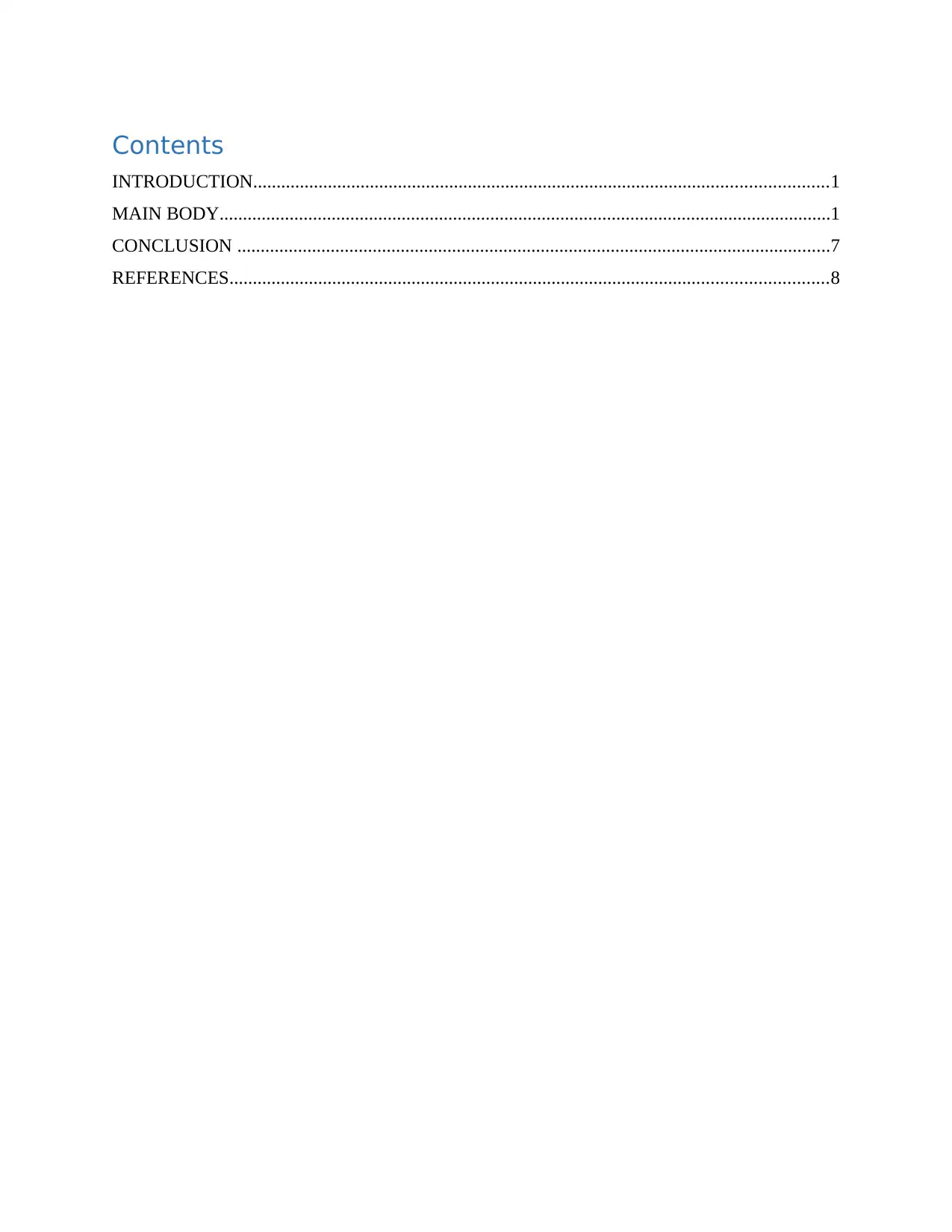
Contents
INTRODUCTION...........................................................................................................................1
MAIN BODY...................................................................................................................................1
CONCLUSION ...............................................................................................................................7
REFERENCES................................................................................................................................8
INTRODUCTION...........................................................................................................................1
MAIN BODY...................................................................................................................................1
CONCLUSION ...............................................................................................................................7
REFERENCES................................................................................................................................8
INTRODUCTION
Student success is measured through how capable a learner is to understand accomplish
their academic goals as well as objectives (Bellingham and Et. Al., 2018). This learning helps
an individual in becoming self-reliant and successful. Orientation aids an individual well as
university to get a better knowledge of of each other. This project essentially highlights the
understanding of varied topics as well as learning outcomes from them.
MAIN BODY
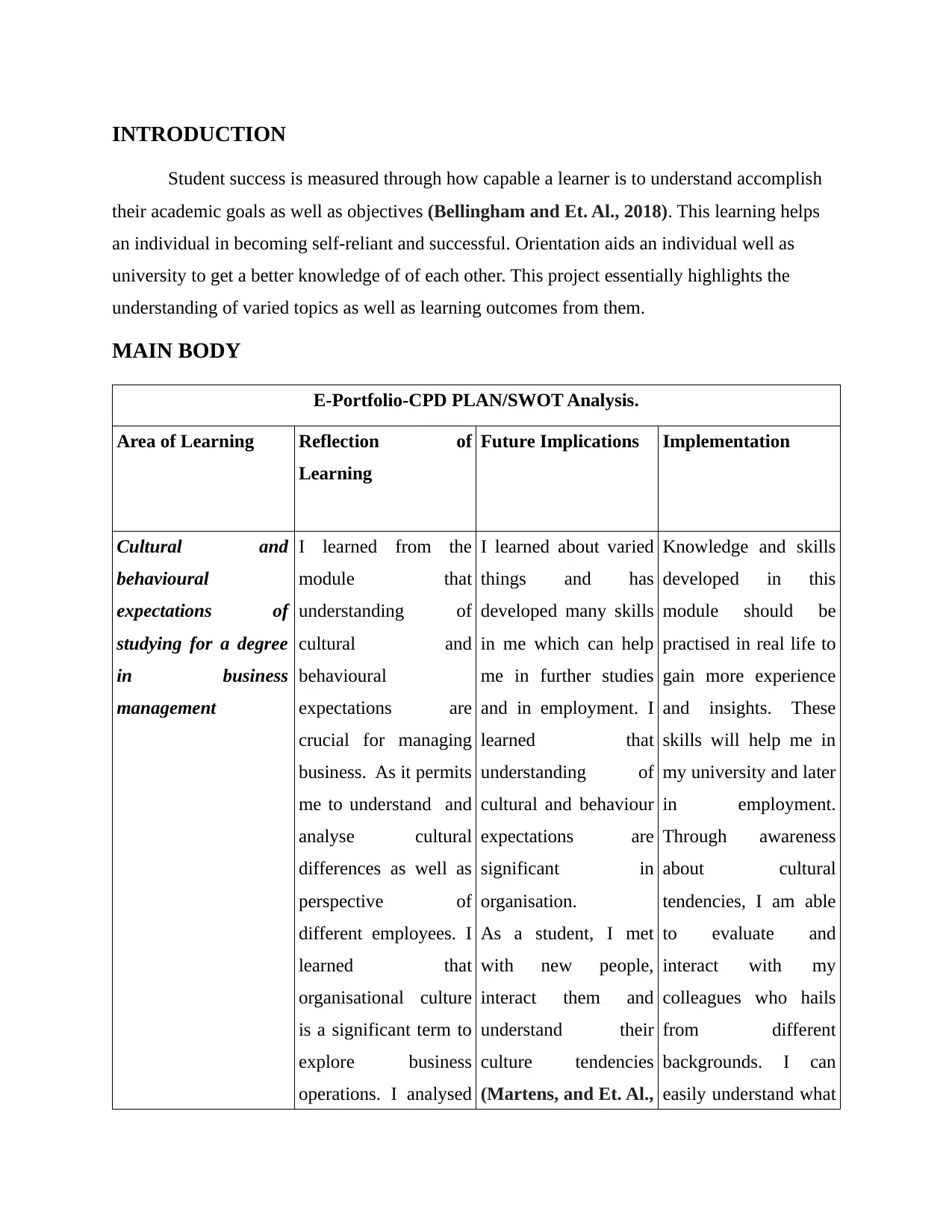
E-Portfolio-CPD PLAN/SWOT Analysis.
Area of Learning Reflection of
Learning
Future Implications Implementation
Cultural and
behavioural
expectations of
studying for a degree
in business
management
I learned from the
module that
understanding of
cultural and
behavioural
expectations are
crucial for managing
business. As it permits
me to understand and
analyse cultural
differences as well as
perspective of
different employees. I
learned that
organisational culture
is a significant term to
explore business
operations. I analysed
I learned about varied
things and has
developed many skills
in me which can help
me in further studies
and in employment. I
learned that
understanding of
cultural and behaviour
expectations are
significant in
organisation.
As a student, I met
with new people,
interact them and
understand their
culture tendencies
(Martens, and Et. Al.,
Knowledge and skills
developed in this
module should be
practised in real life to
gain more experience
and insights. These
skills will help me in
my university and later
in employment.
Through awareness
about cultural
tendencies, I am able
to evaluate and
interact with my
colleagues who hails
from different
backgrounds. I can
easily understand what
Student success is measured through how capable a learner is to understand accomplish
their academic goals as well as objectives (Bellingham and Et. Al., 2018). This learning helps
an individual in becoming self-reliant and successful. Orientation aids an individual well as
university to get a better knowledge of of each other. This project essentially highlights the
understanding of varied topics as well as learning outcomes from them.
MAIN BODY
E-Portfolio-CPD PLAN/SWOT Analysis.
Area of Learning Reflection of
Learning
Future Implications Implementation
Cultural and
behavioural
expectations of
studying for a degree
in business
management
I learned from the
module that
understanding of
cultural and
behavioural
expectations are
crucial for managing
business. As it permits
me to understand and
analyse cultural
differences as well as
perspective of
different employees. I
learned that
organisational culture
is a significant term to
explore business
operations. I analysed
I learned about varied
things and has
developed many skills
in me which can help
me in further studies
and in employment. I
learned that
understanding of
cultural and behaviour
expectations are
significant in
organisation.
As a student, I met
with new people,
interact them and
understand their
culture tendencies
(Martens, and Et. Al.,
Knowledge and skills
developed in this
module should be
practised in real life to
gain more experience
and insights. These
skills will help me in
my university and later
in employment.
Through awareness
about cultural
tendencies, I am able
to evaluate and
interact with my
colleagues who hails
from different
backgrounds. I can
easily understand what
⊘ This is a preview!⊘
Do you want full access?
Subscribe today to unlock all pages.

Trusted by 1+ million students worldwide
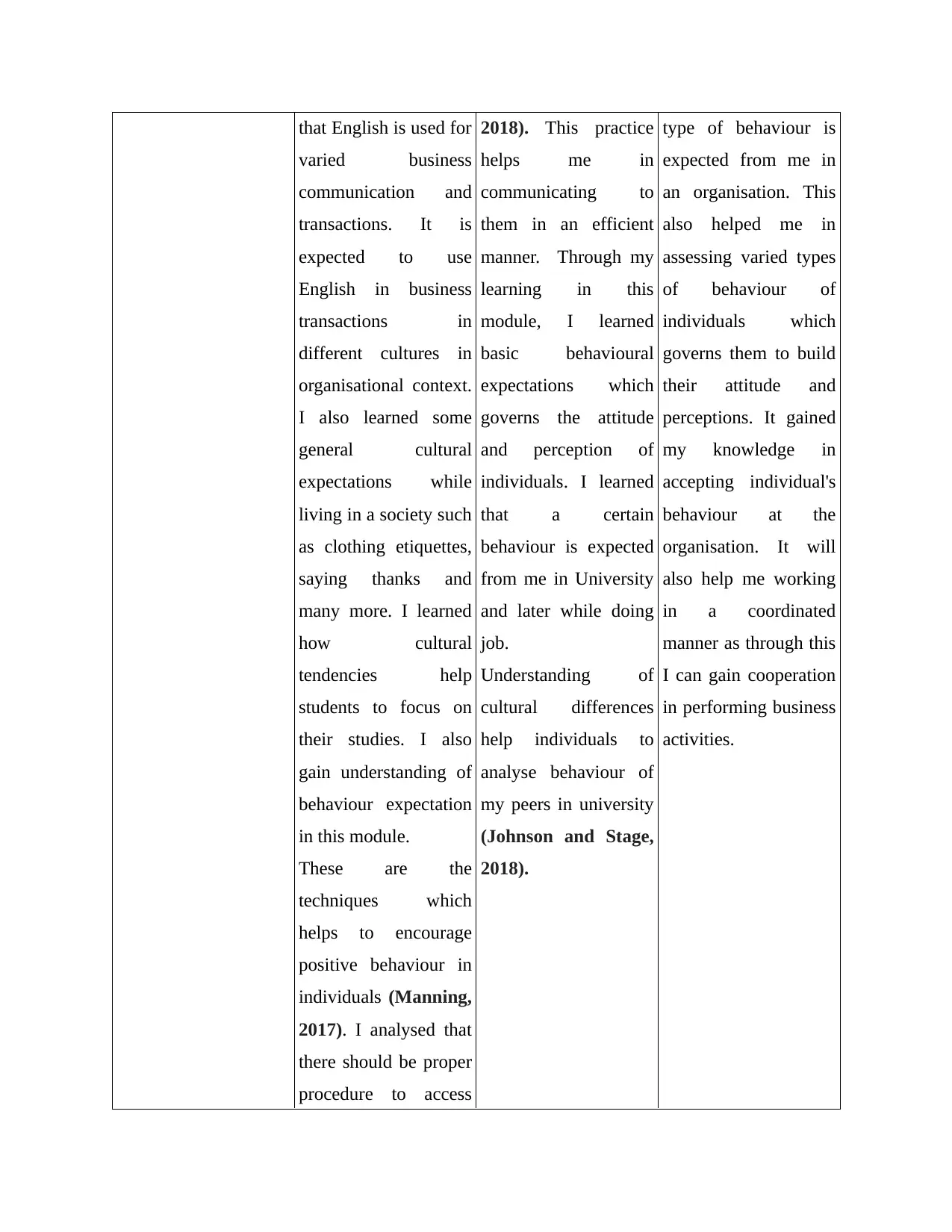
that English is used for
varied business
communication and
transactions. It is
expected to use
English in business
transactions in
different cultures in
organisational context.
I also learned some
general cultural
expectations while
living in a society such
as clothing etiquettes,
saying thanks and
many more. I learned
how cultural
tendencies help
students to focus on
their studies. I also
gain understanding of
behaviour expectation
in this module.
These are the
techniques which
helps to encourage
positive behaviour in
individuals (Manning,
2017). I analysed that
there should be proper
procedure to access
2018). This practice
helps me in
communicating to
them in an efficient
manner. Through my
learning in this
module, I learned
basic behavioural
expectations which
governs the attitude
and perception of
individuals. I learned
that a certain
behaviour is expected
from me in University
and later while doing
job.
Understanding of
cultural differences
help individuals to
analyse behaviour of
my peers in university
(Johnson and Stage,
2018).
type of behaviour is
expected from me in
an organisation. This
also helped me in
assessing varied types
of behaviour of
individuals which
governs them to build
their attitude and
perceptions. It gained
my knowledge in
accepting individual's
behaviour at the
organisation. It will
also help me working
in a coordinated
manner as through this
I can gain cooperation
in performing business
activities.
varied business
communication and
transactions. It is
expected to use
English in business
transactions in
different cultures in
organisational context.
I also learned some
general cultural
expectations while
living in a society such
as clothing etiquettes,
saying thanks and
many more. I learned
how cultural
tendencies help
students to focus on
their studies. I also
gain understanding of
behaviour expectation
in this module.
These are the
techniques which
helps to encourage
positive behaviour in
individuals (Manning,
2017). I analysed that
there should be proper
procedure to access
2018). This practice
helps me in
communicating to
them in an efficient
manner. Through my
learning in this
module, I learned
basic behavioural
expectations which
governs the attitude
and perception of
individuals. I learned
that a certain
behaviour is expected
from me in University
and later while doing
job.
Understanding of
cultural differences
help individuals to
analyse behaviour of
my peers in university
(Johnson and Stage,
2018).
type of behaviour is
expected from me in
an organisation. This
also helped me in
assessing varied types
of behaviour of
individuals which
governs them to build
their attitude and
perceptions. It gained
my knowledge in
accepting individual's
behaviour at the
organisation. It will
also help me working
in a coordinated
manner as through this
I can gain cooperation
in performing business
activities.
Paraphrase This Document
Need a fresh take? Get an instant paraphrase of this document with our AI Paraphraser
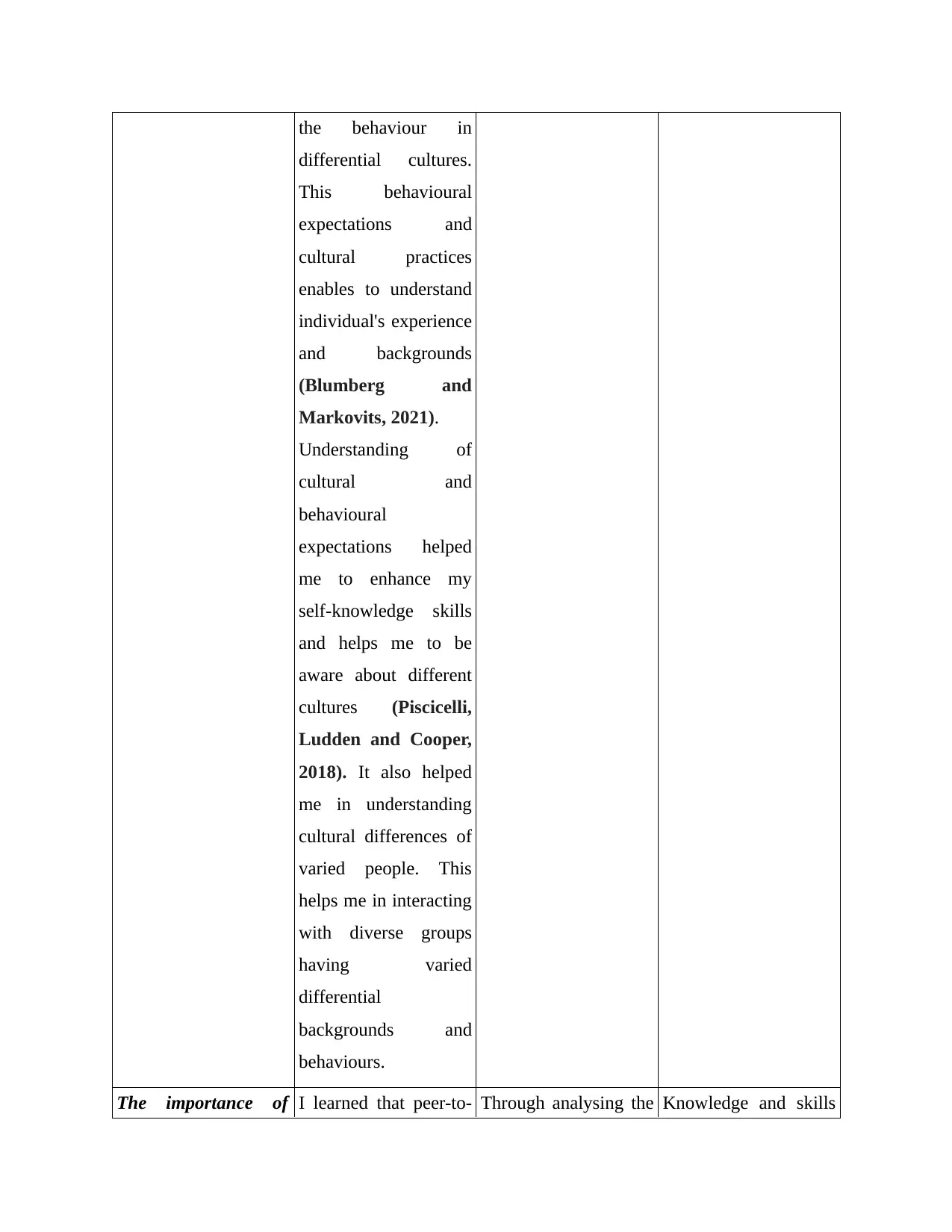
the behaviour in
differential cultures.
This behavioural
expectations and
cultural practices
enables to understand
individual's experience
and backgrounds
(Blumberg and
Markovits, 2021).
Understanding of
cultural and
behavioural
expectations helped
me to enhance my
self-knowledge skills
and helps me to be
aware about different
cultures (Piscicelli,
Ludden and Cooper,
2018). It also helped
me in understanding
cultural differences of
varied people. This
helps me in interacting
with diverse groups
having varied
differential
backgrounds and
behaviours.
The importance of I learned that peer-to- Through analysing the Knowledge and skills
differential cultures.
This behavioural
expectations and
cultural practices
enables to understand
individual's experience
and backgrounds
(Blumberg and
Markovits, 2021).
Understanding of
cultural and
behavioural
expectations helped
me to enhance my
self-knowledge skills
and helps me to be
aware about different
cultures (Piscicelli,
Ludden and Cooper,
2018). It also helped
me in understanding
cultural differences of
varied people. This
helps me in interacting
with diverse groups
having varied
differential
backgrounds and
behaviours.
The importance of I learned that peer-to- Through analysing the Knowledge and skills
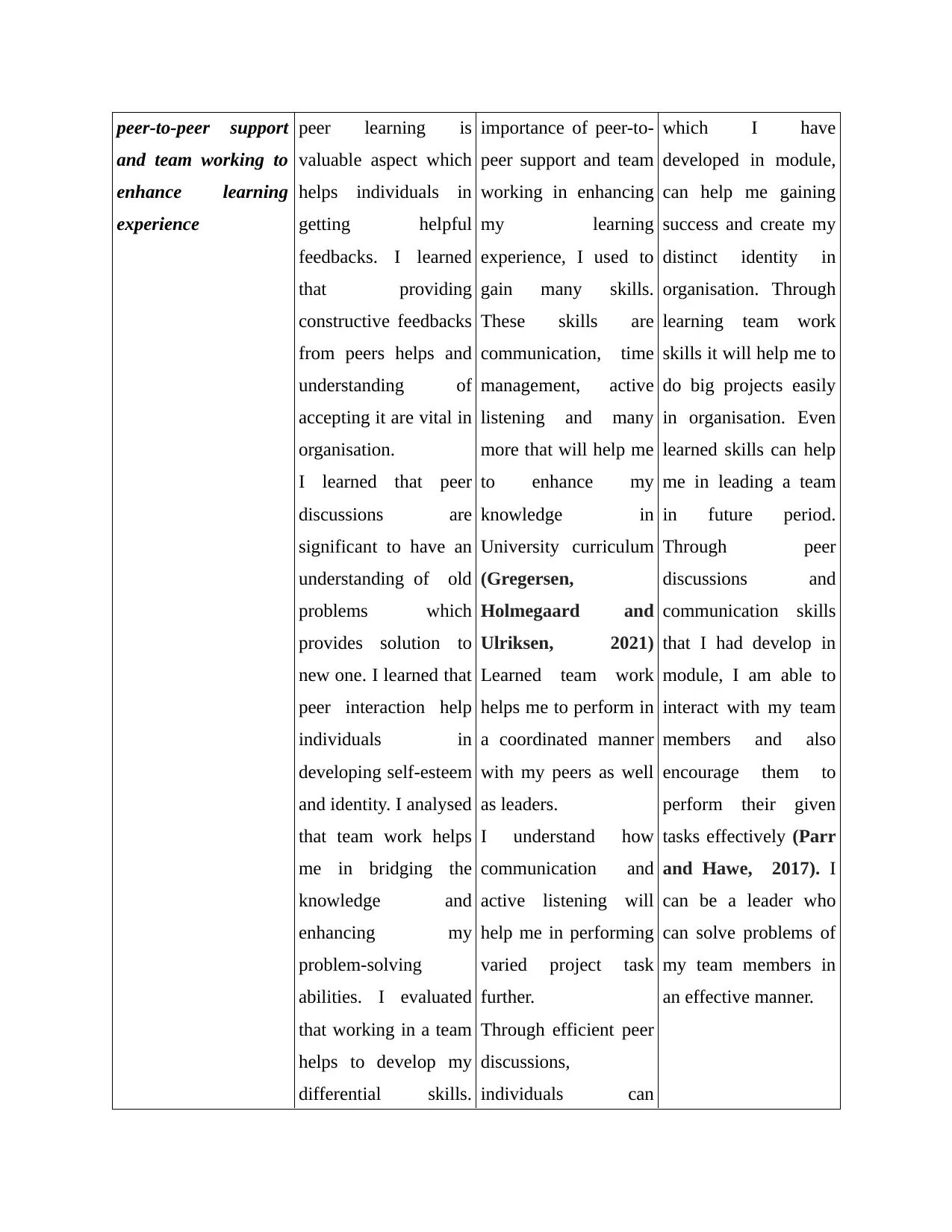
peer-to-peer support
and team working to
enhance learning
experience
peer learning is
valuable aspect which
helps individuals in
getting helpful
feedbacks. I learned
that providing
constructive feedbacks
from peers helps and
understanding of
accepting it are vital in
organisation.
I learned that peer
discussions are
significant to have an
understanding of old
problems which
provides solution to
new one. I learned that
peer interaction help
individuals in
developing self-esteem
and identity. I analysed
that team work helps
me in bridging the
knowledge and
enhancing my
problem-solving
abilities. I evaluated
that working in a team
helps to develop my
differential skills.
importance of peer-to-
peer support and team
working in enhancing
my learning
experience, I used to
gain many skills.
These skills are
communication, time
management, active
listening and many
more that will help me
to enhance my
knowledge in
University curriculum
(Gregersen,
Holmegaard and
Ulriksen, 2021)
Learned team work
helps me to perform in
a coordinated manner
with my peers as well
as leaders.
I understand how
communication and
active listening will
help me in performing
varied project task
further.
Through efficient peer
discussions,
individuals can
which I have
developed in module,
can help me gaining
success and create my
distinct identity in
organisation. Through
learning team work
skills it will help me to
do big projects easily
in organisation. Even
learned skills can help
me in leading a team
in future period.
Through peer
discussions and
communication skills
that I had develop in
module, I am able to
interact with my team
members and also
encourage them to
perform their given
tasks effectively (Parr
and Hawe, 2017). I
can be a leader who
can solve problems of
my team members in
an effective manner.
and team working to
enhance learning
experience
peer learning is
valuable aspect which
helps individuals in
getting helpful
feedbacks. I learned
that providing
constructive feedbacks
from peers helps and
understanding of
accepting it are vital in
organisation.
I learned that peer
discussions are
significant to have an
understanding of old
problems which
provides solution to
new one. I learned that
peer interaction help
individuals in
developing self-esteem
and identity. I analysed
that team work helps
me in bridging the
knowledge and
enhancing my
problem-solving
abilities. I evaluated
that working in a team
helps to develop my
differential skills.
importance of peer-to-
peer support and team
working in enhancing
my learning
experience, I used to
gain many skills.
These skills are
communication, time
management, active
listening and many
more that will help me
to enhance my
knowledge in
University curriculum
(Gregersen,
Holmegaard and
Ulriksen, 2021)
Learned team work
helps me to perform in
a coordinated manner
with my peers as well
as leaders.
I understand how
communication and
active listening will
help me in performing
varied project task
further.
Through efficient peer
discussions,
individuals can
which I have
developed in module,
can help me gaining
success and create my
distinct identity in
organisation. Through
learning team work
skills it will help me to
do big projects easily
in organisation. Even
learned skills can help
me in leading a team
in future period.
Through peer
discussions and
communication skills
that I had develop in
module, I am able to
interact with my team
members and also
encourage them to
perform their given
tasks effectively (Parr
and Hawe, 2017). I
can be a leader who
can solve problems of
my team members in
an effective manner.
⊘ This is a preview!⊘
Do you want full access?
Subscribe today to unlock all pages.
Trusted by 1+ million students worldwide
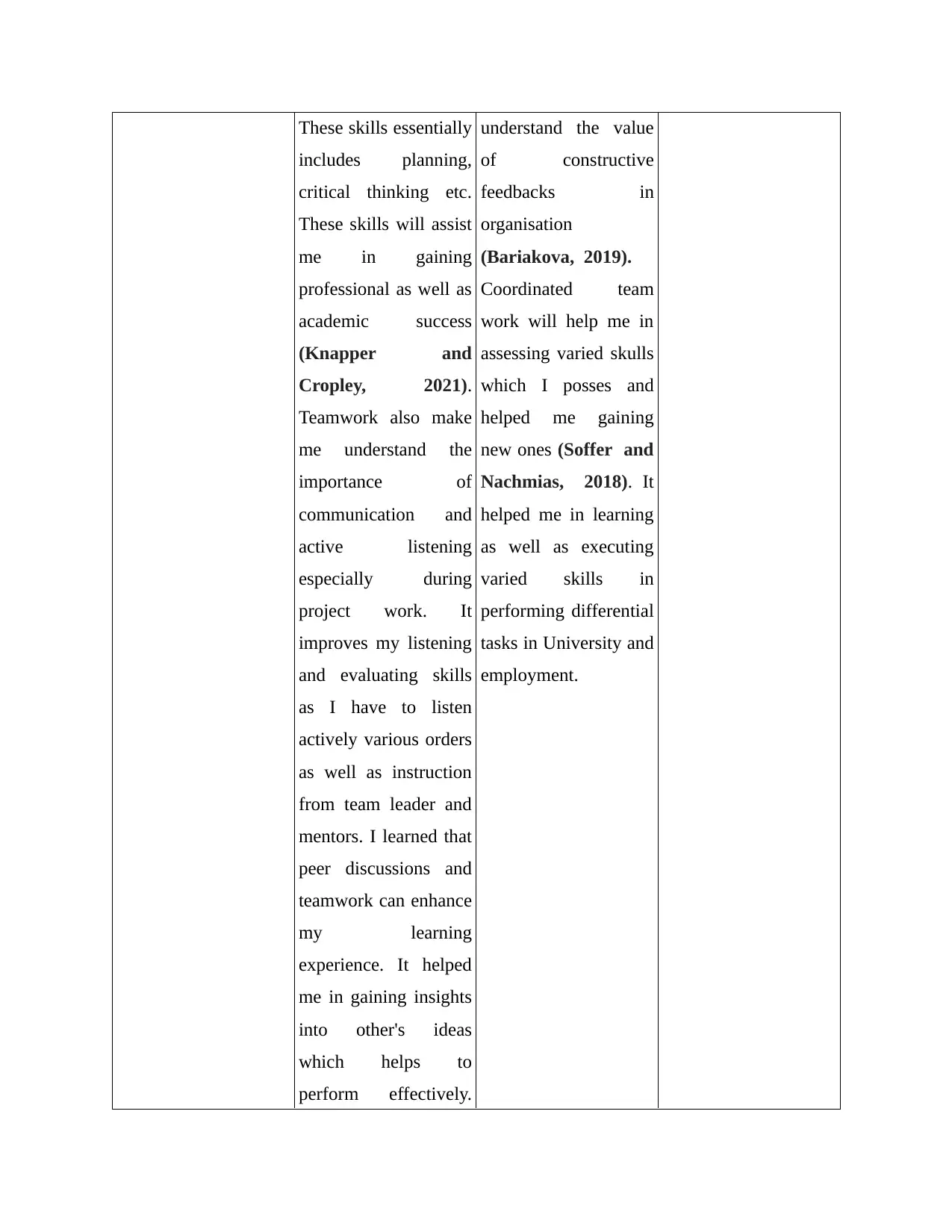
These skills essentially
includes planning,
critical thinking etc.
These skills will assist
me in gaining
professional as well as
academic success
(Knapper and
Cropley, 2021).
Teamwork also make
me understand the
importance of
communication and
active listening
especially during
project work. It
improves my listening
and evaluating skills
as I have to listen
actively various orders
as well as instruction
from team leader and
mentors. I learned that
peer discussions and
teamwork can enhance
my learning
experience. It helped
me in gaining insights
into other's ideas
which helps to
perform effectively.
understand the value
of constructive
feedbacks in
organisation
(Bariakova, 2019).
Coordinated team
work will help me in
assessing varied skulls
which I posses and
helped me gaining
new ones (Soffer and
Nachmias, 2018). It
helped me in learning
as well as executing
varied skills in
performing differential
tasks in University and
employment.
includes planning,
critical thinking etc.
These skills will assist
me in gaining
professional as well as
academic success
(Knapper and
Cropley, 2021).
Teamwork also make
me understand the
importance of
communication and
active listening
especially during
project work. It
improves my listening
and evaluating skills
as I have to listen
actively various orders
as well as instruction
from team leader and
mentors. I learned that
peer discussions and
teamwork can enhance
my learning
experience. It helped
me in gaining insights
into other's ideas
which helps to
perform effectively.
understand the value
of constructive
feedbacks in
organisation
(Bariakova, 2019).
Coordinated team
work will help me in
assessing varied skulls
which I posses and
helped me gaining
new ones (Soffer and
Nachmias, 2018). It
helped me in learning
as well as executing
varied skills in
performing differential
tasks in University and
employment.
Paraphrase This Document
Need a fresh take? Get an instant paraphrase of this document with our AI Paraphraser
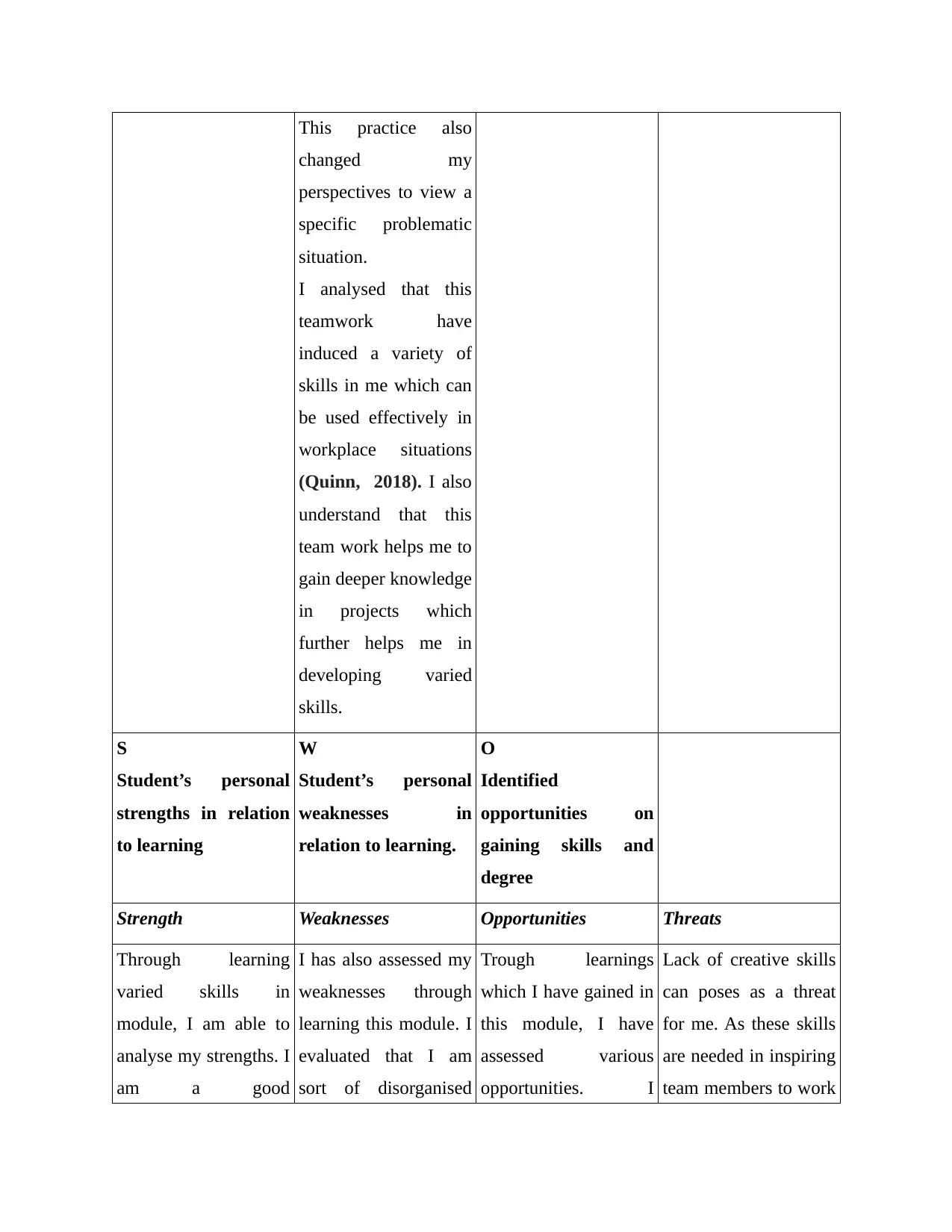
This practice also
changed my
perspectives to view a
specific problematic
situation.
I analysed that this
teamwork have
induced a variety of
skills in me which can
be used effectively in
workplace situations
(Quinn, 2018). I also
understand that this
team work helps me to
gain deeper knowledge
in projects which
further helps me in
developing varied
skills.
S
Student’s personal
strengths in relation
to learning
W
Student’s personal
weaknesses in
relation to learning.
O
Identified
opportunities on
gaining skills and
degree
Strength Weaknesses Opportunities Threats
Through learning
varied skills in
module, I am able to
analyse my strengths. I
am a good
I has also assessed my
weaknesses through
learning this module. I
evaluated that I am
sort of disorganised
Trough learnings
which I have gained in
this module, I have
assessed various
opportunities. I
Lack of creative skills
can poses as a threat
for me. As these skills
are needed in inspiring
team members to work
changed my
perspectives to view a
specific problematic
situation.
I analysed that this
teamwork have
induced a variety of
skills in me which can
be used effectively in
workplace situations
(Quinn, 2018). I also
understand that this
team work helps me to
gain deeper knowledge
in projects which
further helps me in
developing varied
skills.
S
Student’s personal
strengths in relation
to learning
W
Student’s personal
weaknesses in
relation to learning.
O
Identified
opportunities on
gaining skills and
degree
Strength Weaknesses Opportunities Threats
Through learning
varied skills in
module, I am able to
analyse my strengths. I
am a good
I has also assessed my
weaknesses through
learning this module. I
evaluated that I am
sort of disorganised
Trough learnings
which I have gained in
this module, I have
assessed various
opportunities. I
Lack of creative skills
can poses as a threat
for me. As these skills
are needed in inspiring
team members to work
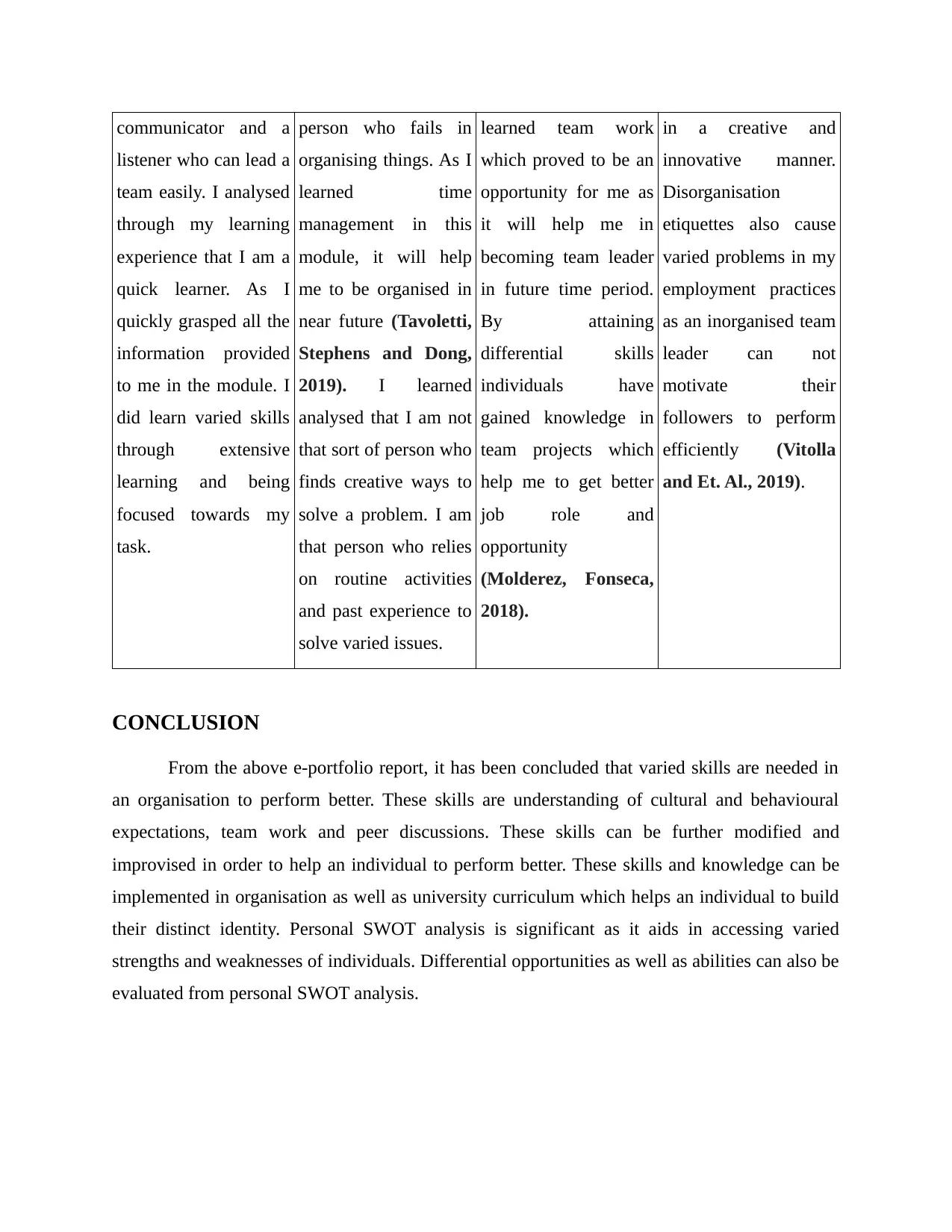
communicator and a
listener who can lead a
team easily. I analysed
through my learning
experience that I am a
quick learner. As I
quickly grasped all the
information provided
to me in the module. I
did learn varied skills
through extensive
learning and being
focused towards my
task.
person who fails in
organising things. As I
learned time
management in this
module, it will help
me to be organised in
near future (Tavoletti,
Stephens and Dong,
2019). I learned
analysed that I am not
that sort of person who
finds creative ways to
solve a problem. I am
that person who relies
on routine activities
and past experience to
solve varied issues.
learned team work
which proved to be an
opportunity for me as
it will help me in
becoming team leader
in future time period.
By attaining
differential skills
individuals have
gained knowledge in
team projects which
help me to get better
job role and
opportunity
(Molderez, Fonseca,
2018).
in a creative and
innovative manner.
Disorganisation
etiquettes also cause
varied problems in my
employment practices
as an inorganised team
leader can not
motivate their
followers to perform
efficiently (Vitolla
and Et. Al., 2019).
CONCLUSION
From the above e-portfolio report, it has been concluded that varied skills are needed in
an organisation to perform better. These skills are understanding of cultural and behavioural
expectations, team work and peer discussions. These skills can be further modified and
improvised in order to help an individual to perform better. These skills and knowledge can be
implemented in organisation as well as university curriculum which helps an individual to build
their distinct identity. Personal SWOT analysis is significant as it aids in accessing varied
strengths and weaknesses of individuals. Differential opportunities as well as abilities can also be
evaluated from personal SWOT analysis.
listener who can lead a
team easily. I analysed
through my learning
experience that I am a
quick learner. As I
quickly grasped all the
information provided
to me in the module. I
did learn varied skills
through extensive
learning and being
focused towards my
task.
person who fails in
organising things. As I
learned time
management in this
module, it will help
me to be organised in
near future (Tavoletti,
Stephens and Dong,
2019). I learned
analysed that I am not
that sort of person who
finds creative ways to
solve a problem. I am
that person who relies
on routine activities
and past experience to
solve varied issues.
learned team work
which proved to be an
opportunity for me as
it will help me in
becoming team leader
in future time period.
By attaining
differential skills
individuals have
gained knowledge in
team projects which
help me to get better
job role and
opportunity
(Molderez, Fonseca,
2018).
in a creative and
innovative manner.
Disorganisation
etiquettes also cause
varied problems in my
employment practices
as an inorganised team
leader can not
motivate their
followers to perform
efficiently (Vitolla
and Et. Al., 2019).
CONCLUSION
From the above e-portfolio report, it has been concluded that varied skills are needed in
an organisation to perform better. These skills are understanding of cultural and behavioural
expectations, team work and peer discussions. These skills can be further modified and
improvised in order to help an individual to perform better. These skills and knowledge can be
implemented in organisation as well as university curriculum which helps an individual to build
their distinct identity. Personal SWOT analysis is significant as it aids in accessing varied
strengths and weaknesses of individuals. Differential opportunities as well as abilities can also be
evaluated from personal SWOT analysis.
⊘ This is a preview!⊘
Do you want full access?
Subscribe today to unlock all pages.
Trusted by 1+ million students worldwide

Paraphrase This Document
Need a fresh take? Get an instant paraphrase of this document with our AI Paraphraser
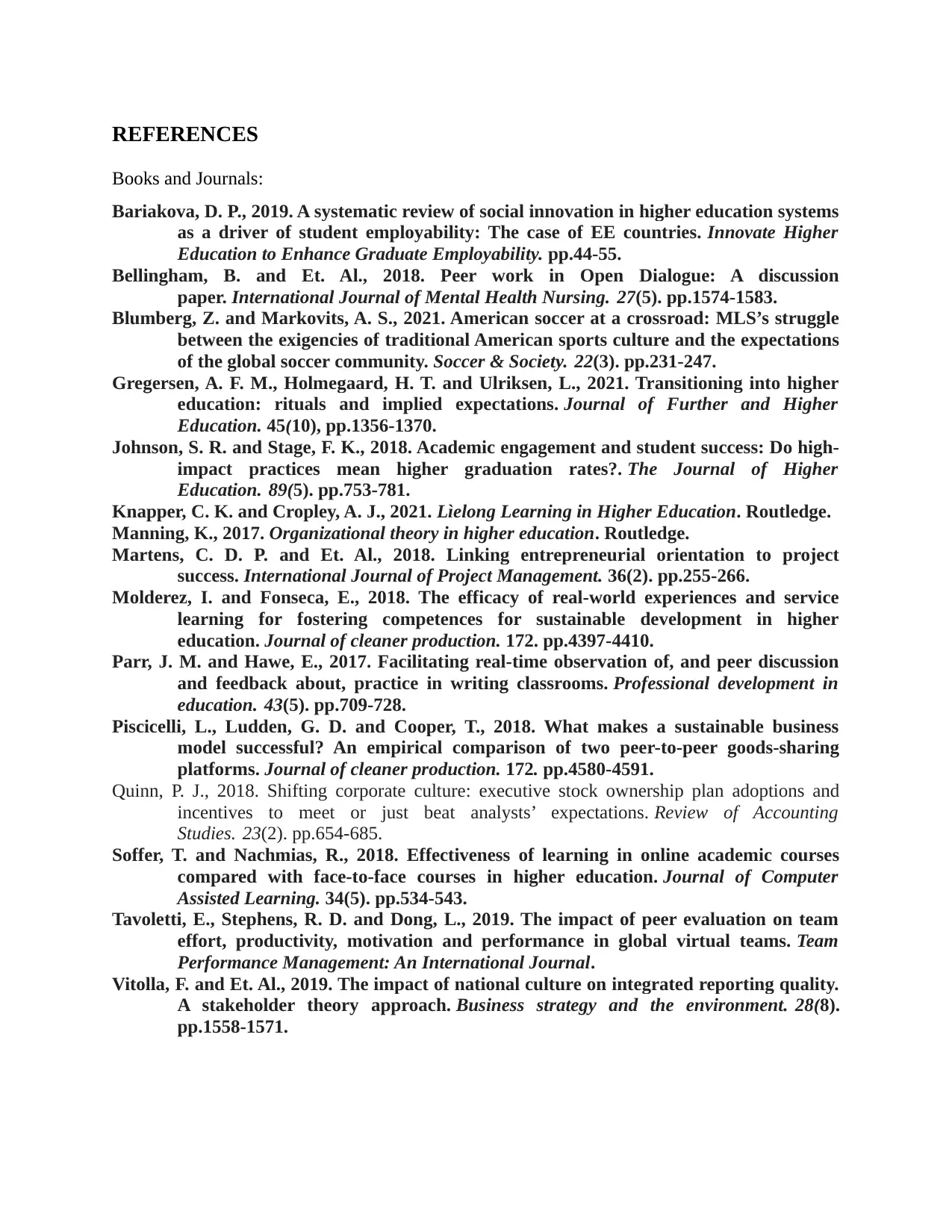
REFERENCES
Books and Journals:
Bariakova, D. P., 2019. A systematic review of social innovation in higher education systems
as a driver of student employability: The case of EE countries. Innovate Higher
Education to Enhance Graduate Employability. pp.44-55.
Bellingham, B. and Et. Al., 2018. Peer work in Open Dialogue: A discussion
paper. International Journal of Mental Health Nursing. 27(5). pp.1574-1583.
Blumberg, Z. and Markovits, A. S., 2021. American soccer at a crossroad: MLS’s struggle
between the exigencies of traditional American sports culture and the expectations
of the global soccer community. Soccer & Society. 22(3). pp.231-247.
Gregersen, A. F. M., Holmegaard, H. T. and Ulriksen, L., 2021. Transitioning into higher
education: rituals and implied expectations. Journal of Further and Higher
Education. 45(10), pp.1356-1370.
Johnson, S. R. and Stage, F. K., 2018. Academic engagement and student success: Do high-
impact practices mean higher graduation rates?. The Journal of Higher
Education. 89(5). pp.753-781.
Knapper, C. K. and Cropley, A. J., 2021. Lìelong Learning in Higher Education. Routledge.
Manning, K., 2017. Organizational theory in higher education. Routledge.
Martens, C. D. P. and Et. Al., 2018. Linking entrepreneurial orientation to project
success. International Journal of Project Management. 36(2). pp.255-266.
Molderez, I. and Fonseca, E., 2018. The efficacy of real-world experiences and service
learning for fostering competences for sustainable development in higher
education. Journal of cleaner production. 172. pp.4397-4410.
Parr, J. M. and Hawe, E., 2017. Facilitating real-time observation of, and peer discussion
and feedback about, practice in writing classrooms. Professional development in
education. 43(5). pp.709-728.
Piscicelli, L., Ludden, G. D. and Cooper, T., 2018. What makes a sustainable business
model successful? An empirical comparison of two peer-to-peer goods-sharing
platforms. Journal of cleaner production. 172. pp.4580-4591.
Quinn, P. J., 2018. Shifting corporate culture: executive stock ownership plan adoptions and
incentives to meet or just beat analysts’ expectations. Review of Accounting
Studies. 23(2). pp.654-685.
Soffer, T. and Nachmias, R., 2018. Effectiveness of learning in online academic courses
compared with face‐to‐face courses in higher education. Journal of Computer
Assisted Learning. 34(5). pp.534-543.
Tavoletti, E., Stephens, R. D. and Dong, L., 2019. The impact of peer evaluation on team
effort, productivity, motivation and performance in global virtual teams. Team
Performance Management: An International Journal.
Vitolla, F. and Et. Al., 2019. The impact of national culture on integrated reporting quality.
A stakeholder theory approach. Business strategy and the environment. 28(8).
pp.1558-1571.
Books and Journals:
Bariakova, D. P., 2019. A systematic review of social innovation in higher education systems
as a driver of student employability: The case of EE countries. Innovate Higher
Education to Enhance Graduate Employability. pp.44-55.
Bellingham, B. and Et. Al., 2018. Peer work in Open Dialogue: A discussion
paper. International Journal of Mental Health Nursing. 27(5). pp.1574-1583.
Blumberg, Z. and Markovits, A. S., 2021. American soccer at a crossroad: MLS’s struggle
between the exigencies of traditional American sports culture and the expectations
of the global soccer community. Soccer & Society. 22(3). pp.231-247.
Gregersen, A. F. M., Holmegaard, H. T. and Ulriksen, L., 2021. Transitioning into higher
education: rituals and implied expectations. Journal of Further and Higher
Education. 45(10), pp.1356-1370.
Johnson, S. R. and Stage, F. K., 2018. Academic engagement and student success: Do high-
impact practices mean higher graduation rates?. The Journal of Higher
Education. 89(5). pp.753-781.
Knapper, C. K. and Cropley, A. J., 2021. Lìelong Learning in Higher Education. Routledge.
Manning, K., 2017. Organizational theory in higher education. Routledge.
Martens, C. D. P. and Et. Al., 2018. Linking entrepreneurial orientation to project
success. International Journal of Project Management. 36(2). pp.255-266.
Molderez, I. and Fonseca, E., 2018. The efficacy of real-world experiences and service
learning for fostering competences for sustainable development in higher
education. Journal of cleaner production. 172. pp.4397-4410.
Parr, J. M. and Hawe, E., 2017. Facilitating real-time observation of, and peer discussion
and feedback about, practice in writing classrooms. Professional development in
education. 43(5). pp.709-728.
Piscicelli, L., Ludden, G. D. and Cooper, T., 2018. What makes a sustainable business
model successful? An empirical comparison of two peer-to-peer goods-sharing
platforms. Journal of cleaner production. 172. pp.4580-4591.
Quinn, P. J., 2018. Shifting corporate culture: executive stock ownership plan adoptions and
incentives to meet or just beat analysts’ expectations. Review of Accounting
Studies. 23(2). pp.654-685.
Soffer, T. and Nachmias, R., 2018. Effectiveness of learning in online academic courses
compared with face‐to‐face courses in higher education. Journal of Computer
Assisted Learning. 34(5). pp.534-543.
Tavoletti, E., Stephens, R. D. and Dong, L., 2019. The impact of peer evaluation on team
effort, productivity, motivation and performance in global virtual teams. Team
Performance Management: An International Journal.
Vitolla, F. and Et. Al., 2019. The impact of national culture on integrated reporting quality.
A stakeholder theory approach. Business strategy and the environment. 28(8).
pp.1558-1571.

1 out of 11


Related Documents


Your All-in-One AI-Powered Toolkit for Academic Success.
+13062052269
info@desklib.com
Available 24*7 on WhatsApp / Email
![[object Object]](/_next/static/media/star-bottom.7253800d.svg)
Unlock your academic potential
Copyright © 2020–2025 A2Z Services. All Rights Reserved. Developed and managed by ZUCOL.