Analysis of Segmentation and Paging Techniques in Operating Systems

Verified

Added on  2023/04/23

|4
|1032
|185
Essay
AI Summary
This essay provides a comprehensive comparison of segmentation and paging, two essential virtual memory techniques used in operating systems. The document begins by defining both segmentation and paging, explaining their roles in memory allocation and management. Segmentation is presented as a method where memory is divided into variable-sized segments, each containing related functions, while paging involves dividing memory into fixed-size blocks called pages. The essay then contrasts these techniques, highlighting key differences such as segment size, fragmentation, and security features. It emphasizes that segmentation offers better data protection, while paging is more efficient in terms of memory utilization. The essay also includes a comparison table summarizing the key differences, such as the hardware's role in defining page size, and the presence of page or segment tables. The conclusion underscores the importance of both techniques in operating systems and enhances the readers' understanding of virtual memory concepts.
Document Page
OPERATING SYSTEM
0
Operating system
tabler-icon-diamond-filled.svg

Paraphrase This Document

Need a fresh take? Get an instant paraphrase of this document with our AI Paraphraser
Document Page
OPERATING SYSTEM
1
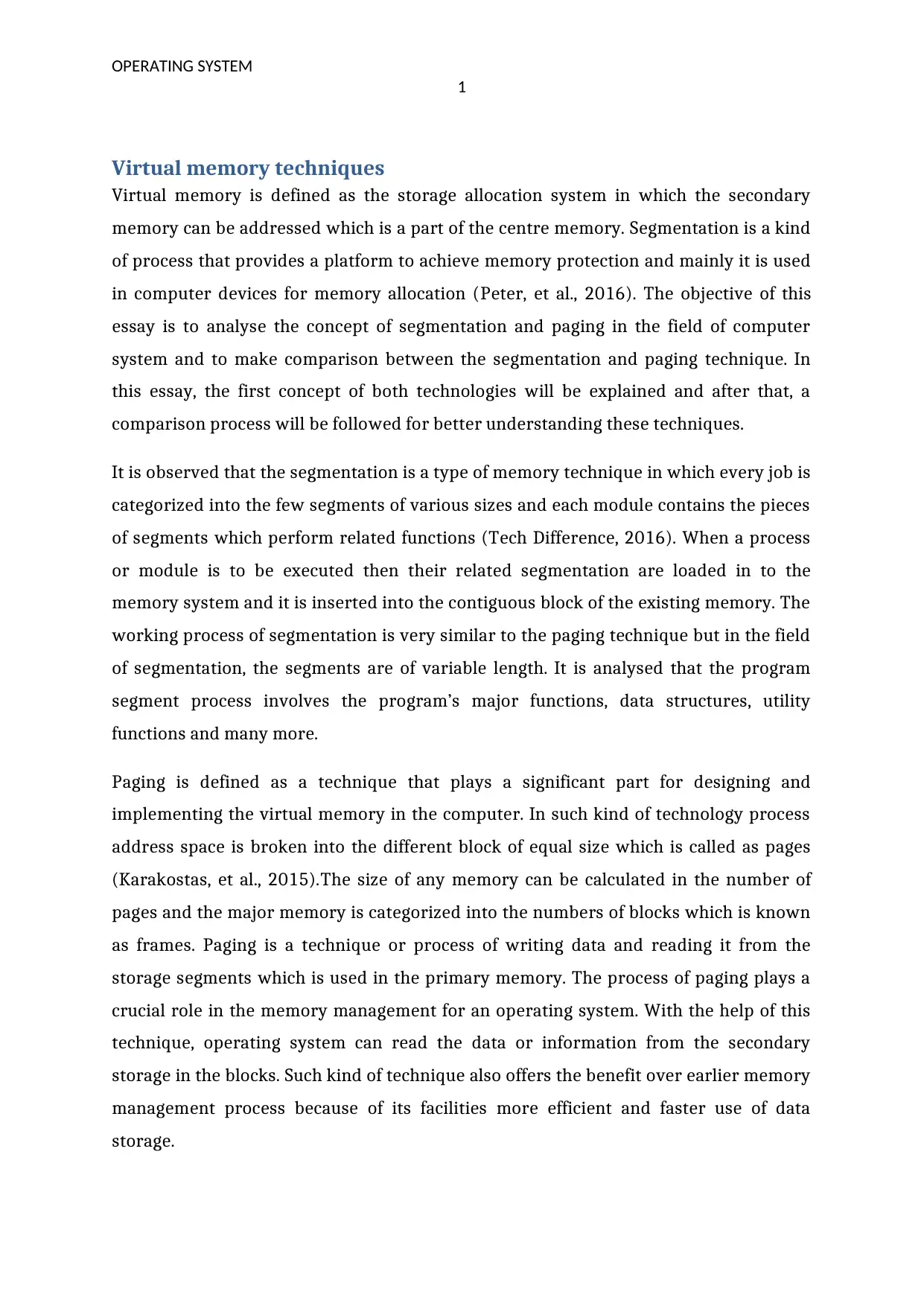
Virtual memory techniques
Virtual memory is defined as the storage allocation system in which the secondary
memory can be addressed which is a part of the centre memory. Segmentation is a kind
of process that provides a platform to achieve memory protection and mainly it is used
in computer devices for memory allocation (Peter, et al., 2016). The objective of this
essay is to analyse the concept of segmentation and paging in the field of computer
system and to make comparison between the segmentation and paging technique. In
this essay, the first concept of both technologies will be explained and after that, a
comparison process will be followed for better understanding these techniques.
It is observed that the segmentation is a type of memory technique in which every job is
categorized into the few segments of various sizes and each module contains the pieces
of segments which perform related functions (Tech Difference, 2016). When a process
or module is to be executed then their related segmentation are loaded in to the
memory system and it is inserted into the contiguous block of the existing memory. The
working process of segmentation is very similar to the paging technique but in the field
of segmentation, the segments are of variable length. It is analysed that the program
segment process involves the program’s major functions, data structures, utility
functions and many more.
Paging is defined as a technique that plays a significant part for designing and
implementing the virtual memory in the computer. In such kind of technology process
address space is broken into the different block of equal size which is called as pages
(Karakostas, et al., 2015).The size of any memory can be calculated in the number of
pages and the major memory is categorized into the numbers of blocks which is known
as frames. Paging is a technique or process of writing data and reading it from the
storage segments which is used in the primary memory. The process of paging plays a
crucial role in the memory management for an operating system. With the help of this
technique, operating system can read the data or information from the secondary
storage in the blocks. Such kind of technique also offers the benefit over earlier memory
management process because of its facilities more efficient and faster use of data
storage.
Document Page
OPERATING SYSTEM
2
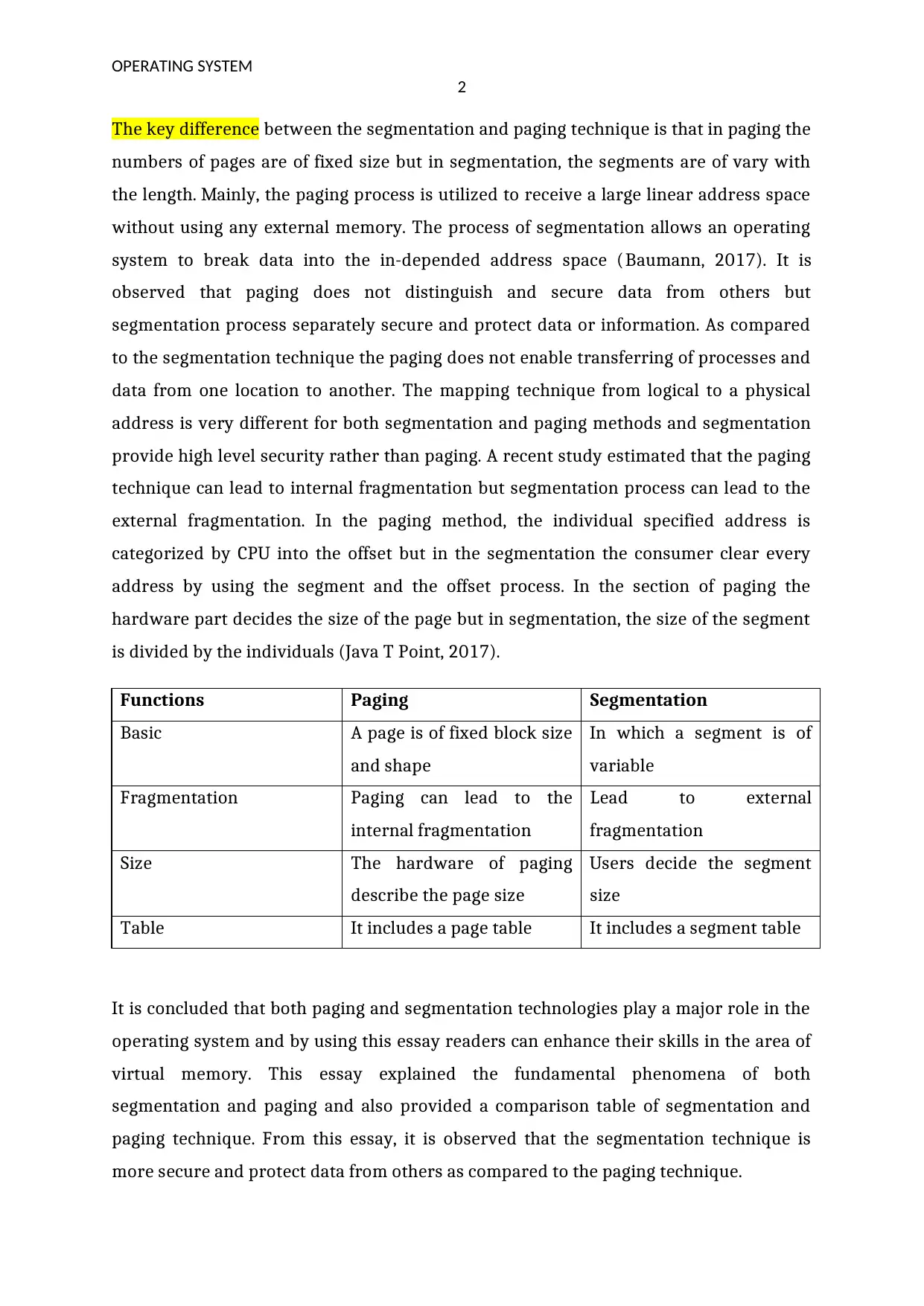
The key difference between the segmentation and paging technique is that in paging the
numbers of pages are of fixed size but in segmentation, the segments are of vary with
the length. Mainly, the paging process is utilized to receive a large linear address space
without using any external memory. The process of segmentation allows an operating
system to break data into the in-depended address space (Baumann, 2017). It is
observed that paging does not distinguish and secure data from others but
segmentation process separately secure and protect data or information. As compared
to the segmentation technique the paging does not enable transferring of processes and
data from one location to another. The mapping technique from logical to a physical
address is very different for both segmentation and paging methods and segmentation
provide high level security rather than paging. A recent study estimated that the paging
technique can lead to internal fragmentation but segmentation process can lead to the
external fragmentation. In the paging method, the individual specified address is
categorized by CPU into the offset but in the segmentation the consumer clear every
address by using the segment and the offset process. In the section of paging the
hardware part decides the size of the page but in segmentation, the size of the segment
is divided by the individuals (Java T Point, 2017).
Functions Paging Segmentation
Basic A page is of fixed block size
and shape
In which a segment is of
variable
Fragmentation Paging can lead to the
internal fragmentation
Lead to external
fragmentation
Size The hardware of paging
describe the page size
Users decide the segment
size
Table It includes a page table It includes a segment table
It is concluded that both paging and segmentation technologies play a major role in the
operating system and by using this essay readers can enhance their skills in the area of
virtual memory. This essay explained the fundamental phenomena of both
segmentation and paging and also provided a comparison table of segmentation and
paging technique. From this essay, it is observed that the segmentation technique is
more secure and protect data from others as compared to the paging technique.
Document Page
OPERATING SYSTEM
3
References
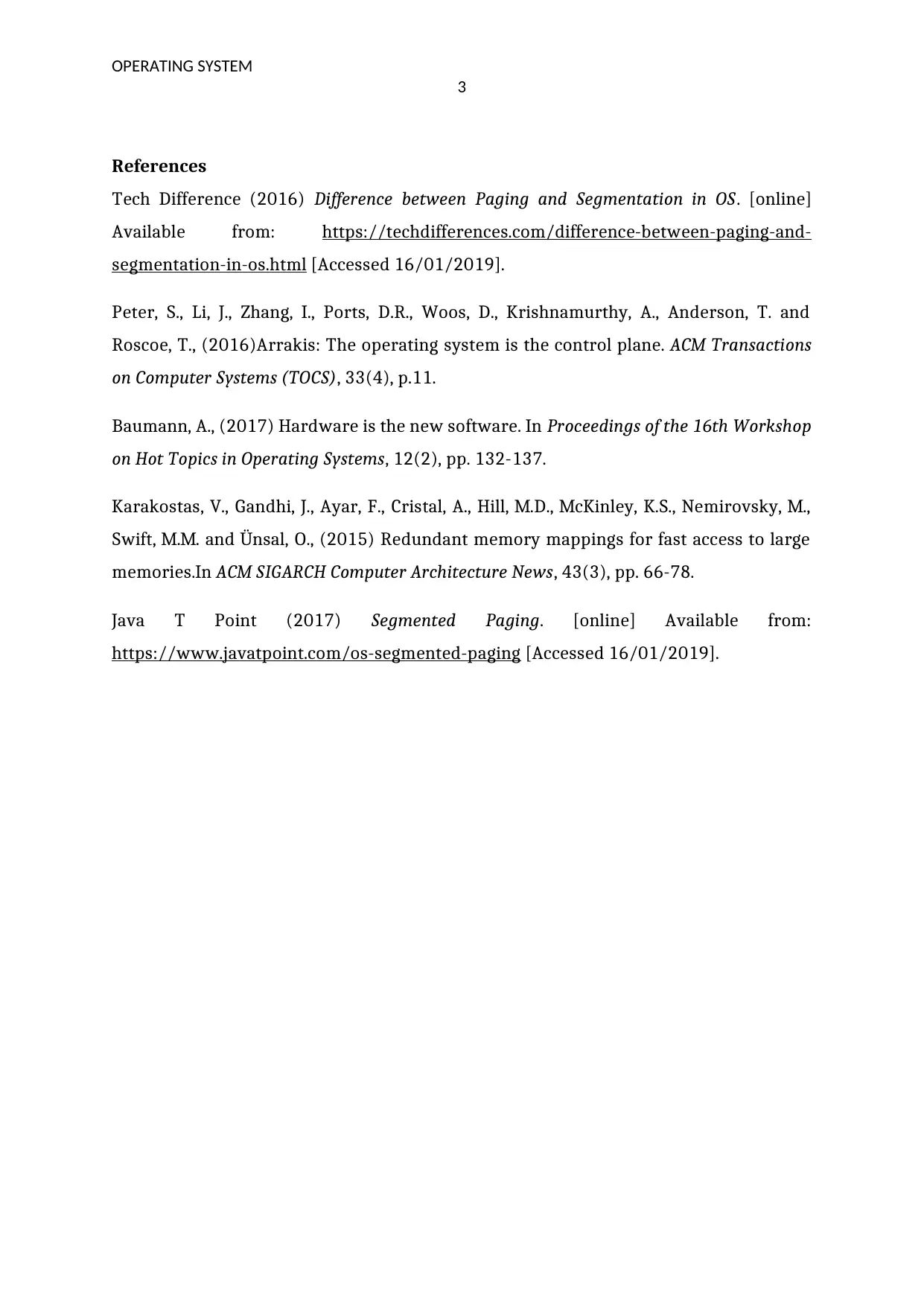
Tech Difference (2016) Difference between Paging and Segmentation in OS. [online]
Available from: https://techdifferences.com/difference-between-paging-and-
segmentation-in-os.html [Accessed 16/01/2019].
Peter, S., Li, J., Zhang, I., Ports, D.R., Woos, D., Krishnamurthy, A., Anderson, T. and
Roscoe, T., (2016)Arrakis: The operating system is the control plane. ACM Transactions
on Computer Systems (TOCS), 33(4), p.11.
Baumann, A., (2017) Hardware is the new software. In Proceedings of the 16th Workshop
on Hot Topics in Operating Systems, 12(2), pp. 132-137.
Karakostas, V., Gandhi, J., Ayar, F., Cristal, A., Hill, M.D., McKinley, K.S., Nemirovsky, M.,
Swift, M.M. and Ünsal, O., (2015) Redundant memory mappings for fast access to large
memories.In ACM SIGARCH Computer Architecture News, 43(3), pp. 66-78.
Java T Point (2017) Segmented Paging. [online] Available from:
https://www.javatpoint.com/os-segmented-paging [Accessed 16/01/2019].
chevron_up_icon
1 out of 4
circle_padding
hide_on_mobile
zoom_out_icon
[object Object]