Occupational Therapy: Detailed Analysis of Ponytail Activity

Verified

Added on  2023/05/28

|7
|344
|261
Presentation
AI Summary
This presentation provides an occupational therapy analysis of the task of putting hair into a ponytail. It identifies the deltoid muscles and forearm muscles (infraspinatus, teres major/minor, subscapularis, latissimus dorsi, and pectoralis major) as crucial for the activity. Goniometric measurements are provided for shoulder extension/flexion and abduction, elbow abduction and extension, forearm pronation, wrist extension and radial deviation, and finger abduction/extension and thumb flexion. The presentation outlines the strength required for the two-joint movement and details the proper positioning for the client. The presentation concludes by emphasizing the importance of seated positioning, table distance, shoulder and elbow positioning, and forearm pronation for optimal task performance.
Document Page
Occupational therapy
-PRESENTED BY:
tabler-icon-diamond-filled.svg

Paraphrase This Document

Need a fresh take? Get an instant paraphrase of this document with our AI Paraphraser
Document Page
Two important joint movements
to accomplish the activity:
The two important muscles that are
involved in the occupational activity of
putting the hair in a ponytail include:
The Deltoid muscles that assist the
side-lifting of arms and shoulder flexion
The forearm muscles that include the
infraspinatus, Teres Major, Teres Minor,
subscapularis, Latissimus Dorsi and
Pectoralis Major
Document Page
Goniometric measurement:
Shoulder:
Extension and forward flexion
40% abduction of the shoulder
Elbow:
Abducted and extended forward at 45 degrees
Forearm:
Pronation of the forearm
Wrist:
Extension of the wrist
10 degrees radial deviation
Fingers:
Abduction and Extension of the fingers at 80 degrees
Flexion in the thumb
Document Page
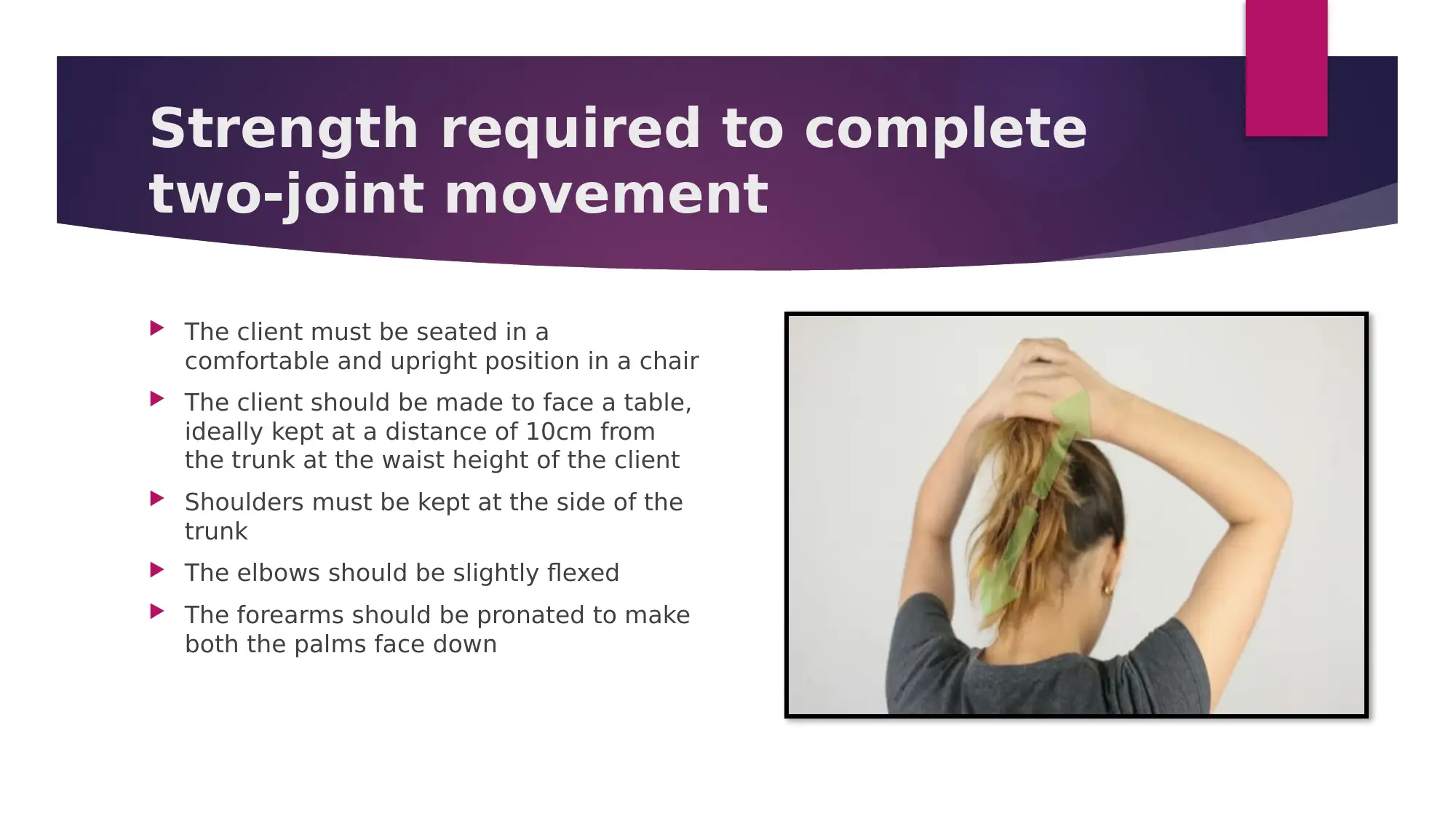
Strength required to complete
two-joint movement
The client must be seated in a
comfortable and upright position in a chair
The client should be made to face a table,
ideally kept at a distance of 10cm from
the trunk at the waist height of the client
Shoulders must be kept at the side of the
trunk
The elbows should be slightly flexed
The forearms should be pronated to make
both the palms face down
tabler-icon-diamond-filled.svg

Paraphrase This Document

Need a fresh take? Get an instant paraphrase of this document with our AI Paraphraser
Document Page
Continued
The right wrist must be at a neutral
position
The fingers must be relaxed with
flexed joints and thumb abducted
and extended
The hair brush and the hair tie must
be picked up with the use of the
pectoral girdle of the hand
Document Page
References:
Foti, D. I. A. N. E., & Koketsu, J. S. (2013). Activities of daily
living. Pedretti’s occupational therapy: Practical skills for physical
dysfunction, 7, 157-232.
O’BRIEN, J. C., & SOLOMON, J. W. (2013). 10 Teaching and Learning Motor
Performance in Occupational Therapy. Physical Dysfunction Practice
Skills for the Occupational Therapy Assistant-E-Book, 174.
Document Page
THANK YOU!
chevron_up_icon
1 out of 7
circle_padding
hide_on_mobile
zoom_out_icon
[object Object]