OTHM Level 5 Diploma: Analyzing Teaching, Learning, and Assessment
VerifiedAdded on 2023/06/07
|16
|4852
|436
Report
AI Summary
This report analyzes teaching practices, focusing on student development and lifelong learning. It examines the roles and responsibilities of educators, emphasizing the importance of meeting learner needs, adhering to codes of practice, and providing appropriate referrals. Key aspects of legislation, such as the Health and Safety Act and the Data Protection Act, are summarized in relation to their impact on teaching. The report also explores the relationships and boundaries between teaching roles and other professional roles, highlighting the significance of promoting equality, valuing diversity, and establishing safe, inclusive learning environments. Furthermore, it assesses the effectiveness of various teaching and learning approaches, communication methods, and resources in meeting individual learner needs, while also addressing the purposes and types of assessment used in education and training, including peer and self-assessment. The analysis extends to the integration of minimum core elements in planning, delivering, and assessing inclusive teaching and learning, culminating in a review of the effectiveness of one's own teaching practices and the identification of areas for improvement.
Teaching learning and
assessment in
education and training
assessment in
education and training

Paraphrase This Document
Need a fresh take? Get an instant paraphrase of this document with our AI Paraphraser
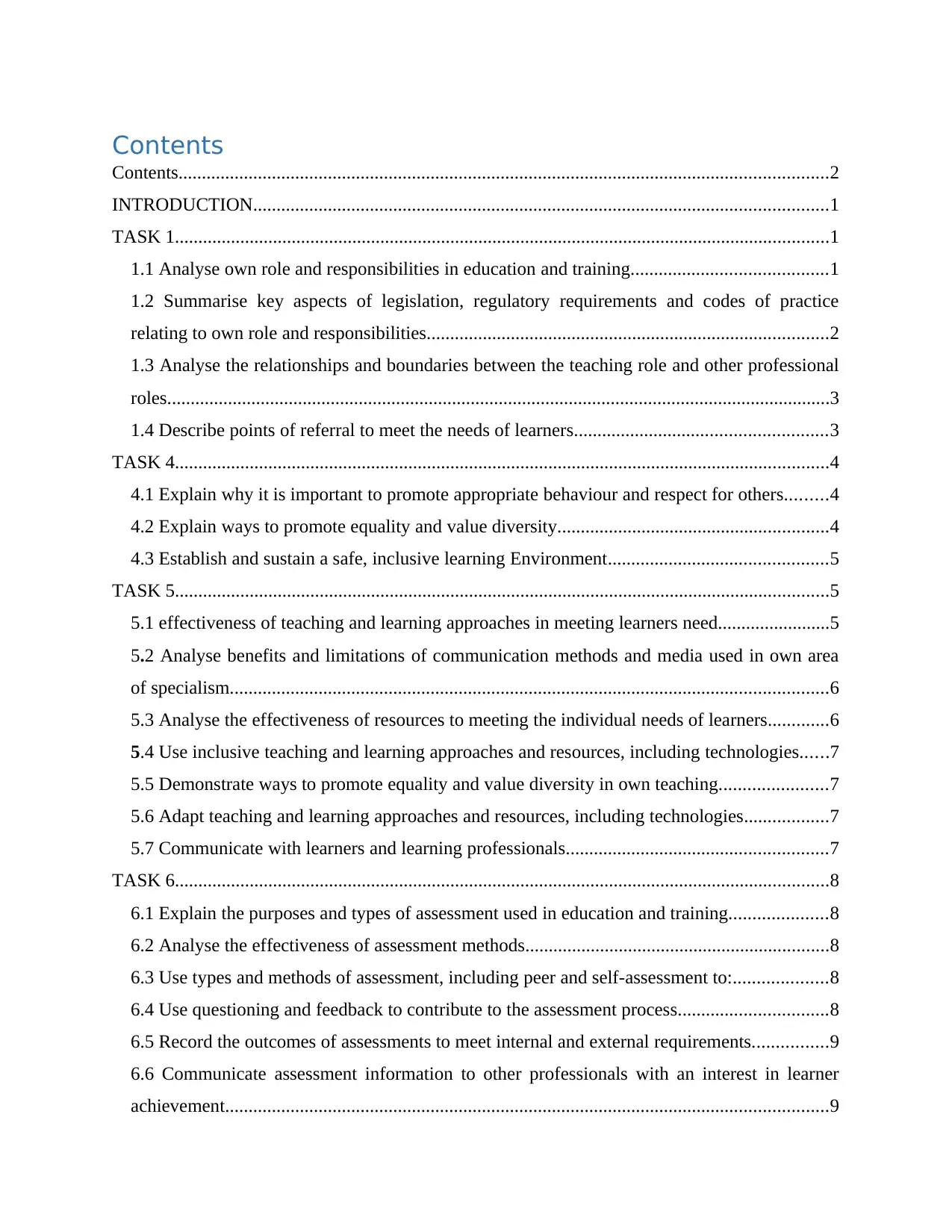
Contents
Contents...........................................................................................................................................2
INTRODUCTION...........................................................................................................................1
TASK 1............................................................................................................................................1
1.1 Analyse own role and responsibilities in education and training..........................................1
1.2 Summarise key aspects of legislation, regulatory requirements and codes of practice
relating to own role and responsibilities......................................................................................2
1.3 Analyse the relationships and boundaries between the teaching role and other professional
roles..............................................................................................................................................3
1.4 Describe points of referral to meet the needs of learners......................................................3
TASK 4............................................................................................................................................4
4.1 Explain why it is important to promote appropriate behaviour and respect for others.........4
4.2 Explain ways to promote equality and value diversity..........................................................4
4.3 Establish and sustain a safe, inclusive learning Environment...............................................5
TASK 5............................................................................................................................................5
5.1 effectiveness of teaching and learning approaches in meeting learners need........................5
5.2 Analyse benefits and limitations of communication methods and media used in own area
of specialism................................................................................................................................6
5.3 Analyse the effectiveness of resources to meeting the individual needs of learners.............6
5.4 Use inclusive teaching and learning approaches and resources, including technologies......7
5.5 Demonstrate ways to promote equality and value diversity in own teaching.......................7
5.6 Adapt teaching and learning approaches and resources, including technologies..................7
5.7 Communicate with learners and learning professionals........................................................7
TASK 6............................................................................................................................................8
6.1 Explain the purposes and types of assessment used in education and training.....................8
6.2 Analyse the effectiveness of assessment methods.................................................................8
6.3 Use types and methods of assessment, including peer and self-assessment to:....................8
6.4 Use questioning and feedback to contribute to the assessment process................................8
6.5 Record the outcomes of assessments to meet internal and external requirements................9
6.6 Communicate assessment information to other professionals with an interest in learner
achievement.................................................................................................................................9
Contents...........................................................................................................................................2
INTRODUCTION...........................................................................................................................1
TASK 1............................................................................................................................................1
1.1 Analyse own role and responsibilities in education and training..........................................1
1.2 Summarise key aspects of legislation, regulatory requirements and codes of practice
relating to own role and responsibilities......................................................................................2
1.3 Analyse the relationships and boundaries between the teaching role and other professional
roles..............................................................................................................................................3
1.4 Describe points of referral to meet the needs of learners......................................................3
TASK 4............................................................................................................................................4
4.1 Explain why it is important to promote appropriate behaviour and respect for others.........4
4.2 Explain ways to promote equality and value diversity..........................................................4
4.3 Establish and sustain a safe, inclusive learning Environment...............................................5
TASK 5............................................................................................................................................5
5.1 effectiveness of teaching and learning approaches in meeting learners need........................5
5.2 Analyse benefits and limitations of communication methods and media used in own area
of specialism................................................................................................................................6
5.3 Analyse the effectiveness of resources to meeting the individual needs of learners.............6
5.4 Use inclusive teaching and learning approaches and resources, including technologies......7
5.5 Demonstrate ways to promote equality and value diversity in own teaching.......................7
5.6 Adapt teaching and learning approaches and resources, including technologies..................7
5.7 Communicate with learners and learning professionals........................................................7
TASK 6............................................................................................................................................8
6.1 Explain the purposes and types of assessment used in education and training.....................8
6.2 Analyse the effectiveness of assessment methods.................................................................8
6.3 Use types and methods of assessment, including peer and self-assessment to:....................8
6.4 Use questioning and feedback to contribute to the assessment process................................8
6.5 Record the outcomes of assessments to meet internal and external requirements................9
6.6 Communicate assessment information to other professionals with an interest in learner
achievement.................................................................................................................................9
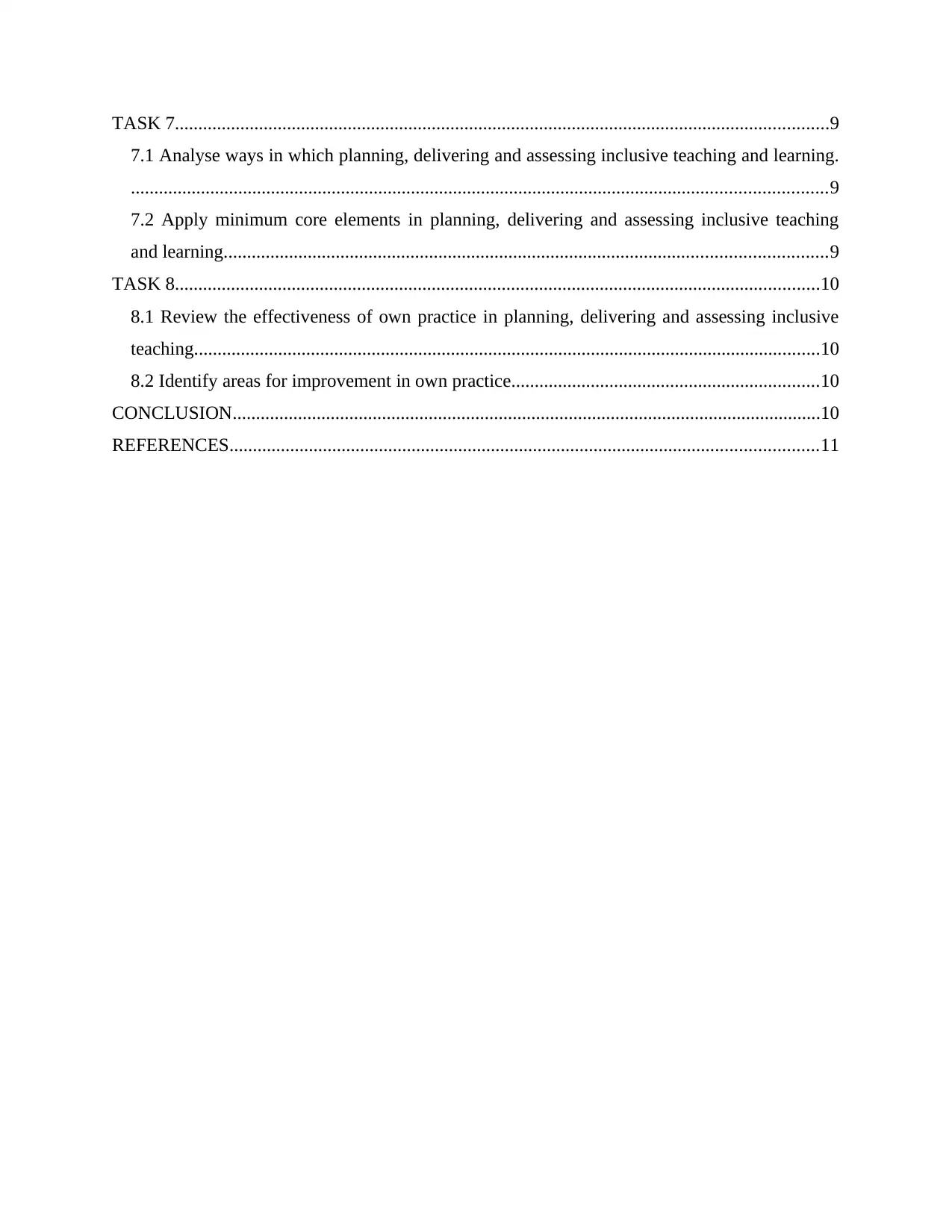
TASK 7............................................................................................................................................9
7.1 Analyse ways in which planning, delivering and assessing inclusive teaching and learning.
.....................................................................................................................................................9
7.2 Apply minimum core elements in planning, delivering and assessing inclusive teaching
and learning.................................................................................................................................9
TASK 8..........................................................................................................................................10
8.1 Review the effectiveness of own practice in planning, delivering and assessing inclusive
teaching......................................................................................................................................10
8.2 Identify areas for improvement in own practice..................................................................10
CONCLUSION..............................................................................................................................10
REFERENCES..............................................................................................................................11
7.1 Analyse ways in which planning, delivering and assessing inclusive teaching and learning.
.....................................................................................................................................................9
7.2 Apply minimum core elements in planning, delivering and assessing inclusive teaching
and learning.................................................................................................................................9
TASK 8..........................................................................................................................................10
8.1 Review the effectiveness of own practice in planning, delivering and assessing inclusive
teaching......................................................................................................................................10
8.2 Identify areas for improvement in own practice..................................................................10
CONCLUSION..............................................................................................................................10
REFERENCES..............................................................................................................................11
⊘ This is a preview!⊘
Do you want full access?
Subscribe today to unlock all pages.

Trusted by 1+ million students worldwide

Paraphrase This Document
Need a fresh take? Get an instant paraphrase of this document with our AI Paraphraser
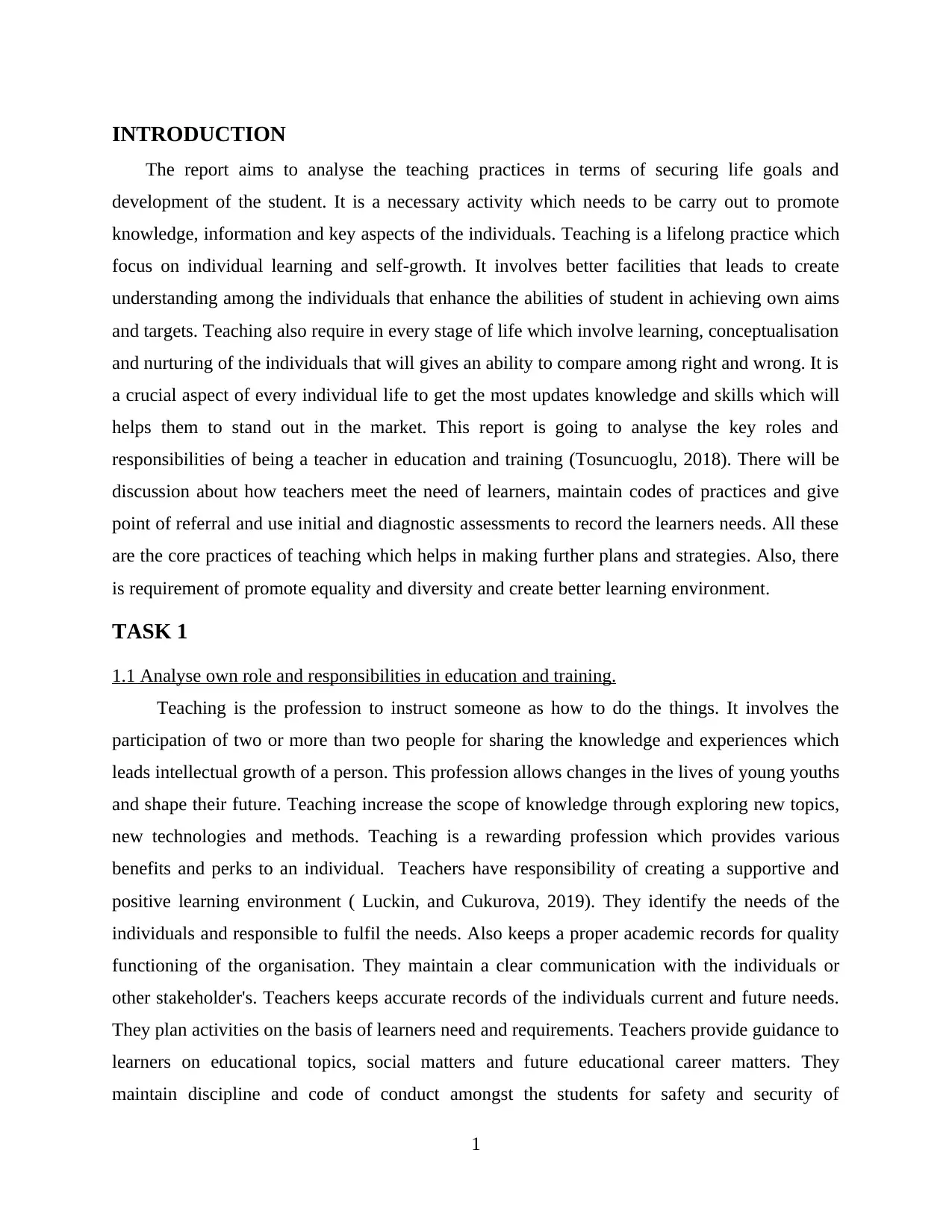
INTRODUCTION
The report aims to analyse the teaching practices in terms of securing life goals and
development of the student. It is a necessary activity which needs to be carry out to promote
knowledge, information and key aspects of the individuals. Teaching is a lifelong practice which
focus on individual learning and self-growth. It involves better facilities that leads to create
understanding among the individuals that enhance the abilities of student in achieving own aims
and targets. Teaching also require in every stage of life which involve learning, conceptualisation
and nurturing of the individuals that will gives an ability to compare among right and wrong. It is
a crucial aspect of every individual life to get the most updates knowledge and skills which will
helps them to stand out in the market. This report is going to analyse the key roles and
responsibilities of being a teacher in education and training (Tosuncuoglu, 2018). There will be
discussion about how teachers meet the need of learners, maintain codes of practices and give
point of referral and use initial and diagnostic assessments to record the learners needs. All these
are the core practices of teaching which helps in making further plans and strategies. Also, there
is requirement of promote equality and diversity and create better learning environment.
TASK 1
1.1 Analyse own role and responsibilities in education and training.
Teaching is the profession to instruct someone as how to do the things. It involves the
participation of two or more than two people for sharing the knowledge and experiences which
leads intellectual growth of a person. This profession allows changes in the lives of young youths
and shape their future. Teaching increase the scope of knowledge through exploring new topics,
new technologies and methods. Teaching is a rewarding profession which provides various
benefits and perks to an individual. Teachers have responsibility of creating a supportive and
positive learning environment ( Luckin, and Cukurova, 2019). They identify the needs of the
individuals and responsible to fulfil the needs. Also keeps a proper academic records for quality
functioning of the organisation. They maintain a clear communication with the individuals or
other stakeholder's. Teachers keeps accurate records of the individuals current and future needs.
They plan activities on the basis of learners need and requirements. Teachers provide guidance to
learners on educational topics, social matters and future educational career matters. They
maintain discipline and code of conduct amongst the students for safety and security of
1
The report aims to analyse the teaching practices in terms of securing life goals and
development of the student. It is a necessary activity which needs to be carry out to promote
knowledge, information and key aspects of the individuals. Teaching is a lifelong practice which
focus on individual learning and self-growth. It involves better facilities that leads to create
understanding among the individuals that enhance the abilities of student in achieving own aims
and targets. Teaching also require in every stage of life which involve learning, conceptualisation
and nurturing of the individuals that will gives an ability to compare among right and wrong. It is
a crucial aspect of every individual life to get the most updates knowledge and skills which will
helps them to stand out in the market. This report is going to analyse the key roles and
responsibilities of being a teacher in education and training (Tosuncuoglu, 2018). There will be
discussion about how teachers meet the need of learners, maintain codes of practices and give
point of referral and use initial and diagnostic assessments to record the learners needs. All these
are the core practices of teaching which helps in making further plans and strategies. Also, there
is requirement of promote equality and diversity and create better learning environment.
TASK 1
1.1 Analyse own role and responsibilities in education and training.
Teaching is the profession to instruct someone as how to do the things. It involves the
participation of two or more than two people for sharing the knowledge and experiences which
leads intellectual growth of a person. This profession allows changes in the lives of young youths
and shape their future. Teaching increase the scope of knowledge through exploring new topics,
new technologies and methods. Teaching is a rewarding profession which provides various
benefits and perks to an individual. Teachers have responsibility of creating a supportive and
positive learning environment ( Luckin, and Cukurova, 2019). They identify the needs of the
individuals and responsible to fulfil the needs. Also keeps a proper academic records for quality
functioning of the organisation. They maintain a clear communication with the individuals or
other stakeholder's. Teachers keeps accurate records of the individuals current and future needs.
They plan activities on the basis of learners need and requirements. Teachers provide guidance to
learners on educational topics, social matters and future educational career matters. They
maintain discipline and code of conduct amongst the students for safety and security of
1
individuals. These practices help in providing training and motivation to the students to boost
their confidence level and to perform well throughout the academics. Also, the students develop
right behaviour and builds respect for others. Teachers prepares learning materials and content
according to the context and person needs. Different tools and techniques helps them to increase
their knowledge and evaluate their own performance. Develop a base to provide a moral ethics
and values to the learner's related to society and education. Proper guidance regarding the future
career choices helps students in selecting their career choices. They build rules and regulations
which needs to follow by every individual in the organisation and leads a proper smooth
functioning of the organisation. Ensures that the learning platform is safe and follow Health and
Safety Act 1974 at work.
1.2 Summarise key aspects of legislation, regulatory requirements and codes of practice relating
to own role and responsibilities.
There are many legislations and regulatory requirements which is related to the codes of
practice and teaching requirements. These regulations are important to undertake while providing
teaching practice in the university or school level (Arora, and Srinivasan, 2020). These
legislations help in maintaining standards and policy which needs to be adhere by all the staff
and regulate it into the classroom. It also ensures that, the behaviour, attitude and learning
practices will be done in a n accurate manner.
Health and safety Act: This regulation is all about maintaining health and safety precaution
while working in the organisation. It is a crucial decision which needs to be taken by the teachers
and to ensure mental, physical and emotional health of the student through using right
equipment’s and be connected with them. Being a teacher of primary school, I need to be
concerned about the materials and props using in teaching which should not harm the health of
students.
Equality and diversity: This regulation is all about maintaining equality and diversity in the
classroom. Equal behaviour and right treatment is necessary for the all the learners to get valued
and listened by the experts. Being a teacher of primary level, each student must get all the
opportunities and equal behaviour to keep the motivation towards learning (Mishra, Gupta, and
Shree, 2020). This code of practice ensures that, every child gets the proper attention and focused
to make them learned and skilful.
2
their confidence level and to perform well throughout the academics. Also, the students develop
right behaviour and builds respect for others. Teachers prepares learning materials and content
according to the context and person needs. Different tools and techniques helps them to increase
their knowledge and evaluate their own performance. Develop a base to provide a moral ethics
and values to the learner's related to society and education. Proper guidance regarding the future
career choices helps students in selecting their career choices. They build rules and regulations
which needs to follow by every individual in the organisation and leads a proper smooth
functioning of the organisation. Ensures that the learning platform is safe and follow Health and
Safety Act 1974 at work.
1.2 Summarise key aspects of legislation, regulatory requirements and codes of practice relating
to own role and responsibilities.
There are many legislations and regulatory requirements which is related to the codes of
practice and teaching requirements. These regulations are important to undertake while providing
teaching practice in the university or school level (Arora, and Srinivasan, 2020). These
legislations help in maintaining standards and policy which needs to be adhere by all the staff
and regulate it into the classroom. It also ensures that, the behaviour, attitude and learning
practices will be done in a n accurate manner.
Health and safety Act: This regulation is all about maintaining health and safety precaution
while working in the organisation. It is a crucial decision which needs to be taken by the teachers
and to ensure mental, physical and emotional health of the student through using right
equipment’s and be connected with them. Being a teacher of primary school, I need to be
concerned about the materials and props using in teaching which should not harm the health of
students.
Equality and diversity: This regulation is all about maintaining equality and diversity in the
classroom. Equal behaviour and right treatment is necessary for the all the learners to get valued
and listened by the experts. Being a teacher of primary level, each student must get all the
opportunities and equal behaviour to keep the motivation towards learning (Mishra, Gupta, and
Shree, 2020). This code of practice ensures that, every child gets the proper attention and focused
to make them learned and skilful.
2
⊘ This is a preview!⊘
Do you want full access?
Subscribe today to unlock all pages.
Trusted by 1+ million students worldwide
Data protection Act: As per this regulation, the data and key information of the individuals
needs to be secured in an appropriate way. The data includes student information, address,
contact details and the projects they have served. All these documents and information must not
have gone in the wrong hands for the purpose of misuse. I should be aware about the hacks and
cybercrime security to protect the data from third party interference. Hence, I need to use
effective software and keep every records under passwords.
1.3 Analyse the relationships and boundaries between the teaching role and other professional
roles.
The relationship and boundaries between own roles and other professional creates much
similarities and differences. Every teacher has their different roles and responsibilities while
working on teaching platform. There is requirement of creating better working environment in
addressing key issues and roles (Middleton, 2020). The teaching career requires to build great
relations with the other professionals. It shows that the boundaries and relationship creates a
systematic workflow in the school or university level. The relationship must be maintaining with
the stakeholders, staff and teachers of the school who take care of every need of student. Being a
teacher in primary school, there are subject’s areas and other teaching behaviour which I am not
able to make up on the mark. When relations are maintaining, I could take better assistance and
guidance with other staffs and experts. It creates good role and coordination among each other.
When we share values, behaviour and thinking with others, it becomes easy to collaborate and
work together for the same goal. Also, in teaching, boundaries are also required to set within the
institution. In my own primary school teaching, I need to be much concerned about setting
boundaries in order to keep a systematic way for doing great activities. These boundaries must be
set with students and other staff to attain respect and confidentiality over the work. There should
not be any unnecessary interference, inequality and nominal concerned with each other.
Therefore, I have to promote good relations but by setting some boundary for both the parties to
work appropriately and without hurting others sentiments.
1.4 Describe points of referral to meet the needs of learners.
In teaching field, point of referral is the crucial elements that are useful for both teachers and
students as well. Not every teacher is much perfect in their subject area so they require some or
other experts and professional guidance (Saiyad, Virk, Mahajan, and Singh, 2020). They are the
different bodies who take concerned towards the institution learning environment and fulfil
3
needs to be secured in an appropriate way. The data includes student information, address,
contact details and the projects they have served. All these documents and information must not
have gone in the wrong hands for the purpose of misuse. I should be aware about the hacks and
cybercrime security to protect the data from third party interference. Hence, I need to use
effective software and keep every records under passwords.
1.3 Analyse the relationships and boundaries between the teaching role and other professional
roles.
The relationship and boundaries between own roles and other professional creates much
similarities and differences. Every teacher has their different roles and responsibilities while
working on teaching platform. There is requirement of creating better working environment in
addressing key issues and roles (Middleton, 2020). The teaching career requires to build great
relations with the other professionals. It shows that the boundaries and relationship creates a
systematic workflow in the school or university level. The relationship must be maintaining with
the stakeholders, staff and teachers of the school who take care of every need of student. Being a
teacher in primary school, there are subject’s areas and other teaching behaviour which I am not
able to make up on the mark. When relations are maintaining, I could take better assistance and
guidance with other staffs and experts. It creates good role and coordination among each other.
When we share values, behaviour and thinking with others, it becomes easy to collaborate and
work together for the same goal. Also, in teaching, boundaries are also required to set within the
institution. In my own primary school teaching, I need to be much concerned about setting
boundaries in order to keep a systematic way for doing great activities. These boundaries must be
set with students and other staff to attain respect and confidentiality over the work. There should
not be any unnecessary interference, inequality and nominal concerned with each other.
Therefore, I have to promote good relations but by setting some boundary for both the parties to
work appropriately and without hurting others sentiments.
1.4 Describe points of referral to meet the needs of learners.
In teaching field, point of referral is the crucial elements that are useful for both teachers and
students as well. Not every teacher is much perfect in their subject area so they require some or
other experts and professional guidance (Saiyad, Virk, Mahajan, and Singh, 2020). They are the
different bodies who take concerned towards the institution learning environment and fulfil
3
Paraphrase This Document
Need a fresh take? Get an instant paraphrase of this document with our AI Paraphraser
required need for infrastructure, assistance and creating plans. Points of referral can be used by
students when they are need for the experts’ solution of subject related problems. There are two
types of point of referral such as internal and external these includes both insiders and outsiders
of company who take care of institution I direct or indirect ways. Internal pint of referrals are
teachers, expert’s professionals who are always ready to provide help whenever a student stuck
with lessons, examination and working on their assessments. When the institutions provided
opportunity for the students, so the points of referral are one of it. External referrals are the
government, stakeholders, health and safety advised who provide better facilities and funds for
institutional growth. These parties have practices to help the institutions for attaining student
satisfaction. Hence, it is crucial to analyse about the key areas and factors which will enhance
student abilities and knowledge.
TASK 4
4.1 Explain why it is important to promote appropriate behaviour and respect for others.
It is important to maintain an appropriate behaviour among each other in teaching
institution. This shows that, respect, confidentiality and trust keeps the mutual understanding and
a positive learning place for both students and teachers (Daniel, 2020). Being a teacher in
primary school, I need to be ensure about not letting any bad behaviour within the students
through their surroundings. They learn what they see around them which will have impact on
their mind and thinking, hence, it is important to have respect of others opinion and culture to
learn with different individuals at one place.
4.2 Explain ways to promote equality and value diversity.
It is necessary to promote equality and diversity in the classroom. Being a teacher, it is
own responsibility to treat equally and mutually to every student. No student should feel
unvalued or less focused as it may impact on their motivating factors of learning. Giving equal
rights and opportunities will create a systematic place in which vey other students gets the same
knowledge and guidance to boost their skills. In my own teaching at primary school, I make sure
there should be a single classroom for disable students and possess value into them for giving
respects to each other.
4
students when they are need for the experts’ solution of subject related problems. There are two
types of point of referral such as internal and external these includes both insiders and outsiders
of company who take care of institution I direct or indirect ways. Internal pint of referrals are
teachers, expert’s professionals who are always ready to provide help whenever a student stuck
with lessons, examination and working on their assessments. When the institutions provided
opportunity for the students, so the points of referral are one of it. External referrals are the
government, stakeholders, health and safety advised who provide better facilities and funds for
institutional growth. These parties have practices to help the institutions for attaining student
satisfaction. Hence, it is crucial to analyse about the key areas and factors which will enhance
student abilities and knowledge.
TASK 4
4.1 Explain why it is important to promote appropriate behaviour and respect for others.
It is important to maintain an appropriate behaviour among each other in teaching
institution. This shows that, respect, confidentiality and trust keeps the mutual understanding and
a positive learning place for both students and teachers (Daniel, 2020). Being a teacher in
primary school, I need to be ensure about not letting any bad behaviour within the students
through their surroundings. They learn what they see around them which will have impact on
their mind and thinking, hence, it is important to have respect of others opinion and culture to
learn with different individuals at one place.
4.2 Explain ways to promote equality and value diversity.
It is necessary to promote equality and diversity in the classroom. Being a teacher, it is
own responsibility to treat equally and mutually to every student. No student should feel
unvalued or less focused as it may impact on their motivating factors of learning. Giving equal
rights and opportunities will create a systematic place in which vey other students gets the same
knowledge and guidance to boost their skills. In my own teaching at primary school, I make sure
there should be a single classroom for disable students and possess value into them for giving
respects to each other.
4
4.3 Establish and sustain a safe, inclusive learning Environment
Teaching is an area where different students comes from different background learn
together. Creating an inclusive environment is crucial to provide every knowledge with an initial
guidance and assistance (Canedo, Santos, and Leite, 2018). A safe and inclusive environment
can be creating through giving all the health precautions while learning in the classroom.
Therefore, in order to analyse better inclusive environment, it is crucial to give proper guidance
by analysing their previous knowledge and use it for creating a positive learning platform.
Sustaining and learning environment is necessary for the key developmental ways to grow
student learning and abilities. Hence, a student will feel confident and motivated to explore new
ways of learning.
TASK 5
5.1 effectiveness of teaching and learning approaches in meeting learners need.
Teaching and learning approaches are useful for meeting with the learners need. It is
crucial to utilise best approaches for providing teaching practices to the students. In order to
effectively meet with the learners needs, a systematic approach is way effective than of working
unsystematically. Being a teacher in primary school, I mainly focus on student understanding
and their abilities to make plans (Hasan, and Khan, 2020). This way, I can prepare better plans
and scheme of work which will help me meet with every learner need. Also, I use VARK
analysis to find the appropriate learning style of the student for providing guidance.
6
5
Teaching is an area where different students comes from different background learn
together. Creating an inclusive environment is crucial to provide every knowledge with an initial
guidance and assistance (Canedo, Santos, and Leite, 2018). A safe and inclusive environment
can be creating through giving all the health precautions while learning in the classroom.
Therefore, in order to analyse better inclusive environment, it is crucial to give proper guidance
by analysing their previous knowledge and use it for creating a positive learning platform.
Sustaining and learning environment is necessary for the key developmental ways to grow
student learning and abilities. Hence, a student will feel confident and motivated to explore new
ways of learning.
TASK 5
5.1 effectiveness of teaching and learning approaches in meeting learners need.
Teaching and learning approaches are useful for meeting with the learners need. It is
crucial to utilise best approaches for providing teaching practices to the students. In order to
effectively meet with the learners needs, a systematic approach is way effective than of working
unsystematically. Being a teacher in primary school, I mainly focus on student understanding
and their abilities to make plans (Hasan, and Khan, 2020). This way, I can prepare better plans
and scheme of work which will help me meet with every learner need. Also, I use VARK
analysis to find the appropriate learning style of the student for providing guidance.
6
5
⊘ This is a preview!⊘
Do you want full access?
Subscribe today to unlock all pages.
Trusted by 1+ million students worldwide
5.2 Analyse benefits and limitations of communication methods and media used in own area of
specialism.
There are basically five communication methods which are Nonverbal communication,
which means the communication is done with by eye contact, movement of hands or by facial
expression. It advantage is that it is more reliable then oral expression because it is a powerful
tool of communication. The disadvantage of this communication method is that it may be
sometime bit difficult for the other person to understand things with the help of gestures. The
another communication method is written communication, when individuals or group of
individuals communicate with each other by writing it (Lawrence, and Tar, 2018). The
advantages of this communication method is the receiver will get the permanent record of that
particular message. With this, the receiver can read it at any time and any place. Its disadvantage
is that it emphasises more on paper work, with this the cost of printing is also incurred. The next
communication tool is listening; the two-way communication is not possible if the persons are
not listening to each other. The advantages of listening are that the effective way of
communication takes place by having a habit of good listener. The disadvantage of poor listening
is that the message which the sender wants to deliver to receiver will be misunderstood. The
fourth communication method is visual communication, it is the communication which is done
with the help of virtual tools, such as social media platforms. The advantage of this method is
that it reaches to a large customer base within a span of less time period. Its disadvantage is that
it does not contains full information which can misguide the receiver. The last communication
method is verbal communication, which occurs when two individuals or groups of individuals
communicate with each other verbally. Its advantage is that it is the easiest way of
communication and maintains privacy. The disadvantage of this method is once the message is
being delivered then there is no way to make correction in it.
5.3 Analyse the effectiveness of resources to meeting the individual needs of learners.
The resources used by the teacher in order to deliver information to learners effectively is
that they can make use to virtual learning tools. This will enhance the experience of students and
the learning process of students also develops. With this, the teacher can conduct test of students
on timely basis (Jirgensons, andKapenieks, 2018). They good performing students should be
appreciated by teachers and poor performing students should be provided with effective
feedbacks and extra classes could be conducted for them.
6
specialism.
There are basically five communication methods which are Nonverbal communication,
which means the communication is done with by eye contact, movement of hands or by facial
expression. It advantage is that it is more reliable then oral expression because it is a powerful
tool of communication. The disadvantage of this communication method is that it may be
sometime bit difficult for the other person to understand things with the help of gestures. The
another communication method is written communication, when individuals or group of
individuals communicate with each other by writing it (Lawrence, and Tar, 2018). The
advantages of this communication method is the receiver will get the permanent record of that
particular message. With this, the receiver can read it at any time and any place. Its disadvantage
is that it emphasises more on paper work, with this the cost of printing is also incurred. The next
communication tool is listening; the two-way communication is not possible if the persons are
not listening to each other. The advantages of listening are that the effective way of
communication takes place by having a habit of good listener. The disadvantage of poor listening
is that the message which the sender wants to deliver to receiver will be misunderstood. The
fourth communication method is visual communication, it is the communication which is done
with the help of virtual tools, such as social media platforms. The advantage of this method is
that it reaches to a large customer base within a span of less time period. Its disadvantage is that
it does not contains full information which can misguide the receiver. The last communication
method is verbal communication, which occurs when two individuals or groups of individuals
communicate with each other verbally. Its advantage is that it is the easiest way of
communication and maintains privacy. The disadvantage of this method is once the message is
being delivered then there is no way to make correction in it.
5.3 Analyse the effectiveness of resources to meeting the individual needs of learners.
The resources used by the teacher in order to deliver information to learners effectively is
that they can make use to virtual learning tools. This will enhance the experience of students and
the learning process of students also develops. With this, the teacher can conduct test of students
on timely basis (Jirgensons, andKapenieks, 2018). They good performing students should be
appreciated by teachers and poor performing students should be provided with effective
feedbacks and extra classes could be conducted for them.
6
Paraphrase This Document
Need a fresh take? Get an instant paraphrase of this document with our AI Paraphraser
5.4 Use inclusive teaching and learning approaches and resources, including technologies.
The learning tools which can be used by teachers which includes technology are that the
teachers can conduct online classes for students which helps the them in taking classes
conveniently. The teachers can conduct test for students though online portals such as canvas, the
time taken by teachers in checking it also reduces, so a lot of time and efforts could be saved. To
make the learning process easy teachers can also explain things to students by preparing
presentations, which makes the learning process easy for students (Madani, 2019). This shows
that, being a teacher, this includes various forms of approaches that impact on the resource
teaching practices. the technologies like Moodle, Kohoot and other software like Zoom
applications is relevant to take online classes. All the technologies are relevant to the necessary
areas which ensure key practices in leading behaviour.
5.5 Demonstrate ways to promote equality and value diversity in own teaching.
There are many areas to promote equality and value diversity in order to keep an equal
opportunity for the teaching. In order to ensure better quality and diversity areas, it is crucial to
create wellbeing for the students which will lead to promote motivation and student engagement
in the classroom. Being a teacher, I promote equality and diversity through creating a well versed
environment among students in which all the students learn together or in groups. The project,
assignments and assessments will be given to each child to identify their knowledge and skills
and give relevant opinion about it. It is a main way to develop equality and diversity in own
teaching areas that will ensure about good collaboration among peers.
5.6 Adapt teaching and learning approaches and resources, including technologies
There are many teaching and learning approaches which helps in fulfil each individual
needs. Using technologies is a great platform to providing online learning programmes and
provide better visual experience to the child (Andrade, and Brookhart, 2020). In primary school
teaching, the resources I would adopt Moodle, Koohot and learning criteria that would ensure
better practices which needs to be used in the classroom. Therefore, I will use software’s, pallets
and other promotes to teach children to gain their attraction towards subject areas.
5.7 Communicate with learners and learning professionals.
Communication is much key concept in analysing learning areas and key professional
behaviour. In order to maintain good practices, make relations and analyse own expertise,
7
The learning tools which can be used by teachers which includes technology are that the
teachers can conduct online classes for students which helps the them in taking classes
conveniently. The teachers can conduct test for students though online portals such as canvas, the
time taken by teachers in checking it also reduces, so a lot of time and efforts could be saved. To
make the learning process easy teachers can also explain things to students by preparing
presentations, which makes the learning process easy for students (Madani, 2019). This shows
that, being a teacher, this includes various forms of approaches that impact on the resource
teaching practices. the technologies like Moodle, Kohoot and other software like Zoom
applications is relevant to take online classes. All the technologies are relevant to the necessary
areas which ensure key practices in leading behaviour.
5.5 Demonstrate ways to promote equality and value diversity in own teaching.
There are many areas to promote equality and value diversity in order to keep an equal
opportunity for the teaching. In order to ensure better quality and diversity areas, it is crucial to
create wellbeing for the students which will lead to promote motivation and student engagement
in the classroom. Being a teacher, I promote equality and diversity through creating a well versed
environment among students in which all the students learn together or in groups. The project,
assignments and assessments will be given to each child to identify their knowledge and skills
and give relevant opinion about it. It is a main way to develop equality and diversity in own
teaching areas that will ensure about good collaboration among peers.
5.6 Adapt teaching and learning approaches and resources, including technologies
There are many teaching and learning approaches which helps in fulfil each individual
needs. Using technologies is a great platform to providing online learning programmes and
provide better visual experience to the child (Andrade, and Brookhart, 2020). In primary school
teaching, the resources I would adopt Moodle, Koohot and learning criteria that would ensure
better practices which needs to be used in the classroom. Therefore, I will use software’s, pallets
and other promotes to teach children to gain their attraction towards subject areas.
5.7 Communicate with learners and learning professionals.
Communication is much key concept in analysing learning areas and key professional
behaviour. In order to maintain good practices, make relations and analyse own expertise,
7
communication is necessary to share thought, ideas and own attitude with others. Hence,
professions must be listened and valued to admire their assistances and efforts to help in the daily
activities. Communication can be done in both online and offline ways to secure relations and
collaborative efforts for gaining effective results.
TASK 6
6.1 Explain the purposes and types of assessment used in education and training.
Assessments are the essential academic projects which creates by the teacher to check the
knowledge, abilities and capability of students in the subject field. There are various educational
projects related to the assessing criteria that helps me in finds the mistakes and issues and give
further guidance for the growth and development (Pham, and Ho, 2020). In education and
training, these assessments play a vital role in ensuring the current performance of the students.
6.2 Analyse the effectiveness of assessment methods
The assessment methods make sure about the roles and activities covered during the
projects. There are various types of methods which are useful such as summative and diagnostic
which is prepared as per the key knowledge of students. There is requirement of key components
in believing much impact of projects and assessments. This shows that, all the methods are used
as per the initial learning of students. The effectiveness of using diagnostic assessment in
primary school teaching is to engage the whole class through mind maps, short quizzes, and
discussions. Also summative assessments are also vital for the creativeness and communicating
with the students.
6.3 Use types and methods of assessment, including peer and self-assessment to:
These types of methods which are peer and self-assessments are effective for the student.
Peer assessment is effective in order to make collaborative working by working in the groups.
Also, self-assessments are necessary which ensure better success in the market. Peer assessments
are meant to be beneficial for assessing each other’s work and taking feedbacks. Therefore, self-
assessment those which the students works by their own.
6.4 Use questioning and feedback to contribute to the assessment process.
8
professions must be listened and valued to admire their assistances and efforts to help in the daily
activities. Communication can be done in both online and offline ways to secure relations and
collaborative efforts for gaining effective results.
TASK 6
6.1 Explain the purposes and types of assessment used in education and training.
Assessments are the essential academic projects which creates by the teacher to check the
knowledge, abilities and capability of students in the subject field. There are various educational
projects related to the assessing criteria that helps me in finds the mistakes and issues and give
further guidance for the growth and development (Pham, and Ho, 2020). In education and
training, these assessments play a vital role in ensuring the current performance of the students.
6.2 Analyse the effectiveness of assessment methods
The assessment methods make sure about the roles and activities covered during the
projects. There are various types of methods which are useful such as summative and diagnostic
which is prepared as per the key knowledge of students. There is requirement of key components
in believing much impact of projects and assessments. This shows that, all the methods are used
as per the initial learning of students. The effectiveness of using diagnostic assessment in
primary school teaching is to engage the whole class through mind maps, short quizzes, and
discussions. Also summative assessments are also vital for the creativeness and communicating
with the students.
6.3 Use types and methods of assessment, including peer and self-assessment to:
These types of methods which are peer and self-assessments are effective for the student.
Peer assessment is effective in order to make collaborative working by working in the groups.
Also, self-assessments are necessary which ensure better success in the market. Peer assessments
are meant to be beneficial for assessing each other’s work and taking feedbacks. Therefore, self-
assessment those which the students works by their own.
6.4 Use questioning and feedback to contribute to the assessment process.
8
⊘ This is a preview!⊘
Do you want full access?
Subscribe today to unlock all pages.
Trusted by 1+ million students worldwide

1 out of 16


Related Documents


Your All-in-One AI-Powered Toolkit for Academic Success.
+13062052269
info@desklib.com
Available 24*7 on WhatsApp / Email
![[object Object]](/_next/static/media/star-bottom.7253800d.svg)
Unlock your academic potential
Copyright © 2020–2026 A2Z Services. All Rights Reserved. Developed and managed by ZUCOL.