Enhancing Warehouse Efficiency via Outbound Logistics Management
VerifiedAdded on 2022/11/13
|45
|13687
|385
Project
AI Summary
This engineering graduate project investigates the use of outbound logistics management to improve warehouse efficiency within the manufacturing sector in Australia. The study begins with a background on the importance of logistics in a competitive global market, emphasizing the need for efficient warehousing and distribution. The research aims to develop a plan for enhancing warehouse efficiency through outbound logistics, specifically assessing the relevant processes and exploring the associated challenges. The project uses both primary and secondary data, employing qualitative and quantitative analysis to draw conclusions, provide recommendations, and acknowledge limitations. The literature review covers the concept of outbound logistics, its benefits, and its impact on supply chain and customer relationship management. The research also addresses specific research questions such as the benefits and advantages of outbound logistics and how it helps in lowering costs and enhancing efficiency. The study also includes hypothesis regarding the classification of firms, the role of logistics in profitability, and the association of outbound delivery with industry membership. The project also explores the challenges faced by manufacturing companies in outbound logistics, such as sourcing skilled experts and the impact of these challenges. This project provides valuable insights into enhancing warehouse efficiency in Australia.
Engineering Graduate Project Title
Use of Outbound Logistics Management to Enhance Efficiency in Warehouse in Australia
Student Name
Subject
Date
Abstract
Due the increasing global competitions,
different stakeholders and logistics
companies have embarked on improving the
warehouses as well as the distribution
services. This paper discussed the use of
Use of Outbound Logistics Management to Enhance Efficiency in Warehouse in Australia
Student Name
Subject
Date
Abstract
Due the increasing global competitions,
different stakeholders and logistics
companies have embarked on improving the
warehouses as well as the distribution
services. This paper discussed the use of

Paraphrase This Document
Need a fresh take? Get an instant paraphrase of this document with our AI Paraphraser
outbound logistics management to enhance
efficiency in warehouse in Australia. It has
been noted that the outbound logistics not
only has the immense impacts but also
equitable advantages in the long run. The
key objective described in line with this
study is to develop the plan on how use of
outbound logistics management helps in
enhancing efficiency in warehouse. Also the
specific objectives for this study include
assessing the processes involved in the
outbound logistics management of the
warehouses in manufacturing as well as to
explore the challenges affecting the
outbound logistics warehousing
management. The literature studies on the
research topic have help in establishing and
giving the in-depth understanding of the
topic with the present state. The data
collection and analysis for the study largely
involved the use of both the primary and
secondary. The qualitative and quantitative
evaluation helps in defining and establishing
the clear distinction as far as the study is
concerned. Also, the data gathered helped in
drawing the deceive conclusion,
recommendations as well as limitations of
the research which requires future appraisal.
Keywords
Outbound Logistics Management,
Efficiency, Warehouse, Qualitative,
Quantitative, Limitations and
Recommendations
Chapter 1: Introduction
1.1 Background to Study
In essence, most of the organizations are
presently using the customized systems to
manage and operate their warehousing and
the overall distribution services. This aims at
improving the service delivery while at the
same time enabling these companies to
efficiency in warehouse in Australia. It has
been noted that the outbound logistics not
only has the immense impacts but also
equitable advantages in the long run. The
key objective described in line with this
study is to develop the plan on how use of
outbound logistics management helps in
enhancing efficiency in warehouse. Also the
specific objectives for this study include
assessing the processes involved in the
outbound logistics management of the
warehouses in manufacturing as well as to
explore the challenges affecting the
outbound logistics warehousing
management. The literature studies on the
research topic have help in establishing and
giving the in-depth understanding of the
topic with the present state. The data
collection and analysis for the study largely
involved the use of both the primary and
secondary. The qualitative and quantitative
evaluation helps in defining and establishing
the clear distinction as far as the study is
concerned. Also, the data gathered helped in
drawing the deceive conclusion,
recommendations as well as limitations of
the research which requires future appraisal.
Keywords
Outbound Logistics Management,
Efficiency, Warehouse, Qualitative,
Quantitative, Limitations and
Recommendations
Chapter 1: Introduction
1.1 Background to Study
In essence, most of the organizations are
presently using the customized systems to
manage and operate their warehousing and
the overall distribution services. This aims at
improving the service delivery while at the
same time enabling these companies to
maximize on the profit. Over the years, there
have been claims on the operational
excellence as far as the delivery of quality
product is concerned. Therefore, it implies
that one must ensure that there is the
consistence in the services delivered and this
should cut across the makeable operations.
Thus, some of the manufacturing firms have
depicted on the outsourcing of the outbound
logistics with the aim of remaining
competitive in the market. Alternatively,
there are some of the manufacturing firms
which prefer the outbound logistics because
they are not in a position to do it alone [1].
Most of the companies have begun the
process of recruiting the specialist to assist
them in the performing the some of the
activities. These activities were not
considered to be the part and parcel of the
company core in line with the competency.
However, there are companies which have
the expertise to handle the daily operations
as well as the management and designs of
the warehouse as well as distribution
processes [2].
Outbound logistics is largely considered to
play an important role when appraising the
supply chain and the overall customer’s
relationship and management process
(CRM). The concept of the outbound
logistics essentially defined as the prospect
which not only relates to the movement of
the goods but also to the product storage.
This norm has to involve the movement of
the products from the makeable one of the
overall production line to the sophisticated
end user. There are different retailers which
one has to consider when dealing with the
concept of the outbound and the stringent
product and delivery standards [3]. Some of
these retailers include Target and Wal-Mart
and they hold their overall suppliers to the
parametric stringent product in line with the
delivery standard. In essence, the failure of
the suppliers to deliver the products as
outlined by the clients can equally result to
have been claims on the operational
excellence as far as the delivery of quality
product is concerned. Therefore, it implies
that one must ensure that there is the
consistence in the services delivered and this
should cut across the makeable operations.
Thus, some of the manufacturing firms have
depicted on the outsourcing of the outbound
logistics with the aim of remaining
competitive in the market. Alternatively,
there are some of the manufacturing firms
which prefer the outbound logistics because
they are not in a position to do it alone [1].
Most of the companies have begun the
process of recruiting the specialist to assist
them in the performing the some of the
activities. These activities were not
considered to be the part and parcel of the
company core in line with the competency.
However, there are companies which have
the expertise to handle the daily operations
as well as the management and designs of
the warehouse as well as distribution
processes [2].
Outbound logistics is largely considered to
play an important role when appraising the
supply chain and the overall customer’s
relationship and management process
(CRM). The concept of the outbound
logistics essentially defined as the prospect
which not only relates to the movement of
the goods but also to the product storage.
This norm has to involve the movement of
the products from the makeable one of the
overall production line to the sophisticated
end user. There are different retailers which
one has to consider when dealing with the
concept of the outbound and the stringent
product and delivery standards [3]. Some of
these retailers include Target and Wal-Mart
and they hold their overall suppliers to the
parametric stringent product in line with the
delivery standard. In essence, the failure of
the suppliers to deliver the products as
outlined by the clients can equally result to
⊘ This is a preview!⊘
Do you want full access?
Subscribe today to unlock all pages.

Trusted by 1+ million students worldwide
the huge losses and penalty in the long run.
Further to this, the process can also lead to
the delisting of the suppliers in the process
[4]. The delisting involves the elimination of
the suppliers from the active retail product
portfolio. Therefore, the outbound logistics
plays and represents significant factors as far
as the decision of the retailers to either retain
or not to stock from the various product
suppliers is concerned [5].
Thus, there is product flows are often
optimized along supply cost which are
driven at lower levels. Thus, the customers
are in the position of increasing services and
reducing stockholding levels. The modern
approaches help in attaining the required
flexibility which is needed to meet the
overall fast-changing and demands in the
market. There are various long supply and
chain management approaches which one
can depict as per the outbound and inbound
logistics activities. Most of the third parties
in the field tend to specialize in the
distribution and the warehousing. This is
demarcated and anticipated by many studies
as their parametric and core business [6].
Preferably, it is important to denote that the
outbound logistics comprises of the last mile
which is also regarded as the demarcated
key concepts when it comes to either the
make or the break step in line with the CRM
process. From the critical role, it can be
deduced that the planning and approach firm
tend to gain much from the outbound
logistics. The benefits are immeasurable
when analyzed in line with the insight
qualitative perception. There are few
research and studies which have focused
only on the existing links between the firm
financial and logistic performance and
profitability. For instance, it is important for
one to note that there are researches which
have only focused on the Strategic Profit
Model and they are often used in
determining the adjusting effects in line with
the logistical policies. Also, the using of the
Further to this, the process can also lead to
the delisting of the suppliers in the process
[4]. The delisting involves the elimination of
the suppliers from the active retail product
portfolio. Therefore, the outbound logistics
plays and represents significant factors as far
as the decision of the retailers to either retain
or not to stock from the various product
suppliers is concerned [5].
Thus, there is product flows are often
optimized along supply cost which are
driven at lower levels. Thus, the customers
are in the position of increasing services and
reducing stockholding levels. The modern
approaches help in attaining the required
flexibility which is needed to meet the
overall fast-changing and demands in the
market. There are various long supply and
chain management approaches which one
can depict as per the outbound and inbound
logistics activities. Most of the third parties
in the field tend to specialize in the
distribution and the warehousing. This is
demarcated and anticipated by many studies
as their parametric and core business [6].
Preferably, it is important to denote that the
outbound logistics comprises of the last mile
which is also regarded as the demarcated
key concepts when it comes to either the
make or the break step in line with the CRM
process. From the critical role, it can be
deduced that the planning and approach firm
tend to gain much from the outbound
logistics. The benefits are immeasurable
when analyzed in line with the insight
qualitative perception. There are few
research and studies which have focused
only on the existing links between the firm
financial and logistic performance and
profitability. For instance, it is important for
one to note that there are researches which
have only focused on the Strategic Profit
Model and they are often used in
determining the adjusting effects in line with
the logistical policies. Also, the using of the
Paraphrase This Document
Need a fresh take? Get an instant paraphrase of this document with our AI Paraphraser
survey data has enable some research
individuals to investigate the overall impacts
of the outbound logistics in line with the
financial performance and the operational
capabilities of some firms [7].
Although it has been deduced that there
immense impacts and benefits which the
outbound logistics have, there are minimal
research which have conducted on the case.
Some of the areas which the inadequate
researches on the outbound logistics have
been conducted in direct and stand-alone
outbound impact logistics. In essence, there
are questions which have been raised as far
as the influence on the different approaches
and profitability of the firms is concerned.
Preferably, the present literatures have
denoted that outbound logistics and the
related activities can be depicted into the
expansive studies of the overall supply chain
operations. In this process, it is important to
note that the overall outbound logistics tend
to represent one of the major sub-
components in the analysis [8].
The past analysis on the supply chain
management has included the analogy of the
outbound logistics and this tends to
encompass on the survey base at the expense
of the performance data. This study also
reported the various attempts which one can
put in place in trying to bridge the gap via
the utilization of the actual firm and
performance data. However, there are no
clear and rigorous quantitative publications
which depicts on the outbound logistics and
performance in line with the firm
profitability [9]. Thus, most of the resources
often focus on the decisive supply chain
performance. The research on the senior
executive in line with the supply chain
deduced that the norm is a critical ad
fundamental shareholder driver as far as the
corporate differentiation and value is
concerned. It was also established that the
malfunctions of the supply chain can results
individuals to investigate the overall impacts
of the outbound logistics in line with the
financial performance and the operational
capabilities of some firms [7].
Although it has been deduced that there
immense impacts and benefits which the
outbound logistics have, there are minimal
research which have conducted on the case.
Some of the areas which the inadequate
researches on the outbound logistics have
been conducted in direct and stand-alone
outbound impact logistics. In essence, there
are questions which have been raised as far
as the influence on the different approaches
and profitability of the firms is concerned.
Preferably, the present literatures have
denoted that outbound logistics and the
related activities can be depicted into the
expansive studies of the overall supply chain
operations. In this process, it is important to
note that the overall outbound logistics tend
to represent one of the major sub-
components in the analysis [8].
The past analysis on the supply chain
management has included the analogy of the
outbound logistics and this tends to
encompass on the survey base at the expense
of the performance data. This study also
reported the various attempts which one can
put in place in trying to bridge the gap via
the utilization of the actual firm and
performance data. However, there are no
clear and rigorous quantitative publications
which depicts on the outbound logistics and
performance in line with the firm
profitability [9]. Thus, most of the resources
often focus on the decisive supply chain
performance. The research on the senior
executive in line with the supply chain
deduced that the norm is a critical ad
fundamental shareholder driver as far as the
corporate differentiation and value is
concerned. It was also established that the
malfunctions of the supply chain can results
to the numerous and strong negative impacts
in line with the financial and operating
income, returns on the overall sales as well
as the assets returns [10].
On the other hand, there was the study on
the supply chain and the appraisal of the
management competency in line with the
firm success. The measuring of the supply
chain in this process was largely conducted
via the application of the Delphi-style
opinion data. This was obtained from AMR
Research on the Supply Chain Top of the 25
ranking [11]. This study also applied the
Altman’s Z-score and this was used to
measure the overall financial success of the
firm. The findings obtained depicted that the
firms which had recognized the overall
industry experts to conduct their supply
chain and management competency
recorded significantly higher results in line
with the Z-scores as compared to the other
companies [12].
1.2 Research Objectives and Aims
1.2.1 Aims of Research
The aims of this research mainly discussed
as follows
Main Objective
The key and main objective of the study is
to develop the plan on how use of outbound
logistics management helps in enhancing
efficiency in warehouse
Specific Objectives
There two specific objectives outlined for
this study and they are discussed as follows
To assess the processes involved in the
outbound logistics management of the
warehouses in manufacturing
To explore the challenges affecting the
outbound logistics warehousing
management
1.3 Research Questions
The key research questions used for the
research study mainly outlined as discussed
below
in line with the financial and operating
income, returns on the overall sales as well
as the assets returns [10].
On the other hand, there was the study on
the supply chain and the appraisal of the
management competency in line with the
firm success. The measuring of the supply
chain in this process was largely conducted
via the application of the Delphi-style
opinion data. This was obtained from AMR
Research on the Supply Chain Top of the 25
ranking [11]. This study also applied the
Altman’s Z-score and this was used to
measure the overall financial success of the
firm. The findings obtained depicted that the
firms which had recognized the overall
industry experts to conduct their supply
chain and management competency
recorded significantly higher results in line
with the Z-scores as compared to the other
companies [12].
1.2 Research Objectives and Aims
1.2.1 Aims of Research
The aims of this research mainly discussed
as follows
Main Objective
The key and main objective of the study is
to develop the plan on how use of outbound
logistics management helps in enhancing
efficiency in warehouse
Specific Objectives
There two specific objectives outlined for
this study and they are discussed as follows
To assess the processes involved in the
outbound logistics management of the
warehouses in manufacturing
To explore the challenges affecting the
outbound logistics warehousing
management
1.3 Research Questions
The key research questions used for the
research study mainly outlined as discussed
below
⊘ This is a preview!⊘
Do you want full access?
Subscribe today to unlock all pages.
Trusted by 1+ million students worldwide
1. What is the concept of the outbound
logistics and the management
efficiency in warehousing in
Australia?
2. What are the key benefits and
advantages associated with the
outbound logistics application in
manufacturing companies?
3. How the outbound logistics does
help in lowering the costs and
enhancing the efficiency in
warehousing utilization in Australia?
1.4 Rationale of the Research
Outbound logistics largely considered to
have emerged in most of the manufacturing
organizations and it is been used to enhance
sustainable development. The outbound
logistics is a critical element which helps in
increasing the efficiency in line with the
overall manufacturing process. However, the
manufacturing companies have continued to
report different challenges as far as
outbound logistics is concerned [13]. Most
of the challenges they faced largely results
from the capacities of these companies to be
able to source skilled experts to conduct the
analysis regarding the process. On the other
hand, it is important to deduce that there are
various impacts which the outbound
logistics have largely on the manufacturing
context. In essence, the application of the
process is largely considered as a pivoted
norm and thus, its impacts cannot be
underestimated. The contemporary literature
reviews reports that the outbound logistics is
a noble element which tends impact on the
manufacturing industries immensely as far
as the logistics and the warehousing is
concerned [14]. Considerable factors are
not only important when dealing with the
aspect but they are also essential at all costs
in the long run. The redesigning and the
evaluation of the performances as far as the
logistics and efficiency in the warehousing
is concerned cannot also be left behind when
dealing with the norm in the long run.
logistics and the management
efficiency in warehousing in
Australia?
2. What are the key benefits and
advantages associated with the
outbound logistics application in
manufacturing companies?
3. How the outbound logistics does
help in lowering the costs and
enhancing the efficiency in
warehousing utilization in Australia?
1.4 Rationale of the Research
Outbound logistics largely considered to
have emerged in most of the manufacturing
organizations and it is been used to enhance
sustainable development. The outbound
logistics is a critical element which helps in
increasing the efficiency in line with the
overall manufacturing process. However, the
manufacturing companies have continued to
report different challenges as far as
outbound logistics is concerned [13]. Most
of the challenges they faced largely results
from the capacities of these companies to be
able to source skilled experts to conduct the
analysis regarding the process. On the other
hand, it is important to deduce that there are
various impacts which the outbound
logistics have largely on the manufacturing
context. In essence, the application of the
process is largely considered as a pivoted
norm and thus, its impacts cannot be
underestimated. The contemporary literature
reviews reports that the outbound logistics is
a noble element which tends impact on the
manufacturing industries immensely as far
as the logistics and the warehousing is
concerned [14]. Considerable factors are
not only important when dealing with the
aspect but they are also essential at all costs
in the long run. The redesigning and the
evaluation of the performances as far as the
logistics and efficiency in the warehousing
is concerned cannot also be left behind when
dealing with the norm in the long run.
Paraphrase This Document
Need a fresh take? Get an instant paraphrase of this document with our AI Paraphraser
Outbound logistics in most cases is
considered as not only the easy target when
dealing with the cost saving but also assist in
improving the delivery speed. Most of the
companies tend to have the optimization
sorts for dealing with the overall outbound
freight and management. Notably, the
logistics management concept is considered
as a complicated process [15]. However, the
outbound logistics on the other hand, largely
considered as a fairly simple. The process
often tends to involve the movement and the
storage of the product while at the same time
maintaining safety. Although the analogy is
considered to be simple, it still has different
pain points as far as the analysis is
concerned.
1.5 Research Hypothesis
The hypothesis for this research mainly
discussed as follows [16].
Hypothesis 1: The classification of the firms
can be conducted via the application of
different groups and this can be grounded on
the makeable outbound logistics
Hypothesis 1: orientation of the outbound
logistics in line with the groups identified
plays an essential role when appraising the
profitability levels in the organization
Hypothesis 1: the overall outbound delivery
in line with the metrics is largely associated
with the overall industry membership
Chapter 2: Literature Review
2.1 What Is Outbound Logistics?
First and foremost, it is important to deduce
the term logistics is largely used to describe
the efficient management of the overall
products flow [17]. These include the supply
chain storage. On the other hand, the term
outbound logistics often used to describe the
processes which involve the movement as
well as the product storage and how they
decisively relate to the gathered information.
This has to be appraised from begin to the
end of the production line and must include
the firm’s customer. The warehouse logistics
considered as not only the easy target when
dealing with the cost saving but also assist in
improving the delivery speed. Most of the
companies tend to have the optimization
sorts for dealing with the overall outbound
freight and management. Notably, the
logistics management concept is considered
as a complicated process [15]. However, the
outbound logistics on the other hand, largely
considered as a fairly simple. The process
often tends to involve the movement and the
storage of the product while at the same time
maintaining safety. Although the analogy is
considered to be simple, it still has different
pain points as far as the analysis is
concerned.
1.5 Research Hypothesis
The hypothesis for this research mainly
discussed as follows [16].
Hypothesis 1: The classification of the firms
can be conducted via the application of
different groups and this can be grounded on
the makeable outbound logistics
Hypothesis 1: orientation of the outbound
logistics in line with the groups identified
plays an essential role when appraising the
profitability levels in the organization
Hypothesis 1: the overall outbound delivery
in line with the metrics is largely associated
with the overall industry membership
Chapter 2: Literature Review
2.1 What Is Outbound Logistics?
First and foremost, it is important to deduce
the term logistics is largely used to describe
the efficient management of the overall
products flow [17]. These include the supply
chain storage. On the other hand, the term
outbound logistics often used to describe the
processes which involve the movement as
well as the product storage and how they
decisively relate to the gathered information.
This has to be appraised from begin to the
end of the production line and must include
the firm’s customer. The warehouse logistics
in line with the outbound logistics takes a
different aspect. In essence, it has depicted
differences as compared to the inbound
logistics which tend to focuses on the
overall arraigning and purchasing of the
inbound movements. The norm includes the
parts, product, materials as well as finished
inventory drawn from the sophisticated
suppliers and directed to the various
manufacturing plants and warehouses [18].
This section largely depicts profoundly on
both the transportation as well as storage of
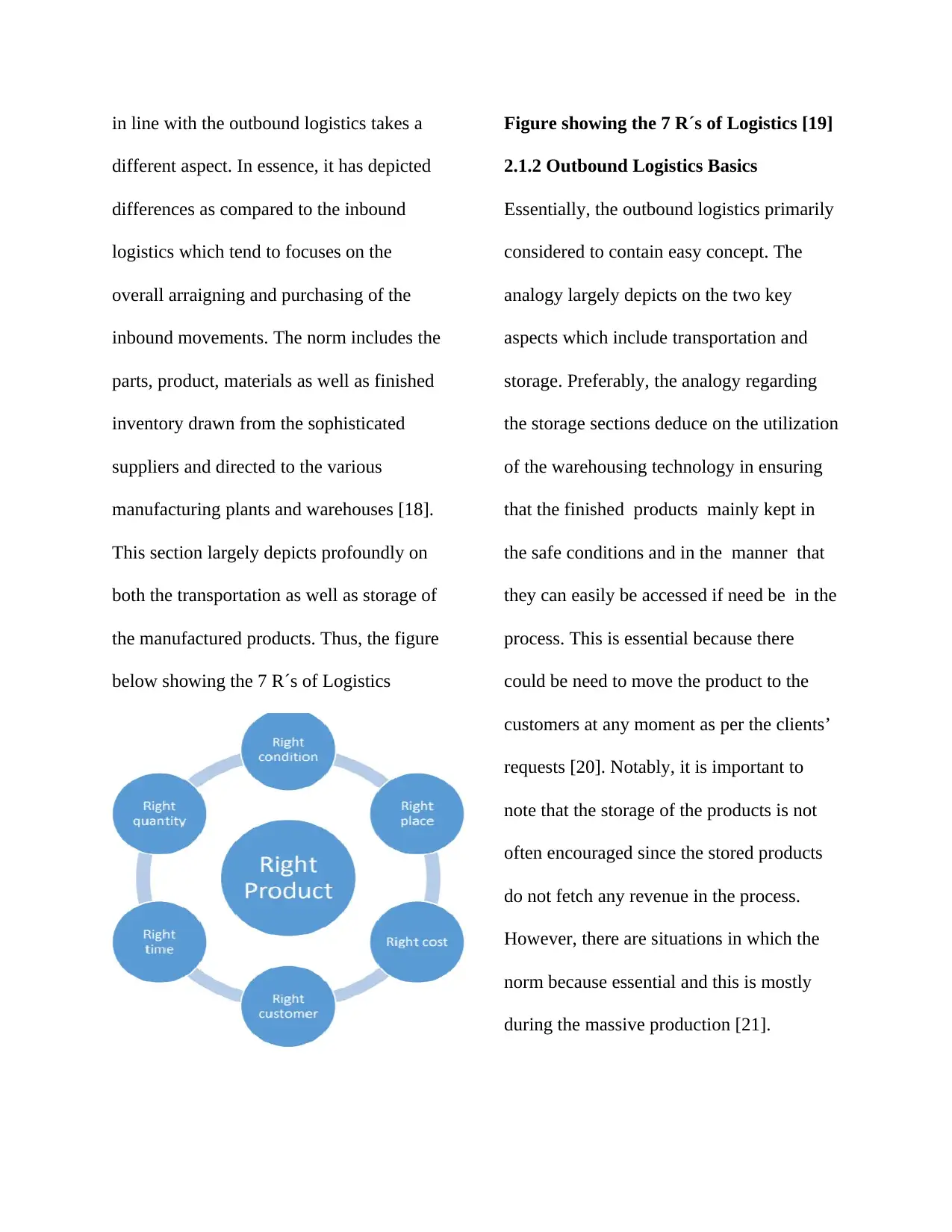
the manufactured products. Thus, the figure
below showing the 7 R´s of Logistics
Figure showing the 7 R´s of Logistics [19]
2.1.2 Outbound Logistics Basics
Essentially, the outbound logistics primarily
considered to contain easy concept. The
analogy largely depicts on the two key
aspects which include transportation and
storage. Preferably, the analogy regarding
the storage sections deduce on the utilization
of the warehousing technology in ensuring
that the finished products mainly kept in
the safe conditions and in the manner that
they can easily be accessed if need be in the
process. This is essential because there
could be need to move the product to the
customers at any moment as per the clients’
requests [20]. Notably, it is important to
note that the storage of the products is not
often encouraged since the stored products
do not fetch any revenue in the process.
However, there are situations in which the
norm because essential and this is mostly
during the massive production [21].
different aspect. In essence, it has depicted
differences as compared to the inbound
logistics which tend to focuses on the
overall arraigning and purchasing of the
inbound movements. The norm includes the
parts, product, materials as well as finished
inventory drawn from the sophisticated
suppliers and directed to the various
manufacturing plants and warehouses [18].
This section largely depicts profoundly on
both the transportation as well as storage of
the manufactured products. Thus, the figure
below showing the 7 R´s of Logistics
Figure showing the 7 R´s of Logistics [19]
2.1.2 Outbound Logistics Basics
Essentially, the outbound logistics primarily
considered to contain easy concept. The
analogy largely depicts on the two key
aspects which include transportation and
storage. Preferably, the analogy regarding
the storage sections deduce on the utilization
of the warehousing technology in ensuring
that the finished products mainly kept in
the safe conditions and in the manner that
they can easily be accessed if need be in the
process. This is essential because there
could be need to move the product to the
customers at any moment as per the clients’
requests [20]. Notably, it is important to
note that the storage of the products is not
often encouraged since the stored products
do not fetch any revenue in the process.
However, there are situations in which the
norm because essential and this is mostly
during the massive production [21].
⊘ This is a preview!⊘
Do you want full access?
Subscribe today to unlock all pages.
Trusted by 1+ million students worldwide
On the other hand, transportation is not only
considered as the most complex section but
also the highly occurred part as per the
outbound logistics. Most analysis has
documented that without transport, and then
one can simply deduce that there is overall
logistics. This is because transport helps in
the process of moving the finished products
from the manufactured point to another
place. The process helps one to move the
products not only in the efficient but also in
the most convenient way possible [22].
Alternatively, the past studies have reported
that transportation is a key variable and this
poses the overall fluctuations with time. In
addition to this, it is important to consider
factors such as the delays, transport team as
well as fuel costs change. The analogy
regarding these factors is essential in
ensuring that they do not jeopardize the
movement efficiency of products. For
example, the reported delays in the
shipment of the goods can lead to huge
losses in terms of dollars for the company,
however if there is the one shipment can be
combine with the larger batch, and then this
can result to more efficient process in due
course [23].
2.1.3 Outbound Process
There are different stages which the
organizations or the businesses can go
through in line with the outbound logistics
process. For example, the sales sections tend
to gather the purchase order from the
makeable customer. Thereafter, they
confirm the inventory records in ensuring
that the order has been completed. Then
there is the sending of the order to
warehouse for either picking or packing and
then it is shipped to the overall customers.
This is followed by the billing of the
customer and the cash for the order thereby
collected [24].
2.1.4 Channels of Distribution
Channel distribution is largely considered
when one is working directly with the
considered as the most complex section but
also the highly occurred part as per the
outbound logistics. Most analysis has
documented that without transport, and then
one can simply deduce that there is overall
logistics. This is because transport helps in
the process of moving the finished products
from the manufactured point to another
place. The process helps one to move the
products not only in the efficient but also in
the most convenient way possible [22].
Alternatively, the past studies have reported
that transportation is a key variable and this
poses the overall fluctuations with time. In
addition to this, it is important to consider
factors such as the delays, transport team as
well as fuel costs change. The analogy
regarding these factors is essential in
ensuring that they do not jeopardize the
movement efficiency of products. For
example, the reported delays in the
shipment of the goods can lead to huge
losses in terms of dollars for the company,
however if there is the one shipment can be
combine with the larger batch, and then this
can result to more efficient process in due
course [23].
2.1.3 Outbound Process
There are different stages which the
organizations or the businesses can go
through in line with the outbound logistics
process. For example, the sales sections tend
to gather the purchase order from the
makeable customer. Thereafter, they
confirm the inventory records in ensuring
that the order has been completed. Then
there is the sending of the order to
warehouse for either picking or packing and
then it is shipped to the overall customers.
This is followed by the billing of the
customer and the cash for the order thereby
collected [24].
2.1.4 Channels of Distribution
Channel distribution is largely considered
when one is working directly with the
Paraphrase This Document
Need a fresh take? Get an instant paraphrase of this document with our AI Paraphraser
clients. The parametric individuals and the
distributors assist in the process of
conveying the services and products to the
overall end user. For example, there are
varieties of dealers which are associated
with the distribution channel. The channels
help in the promotion of the products,
storage, transportation as well as
arrangements. It is also essential to note that
outbound logistics is considered as part and
parcel of the choice which one makes in line
the product promotion. The consideration in
this process is that there should be a good
network for handling the logistics as well as
for catering for the individual customers
[25].
2.1.5 Inventory System
The bid to ensure that there is efficient
outbound process works when the stretch
film and packaging takes into consideration
the working inventory and system. It is
important to note that the overstocking in
line with the inventory can results to the
product obsolesces. If the company fails to
stock enough makeable inventories, then it
can lead to the loss of the customers. It is
important for the companies to try and
balance. They can do this by utilizing the
past inventory entries to enable them to
forecast on the future demands as well as
stay in parametric touch with the distributor.
2.1.6 Delivery Optimization
Optimization in line with the delivery and
shipping is also considered as a vital
outbound logistics component. Thus, the
application of the barcode scanning often
helps in dealing with the inventory tracking
[26]. This will ensure that the client get the
updates regarding the order status.
2.2 Logistics as well as Supply Chain
Management Overview
Essentially, supply chain management or
SCM is regarded to have been introduced in
1980s and it has attracted great and
makeable deals from that time. According to
the supply chain management council, it is
distributors assist in the process of
conveying the services and products to the
overall end user. For example, there are
varieties of dealers which are associated
with the distribution channel. The channels
help in the promotion of the products,
storage, transportation as well as
arrangements. It is also essential to note that
outbound logistics is considered as part and
parcel of the choice which one makes in line
the product promotion. The consideration in
this process is that there should be a good
network for handling the logistics as well as
for catering for the individual customers
[25].
2.1.5 Inventory System
The bid to ensure that there is efficient
outbound process works when the stretch
film and packaging takes into consideration
the working inventory and system. It is
important to note that the overstocking in
line with the inventory can results to the
product obsolesces. If the company fails to
stock enough makeable inventories, then it
can lead to the loss of the customers. It is
important for the companies to try and
balance. They can do this by utilizing the
past inventory entries to enable them to
forecast on the future demands as well as
stay in parametric touch with the distributor.
2.1.6 Delivery Optimization
Optimization in line with the delivery and
shipping is also considered as a vital
outbound logistics component. Thus, the
application of the barcode scanning often
helps in dealing with the inventory tracking
[26]. This will ensure that the client get the
updates regarding the order status.
2.2 Logistics as well as Supply Chain
Management Overview
Essentially, supply chain management or
SCM is regarded to have been introduced in
1980s and it has attracted great and
makeable deals from that time. According to
the supply chain management council, it is
defined as the environment, planning as
well as management of the related activities
which involves not only the procurement
and sourcing but also all the logistics and
conversion[27]. In addition to this, it is
important to note that supply chain
management tends to have major
components which deal with the competitive
strategies and this aims at enhancing the
profitability and the productivity of the
organization. Supply chain management also
comprises of the collaboration and
coordination with the sophisticated channel
partners. The partners may include
suppliers, customers, intermediaries as well
as third party service benefactors [28]. In
the organization context, the term supply
chain is often utilized to refer to the
makeable wide functional range in line with
the areas. The elements considered in the
context may include supply chain
management-related which include
outbound transportation, inbound,
warehousing as well as inventory control.
Further to this, procurement, sourcing as
well as supply management also considered
to be important ingredients which fall under
the described supply chain and umbrella.
Considerably, there are also other
elementary aspects which one may consider
to fall under the concept as well. These
include production planning, forecasting and
scheduling, customer services and order
processing [29]. The analogy also
encompasses all the bodies which works
with the intention of offering the
information system which is often helpful in
the monitoring all the activities in the
process. Thus, one can anticipate that the
supply chain management is the norm which
deals with the all the parametric activities
largely associated with not only the
movement of goods from the amicable raw
material phases but also to the viable end
users. The supply chain in the
manufacturing plants commences with the
well as management of the related activities
which involves not only the procurement
and sourcing but also all the logistics and
conversion[27]. In addition to this, it is
important to note that supply chain
management tends to have major
components which deal with the competitive
strategies and this aims at enhancing the
profitability and the productivity of the
organization. Supply chain management also
comprises of the collaboration and
coordination with the sophisticated channel
partners. The partners may include
suppliers, customers, intermediaries as well
as third party service benefactors [28]. In
the organization context, the term supply
chain is often utilized to refer to the
makeable wide functional range in line with
the areas. The elements considered in the
context may include supply chain
management-related which include
outbound transportation, inbound,
warehousing as well as inventory control.
Further to this, procurement, sourcing as
well as supply management also considered
to be important ingredients which fall under
the described supply chain and umbrella.
Considerably, there are also other
elementary aspects which one may consider
to fall under the concept as well. These
include production planning, forecasting and
scheduling, customer services and order
processing [29]. The analogy also
encompasses all the bodies which works
with the intention of offering the
information system which is often helpful in
the monitoring all the activities in the
process. Thus, one can anticipate that the
supply chain management is the norm which
deals with the all the parametric activities
largely associated with not only the
movement of goods from the amicable raw
material phases but also to the viable end
users. The supply chain in the
manufacturing plants commences with the
⊘ This is a preview!⊘
Do you want full access?
Subscribe today to unlock all pages.
Trusted by 1+ million students worldwide

1 out of 45


Related Documents


Your All-in-One AI-Powered Toolkit for Academic Success.
+13062052269
info@desklib.com
Available 24*7 on WhatsApp / Email
![[object Object]](/_next/static/media/star-bottom.7253800d.svg)
Unlock your academic potential
Copyright © 2020–2026 A2Z Services. All Rights Reserved. Developed and managed by ZUCOL.