The Role of Outdoor Education in Promoting Health and Wellbeing

Verified

Added on  2023/06/04

|7
|1689
|311
Essay
AI Summary
This essay delves into the significant contributions of outdoor education to the health and wellbeing of students. It begins by defining outdoor education and its various forms, highlighting its empirical links to physical and emotional health benefits. The essay then explores how outdoor activities promote wellbeing, referencing research that correlates outdoor learning with improved productivity, creative thinking, and resilience. It further examines specific practices, such as sporting and physical education, that enhance health outcomes in outdoor settings while also discussing factors that may hinder these outcomes. The essay underscores the importance of school policies and regulations in fostering outdoor education and concludes by emphasizing the positive impact of outdoor learning environments on students' overall health and academic performance. The essay also references and cites various sources to support its arguments, providing a comprehensive overview of the topic.
Document Page
Running Head: OUTDOOR EDUCATION AND HEALTH AND WELLBEING
Outdoor Education and Health and Wellbeing
Students Name
University Affiliation
Date
tabler-icon-diamond-filled.svg

Paraphrase This Document

Need a fresh take? Get an instant paraphrase of this document with our AI Paraphraser
Document Page
OUTDOOR EDUCATION AND HEALTH AND WELLBEING 2
Outdoor Education and Health and Wellbeing
Introduction
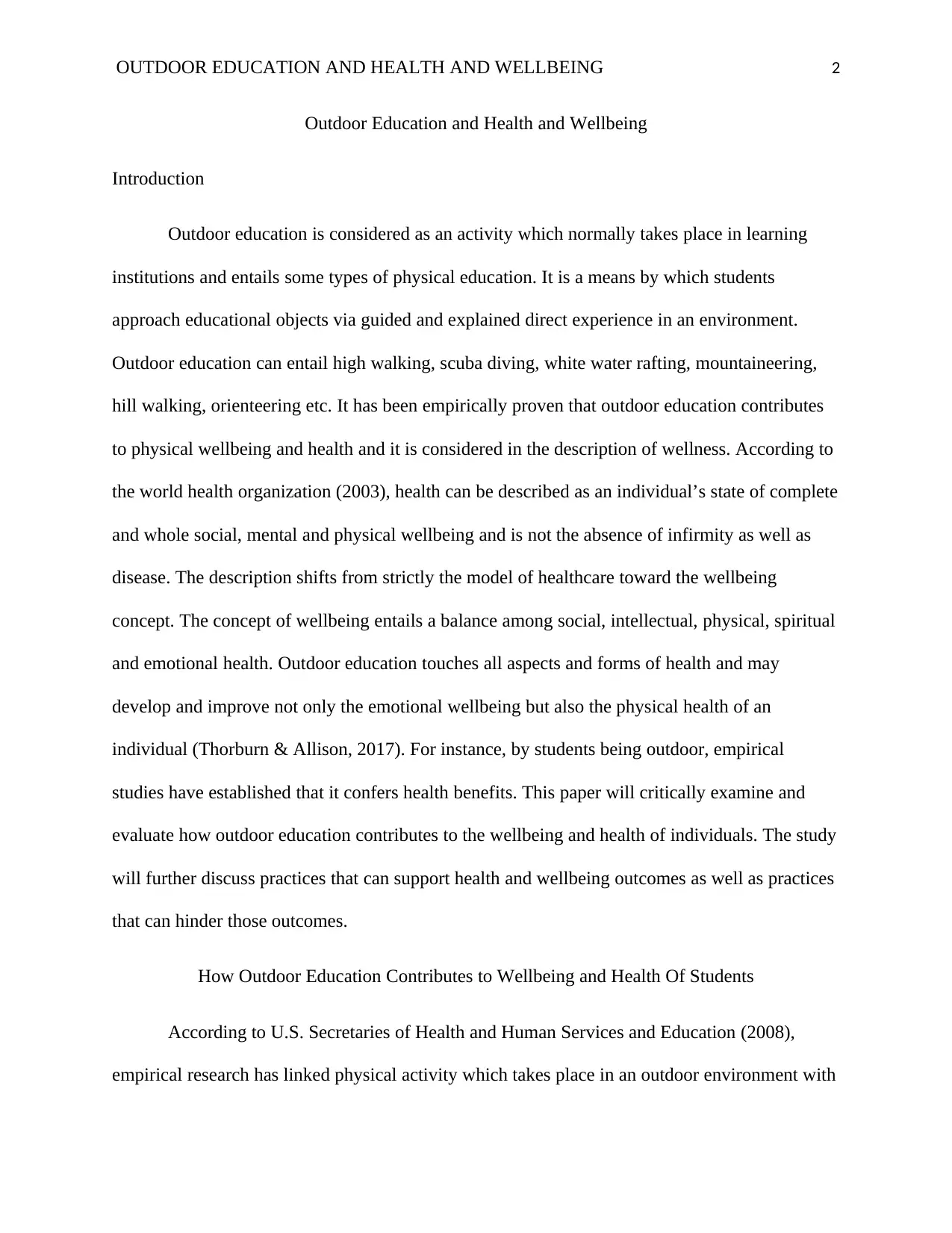
Outdoor education is considered as an activity which normally takes place in learning
institutions and entails some types of physical education. It is a means by which students
approach educational objects via guided and explained direct experience in an environment.
Outdoor education can entail high walking, scuba diving, white water rafting, mountaineering,
hill walking, orienteering etc. It has been empirically proven that outdoor education contributes
to physical wellbeing and health and it is considered in the description of wellness. According to
the world health organization (2003), health can be described as an individual’s state of complete
and whole social, mental and physical wellbeing and is not the absence of infirmity as well as
disease. The description shifts from strictly the model of healthcare toward the wellbeing
concept. The concept of wellbeing entails a balance among social, intellectual, physical, spiritual
and emotional health. Outdoor education touches all aspects and forms of health and may
develop and improve not only the emotional wellbeing but also the physical health of an
individual (Thorburn & Allison, 2017). For instance, by students being outdoor, empirical
studies have established that it confers health benefits. This paper will critically examine and
evaluate how outdoor education contributes to the wellbeing and health of individuals. The study
will further discuss practices that can support health and wellbeing outcomes as well as practices
that can hinder those outcomes.
How Outdoor Education Contributes to Wellbeing and Health Of Students
According to U.S. Secretaries of Health and Human Services and Education (2008),
empirical research has linked physical activity which takes place in an outdoor environment with
Document Page
OUTDOOR EDUCATION AND HEALTH AND WELLBEING 3
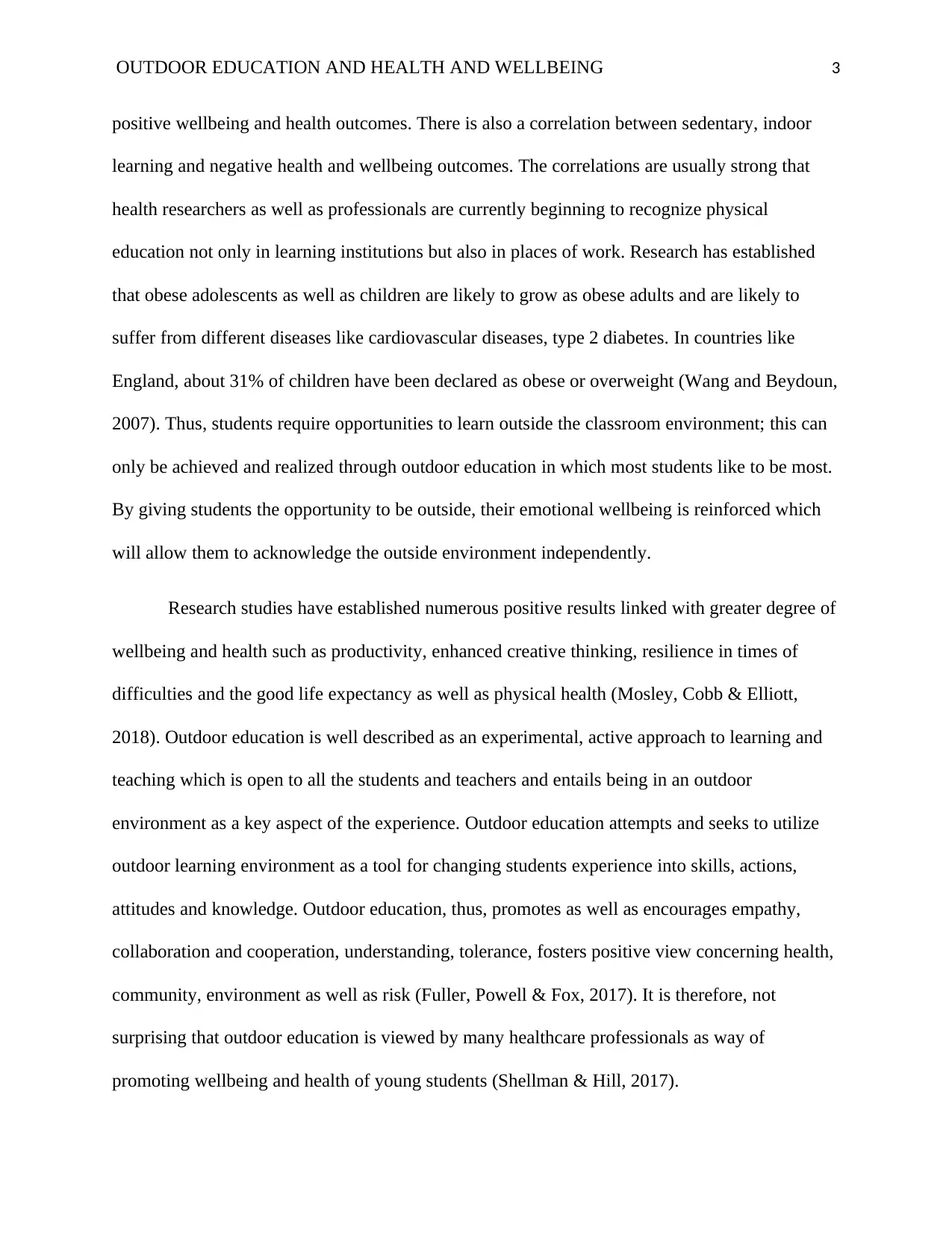
positive wellbeing and health outcomes. There is also a correlation between sedentary, indoor
learning and negative health and wellbeing outcomes. The correlations are usually strong that
health researchers as well as professionals are currently beginning to recognize physical
education not only in learning institutions but also in places of work. Research has established
that obese adolescents as well as children are likely to grow as obese adults and are likely to
suffer from different diseases like cardiovascular diseases, type 2 diabetes. In countries like
England, about 31% of children have been declared as obese or overweight (Wang and Beydoun,
2007). Thus, students require opportunities to learn outside the classroom environment; this can
only be achieved and realized through outdoor education in which most students like to be most.
By giving students the opportunity to be outside, their emotional wellbeing is reinforced which
will allow them to acknowledge the outside environment independently.
Research studies have established numerous positive results linked with greater degree of
wellbeing and health such as productivity, enhanced creative thinking, resilience in times of
difficulties and the good life expectancy as well as physical health (Mosley, Cobb & Elliott,
2018). Outdoor education is well described as an experimental, active approach to learning and
teaching which is open to all the students and teachers and entails being in an outdoor
environment as a key aspect of the experience. Outdoor education attempts and seeks to utilize
outdoor learning environment as a tool for changing students experience into skills, actions,
attitudes and knowledge. Outdoor education, thus, promotes as well as encourages empathy,
collaboration and cooperation, understanding, tolerance, fosters positive view concerning health,
community, environment as well as risk (Fuller, Powell & Fox, 2017). It is therefore, not
surprising that outdoor education is viewed by many healthcare professionals as way of
promoting wellbeing and health of young students (Shellman & Hill, 2017).
Document Page
OUTDOOR EDUCATION AND HEALTH AND WELLBEING 4
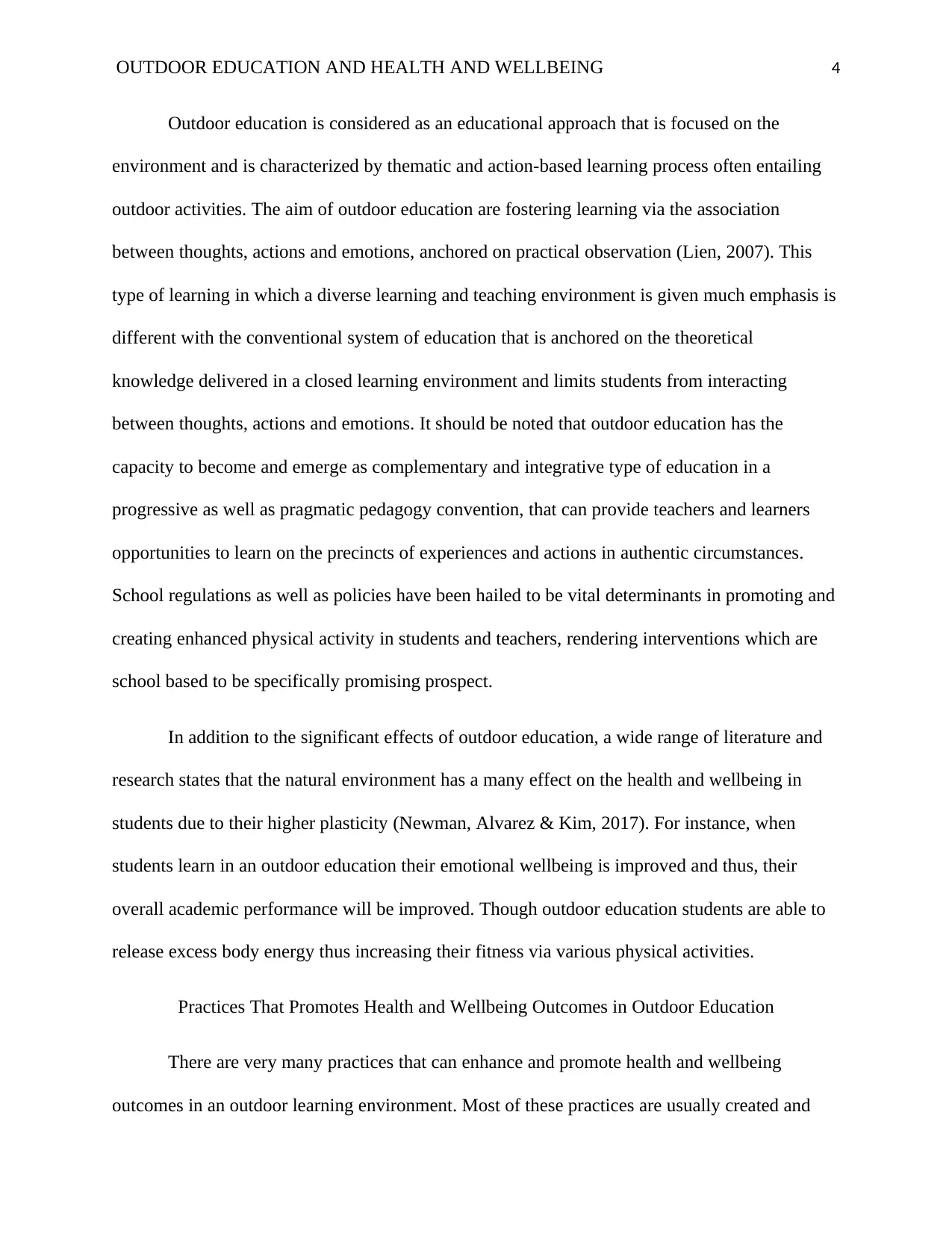
Outdoor education is considered as an educational approach that is focused on the
environment and is characterized by thematic and action-based learning process often entailing
outdoor activities. The aim of outdoor education are fostering learning via the association
between thoughts, actions and emotions, anchored on practical observation (Lien, 2007). This
type of learning in which a diverse learning and teaching environment is given much emphasis is
different with the conventional system of education that is anchored on the theoretical
knowledge delivered in a closed learning environment and limits students from interacting
between thoughts, actions and emotions. It should be noted that outdoor education has the
capacity to become and emerge as complementary and integrative type of education in a
progressive as well as pragmatic pedagogy convention, that can provide teachers and learners
opportunities to learn on the precincts of experiences and actions in authentic circumstances.
School regulations as well as policies have been hailed to be vital determinants in promoting and
creating enhanced physical activity in students and teachers, rendering interventions which are
school based to be specifically promising prospect.
In addition to the significant effects of outdoor education, a wide range of literature and
research states that the natural environment has a many effect on the health and wellbeing in
students due to their higher plasticity (Newman, Alvarez & Kim, 2017). For instance, when
students learn in an outdoor education their emotional wellbeing is improved and thus, their
overall academic performance will be improved. Though outdoor education students are able to
release excess body energy thus increasing their fitness via various physical activities.
Practices That Promotes Health and Wellbeing Outcomes in Outdoor Education
There are very many practices that can enhance and promote health and wellbeing
outcomes in an outdoor learning environment. Most of these practices are usually created and
tabler-icon-diamond-filled.svg

Paraphrase This Document

Need a fresh take? Get an instant paraphrase of this document with our AI Paraphraser
Document Page
OUTDOOR EDUCATION AND HEALTH AND WELLBEING 5
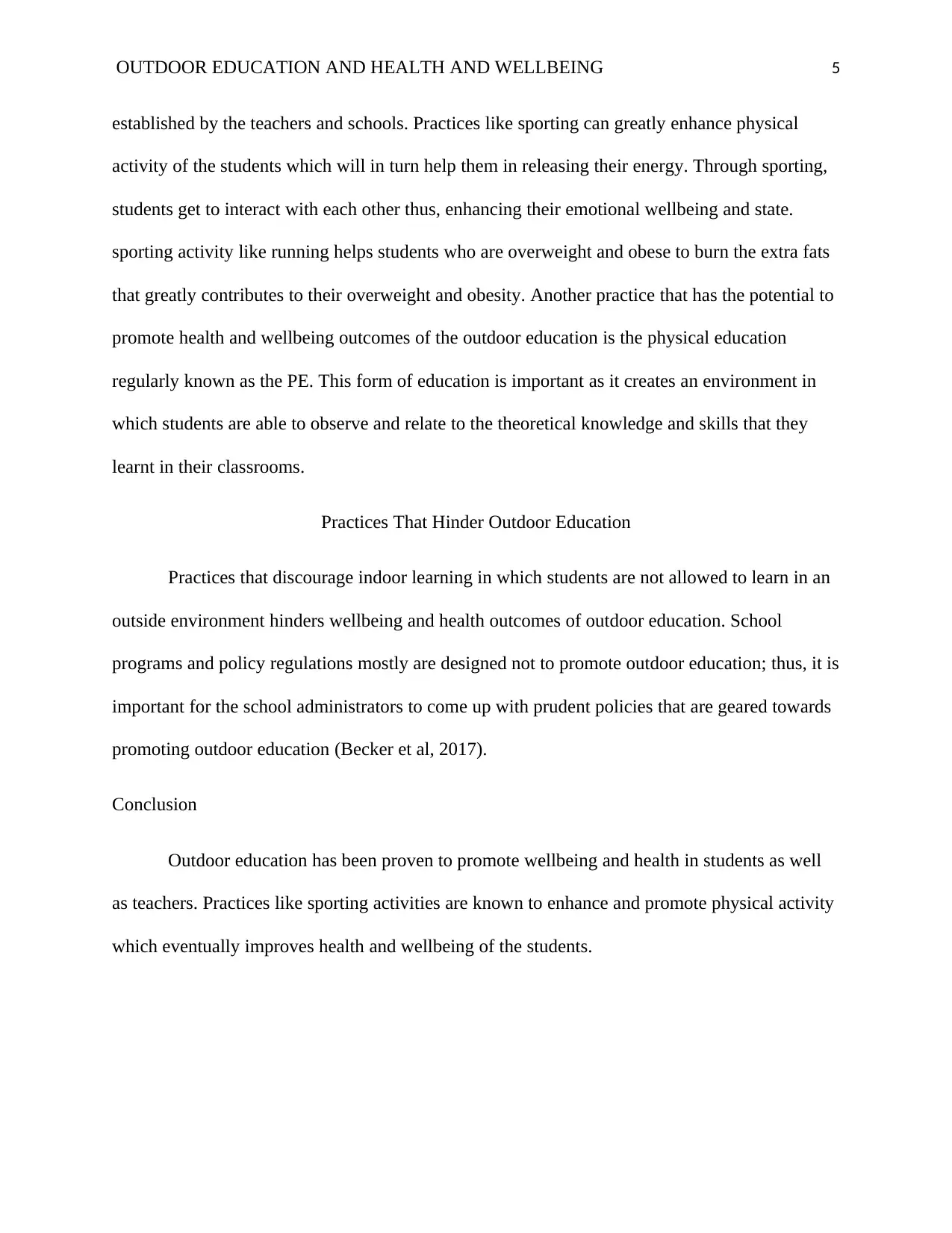
established by the teachers and schools. Practices like sporting can greatly enhance physical
activity of the students which will in turn help them in releasing their energy. Through sporting,
students get to interact with each other thus, enhancing their emotional wellbeing and state.
sporting activity like running helps students who are overweight and obese to burn the extra fats
that greatly contributes to their overweight and obesity. Another practice that has the potential to
promote health and wellbeing outcomes of the outdoor education is the physical education
regularly known as the PE. This form of education is important as it creates an environment in
which students are able to observe and relate to the theoretical knowledge and skills that they
learnt in their classrooms.
Practices That Hinder Outdoor Education
Practices that discourage indoor learning in which students are not allowed to learn in an
outside environment hinders wellbeing and health outcomes of outdoor education. School
programs and policy regulations mostly are designed not to promote outdoor education; thus, it is
important for the school administrators to come up with prudent policies that are geared towards
promoting outdoor education (Becker et al, 2017).
Conclusion
Outdoor education has been proven to promote wellbeing and health in students as well
as teachers. Practices like sporting activities are known to enhance and promote physical activity
which eventually improves health and wellbeing of the students.
Document Page
OUTDOOR EDUCATION AND HEALTH AND WELLBEING 6
References
Becker, C., Lauterbach, G., Spengler, S., Dettweiler, U and Mess, F 2017, Effects of regular
classes in outdoor education setting: A systematic review on students’ learning, social and
health dimensions. Journal List Int J Environ Res Public Health v.14(5); 2017 May
PMC5451936. Retrieved from https://www.ncbi.nlm.nih.gov/pmc/articles/PMC5451936/
Fuller, C, Powell, D & Fox, S 2017, ‘Making gains: the impact of outdoor residential
experiences on students’ examination grades and self-efficacy’, Educational Review, vol. 69, no.
2, pp. 232–247,
Lien, AH 2007, ‘The Benefits of Outdoor Education Experiences on Today’s Youth’, Conference
Papers -- North American Association of Environmental Education, p. 1,
Mosley, C, Cobb, N & Elliott, K 2018, ‘Teaching Outside the Box’, Techniques: Connecting
Education & Careers, vol. 93, no. 7, pp. 46–49,
Newman, TJ, Alvarez, MAG & Kim, M 2017, ‘An Experiential Approach to Sport for Youth
Development’, Journal of Experiential Education, vol. 40, no. 3, pp. 308–322,
Shellman, A & Hill, E 2017, ‘Flourishing through Resilience: The Impact of a College Outdoor
Education Program’, Journal of Park & Recreation Administration, vol. 35, no. 4, pp. 59–68,
Thorburn, M & Allison, P 2017, ‘Learning outdoors and living well? Conceptual prospects for
enhancing curriculum planning and pedagogical practices’, Cambridge Journal of Education,
vol. 47, no. 1, pp. 103–115,
Document Page
OUTDOOR EDUCATION AND HEALTH AND WELLBEING 7
U.S. Secretaries of Health and Human Services and Education, 2008, Promoting Better Health
for Young People through Physical Activity and Sports: A Report to the President. Washington,
DC.
Wang, Y. and Beydoun, M 2007, The Obesity Epidemic in the United States—Gender, Age,
Socioeconomic, Racial/Ethnic and Geographic Characteristics: A Systematic Review and Meta-
Regression Analysis. Epidemologic Reviews 29: 6–28.
World Health Organization. 2003 www.who.int/about/definition/en/print.html.
chevron_up_icon
1 out of 7
circle_padding
hide_on_mobile
zoom_out_icon
[object Object]