Designing Play Area: Environment, Learning & Risk Management
VerifiedAdded on 2023/06/07
|11
|3981
|420
Report
AI Summary
This report provides an analysis of outdoor and nature play environments, focusing on their impact on child development and learning. It examines the environment setting, available resources, and the learning opportunities they provide, linking these ideas to the Early Years Learning Framework and supporting them with research. The report also details the design of a play area, considering factors such as aesthetics, indigenous world views, and sustainable development practices, while addressing risk management and safety concerns. The importance of aesthetics in inspiring children to engage with nature is highlighted, along with the value of indigenous perspectives in fostering a connection with the environment. The report emphasizes the use of sustainable practices, such as the 3Rs (reduce, reuse, recycle), to promote environmental awareness and responsibility among children. Finally, the report stresses the need for risk assessment and management to ensure a safe and enriching play environment for children.
OUTDOOR AND NATURE
PLAY
PLAY

Paraphrase This Document
Need a fresh take? Get an instant paraphrase of this document with our AI Paraphraser
TABLE OF CONTENT
MAIN BODY...................................................................................................................................3
Task 1A:...........................................................................................................................................3
The environment setting:.............................................................................................................3
Resources and materials available for the children:....................................................................3
Task 1B:...........................................................................................................................................3
Analysing the learning through the environment:.......................................................................3
Analysing the learning in and for the environment:....................................................................5
Analysing the Ways in which these ideas link with the Early Year Learning Framework:........6
Explaining the Ways in which these ideas are supported by research and/or academic
literature:......................................................................................................................................7
Task 2:..............................................................................................................................................7
Providing with the brief introduction of the surroundings:.........................................................7
Designing the surroundings of the play area:..............................................................................7
Evaluation of the design by following various principles:........................................................11
REFERENCES................................................................................................................................1
MAIN BODY...................................................................................................................................3
Task 1A:...........................................................................................................................................3
The environment setting:.............................................................................................................3
Resources and materials available for the children:....................................................................3
Task 1B:...........................................................................................................................................3
Analysing the learning through the environment:.......................................................................3
Analysing the learning in and for the environment:....................................................................5
Analysing the Ways in which these ideas link with the Early Year Learning Framework:........6
Explaining the Ways in which these ideas are supported by research and/or academic
literature:......................................................................................................................................7
Task 2:..............................................................................................................................................7
Providing with the brief introduction of the surroundings:.........................................................7
Designing the surroundings of the play area:..............................................................................7
Evaluation of the design by following various principles:........................................................11
REFERENCES................................................................................................................................1
MAIN BODY
Task 1A:
The environment setting:
Environmental setting is the information about the various aspects related to the surroundings of
a particular area, including the existing problems related to the surroundings of that area. The
child B have founded out the environment settings in the way that includes the Yarra river where
he was sitting with the fellow mates (Matthews, & Lippman, (2020). Child finds out the
surroundings more exciting as by eels are being founded there in the river and in the
surroundings so many trees can be founded there and rubbish can be found by the child, and he
prays that people do not spread there spills in the river and let the river be in the proper
conditions of the environment.
Resources and materials available for the children:
The availability of the resources and the material in that program are on the better side of the
environment. The child B was able to find out the river, trees, huge areas to explore the
environment, eels in the river (Neilson, & et.al., (2021). In the surroundings, the child founds the
house in the area with the apple tree. The child also founds a dried flower and the fruit. Child
also finds the ducks in the river and the child finds that the river Yarra must be preserved as the
water source for the wurandjeri peoples.
Task 1B:
In attached presentation.
Task 2:
Providing with the brief introduction of the surroundings:
The environment of surroundings that have been visited is like the best circumstances, objects
and the conditions that have surrounded them in the outdoor area that have been visited in the
program of the kindergarten. The environment was covered with all the living and the non-living
things. The living part of the surroundings was covered by the things like atmosphere that was
there in the area is covered by the trees, rivers, marine creatures like eels, fishes, etc. the
surroundings was also covered with the beautiful area that was having the house that was
Task 1A:
The environment setting:
Environmental setting is the information about the various aspects related to the surroundings of
a particular area, including the existing problems related to the surroundings of that area. The
child B have founded out the environment settings in the way that includes the Yarra river where
he was sitting with the fellow mates (Matthews, & Lippman, (2020). Child finds out the
surroundings more exciting as by eels are being founded there in the river and in the
surroundings so many trees can be founded there and rubbish can be found by the child, and he
prays that people do not spread there spills in the river and let the river be in the proper
conditions of the environment.
Resources and materials available for the children:
The availability of the resources and the material in that program are on the better side of the
environment. The child B was able to find out the river, trees, huge areas to explore the
environment, eels in the river (Neilson, & et.al., (2021). In the surroundings, the child founds the
house in the area with the apple tree. The child also founds a dried flower and the fruit. Child
also finds the ducks in the river and the child finds that the river Yarra must be preserved as the
water source for the wurandjeri peoples.
Task 1B:
In attached presentation.
Task 2:
Providing with the brief introduction of the surroundings:
The environment of surroundings that have been visited is like the best circumstances, objects
and the conditions that have surrounded them in the outdoor area that have been visited in the
program of the kindergarten. The environment was covered with all the living and the non-living
things. The living part of the surroundings was covered by the things like atmosphere that was
there in the area is covered by the trees, rivers, marine creatures like eels, fishes, etc. the
surroundings was also covered with the beautiful area that was having the house that was
⊘ This is a preview!⊘
Do you want full access?
Subscribe today to unlock all pages.

Trusted by 1+ million students worldwide
surrounded by the apple tree and by the beautiful birds and other creatures that was influencing
the outdoor surroundings (Worch, Odell, & Magdich, (2022). Environment plays an essential
role in healthy living and the existence of life on the planet earth. Earth is a home for different
living species like the humans natural creatures and the animals of the marine and the land lives,
and these all creatures are dependent on the environment for food, air, water, and other needs.
Hence, it is important for every individual to save as well as protect the environment that is being
provided to the humans and the other creatures.
Designing the surroundings of the play area:
Some of the most important area for the kids are the play area. This area is like one of the most
important area for the kids. This area for the kids is like it must be including the proper
surroundings and the resources for the kids to get developed by playing in the area and passing
their time in that area. The surroundings of the play area must be including all the resources like
the play space, sensory features, social aspects ad the familiarity of the area to develop the
surroundings as per their capability to get developed according to the future of the kids and help
in developing the curriculum and the proper philosophy of the children (LeMasters, &
Vandermaas-Peeler, (2021). The play area must be developed in the way that it must be covered
with the different things like the playing material, plantation material, and the other sources
required to develop their skills. Play area in the outside surroundings must be having the well
organized, personable and the comfortable area that develops the children by also developing
them in the physical ways.
This value of the learning aesthetics to inspire children to engage with nature helps in
setting out the values for the children to get engaged with the nature by doing out the plantation
activities and appreciating the beauty of the nature. This becomes an important task for the
development of the child. This takes part as the important task in the early lives of the children to
make them connect with the nature and getting educated about the nature. Aesthetics helps in
inspiring children to engage with nature as it makes that thing happy and make them feel like
happily engaged in the learning and generates the ability to make them learn more out of that.
This development in the early childhood plays a vital role to develop the understanding in the
lives of about the surroundings.
Making the children learn in their early childhood in the indigenous ways make it
relational with the learnings related to the nature and the environment. Learning under the
the outdoor surroundings (Worch, Odell, & Magdich, (2022). Environment plays an essential
role in healthy living and the existence of life on the planet earth. Earth is a home for different
living species like the humans natural creatures and the animals of the marine and the land lives,
and these all creatures are dependent on the environment for food, air, water, and other needs.
Hence, it is important for every individual to save as well as protect the environment that is being
provided to the humans and the other creatures.
Designing the surroundings of the play area:
Some of the most important area for the kids are the play area. This area is like one of the most
important area for the kids. This area for the kids is like it must be including the proper
surroundings and the resources for the kids to get developed by playing in the area and passing
their time in that area. The surroundings of the play area must be including all the resources like
the play space, sensory features, social aspects ad the familiarity of the area to develop the
surroundings as per their capability to get developed according to the future of the kids and help
in developing the curriculum and the proper philosophy of the children (LeMasters, &
Vandermaas-Peeler, (2021). The play area must be developed in the way that it must be covered
with the different things like the playing material, plantation material, and the other sources
required to develop their skills. Play area in the outside surroundings must be having the well
organized, personable and the comfortable area that develops the children by also developing
them in the physical ways.
This value of the learning aesthetics to inspire children to engage with nature helps in
setting out the values for the children to get engaged with the nature by doing out the plantation
activities and appreciating the beauty of the nature. This becomes an important task for the
development of the child. This takes part as the important task in the early lives of the children to
make them connect with the nature and getting educated about the nature. Aesthetics helps in
inspiring children to engage with nature as it makes that thing happy and make them feel like
happily engaged in the learning and generates the ability to make them learn more out of that.
This development in the early childhood plays a vital role to develop the understanding in the
lives of about the surroundings.
Making the children learn in their early childhood in the indigenous ways make it
relational with the learnings related to the nature and the environment. Learning under the
Paraphrase This Document
Need a fresh take? Get an instant paraphrase of this document with our AI Paraphraser
Indigenous world views make it feel like the things are connected with the lives and are the parts
related to the everyday activities. This make the children connected with the nature in the
indigenous ways and with the qualities of the honour towards the natural resources and the
environment and with the quality of the trust to protect it, with accordance to the honesty and
humility. This practise makes the children connect with the nature and the surroundings they are
in, of the play area by fostering the relationship in the positive ways.
The play area for the child can be filled with the sustainable developed area like the
playing equipments of the children can be build with the recyclable things. The surroundings in
the area can be developed in the sustainable ways like the things available in the area can be used
in the ways of the 3R's which is reduced, reuse and recycle. There in the play area volunteers can
be facilitated for the children so that the place can be cleared off and can be made healthy for the
community. The area must be developed in a way that the children using the outdoor area makes
them learn about the sustainable activities like plantation activities, water conservation
techniques. Making the children learn about the sustainable development in the way that it can
make them learn about the things that make it developed in the way helping them to learn about
the future needs to meet their needs to be related with natural environment (Chandwania, &
Natu, (2021). The sustainability in the play area can be developed by using the natural resources
to give knowledge to the children. Use of the natural things that the can help are like making the
use of the natural light, eliminating the use of energy waste, by guiding them about not to waste
food, making them know about the plantation and the rain water harvesting, etc. the children
should be made learnt about the use of the reducing, recycling, upcycling, and they ways to
participate in the bio diversity activities. This will help them to develop the meanings of the
sustainable development and gives them the opportunities of the different types like to think in
the creative manner and bring out the solution to the problem related to that of the play area and
that of their personal surroundings. The properly developed play area for the child can help one
in gaining confidence, having the ability to be independent and make the sense of achievement in
doing the tasks.
In the kids play area properly developed with the different factors like aesthetics that
inspire the children to engage with the nature, having the indigenous world views that help the
children to look more in to the real world lives, and the area with sustainable development for the
children to grow and have the opportunities to develop. These all factor inclusive area requires
related to the everyday activities. This make the children connected with the nature in the
indigenous ways and with the qualities of the honour towards the natural resources and the
environment and with the quality of the trust to protect it, with accordance to the honesty and
humility. This practise makes the children connect with the nature and the surroundings they are
in, of the play area by fostering the relationship in the positive ways.
The play area for the child can be filled with the sustainable developed area like the
playing equipments of the children can be build with the recyclable things. The surroundings in
the area can be developed in the sustainable ways like the things available in the area can be used
in the ways of the 3R's which is reduced, reuse and recycle. There in the play area volunteers can
be facilitated for the children so that the place can be cleared off and can be made healthy for the
community. The area must be developed in a way that the children using the outdoor area makes
them learn about the sustainable activities like plantation activities, water conservation
techniques. Making the children learn about the sustainable development in the way that it can
make them learn about the things that make it developed in the way helping them to learn about
the future needs to meet their needs to be related with natural environment (Chandwania, &
Natu, (2021). The sustainability in the play area can be developed by using the natural resources
to give knowledge to the children. Use of the natural things that the can help are like making the
use of the natural light, eliminating the use of energy waste, by guiding them about not to waste
food, making them know about the plantation and the rain water harvesting, etc. the children
should be made learnt about the use of the reducing, recycling, upcycling, and they ways to
participate in the bio diversity activities. This will help them to develop the meanings of the
sustainable development and gives them the opportunities of the different types like to think in
the creative manner and bring out the solution to the problem related to that of the play area and
that of their personal surroundings. The properly developed play area for the child can help one
in gaining confidence, having the ability to be independent and make the sense of achievement in
doing the tasks.
In the kids play area properly developed with the different factors like aesthetics that
inspire the children to engage with the nature, having the indigenous world views that help the
children to look more in to the real world lives, and the area with sustainable development for the
children to grow and have the opportunities to develop. These all factor inclusive area requires
with the risk management in that area and the solution for the problems to be solved in the play
area. Risk management in the area cannot be designed as per the views of removing all the risks.
But the area can be developed in the way that can help in removing the serious injuries to the
children. This can be done by taking the valid precautions (Aminpour, (2022). In the play areas,
incidents offers in most of the cases which are minor and this all can happen due to the normal
playing activities. Some major cases in the play area might happen due to lack of proper
management. Some hazards in the area takes place even due to the not doing in the proper
maintenance of the equipments and the resources available for the students to play in the area.
So, the equipments available for the students in the play area must be properly managed and
protected with proper maintenance to provide the children with good times in the play area by
making them learn new things and develop them in the accordance with according to their near
future.
The assessment of the risk in the play area for the kids, comes up as an essential topic of
concern. Management authorities of the area must be taking out the visual inspection of the area
on the weekly basis and must maintain the area in relevant ways to give the protection to the
children in the play area (Striniste, (2019). The risk in the play area can be maintained by
following the different measures for the safety of the children like the health and safety executive
can take the initiative and can give the particular norms like daily inspection, once in a month or
the quarterly inspection, and annual inspection of the equipments by the experts for all the
resources available and playing equipments of the children to ensure their safety in play area.
The following can be facilitated by paying major attention on the main sources like:
Playing at a height and playground surfaces: the playing equipment that is placed above the
nominal height, must be placed on the proper surface that might be a bit rubberized. The area of
the surface near that equipments must be extended to some meters that can help in preventing
some major injury.
Equipments and resources: stuff for the playing area must be purchased from the reputed
suppliers only to ensure the good quality and must be complying with the safety standards. The
management of the play area must undergo with the post installation of the playing stuff of the
kids (Hamilton & Hile, (2022).
area. Risk management in the area cannot be designed as per the views of removing all the risks.
But the area can be developed in the way that can help in removing the serious injuries to the
children. This can be done by taking the valid precautions (Aminpour, (2022). In the play areas,
incidents offers in most of the cases which are minor and this all can happen due to the normal
playing activities. Some major cases in the play area might happen due to lack of proper
management. Some hazards in the area takes place even due to the not doing in the proper
maintenance of the equipments and the resources available for the students to play in the area.
So, the equipments available for the students in the play area must be properly managed and
protected with proper maintenance to provide the children with good times in the play area by
making them learn new things and develop them in the accordance with according to their near
future.
The assessment of the risk in the play area for the kids, comes up as an essential topic of
concern. Management authorities of the area must be taking out the visual inspection of the area
on the weekly basis and must maintain the area in relevant ways to give the protection to the
children in the play area (Striniste, (2019). The risk in the play area can be maintained by
following the different measures for the safety of the children like the health and safety executive
can take the initiative and can give the particular norms like daily inspection, once in a month or
the quarterly inspection, and annual inspection of the equipments by the experts for all the
resources available and playing equipments of the children to ensure their safety in play area.
The following can be facilitated by paying major attention on the main sources like:
Playing at a height and playground surfaces: the playing equipment that is placed above the
nominal height, must be placed on the proper surface that might be a bit rubberized. The area of
the surface near that equipments must be extended to some meters that can help in preventing
some major injury.
Equipments and resources: stuff for the playing area must be purchased from the reputed
suppliers only to ensure the good quality and must be complying with the safety standards. The
management of the play area must undergo with the post installation of the playing stuff of the
kids (Hamilton & Hile, (2022).
⊘ This is a preview!⊘
Do you want full access?
Subscribe today to unlock all pages.
Trusted by 1+ million students worldwide
Damaged equipments: the damaged equipments in the play area must be avoided to ensure the
safety for the children. The equipments that are damaged must be avoided and not to be taken in
the use by the children. Equipments must be vandalized if they are posing towards the danger.
Avoidance of the thorny plants: to give out the sustainable and the naturally developed
surroundings to children the play area must be developed with that type of plantation that will be
having the safe flower plants and trees around which children can spend their time by learning
about the nature.
The community of the play area must give out the best of the area by following the
discussed design, that is focusing on providing the children with the properly developed area
with the idea of giving the children with the aesthetics to learn about the nature with the world
view in the indigenous way. The area developed for the kids will be providing them with the
sustainability development practises like the usage of the 3r methodology and plantation methods
to grow out more of the plants in the area with the knowledge of the indoor and outdoor plants.
The area developed for the kids will also be properly assessed by the management team to ensure
the safety of the area for the kids (Ng, & et.al., (2020).
Evaluation of the design by following various principles:
Opportunities for the learning through in and for the environment gave the children with the
proper accessibility to learn and develop with the nature. In the early years of their learning
frame work, by having the type of play area as discussed can give them with the proper
assessment of their future and can develop them with the time. This area can make them focus on
the areas of their personal attention and helps them to focus more on the areas required. The
environmental learning areas provides the children to get them to develop their thinking skills
and give them with the acknowledged creativity. This type of the learning for the children help
them in facilitating the learning with the following aspects of the knowledge like identity,
community, well-being, organized learning, and communicating.
The proper area for the children developed in the proper way provides the children with
the developed scientific thinking towards their personal areas of learning and gives them with
more of the motivation and grows of their interest to pursue the things. In their early times,
curiosity helps them in developing with the most of natural environment and by providing with
the grown muscle strength. For the children, curiosity and wonders helps to stimulate with the
sense of the development. The proper areas of the curiosity provide with the opportunities to
safety for the children. The equipments that are damaged must be avoided and not to be taken in
the use by the children. Equipments must be vandalized if they are posing towards the danger.
Avoidance of the thorny plants: to give out the sustainable and the naturally developed
surroundings to children the play area must be developed with that type of plantation that will be
having the safe flower plants and trees around which children can spend their time by learning
about the nature.
The community of the play area must give out the best of the area by following the
discussed design, that is focusing on providing the children with the properly developed area
with the idea of giving the children with the aesthetics to learn about the nature with the world
view in the indigenous way. The area developed for the kids will be providing them with the
sustainability development practises like the usage of the 3r methodology and plantation methods
to grow out more of the plants in the area with the knowledge of the indoor and outdoor plants.
The area developed for the kids will also be properly assessed by the management team to ensure
the safety of the area for the kids (Ng, & et.al., (2020).
Evaluation of the design by following various principles:
Opportunities for the learning through in and for the environment gave the children with the
proper accessibility to learn and develop with the nature. In the early years of their learning
frame work, by having the type of play area as discussed can give them with the proper
assessment of their future and can develop them with the time. This area can make them focus on
the areas of their personal attention and helps them to focus more on the areas required. The
environmental learning areas provides the children to get them to develop their thinking skills
and give them with the acknowledged creativity. This type of the learning for the children help
them in facilitating the learning with the following aspects of the knowledge like identity,
community, well-being, organized learning, and communicating.
The proper area for the children developed in the proper way provides the children with
the developed scientific thinking towards their personal areas of learning and gives them with
more of the motivation and grows of their interest to pursue the things. In their early times,
curiosity helps them in developing with the most of natural environment and by providing with
the grown muscle strength. For the children, curiosity and wonders helps to stimulate with the
sense of the development. The proper areas of the curiosity provide with the opportunities to
Paraphrase This Document
Need a fresh take? Get an instant paraphrase of this document with our AI Paraphraser
develop with both the gross and fine skills in the children. The play area developed in the
sustainable way can help in the gaining there natural interest towards the natural surroundings
related to the play area and the other environment (Spilker, (2022). Play area can become one of
the best area to make the kids learn about new things and develop with the feeling of the
curiosity and wonder.
The land owners in the australian region are the aboriginal and the torres strait people that
have been operating with the land mass of the australian region. They have around 40 percent of
the land area. For in the spirit of the reconciliation is given to the traditional custodians of the
country demonstrating their connections with sea, land and community. This all become helpful
for the children to know more about the place and to develop the surroundings as per the
acknowledgement. The acknowledgement consists of the reconcilation australia acknowledges
that the traditional owners of the country throughout australia by paying in the respect to the
elders past and the present of the country. This acknowledgement of the country can be adapted
and expanded to make it reflect in the various context. By making the children learn about this,
they can be made learnt about the way of showing in the awareness, and respect the aboriginal
traditional owners of the land for the area on which the play area for the kids have been made.
Making them learn about the rituals can make them to relate with the environment on more of
the context of the natural surroundings (Tunçeli, & Şenöz, (2022).
Having in the inclusive practices of the play area can make the kids learn and play by
developing the abilities of the play in the rich range of physical activity, sensory activity and
their socail experience towards the environment. Play space in such natural surroundings can
play an important role in the life of hte kids to develop their levels of understanding and to help
them have the proper knowledg about the surroundings. The involvement of the inclusive
activity of the play area make the learning capabilities of the area and to develop different
opportunities like learning plantation and many more from the nature not taking the disabilities
in the count. Inclusion activities look in by including all the children and parents, staff in to the
count with allthe people connected to the activities of the early year learning program for the
kids.
The kids must be provided with all the affordance in the play area to have all that make it
click to the environment. This all interactions are immediate as these all affordance are gathered
in for the children from the surroundings. The physical play affordane is the proper interaction in
sustainable way can help in the gaining there natural interest towards the natural surroundings
related to the play area and the other environment (Spilker, (2022). Play area can become one of
the best area to make the kids learn about new things and develop with the feeling of the
curiosity and wonder.
The land owners in the australian region are the aboriginal and the torres strait people that
have been operating with the land mass of the australian region. They have around 40 percent of
the land area. For in the spirit of the reconciliation is given to the traditional custodians of the
country demonstrating their connections with sea, land and community. This all become helpful
for the children to know more about the place and to develop the surroundings as per the
acknowledgement. The acknowledgement consists of the reconcilation australia acknowledges
that the traditional owners of the country throughout australia by paying in the respect to the
elders past and the present of the country. This acknowledgement of the country can be adapted
and expanded to make it reflect in the various context. By making the children learn about this,
they can be made learnt about the way of showing in the awareness, and respect the aboriginal
traditional owners of the land for the area on which the play area for the kids have been made.
Making them learn about the rituals can make them to relate with the environment on more of
the context of the natural surroundings (Tunçeli, & Şenöz, (2022).
Having in the inclusive practices of the play area can make the kids learn and play by
developing the abilities of the play in the rich range of physical activity, sensory activity and
their socail experience towards the environment. Play space in such natural surroundings can
play an important role in the life of hte kids to develop their levels of understanding and to help
them have the proper knowledg about the surroundings. The involvement of the inclusive
activity of the play area make the learning capabilities of the area and to develop different
opportunities like learning plantation and many more from the nature not taking the disabilities
in the count. Inclusion activities look in by including all the children and parents, staff in to the
count with allthe people connected to the activities of the early year learning program for the
kids.
The kids must be provided with all the affordance in the play area to have all that make it
click to the environment. This all interactions are immediate as these all affordance are gathered
in for the children from the surroundings. The physical play affordane is the proper interaction in
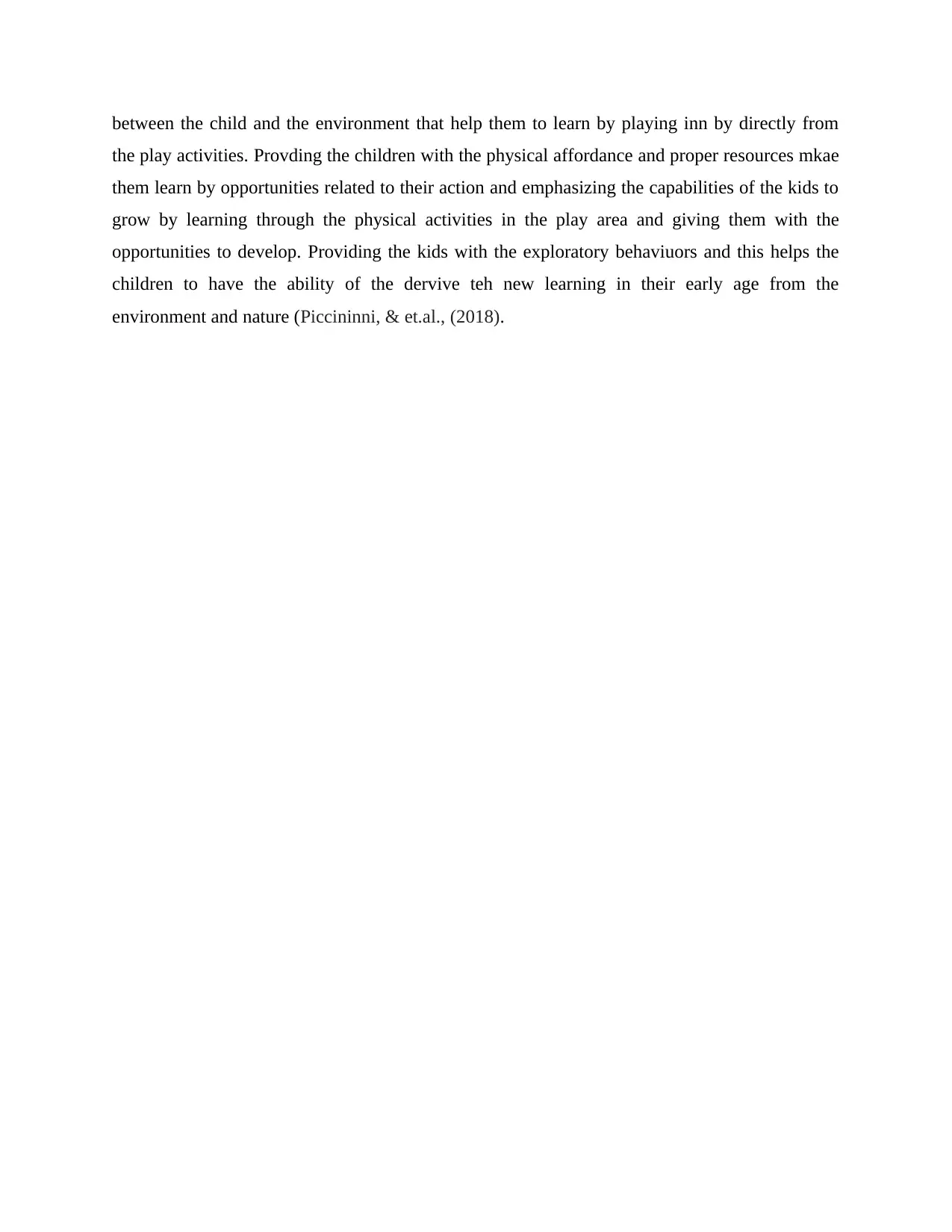
between the child and the environment that help them to learn by playing inn by directly from
the play activities. Provding the children with the physical affordance and proper resources mkae
them learn by opportunities related to their action and emphasizing the capabilities of the kids to
grow by learning through the physical activities in the play area and giving them with the
opportunities to develop. Providing the kids with the exploratory behaviuors and this helps the
children to have the ability of the dervive teh new learning in their early age from the
environment and nature (Piccininni, & et.al., (2018).
the play activities. Provding the children with the physical affordance and proper resources mkae
them learn by opportunities related to their action and emphasizing the capabilities of the kids to
grow by learning through the physical activities in the play area and giving them with the
opportunities to develop. Providing the kids with the exploratory behaviuors and this helps the
children to have the ability of the dervive teh new learning in their early age from the
environment and nature (Piccininni, & et.al., (2018).
⊘ This is a preview!⊘
Do you want full access?
Subscribe today to unlock all pages.
Trusted by 1+ million students worldwide
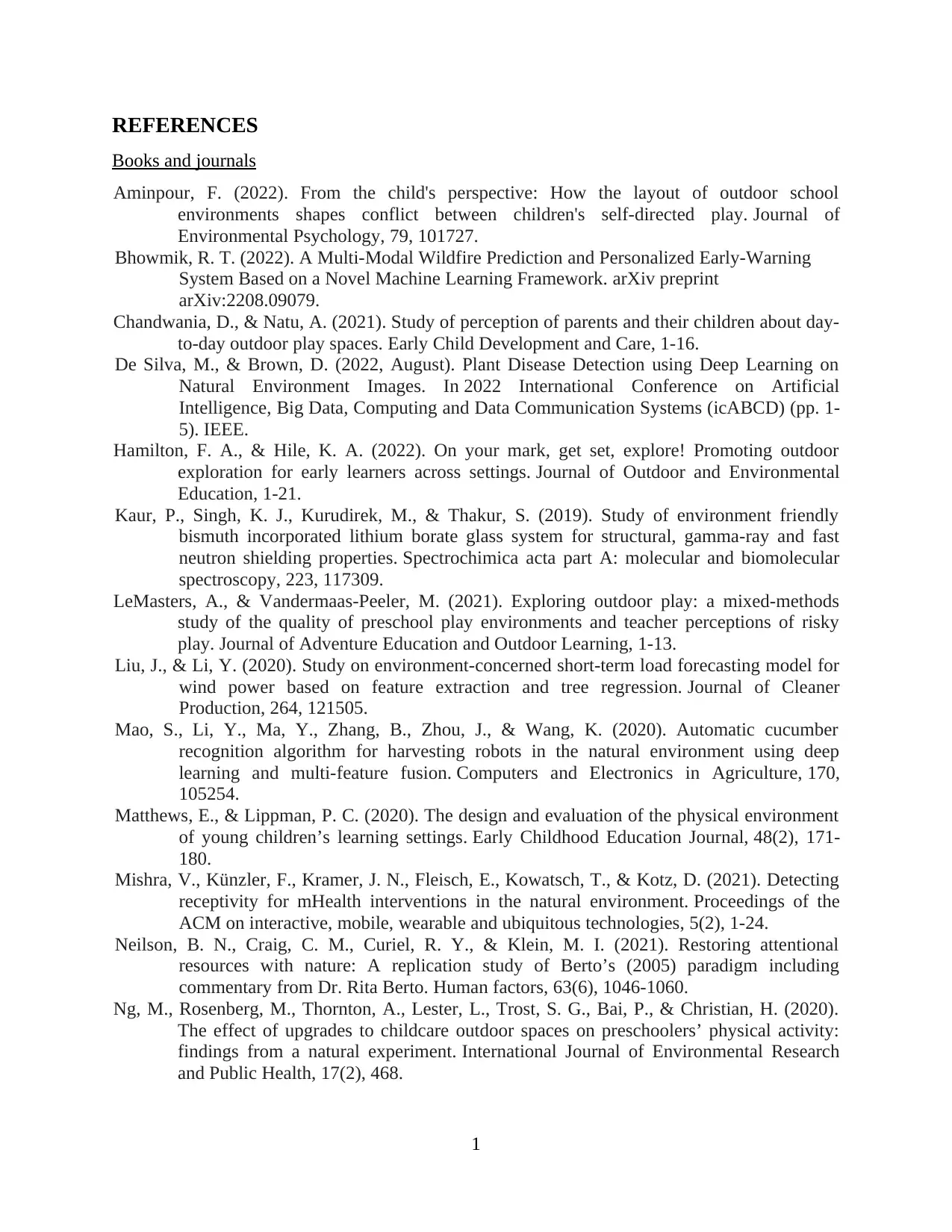
REFERENCES
Books and journals
Aminpour, F. (2022). From the child's perspective: How the layout of outdoor school
environments shapes conflict between children's self-directed play. Journal of
Environmental Psychology, 79, 101727.
Bhowmik, R. T. (2022). A Multi-Modal Wildfire Prediction and Personalized Early-Warning
System Based on a Novel Machine Learning Framework. arXiv preprint
arXiv:2208.09079.
Chandwania, D., & Natu, A. (2021). Study of perception of parents and their children about day-
to-day outdoor play spaces. Early Child Development and Care, 1-16.
De Silva, M., & Brown, D. (2022, August). Plant Disease Detection using Deep Learning on
Natural Environment Images. In 2022 International Conference on Artificial
Intelligence, Big Data, Computing and Data Communication Systems (icABCD) (pp. 1-
5). IEEE.
Hamilton, F. A., & Hile, K. A. (2022). On your mark, get set, explore! Promoting outdoor
exploration for early learners across settings. Journal of Outdoor and Environmental
Education, 1-21.
Kaur, P., Singh, K. J., Kurudirek, M., & Thakur, S. (2019). Study of environment friendly
bismuth incorporated lithium borate glass system for structural, gamma-ray and fast
neutron shielding properties. Spectrochimica acta part A: molecular and biomolecular
spectroscopy, 223, 117309.
LeMasters, A., & Vandermaas-Peeler, M. (2021). Exploring outdoor play: a mixed-methods
study of the quality of preschool play environments and teacher perceptions of risky
play. Journal of Adventure Education and Outdoor Learning, 1-13.
Liu, J., & Li, Y. (2020). Study on environment-concerned short-term load forecasting model for
wind power based on feature extraction and tree regression. Journal of Cleaner
Production, 264, 121505.
Mao, S., Li, Y., Ma, Y., Zhang, B., Zhou, J., & Wang, K. (2020). Automatic cucumber
recognition algorithm for harvesting robots in the natural environment using deep
learning and multi-feature fusion. Computers and Electronics in Agriculture, 170,
105254.
Matthews, E., & Lippman, P. C. (2020). The design and evaluation of the physical environment
of young children’s learning settings. Early Childhood Education Journal, 48(2), 171-
180.
Mishra, V., Künzler, F., Kramer, J. N., Fleisch, E., Kowatsch, T., & Kotz, D. (2021). Detecting
receptivity for mHealth interventions in the natural environment. Proceedings of the
ACM on interactive, mobile, wearable and ubiquitous technologies, 5(2), 1-24.
Neilson, B. N., Craig, C. M., Curiel, R. Y., & Klein, M. I. (2021). Restoring attentional
resources with nature: A replication study of Berto’s (2005) paradigm including
commentary from Dr. Rita Berto. Human factors, 63(6), 1046-1060.
Ng, M., Rosenberg, M., Thornton, A., Lester, L., Trost, S. G., Bai, P., & Christian, H. (2020).
The effect of upgrades to childcare outdoor spaces on preschoolers’ physical activity:
findings from a natural experiment. International Journal of Environmental Research
and Public Health, 17(2), 468.
1
Books and journals
Aminpour, F. (2022). From the child's perspective: How the layout of outdoor school
environments shapes conflict between children's self-directed play. Journal of
Environmental Psychology, 79, 101727.
Bhowmik, R. T. (2022). A Multi-Modal Wildfire Prediction and Personalized Early-Warning
System Based on a Novel Machine Learning Framework. arXiv preprint
arXiv:2208.09079.
Chandwania, D., & Natu, A. (2021). Study of perception of parents and their children about day-
to-day outdoor play spaces. Early Child Development and Care, 1-16.
De Silva, M., & Brown, D. (2022, August). Plant Disease Detection using Deep Learning on
Natural Environment Images. In 2022 International Conference on Artificial
Intelligence, Big Data, Computing and Data Communication Systems (icABCD) (pp. 1-
5). IEEE.
Hamilton, F. A., & Hile, K. A. (2022). On your mark, get set, explore! Promoting outdoor
exploration for early learners across settings. Journal of Outdoor and Environmental
Education, 1-21.
Kaur, P., Singh, K. J., Kurudirek, M., & Thakur, S. (2019). Study of environment friendly
bismuth incorporated lithium borate glass system for structural, gamma-ray and fast
neutron shielding properties. Spectrochimica acta part A: molecular and biomolecular
spectroscopy, 223, 117309.
LeMasters, A., & Vandermaas-Peeler, M. (2021). Exploring outdoor play: a mixed-methods
study of the quality of preschool play environments and teacher perceptions of risky
play. Journal of Adventure Education and Outdoor Learning, 1-13.
Liu, J., & Li, Y. (2020). Study on environment-concerned short-term load forecasting model for
wind power based on feature extraction and tree regression. Journal of Cleaner
Production, 264, 121505.
Mao, S., Li, Y., Ma, Y., Zhang, B., Zhou, J., & Wang, K. (2020). Automatic cucumber
recognition algorithm for harvesting robots in the natural environment using deep
learning and multi-feature fusion. Computers and Electronics in Agriculture, 170,
105254.
Matthews, E., & Lippman, P. C. (2020). The design and evaluation of the physical environment
of young children’s learning settings. Early Childhood Education Journal, 48(2), 171-
180.
Mishra, V., Künzler, F., Kramer, J. N., Fleisch, E., Kowatsch, T., & Kotz, D. (2021). Detecting
receptivity for mHealth interventions in the natural environment. Proceedings of the
ACM on interactive, mobile, wearable and ubiquitous technologies, 5(2), 1-24.
Neilson, B. N., Craig, C. M., Curiel, R. Y., & Klein, M. I. (2021). Restoring attentional
resources with nature: A replication study of Berto’s (2005) paradigm including
commentary from Dr. Rita Berto. Human factors, 63(6), 1046-1060.
Ng, M., Rosenberg, M., Thornton, A., Lester, L., Trost, S. G., Bai, P., & Christian, H. (2020).
The effect of upgrades to childcare outdoor spaces on preschoolers’ physical activity:
findings from a natural experiment. International Journal of Environmental Research
and Public Health, 17(2), 468.
1
Paraphrase This Document
Need a fresh take? Get an instant paraphrase of this document with our AI Paraphraser
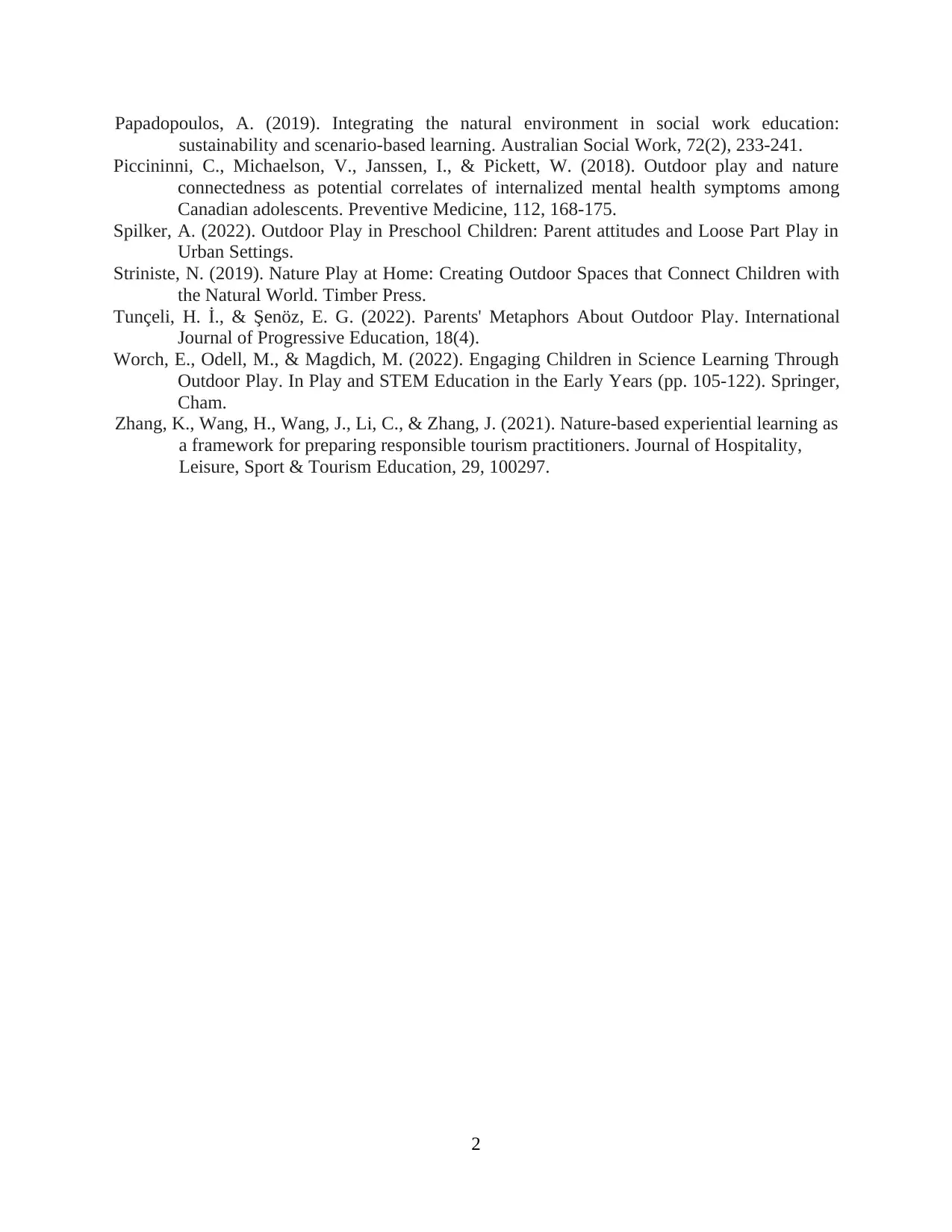
Papadopoulos, A. (2019). Integrating the natural environment in social work education:
sustainability and scenario-based learning. Australian Social Work, 72(2), 233-241.
Piccininni, C., Michaelson, V., Janssen, I., & Pickett, W. (2018). Outdoor play and nature
connectedness as potential correlates of internalized mental health symptoms among
Canadian adolescents. Preventive Medicine, 112, 168-175.
Spilker, A. (2022). Outdoor Play in Preschool Children: Parent attitudes and Loose Part Play in
Urban Settings.
Striniste, N. (2019). Nature Play at Home: Creating Outdoor Spaces that Connect Children with
the Natural World. Timber Press.
Tunçeli, H. İ., & Şenöz, E. G. (2022). Parents' Metaphors About Outdoor Play. International
Journal of Progressive Education, 18(4).
Worch, E., Odell, M., & Magdich, M. (2022). Engaging Children in Science Learning Through
Outdoor Play. In Play and STEM Education in the Early Years (pp. 105-122). Springer,
Cham.
Zhang, K., Wang, H., Wang, J., Li, C., & Zhang, J. (2021). Nature-based experiential learning as
a framework for preparing responsible tourism practitioners. Journal of Hospitality,
Leisure, Sport & Tourism Education, 29, 100297.
2
sustainability and scenario-based learning. Australian Social Work, 72(2), 233-241.
Piccininni, C., Michaelson, V., Janssen, I., & Pickett, W. (2018). Outdoor play and nature
connectedness as potential correlates of internalized mental health symptoms among
Canadian adolescents. Preventive Medicine, 112, 168-175.
Spilker, A. (2022). Outdoor Play in Preschool Children: Parent attitudes and Loose Part Play in
Urban Settings.
Striniste, N. (2019). Nature Play at Home: Creating Outdoor Spaces that Connect Children with
the Natural World. Timber Press.
Tunçeli, H. İ., & Şenöz, E. G. (2022). Parents' Metaphors About Outdoor Play. International
Journal of Progressive Education, 18(4).
Worch, E., Odell, M., & Magdich, M. (2022). Engaging Children in Science Learning Through
Outdoor Play. In Play and STEM Education in the Early Years (pp. 105-122). Springer,
Cham.
Zhang, K., Wang, H., Wang, J., Li, C., & Zhang, J. (2021). Nature-based experiential learning as
a framework for preparing responsible tourism practitioners. Journal of Hospitality,
Leisure, Sport & Tourism Education, 29, 100297.
2

1 out of 11


Your All-in-One AI-Powered Toolkit for Academic Success.
+13062052269
info@desklib.com
Available 24*7 on WhatsApp / Email
![[object Object]](/_next/static/media/star-bottom.7253800d.svg)
Unlock your academic potential
Copyright © 2020–2026 A2Z Services. All Rights Reserved. Developed and managed by ZUCOL.