Manufacturing Company Overhead Allocation Case Study Analysis

Verified

Added on  2020/05/11

|2
|524
|86
Case Study
AI Summary
This case study analyzes a manufacturing company facing challenges with its overhead allocation method. The company currently uses a plant-wide overhead rate based on direct labor costs, leading to inaccurate cost allocation across different departments (cutting, machining, and assembly). The analysis reveals that the assembly department, being labor-intensive, is overcharged, while the cutting and machining departments are undercharged. This misallocation impacts pricing, causing the company to charge higher prices for assembly-related jobs (primarily for government contracts) and lower prices for jobs from the private sector, leading to a decline in private sector revenue. The company faces a dilemma: maintaining the plant-wide rate exacerbates the problem, while switching to department-wide rates could further decrease revenue from the assembly department. The case study highlights the need for a more accurate overhead allocation method to improve pricing strategies and overall financial performance.
Document Page
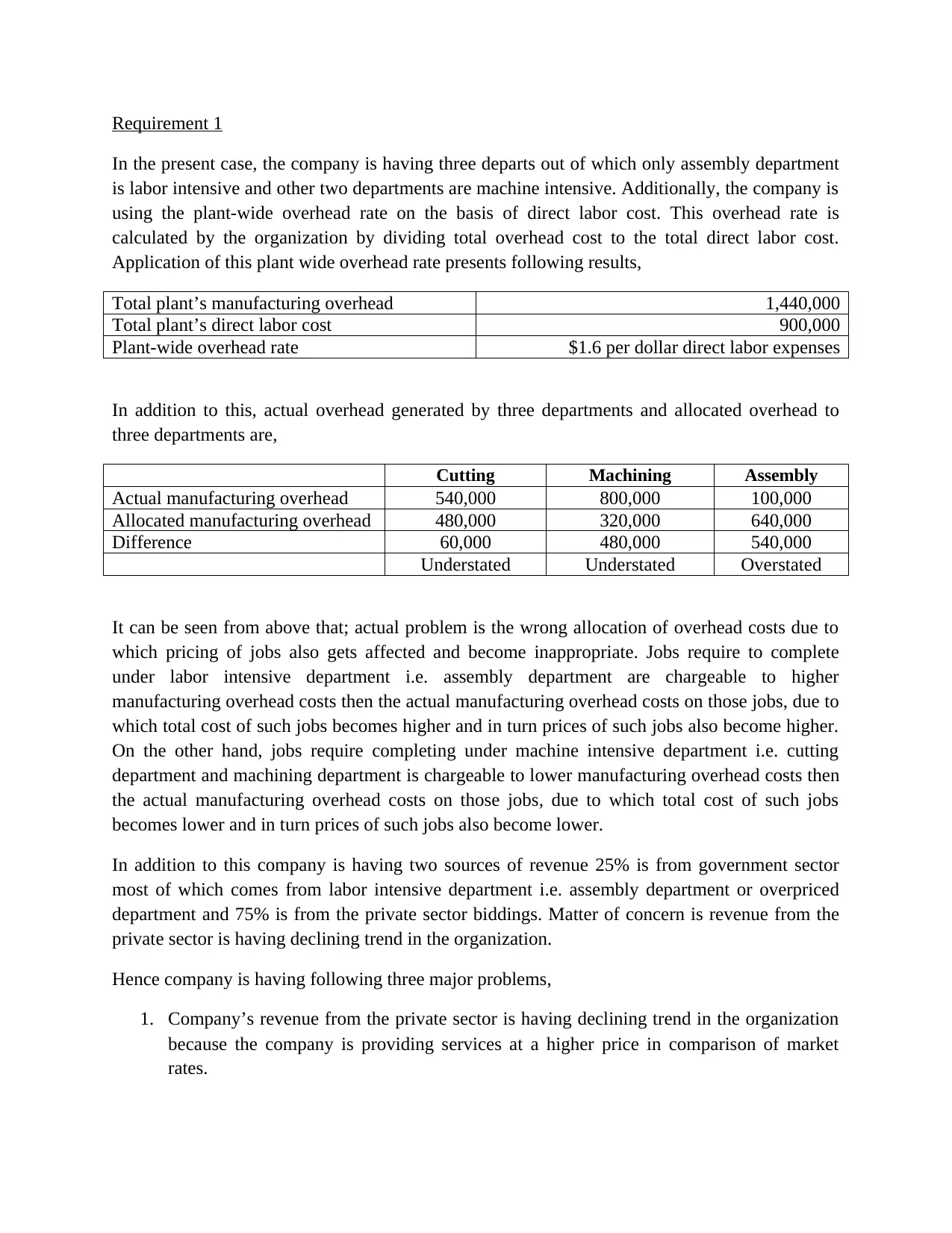
Requirement 1
In the present case, the company is having three departs out of which only assembly department
is labor intensive and other two departments are machine intensive. Additionally, the company is
using the plant-wide overhead rate on the basis of direct labor cost. This overhead rate is
calculated by the organization by dividing total overhead cost to the total direct labor cost.
Application of this plant wide overhead rate presents following results,
Total plant’s manufacturing overhead 1,440,000
Total plant’s direct labor cost 900,000
Plant-wide overhead rate $1.6 per dollar direct labor expenses
In addition to this, actual overhead generated by three departments and allocated overhead to
three departments are,
Cutting Machining Assembly
Actual manufacturing overhead 540,000 800,000 100,000
Allocated manufacturing overhead 480,000 320,000 640,000
Difference 60,000 480,000 540,000
Understated Understated Overstated
It can be seen from above that; actual problem is the wrong allocation of overhead costs due to
which pricing of jobs also gets affected and become inappropriate. Jobs require to complete
under labor intensive department i.e. assembly department are chargeable to higher
manufacturing overhead costs then the actual manufacturing overhead costs on those jobs, due to
which total cost of such jobs becomes higher and in turn prices of such jobs also become higher.
On the other hand, jobs require completing under machine intensive department i.e. cutting
department and machining department is chargeable to lower manufacturing overhead costs then
the actual manufacturing overhead costs on those jobs, due to which total cost of such jobs
becomes lower and in turn prices of such jobs also become lower.
In addition to this company is having two sources of revenue 25% is from government sector
most of which comes from labor intensive department i.e. assembly department or overpriced
department and 75% is from the private sector biddings. Matter of concern is revenue from the
private sector is having declining trend in the organization.
Hence company is having following three major problems,
1. Company’s revenue from the private sector is having declining trend in the organization
because the company is providing services at a higher price in comparison of market
rates.
tabler-icon-diamond-filled.svg

Paraphrase This Document

Need a fresh take? Get an instant paraphrase of this document with our AI Paraphraser
Document Page
2. Higher prices are charged by the company because the company is having plant wide
overhead rate and jobs require to complete under labor intensive department i.e. assembly
department are chargeable to higher overhead costs then the actual overhead costs, due to
which cost of such jobs becomes higher and in turn prices of such jobs also become
higher.
3. The company cannot change plant wide overhead rate to department wide overhead rate
because if the company will change the method of overhead cost allocation from the plant
wide overhead rates to the department wide overhead rates then revenues generated by
the company from the jobs of labor intensive department will decline.
Therefore it can be concluded that company is in trouble in both cases whether the company will
use plant wide overhead allocation or department wide overhead allocation.
chevron_up_icon
1 out of 2
circle_padding
hide_on_mobile
zoom_out_icon
[object Object]