P22105 Advanced Legal Research: Intellectual Property Gap Lit Review
VerifiedAdded on 2023/05/30
|10
|2683
|158
Literature Review
AI Summary
This literature review provides a comprehensive analysis of the intellectual property (IP) gap in the Middle East, comparing it with the United Kingdom. It highlights the increasing digitization in the Middle East, the lagging implementation of ICT security measures, and the rise of cybercrime targeting regions with weak regulations. The review explores challenges related to trademark protection, data transfer regulations, and the impact of the Internet of Things on IP in the Middle East. It also contrasts the legal frameworks and enforcement mechanisms in the Middle East with those in the UK, noting differences in patent protection, trademark laws, and approaches to cyber security. The review concludes by emphasizing the need for stronger regulations, enhanced cyber defenses, and improved data protection measures to address the growing threats to intellectual property in the Middle East. Desklib offers a wealth of resources, including past papers and solved assignments, to aid students in their academic pursuits.
Running head: GAP IN INTELLECTUAL PROPERTY IN MIDDLE EAST
Gap in Intellectual Property in Middle East
Name of the student
Name of the University
Author note
Gap in Intellectual Property in Middle East
Name of the student
Name of the University
Author note

Paraphrase This Document
Need a fresh take? Get an instant paraphrase of this document with our AI Paraphraser
1GAP IN INTELLECTUAL PROPERTY IN MIDDLE EAST
Introduction
Intellectual property (IP) refers to category of the property which includes the
intangible creation pertaining to human intellect like copyrights, patents along with
trademarks. It includes the other kind of rights like moral rights, trade secrets and the right
against that of unfair competition1. The cybercriminals have a tendency of targeting the
regions that have poor regulation that helps people in carrying out the financial cyberattacks.
The banks in Middle East lag behind in terms of implementing ICT data security measures
that creates gap in relation to intellectual property in Middle East. This literature review
makes a comparison pertaining to IP of Middle East and UK. It also elaborates on the
challenge in relation to trade mark in Middle East and data transfer regulation within Middle
East. It discusses about the impact of Internet of Things that has an effect on intellectual
property in the Middle East.
Comparison of IP of Middle East and UK
Governments and the enterprises in Middle East are taking recourse to digital
technologies which is called digitisation. The digital market of Middle East is growing at a
rate of 12 %. The financial institutions in UK are working for improving the policies that can
help in meeting the international standards. Implementation pertaining to the security
measures is at a weak stage in the Middle East and this creates challenges in relation to
Intellectual Property in the Middle East. The cybercriminals can target the small entities of
the region owing to gaps that exist in the security systems of the entities2. Growth of mobile
1 Dutfield, Graham. Intellectual property rights and the life science industries: a twentieth century history.
Routledge, 2017.
2 Mendis, Dinusha, Mark A. Lemley, and Matthew Rimmer. "3D Printing and Beyond: Intellectual Property and
Regulation." (2019).
Introduction
Intellectual property (IP) refers to category of the property which includes the
intangible creation pertaining to human intellect like copyrights, patents along with
trademarks. It includes the other kind of rights like moral rights, trade secrets and the right
against that of unfair competition1. The cybercriminals have a tendency of targeting the
regions that have poor regulation that helps people in carrying out the financial cyberattacks.
The banks in Middle East lag behind in terms of implementing ICT data security measures
that creates gap in relation to intellectual property in Middle East. This literature review
makes a comparison pertaining to IP of Middle East and UK. It also elaborates on the
challenge in relation to trade mark in Middle East and data transfer regulation within Middle
East. It discusses about the impact of Internet of Things that has an effect on intellectual
property in the Middle East.
Comparison of IP of Middle East and UK
Governments and the enterprises in Middle East are taking recourse to digital
technologies which is called digitisation. The digital market of Middle East is growing at a
rate of 12 %. The financial institutions in UK are working for improving the policies that can
help in meeting the international standards. Implementation pertaining to the security
measures is at a weak stage in the Middle East and this creates challenges in relation to
Intellectual Property in the Middle East. The cybercriminals can target the small entities of
the region owing to gaps that exist in the security systems of the entities2. Growth of mobile
1 Dutfield, Graham. Intellectual property rights and the life science industries: a twentieth century history.
Routledge, 2017.
2 Mendis, Dinusha, Mark A. Lemley, and Matthew Rimmer. "3D Printing and Beyond: Intellectual Property and
Regulation." (2019).
2GAP IN INTELLECTUAL PROPERTY IN MIDDLE EAST
internet in Middle East has paved the way for increase in relation to the stealing of the
intellectual property. The research and the development facilities in Middle East is not that
developed which paves the way for gap in relation to intellectual property. The technology
that is made use of by the business in UK are well-developed that helps in safeguarding the
intellectual property of the companies in UK. The companies in UK have their own
trademarks that helps in distinguishing their service from that of other companies within UK.
Patents in UAE can be protected with the help of Industrial Property Law within UAE. UAE
is operative under that of two systems: Patent Cooperation Treaty System along with Gulf
Cooperation Council. Patent system helps in providing mechanism for the regional fillings
pertaining to patent application in Gulf Co-operation Council Countries. The companies in
UK take recourse to automatic protection for safeguarding the intellectual property3. The
intellectual property of the different business in UK are protected with the help of patents that
helps in affording protection to the unique intellectual property of the country4. In UK,
owners of the trade mark can defend the mark against that of infringements. Trade Mark in
UK should have been used for a span of time that can help it in acquiring local
distinctiveness.
Trademark protection in Middle East
UAE officials along with brand owners agree to the fact that penalties that are
provided under the UAE law is not deterrent to the infringers. The trademark law in UAE is
3 Dratler Jr, Jay, and Stephen M. McJohn. Intellectual Property Law: Commercial, Creative and Industrial
Property. Law Journal Press, 2018.
4 Min, Kyoung-Sik, Seung-Woan Chai, and Mijeong Han. "An international comparative study on cyber
security strategy." International Journal of Security and Its Applications 9.2 (2015): 13-20.
internet in Middle East has paved the way for increase in relation to the stealing of the
intellectual property. The research and the development facilities in Middle East is not that
developed which paves the way for gap in relation to intellectual property. The technology
that is made use of by the business in UK are well-developed that helps in safeguarding the
intellectual property of the companies in UK. The companies in UK have their own
trademarks that helps in distinguishing their service from that of other companies within UK.
Patents in UAE can be protected with the help of Industrial Property Law within UAE. UAE
is operative under that of two systems: Patent Cooperation Treaty System along with Gulf
Cooperation Council. Patent system helps in providing mechanism for the regional fillings
pertaining to patent application in Gulf Co-operation Council Countries. The companies in
UK take recourse to automatic protection for safeguarding the intellectual property3. The
intellectual property of the different business in UK are protected with the help of patents that
helps in affording protection to the unique intellectual property of the country4. In UK,
owners of the trade mark can defend the mark against that of infringements. Trade Mark in
UK should have been used for a span of time that can help it in acquiring local
distinctiveness.
Trademark protection in Middle East
UAE officials along with brand owners agree to the fact that penalties that are
provided under the UAE law is not deterrent to the infringers. The trademark law in UAE is
3 Dratler Jr, Jay, and Stephen M. McJohn. Intellectual Property Law: Commercial, Creative and Industrial
Property. Law Journal Press, 2018.
4 Min, Kyoung-Sik, Seung-Woan Chai, and Mijeong Han. "An international comparative study on cyber
security strategy." International Journal of Security and Its Applications 9.2 (2015): 13-20.
⊘ This is a preview!⊘
Do you want full access?
Subscribe today to unlock all pages.

Trusted by 1+ million students worldwide
3GAP IN INTELLECTUAL PROPERTY IN MIDDLE EAST
instrumental in providing maximum fine of that of $ 2275 that does not prevent the crimes
related to intellectual property. There exist some level of harmonisation pertaining to the
common standards which is available across the Arab countries. Within Saudi Arabia, trade
mark law has to be used along with Sharias law. Country is instrumental in demonstrating
greater sensitivity to that of the religious tradition that acts like a challenge in relation to trade
secrets in the Middle East.
Trademark Protection in UK
The trade marks that cover the alcoholic goods are prohibited in UK that proves to be
a barrier in relation to protecting intellectual property within the UK5. The trade mark owners
in Australia do not take into consideration the aspect of language along with culture that
proves to be difficult in relation to protecting the aspect of intellectual property.
Challenges faced by Middle East and UK
There are many Arab countries that want the use of the Arab script on the products
and in the industries6. The marks that are put on the signboards of Kuwait, Qatar along with
Saudi Arabia should be in compliance with that of local regulation. Transliteration should be
registered in the local script that can help in protecting the intellectual property of the
business running in the Middle East7. The countries in Middle East does not have anti-
5 Halilem, Norrin, et al. "“To Own, or not to Own?” A multilevel analysis of intellectual property right policies'
on academic entrepreneurship." Research Policy 46.8 (2017): 1479-1489.
6 May, Christopher. The global political economy of intellectual property rights: The new enclosures.
Routledge, 2015.
7 Parr, Russell L. Intellectual property: valuation, exploitation, and infringement damages. John Wiley & Sons,
2018.
instrumental in providing maximum fine of that of $ 2275 that does not prevent the crimes
related to intellectual property. There exist some level of harmonisation pertaining to the
common standards which is available across the Arab countries. Within Saudi Arabia, trade
mark law has to be used along with Sharias law. Country is instrumental in demonstrating
greater sensitivity to that of the religious tradition that acts like a challenge in relation to trade
secrets in the Middle East.
Trademark Protection in UK
The trade marks that cover the alcoholic goods are prohibited in UK that proves to be
a barrier in relation to protecting intellectual property within the UK5. The trade mark owners
in Australia do not take into consideration the aspect of language along with culture that
proves to be difficult in relation to protecting the aspect of intellectual property.
Challenges faced by Middle East and UK
There are many Arab countries that want the use of the Arab script on the products
and in the industries6. The marks that are put on the signboards of Kuwait, Qatar along with
Saudi Arabia should be in compliance with that of local regulation. Transliteration should be
registered in the local script that can help in protecting the intellectual property of the
business running in the Middle East7. The countries in Middle East does not have anti-
5 Halilem, Norrin, et al. "“To Own, or not to Own?” A multilevel analysis of intellectual property right policies'
on academic entrepreneurship." Research Policy 46.8 (2017): 1479-1489.
6 May, Christopher. The global political economy of intellectual property rights: The new enclosures.
Routledge, 2015.
7 Parr, Russell L. Intellectual property: valuation, exploitation, and infringement damages. John Wiley & Sons,
2018.
Paraphrase This Document
Need a fresh take? Get an instant paraphrase of this document with our AI Paraphraser
4GAP IN INTELLECTUAL PROPERTY IN MIDDLE EAST
dilution provision in relation to trade mark laws. An Arabic trade mark would entail
additional cost pertaining to clearance along with registration that creates challenges for
companies in the Middle East. Transliteration into Arabic script has challenges as because
there are certain vowels along with consonants that does not have any kind of equivalent in
Arabic language like letter V along with P. The common practice that is carried out is to
substitute a letter with that of next best option. The trade mark can undergo transliteration
pertaining to phonetic rendition but inconsistencies can occur that throws challenges
pertaining to trade mark within that of the Middle East. The challenge is faced by UK in
relation to trademarking because there occurs the unauthorised use of the brand names on the
social media in UK. The Brexit negotiations has made the trademark clearance a challenge
for the various business within UK. Registration of the UK trademark can be challenged with
the help of existing registration that designates UK under that of Madrid Protocol.
Measures taken to overcome challenges
The measures that have been taken in Middle East to overcome challenges is
imposing responsibility on licensee for registering licences in UAE and notifying the
company about claims in relation to IP infringement. A company can establish contractual
arrangement that can help in assigning financial rights in the works and it can help in the
execution of retrospective assignments when they would be required. The measures that have
been taken for overcoming challenges in UK is providing of expert assistance in the issues
related to IP commercialization along with technology transfer. It can connect with the
various regions situated outside Europe that can help in enhancing IP based collaboration.
Cyber-defence can be taken recourse to in the Middle East that can be useful in the
aspect of cyber surveillance. National Cyber Bureaus can be set up that can help in co-
dilution provision in relation to trade mark laws. An Arabic trade mark would entail
additional cost pertaining to clearance along with registration that creates challenges for
companies in the Middle East. Transliteration into Arabic script has challenges as because
there are certain vowels along with consonants that does not have any kind of equivalent in
Arabic language like letter V along with P. The common practice that is carried out is to
substitute a letter with that of next best option. The trade mark can undergo transliteration
pertaining to phonetic rendition but inconsistencies can occur that throws challenges
pertaining to trade mark within that of the Middle East. The challenge is faced by UK in
relation to trademarking because there occurs the unauthorised use of the brand names on the
social media in UK. The Brexit negotiations has made the trademark clearance a challenge
for the various business within UK. Registration of the UK trademark can be challenged with
the help of existing registration that designates UK under that of Madrid Protocol.
Measures taken to overcome challenges
The measures that have been taken in Middle East to overcome challenges is
imposing responsibility on licensee for registering licences in UAE and notifying the
company about claims in relation to IP infringement. A company can establish contractual
arrangement that can help in assigning financial rights in the works and it can help in the
execution of retrospective assignments when they would be required. The measures that have
been taken for overcoming challenges in UK is providing of expert assistance in the issues
related to IP commercialization along with technology transfer. It can connect with the
various regions situated outside Europe that can help in enhancing IP based collaboration.
Cyber-defence can be taken recourse to in the Middle East that can be useful in the
aspect of cyber surveillance. National Cyber Bureaus can be set up that can help in co-
5GAP IN INTELLECTUAL PROPERTY IN MIDDLE EAST
ordinating developing of the cyber defences8. Iran is building the cyber forces with the help
of a programme that will cost around US $ 1 billion. The malicious actions that take place in
the cyberspace can take up various forms like cyber fraud, cybercrime along with spying. The
civil society along with state actors should be able to understand that all the vindictive cyber
actions does not result in cyber war.
Gaps in addressing challenges
Cyber threats have increased in the region of the Middle East and this occurs owing to
the fact that the companies in Middle East does not have an organisational structure that is
highly developed. In the event of not having these structures, investigations cannot be carried
out that requires complex technical knowledge. There does not exist collaboration among the
actors that can help in tackling the incidence of cybercrimes in the Middle East. There are
various factors that pave the path for flaws in relation to software design. Technical
vulnerabilities take place owing to the factor of human weakness in UK. Exposure is another
problem in relation to system configuration that helps the attacker to find out about vital
information of a company9. The devices in relation to IOT application are left unattended in
UK that helps the attacker in capturing device and extracting cryptographic secrets. The
devices pertaining to IOT have to operate in the outdoor environments that becomes
susceptible to the physical attacks10.
8 Melnyk, Valentyna, Marco Giarratana, and Anna Torres. "Marking your trade: Cultural factors in the
prolongation of trademarks." Journal of Business Research 67.4 (2014): 478-485.
9 Popkova, Elena G., et al. "Transformation and concentration of intellectual capital as a factor of economic
growth in the modern economy." Regional and Sectoral Economic Studies15.1 (2015): 53-60.
10 Bettig, Ronald V. Copyrighting culture: The political economy of intellectual property. Routledge, 2018.
ordinating developing of the cyber defences8. Iran is building the cyber forces with the help
of a programme that will cost around US $ 1 billion. The malicious actions that take place in
the cyberspace can take up various forms like cyber fraud, cybercrime along with spying. The
civil society along with state actors should be able to understand that all the vindictive cyber
actions does not result in cyber war.
Gaps in addressing challenges
Cyber threats have increased in the region of the Middle East and this occurs owing to
the fact that the companies in Middle East does not have an organisational structure that is
highly developed. In the event of not having these structures, investigations cannot be carried
out that requires complex technical knowledge. There does not exist collaboration among the
actors that can help in tackling the incidence of cybercrimes in the Middle East. There are
various factors that pave the path for flaws in relation to software design. Technical
vulnerabilities take place owing to the factor of human weakness in UK. Exposure is another
problem in relation to system configuration that helps the attacker to find out about vital
information of a company9. The devices in relation to IOT application are left unattended in
UK that helps the attacker in capturing device and extracting cryptographic secrets. The
devices pertaining to IOT have to operate in the outdoor environments that becomes
susceptible to the physical attacks10.
8 Melnyk, Valentyna, Marco Giarratana, and Anna Torres. "Marking your trade: Cultural factors in the
prolongation of trademarks." Journal of Business Research 67.4 (2014): 478-485.
9 Popkova, Elena G., et al. "Transformation and concentration of intellectual capital as a factor of economic
growth in the modern economy." Regional and Sectoral Economic Studies15.1 (2015): 53-60.
10 Bettig, Ronald V. Copyrighting culture: The political economy of intellectual property. Routledge, 2018.
⊘ This is a preview!⊘
Do you want full access?
Subscribe today to unlock all pages.
Trusted by 1+ million students worldwide
6GAP IN INTELLECTUAL PROPERTY IN MIDDLE EAST
Data transfer Regulation in Middle East
There are various factors that has to be considered in relation to data transfer
regulation like storing, processing along with accessing large volume of the data. The
handlers should ensure that the personal data remains private at the rime of process of data
transfer11. The errors are often made by the handlers that has a negative impact on the element
of security in relation to the individual citizens. The personal information pertaining to the
customers and the clients are often leaked that jeopardises the lives of the citizens in the
Middle East12. Multifactor authentication is not used that can help in securing the sensitive
data13. A large number of the Middle East companies rank high in terms of financial crime
statistics. Companies in the various regions of United Kingdom are creating the solutions that
can help them in blocking the aspect of network breach14. The cybercriminals in Middle East
are changing the tactics so that they can evade detection and at the same time steal the
information.
Conclusion
11 Duygun, Meryem, Vania Sena, and Mohamed Shaban. "Trademarking status and economic efficiency among
commercial banks: Some evidence for the UK." Journal of Banking & Finance 49 (2014): 506-514.
12 Johnson, Julia. "Database Protection a Reality? How the Professional and Fantasy Sporting World Could
Benefit from a Sui Generis Intellectual Property Right." Intellectual Property Journal 27.2 (2015): 237.
13 Halpern, Manfred. Politics of social change: in the Middle East and North Africa. Princeton University Press,
2015.
14 Cleveland, William L., and Martin Bunton. A history of the modern Middle East. Hachette UK, 2016.
Data transfer Regulation in Middle East
There are various factors that has to be considered in relation to data transfer
regulation like storing, processing along with accessing large volume of the data. The
handlers should ensure that the personal data remains private at the rime of process of data
transfer11. The errors are often made by the handlers that has a negative impact on the element
of security in relation to the individual citizens. The personal information pertaining to the
customers and the clients are often leaked that jeopardises the lives of the citizens in the
Middle East12. Multifactor authentication is not used that can help in securing the sensitive
data13. A large number of the Middle East companies rank high in terms of financial crime
statistics. Companies in the various regions of United Kingdom are creating the solutions that
can help them in blocking the aspect of network breach14. The cybercriminals in Middle East
are changing the tactics so that they can evade detection and at the same time steal the
information.
Conclusion
11 Duygun, Meryem, Vania Sena, and Mohamed Shaban. "Trademarking status and economic efficiency among
commercial banks: Some evidence for the UK." Journal of Banking & Finance 49 (2014): 506-514.
12 Johnson, Julia. "Database Protection a Reality? How the Professional and Fantasy Sporting World Could
Benefit from a Sui Generis Intellectual Property Right." Intellectual Property Journal 27.2 (2015): 237.
13 Halpern, Manfred. Politics of social change: in the Middle East and North Africa. Princeton University Press,
2015.
14 Cleveland, William L., and Martin Bunton. A history of the modern Middle East. Hachette UK, 2016.
Paraphrase This Document
Need a fresh take? Get an instant paraphrase of this document with our AI Paraphraser
7GAP IN INTELLECTUAL PROPERTY IN MIDDLE EAST
Cybercriminals target regions having poor regulations that makes people in
conducting financial cyberattacks. The banks in Middle East does not implement security
measures that helps in the creation of gap pertaining to intellectual property within Middle
East. Implementation of security measures is weak in Middle East that creates barriers in the
path of intellectual property within Middle East. There are gaps in security system that can be
targeted by cybercriminals. The usage of mobile internet has increased in the present age that
helps in the aspect of stealing intellectual property. Transliteration into that of the Arabic
script poses various challenges as there exist letters that have no equivalent within that of
Arabic language. The handlers make errors that bears negative repercussion on security of
citizens. The information of the customers are leaked that threatens lives of the citizens in the
Middle East. The organisations within Middle East are devoid of any kind of organisational
structure that increases the risk of stealing of intellectual property. There exist hardware
vulnerabilities that creates gap in relation to intellectual property in the Middle East.
Cybercriminals target regions having poor regulations that makes people in
conducting financial cyberattacks. The banks in Middle East does not implement security
measures that helps in the creation of gap pertaining to intellectual property within Middle
East. Implementation of security measures is weak in Middle East that creates barriers in the
path of intellectual property within Middle East. There are gaps in security system that can be
targeted by cybercriminals. The usage of mobile internet has increased in the present age that
helps in the aspect of stealing intellectual property. Transliteration into that of the Arabic
script poses various challenges as there exist letters that have no equivalent within that of
Arabic language. The handlers make errors that bears negative repercussion on security of
citizens. The information of the customers are leaked that threatens lives of the citizens in the
Middle East. The organisations within Middle East are devoid of any kind of organisational
structure that increases the risk of stealing of intellectual property. There exist hardware
vulnerabilities that creates gap in relation to intellectual property in the Middle East.
8GAP IN INTELLECTUAL PROPERTY IN MIDDLE EAST
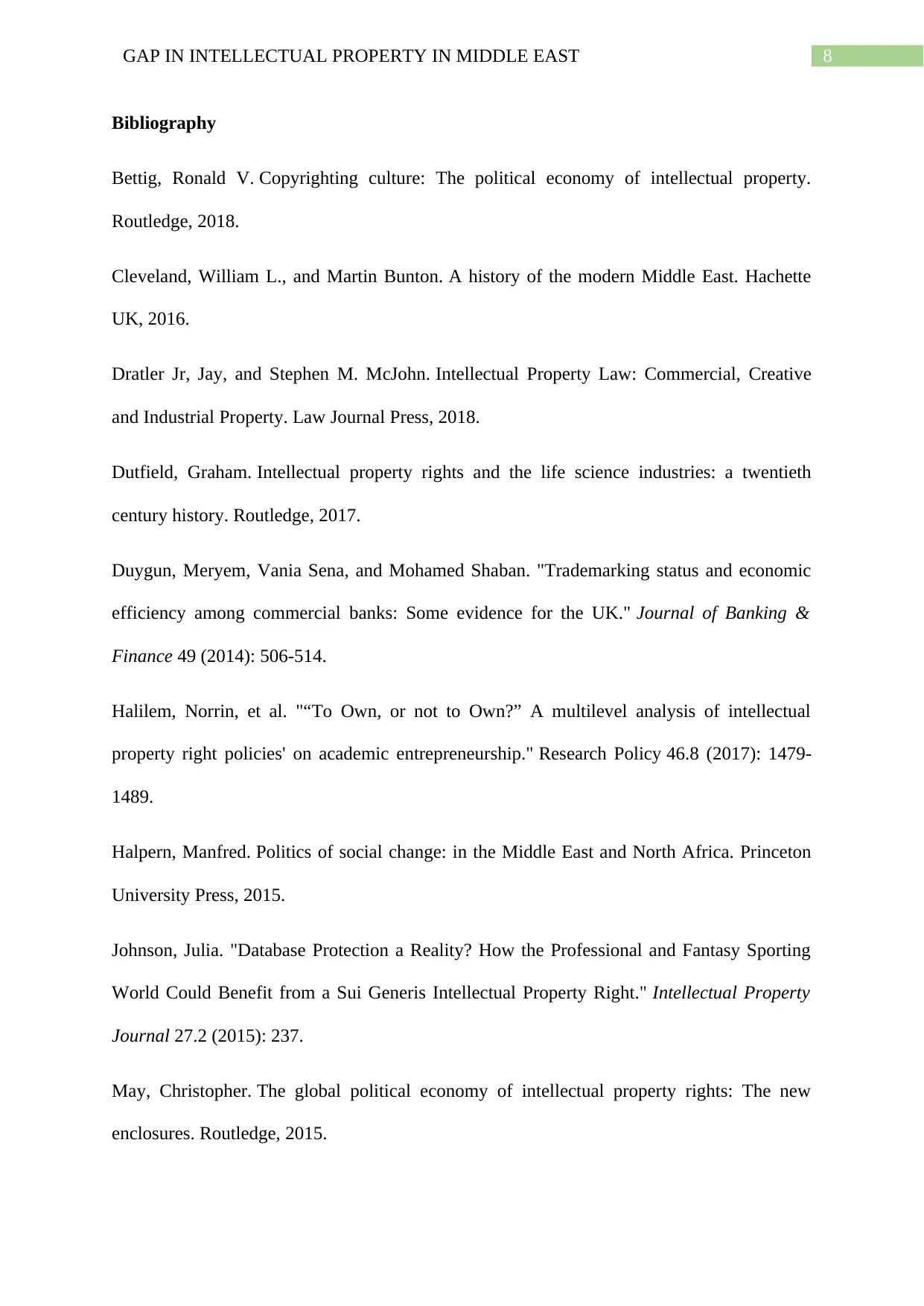
Bibliography
Bettig, Ronald V. Copyrighting culture: The political economy of intellectual property.
Routledge, 2018.
Cleveland, William L., and Martin Bunton. A history of the modern Middle East. Hachette
UK, 2016.
Dratler Jr, Jay, and Stephen M. McJohn. Intellectual Property Law: Commercial, Creative
and Industrial Property. Law Journal Press, 2018.
Dutfield, Graham. Intellectual property rights and the life science industries: a twentieth
century history. Routledge, 2017.
Duygun, Meryem, Vania Sena, and Mohamed Shaban. "Trademarking status and economic
efficiency among commercial banks: Some evidence for the UK." Journal of Banking &
Finance 49 (2014): 506-514.
Halilem, Norrin, et al. "“To Own, or not to Own?” A multilevel analysis of intellectual
property right policies' on academic entrepreneurship." Research Policy 46.8 (2017): 1479-
1489.
Halpern, Manfred. Politics of social change: in the Middle East and North Africa. Princeton
University Press, 2015.
Johnson, Julia. "Database Protection a Reality? How the Professional and Fantasy Sporting
World Could Benefit from a Sui Generis Intellectual Property Right." Intellectual Property
Journal 27.2 (2015): 237.
May, Christopher. The global political economy of intellectual property rights: The new
enclosures. Routledge, 2015.
Bibliography
Bettig, Ronald V. Copyrighting culture: The political economy of intellectual property.
Routledge, 2018.
Cleveland, William L., and Martin Bunton. A history of the modern Middle East. Hachette
UK, 2016.
Dratler Jr, Jay, and Stephen M. McJohn. Intellectual Property Law: Commercial, Creative
and Industrial Property. Law Journal Press, 2018.
Dutfield, Graham. Intellectual property rights and the life science industries: a twentieth
century history. Routledge, 2017.
Duygun, Meryem, Vania Sena, and Mohamed Shaban. "Trademarking status and economic
efficiency among commercial banks: Some evidence for the UK." Journal of Banking &
Finance 49 (2014): 506-514.
Halilem, Norrin, et al. "“To Own, or not to Own?” A multilevel analysis of intellectual
property right policies' on academic entrepreneurship." Research Policy 46.8 (2017): 1479-
1489.
Halpern, Manfred. Politics of social change: in the Middle East and North Africa. Princeton
University Press, 2015.
Johnson, Julia. "Database Protection a Reality? How the Professional and Fantasy Sporting
World Could Benefit from a Sui Generis Intellectual Property Right." Intellectual Property
Journal 27.2 (2015): 237.
May, Christopher. The global political economy of intellectual property rights: The new
enclosures. Routledge, 2015.
⊘ This is a preview!⊘
Do you want full access?
Subscribe today to unlock all pages.
Trusted by 1+ million students worldwide
9GAP IN INTELLECTUAL PROPERTY IN MIDDLE EAST
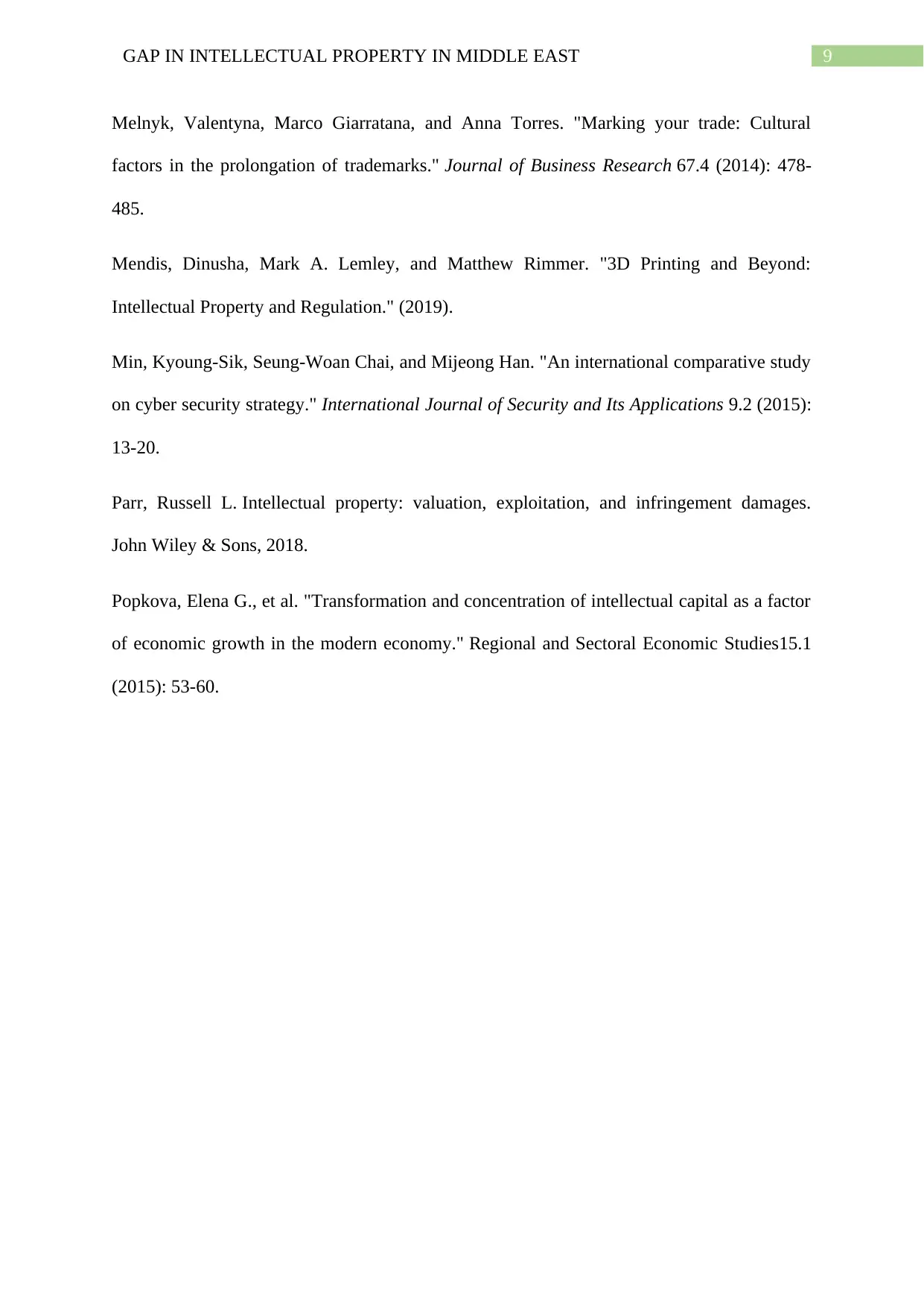
Melnyk, Valentyna, Marco Giarratana, and Anna Torres. "Marking your trade: Cultural
factors in the prolongation of trademarks." Journal of Business Research 67.4 (2014): 478-
485.
Mendis, Dinusha, Mark A. Lemley, and Matthew Rimmer. "3D Printing and Beyond:
Intellectual Property and Regulation." (2019).
Min, Kyoung-Sik, Seung-Woan Chai, and Mijeong Han. "An international comparative study
on cyber security strategy." International Journal of Security and Its Applications 9.2 (2015):
13-20.
Parr, Russell L. Intellectual property: valuation, exploitation, and infringement damages.
John Wiley & Sons, 2018.
Popkova, Elena G., et al. "Transformation and concentration of intellectual capital as a factor
of economic growth in the modern economy." Regional and Sectoral Economic Studies15.1
(2015): 53-60.
Melnyk, Valentyna, Marco Giarratana, and Anna Torres. "Marking your trade: Cultural
factors in the prolongation of trademarks." Journal of Business Research 67.4 (2014): 478-
485.
Mendis, Dinusha, Mark A. Lemley, and Matthew Rimmer. "3D Printing and Beyond:
Intellectual Property and Regulation." (2019).
Min, Kyoung-Sik, Seung-Woan Chai, and Mijeong Han. "An international comparative study
on cyber security strategy." International Journal of Security and Its Applications 9.2 (2015):
13-20.
Parr, Russell L. Intellectual property: valuation, exploitation, and infringement damages.
John Wiley & Sons, 2018.
Popkova, Elena G., et al. "Transformation and concentration of intellectual capital as a factor
of economic growth in the modern economy." Regional and Sectoral Economic Studies15.1
(2015): 53-60.

1 out of 10


Your All-in-One AI-Powered Toolkit for Academic Success.
+13062052269
info@desklib.com
Available 24*7 on WhatsApp / Email
![[object Object]](/_next/static/media/star-bottom.7253800d.svg)
Unlock your academic potential
Copyright © 2020–2025 A2Z Services. All Rights Reserved. Developed and managed by ZUCOL.