Pain Assessment in Critically Ill Patients: A Study of ER Nurses
VerifiedAdded on 2023/04/21
|41
|12061
|429
Report
AI Summary
This report investigates the knowledge and practices of nurses in the Emergency Room at Military Hospital Makkah, Saudi Arabia, regarding pain assessment in critically ill patients. The study uses a cross-sectional research design with a sample population of 30 nurses to determine their understanding of pain assessment processes, standard precautions for infection control, and adherence to pain management guidelines. The findings indicate a high level of knowledge among the nurses regarding pain assessment standards and practices. However, the study acknowledges limitations due to the small sample size and lack of diversity within the study population. The research aims to contribute to the understanding of pain assessment practices in Saudi Arabian healthcare settings, where limited research exists on this topic, and emphasizes the importance of proper pain management for improving patient outcomes and quality of life. Desklib provides access to this document and many other solved assignments.

Running head: PAIN ASSESSMENT IN CRITICALLY ILL PATIENT
.
Knowledge and Practice towards Pain Assessment in Critically Ill Patient among
Nurses in Emergency Room at Military Hospital Makkah, Saudi Arabia.
Name of the Student
Name of the University
Author’s Note:
.
Knowledge and Practice towards Pain Assessment in Critically Ill Patient among
Nurses in Emergency Room at Military Hospital Makkah, Saudi Arabia.
Name of the Student
Name of the University
Author’s Note:

Paraphrase This Document
Need a fresh take? Get an instant paraphrase of this document with our AI Paraphraser

1PAIN ASSESSMENT IN CRITICALLY ILL PATIENT
Abstract
Introduction: Pain can be defined as an unpleasant sensory experience that occurs due to the
potential tissue damage due to which majority of the people suffers from distress and
restlessness. However, despite of advanced healthcare interventions and processes pain
assessment is one of the unmet aspects that the healthcare professionals are unable to achieve.
Moreover, the usage of pain assessment tools for pain management is also minimal and the
primary reason behind this incompetence is the inability of the healthcare professionals to
conduct accurate and relevant pain assessment practice using the guidelines and
recommendations. Hence, the primary intention of this research paper was to understand and
determine the knowledge of the nursing professionals of healthcare facilities in Military
Hospital Makkah, Saudi Arabia.
Methods: Quantitative, qualitative, and descriptive research methodology was chosen for this
investigation and research design that was selected for this investigation was cross sectional
research design. Total sample population for this investigation was 30.
Results: From the data presented in this investigation, it can be deduced that the all the
participants had same responses for the questions in Section II with same number of
frequency as the number of participants.
Discussion: The analysed data deduced from the responses of the present shows that the
nurses in the Military Hospital Makkah, Saudi Arabia have very high understanding of the
Standard of practice and high level of the knowledge regarding the pain assessment among
the chronically ill patients in emergency department. This investigation is limited by the
number of study population in which only the emergency nursing staff at Military Hospital
Makkah, Saudi Arabia participated and the reason behind this small number of sample size
and lack of diversity with regard to sample population.
Abstract
Introduction: Pain can be defined as an unpleasant sensory experience that occurs due to the
potential tissue damage due to which majority of the people suffers from distress and
restlessness. However, despite of advanced healthcare interventions and processes pain
assessment is one of the unmet aspects that the healthcare professionals are unable to achieve.
Moreover, the usage of pain assessment tools for pain management is also minimal and the
primary reason behind this incompetence is the inability of the healthcare professionals to
conduct accurate and relevant pain assessment practice using the guidelines and
recommendations. Hence, the primary intention of this research paper was to understand and
determine the knowledge of the nursing professionals of healthcare facilities in Military
Hospital Makkah, Saudi Arabia.
Methods: Quantitative, qualitative, and descriptive research methodology was chosen for this
investigation and research design that was selected for this investigation was cross sectional
research design. Total sample population for this investigation was 30.
Results: From the data presented in this investigation, it can be deduced that the all the
participants had same responses for the questions in Section II with same number of
frequency as the number of participants.
Discussion: The analysed data deduced from the responses of the present shows that the
nurses in the Military Hospital Makkah, Saudi Arabia have very high understanding of the
Standard of practice and high level of the knowledge regarding the pain assessment among
the chronically ill patients in emergency department. This investigation is limited by the
number of study population in which only the emergency nursing staff at Military Hospital
Makkah, Saudi Arabia participated and the reason behind this small number of sample size
and lack of diversity with regard to sample population.

2PAIN ASSESSMENT IN CRITICALLY ILL PATIENT
Table of Contents
Chapter 1: Introduction..............................................................................................................5
1.1 Background of the study..................................................................................................5
1.2 Problem statement............................................................................................................6
1.3 Purpose of the study.........................................................................................................7
1.4 Research objectives..........................................................................................................8
1.4.1 General objectives.....................................................................................................8
1.4.2 Specific objectives....................................................................................................8
1.5 Research Questions..........................................................................................................9
1.6 Significance of the study..................................................................................................9
1.7 Definition of terms.........................................................................................................10
Chapter 2: Literature Review...................................................................................................11
2.1 Introduction on review of literature...............................................................................11
2.2 Review of literatures on level of knowledge of pain assessment in critically ill patients
..............................................................................................................................................12
2.2.1 Review of literature regarding standard of practice in pain management..............14
2.2.3 Review of literature on complications regarding the pain assessment among the
patients.............................................................................................................................16
2.3 Conceptual & Theoretical Framework...........................................................................18
2.3.1 Conceptual Framework...........................................................................................18
Chapter 3: Methodology..........................................................................................................19
3.1 Research Design.............................................................................................................19
Table of Contents
Chapter 1: Introduction..............................................................................................................5
1.1 Background of the study..................................................................................................5
1.2 Problem statement............................................................................................................6
1.3 Purpose of the study.........................................................................................................7
1.4 Research objectives..........................................................................................................8
1.4.1 General objectives.....................................................................................................8
1.4.2 Specific objectives....................................................................................................8
1.5 Research Questions..........................................................................................................9
1.6 Significance of the study..................................................................................................9
1.7 Definition of terms.........................................................................................................10
Chapter 2: Literature Review...................................................................................................11
2.1 Introduction on review of literature...............................................................................11
2.2 Review of literatures on level of knowledge of pain assessment in critically ill patients
..............................................................................................................................................12
2.2.1 Review of literature regarding standard of practice in pain management..............14
2.2.3 Review of literature on complications regarding the pain assessment among the
patients.............................................................................................................................16
2.3 Conceptual & Theoretical Framework...........................................................................18
2.3.1 Conceptual Framework...........................................................................................18
Chapter 3: Methodology..........................................................................................................19
3.1 Research Design.............................................................................................................19
⊘ This is a preview!⊘
Do you want full access?
Subscribe today to unlock all pages.

Trusted by 1+ million students worldwide
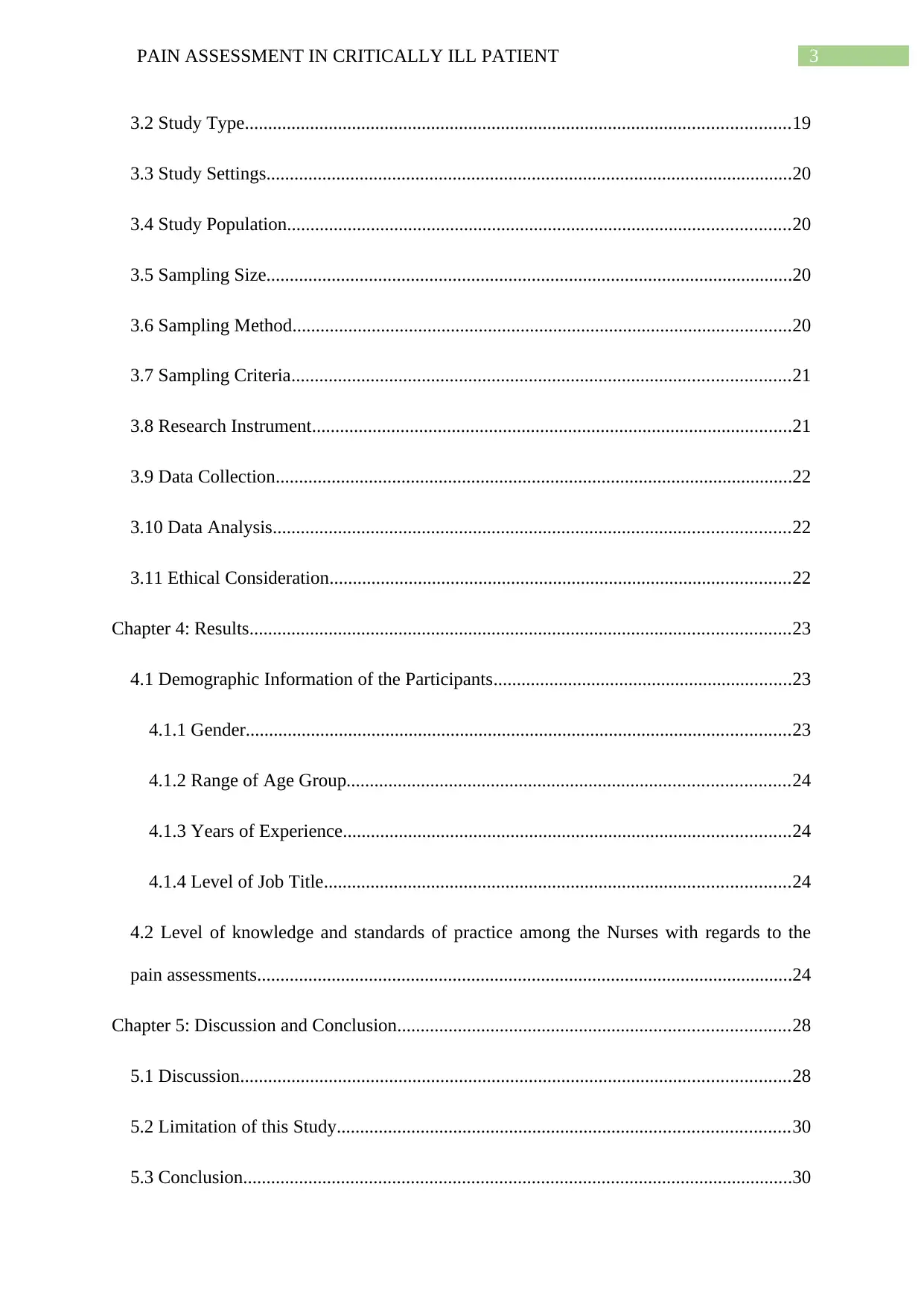
3PAIN ASSESSMENT IN CRITICALLY ILL PATIENT
3.2 Study Type.....................................................................................................................19
3.3 Study Settings.................................................................................................................20
3.4 Study Population............................................................................................................20
3.5 Sampling Size.................................................................................................................20
3.6 Sampling Method...........................................................................................................20
3.7 Sampling Criteria...........................................................................................................21
3.8 Research Instrument.......................................................................................................21
3.9 Data Collection...............................................................................................................22
3.10 Data Analysis...............................................................................................................22
3.11 Ethical Consideration...................................................................................................22
Chapter 4: Results....................................................................................................................23
4.1 Demographic Information of the Participants................................................................23
4.1.1 Gender.....................................................................................................................23
4.1.2 Range of Age Group...............................................................................................24
4.1.3 Years of Experience................................................................................................24
4.1.4 Level of Job Title....................................................................................................24
4.2 Level of knowledge and standards of practice among the Nurses with regards to the
pain assessments...................................................................................................................24
Chapter 5: Discussion and Conclusion....................................................................................28
5.1 Discussion......................................................................................................................28
5.2 Limitation of this Study.................................................................................................30
5.3 Conclusion......................................................................................................................30
3.2 Study Type.....................................................................................................................19
3.3 Study Settings.................................................................................................................20
3.4 Study Population............................................................................................................20
3.5 Sampling Size.................................................................................................................20
3.6 Sampling Method...........................................................................................................20
3.7 Sampling Criteria...........................................................................................................21
3.8 Research Instrument.......................................................................................................21
3.9 Data Collection...............................................................................................................22
3.10 Data Analysis...............................................................................................................22
3.11 Ethical Consideration...................................................................................................22
Chapter 4: Results....................................................................................................................23
4.1 Demographic Information of the Participants................................................................23
4.1.1 Gender.....................................................................................................................23
4.1.2 Range of Age Group...............................................................................................24
4.1.3 Years of Experience................................................................................................24
4.1.4 Level of Job Title....................................................................................................24
4.2 Level of knowledge and standards of practice among the Nurses with regards to the
pain assessments...................................................................................................................24
Chapter 5: Discussion and Conclusion....................................................................................28
5.1 Discussion......................................................................................................................28
5.2 Limitation of this Study.................................................................................................30
5.3 Conclusion......................................................................................................................30
Paraphrase This Document
Need a fresh take? Get an instant paraphrase of this document with our AI Paraphraser

4PAIN ASSESSMENT IN CRITICALLY ILL PATIENT
5.4 Recommendation............................................................................................................31
References................................................................................................................................32
Appendix – 1............................................................................................................................39
5.4 Recommendation............................................................................................................31
References................................................................................................................................32
Appendix – 1............................................................................................................................39

5PAIN ASSESSMENT IN CRITICALLY ILL PATIENT
Chapter 1: Introduction
1.1 Background of the study
The World Health Organisation mentions pain as an unpleasant sensory experience that
occurs due to the potential tissue damage due to which majority of the people suffers from
distress and restlessness (Glick et al. 2016). While providing critical care to the patients, pain
assessment and associated interventions are the most important care process that should be
conducted to provide the patients with effective relief (Burke, Mathias and Denson 2015).
However, despite of advanced healthcare interventions and processes pain assessment is one
of the unmet aspects that the healthcare professionals are unable to achieve (Watt-Watson
and Murinson 2013). As per Andersson, Otterstrom-Rydberg and Karlsson (2015) there are
several instances around the world, in which due to improper pain assessment and
management, patients suffer from several psychological and physiological consequences. As
per Chang et al. (2015), majority of the adverse events associated with improper pain
assessment and management is connected to enhanced rate of infection, increased duration of
mechanical ventilation, haemodynamic imbalance, affected immune system and the stress or
depression associated with delirium (Andersson, Otterstrom-Rydberg and Karlsson 2015).
Proper and accurate pain assessment is associated with systematic and comprehensive ways
of pain assessment and depending on these healthcare professionals are allowed to titrate the
amount of analgesia which could be used for the patients to relive their condition (Watt-
Watson and Murinson 2013). Further, in the research of Herr et al. (2015), it was noted that
despite developed and widely available pain management skills and guidelines, healthcare
professionals are unable to use the systematic or comprehensive ways of pain assessment.
Moreover, the usage of pain assessment tools for pain management is also minimal and as per
Attar (2014), the primary reason behind these incompetence is the inability of the healthcare
Chapter 1: Introduction
1.1 Background of the study
The World Health Organisation mentions pain as an unpleasant sensory experience that
occurs due to the potential tissue damage due to which majority of the people suffers from
distress and restlessness (Glick et al. 2016). While providing critical care to the patients, pain
assessment and associated interventions are the most important care process that should be
conducted to provide the patients with effective relief (Burke, Mathias and Denson 2015).
However, despite of advanced healthcare interventions and processes pain assessment is one
of the unmet aspects that the healthcare professionals are unable to achieve (Watt-Watson
and Murinson 2013). As per Andersson, Otterstrom-Rydberg and Karlsson (2015) there are
several instances around the world, in which due to improper pain assessment and
management, patients suffer from several psychological and physiological consequences. As
per Chang et al. (2015), majority of the adverse events associated with improper pain
assessment and management is connected to enhanced rate of infection, increased duration of
mechanical ventilation, haemodynamic imbalance, affected immune system and the stress or
depression associated with delirium (Andersson, Otterstrom-Rydberg and Karlsson 2015).
Proper and accurate pain assessment is associated with systematic and comprehensive ways
of pain assessment and depending on these healthcare professionals are allowed to titrate the
amount of analgesia which could be used for the patients to relive their condition (Watt-
Watson and Murinson 2013). Further, in the research of Herr et al. (2015), it was noted that
despite developed and widely available pain management skills and guidelines, healthcare
professionals are unable to use the systematic or comprehensive ways of pain assessment.
Moreover, the usage of pain assessment tools for pain management is also minimal and as per
Attar (2014), the primary reason behind these incompetence is the inability of the healthcare
⊘ This is a preview!⊘
Do you want full access?
Subscribe today to unlock all pages.
Trusted by 1+ million students worldwide

6PAIN ASSESSMENT IN CRITICALLY ILL PATIENT
professionals to conduct accurate and relevant pain assessment practice using the guidelines
and recommendations, or widely available pain assessment tools (Burke, Mathias and Denson
2015).
Therefore, the study attempts to determine the knowledge and practice skills of healthcare
nursing professionals regarding the pain assessment among the critically ill patients, admitted
in the Emergency Room at Military Hospital Makkah, Saudi Arabia. Further, it would also
develop understanding about the knowledge of the professionals regarding the safety, security
and hygiene practices that should be conducted while pain assessment in critically ill patients
(Alqahtani and Jones 2015).
1.2 Problem statement
Healthcare facilities around the world are provided with governmental guidelines and
principles depending on which accurate and appropriate pain management and assessment
could be conducted. Further as per Khalaileh and Qadire (2013) there are several pain
assessment tools namely the Numeric rating Scale or the NRS, verbal descriptive scale, visual
analogue scale and others which is used extensively in the healthcare facilities around the
world. However, as per Darwish and Al-Zuhair (2014), the healthcare facilities in Saudi
Arabia do not have such specific protocols and guidelines that target the accurate and
appropriate pain assessment among the patients. Furthermore, very few researchers has
targeted this section of research and minimal research articles for pain assessment guidelines
in healthcare facilities of Saudi Arabia is available (Herr et al. 2015). Due to this, the
healthcare professionals working in ICU with terminally or critically ill patients required to
be assessed for their knowledge of pain assessment methods, tools and guidelines so that their
understanding related to the process could be assessed.
professionals to conduct accurate and relevant pain assessment practice using the guidelines
and recommendations, or widely available pain assessment tools (Burke, Mathias and Denson
2015).
Therefore, the study attempts to determine the knowledge and practice skills of healthcare
nursing professionals regarding the pain assessment among the critically ill patients, admitted
in the Emergency Room at Military Hospital Makkah, Saudi Arabia. Further, it would also
develop understanding about the knowledge of the professionals regarding the safety, security
and hygiene practices that should be conducted while pain assessment in critically ill patients
(Alqahtani and Jones 2015).
1.2 Problem statement
Healthcare facilities around the world are provided with governmental guidelines and
principles depending on which accurate and appropriate pain management and assessment
could be conducted. Further as per Khalaileh and Qadire (2013) there are several pain
assessment tools namely the Numeric rating Scale or the NRS, verbal descriptive scale, visual
analogue scale and others which is used extensively in the healthcare facilities around the
world. However, as per Darwish and Al-Zuhair (2014), the healthcare facilities in Saudi
Arabia do not have such specific protocols and guidelines that target the accurate and
appropriate pain assessment among the patients. Furthermore, very few researchers has
targeted this section of research and minimal research articles for pain assessment guidelines
in healthcare facilities of Saudi Arabia is available (Herr et al. 2015). Due to this, the
healthcare professionals working in ICU with terminally or critically ill patients required to
be assessed for their knowledge of pain assessment methods, tools and guidelines so that their
understanding related to the process could be assessed.
Paraphrase This Document
Need a fresh take? Get an instant paraphrase of this document with our AI Paraphraser

7PAIN ASSESSMENT IN CRITICALLY ILL PATIENT
In another research which was conducted on a global perspective by Alqahtani and Jones
(2015), mentioned that majority of the healthcare or nursing professionals are unaware of the
accurate process and guidelines which should be used while conducting pain assessment
among critically ill patients. Duke et al. (2013) mentions about similar concept and mentions
that limited knowledge and negative attitude of the nursing professional regarding pain
assessment affect the holistic care of the patient by increasing obstacles in the care process.
The research by Ung et al. (2016) also indicated towards similar research finding as nursing
professionals behaviour and attitude while assessing pain affected the health and wellbeing
improvement of the patients by increasing hopelessness, impeding their responses to
healthcare interventions and ultimately hampering their quality of life (Duke et al. 2013).
As per the governmental data collected from the Institute for Health Metrics and Evaluation
(2019), pain is one of the most important aspects, due to which majority of the patients
suffered from disability. On an average, more than 89% people admitted in the healthcare
facilities with critical and chronic healthcare situations suffered from chronic and severe pain
and reported that their pain management and assessment was not done properly in the
healthcare facilities.
Further, lack of knowledge and practice skills related to pain assessment and management is
one of the crucial problems due to which the majority of cancer patients admitted in the
inpatient or outpatient service in healthcare facilities across Saudi Arabia suffered severe pain
as mentioned in (Al-Khawaldeh, Al-Hussami and Darawad 2013). Hence, this was the
primary problem focusing on which this paper has been developed.
1.3 Purpose of the study
The primary intention of this research paper was to understand and determine the knowledge
of the nursing professionals of healthcare facilities in Military Hospital Makkah, Saudi
In another research which was conducted on a global perspective by Alqahtani and Jones
(2015), mentioned that majority of the healthcare or nursing professionals are unaware of the
accurate process and guidelines which should be used while conducting pain assessment
among critically ill patients. Duke et al. (2013) mentions about similar concept and mentions
that limited knowledge and negative attitude of the nursing professional regarding pain
assessment affect the holistic care of the patient by increasing obstacles in the care process.
The research by Ung et al. (2016) also indicated towards similar research finding as nursing
professionals behaviour and attitude while assessing pain affected the health and wellbeing
improvement of the patients by increasing hopelessness, impeding their responses to
healthcare interventions and ultimately hampering their quality of life (Duke et al. 2013).
As per the governmental data collected from the Institute for Health Metrics and Evaluation
(2019), pain is one of the most important aspects, due to which majority of the patients
suffered from disability. On an average, more than 89% people admitted in the healthcare
facilities with critical and chronic healthcare situations suffered from chronic and severe pain
and reported that their pain management and assessment was not done properly in the
healthcare facilities.
Further, lack of knowledge and practice skills related to pain assessment and management is
one of the crucial problems due to which the majority of cancer patients admitted in the
inpatient or outpatient service in healthcare facilities across Saudi Arabia suffered severe pain
as mentioned in (Al-Khawaldeh, Al-Hussami and Darawad 2013). Hence, this was the
primary problem focusing on which this paper has been developed.
1.3 Purpose of the study
The primary intention of this research paper was to understand and determine the knowledge
of the nursing professionals of healthcare facilities in Military Hospital Makkah, Saudi

8PAIN ASSESSMENT IN CRITICALLY ILL PATIENT
Arabia so that while working with critically ill patients, they could conduct accurate pain
assessment process (Alqahtani and Jones 2015). Further, with this their understanding, their
knowledge, and their ability to practice the accurate and appropriate pain assessment and
management process could be assessed while working with patients who are critically or
terminally ill (Duke et al. 2013). It was also observed in the process, that majority of the
healthcare professionals were not able to conduct the care process effectively because the
healthcare facility they were working with did not provide them with intervention of facilities
as well as guidelines for pain assessment due to which majority of the healthcare issues were
faced by the patient in the care scenario. Further, it was also observed that the attitude and
behaviour of the healthcare professionals while conducting the pain assessment without any
recommendations and guidelines hence, it was observed that majority of the patients were
unable to mention the self-assessed pain score to the nursing professionals (Williams and
Craig 2016). Therefore, this was one of the limiting factors due to which the pain assessment
guidelines and practices developed and followed by the healthcare professionals should be
assessed (Fallatah 2017). Hence, this was the purpose of the study that was utilised for the
complete and detailed assessed of the research process.
1.4 Research objectives
1.4.1 General objectives
The general objective of this research project was to understand the knowledge of the nursing
professionals regarding pain assessment and pain management strategies, recommendations
and processes while working with critically and terminally ill patients in Military Hospital
Makkah, Saudi Arabia.
1.4.2 Specific objectives
a) To determine the level of understanding within healthcare nursing professionals of
Military Hospital Makkah, Saudi Arabia regarding pain assessment.
Arabia so that while working with critically ill patients, they could conduct accurate pain
assessment process (Alqahtani and Jones 2015). Further, with this their understanding, their
knowledge, and their ability to practice the accurate and appropriate pain assessment and
management process could be assessed while working with patients who are critically or
terminally ill (Duke et al. 2013). It was also observed in the process, that majority of the
healthcare professionals were not able to conduct the care process effectively because the
healthcare facility they were working with did not provide them with intervention of facilities
as well as guidelines for pain assessment due to which majority of the healthcare issues were
faced by the patient in the care scenario. Further, it was also observed that the attitude and
behaviour of the healthcare professionals while conducting the pain assessment without any
recommendations and guidelines hence, it was observed that majority of the patients were
unable to mention the self-assessed pain score to the nursing professionals (Williams and
Craig 2016). Therefore, this was one of the limiting factors due to which the pain assessment
guidelines and practices developed and followed by the healthcare professionals should be
assessed (Fallatah 2017). Hence, this was the purpose of the study that was utilised for the
complete and detailed assessed of the research process.
1.4 Research objectives
1.4.1 General objectives
The general objective of this research project was to understand the knowledge of the nursing
professionals regarding pain assessment and pain management strategies, recommendations
and processes while working with critically and terminally ill patients in Military Hospital
Makkah, Saudi Arabia.
1.4.2 Specific objectives
a) To determine the level of understanding within healthcare nursing professionals of
Military Hospital Makkah, Saudi Arabia regarding pain assessment.
⊘ This is a preview!⊘
Do you want full access?
Subscribe today to unlock all pages.
Trusted by 1+ million students worldwide

9PAIN ASSESSMENT IN CRITICALLY ILL PATIENT
b) To determine their understanding of the concept of standard precaution for infection
control among critically ill patients
c) To assess their knowledge regarding personal protective agents so that the infection
among patients could be controlled
d) To assess their knowledge regarding the way regulations, guidelines and principles
help them to comply with the standard of practice for pain management and pain
assessment using several tools.
1.5 Research Questions
a) What is the status of knowledge of healthcare nursing professionals about the pain
assessment process so that they could conduct the process without any loophole?
b) What recommendations or practice guidelines the nurses follow while assessing the
level of pain among critically or terminally ill patients so that their understanding of
the critical healthcare situations could be assessed?
c) Is there any relationship between the knowledge of nursing principles and guidelines
with accurate implementation of pain assessment guidelines in the Military Hospital
Makkah, Saudi Arabia?
1.6 Significance of the study
The primary intention of this research project was to understand the level of knowledge or
practice skills the nursing professionals of Military Hospital Makkah, Saudi Arabia has
regarding pain assessment so that the successful pi assessment could be conducted. As per
Alqahtani and Jones (2015), very few research work has been done in this aspect and hence
to understand the type and extent of pain assessment guidelines which is used by the
healthcare professionals in the country (Williams and Craig 2016). Further, it was also
observed in the research processes that application of improper pain assessment is associated
with mental and physical ailments and was related to morbidity and mortality rates of the
b) To determine their understanding of the concept of standard precaution for infection
control among critically ill patients
c) To assess their knowledge regarding personal protective agents so that the infection
among patients could be controlled
d) To assess their knowledge regarding the way regulations, guidelines and principles
help them to comply with the standard of practice for pain management and pain
assessment using several tools.
1.5 Research Questions
a) What is the status of knowledge of healthcare nursing professionals about the pain
assessment process so that they could conduct the process without any loophole?
b) What recommendations or practice guidelines the nurses follow while assessing the
level of pain among critically or terminally ill patients so that their understanding of
the critical healthcare situations could be assessed?
c) Is there any relationship between the knowledge of nursing principles and guidelines
with accurate implementation of pain assessment guidelines in the Military Hospital
Makkah, Saudi Arabia?
1.6 Significance of the study
The primary intention of this research project was to understand the level of knowledge or
practice skills the nursing professionals of Military Hospital Makkah, Saudi Arabia has
regarding pain assessment so that the successful pi assessment could be conducted. As per
Alqahtani and Jones (2015), very few research work has been done in this aspect and hence
to understand the type and extent of pain assessment guidelines which is used by the
healthcare professionals in the country (Williams and Craig 2016). Further, it was also
observed in the research processes that application of improper pain assessment is associated
with mental and physical ailments and was related to morbidity and mortality rates of the
Paraphrase This Document
Need a fresh take? Get an instant paraphrase of this document with our AI Paraphraser

10PAIN ASSESSMENT IN CRITICALLY ILL PATIENT
patients. Further, the significance of the study is associated with the understanding of the pain
assessment method that is conducted by the healthcare professionals in the healthcare
facilities of Saudi Arabia so that the physical and mental trauma the patients suffer from
while undergoing the process could be understood (Jenkins et al. 2013). As per Pereira et al.
(2015), this was important to assess because the patients that undergone such serous health
complication and severe pain, required accurate and appropriate interventions to make the
care process accurate and provide the patient with effective pain management and assessment
for improved patient condition (Al-Quliti and Alamri 2015).
1.7 Definition of terms
1. Pain: unpleasant physical condition due to which patients suffer from sensation that
occurs due to tissue damages. Further it is also a type of emotional experiences due to
which the patient suffers from difficult situation and developed distress and agitation
(Williams and Craig 2016).
2. Pain assessment: pain assessment is the process using which the pain of the patient is
assessed using a multidisciplinary approach, this process helps the nursing
professionals to understand the level of pain the patients are suffering from in the
critical healthcare conditions (Andersson et al. 2015). As per Williams (2013), the
pain assessment is primarily based on the self-reporting methods and involvement of
patient is of higher importance in the process.
3. Nursing knowledge: the nursing knowledge is the detailed knowledge of the patients
depending on which they determine the healthcare interventions for the health and
wellbeing improvement among the critically ill patients. Further, in this aspect, they
include governmental recommendations, principles, guidelines, and other so that
ethical and professional codes of nursing care could be complied with (Fawcett and
Desanto-Madeya 2012).
patients. Further, the significance of the study is associated with the understanding of the pain
assessment method that is conducted by the healthcare professionals in the healthcare
facilities of Saudi Arabia so that the physical and mental trauma the patients suffer from
while undergoing the process could be understood (Jenkins et al. 2013). As per Pereira et al.
(2015), this was important to assess because the patients that undergone such serous health
complication and severe pain, required accurate and appropriate interventions to make the
care process accurate and provide the patient with effective pain management and assessment
for improved patient condition (Al-Quliti and Alamri 2015).
1.7 Definition of terms
1. Pain: unpleasant physical condition due to which patients suffer from sensation that
occurs due to tissue damages. Further it is also a type of emotional experiences due to
which the patient suffers from difficult situation and developed distress and agitation
(Williams and Craig 2016).
2. Pain assessment: pain assessment is the process using which the pain of the patient is
assessed using a multidisciplinary approach, this process helps the nursing
professionals to understand the level of pain the patients are suffering from in the
critical healthcare conditions (Andersson et al. 2015). As per Williams (2013), the
pain assessment is primarily based on the self-reporting methods and involvement of
patient is of higher importance in the process.
3. Nursing knowledge: the nursing knowledge is the detailed knowledge of the patients
depending on which they determine the healthcare interventions for the health and
wellbeing improvement among the critically ill patients. Further, in this aspect, they
include governmental recommendations, principles, guidelines, and other so that
ethical and professional codes of nursing care could be complied with (Fawcett and
Desanto-Madeya 2012).

11PAIN ASSESSMENT IN CRITICALLY ILL PATIENT
4. Healthcare guidelines and recommendations: these guidelines and
recommendations are documents which are published by specific governmental
organisations or ministry of healthcare so that within a specific area or states,
healthcare professionals utilises similar process or interventions for healthcare
purpose (Jenkins et al. 2013).
5. Standard of practice: this standards are the guidelines or the benchmarks so that the
professional knowledge of the nursing professionals, their skills and attitudes could be
understood (Holmberg, Suryaprasad and Ward 2012).
6. Numeric rating Scale: the Numeric rating Scale is a pain assessment scale that
includes 11 points so that the self-reporting of the pain could be understood. This
assessment scale could only be applied on patients above the age of 10 as the patients
below that are unable to understand their level of pain and accordingly inaccurate
result is obtained (Oldenmenger et al. 2013).
7. Verbal Descriptive Scale: This is a type of pain assessment tool which is applied on
elders or adult patients so that their level of critical pain could be assessed. Further, it
was also seen in case of patients who can self- report their level of pain. Hence, this
assessment tool is used for patients who would be able to self- report the level of pain
in their healthcare condition (Pereira et al. 2015).
Chapter 2: Literature Review
2.1 Introduction on review of literature
The latest research articles that have been included in this literature review sections, were
collected from the search results from the reliable and easily available databases such as
Google Scholar and PubMed. Further, within these databases, several inclusion and exclusion
criteria were selected so that accurate and effective research articles could be collected for the
conduction of the literature review. The keywords, that were searched for the process was
4. Healthcare guidelines and recommendations: these guidelines and
recommendations are documents which are published by specific governmental
organisations or ministry of healthcare so that within a specific area or states,
healthcare professionals utilises similar process or interventions for healthcare
purpose (Jenkins et al. 2013).
5. Standard of practice: this standards are the guidelines or the benchmarks so that the
professional knowledge of the nursing professionals, their skills and attitudes could be
understood (Holmberg, Suryaprasad and Ward 2012).
6. Numeric rating Scale: the Numeric rating Scale is a pain assessment scale that
includes 11 points so that the self-reporting of the pain could be understood. This
assessment scale could only be applied on patients above the age of 10 as the patients
below that are unable to understand their level of pain and accordingly inaccurate
result is obtained (Oldenmenger et al. 2013).
7. Verbal Descriptive Scale: This is a type of pain assessment tool which is applied on
elders or adult patients so that their level of critical pain could be assessed. Further, it
was also seen in case of patients who can self- report their level of pain. Hence, this
assessment tool is used for patients who would be able to self- report the level of pain
in their healthcare condition (Pereira et al. 2015).
Chapter 2: Literature Review
2.1 Introduction on review of literature
The latest research articles that have been included in this literature review sections, were
collected from the search results from the reliable and easily available databases such as
Google Scholar and PubMed. Further, within these databases, several inclusion and exclusion
criteria were selected so that accurate and effective research articles could be collected for the
conduction of the literature review. The keywords, that were searched for the process was
⊘ This is a preview!⊘
Do you want full access?
Subscribe today to unlock all pages.
Trusted by 1+ million students worldwide

1 out of 41


Related Documents


Your All-in-One AI-Powered Toolkit for Academic Success.
+13062052269
info@desklib.com
Available 24*7 on WhatsApp / Email
![[object Object]](/_next/static/media/star-bottom.7253800d.svg)
Unlock your academic potential
Copyright © 2020–2026 A2Z Services. All Rights Reserved. Developed and managed by ZUCOL.