BUS8350 Global Business Management Capstone: Palliser in Mexico
VerifiedAdded on 2023/04/20
|19
|4399
|340
Report
AI Summary
This report provides a comprehensive analysis of Palliser Furniture's market entry strategy in Mexico. It begins with a SWOT analysis, highlighting the company's strengths in cost-effective, durable products and the opportunities presented by Mexico's evolving consumer preferences and growing middle class. Weaknesses such as limited style options and threats from existing brands are also addressed. The report then examines the customer value proposition, emphasizing cost leadership and design differentiation, and discusses the company's competitive advantage in the Mexican market. A DEPEST analysis explores demographic, economic, socio-cultural, technological, ecological, and political factors influencing Palliser's success. Porter’s five forces analysis assesses the competitive landscape. The report also details the proposed market entry strategy, target market segment, and 4Ps analysis (product, price, promotion, place). Finally, it addresses potential business risks and evaluates the financial viability and attractiveness of the business plan for Palliser Furniture in Mexico.
Running head: BUS8350 GLOBAL BUSINESS MANAGEMENT CAPSTONE
BUS8350 Global Business Management Capstone
Student’s Name
University Name
Author’s Note
BUS8350 Global Business Management Capstone
Student’s Name
University Name
Author’s Note

Paraphrase This Document
Need a fresh take? Get an instant paraphrase of this document with our AI Paraphraser
2BUS8350 GLOBAL BUSINESS MANAGEMENT CAPSTONE
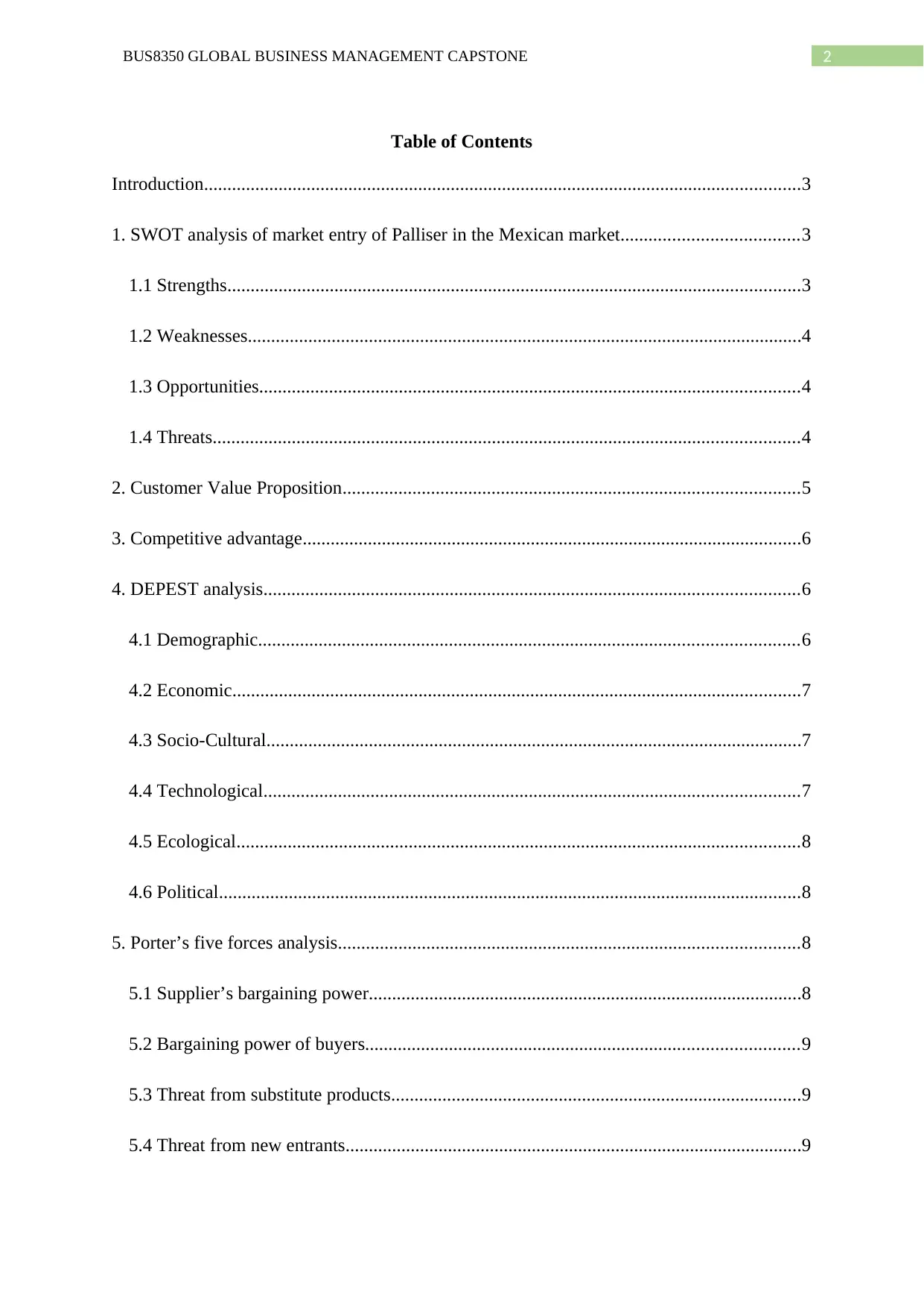
Table of Contents
Introduction................................................................................................................................3
1. SWOT analysis of market entry of Palliser in the Mexican market......................................3
1.1 Strengths...........................................................................................................................3
1.2 Weaknesses.......................................................................................................................4
1.3 Opportunities....................................................................................................................4
1.4 Threats..............................................................................................................................4
2. Customer Value Proposition..................................................................................................5
3. Competitive advantage...........................................................................................................6
4. DEPEST analysis...................................................................................................................6
4.1 Demographic....................................................................................................................6
4.2 Economic..........................................................................................................................7
4.3 Socio-Cultural...................................................................................................................7
4.4 Technological...................................................................................................................7
4.5 Ecological.........................................................................................................................8
4.6 Political.............................................................................................................................8
5. Porter’s five forces analysis...................................................................................................8
5.1 Supplier’s bargaining power.............................................................................................8
5.2 Bargaining power of buyers.............................................................................................9
5.3 Threat from substitute products........................................................................................9
5.4 Threat from new entrants..................................................................................................9
Table of Contents
Introduction................................................................................................................................3
1. SWOT analysis of market entry of Palliser in the Mexican market......................................3
1.1 Strengths...........................................................................................................................3
1.2 Weaknesses.......................................................................................................................4
1.3 Opportunities....................................................................................................................4
1.4 Threats..............................................................................................................................4
2. Customer Value Proposition..................................................................................................5
3. Competitive advantage...........................................................................................................6
4. DEPEST analysis...................................................................................................................6
4.1 Demographic....................................................................................................................6
4.2 Economic..........................................................................................................................7
4.3 Socio-Cultural...................................................................................................................7
4.4 Technological...................................................................................................................7
4.5 Ecological.........................................................................................................................8
4.6 Political.............................................................................................................................8
5. Porter’s five forces analysis...................................................................................................8
5.1 Supplier’s bargaining power.............................................................................................8
5.2 Bargaining power of buyers.............................................................................................9
5.3 Threat from substitute products........................................................................................9
5.4 Threat from new entrants..................................................................................................9
3BUS8350 GLOBAL BUSINESS MANAGEMENT CAPSTONE
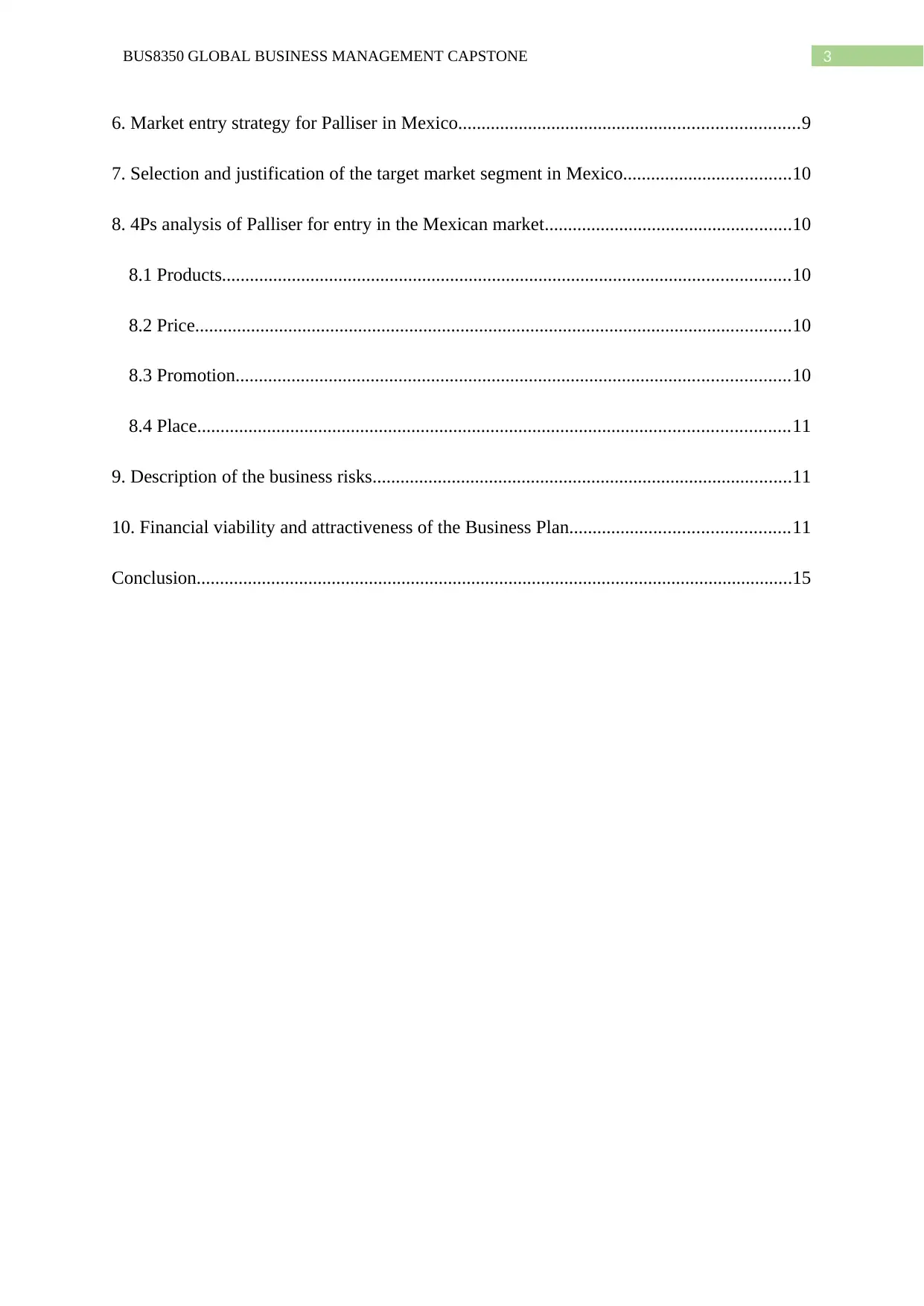
6. Market entry strategy for Palliser in Mexico.........................................................................9
7. Selection and justification of the target market segment in Mexico....................................10
8. 4Ps analysis of Palliser for entry in the Mexican market.....................................................10
8.1 Products..........................................................................................................................10
8.2 Price................................................................................................................................10
8.3 Promotion.......................................................................................................................10
8.4 Place...............................................................................................................................11
9. Description of the business risks..........................................................................................11
10. Financial viability and attractiveness of the Business Plan...............................................11
Conclusion................................................................................................................................15
6. Market entry strategy for Palliser in Mexico.........................................................................9
7. Selection and justification of the target market segment in Mexico....................................10
8. 4Ps analysis of Palliser for entry in the Mexican market.....................................................10
8.1 Products..........................................................................................................................10
8.2 Price................................................................................................................................10
8.3 Promotion.......................................................................................................................10
8.4 Place...............................................................................................................................11
9. Description of the business risks..........................................................................................11
10. Financial viability and attractiveness of the Business Plan...............................................11
Conclusion................................................................................................................................15
⊘ This is a preview!⊘
Do you want full access?
Subscribe today to unlock all pages.

Trusted by 1+ million students worldwide
4BUS8350 GLOBAL BUSINESS MANAGEMENT CAPSTONE
Introduction
This report will analyse the market entry options for the Palliser Furniture in the
Mexican market. In the first part of the essay, the necessary strengths and opportunities that
the company would experience in the Mexican market have been highlighted. Along with that
the threats an risks that the company would witness will also be highlighted in the report. In
the next part, the competitive advantage of the company by operating in the Mexican market
will be highlighted. The DEPEST model have been highlighted in the next part of the report.
This model specifically sheds light on the various macro environmental factors that would be
detrimental for the success or failure of the company in Mexico. Lastly, the 4Ps model as
well as the Market Segmentation theory have been applied for the assessment of marketing
feasibilities that would impact the business of the company in the country. In the end, a
detailed analysis of the business plan of the company for launching its products have been
highlighted here.
1. SWOT analysis of market entry of Palliser in the Mexican market
1.1 Strengths
Palliser provides good quality products that are durable and light weight. More
importantly, the prices of the products of the company are also low. This is why they are
going to get a competitive edge in the Mexican market. The customers of the Mexican
market, unlike the customers of the other neighbouring customer bases, prefer changing
furniture on a regular basis and keep up with the latest trends (Yu et al. 2017). Whereas broad
customer bases elsewhere consider furniture to be lifetime asset. Herein lies the main strength
(advantage) in terms of entering the Mexican customer market.
Introduction
This report will analyse the market entry options for the Palliser Furniture in the
Mexican market. In the first part of the essay, the necessary strengths and opportunities that
the company would experience in the Mexican market have been highlighted. Along with that
the threats an risks that the company would witness will also be highlighted in the report. In
the next part, the competitive advantage of the company by operating in the Mexican market
will be highlighted. The DEPEST model have been highlighted in the next part of the report.
This model specifically sheds light on the various macro environmental factors that would be
detrimental for the success or failure of the company in Mexico. Lastly, the 4Ps model as
well as the Market Segmentation theory have been applied for the assessment of marketing
feasibilities that would impact the business of the company in the country. In the end, a
detailed analysis of the business plan of the company for launching its products have been
highlighted here.
1. SWOT analysis of market entry of Palliser in the Mexican market
1.1 Strengths
Palliser provides good quality products that are durable and light weight. More
importantly, the prices of the products of the company are also low. This is why they are
going to get a competitive edge in the Mexican market. The customers of the Mexican
market, unlike the customers of the other neighbouring customer bases, prefer changing
furniture on a regular basis and keep up with the latest trends (Yu et al. 2017). Whereas broad
customer bases elsewhere consider furniture to be lifetime asset. Herein lies the main strength
(advantage) in terms of entering the Mexican customer market.
Paraphrase This Document
Need a fresh take? Get an instant paraphrase of this document with our AI Paraphraser
5BUS8350 GLOBAL BUSINESS MANAGEMENT CAPSTONE
Other than that cost control and sustainability are two well-known aspects of the
company and this is going to favour them highly in the Mexican market as the primary
customer base of the region are middle class people with average disposable income.
1.2 Weaknesses
One of the primary weaknesses of the furniture of the company is that they require
manual set up and they are also lacking is styles, patterns and colours. These are the attributes
that the Mexican furniture brands are known (Thomas & Ong, 2016). Furthermore, given the
fact that the customers mostly favour to alternate their products on a regular basis shows that
the above discussed attributes of the Palliser Company can go against the taste of the
customers.
1.3 Opportunities
The market of home furnishings in the Mexican market is highly segmented. Again,
the developing consumer preferences in the market are rather chained. This shows that if the
company is once able to establish a likeability for their products among a small customer
base, customer loyalty of the brand would gradually keep spreading. Another important
opportunity for the company in the market is that Mexico is having a rapidly growing middle
class who are developing a likeability for the branded furniture (Klooster & Mercado-Celis,
2016). This would favour the market entry of the company in the Mexican market.
1.4 Threats
The existing branded as well as fashionable furniture brands in the Mexican market
are going to poise a high level of competition for Palliser in the Mexican market. Besides, the
corruption level in the country is also high and that is why the company might find it difficult
to establish a significant business set up with physical stores and business warehouses.
Other than that cost control and sustainability are two well-known aspects of the
company and this is going to favour them highly in the Mexican market as the primary
customer base of the region are middle class people with average disposable income.
1.2 Weaknesses
One of the primary weaknesses of the furniture of the company is that they require
manual set up and they are also lacking is styles, patterns and colours. These are the attributes
that the Mexican furniture brands are known (Thomas & Ong, 2016). Furthermore, given the
fact that the customers mostly favour to alternate their products on a regular basis shows that
the above discussed attributes of the Palliser Company can go against the taste of the
customers.
1.3 Opportunities
The market of home furnishings in the Mexican market is highly segmented. Again,
the developing consumer preferences in the market are rather chained. This shows that if the
company is once able to establish a likeability for their products among a small customer
base, customer loyalty of the brand would gradually keep spreading. Another important
opportunity for the company in the market is that Mexico is having a rapidly growing middle
class who are developing a likeability for the branded furniture (Klooster & Mercado-Celis,
2016). This would favour the market entry of the company in the Mexican market.
1.4 Threats
The existing branded as well as fashionable furniture brands in the Mexican market
are going to poise a high level of competition for Palliser in the Mexican market. Besides, the
corruption level in the country is also high and that is why the company might find it difficult
to establish a significant business set up with physical stores and business warehouses.
6BUS8350 GLOBAL BUSINESS MANAGEMENT CAPSTONE
However, the SWOT analysis shows that if the company is able to meet the
customer’s requirements in the Mexican market and gain a certain level of brand equity
among the primary customer base, the company would be able to gain easy market
penetration in the furniture industry of Mexico.
2. Customer Value Proposition
A chief aspect of the value proposition of the Mexican market is that the customers
need to well communicate with the values that the products are bringing in the customer
market.
In this context, the cost leadership of the Palliser Company is going to favour the
market entry of the company in Mexico. As Ng, B. K., & Kanagasundaram, T. (2017),
informs, in the other markets where the company have been operational, they have shown a
typical trend of adapting to the pricing policies of the local market and as such moderated the
prices of the products keeping the quality and the designs of the products almost similar. The
company after entering in to the Mexican customer market, only needs to develop a distinct
product line based on the preferences of the customers. That is how the brand loyalty and the
product equity can be developed in the target market of Mexico that is mostly comprised of
the young and middle aged customers most of whom pertain to the middle class and have a
distinct taste for branded customers.
The advertising campaign that have been launched by the company would be
favouring the recent market trend of the Mexican market. The advertisements of the Palliser
Company exhibits that the people should not consider changing furniture with life style
(Rabellotti, 2016). This is a very poignant step that shows that the company is ready to accept
the demographic purchasing pattern in the country and as such it implies that they have been
able to adapt to the buying trends of the company. They have already introduced flexible
However, the SWOT analysis shows that if the company is able to meet the
customer’s requirements in the Mexican market and gain a certain level of brand equity
among the primary customer base, the company would be able to gain easy market
penetration in the furniture industry of Mexico.
2. Customer Value Proposition
A chief aspect of the value proposition of the Mexican market is that the customers
need to well communicate with the values that the products are bringing in the customer
market.
In this context, the cost leadership of the Palliser Company is going to favour the
market entry of the company in Mexico. As Ng, B. K., & Kanagasundaram, T. (2017),
informs, in the other markets where the company have been operational, they have shown a
typical trend of adapting to the pricing policies of the local market and as such moderated the
prices of the products keeping the quality and the designs of the products almost similar. The
company after entering in to the Mexican customer market, only needs to develop a distinct
product line based on the preferences of the customers. That is how the brand loyalty and the
product equity can be developed in the target market of Mexico that is mostly comprised of
the young and middle aged customers most of whom pertain to the middle class and have a
distinct taste for branded customers.
The advertising campaign that have been launched by the company would be
favouring the recent market trend of the Mexican market. The advertisements of the Palliser
Company exhibits that the people should not consider changing furniture with life style
(Rabellotti, 2016). This is a very poignant step that shows that the company is ready to accept
the demographic purchasing pattern in the country and as such it implies that they have been
able to adapt to the buying trends of the company. They have already introduced flexible
⊘ This is a preview!⊘
Do you want full access?
Subscribe today to unlock all pages.
Trusted by 1+ million students worldwide
7BUS8350 GLOBAL BUSINESS MANAGEMENT CAPSTONE
furniture (multipurpose) and other categories of kitchen as well as living room furniture that
are interchangeable.
The company is pertaining to the market competition based on the four significant
features. These are:
Cost Leadership
Catering to broad customer segments in the new market
Design Differentiation
Again, in order to alleviate the user experience, the company are introducing the designation
of design consultants in the Mexican market. These professional are going to provide free
advice to the customers regarding how they can best decorate their home using products of
Palliser (Guerrero et al. 2017). This is a customer involvement strategy that adds significantly
to the value proposition also.
3. Competitive advantage
As highlighted in the SWOT analysis, the strength of the company to develop low
cost products and that also with the appropriate product qualities grants an assured advantage
to the Palliser Company in consideration to then recent economic developments of the
Mexican major customer base. Mexico is a potential market and the demographic customer
are highly influenced by the adherence to the American market alignment and that is why
having a comprehensive sales party in the customer market of USA is going to help the
company develop a purchasing parity in the Mexican market also.
4. DEPEST analysis
4.1 Demographic
furniture (multipurpose) and other categories of kitchen as well as living room furniture that
are interchangeable.
The company is pertaining to the market competition based on the four significant
features. These are:
Cost Leadership
Catering to broad customer segments in the new market
Design Differentiation
Again, in order to alleviate the user experience, the company are introducing the designation
of design consultants in the Mexican market. These professional are going to provide free
advice to the customers regarding how they can best decorate their home using products of
Palliser (Guerrero et al. 2017). This is a customer involvement strategy that adds significantly
to the value proposition also.
3. Competitive advantage
As highlighted in the SWOT analysis, the strength of the company to develop low
cost products and that also with the appropriate product qualities grants an assured advantage
to the Palliser Company in consideration to then recent economic developments of the
Mexican major customer base. Mexico is a potential market and the demographic customer
are highly influenced by the adherence to the American market alignment and that is why
having a comprehensive sales party in the customer market of USA is going to help the
company develop a purchasing parity in the Mexican market also.
4. DEPEST analysis
4.1 Demographic
Paraphrase This Document
Need a fresh take? Get an instant paraphrase of this document with our AI Paraphraser
8BUS8350 GLOBAL BUSINESS MANAGEMENT CAPSTONE
The primary quality of the major demographic base of the customer market of Mexico
is that the majority of the purchasing parity (in context to the furniture industry) lies with the
young and middle aged population. Analysis by Gereffi (2017), reveals that this is the exact
customer segment that likes changing products mostly and adapting to the latest life style
trends. Palliser provides good quality products that are durable and light weight. More
importantly, the prices of the products of the company are also low. That is where the role of
the company’s sales strategy is going to come in to play. The trendy product line of Palliser is
going to entice the above mentioned customer base.
4.2 Economic
The economic advantage of the Palliser company is that they are they are offering
good quality product at a comprehensible price range and because of that the company is
going to reap an added advantage of quicker market penetration. Other than that the company
is going to enjoy the advantages of high purchasing parity of the target sales market where
they are operating. Mexico have also witnessed a steady growth in its GDP and that implies
that the market liquidity of the market will keep rising steadily (Story, 2014). Hence, the time
for the market entry of the company is also ideal.
4.3 Socio-Cultural
In Mexico, the main characteristic of the customer’s buying parity is highly dependent
on the decision taken by the elders also, particularly regarding the homely assets like
furniture. In this context, Arriaga & Leal (2018), have opined that the elders while shopping
always seeks for price comparison and as an outcome, of which, it implies that the company
have to resemble with the pricing trends of the region where they are attempting to maximise
their sales.
4.4 Technological
The primary quality of the major demographic base of the customer market of Mexico
is that the majority of the purchasing parity (in context to the furniture industry) lies with the
young and middle aged population. Analysis by Gereffi (2017), reveals that this is the exact
customer segment that likes changing products mostly and adapting to the latest life style
trends. Palliser provides good quality products that are durable and light weight. More
importantly, the prices of the products of the company are also low. That is where the role of
the company’s sales strategy is going to come in to play. The trendy product line of Palliser is
going to entice the above mentioned customer base.
4.2 Economic
The economic advantage of the Palliser company is that they are they are offering
good quality product at a comprehensible price range and because of that the company is
going to reap an added advantage of quicker market penetration. Other than that the company
is going to enjoy the advantages of high purchasing parity of the target sales market where
they are operating. Mexico have also witnessed a steady growth in its GDP and that implies
that the market liquidity of the market will keep rising steadily (Story, 2014). Hence, the time
for the market entry of the company is also ideal.
4.3 Socio-Cultural
In Mexico, the main characteristic of the customer’s buying parity is highly dependent
on the decision taken by the elders also, particularly regarding the homely assets like
furniture. In this context, Arriaga & Leal (2018), have opined that the elders while shopping
always seeks for price comparison and as an outcome, of which, it implies that the company
have to resemble with the pricing trends of the region where they are attempting to maximise
their sales.
4.4 Technological
9BUS8350 GLOBAL BUSINESS MANAGEMENT CAPSTONE
One most important technological aspect of the business of Palliser is that they are
coming from an origin where they were mostly accustomed with warehouse storing and
physical stores operations. On the contrary, the market in Mexico heavily relies on
ecommerce. This is where the company needs to develop an absolutely new infrastructure
and update their whole warehouse potential, digitally (Griffith et al. 2017). This would incur
a heavy investment and require a distinct team of technical proficiency which has an
experience of operating in the local and zonal markets of Mexico and also a very good
understanding of the market trends as well as demographic demands of the customers.
4.5 Ecological
The company has launched an environment management system by means of which
they can reduce the environmental impact by using the currently employed resources of the
company. The baseline environment performance of the company exhibits that they generally
prefer to use seasoned wood for all their products. In order to reduce the environmental
impact from their products, the company have also planned to develop synthetic timber from
absolutely natural ingredients. This would help the company to contribute to the green
synergy program of the country.
4.6 Political
The Mexican political domain have been quite open to the brands that have a prolific
business base in the American domain. As a consequence the brands that have gained access
to the American market are greatly favoured in the Mexican market also. As Ruiz Massieu
and González Brambila (2016), informs, Mexico is a popular supply chain for the products of
American origin. That is why, the governments of the areas have developed a strategic
collaboration that would enable trade to flourish. Now since, Palliser is a company that have
well spread .business in US, the market entry would be easier for the company.
One most important technological aspect of the business of Palliser is that they are
coming from an origin where they were mostly accustomed with warehouse storing and
physical stores operations. On the contrary, the market in Mexico heavily relies on
ecommerce. This is where the company needs to develop an absolutely new infrastructure
and update their whole warehouse potential, digitally (Griffith et al. 2017). This would incur
a heavy investment and require a distinct team of technical proficiency which has an
experience of operating in the local and zonal markets of Mexico and also a very good
understanding of the market trends as well as demographic demands of the customers.
4.5 Ecological
The company has launched an environment management system by means of which
they can reduce the environmental impact by using the currently employed resources of the
company. The baseline environment performance of the company exhibits that they generally
prefer to use seasoned wood for all their products. In order to reduce the environmental
impact from their products, the company have also planned to develop synthetic timber from
absolutely natural ingredients. This would help the company to contribute to the green
synergy program of the country.
4.6 Political
The Mexican political domain have been quite open to the brands that have a prolific
business base in the American domain. As a consequence the brands that have gained access
to the American market are greatly favoured in the Mexican market also. As Ruiz Massieu
and González Brambila (2016), informs, Mexico is a popular supply chain for the products of
American origin. That is why, the governments of the areas have developed a strategic
collaboration that would enable trade to flourish. Now since, Palliser is a company that have
well spread .business in US, the market entry would be easier for the company.
⊘ This is a preview!⊘
Do you want full access?
Subscribe today to unlock all pages.
Trusted by 1+ million students worldwide
10BUS8350 GLOBAL BUSINESS MANAGEMENT CAPSTONE
5. Porter’s five forces analysis
5.1 Supplier’s bargaining power
Supplier’s bargaining power in Mexican market is very low. This is because, very less
proportion of the timber is procured from the local suppliers. Majority of the raw timber is
imported by the company. However, in Mexico, the company uses some selective suppliers
only. In fact, the company also conducts aplenty audits every year and thus ensures that there
is regularity in the supply chain and absolutely no violations.
5.2 Bargaining power of buyers
The influencing capacity of the individual buyers in the country is minimal. However,
since the company lays high level of emphasis on the attractiveness of the products as well as
their affordability, it can be easily commented that the company seriously considers the
influence of the buyers on the business. In the same context, Finzi and Pelizzari (2017),
informs that the company have to manufacture products that suits the pockets of the
customers.
5.3 Threat from substitute products
The threat of substitute products is low in the Mexican market. This is because of the
fact that the company makes products from various kinds of products that are natural
substitute of timber. Besides, owing to the availability of various products under the same
roof, the company have less threat from the substitute products.
5.4 Threat from new entrants
The threat of the new entrants entering the market is high since this is the ideal time
for the market entry in the furniture industry of the country (Kabiraj, 2018). However, other
5. Porter’s five forces analysis
5.1 Supplier’s bargaining power
Supplier’s bargaining power in Mexican market is very low. This is because, very less
proportion of the timber is procured from the local suppliers. Majority of the raw timber is
imported by the company. However, in Mexico, the company uses some selective suppliers
only. In fact, the company also conducts aplenty audits every year and thus ensures that there
is regularity in the supply chain and absolutely no violations.
5.2 Bargaining power of buyers
The influencing capacity of the individual buyers in the country is minimal. However,
since the company lays high level of emphasis on the attractiveness of the products as well as
their affordability, it can be easily commented that the company seriously considers the
influence of the buyers on the business. In the same context, Finzi and Pelizzari (2017),
informs that the company have to manufacture products that suits the pockets of the
customers.
5.3 Threat from substitute products
The threat of substitute products is low in the Mexican market. This is because of the
fact that the company makes products from various kinds of products that are natural
substitute of timber. Besides, owing to the availability of various products under the same
roof, the company have less threat from the substitute products.
5.4 Threat from new entrants
The threat of the new entrants entering the market is high since this is the ideal time
for the market entry in the furniture industry of the country (Kabiraj, 2018). However, other
Paraphrase This Document
Need a fresh take? Get an instant paraphrase of this document with our AI Paraphraser
11BUS8350 GLOBAL BUSINESS MANAGEMENT CAPSTONE
than Palliser, there are no other major brands in the market who are likely to make an entry in
the market of Mexico.
6. Market entry strategy for Palliser in Mexico
Based on the size of the market, specific regional territories should be considered by
the company. Like most of the firms, local distributors or agents have to be affixed for the
various locations. The company can also consider framing contract with the government
which would help the company to gain momentum of market entry.
7. Selection and justification of the target market segment in Mexico
In the Mexican market, the company should specifically target the young and the
middle aged customers. This is because, this customer base specifically emphasises on
buying the latest products that pertain to trendy lifestyle (Sellitto et al. 2017). Other than that
it is to be ensured that the salaried section of the society develops a brand loyalty towards
products of Palliser.
8. 4Ps analysis of Palliser for entry in the Mexican market
8.1 Products
The company specialises in making sectional gourmet furniture, beds and sofas as
well as room décor. There are not many companies that professes in manufacturing of such a
vast range of products in the country.
8.2 Price
The company have to keep the prices of the products moderate. They should not
lessen the price excessively. Otherwise the brand parity of the product line would go down.
On the other hand, the price cannot be too high also. This is because the target customer
segment is mainly salaried middle class.
than Palliser, there are no other major brands in the market who are likely to make an entry in
the market of Mexico.
6. Market entry strategy for Palliser in Mexico
Based on the size of the market, specific regional territories should be considered by
the company. Like most of the firms, local distributors or agents have to be affixed for the
various locations. The company can also consider framing contract with the government
which would help the company to gain momentum of market entry.
7. Selection and justification of the target market segment in Mexico
In the Mexican market, the company should specifically target the young and the
middle aged customers. This is because, this customer base specifically emphasises on
buying the latest products that pertain to trendy lifestyle (Sellitto et al. 2017). Other than that
it is to be ensured that the salaried section of the society develops a brand loyalty towards
products of Palliser.
8. 4Ps analysis of Palliser for entry in the Mexican market
8.1 Products
The company specialises in making sectional gourmet furniture, beds and sofas as
well as room décor. There are not many companies that professes in manufacturing of such a
vast range of products in the country.
8.2 Price
The company have to keep the prices of the products moderate. They should not
lessen the price excessively. Otherwise the brand parity of the product line would go down.
On the other hand, the price cannot be too high also. This is because the target customer
segment is mainly salaried middle class.
12BUS8350 GLOBAL BUSINESS MANAGEMENT CAPSTONE
8.3 Promotion
As a part of promotional strategy, the company have to pertain to traditional television
advertisements as well as online branding over the social media as well as paid websites.
8.4 Place
The specific residential zone based cities should be the main target of the company.
9. Description of the business risks
The threats are as follows:
Threats coming from the large companies as well as economies of scale
Stringent business relation with the current existing companies in the circuit
(Bahmani‐Oskooee, Harvey & Hegerty, 2018)
Failure to create product differentiation from other leading brands.
10. Financial viability and attractiveness of the Business Plan
The basic financial goals that have been set by the company are:
Obtaining an operating line of credit from one financial institution
Growth of finance through retained earnings
Operating over a 25 to 30% gross margin.
The viability of the business plan is reflected in the table of annual assumptions that is stated
below:
8.3 Promotion
As a part of promotional strategy, the company have to pertain to traditional television
advertisements as well as online branding over the social media as well as paid websites.
8.4 Place
The specific residential zone based cities should be the main target of the company.
9. Description of the business risks
The threats are as follows:
Threats coming from the large companies as well as economies of scale
Stringent business relation with the current existing companies in the circuit
(Bahmani‐Oskooee, Harvey & Hegerty, 2018)
Failure to create product differentiation from other leading brands.
10. Financial viability and attractiveness of the Business Plan
The basic financial goals that have been set by the company are:
Obtaining an operating line of credit from one financial institution
Growth of finance through retained earnings
Operating over a 25 to 30% gross margin.
The viability of the business plan is reflected in the table of annual assumptions that is stated
below:
⊘ This is a preview!⊘
Do you want full access?
Subscribe today to unlock all pages.
Trusted by 1+ million students worldwide

1 out of 19


Related Documents


Your All-in-One AI-Powered Toolkit for Academic Success.
+13062052269
info@desklib.com
Available 24*7 on WhatsApp / Email
![[object Object]](/_next/static/media/star-bottom.7253800d.svg)
Unlock your academic potential
Copyright © 2020–2026 A2Z Services. All Rights Reserved. Developed and managed by ZUCOL.