Criminal Law: An Analysis of Panopticism and DNA Fingerprinting

Verified

Added on  2022/11/14

|3
|376
|100
Report
AI Summary
This report delves into the concepts of Panopticism and DNA fingerprinting within the framework of criminal law. It begins by defining Panopticism, referencing Jeremy Bentham's theory and its implications for surveillance and behavioral control, particularly in institutional settings. The report then moves on to DNA fingerprinting, highlighting its importance as a forensic tool and its validation through scientific research and experimentation. It emphasizes the reliability of DNA fingerprinting in forensic science, supported by the work of organizations like the National Academy of Science. The report also touches on the use of these technologies in law enforcement and the legal system, offering insights into their impact on crime-fighting and the justice process. The report uses references like FRONTLINE and Hope to support the analysis.
Document Page
Running head: CRIMINAL LAW
Criminal Law
Name of the Student
Name of the University
Author Note
tabler-icon-diamond-filled.svg

Paraphrase This Document

Need a fresh take? Get an instant paraphrase of this document with our AI Paraphraser
Document Page
1CRIMINAL LAW
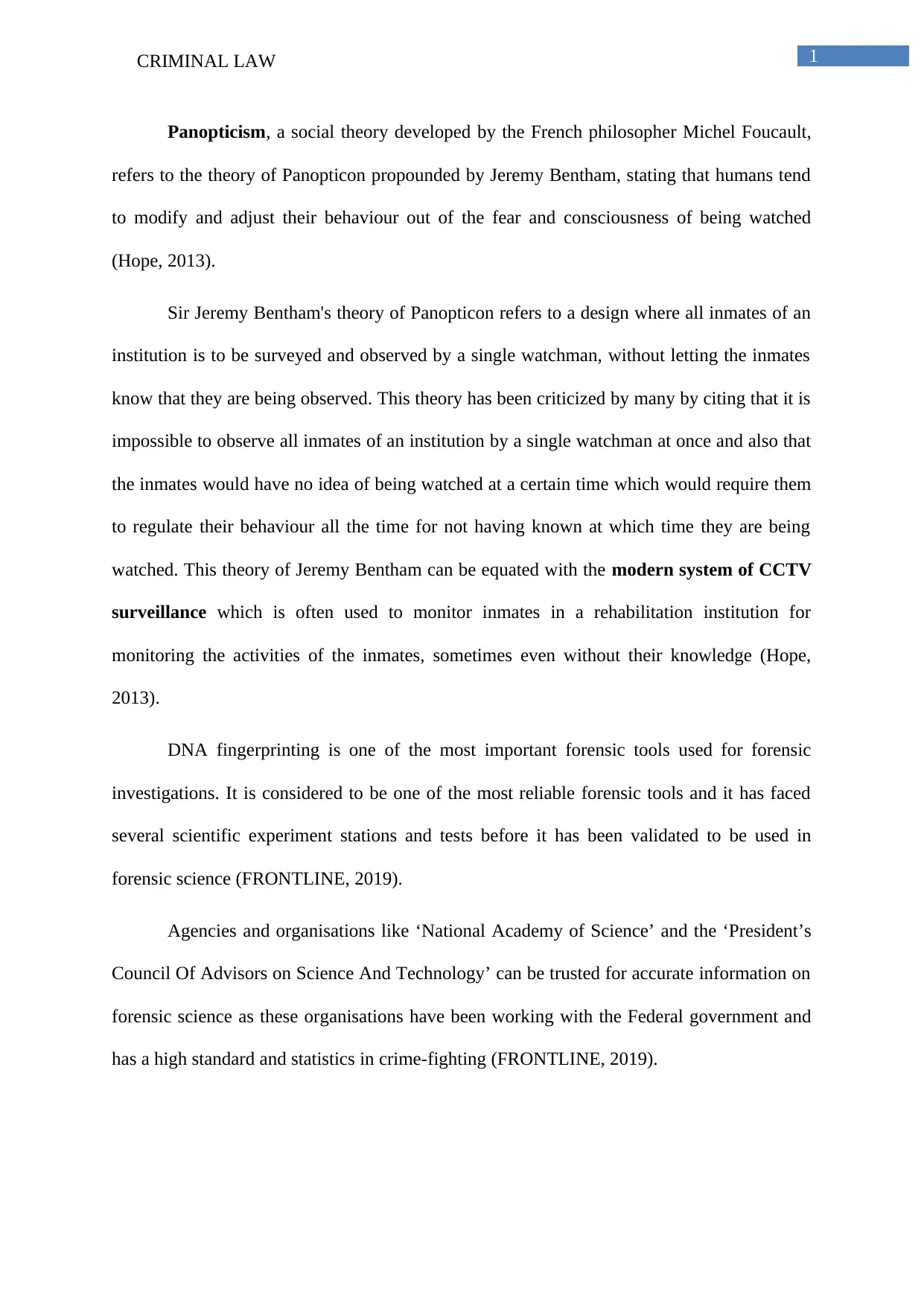
Panopticism, a social theory developed by the French philosopher Michel Foucault,
refers to the theory of Panopticon propounded by Jeremy Bentham, stating that humans tend
to modify and adjust their behaviour out of the fear and consciousness of being watched
(Hope, 2013).
Sir Jeremy Bentham's theory of Panopticon refers to a design where all inmates of an
institution is to be surveyed and observed by a single watchman, without letting the inmates
know that they are being observed. This theory has been criticized by many by citing that it is
impossible to observe all inmates of an institution by a single watchman at once and also that
the inmates would have no idea of being watched at a certain time which would require them
to regulate their behaviour all the time for not having known at which time they are being
watched. This theory of Jeremy Bentham can be equated with the modern system of CCTV
surveillance which is often used to monitor inmates in a rehabilitation institution for
monitoring the activities of the inmates, sometimes even without their knowledge (Hope,
2013).
DNA fingerprinting is one of the most important forensic tools used for forensic
investigations. It is considered to be one of the most reliable forensic tools and it has faced
several scientific experiment stations and tests before it has been validated to be used in
forensic science (FRONTLINE, 2019).
Agencies and organisations like ‘National Academy of Science’ and the ‘President’s
Council Of Advisors on Science And Technology’ can be trusted for accurate information on
forensic science as these organisations have been working with the Federal government and
has a high standard and statistics in crime-fighting (FRONTLINE, 2019).
Document Page
2CRIMINAL LAW
References
FRONTLINE. (2019). The Real CSI. Retrieved from
https://www.pbs.org/wgbh/frontline/film/real-csi/
Hope, A. (2013). Foucault, panopticism and school surveillance research. In Social Theory
and Education Research (pp. 47-63). Routledge.
chevron_up_icon
1 out of 3
circle_padding
hide_on_mobile
zoom_out_icon
[object Object]