Healthcare Report: Paranoid Schizophrenia Case Study Analysis
VerifiedAdded on 2020/11/12
|13
|4438
|121
Report
AI Summary
This report presents a detailed analysis of a case study involving a 46-year-old man diagnosed with paranoid schizophrenia. The report begins by outlining the patient's experience, including his refusal to eat due to delusions about contaminated food, his physical presentation, and his fear and distraction. It then delves into the underlying bioscience, discussing the impact of the illness on the patient's ability to think, act, and respond to reality, and the role of factors like immune activation and neurotransmitter dysfunction. The report explores intervention approaches, emphasizing the importance of timely medication, meeting nutritional needs, and evaluating mood disorders. It highlights the aims of care planning, focusing on patient-centered care and the skills required for safe and effective care, such as communication, compassion, courage, and commitment. The report also discusses the application of nursing models and clinical guidelines in the care planning process, emphasizing the importance of holistic, service user and carer-centered care, and evidence-based strategies. Finally, the report underscores the significance of local policies, regulations, and information about the patient's condition in providing comprehensive care.
PARANOID SCHIZOPHRENIA

Paraphrase This Document
Need a fresh take? Get an instant paraphrase of this document with our AI Paraphraser
Table of Contents
INTRODUCTION...........................................................................................................................1
MAIN BODY...................................................................................................................................1
HEALTH CARE CONDITION UNDERPINNING BIOSCIENCE...............................................1
Patient experience.......................................................................................................................1
Bio science knowledge to discuss health care condition of service user....................................2
INTERVENTION APPROACH AND ASPECT OF CARE..........................................................3
Intervention approach to plan care for service user....................................................................3
Aim of care planning and skills required for safe care...............................................................4
IMPORTANCE OF CARE AND KEY ISSUES IN PLANNING OF CARE................................5
Nursing process and importance of care planning......................................................................5
Nursing models used for care planning process..........................................................................6
Concept of holistic service user and carer centred care..............................................................7
Strategies which support evidence based care plans...................................................................7
Approach of care.........................................................................................................................8
Clinical guidelines of National Institute for Health and care excellence....................................8
RCN care.....................................................................................................................................8
Importance of local policies and regulations..............................................................................8
Information about patient and their condition.............................................................................9
CONCLUSION................................................................................................................................9
REFERENCES..............................................................................................................................10
INTRODUCTION...........................................................................................................................1
MAIN BODY...................................................................................................................................1
HEALTH CARE CONDITION UNDERPINNING BIOSCIENCE...............................................1
Patient experience.......................................................................................................................1
Bio science knowledge to discuss health care condition of service user....................................2
INTERVENTION APPROACH AND ASPECT OF CARE..........................................................3
Intervention approach to plan care for service user....................................................................3
Aim of care planning and skills required for safe care...............................................................4
IMPORTANCE OF CARE AND KEY ISSUES IN PLANNING OF CARE................................5
Nursing process and importance of care planning......................................................................5
Nursing models used for care planning process..........................................................................6
Concept of holistic service user and carer centred care..............................................................7
Strategies which support evidence based care plans...................................................................7
Approach of care.........................................................................................................................8
Clinical guidelines of National Institute for Health and care excellence....................................8
RCN care.....................................................................................................................................8
Importance of local policies and regulations..............................................................................8
Information about patient and their condition.............................................................................9
CONCLUSION................................................................................................................................9
REFERENCES..............................................................................................................................10
INTRODUCTION
Paranoid Schizophrenia is one of the common type of mental illness and type of
schizophrenia in which person loses connection with reality. The patient suffering from this
chronic mental disorder reflects condition of psychosis. In this disorder individual experiences
two types of situation where in one person act abnormally and in one the person do not reflect
any symptom of diseases where patient experience hallucination and delusions but handles them
responsibly.
The assessment will outline health care condition of patient suffering form Paranoid
Schizophrenia by evaluating experience and bio science theory. Further, it will discuss
intervention which are implied for planning of care of person suffering from Chronic mental
disorder. Thus, it will derive importance of care and key issues which needs to considered when
planning for care.
MAIN BODY
HEALTH CARE CONDITION UNDERPINNING BIOSCIENCE
Patient experience
According to Busse and et.al., 2012, schizophrenia is devastating mental disorder which
impact individual ability to think, act and respond to reality. In this disease' person undergo
trouble in determining difference between reality and imaginary world. However, the author
argued that it is not multiple or split personality disorder but it is the situation where person loses
connect with reality of life and is unable to react to real life situation.
John a 46 year old man suffering from paranoid schizophrenia presented in hospital and
care unit. From the diagnosis and review of his past condition it is determined that he refuses to
eat because according to him food and medicines are contaminated by spies and can hamper his
health. In accordance with analysis it is determined that he had a dream where god informed him
that his food is poised and if eats it he will die ad therefore he stopped eating because of which
he has become weak and vulnerable to surroundings and food. Further, health practitioner noted
that John does reflect any motion and when talking he always looks down on the floor. Further,
the patient was wearing dirty clothes and has strong body odor from which nurse determine that
need of hygiene. In addition, it was noticed that he was frightened and is always distracted
because of which he was always looking at the end of room during conversation and there was
continuous look of fear on his face. Thus, it is analyzed that he is experiencing some threat from
1
Paranoid Schizophrenia is one of the common type of mental illness and type of
schizophrenia in which person loses connection with reality. The patient suffering from this
chronic mental disorder reflects condition of psychosis. In this disorder individual experiences
two types of situation where in one person act abnormally and in one the person do not reflect
any symptom of diseases where patient experience hallucination and delusions but handles them
responsibly.
The assessment will outline health care condition of patient suffering form Paranoid
Schizophrenia by evaluating experience and bio science theory. Further, it will discuss
intervention which are implied for planning of care of person suffering from Chronic mental
disorder. Thus, it will derive importance of care and key issues which needs to considered when
planning for care.
MAIN BODY
HEALTH CARE CONDITION UNDERPINNING BIOSCIENCE
Patient experience
According to Busse and et.al., 2012, schizophrenia is devastating mental disorder which
impact individual ability to think, act and respond to reality. In this disease' person undergo
trouble in determining difference between reality and imaginary world. However, the author
argued that it is not multiple or split personality disorder but it is the situation where person loses
connect with reality of life and is unable to react to real life situation.
John a 46 year old man suffering from paranoid schizophrenia presented in hospital and
care unit. From the diagnosis and review of his past condition it is determined that he refuses to
eat because according to him food and medicines are contaminated by spies and can hamper his
health. In accordance with analysis it is determined that he had a dream where god informed him
that his food is poised and if eats it he will die ad therefore he stopped eating because of which
he has become weak and vulnerable to surroundings and food. Further, health practitioner noted
that John does reflect any motion and when talking he always looks down on the floor. Further,
the patient was wearing dirty clothes and has strong body odor from which nurse determine that
need of hygiene. In addition, it was noticed that he was frightened and is always distracted
because of which he was always looking at the end of room during conversation and there was
continuous look of fear on his face. Thus, it is analyzed that he is experiencing some threat from
1
⊘ This is a preview!⊘
Do you want full access?
Subscribe today to unlock all pages.

Trusted by 1+ million students worldwide
his imaginary world which needs to controlled with effective care plan because his condition is
drowning as he stopped eating.
Bio science knowledge to discuss health care condition of service user
Implication of bio science theory plays an important role of nurse because it helps the
individuals in incorporating knowledge and experience with current patient experience.
According to Guo and et.al., 2012, it is articulated that paranoid schizophrenia is common form
of chronic mental illness in which person experiences hallucination and delusion which are away
from reality. It is the situation where patient starts loosing connection with the reality of life. The
main causes which triggers schizophrenia are inheritance, family history, increase activation of
immune system, autoimmune disease and inflammation. However, in accordance with condition
of John it is evaluated that the major cause behind his paranoid schizophrenia is increase immune
activation because of which is immune dysfunction where blunted type-1 immune response is
related with a dysbalance in the activation of the enzyme indoleamine 2,3-dioxygenase (IDO)
and in the tryptophan - kynurenine metabolism resulting in increased production of kynurenic
acid in schizophrenia.
In accordance with condition of John physiology the bio science knowledge can be
interpreted where Chen and et.al., 2012, discussed about Anatimical abnormality which focuses
on involvement of prefrontal cortex in specific cognitive deficits. In this there is slow reduction
in Grey matters which started causing irregularities of white matter which is core part of circuits
and brain areas. However, the decline in Grey matter from brain areas denotes the need of anti
psychotic treatment. Further, there is dysfunctional neurotransmission which is clearly related to
symptom and situation experienced by John. In this brain of human body started imaging things
which are far way from reality. It is phase of patient experience where individual experiences
delusions and hallucinations like John where he was feeling like food is poisoned and if he eats
he will die. According to Sanders and et.al., 2012, it is argued that as per clinical pharmacology
and altered physiology in dysfunctional neurotransmission brain imaging gets disturbed. It is the
dysfunction of parvalbumin-positive interneurons inside the cerebral cortex and hippocampus,
which are subtle to alterations in NMDA-type glutamate receptors.
Webster, 2013, suggested theory of mind in schizophrenia which promotes ability to infer
mental states of others. The theory can be used by health practitioner because in this delusional
though of other person are better understood by relating to own intention to executing behavior.
2
drowning as he stopped eating.
Bio science knowledge to discuss health care condition of service user
Implication of bio science theory plays an important role of nurse because it helps the
individuals in incorporating knowledge and experience with current patient experience.
According to Guo and et.al., 2012, it is articulated that paranoid schizophrenia is common form
of chronic mental illness in which person experiences hallucination and delusion which are away
from reality. It is the situation where patient starts loosing connection with the reality of life. The
main causes which triggers schizophrenia are inheritance, family history, increase activation of
immune system, autoimmune disease and inflammation. However, in accordance with condition
of John it is evaluated that the major cause behind his paranoid schizophrenia is increase immune
activation because of which is immune dysfunction where blunted type-1 immune response is
related with a dysbalance in the activation of the enzyme indoleamine 2,3-dioxygenase (IDO)
and in the tryptophan - kynurenine metabolism resulting in increased production of kynurenic
acid in schizophrenia.
In accordance with condition of John physiology the bio science knowledge can be
interpreted where Chen and et.al., 2012, discussed about Anatimical abnormality which focuses
on involvement of prefrontal cortex in specific cognitive deficits. In this there is slow reduction
in Grey matters which started causing irregularities of white matter which is core part of circuits
and brain areas. However, the decline in Grey matter from brain areas denotes the need of anti
psychotic treatment. Further, there is dysfunctional neurotransmission which is clearly related to
symptom and situation experienced by John. In this brain of human body started imaging things
which are far way from reality. It is phase of patient experience where individual experiences
delusions and hallucinations like John where he was feeling like food is poisoned and if he eats
he will die. According to Sanders and et.al., 2012, it is argued that as per clinical pharmacology
and altered physiology in dysfunctional neurotransmission brain imaging gets disturbed. It is the
dysfunction of parvalbumin-positive interneurons inside the cerebral cortex and hippocampus,
which are subtle to alterations in NMDA-type glutamate receptors.
Webster, 2013, suggested theory of mind in schizophrenia which promotes ability to infer
mental states of others. The theory can be used by health practitioner because in this delusional
though of other person are better understood by relating to own intention to executing behavior.
2
Paraphrase This Document
Need a fresh take? Get an instant paraphrase of this document with our AI Paraphraser
It is effective for the nurse to imply when planing Care for John because it helps in driving
reason why he stopped eating ways to motivate d and make him understand that no one has
poisoned his food and his food is good to eat.
INTERVENTION APPROACH AND ASPECT OF CARE
Intervention approach to plan care for service user
Intervention approach according to specific patient condition plays a vital role for the
nurse in managing safe and effective nursing care plan. Identifying care aspect by evaluating
patient medical condition for individuals experience plays critical role in implementing effective
nursing invention to improvise care services for particular patients. Approaches of nurses are
patient centric and therefore assist in getting valuable health outcomes (Galletly and et.al., 2016).
Further intervention approach are implied by nurse because it helps in working in partnership
with patient which helped in gaining their interest and participation in care practices. The nursing
intervention in care planning for John who is suffering from Paranoid Schizophrenia are as
follows:
Timely medication: Medication is the crucial part of recovery and therefore it is
important for the nurse to ensure that patient is taking regular medication on timely basis.
Mental illness is the condition in which skipping medication reverse entire recovery 14
days back. Therefore, in case of John foremost priority of health care practitioner will be
on making John agrees for medication. It can be done by continuously being with which
will helps them in feeling secure from hallucination he is experiencing. As per the views
of Aggelidou and Georgaca, 2017, it takes six weeks from first dose to reduce impact of
symptom which denotes the need of following five medication rights that is right dose,
drug, time and right route.
Meeting nutritional needs: Managing nutritional needs of patient suffering for paranoid
schizophrenia play a critical role in improving health outcomes because it helps in
building immune system and reducing inflammation. However, John is vulnerable to
food and medication therefore it is critical and essential task for the health practitioner to
make him eat properly in order to meet nutritional needs of his body and mind. However,
diet plan of John will comprise, food items which are rich in Vitamin B that is nuts,
seeds, fruits, vegetable and whole grains. Further, diet plan will comprise intake of folic
acid that is food item like, beans, green vegetable, lentils, seeds and nuts. Further, John is
3
reason why he stopped eating ways to motivate d and make him understand that no one has
poisoned his food and his food is good to eat.
INTERVENTION APPROACH AND ASPECT OF CARE
Intervention approach to plan care for service user
Intervention approach according to specific patient condition plays a vital role for the
nurse in managing safe and effective nursing care plan. Identifying care aspect by evaluating
patient medical condition for individuals experience plays critical role in implementing effective
nursing invention to improvise care services for particular patients. Approaches of nurses are
patient centric and therefore assist in getting valuable health outcomes (Galletly and et.al., 2016).
Further intervention approach are implied by nurse because it helps in working in partnership
with patient which helped in gaining their interest and participation in care practices. The nursing
intervention in care planning for John who is suffering from Paranoid Schizophrenia are as
follows:
Timely medication: Medication is the crucial part of recovery and therefore it is
important for the nurse to ensure that patient is taking regular medication on timely basis.
Mental illness is the condition in which skipping medication reverse entire recovery 14
days back. Therefore, in case of John foremost priority of health care practitioner will be
on making John agrees for medication. It can be done by continuously being with which
will helps them in feeling secure from hallucination he is experiencing. As per the views
of Aggelidou and Georgaca, 2017, it takes six weeks from first dose to reduce impact of
symptom which denotes the need of following five medication rights that is right dose,
drug, time and right route.
Meeting nutritional needs: Managing nutritional needs of patient suffering for paranoid
schizophrenia play a critical role in improving health outcomes because it helps in
building immune system and reducing inflammation. However, John is vulnerable to
food and medication therefore it is critical and essential task for the health practitioner to
make him eat properly in order to meet nutritional needs of his body and mind. However,
diet plan of John will comprise, food items which are rich in Vitamin B that is nuts,
seeds, fruits, vegetable and whole grains. Further, diet plan will comprise intake of folic
acid that is food item like, beans, green vegetable, lentils, seeds and nuts. Further, John is
3
non vegetarian that is why nutritional needs will be effectively managing by adding meat,
fish, diary products and eggs item which are rich in vitamin B12. As per the views of
Mitchell and Golden, 2012, it is determined that meeting nutritional needs of patient
suffering from paranoid schizophrenia helps in preventing relapse which is very common
in case of skip in medication or food intake.
Evaluating mood disorder: Mood disorder are the common part of health care practice
when managing effective care for patient suffering form Paranoid Schizophrenia. The
early signs of mental illness comprise social withdrawal, depression, anxiety, fear, lack of
personal hygiene, etc. However, in case of John it was noticed that his clothes were dirty
and had strong body odor which reflected that his personal hygiene is Detroited. In
accordance with this case it can be articulated that evaluating and considering mood
disorder will another care priority of nurse where health practitioner will be focus on
hygiene of patient and on understanding his hallucination with the help of theory of mind.
According to Gulanick and Myers, 2016, it is articulated that mood disorder in patient
undergoing paranoid schizophrenia is common for which it is important for the nurse to
understand the situation when there is certain change in individual behavior. Evaluating
mood swings is the approach of managing control over behaviors of patient and is
beneficial for improving individual health outcomes and changes in behaviors.
Aim of care planning and skills required for safe care
According to Zugai, Stein‐Parbury and Roche, 2013, health care services are
revolutionized by develop partnership of nurses and patient which is supported by patient
centered model of care. In Accordance with this approach of care planning nurses are able to
plan care services according to holistic needs of patient which helps in protecting interest of
individual and aid in gaining support for service user which is the best heath care planing that
promotes improvement in health outcomes.
Aim of care planning for the John suffering from Paranoid schizophrenia is improving his
health outcomes by deriving patient centric care plan. However, the focus of nurse will be on
develop partnership relationship with John as it will help health practitioner in analyzing his
holistic needs and condition which needs to be more focused. It will promote relationship apart
from medication and care where care provider will be able to understand hallucination
experienced by John and treason behind this thinking over Food. Further, it will support care
4
fish, diary products and eggs item which are rich in vitamin B12. As per the views of
Mitchell and Golden, 2012, it is determined that meeting nutritional needs of patient
suffering from paranoid schizophrenia helps in preventing relapse which is very common
in case of skip in medication or food intake.
Evaluating mood disorder: Mood disorder are the common part of health care practice
when managing effective care for patient suffering form Paranoid Schizophrenia. The
early signs of mental illness comprise social withdrawal, depression, anxiety, fear, lack of
personal hygiene, etc. However, in case of John it was noticed that his clothes were dirty
and had strong body odor which reflected that his personal hygiene is Detroited. In
accordance with this case it can be articulated that evaluating and considering mood
disorder will another care priority of nurse where health practitioner will be focus on
hygiene of patient and on understanding his hallucination with the help of theory of mind.
According to Gulanick and Myers, 2016, it is articulated that mood disorder in patient
undergoing paranoid schizophrenia is common for which it is important for the nurse to
understand the situation when there is certain change in individual behavior. Evaluating
mood swings is the approach of managing control over behaviors of patient and is
beneficial for improving individual health outcomes and changes in behaviors.
Aim of care planning and skills required for safe care
According to Zugai, Stein‐Parbury and Roche, 2013, health care services are
revolutionized by develop partnership of nurses and patient which is supported by patient
centered model of care. In Accordance with this approach of care planning nurses are able to
plan care services according to holistic needs of patient which helps in protecting interest of
individual and aid in gaining support for service user which is the best heath care planing that
promotes improvement in health outcomes.
Aim of care planning for the John suffering from Paranoid schizophrenia is improving his
health outcomes by deriving patient centric care plan. However, the focus of nurse will be on
develop partnership relationship with John as it will help health practitioner in analyzing his
holistic needs and condition which needs to be more focused. It will promote relationship apart
from medication and care where care provider will be able to understand hallucination
experienced by John and treason behind this thinking over Food. Further, it will support care
4
⊘ This is a preview!⊘
Do you want full access?
Subscribe today to unlock all pages.
Trusted by 1+ million students worldwide
plan because it will be according to patient and therefore will help in gaining his support in care
practices.
As per the views of Mitchell and Golden, 2012, Communication skills assist health
practitioner in safe planning and effective care. The author discussed about 6 C's of
communication which play a crucial role in managing safe care planning for patient suffering
from paranoid Schizophrenia. In accordance 6 C's it can be said that first C of model is care
which needs to perfect and is managed by nurses via intervention according to patient medical
condition. For example for John the focus of nurse will be meeting his nutritional needs and
timely medication because he avoids eating and medication which is a critical aspect of effective
care planning. Further, there is compassion where it is necessary for the care provider to
motivate patient for taking medication and following routine as per care plan. For example, In
case of John nurse will be compassionate to wards John which will helps in gaining his trust and
making him deal with hallucination by in taking proper food and medication.
On the other hand, Camicia and et.al., 2013, discussed about courage and commitment
like the nurse needs to focus on safe care plan for which having courage to deal with individual
medical condition is foremost concern which helps the care provider in committing to one aim
which is improving health outcomes. For example, in case of John focus of heath practitioner
will be on understanding hallucination and fear of John which he is experiencing because of
chronic mental condition. Further, focus of nurse will be on regular communication with John
which will helps the practitioner in deriving day to delusion he is experiencing and are reason of
his disturbing thoughts over eating and medication. Hence, it can be commitment, compassion,
communication, courage and effective care are the key skills which helps the nurse in managing
safe and effective care.
IMPORTANCE OF CARE AND KEY ISSUES IN PLANNING OF CARE
Nursing process and importance of care planning
Care planning is important because it helps the person in forming unique list of care pans
by considering patient experience, diagnose, health care needs, cause and symptoms o diseases.
Like in case of John it is important for the heath practitioner to focus on his delusion because of
which stopped eating and taking medication. Nursing planning enables clear direction which
needs to followed in order to incorporate patient centric care services. It is important for the
nurse to incorporate use of nursing process because it helps health care practitioner in managing
5
practices.
As per the views of Mitchell and Golden, 2012, Communication skills assist health
practitioner in safe planning and effective care. The author discussed about 6 C's of
communication which play a crucial role in managing safe care planning for patient suffering
from paranoid Schizophrenia. In accordance 6 C's it can be said that first C of model is care
which needs to perfect and is managed by nurses via intervention according to patient medical
condition. For example for John the focus of nurse will be meeting his nutritional needs and
timely medication because he avoids eating and medication which is a critical aspect of effective
care planning. Further, there is compassion where it is necessary for the care provider to
motivate patient for taking medication and following routine as per care plan. For example, In
case of John nurse will be compassionate to wards John which will helps in gaining his trust and
making him deal with hallucination by in taking proper food and medication.
On the other hand, Camicia and et.al., 2013, discussed about courage and commitment
like the nurse needs to focus on safe care plan for which having courage to deal with individual
medical condition is foremost concern which helps the care provider in committing to one aim
which is improving health outcomes. For example, in case of John focus of heath practitioner
will be on understanding hallucination and fear of John which he is experiencing because of
chronic mental condition. Further, focus of nurse will be on regular communication with John
which will helps the practitioner in deriving day to delusion he is experiencing and are reason of
his disturbing thoughts over eating and medication. Hence, it can be commitment, compassion,
communication, courage and effective care are the key skills which helps the nurse in managing
safe and effective care.
IMPORTANCE OF CARE AND KEY ISSUES IN PLANNING OF CARE
Nursing process and importance of care planning
Care planning is important because it helps the person in forming unique list of care pans
by considering patient experience, diagnose, health care needs, cause and symptoms o diseases.
Like in case of John it is important for the heath practitioner to focus on his delusion because of
which stopped eating and taking medication. Nursing planning enables clear direction which
needs to followed in order to incorporate patient centric care services. It is important for the
nurse to incorporate use of nursing process because it helps health care practitioner in managing
5
Paraphrase This Document
Need a fresh take? Get an instant paraphrase of this document with our AI Paraphraser
safe and effective care plan. Therefore, nursing process which will be followed for care planning
of John is a follows:
Assessing: In this nurse will outline conditions and experience of John which comprise
this present condition, symptoms and causes behind paranoid schizophrenia. Further,
nurse will evaluate the reason which supported his hallucination and delusion which his
reaction of imaginary world (Doenges and et.al., 2013). In accordance with this it is
analyzed that John was weaving dirty clothes and had strong body odor. Further, he was
frightened and was emotional less and according to him his medication and food is poised
that is why he stopped eating.
Diagnosing: It is the analysis of clinical condition which is derived via various teas and
clinical diagnostic like MRI which is brain scan, and many other test. With this nurse is
able to understand critical of patient condition like in case of John, he was undergoing
Dysfunctional Neurotransmission. Evaluating this is important for deriving
appropriateness nursing intervention.
Planning: In this nurses evaluated possible nursing approaches which can be
incorporated to managing improvement in health of patient. Like in case of John health
care practitioner will incorporate three intervention that is meeting nutritional needs,
timely mediation and evaluating mood disorders.
Implementing: In this nursing plan and approaches are executed to manage care of
patient. It is execution stag which helps in deriving effective of approaches and is based
on skills of nurse that is compassion, courage, care and commitment.
Evaluating: This is post care process which is done by nurse on the basis of
improvement in health outcomes of patient. In this focus of care provider will be
outlining balance in mood disorders of john, eating and medication habits of John.
Nursing models used for care planning process
Model care planning process: According to Sharaf, Ossman and Lachine, 2012, it is
relevant process of care planning because it is sequential process which promotes patient
centric care plan, four main phases. In this process care plan is made by concern with
patient and immediate guardians. Further, it supports effective care planning because it
comprises care plan management, coordinating care and self management goals.
6
of John is a follows:
Assessing: In this nurse will outline conditions and experience of John which comprise
this present condition, symptoms and causes behind paranoid schizophrenia. Further,
nurse will evaluate the reason which supported his hallucination and delusion which his
reaction of imaginary world (Doenges and et.al., 2013). In accordance with this it is
analyzed that John was weaving dirty clothes and had strong body odor. Further, he was
frightened and was emotional less and according to him his medication and food is poised
that is why he stopped eating.
Diagnosing: It is the analysis of clinical condition which is derived via various teas and
clinical diagnostic like MRI which is brain scan, and many other test. With this nurse is
able to understand critical of patient condition like in case of John, he was undergoing
Dysfunctional Neurotransmission. Evaluating this is important for deriving
appropriateness nursing intervention.
Planning: In this nurses evaluated possible nursing approaches which can be
incorporated to managing improvement in health of patient. Like in case of John health
care practitioner will incorporate three intervention that is meeting nutritional needs,
timely mediation and evaluating mood disorders.
Implementing: In this nursing plan and approaches are executed to manage care of
patient. It is execution stag which helps in deriving effective of approaches and is based
on skills of nurse that is compassion, courage, care and commitment.
Evaluating: This is post care process which is done by nurse on the basis of
improvement in health outcomes of patient. In this focus of care provider will be
outlining balance in mood disorders of john, eating and medication habits of John.
Nursing models used for care planning process
Model care planning process: According to Sharaf, Ossman and Lachine, 2012, it is
relevant process of care planning because it is sequential process which promotes patient
centric care plan, four main phases. In this process care plan is made by concern with
patient and immediate guardians. Further, it supports effective care planning because it
comprises care plan management, coordinating care and self management goals.
6
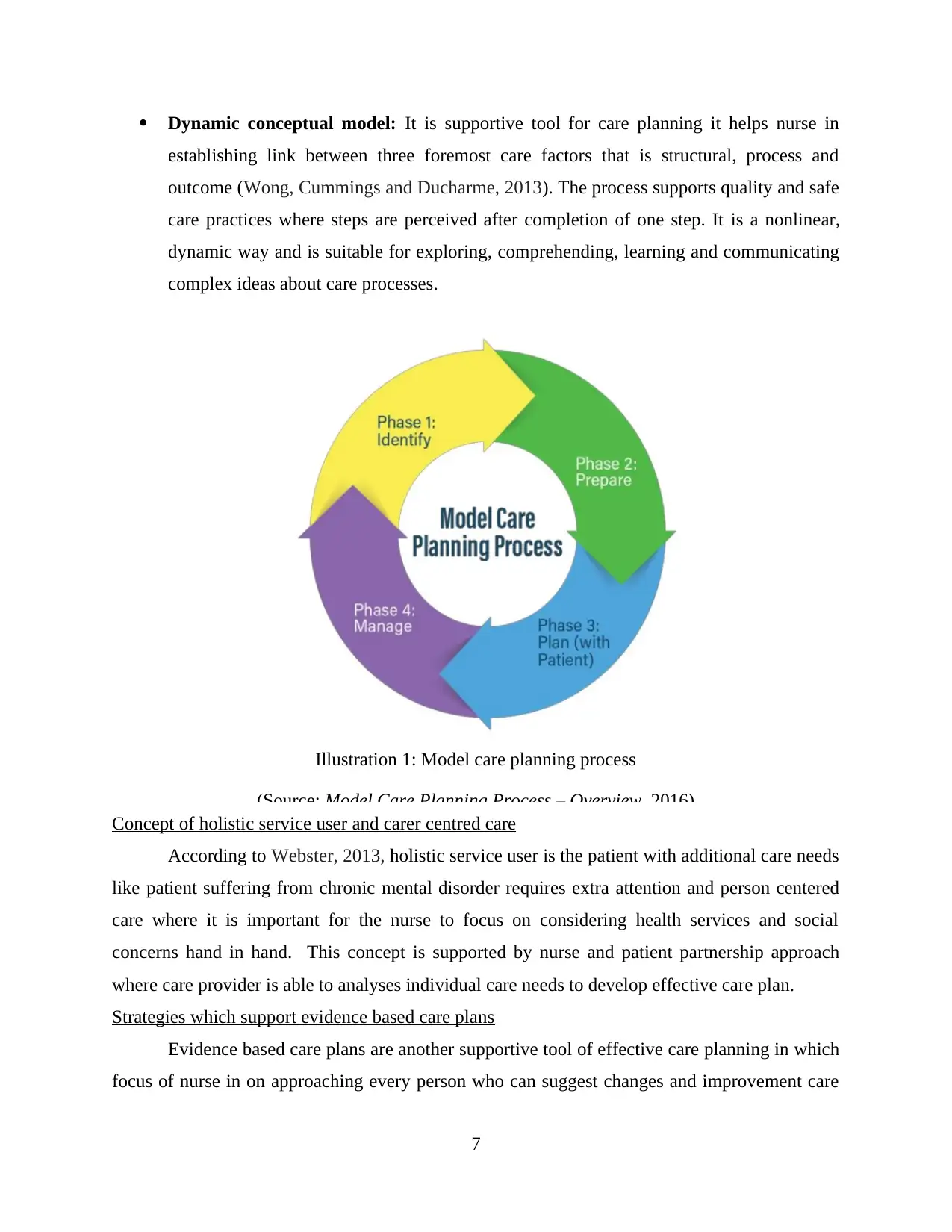
Dynamic conceptual model: It is supportive tool for care planning it helps nurse in
establishing link between three foremost care factors that is structural, process and
outcome (Wong, Cummings and Ducharme, 2013). The process supports quality and safe
care practices where steps are perceived after completion of one step. It is a nonlinear,
dynamic way and is suitable for exploring, comprehending, learning and communicating
complex ideas about care processes.
Concept of holistic service user and carer centred care
According to Webster, 2013, holistic service user is the patient with additional care needs
like patient suffering from chronic mental disorder requires extra attention and person centered
care where it is important for the nurse to focus on considering health services and social
concerns hand in hand. This concept is supported by nurse and patient partnership approach
where care provider is able to analyses individual care needs to develop effective care plan.
Strategies which support evidence based care plans
Evidence based care plans are another supportive tool of effective care planning in which
focus of nurse in on approaching every person who can suggest changes and improvement care
7
Illustration 1: Model care planning process
(Source: Model Care Planning Process – Overview, 2016)
establishing link between three foremost care factors that is structural, process and
outcome (Wong, Cummings and Ducharme, 2013). The process supports quality and safe
care practices where steps are perceived after completion of one step. It is a nonlinear,
dynamic way and is suitable for exploring, comprehending, learning and communicating
complex ideas about care processes.
Concept of holistic service user and carer centred care
According to Webster, 2013, holistic service user is the patient with additional care needs
like patient suffering from chronic mental disorder requires extra attention and person centered
care where it is important for the nurse to focus on considering health services and social
concerns hand in hand. This concept is supported by nurse and patient partnership approach
where care provider is able to analyses individual care needs to develop effective care plan.
Strategies which support evidence based care plans
Evidence based care plans are another supportive tool of effective care planning in which
focus of nurse in on approaching every person who can suggest changes and improvement care
7
Illustration 1: Model care planning process
(Source: Model Care Planning Process – Overview, 2016)
⊘ This is a preview!⊘
Do you want full access?
Subscribe today to unlock all pages.
Trusted by 1+ million students worldwide
planning for particular medical condition. However, in case of John who is suffering from
Paranoid Schizophrenia nurse will ask question for the sake of seeking advice from mental health
administration, practitioners and advocates (Strategies for implementing evidence-based
practices in routine mental health settings, 2018). Thus, this is one of the strategy of evidence
care plan. According to Gerson and Rose, 2012, the best strategies which support evidence
based care plan of health care practitioners are patient values and clinical expertise over medical
condition before preparing care plan.
Approach of care
Approach to care are based on recovery and end of life care where Kotowski, 2012,
discussed about end of life care which is terminal condition where nurse only focuses on
monitoring signs and ensuring resource and support from patients family for ending one's life
because the person is undergoing struggle for life. Further, there is recovery in which focus of
nurse on making safe care plan to support improvement in health outcome. Apparently, in case
of John focus of nurse will be on his recovery by assessing determined nursing intervention.
Clinical guidelines of National Institute for Health and care excellence
Develop standard of care by assessing clinical practices of health professionals.
Managing improvement in communication between heath professional, practitioner and
patient.
Implicate use of recommendation n patient care which are provided by health
professionals.
Nurses are responsible for making informed decision for assisting patients.
RCN care
Principle 1: It is necessary or the nurses to treat every person in heath care organization
equality and with dignity.
Principle 2: It is important for the health practitioner to make responsible decision and
take responsible for own decision.
Principle 3: It is important for the nursing staff to manage risk and keep patient safe.
Importance of local policies and regulations
Local nursing polices and guidelines play an important role in preparing safe and
effective care plan for it suggest areas of improvement which can helps health practitioners in
8
Paranoid Schizophrenia nurse will ask question for the sake of seeking advice from mental health
administration, practitioners and advocates (Strategies for implementing evidence-based
practices in routine mental health settings, 2018). Thus, this is one of the strategy of evidence
care plan. According to Gerson and Rose, 2012, the best strategies which support evidence
based care plan of health care practitioners are patient values and clinical expertise over medical
condition before preparing care plan.
Approach of care
Approach to care are based on recovery and end of life care where Kotowski, 2012,
discussed about end of life care which is terminal condition where nurse only focuses on
monitoring signs and ensuring resource and support from patients family for ending one's life
because the person is undergoing struggle for life. Further, there is recovery in which focus of
nurse on making safe care plan to support improvement in health outcome. Apparently, in case
of John focus of nurse will be on his recovery by assessing determined nursing intervention.
Clinical guidelines of National Institute for Health and care excellence
Develop standard of care by assessing clinical practices of health professionals.
Managing improvement in communication between heath professional, practitioner and
patient.
Implicate use of recommendation n patient care which are provided by health
professionals.
Nurses are responsible for making informed decision for assisting patients.
RCN care
Principle 1: It is necessary or the nurses to treat every person in heath care organization
equality and with dignity.
Principle 2: It is important for the health practitioner to make responsible decision and
take responsible for own decision.
Principle 3: It is important for the nursing staff to manage risk and keep patient safe.
Importance of local policies and regulations
Local nursing polices and guidelines play an important role in preparing safe and
effective care plan for it suggest areas of improvement which can helps health practitioners in
8
Paraphrase This Document
Need a fresh take? Get an instant paraphrase of this document with our AI Paraphraser
deriving potential risk for particular medical condition. It establishes a base on principles and
rules which enables safe care planning and nursing practices.
Information about patient and their condition
Knowledge over condition of service user is important and essential part of nursing care
plan because it is base of managing intervention setting priorities of care (Kotowski, 2012). It is
essential for the nurses to focus on improvement and therefore relevant knowledge helps the
individuals in gaining sights over patient condition and managing safe and effective care plan.
CONCLUSION
The assessment summarized about critical patient experience suffering from paranoid
Schizophrenia. It is critical medical condition where person loses connection from reality of
world and starts experiencing imaginary worlds and suffering from hallucination and delusions.
The report outlined effective acre plan for patient in which it discussed about relevant nursing
intervention, physiology of patient condition. Approaches, of care, and polices which e d to be
incorporate for managing effective and safe nursing care plan.
9
rules which enables safe care planning and nursing practices.
Information about patient and their condition
Knowledge over condition of service user is important and essential part of nursing care
plan because it is base of managing intervention setting priorities of care (Kotowski, 2012). It is
essential for the nurses to focus on improvement and therefore relevant knowledge helps the
individuals in gaining sights over patient condition and managing safe and effective care plan.
CONCLUSION
The assessment summarized about critical patient experience suffering from paranoid
Schizophrenia. It is critical medical condition where person loses connection from reality of
world and starts experiencing imaginary worlds and suffering from hallucination and delusions.
The report outlined effective acre plan for patient in which it discussed about relevant nursing
intervention, physiology of patient condition. Approaches, of care, and polices which e d to be
incorporate for managing effective and safe nursing care plan.
9
REFERENCES
Books and Journals
Aggelidou, K., & Georgaca, E. (2017). Effective strategies for coping with paranoid thoughts: A
qualitative investigation. International Journal of Mental Health. 46(3) pp.188-205.
Busse, S., Busse, M., Schiltz, K., Bielau, H., Gos, T., Brisch, R., Mawrin, C., Schmitt, A.,
Jordan, W., Müller, U.J., & Bernstein, H.G. (2012). Different distribution patterns of
lymphocytes and microglia in the hippocampus of patients with residual versus
paranoid schizophrenia: further evidence for disease course-related immune
alterations?. Brain, behavior, and immunity. 26(8). pp.1273-1279.
Camicia, M., Chamberlain, B., Finnie, R. R., Nalle, M., Lindeke, L. L., Lorenz, L., ... & Jones,
T. (2013). The value of nursing care coordination: A white paper of the American
Nurses Association. Nursing outlook. 61(6). 490-501.
Chen, Y., Zhang, J., Zhang, L., Shen, Y., & Xu, Q. (2012). Effects of MAOA promoter
methylation on susceptibility to paranoid schizophrenia. Human genetics. 131(7).
pp.1081-1087.
Doenges, M. E., Moorhouse, M. F., & Murr, A. C. (2016). Nursing diagnosis manual: planning,
individualizing, and documenting client care. FA Davis.
Galletly, C., Castle, D., Dark, F., Humberstone, V., Jablensky, A., Killackey, E., Kulkarni, J.,
McGorry, P., Nielssen, O., & Tran, N. (2016). Royal Australian and New Zealand
College of Psychiatrists clinical practice guidelines for the management of
schizophrenia and related disorders. Australian & New Zealand Journal of
Psychiatry. 50(5). pp.410-472.
Gerson, L. D., & Rose, L. E. (2012). Needs of persons with serious mental illness following
discharge from inpatient treatment: patient and family views. Archives of psychiatric
nursing. 26(4). 261-271.
Gulanick, M., & Myers, J.L. (2016). Nursing Care Plans: Diagnoses, Interventions, and
Outcomes. Elsevier Health Sciences.
Guo, W., Liu, F., Liu, Z., Gao, K., Xiao, C., Chen, H., & Zhao, J. (2012). Right lateralized white
matter abnormalities in first-episode, drug-naive paranoid schizophrenia. Neuroscience
letters, 531(1), pp.5-9.
10
Books and Journals
Aggelidou, K., & Georgaca, E. (2017). Effective strategies for coping with paranoid thoughts: A
qualitative investigation. International Journal of Mental Health. 46(3) pp.188-205.
Busse, S., Busse, M., Schiltz, K., Bielau, H., Gos, T., Brisch, R., Mawrin, C., Schmitt, A.,
Jordan, W., Müller, U.J., & Bernstein, H.G. (2012). Different distribution patterns of
lymphocytes and microglia in the hippocampus of patients with residual versus
paranoid schizophrenia: further evidence for disease course-related immune
alterations?. Brain, behavior, and immunity. 26(8). pp.1273-1279.
Camicia, M., Chamberlain, B., Finnie, R. R., Nalle, M., Lindeke, L. L., Lorenz, L., ... & Jones,
T. (2013). The value of nursing care coordination: A white paper of the American
Nurses Association. Nursing outlook. 61(6). 490-501.
Chen, Y., Zhang, J., Zhang, L., Shen, Y., & Xu, Q. (2012). Effects of MAOA promoter
methylation on susceptibility to paranoid schizophrenia. Human genetics. 131(7).
pp.1081-1087.
Doenges, M. E., Moorhouse, M. F., & Murr, A. C. (2016). Nursing diagnosis manual: planning,
individualizing, and documenting client care. FA Davis.
Galletly, C., Castle, D., Dark, F., Humberstone, V., Jablensky, A., Killackey, E., Kulkarni, J.,
McGorry, P., Nielssen, O., & Tran, N. (2016). Royal Australian and New Zealand
College of Psychiatrists clinical practice guidelines for the management of
schizophrenia and related disorders. Australian & New Zealand Journal of
Psychiatry. 50(5). pp.410-472.
Gerson, L. D., & Rose, L. E. (2012). Needs of persons with serious mental illness following
discharge from inpatient treatment: patient and family views. Archives of psychiatric
nursing. 26(4). 261-271.
Gulanick, M., & Myers, J.L. (2016). Nursing Care Plans: Diagnoses, Interventions, and
Outcomes. Elsevier Health Sciences.
Guo, W., Liu, F., Liu, Z., Gao, K., Xiao, C., Chen, H., & Zhao, J. (2012). Right lateralized white
matter abnormalities in first-episode, drug-naive paranoid schizophrenia. Neuroscience
letters, 531(1), pp.5-9.
10
⊘ This is a preview!⊘
Do you want full access?
Subscribe today to unlock all pages.
Trusted by 1+ million students worldwide

1 out of 13


Related Documents


Your All-in-One AI-Powered Toolkit for Academic Success.
+13062052269
info@desklib.com
Available 24*7 on WhatsApp / Email
![[object Object]](/_next/static/media/star-bottom.7253800d.svg)
Unlock your academic potential
Copyright © 2020–2026 A2Z Services. All Rights Reserved. Developed and managed by ZUCOL.