Qualitative Study of Parental Trust in Childhood Vaccinations Report
VerifiedAdded on 2021/01/02
|12
|3270
|61
Report
AI Summary
This report presents a detailed analysis of a qualitative research study focusing on parental trust in childhood vaccinations. The study investigates the risks, responsibilities, and negative responses associated with vaccination decisions. The research employs a qualitative design, utilizing in-depth interviews with parents to explore their perceptions, concerns, and hesitations regarding childhood immunizations. The report examines the research methodology, including the use of the PICO framework, participant selection, and data collection methods. Ethical considerations, such as informed consent and the role of research ethics committees, are also addressed. The findings highlight the factors influencing parental decisions, including the impact of misinformation, perceived risks, and the importance of trust in healthcare providers. The report concludes with a reflection on the study's limitations and its implications for public health interventions aimed at improving vaccination rates and addressing vaccine hesitancy. The research emphasizes the need for effective communication strategies and educational programs to build parental confidence in the safety and efficacy of childhood vaccines.

RESEARCH
METHODOLOGIES
METHODOLOGIES

Paraphrase This Document
Need a fresh take? Get an instant paraphrase of this document with our AI Paraphraser
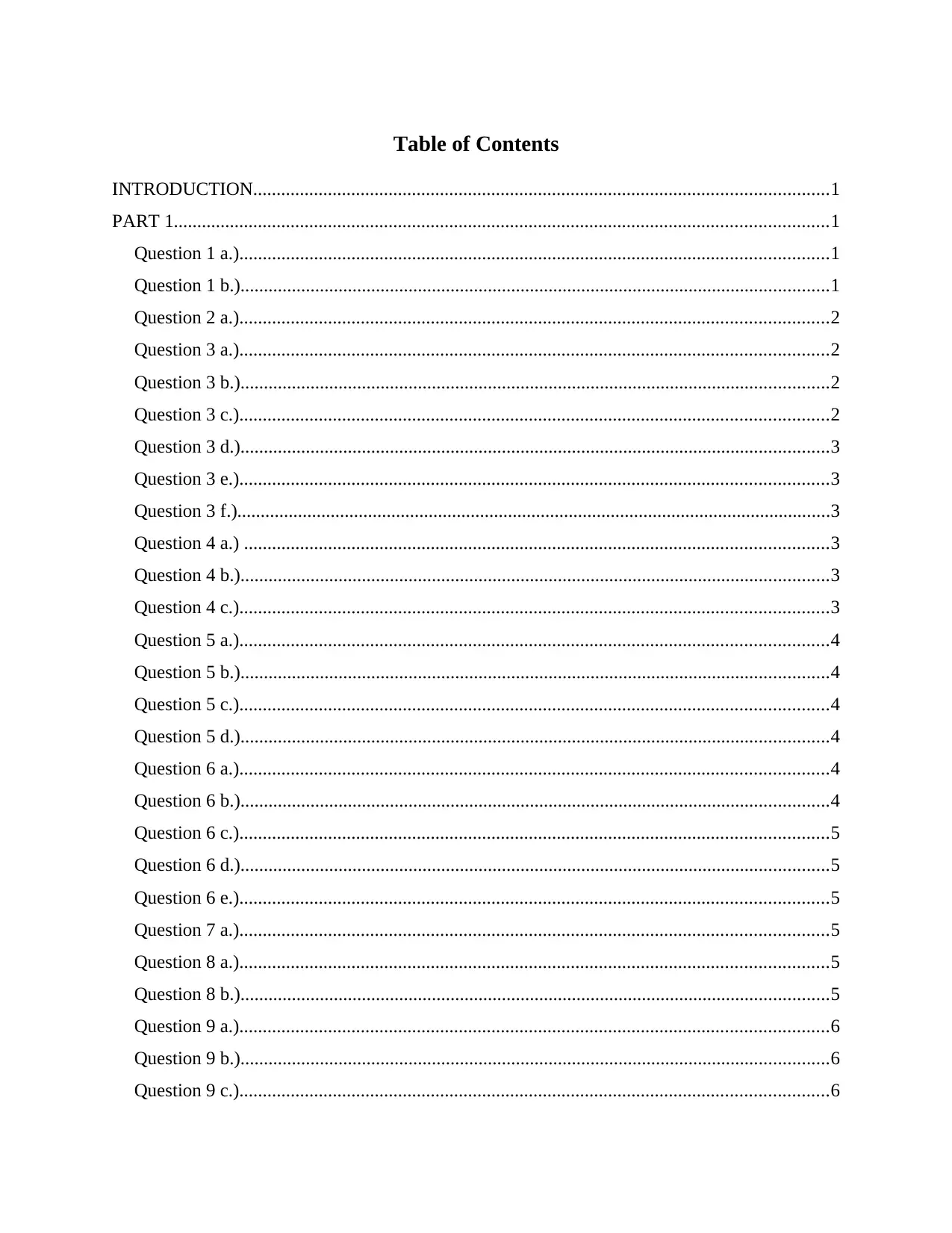
Table of Contents
INTRODUCTION...........................................................................................................................1
PART 1............................................................................................................................................1
Question 1 a.)..............................................................................................................................1
Question 1 b.)..............................................................................................................................1
Question 2 a.)..............................................................................................................................2
Question 3 a.)..............................................................................................................................2
Question 3 b.)..............................................................................................................................2
Question 3 c.)..............................................................................................................................2
Question 3 d.)..............................................................................................................................3
Question 3 e.)..............................................................................................................................3
Question 3 f.)...............................................................................................................................3
Question 4 a.) .............................................................................................................................3
Question 4 b.)..............................................................................................................................3
Question 4 c.)..............................................................................................................................3
Question 5 a.)..............................................................................................................................4
Question 5 b.)..............................................................................................................................4
Question 5 c.)..............................................................................................................................4
Question 5 d.)..............................................................................................................................4
Question 6 a.)..............................................................................................................................4
Question 6 b.)..............................................................................................................................4
Question 6 c.)..............................................................................................................................5
Question 6 d.)..............................................................................................................................5
Question 6 e.)..............................................................................................................................5
Question 7 a.)..............................................................................................................................5
Question 8 a.)..............................................................................................................................5
Question 8 b.)..............................................................................................................................5
Question 9 a.)..............................................................................................................................6
Question 9 b.)..............................................................................................................................6
Question 9 c.)..............................................................................................................................6
INTRODUCTION...........................................................................................................................1
PART 1............................................................................................................................................1
Question 1 a.)..............................................................................................................................1
Question 1 b.)..............................................................................................................................1
Question 2 a.)..............................................................................................................................2
Question 3 a.)..............................................................................................................................2
Question 3 b.)..............................................................................................................................2
Question 3 c.)..............................................................................................................................2
Question 3 d.)..............................................................................................................................3
Question 3 e.)..............................................................................................................................3
Question 3 f.)...............................................................................................................................3
Question 4 a.) .............................................................................................................................3
Question 4 b.)..............................................................................................................................3
Question 4 c.)..............................................................................................................................3
Question 5 a.)..............................................................................................................................4
Question 5 b.)..............................................................................................................................4
Question 5 c.)..............................................................................................................................4
Question 5 d.)..............................................................................................................................4
Question 6 a.)..............................................................................................................................4
Question 6 b.)..............................................................................................................................4
Question 6 c.)..............................................................................................................................5
Question 6 d.)..............................................................................................................................5
Question 6 e.)..............................................................................................................................5
Question 7 a.)..............................................................................................................................5
Question 8 a.)..............................................................................................................................5
Question 8 b.)..............................................................................................................................5
Question 9 a.)..............................................................................................................................6
Question 9 b.)..............................................................................................................................6
Question 9 c.)..............................................................................................................................6

PART 2............................................................................................................................................6
Reflection....................................................................................................................................6
CONCLUSION................................................................................................................................8
REFERENCES................................................................................................................................9
Reflection....................................................................................................................................6
CONCLUSION................................................................................................................................8
REFERENCES................................................................................................................................9
⊘ This is a preview!⊘
Do you want full access?
Subscribe today to unlock all pages.

Trusted by 1+ million students worldwide
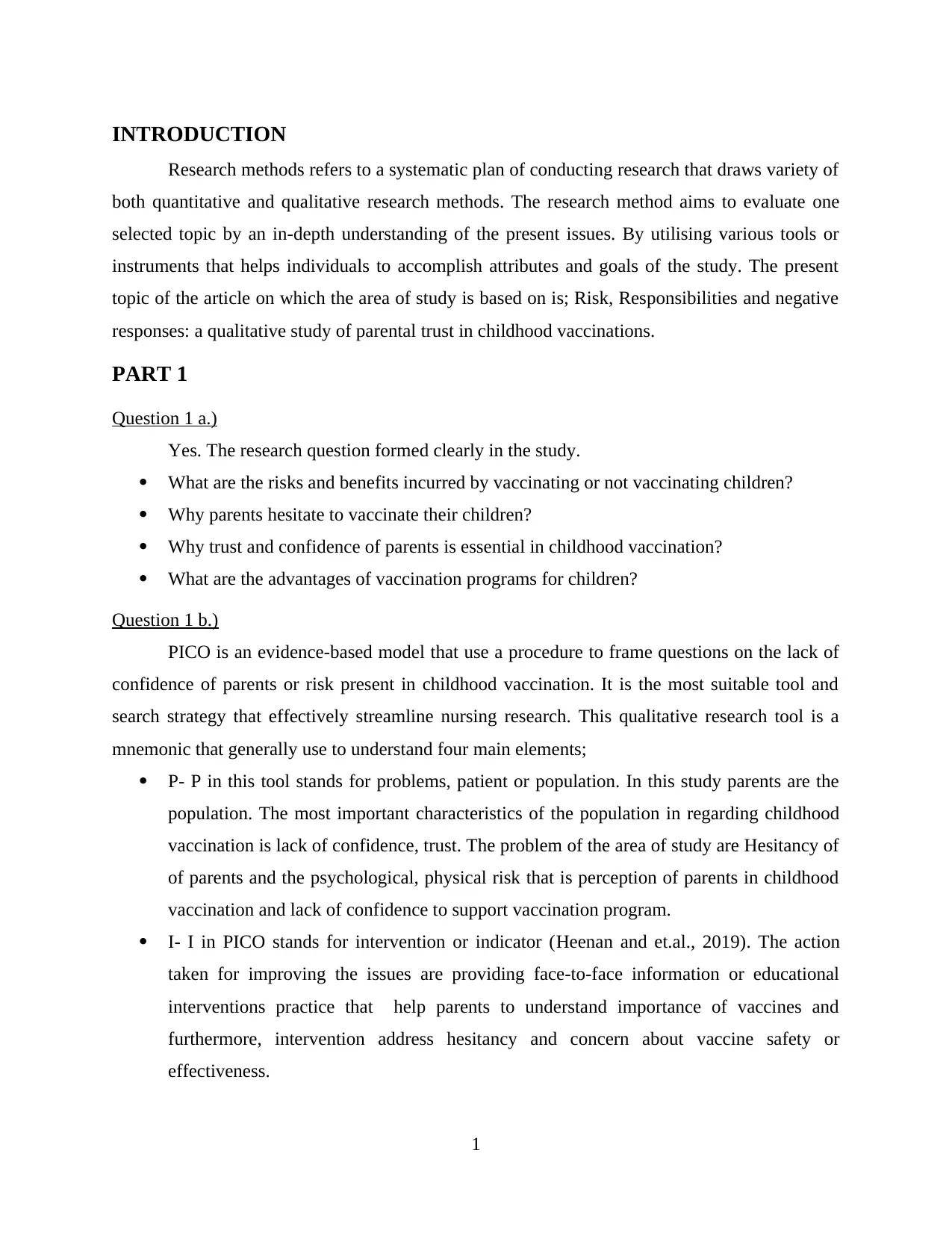
INTRODUCTION
Research methods refers to a systematic plan of conducting research that draws variety of
both quantitative and qualitative research methods. The research method aims to evaluate one
selected topic by an in-depth understanding of the present issues. By utilising various tools or
instruments that helps individuals to accomplish attributes and goals of the study. The present
topic of the article on which the area of study is based on is; Risk, Responsibilities and negative
responses: a qualitative study of parental trust in childhood vaccinations.
PART 1
Question 1 a.)
Yes. The research question formed clearly in the study.
What are the risks and benefits incurred by vaccinating or not vaccinating children?
Why parents hesitate to vaccinate their children?
Why trust and confidence of parents is essential in childhood vaccination?
What are the advantages of vaccination programs for children?
Question 1 b.)
PICO is an evidence-based model that use a procedure to frame questions on the lack of
confidence of parents or risk present in childhood vaccination. It is the most suitable tool and
search strategy that effectively streamline nursing research. This qualitative research tool is a
mnemonic that generally use to understand four main elements;
P- P in this tool stands for problems, patient or population. In this study parents are the
population. The most important characteristics of the population in regarding childhood
vaccination is lack of confidence, trust. The problem of the area of study are Hesitancy of
of parents and the psychological, physical risk that is perception of parents in childhood
vaccination and lack of confidence to support vaccination program.
I- I in PICO stands for intervention or indicator (Heenan and et.al., 2019). The action
taken for improving the issues are providing face-to-face information or educational
interventions practice that help parents to understand importance of vaccines and
furthermore, intervention address hesitancy and concern about vaccine safety or
effectiveness.
1
Research methods refers to a systematic plan of conducting research that draws variety of
both quantitative and qualitative research methods. The research method aims to evaluate one
selected topic by an in-depth understanding of the present issues. By utilising various tools or
instruments that helps individuals to accomplish attributes and goals of the study. The present
topic of the article on which the area of study is based on is; Risk, Responsibilities and negative
responses: a qualitative study of parental trust in childhood vaccinations.
PART 1
Question 1 a.)
Yes. The research question formed clearly in the study.
What are the risks and benefits incurred by vaccinating or not vaccinating children?
Why parents hesitate to vaccinate their children?
Why trust and confidence of parents is essential in childhood vaccination?
What are the advantages of vaccination programs for children?
Question 1 b.)
PICO is an evidence-based model that use a procedure to frame questions on the lack of
confidence of parents or risk present in childhood vaccination. It is the most suitable tool and
search strategy that effectively streamline nursing research. This qualitative research tool is a
mnemonic that generally use to understand four main elements;
P- P in this tool stands for problems, patient or population. In this study parents are the
population. The most important characteristics of the population in regarding childhood
vaccination is lack of confidence, trust. The problem of the area of study are Hesitancy of
of parents and the psychological, physical risk that is perception of parents in childhood
vaccination and lack of confidence to support vaccination program.
I- I in PICO stands for intervention or indicator (Heenan and et.al., 2019). The action
taken for improving the issues are providing face-to-face information or educational
interventions practice that help parents to understand importance of vaccines and
furthermore, intervention address hesitancy and concern about vaccine safety or
effectiveness.
1
Paraphrase This Document
Need a fresh take? Get an instant paraphrase of this document with our AI Paraphraser
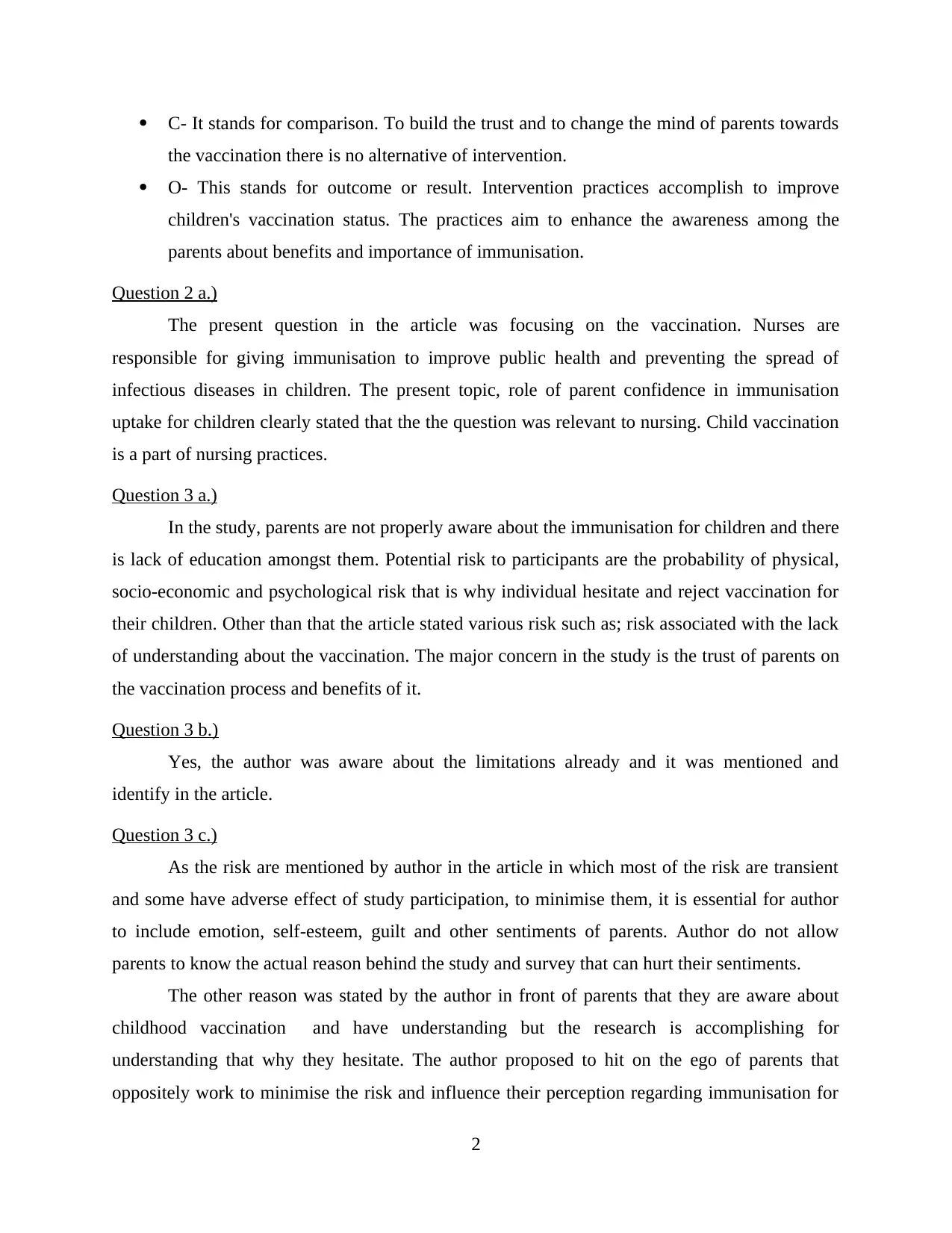
C- It stands for comparison. To build the trust and to change the mind of parents towards
the vaccination there is no alternative of intervention.
O- This stands for outcome or result. Intervention practices accomplish to improve
children's vaccination status. The practices aim to enhance the awareness among the
parents about benefits and importance of immunisation.
Question 2 a.)
The present question in the article was focusing on the vaccination. Nurses are
responsible for giving immunisation to improve public health and preventing the spread of
infectious diseases in children. The present topic, role of parent confidence in immunisation
uptake for children clearly stated that the the question was relevant to nursing. Child vaccination
is a part of nursing practices.
Question 3 a.)
In the study, parents are not properly aware about the immunisation for children and there
is lack of education amongst them. Potential risk to participants are the probability of physical,
socio-economic and psychological risk that is why individual hesitate and reject vaccination for
their children. Other than that the article stated various risk such as; risk associated with the lack
of understanding about the vaccination. The major concern in the study is the trust of parents on
the vaccination process and benefits of it.
Question 3 b.)
Yes, the author was aware about the limitations already and it was mentioned and
identify in the article.
Question 3 c.)
As the risk are mentioned by author in the article in which most of the risk are transient
and some have adverse effect of study participation, to minimise them, it is essential for author
to include emotion, self-esteem, guilt and other sentiments of parents. Author do not allow
parents to know the actual reason behind the study and survey that can hurt their sentiments.
The other reason was stated by the author in front of parents that they are aware about
childhood vaccination and have understanding but the research is accomplishing for
understanding that why they hesitate. The author proposed to hit on the ego of parents that
oppositely work to minimise the risk and influence their perception regarding immunisation for
2
the vaccination there is no alternative of intervention.
O- This stands for outcome or result. Intervention practices accomplish to improve
children's vaccination status. The practices aim to enhance the awareness among the
parents about benefits and importance of immunisation.
Question 2 a.)
The present question in the article was focusing on the vaccination. Nurses are
responsible for giving immunisation to improve public health and preventing the spread of
infectious diseases in children. The present topic, role of parent confidence in immunisation
uptake for children clearly stated that the the question was relevant to nursing. Child vaccination
is a part of nursing practices.
Question 3 a.)
In the study, parents are not properly aware about the immunisation for children and there
is lack of education amongst them. Potential risk to participants are the probability of physical,
socio-economic and psychological risk that is why individual hesitate and reject vaccination for
their children. Other than that the article stated various risk such as; risk associated with the lack
of understanding about the vaccination. The major concern in the study is the trust of parents on
the vaccination process and benefits of it.
Question 3 b.)
Yes, the author was aware about the limitations already and it was mentioned and
identify in the article.
Question 3 c.)
As the risk are mentioned by author in the article in which most of the risk are transient
and some have adverse effect of study participation, to minimise them, it is essential for author
to include emotion, self-esteem, guilt and other sentiments of parents. Author do not allow
parents to know the actual reason behind the study and survey that can hurt their sentiments.
The other reason was stated by the author in front of parents that they are aware about
childhood vaccination and have understanding but the research is accomplishing for
understanding that why they hesitate. The author proposed to hit on the ego of parents that
oppositely work to minimise the risk and influence their perception regarding immunisation for
2
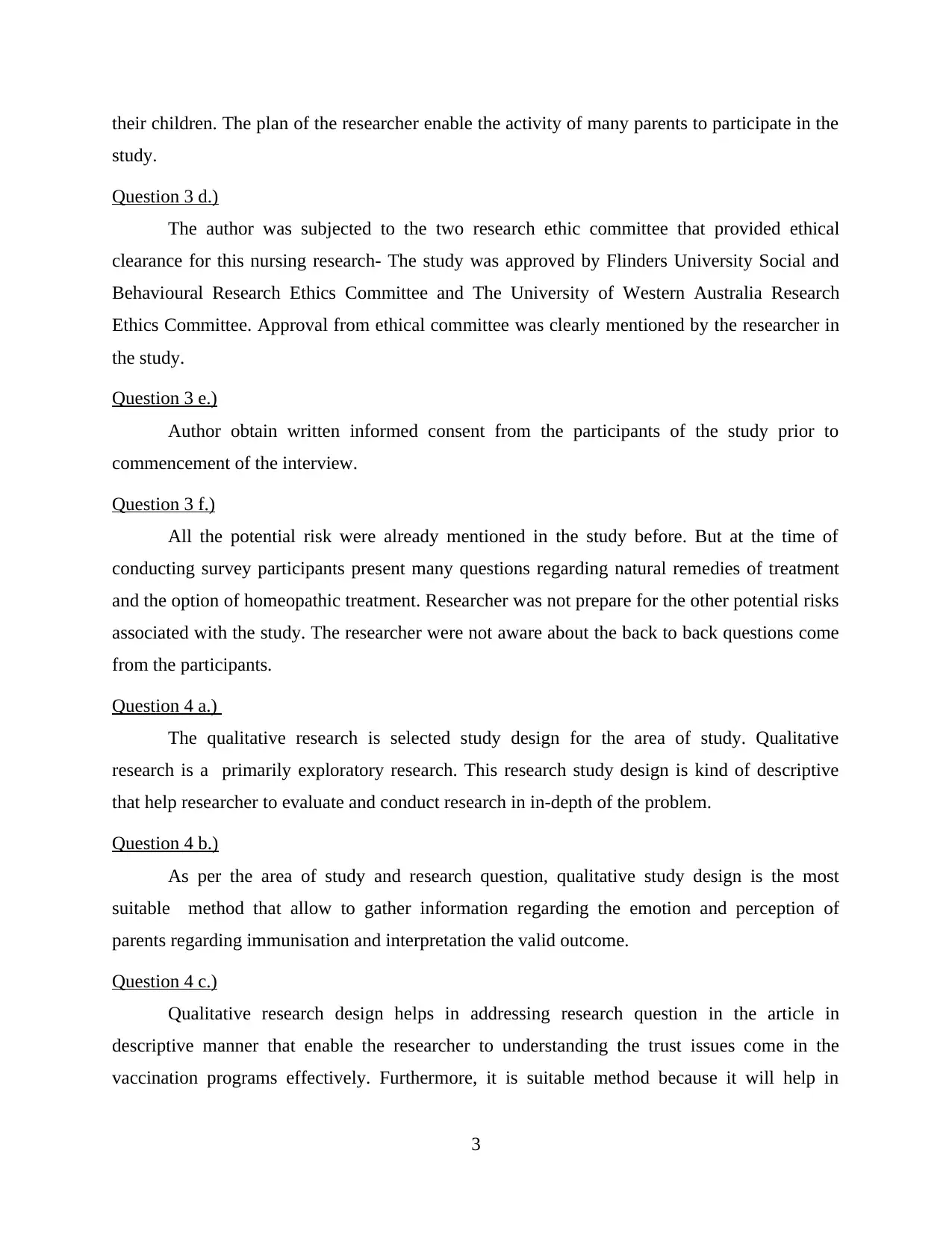
their children. The plan of the researcher enable the activity of many parents to participate in the
study.
Question 3 d.)
The author was subjected to the two research ethic committee that provided ethical
clearance for this nursing research- The study was approved by Flinders University Social and
Behavioural Research Ethics Committee and The University of Western Australia Research
Ethics Committee. Approval from ethical committee was clearly mentioned by the researcher in
the study.
Question 3 e.)
Author obtain written informed consent from the participants of the study prior to
commencement of the interview.
Question 3 f.)
All the potential risk were already mentioned in the study before. But at the time of
conducting survey participants present many questions regarding natural remedies of treatment
and the option of homeopathic treatment. Researcher was not prepare for the other potential risks
associated with the study. The researcher were not aware about the back to back questions come
from the participants.
Question 4 a.)
The qualitative research is selected study design for the area of study. Qualitative
research is a primarily exploratory research. This research study design is kind of descriptive
that help researcher to evaluate and conduct research in in-depth of the problem.
Question 4 b.)
As per the area of study and research question, qualitative study design is the most
suitable method that allow to gather information regarding the emotion and perception of
parents regarding immunisation and interpretation the valid outcome.
Question 4 c.)
Qualitative research design helps in addressing research question in the article in
descriptive manner that enable the researcher to understanding the trust issues come in the
vaccination programs effectively. Furthermore, it is suitable method because it will help in
3
study.
Question 3 d.)
The author was subjected to the two research ethic committee that provided ethical
clearance for this nursing research- The study was approved by Flinders University Social and
Behavioural Research Ethics Committee and The University of Western Australia Research
Ethics Committee. Approval from ethical committee was clearly mentioned by the researcher in
the study.
Question 3 e.)
Author obtain written informed consent from the participants of the study prior to
commencement of the interview.
Question 3 f.)
All the potential risk were already mentioned in the study before. But at the time of
conducting survey participants present many questions regarding natural remedies of treatment
and the option of homeopathic treatment. Researcher was not prepare for the other potential risks
associated with the study. The researcher were not aware about the back to back questions come
from the participants.
Question 4 a.)
The qualitative research is selected study design for the area of study. Qualitative
research is a primarily exploratory research. This research study design is kind of descriptive
that help researcher to evaluate and conduct research in in-depth of the problem.
Question 4 b.)
As per the area of study and research question, qualitative study design is the most
suitable method that allow to gather information regarding the emotion and perception of
parents regarding immunisation and interpretation the valid outcome.
Question 4 c.)
Qualitative research design helps in addressing research question in the article in
descriptive manner that enable the researcher to understanding the trust issues come in the
vaccination programs effectively. Furthermore, it is suitable method because it will help in
3
⊘ This is a preview!⊘
Do you want full access?
Subscribe today to unlock all pages.
Trusted by 1+ million students worldwide
understanding the emotion and perception of parents regarding childhood vaccination. Thus, the
chosen study design i.e. qualitative method is suitable for the given research questions.
Question 5 a.)
In total, 29 parents were included in the study as participants and are selected for the
interview.
Question 5 b.)
All the participants are selected from various part of Australia. 9 are from Fremantle and
20 are from Adelaide. The majority of participants in the study were women. Participants those
have children of the age of 1 month to 10 years are subjected by the researcher in the inclusion
criteria and they are selected because they were delay vaccinating. Parents are must included by
the researcher but those do not have children are not included in the study.
Question 5 c.)
The participants were chosen by the researcher on the basis of their previous activity on
childhood vaccination. Parents who had not vaccinated, partially vaccinated or delayed some
vaccination for their children were recruited for the study. They were recruited through
advertisement. Some of the participants were recruited through snowball sampling.
Question 5 d.)
The research were took place in Fremantle, Western Australia and Adelaide, South
Australia.
Question 6 a.)
The intervention practices were conducted by the researcher through face to face and in-
depth interview with the participants. In-depth interviews help the researcher to understand the
perception of parents effectively.
Question 6 b.)
The analysis done by researcher by the interview identify specific construction of risk
and responsibilities. The researcher stated that there are no alternatives of intervention as this is
related to the emotion of the parents regarding their children.
4
chosen study design i.e. qualitative method is suitable for the given research questions.
Question 5 a.)
In total, 29 parents were included in the study as participants and are selected for the
interview.
Question 5 b.)
All the participants are selected from various part of Australia. 9 are from Fremantle and
20 are from Adelaide. The majority of participants in the study were women. Participants those
have children of the age of 1 month to 10 years are subjected by the researcher in the inclusion
criteria and they are selected because they were delay vaccinating. Parents are must included by
the researcher but those do not have children are not included in the study.
Question 5 c.)
The participants were chosen by the researcher on the basis of their previous activity on
childhood vaccination. Parents who had not vaccinated, partially vaccinated or delayed some
vaccination for their children were recruited for the study. They were recruited through
advertisement. Some of the participants were recruited through snowball sampling.
Question 5 d.)
The research were took place in Fremantle, Western Australia and Adelaide, South
Australia.
Question 6 a.)
The intervention practices were conducted by the researcher through face to face and in-
depth interview with the participants. In-depth interviews help the researcher to understand the
perception of parents effectively.
Question 6 b.)
The analysis done by researcher by the interview identify specific construction of risk
and responsibilities. The researcher stated that there are no alternatives of intervention as this is
related to the emotion of the parents regarding their children.
4
Paraphrase This Document
Need a fresh take? Get an instant paraphrase of this document with our AI Paraphraser
Question 6 c.)
Yes, the intervention was mentioned and described in the study by researcher and in
practice it could be replicated.
Question 6 d.)
Parents are denied partially or fully vaccination for their children and they are constantly
identify the alternatives for this option. The researcher provide correct information on vaccines
improve knowledge and understanding but it does not improve intent to vaccinate.
Question 6 e.)
The main method used by the researcher to collect information and the perception of
parents was in-depth interview with parents who have baby from the age of one month to 6 years
old. The parents are selected in the study are mainly from 24-50 age group and most of them are
women. Interview help the researcher to get insight of the mind of participants and their
perception regarding vaccination.
Question 7 a.)
The study is based on qualitative research and aim to evaluate parental trust in childhood
vaccination. The research will help in promoting parental engagement. By reviewing various
articles it has been analysed that the level of hesitation of parents in childhood vaccination is
high because of risk of trauma to their children. The study find an understanding of socio-
economic, physical and psychological risk occurs in parents perception. There is some
drawbacks of the vaccination process such as; fever, pain, etc. but immunisation is important. It
is concluded that hesitation of immunisation is a high reason of delay.
Question 8 a.)
Author faced a lot of limitation in the study. The level of perception of parents to
participate in the study. The study aim to the understanding of the parental decision making and
rationalities. The contextual difference are the limitation stated by the author on the study (Hull
and McIntyre, 2016).
Question 8 b.)
These are potential limitation in the study because the study is based on the parents who
have children and if their decision making and rationalities regarding vaccination is not so
improved it can result as various health issues for the children.
5
Yes, the intervention was mentioned and described in the study by researcher and in
practice it could be replicated.
Question 6 d.)
Parents are denied partially or fully vaccination for their children and they are constantly
identify the alternatives for this option. The researcher provide correct information on vaccines
improve knowledge and understanding but it does not improve intent to vaccinate.
Question 6 e.)
The main method used by the researcher to collect information and the perception of
parents was in-depth interview with parents who have baby from the age of one month to 6 years
old. The parents are selected in the study are mainly from 24-50 age group and most of them are
women. Interview help the researcher to get insight of the mind of participants and their
perception regarding vaccination.
Question 7 a.)
The study is based on qualitative research and aim to evaluate parental trust in childhood
vaccination. The research will help in promoting parental engagement. By reviewing various
articles it has been analysed that the level of hesitation of parents in childhood vaccination is
high because of risk of trauma to their children. The study find an understanding of socio-
economic, physical and psychological risk occurs in parents perception. There is some
drawbacks of the vaccination process such as; fever, pain, etc. but immunisation is important. It
is concluded that hesitation of immunisation is a high reason of delay.
Question 8 a.)
Author faced a lot of limitation in the study. The level of perception of parents to
participate in the study. The study aim to the understanding of the parental decision making and
rationalities. The contextual difference are the limitation stated by the author on the study (Hull
and McIntyre, 2016).
Question 8 b.)
These are potential limitation in the study because the study is based on the parents who
have children and if their decision making and rationalities regarding vaccination is not so
improved it can result as various health issues for the children.
5
Question 9 a.)
In accordance to the level of evidence pyramid, the risk parents are willing to accept the
responsibility and blame. The evidence are stated by the researcher is that parents are reject
vaccination. The outcome present from the study that parents are avoiding vaccination or
partially abstain from vaccinating their children.
Question 9 b.)
The researcher aim to use this outcome in informing evidence-based learning. The result
of the study should used for the community so that every one can aware of the situation present
in the society.
Question 9 c.)
The reason to respond to the research question is that participants are ignoring and
keeping their children away from vaccination. In the study parents had either partially or fully
rejected vaccination for their children.
PART 2
Reflection
I had a little knowledge about the concept of immunisation safety for the children. The
immunisation refers to a process or the series of steps wherein the person is made resistant or
immune to the infectious disease with the help of the vaccinations. These vaccines stimulate the
body immune system to protect the person against the infection or the disease. I learnt that
immunisation is a proven tool for eliminating and controlling the life dangering and threatening
and infectious diseases. But with the help of the research I learnt more about the immunisation
like it is the most cost effective health investment with proven strategies which make it
accessible and to reach large population. I also learnt that immunisation helps in preventing the
disability, death or illness with help of vaccines to prevent the diseases like diphtheria, hepatitis
B, cervical cancer, measles etc. Vaccines are very safe and effective measure of curing the
diseases because by giving the vaccines it can prevent serious diseases and keeps the people
healthy and safe including the children.
I got the information and knowledge regarding the research topic with the help of the
newspapers and the magazines which publishes the data regarding the use of vaccinations for
immunising the children. According to Thomas, 2018, immunisation is the process by which an
6
In accordance to the level of evidence pyramid, the risk parents are willing to accept the
responsibility and blame. The evidence are stated by the researcher is that parents are reject
vaccination. The outcome present from the study that parents are avoiding vaccination or
partially abstain from vaccinating their children.
Question 9 b.)
The researcher aim to use this outcome in informing evidence-based learning. The result
of the study should used for the community so that every one can aware of the situation present
in the society.
Question 9 c.)
The reason to respond to the research question is that participants are ignoring and
keeping their children away from vaccination. In the study parents had either partially or fully
rejected vaccination for their children.
PART 2
Reflection
I had a little knowledge about the concept of immunisation safety for the children. The
immunisation refers to a process or the series of steps wherein the person is made resistant or
immune to the infectious disease with the help of the vaccinations. These vaccines stimulate the
body immune system to protect the person against the infection or the disease. I learnt that
immunisation is a proven tool for eliminating and controlling the life dangering and threatening
and infectious diseases. But with the help of the research I learnt more about the immunisation
like it is the most cost effective health investment with proven strategies which make it
accessible and to reach large population. I also learnt that immunisation helps in preventing the
disability, death or illness with help of vaccines to prevent the diseases like diphtheria, hepatitis
B, cervical cancer, measles etc. Vaccines are very safe and effective measure of curing the
diseases because by giving the vaccines it can prevent serious diseases and keeps the people
healthy and safe including the children.
I got the information and knowledge regarding the research topic with the help of the
newspapers and the magazines which publishes the data regarding the use of vaccinations for
immunising the children. According to Thomas, 2018, immunisation is the process by which an
6
⊘ This is a preview!⊘
Do you want full access?
Subscribe today to unlock all pages.
Trusted by 1+ million students worldwide
individual gets its body immune to fight for the diseases. With the help of the journal study I
came to know that the most important elements or components of the immune system are T cells,
B cells and antibodies. In the words of Hull and McIntyre, 2006 I got knowledge that
immunisation can be done in two ways that is active and passive immunisation form an article
from the government records. From a journal on importance of vaccination I came to know that
all the vaccines are regularly reviewed and samples of these vaccines are time to time tested by
the doctors, health care professional and scientists to ensure the good quality and applicability of
the vaccines.
Yes I have more concern about the safety and importance of the immunisation for the
children. But many people have misconception that if the child will not be immune then it may
suffer with lot of diseases and even may die in some exceptional situation. But the main reason
of giving vaccinations to the children is to make them strong from inside so that they are able to
face the disease if occur in future. Once the vaccination is given to a child then its body fights
against the diseases more strongly as compared to a child which is not provided with the
vaccination. Also if the person or child is not vaccinated then he has more chance or potential of
catching the disease and getting ill. According to Menzies and Andrews, 2014, the national
immunisation program suggest that some vaccinations must be given to the child at a specific
time only. It is recommended by these schedules that there should not be any delay in
immunising the child because the diseases can harm the child very badly.
In the research I go through the pros and cons of the vaccination for children. In that time
I got to know about the safety of immunisation for children. Before the learning I used to think
that there are some risk and side-effects, but they are for a short period of time. But it is essential
for parents to provide immunisation to their children in order to prevent them from infectious
disease. The learning change my perception regarding the safety and importance of
immunisation. Parents are responsible for preventing their children before entering into the
community.
According to Mohammed, H. and et.al., 2018 it has analysed that maternal immunization
is the best and an effective strategy in order to protect pregnant women and their babies from
vaccines preventable diseases. It also has shown the timing of immunization and their
importance. Pertussis vaccination seven days before delivery has various positive impacts on
infants and pregnant ladies as it prevents them up to 91% of pertussis disease. According to
7
came to know that the most important elements or components of the immune system are T cells,
B cells and antibodies. In the words of Hull and McIntyre, 2006 I got knowledge that
immunisation can be done in two ways that is active and passive immunisation form an article
from the government records. From a journal on importance of vaccination I came to know that
all the vaccines are regularly reviewed and samples of these vaccines are time to time tested by
the doctors, health care professional and scientists to ensure the good quality and applicability of
the vaccines.
Yes I have more concern about the safety and importance of the immunisation for the
children. But many people have misconception that if the child will not be immune then it may
suffer with lot of diseases and even may die in some exceptional situation. But the main reason
of giving vaccinations to the children is to make them strong from inside so that they are able to
face the disease if occur in future. Once the vaccination is given to a child then its body fights
against the diseases more strongly as compared to a child which is not provided with the
vaccination. Also if the person or child is not vaccinated then he has more chance or potential of
catching the disease and getting ill. According to Menzies and Andrews, 2014, the national
immunisation program suggest that some vaccinations must be given to the child at a specific
time only. It is recommended by these schedules that there should not be any delay in
immunising the child because the diseases can harm the child very badly.
In the research I go through the pros and cons of the vaccination for children. In that time
I got to know about the safety of immunisation for children. Before the learning I used to think
that there are some risk and side-effects, but they are for a short period of time. But it is essential
for parents to provide immunisation to their children in order to prevent them from infectious
disease. The learning change my perception regarding the safety and importance of
immunisation. Parents are responsible for preventing their children before entering into the
community.
According to Mohammed, H. and et.al., 2018 it has analysed that maternal immunization
is the best and an effective strategy in order to protect pregnant women and their babies from
vaccines preventable diseases. It also has shown the timing of immunization and their
importance. Pertussis vaccination seven days before delivery has various positive impacts on
infants and pregnant ladies as it prevents them up to 91% of pertussis disease. According to
7
Paraphrase This Document
Need a fresh take? Get an instant paraphrase of this document with our AI Paraphraser
Requejo, J.H. And et.al., 2015 I have known that immunisation protects unborn baby from
various diseases like diphtheria, tetanus, mumps, chickenpox and many more. It also cause
serious side effects like it can be effect heart, eyes, ears and even brain of a baby and also can
increase the risk of stillbirth & miscarriage. From the study I learned many things that I came to
know about the importance of immunization. It protects not only pregnant women but also their
babies from serious diseases. It has increased my knowledge about immunisation and
vaccination. I have learned about different infections that happens by avoiding different types of
vaccinations.
I was alert about immunisation practice and the concern regarding its safety but the studies
helped me in enhancing my knowledge on the perception of parents on immunisation that is
essential in the medical practice. As per the learning from my personal experience I feel believe,
understanding and trust of parents in medication practices plays a crucial role in influencing
individual opinion over vaccination for which I feel promoting health by organising health care
programmes and campaigns for free will help in encouraging parents involvement in
immunisation which will support in influencing individual beliefs over vaccination practice.
CONCLUSION
The present study concluded the role of parents in vaccination of children that is missing
due to hesitation, trust and confidence. The present study outlines various articles over the risk,
responsibility and safety for vaccination.
8
various diseases like diphtheria, tetanus, mumps, chickenpox and many more. It also cause
serious side effects like it can be effect heart, eyes, ears and even brain of a baby and also can
increase the risk of stillbirth & miscarriage. From the study I learned many things that I came to
know about the importance of immunization. It protects not only pregnant women but also their
babies from serious diseases. It has increased my knowledge about immunisation and
vaccination. I have learned about different infections that happens by avoiding different types of
vaccinations.
I was alert about immunisation practice and the concern regarding its safety but the studies
helped me in enhancing my knowledge on the perception of parents on immunisation that is
essential in the medical practice. As per the learning from my personal experience I feel believe,
understanding and trust of parents in medication practices plays a crucial role in influencing
individual opinion over vaccination for which I feel promoting health by organising health care
programmes and campaigns for free will help in encouraging parents involvement in
immunisation which will support in influencing individual beliefs over vaccination practice.
CONCLUSION
The present study concluded the role of parents in vaccination of children that is missing
due to hesitation, trust and confidence. The present study outlines various articles over the risk,
responsibility and safety for vaccination.
8
REFERENCES
Books and Journals
Heenan, R. C. and et.al., 2019. ‘I think we've had a health screen’: New offshore screening, new
refugee health guidelines, new Syrian and Iraqi cohorts: Recommendations, reality,
results and review. Journal of paediatrics and child health. 55(1). pp.95-103.
Hull, B.P. and McIntyre, P.B., 2016. Timeliness of childhood immunisation in
Australia. Vaccine. 24(20). pp.4403-4408.
Menzies, R. and Andrews, R., 2014. Immunisation issues for Indigenous Australian
children. Journal of paediatrics and child health. 50(10). pp.E21-E25.
Mohammed, H. and et. al., 2018. Factors associated with uptake of influenza and pertussis
vaccines among pregnant women in South Australia. PloS one. 13(6). p.e0197867.
Requejo, J.H. And et. al., 2015. Countdown to 2015 and beyond: fulfilling the health agenda for
women and children. The Lancet. 385(9966). pp.466-476.
Thomas, G., 2018. A cost-benefit analysis of the immunisation of children against respiratory
syncytial virus (RSV) using the English Hospital Episode Statistics (HES) data set. The
European Journal of Health Economics. 19(2). pp.177-187.
9
Books and Journals
Heenan, R. C. and et.al., 2019. ‘I think we've had a health screen’: New offshore screening, new
refugee health guidelines, new Syrian and Iraqi cohorts: Recommendations, reality,
results and review. Journal of paediatrics and child health. 55(1). pp.95-103.
Hull, B.P. and McIntyre, P.B., 2016. Timeliness of childhood immunisation in
Australia. Vaccine. 24(20). pp.4403-4408.
Menzies, R. and Andrews, R., 2014. Immunisation issues for Indigenous Australian
children. Journal of paediatrics and child health. 50(10). pp.E21-E25.
Mohammed, H. and et. al., 2018. Factors associated with uptake of influenza and pertussis
vaccines among pregnant women in South Australia. PloS one. 13(6). p.e0197867.
Requejo, J.H. And et. al., 2015. Countdown to 2015 and beyond: fulfilling the health agenda for
women and children. The Lancet. 385(9966). pp.466-476.
Thomas, G., 2018. A cost-benefit analysis of the immunisation of children against respiratory
syncytial virus (RSV) using the English Hospital Episode Statistics (HES) data set. The
European Journal of Health Economics. 19(2). pp.177-187.
9
⊘ This is a preview!⊘
Do you want full access?
Subscribe today to unlock all pages.
Trusted by 1+ million students worldwide

1 out of 12


Related Documents


Your All-in-One AI-Powered Toolkit for Academic Success.
+13062052269
info@desklib.com
Available 24*7 on WhatsApp / Email
![[object Object]](/_next/static/media/star-bottom.7253800d.svg)
Unlock your academic potential
Copyright © 2020–2026 A2Z Services. All Rights Reserved. Developed and managed by ZUCOL.