Parramatta Health Services: A Detailed Population Needs Report
VerifiedAdded on 2023/06/04
|8
|1844
|238
Report
AI Summary
This report assesses the health service needs in Parramatta, Australia, focusing on the impact of the socio-economic index (SEIFA) on the area's health services. Despite a high SEIFA score, Parramatta experiences discrepancies in population health outcomes, including high suicide and mortality rates. The report highlights the need for improved healthcare services, especially for the aging population and immigrants, who contribute significantly to the region's economy but also present unique health challenges such as high hepatitis B prevalence and developmental issues in children. It emphasizes the necessity of culturally relevant and accessible healthcare, along with a comprehensive data collection and reporting tool to address these gaps and improve the overall health and well-being of the Parramatta community, calling for a holistic approach that integrates medical and mental health services.
Running head: PARRAMATTA HEALTH SERVICES NEEDS ASSESSMENT
Parramatta Health Services Needs Assessment
Name
Institution
Parramatta Health Services Needs Assessment
Name
Institution
Paraphrase This Document
Need a fresh take? Get an instant paraphrase of this document with our AI Paraphraser

PARRAMATTA HEALTH SERVICES NEEDS ASSESSMENT
The socio-economic index (SEIFA) is a great determinant of the standard of living of
people in Australian local government areas, and it is set at 1000. Thereby, a local
government area with a SEIFA that is below 1000 means that it is socio-economically
disadvantaged while the converse is also true. The local government area of Parramatta has
improved its SEIFA since 2011, which subsequently has an effect on all the dimensions of
life of its people. The current paper is a discussion of how the high SEIFA impacts on
Parramatta’s heath service.
It is important to understand the population structure in relation to the SEIFA scores
because it helps to understand the state of health within an area. In Parramatta, there are
discrepancies in the SEIFA scores and the population’s health outcomes because in an area
with a SEIFA score is above 1000, it is expected that the people would be healthy with high
productivity and low mortality rates. However, the high suicide rates and high mortality rates
state otherwise (Australian Government, 2016). Despite the fact that the population is
projected to increase in coming years, the increase declines across the lifespan even though
there is a high population of individuals in their productive ages, indicating that there are a lot
of immigrants.
The indicators of population health, which include life expectancy and the mortality
rate of children below five years as indicated by Lange and Vollmer (2017) show that there is
more that needs to be done in Parramatta. Better income, a high life expectancy and
consumption of nutritious food should are all meant to result in good health and a high
population of the elderly population. On a different note, there is need to understand the
association between a stable economy and health behavior in reference to drug and substance
use, which remains a reason for high of the preventable deaths in the region. Also, it could be
the reason for the high suicide rates in Parramatta. Such a phenomenon further justifies the
The socio-economic index (SEIFA) is a great determinant of the standard of living of
people in Australian local government areas, and it is set at 1000. Thereby, a local
government area with a SEIFA that is below 1000 means that it is socio-economically
disadvantaged while the converse is also true. The local government area of Parramatta has
improved its SEIFA since 2011, which subsequently has an effect on all the dimensions of
life of its people. The current paper is a discussion of how the high SEIFA impacts on
Parramatta’s heath service.
It is important to understand the population structure in relation to the SEIFA scores
because it helps to understand the state of health within an area. In Parramatta, there are
discrepancies in the SEIFA scores and the population’s health outcomes because in an area
with a SEIFA score is above 1000, it is expected that the people would be healthy with high
productivity and low mortality rates. However, the high suicide rates and high mortality rates
state otherwise (Australian Government, 2016). Despite the fact that the population is
projected to increase in coming years, the increase declines across the lifespan even though
there is a high population of individuals in their productive ages, indicating that there are a lot
of immigrants.
The indicators of population health, which include life expectancy and the mortality
rate of children below five years as indicated by Lange and Vollmer (2017) show that there is
more that needs to be done in Parramatta. Better income, a high life expectancy and
consumption of nutritious food should are all meant to result in good health and a high
population of the elderly population. On a different note, there is need to understand the
association between a stable economy and health behavior in reference to drug and substance
use, which remains a reason for high of the preventable deaths in the region. Also, it could be
the reason for the high suicide rates in Parramatta. Such a phenomenon further justifies the

PARRAMATTA HEALTH SERVICES NEEDS ASSESSMENT
need for promotional health campaigns and integration of medical services with mental health
care services so that individuals to address people’s both medical and mental health needs.
A high SEIFA means that most of the area’s people are employed in medium to high
skilled occupations with good pay and that most of the people are well-educated (“City of
Parramatta,” 2018). These findings are congruent with the fact that Parramatta has a high life-
expectancy, which means that there is need for the healthcare facilities to align their services
to the needs of this special population that is susceptible to chronic ailments (“People and
neighborhood,” n. d.). Available literature shows that around 48% of individuals in
Parramatta are physically active, but there is limited data to indicate the prevalence of
overweight/obesity in the region. Thereby, there is need for a reliable health reporting tool
within the region because data on health is integrated within the larger Western Sydney
region. Nonetheless, the fact that the older population is the smallest indicates there is a great
need for the healthcare system in Parramatta to align its services to addressing the risk factors
of chronic diseases as well as improve the quality of life of the elderly.
A community profile of Parramatta indicates that women can live up to 82 years while
men can live up to 77 years; thereby, it would be expected that Parramatta has a high elderly
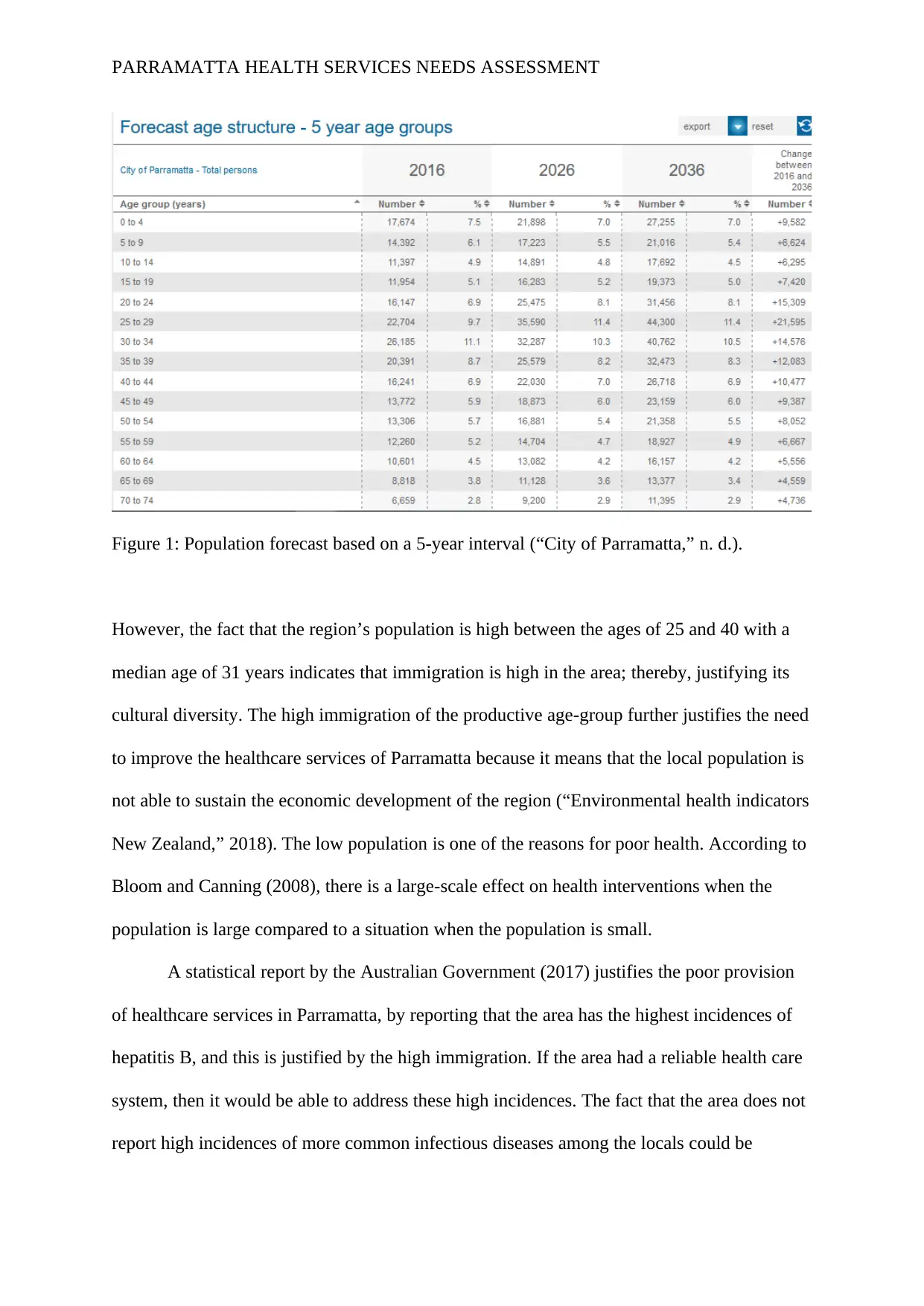
population (“City of Parramatta,” n. d,). Unfortunately, the converse is the case; thereby, it
means there is need to improve the healthcare system to reduce the high mortality that can be
predicted from the figure below. The figure shows a decline in the population on the basis of
age.
need for promotional health campaigns and integration of medical services with mental health
care services so that individuals to address people’s both medical and mental health needs.
A high SEIFA means that most of the area’s people are employed in medium to high
skilled occupations with good pay and that most of the people are well-educated (“City of
Parramatta,” 2018). These findings are congruent with the fact that Parramatta has a high life-
expectancy, which means that there is need for the healthcare facilities to align their services
to the needs of this special population that is susceptible to chronic ailments (“People and
neighborhood,” n. d.). Available literature shows that around 48% of individuals in
Parramatta are physically active, but there is limited data to indicate the prevalence of
overweight/obesity in the region. Thereby, there is need for a reliable health reporting tool
within the region because data on health is integrated within the larger Western Sydney
region. Nonetheless, the fact that the older population is the smallest indicates there is a great
need for the healthcare system in Parramatta to align its services to addressing the risk factors
of chronic diseases as well as improve the quality of life of the elderly.
A community profile of Parramatta indicates that women can live up to 82 years while
men can live up to 77 years; thereby, it would be expected that Parramatta has a high elderly
population (“City of Parramatta,” n. d,). Unfortunately, the converse is the case; thereby, it
means there is need to improve the healthcare system to reduce the high mortality that can be
predicted from the figure below. The figure shows a decline in the population on the basis of
age.
⊘ This is a preview!⊘
Do you want full access?
Subscribe today to unlock all pages.

Trusted by 1+ million students worldwide

PARRAMATTA HEALTH SERVICES NEEDS ASSESSMENT
Figure 1: Population forecast based on a 5-year interval (“City of Parramatta,” n. d.).
However, the fact that the region’s population is high between the ages of 25 and 40 with a
median age of 31 years indicates that immigration is high in the area; thereby, justifying its
cultural diversity. The high immigration of the productive age-group further justifies the need
to improve the healthcare services of Parramatta because it means that the local population is
not able to sustain the economic development of the region (“Environmental health indicators
New Zealand,” 2018). The low population is one of the reasons for poor health. According to
Bloom and Canning (2008), there is a large-scale effect on health interventions when the
population is large compared to a situation when the population is small.
A statistical report by the Australian Government (2017) justifies the poor provision
of healthcare services in Parramatta, by reporting that the area has the highest incidences of
hepatitis B, and this is justified by the high immigration. If the area had a reliable health care
system, then it would be able to address these high incidences. The fact that the area does not
report high incidences of more common infectious diseases among the locals could be
Figure 1: Population forecast based on a 5-year interval (“City of Parramatta,” n. d.).
However, the fact that the region’s population is high between the ages of 25 and 40 with a
median age of 31 years indicates that immigration is high in the area; thereby, justifying its
cultural diversity. The high immigration of the productive age-group further justifies the need
to improve the healthcare services of Parramatta because it means that the local population is
not able to sustain the economic development of the region (“Environmental health indicators
New Zealand,” 2018). The low population is one of the reasons for poor health. According to
Bloom and Canning (2008), there is a large-scale effect on health interventions when the
population is large compared to a situation when the population is small.
A statistical report by the Australian Government (2017) justifies the poor provision
of healthcare services in Parramatta, by reporting that the area has the highest incidences of
hepatitis B, and this is justified by the high immigration. If the area had a reliable health care
system, then it would be able to address these high incidences. The fact that the area does not
report high incidences of more common infectious diseases among the locals could be
Paraphrase This Document
Need a fresh take? Get an instant paraphrase of this document with our AI Paraphraser

PARRAMATTA HEALTH SERVICES NEEDS ASSESSMENT
attributed to the good nutrition that the people in Parramatta embrace. Otherwise, other
indicators as mentioned earlier also indicate that the health care system needs to do more. The
Australian Government (2017) indicates that the high prevalence of hepatitis are in the
suburbs from people emigrating from endemic areas like the Philippines, China, Fiji, and
Vietnam. Also, Parramatta is one of the regions that experiences a high percentage of
children are born with developmental problems, and such children have a low life
expectancy. Thereby, it is apparent that the healthcare system in Parramatta should be
developed to improve health services and develop a reliable health reporting system specific
to the area of Parramatta.
The poor health system is camouflaged by the high SEIFA scores in Parramatta that
misleads individuals to believe that all is well. Yet, the local population is in need of reliable
and quality healthcare services. There is need to ensure that the healthcare facilities are
adequately staffed and provide culturally and friendly services to increase access to
healthcare. In addition, there is need for the healthcare staff to develop innovations that will
help to redress the developmental issues among neonates. In a region that reports economic
success, health indicators should indicate a healthy population to justify the economic
success.
Other than improving the healthcare services, there is need for a comprehensive data
collecting and reporting tool because the available information about Parramatta is
inadequate and with many loopholes. For example, a high life expectancy would be
associated with a large older population, but this is not the case. Also, there is a high suicidal
rate even though the unemployment rate among the youths is lower than that of the country.
Another thing is that there is high neonatal mortality and a high incidence of children born
with developmental problems. Thereby, here is need for the data collection and reporting tool
attributed to the good nutrition that the people in Parramatta embrace. Otherwise, other
indicators as mentioned earlier also indicate that the health care system needs to do more. The
Australian Government (2017) indicates that the high prevalence of hepatitis are in the
suburbs from people emigrating from endemic areas like the Philippines, China, Fiji, and
Vietnam. Also, Parramatta is one of the regions that experiences a high percentage of
children are born with developmental problems, and such children have a low life
expectancy. Thereby, it is apparent that the healthcare system in Parramatta should be
developed to improve health services and develop a reliable health reporting system specific
to the area of Parramatta.
The poor health system is camouflaged by the high SEIFA scores in Parramatta that
misleads individuals to believe that all is well. Yet, the local population is in need of reliable
and quality healthcare services. There is need to ensure that the healthcare facilities are
adequately staffed and provide culturally and friendly services to increase access to
healthcare. In addition, there is need for the healthcare staff to develop innovations that will
help to redress the developmental issues among neonates. In a region that reports economic
success, health indicators should indicate a healthy population to justify the economic
success.
Other than improving the healthcare services, there is need for a comprehensive data
collecting and reporting tool because the available information about Parramatta is
inadequate and with many loopholes. For example, a high life expectancy would be
associated with a large older population, but this is not the case. Also, there is a high suicidal
rate even though the unemployment rate among the youths is lower than that of the country.
Another thing is that there is high neonatal mortality and a high incidence of children born
with developmental problems. Thereby, here is need for the data collection and reporting tool

PARRAMATTA HEALTH SERVICES NEEDS ASSESSMENT
so as to inform the healthcare team of the existing problems that can be remedied by
improved healthcare interventions.
Parramatta is gaining recognition as a potential engine room for Australia’s economy,
and the fact that it has been experiencing increases in the SEIFA score is evidence
(Australian Bureau of Statistics, 2018). The financial prospects of the area and it high SEIFA
score leads to its recognition as a socio-economically stable region. However, the fact that
there are inconsistencies in its population distribution is an indication that more attention is
being paid to the economic aspect of the area as opposed to the health sector (“Parramatta
2021,” 2016). Thereby, future reforms and interventions should overlooks this sector that
needs to be supported to enhance innovation and healthcare promotion.
It is apparent that Parramatta’s population profile shows a decline across the lifespan,
suggesting a problem with the healthcare system. Despite the fact that there is limited specific
data about the health care services in Parramatta, there is need to reinforce the existing
healthcare service through increased awareness, healthcare promotional campaigns with
screening services, and culturally relevant services. The health issues that are of utmost
concern are the high mortality rates across the lifespan and due to suicide. Hence, a holistic
approach in improving the healthcare system in Parramatta is needed so that all individuals
can access both medical and mental health services in alignment with the population’s health
needs.
so as to inform the healthcare team of the existing problems that can be remedied by
improved healthcare interventions.
Parramatta is gaining recognition as a potential engine room for Australia’s economy,
and the fact that it has been experiencing increases in the SEIFA score is evidence
(Australian Bureau of Statistics, 2018). The financial prospects of the area and it high SEIFA
score leads to its recognition as a socio-economically stable region. However, the fact that
there are inconsistencies in its population distribution is an indication that more attention is
being paid to the economic aspect of the area as opposed to the health sector (“Parramatta
2021,” 2016). Thereby, future reforms and interventions should overlooks this sector that
needs to be supported to enhance innovation and healthcare promotion.
It is apparent that Parramatta’s population profile shows a decline across the lifespan,
suggesting a problem with the healthcare system. Despite the fact that there is limited specific
data about the health care services in Parramatta, there is need to reinforce the existing
healthcare service through increased awareness, healthcare promotional campaigns with
screening services, and culturally relevant services. The health issues that are of utmost
concern are the high mortality rates across the lifespan and due to suicide. Hence, a holistic
approach in improving the healthcare system in Parramatta is needed so that all individuals
can access both medical and mental health services in alignment with the population’s health
needs.
⊘ This is a preview!⊘
Do you want full access?
Subscribe today to unlock all pages.

Trusted by 1+ million students worldwide

PARRAMATTA HEALTH SERVICES NEEDS ASSESSMENT
References
Australian Bureau of Statistics. (2018). SEIFA by local government area (LFA). Retrieved
from http://stat.data.abs.gov.au/Index.aspx?DataSetCode=ABS_SEIFA_LGA.
Australian Government. (2016). Primary health network needs assessment reporting
template. Retrieved from https://wentwest.com/content/documents/phn/needs-
assessment/PHNneedsassesMar2016.pdf.
Australian Government. (2017). Western Sydney primary health network needs assessment
report-November 2017. Retrieved from
https://www.wentwest.com.au/content/documents/phn/needs-
assessment/MH_Needs_Assessment_DOH.pdf.
Bloom, D. E., & Canning, D. (2008). Population health and economic growth (Working
paper No. 24). Washington, DC: The World Bank.
City of Parramatta: Population and age structure. (n. d.). Retrieved from
https://forecast.id.com.au/parramatta/population-age-structure.
City of Parramatta. (2018). Retrieved from
https://www.communityprofile.com.au/parramatta/wellbeing/seifa#!seifabar;i=0.
Lange, S., & Vollmer, S. (2017). The effect of economic development on population health: a
review of the empirical evidence. British Medical Bulletin, 121(1), 47–60. Doi:
https://doi.org/10.1093/bmb/ldw052.
Environmental health indicators New Zealand: Population size and change. (2018).
Retrieved from http://www.ehinz.ac.nz/indicators/population-
vulnerability/population-size-and-change/.
Parramatta 2021: Unlocking the potential of a new economy. (2016). Retrieved from
http://www.investparramatta.com.au/sites/default/files/2017- 08/Parramatta
%202021.pdf.
References
Australian Bureau of Statistics. (2018). SEIFA by local government area (LFA). Retrieved
from http://stat.data.abs.gov.au/Index.aspx?DataSetCode=ABS_SEIFA_LGA.
Australian Government. (2016). Primary health network needs assessment reporting
template. Retrieved from https://wentwest.com/content/documents/phn/needs-
assessment/PHNneedsassesMar2016.pdf.
Australian Government. (2017). Western Sydney primary health network needs assessment
report-November 2017. Retrieved from
https://www.wentwest.com.au/content/documents/phn/needs-
assessment/MH_Needs_Assessment_DOH.pdf.
Bloom, D. E., & Canning, D. (2008). Population health and economic growth (Working
paper No. 24). Washington, DC: The World Bank.
City of Parramatta: Population and age structure. (n. d.). Retrieved from
https://forecast.id.com.au/parramatta/population-age-structure.
City of Parramatta. (2018). Retrieved from
https://www.communityprofile.com.au/parramatta/wellbeing/seifa#!seifabar;i=0.
Lange, S., & Vollmer, S. (2017). The effect of economic development on population health: a
review of the empirical evidence. British Medical Bulletin, 121(1), 47–60. Doi:
https://doi.org/10.1093/bmb/ldw052.
Environmental health indicators New Zealand: Population size and change. (2018).
Retrieved from http://www.ehinz.ac.nz/indicators/population-
vulnerability/population-size-and-change/.
Parramatta 2021: Unlocking the potential of a new economy. (2016). Retrieved from
http://www.investparramatta.com.au/sites/default/files/2017- 08/Parramatta
%202021.pdf.
Paraphrase This Document
Need a fresh take? Get an instant paraphrase of this document with our AI Paraphraser

PARRAMATTA HEALTH SERVICES NEEDS ASSESSMENT
People and neighborhoods. (n. d.). Retrieved from
https://www.cityofparramatta.nsw.gov.au/sites/council/files/apps/infographics/neighb
ourhood.html.
People and neighborhoods. (n. d.). Retrieved from
https://www.cityofparramatta.nsw.gov.au/sites/council/files/apps/infographics/neighb
ourhood.html.
1 out of 8
Related Documents
Your All-in-One AI-Powered Toolkit for Academic Success.
+13062052269
info@desklib.com
Available 24*7 on WhatsApp / Email
Unlock your academic potential
Copyright © 2020–2026 A2Z Services. All Rights Reserved. Developed and managed by ZUCOL.