University Research: UK Adults' Part-Time Evening Study Experience
VerifiedAdded on 2020/01/07
|19
|6016
|418
Report
AI Summary
This research project delves into the experiences of UK adults engaged in part-time, evening study at a higher education institution. The study employs qualitative data collection methods, including a telephonic interview with a student, to gather insights into the benefits and obstacles encountered within the UK higher education system. The report provides a critical reflection on the interview process and the role of observation in qualitative research. The data analysis incorporates thematic analysis, supported by peer-reviewed journals, to strengthen the discussion and draw meaningful conclusions about the challenges, such as time constraints and the limitations of part-time study, and the need for improvements in course structure and support systems. The findings highlight the need for more structured courses and better support for students balancing work and education.

University
RESEARCH PROJECT: ‘HOW DO ADULTS EXPERIENCE
PART-TIME, EVENING STUDY AT A HIGHER EDUCATION
INSTITUTION IN THE UK?’
Name
Lecturer’s name
RESEARCH PROJECT: ‘HOW DO ADULTS EXPERIENCE
PART-TIME, EVENING STUDY AT A HIGHER EDUCATION
INSTITUTION IN THE UK?’
Name
Lecturer’s name

Paraphrase This Document
Need a fresh take? Get an instant paraphrase of this document with our AI Paraphraser
RESEARCH PROJECT
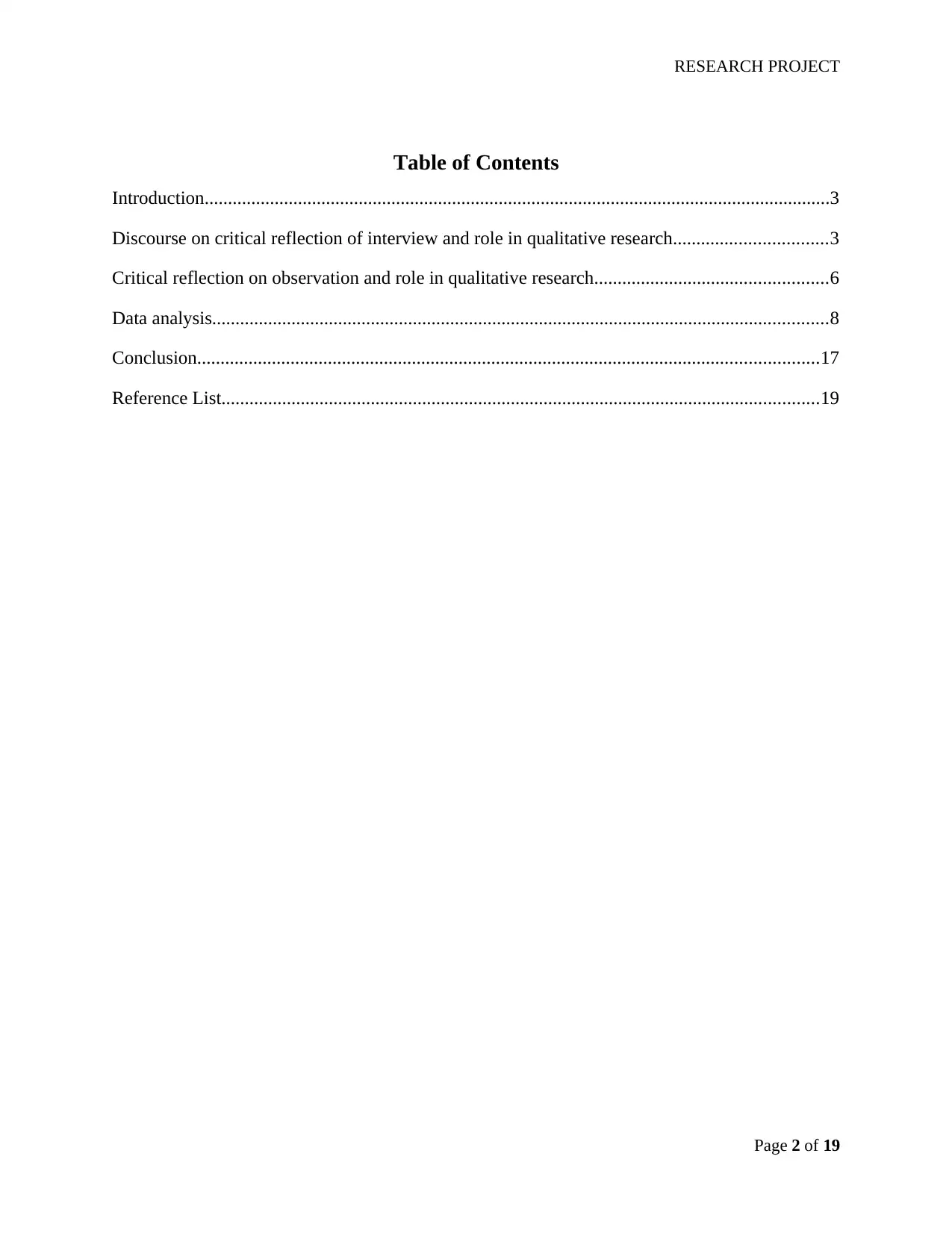
Table of Contents
Introduction......................................................................................................................................3
Discourse on critical reflection of interview and role in qualitative research.................................3
Critical reflection on observation and role in qualitative research..................................................6
Data analysis....................................................................................................................................8
Conclusion.....................................................................................................................................17
Reference List................................................................................................................................19
Page 2 of 19
Table of Contents
Introduction......................................................................................................................................3
Discourse on critical reflection of interview and role in qualitative research.................................3
Critical reflection on observation and role in qualitative research..................................................6
Data analysis....................................................................................................................................8
Conclusion.....................................................................................................................................17
Reference List................................................................................................................................19
Page 2 of 19
RESEARCH PROJECT
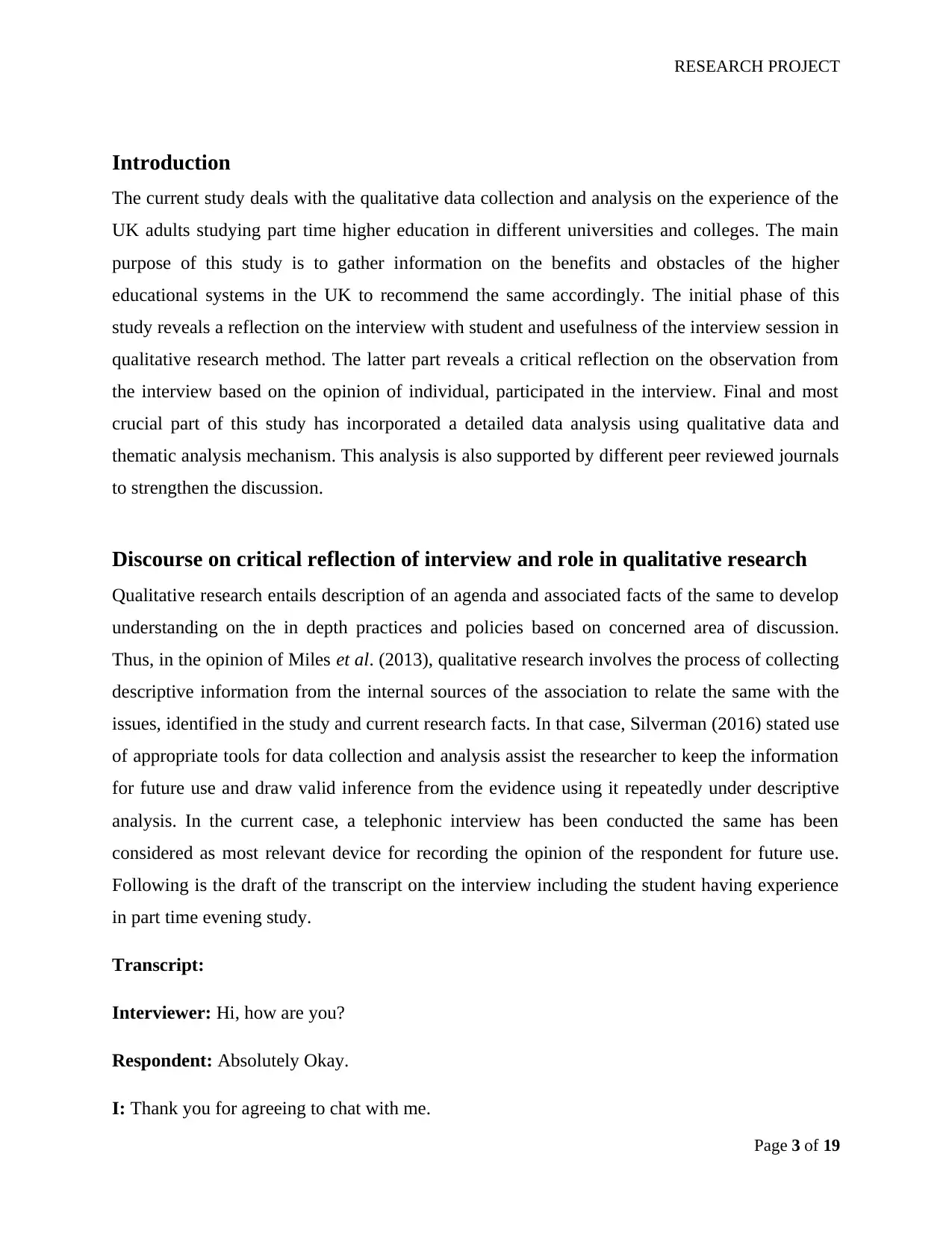
Introduction
The current study deals with the qualitative data collection and analysis on the experience of the
UK adults studying part time higher education in different universities and colleges. The main
purpose of this study is to gather information on the benefits and obstacles of the higher
educational systems in the UK to recommend the same accordingly. The initial phase of this
study reveals a reflection on the interview with student and usefulness of the interview session in
qualitative research method. The latter part reveals a critical reflection on the observation from
the interview based on the opinion of individual, participated in the interview. Final and most
crucial part of this study has incorporated a detailed data analysis using qualitative data and
thematic analysis mechanism. This analysis is also supported by different peer reviewed journals
to strengthen the discussion.
Discourse on critical reflection of interview and role in qualitative research
Qualitative research entails description of an agenda and associated facts of the same to develop
understanding on the in depth practices and policies based on concerned area of discussion.
Thus, in the opinion of Miles et al. (2013), qualitative research involves the process of collecting
descriptive information from the internal sources of the association to relate the same with the
issues, identified in the study and current research facts. In that case, Silverman (2016) stated use
of appropriate tools for data collection and analysis assist the researcher to keep the information
for future use and draw valid inference from the evidence using it repeatedly under descriptive
analysis. In the current case, a telephonic interview has been conducted the same has been
considered as most relevant device for recording the opinion of the respondent for future use.
Following is the draft of the transcript on the interview including the student having experience
in part time evening study.
Transcript:
Interviewer: Hi, how are you?
Respondent: Absolutely Okay.
I: Thank you for agreeing to chat with me.
Page 3 of 19
Introduction
The current study deals with the qualitative data collection and analysis on the experience of the
UK adults studying part time higher education in different universities and colleges. The main
purpose of this study is to gather information on the benefits and obstacles of the higher
educational systems in the UK to recommend the same accordingly. The initial phase of this
study reveals a reflection on the interview with student and usefulness of the interview session in
qualitative research method. The latter part reveals a critical reflection on the observation from
the interview based on the opinion of individual, participated in the interview. Final and most
crucial part of this study has incorporated a detailed data analysis using qualitative data and
thematic analysis mechanism. This analysis is also supported by different peer reviewed journals
to strengthen the discussion.
Discourse on critical reflection of interview and role in qualitative research
Qualitative research entails description of an agenda and associated facts of the same to develop
understanding on the in depth practices and policies based on concerned area of discussion.
Thus, in the opinion of Miles et al. (2013), qualitative research involves the process of collecting
descriptive information from the internal sources of the association to relate the same with the
issues, identified in the study and current research facts. In that case, Silverman (2016) stated use
of appropriate tools for data collection and analysis assist the researcher to keep the information
for future use and draw valid inference from the evidence using it repeatedly under descriptive
analysis. In the current case, a telephonic interview has been conducted the same has been
considered as most relevant device for recording the opinion of the respondent for future use.
Following is the draft of the transcript on the interview including the student having experience
in part time evening study.
Transcript:
Interviewer: Hi, how are you?
Respondent: Absolutely Okay.
I: Thank you for agreeing to chat with me.
Page 3 of 19
⊘ This is a preview!⊘
Do you want full access?
Subscribe today to unlock all pages.

Trusted by 1+ million students worldwide
RESEARCH PROJECT
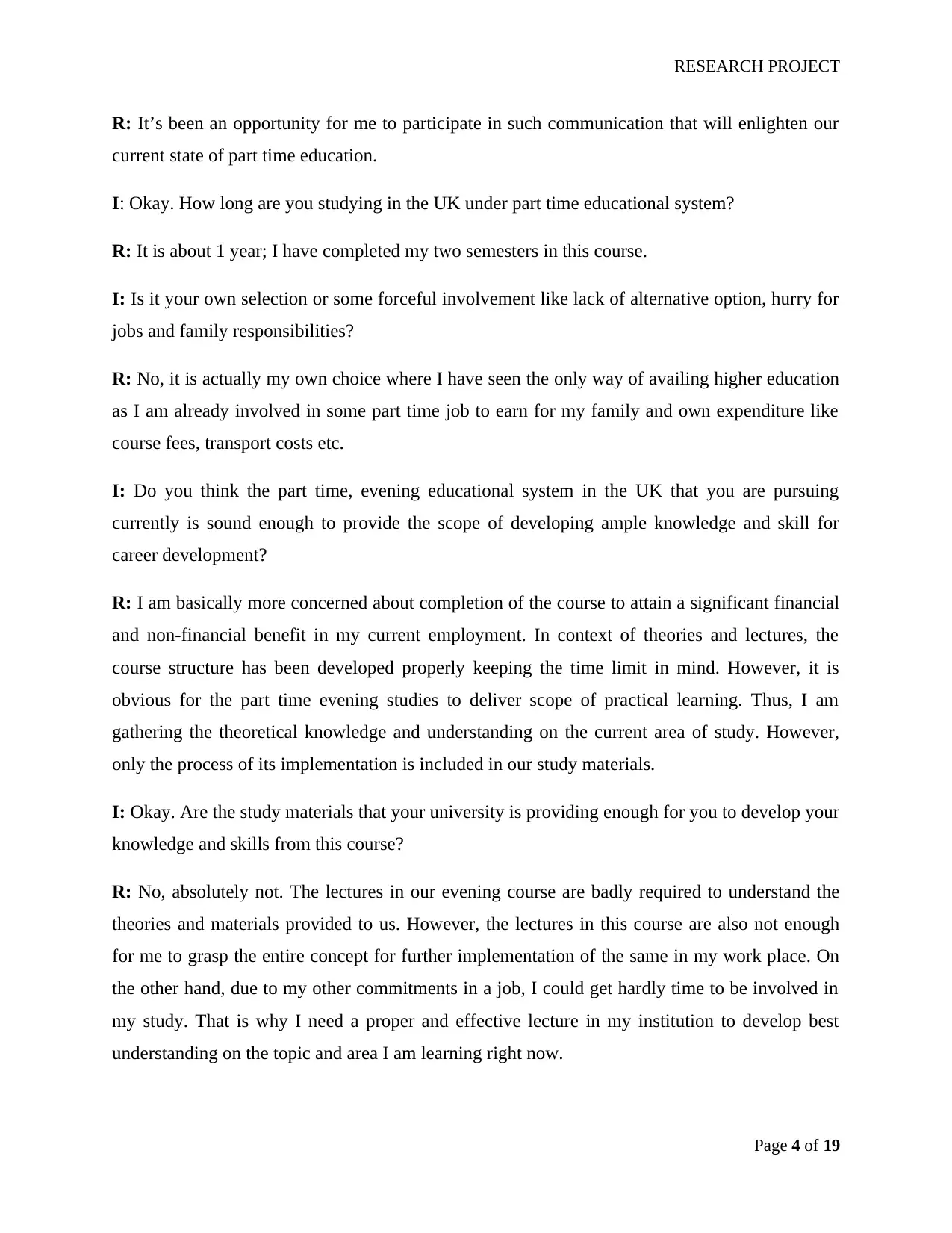
R: It’s been an opportunity for me to participate in such communication that will enlighten our
current state of part time education.
I: Okay. How long are you studying in the UK under part time educational system?
R: It is about 1 year; I have completed my two semesters in this course.
I: Is it your own selection or some forceful involvement like lack of alternative option, hurry for
jobs and family responsibilities?
R: No, it is actually my own choice where I have seen the only way of availing higher education
as I am already involved in some part time job to earn for my family and own expenditure like
course fees, transport costs etc.
I: Do you think the part time, evening educational system in the UK that you are pursuing
currently is sound enough to provide the scope of developing ample knowledge and skill for
career development?
R: I am basically more concerned about completion of the course to attain a significant financial
and non-financial benefit in my current employment. In context of theories and lectures, the
course structure has been developed properly keeping the time limit in mind. However, it is
obvious for the part time evening studies to deliver scope of practical learning. Thus, I am
gathering the theoretical knowledge and understanding on the current area of study. However,
only the process of its implementation is included in our study materials.
I: Okay. Are the study materials that your university is providing enough for you to develop your
knowledge and skills from this course?
R: No, absolutely not. The lectures in our evening course are badly required to understand the
theories and materials provided to us. However, the lectures in this course are also not enough
for me to grasp the entire concept for further implementation of the same in my work place. On
the other hand, due to my other commitments in a job, I could get hardly time to be involved in
my study. That is why I need a proper and effective lecture in my institution to develop best
understanding on the topic and area I am learning right now.
Page 4 of 19
R: It’s been an opportunity for me to participate in such communication that will enlighten our
current state of part time education.
I: Okay. How long are you studying in the UK under part time educational system?
R: It is about 1 year; I have completed my two semesters in this course.
I: Is it your own selection or some forceful involvement like lack of alternative option, hurry for
jobs and family responsibilities?
R: No, it is actually my own choice where I have seen the only way of availing higher education
as I am already involved in some part time job to earn for my family and own expenditure like
course fees, transport costs etc.
I: Do you think the part time, evening educational system in the UK that you are pursuing
currently is sound enough to provide the scope of developing ample knowledge and skill for
career development?
R: I am basically more concerned about completion of the course to attain a significant financial
and non-financial benefit in my current employment. In context of theories and lectures, the
course structure has been developed properly keeping the time limit in mind. However, it is
obvious for the part time evening studies to deliver scope of practical learning. Thus, I am
gathering the theoretical knowledge and understanding on the current area of study. However,
only the process of its implementation is included in our study materials.
I: Okay. Are the study materials that your university is providing enough for you to develop your
knowledge and skills from this course?
R: No, absolutely not. The lectures in our evening course are badly required to understand the
theories and materials provided to us. However, the lectures in this course are also not enough
for me to grasp the entire concept for further implementation of the same in my work place. On
the other hand, due to my other commitments in a job, I could get hardly time to be involved in
my study. That is why I need a proper and effective lecture in my institution to develop best
understanding on the topic and area I am learning right now.
Page 4 of 19
Paraphrase This Document
Need a fresh take? Get an instant paraphrase of this document with our AI Paraphraser
RESEARCH PROJECT
I: I think you need additional guidance for your course and further study as well as exams. Isn’t
it?
R: Yeah, you are right. I actually need a personal guidance as lectures and classes in evening
study are not sufficient due to time constraints. However, I don’t even have sufficient time to
take additional guidance from outside. In that case, the existing lectures and study materials
would be stronger and more descriptive to understand the topic in detail.
I: Do you regularly attend the classes in the evening after your job?
R: Not always. Sometimes I fail to attend the classes due to some additional responsibilities and
additional work pressure. That time, I use to communicate with friends and collect the notes of
that class.
I: By the way, are your classes in institution well structured and organized to provide you an
effective and complete educational package?
R: Not fully, but the infrastructure of the institution is at par to deliver the exact requirement
even the minimum requirement to students. I think the educational package is justified enough
against the course fee.
I: Are you happy with the part time evening study under the current educational services you are
getting in the UK?
R: Not really, as it is a professional course and ultimate measure of my future, it needs to be
more structured and specific with the objectives, associated to the study and individuals.
Sometimes, the classes are based on video presentation and conference call which is really
troublesome for me to clarify the area as such system does not allow me to raise query in some
area I am not aware of.
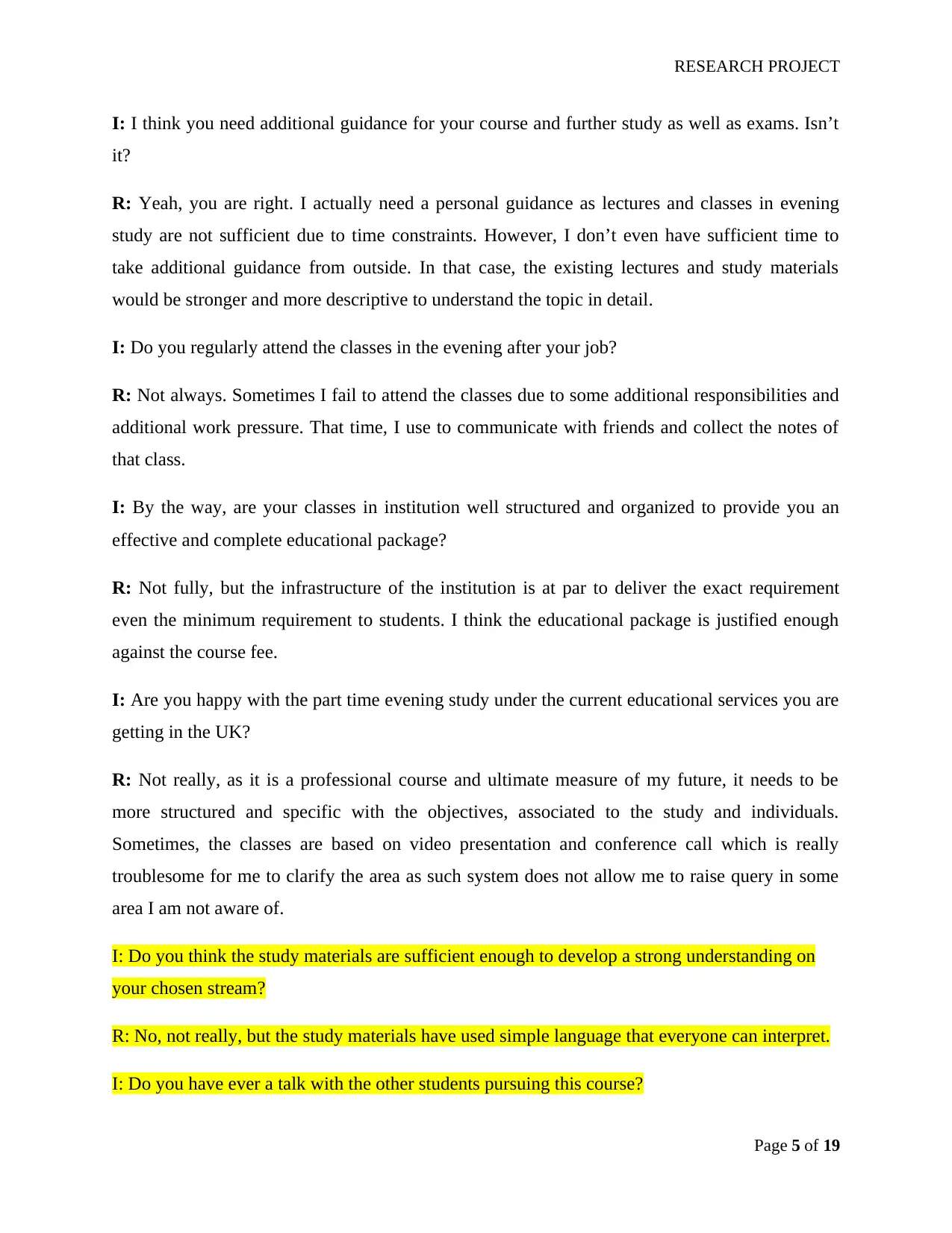
I: Do you think the study materials are sufficient enough to develop a strong understanding on
your chosen stream?
R: No, not really, but the study materials have used simple language that everyone can interpret.
I: Do you have ever a talk with the other students pursuing this course?
Page 5 of 19
I: I think you need additional guidance for your course and further study as well as exams. Isn’t
it?
R: Yeah, you are right. I actually need a personal guidance as lectures and classes in evening
study are not sufficient due to time constraints. However, I don’t even have sufficient time to
take additional guidance from outside. In that case, the existing lectures and study materials
would be stronger and more descriptive to understand the topic in detail.
I: Do you regularly attend the classes in the evening after your job?
R: Not always. Sometimes I fail to attend the classes due to some additional responsibilities and
additional work pressure. That time, I use to communicate with friends and collect the notes of
that class.
I: By the way, are your classes in institution well structured and organized to provide you an
effective and complete educational package?
R: Not fully, but the infrastructure of the institution is at par to deliver the exact requirement
even the minimum requirement to students. I think the educational package is justified enough
against the course fee.
I: Are you happy with the part time evening study under the current educational services you are
getting in the UK?
R: Not really, as it is a professional course and ultimate measure of my future, it needs to be
more structured and specific with the objectives, associated to the study and individuals.
Sometimes, the classes are based on video presentation and conference call which is really
troublesome for me to clarify the area as such system does not allow me to raise query in some
area I am not aware of.
I: Do you think the study materials are sufficient enough to develop a strong understanding on
your chosen stream?
R: No, not really, but the study materials have used simple language that everyone can interpret.
I: Do you have ever a talk with the other students pursuing this course?
Page 5 of 19
RESEARCH PROJECT
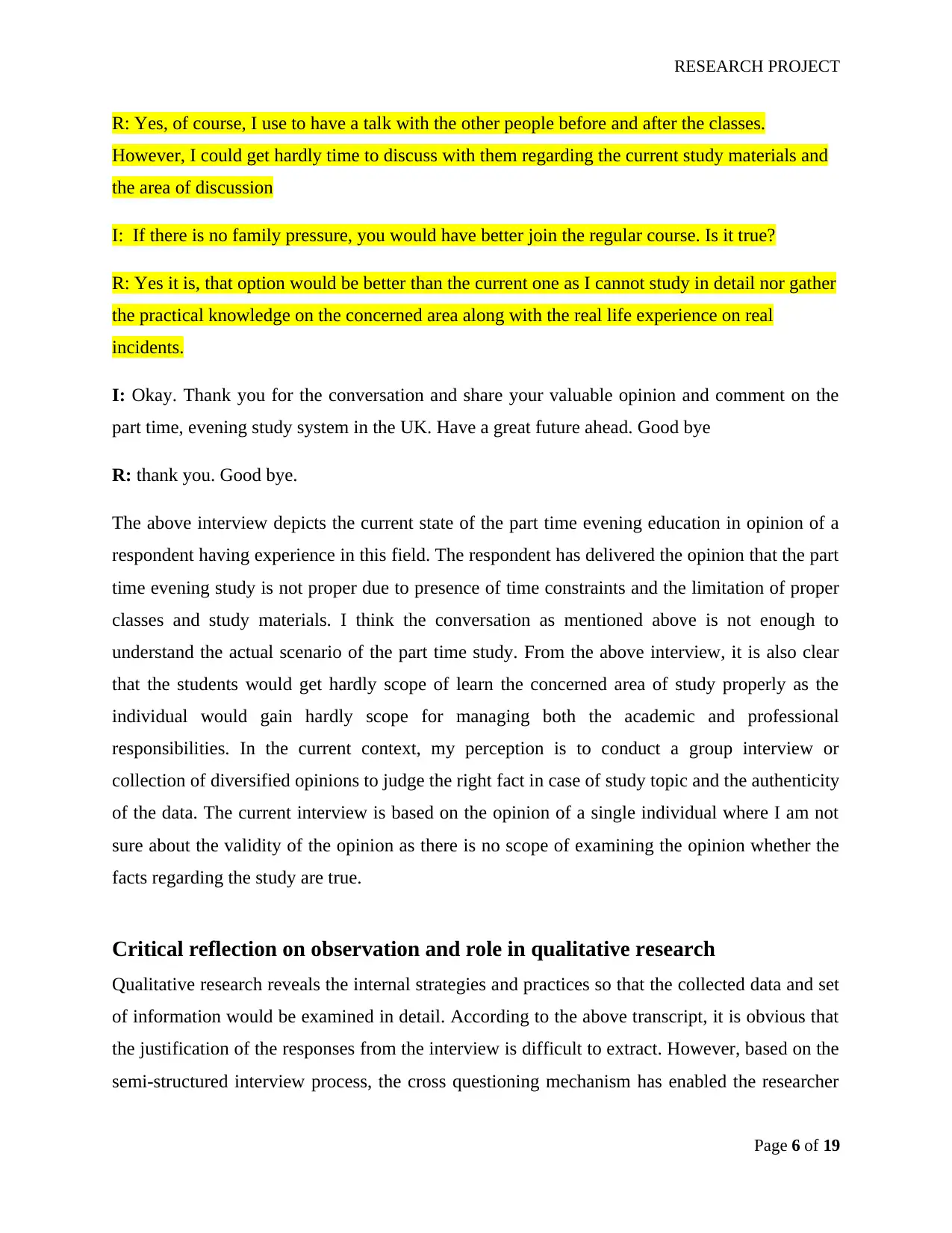
R: Yes, of course, I use to have a talk with the other people before and after the classes.
However, I could get hardly time to discuss with them regarding the current study materials and
the area of discussion
I: If there is no family pressure, you would have better join the regular course. Is it true?
R: Yes it is, that option would be better than the current one as I cannot study in detail nor gather
the practical knowledge on the concerned area along with the real life experience on real
incidents.
I: Okay. Thank you for the conversation and share your valuable opinion and comment on the
part time, evening study system in the UK. Have a great future ahead. Good bye
R: thank you. Good bye.
The above interview depicts the current state of the part time evening education in opinion of a
respondent having experience in this field. The respondent has delivered the opinion that the part
time evening study is not proper due to presence of time constraints and the limitation of proper
classes and study materials. I think the conversation as mentioned above is not enough to
understand the actual scenario of the part time study. From the above interview, it is also clear
that the students would get hardly scope of learn the concerned area of study properly as the
individual would gain hardly scope for managing both the academic and professional
responsibilities. In the current context, my perception is to conduct a group interview or
collection of diversified opinions to judge the right fact in case of study topic and the authenticity
of the data. The current interview is based on the opinion of a single individual where I am not
sure about the validity of the opinion as there is no scope of examining the opinion whether the
facts regarding the study are true.
Critical reflection on observation and role in qualitative research
Qualitative research reveals the internal strategies and practices so that the collected data and set
of information would be examined in detail. According to the above transcript, it is obvious that
the justification of the responses from the interview is difficult to extract. However, based on the
semi-structured interview process, the cross questioning mechanism has enabled the researcher
Page 6 of 19
R: Yes, of course, I use to have a talk with the other people before and after the classes.
However, I could get hardly time to discuss with them regarding the current study materials and
the area of discussion
I: If there is no family pressure, you would have better join the regular course. Is it true?
R: Yes it is, that option would be better than the current one as I cannot study in detail nor gather
the practical knowledge on the concerned area along with the real life experience on real
incidents.
I: Okay. Thank you for the conversation and share your valuable opinion and comment on the
part time, evening study system in the UK. Have a great future ahead. Good bye
R: thank you. Good bye.
The above interview depicts the current state of the part time evening education in opinion of a
respondent having experience in this field. The respondent has delivered the opinion that the part
time evening study is not proper due to presence of time constraints and the limitation of proper
classes and study materials. I think the conversation as mentioned above is not enough to
understand the actual scenario of the part time study. From the above interview, it is also clear
that the students would get hardly scope of learn the concerned area of study properly as the
individual would gain hardly scope for managing both the academic and professional
responsibilities. In the current context, my perception is to conduct a group interview or
collection of diversified opinions to judge the right fact in case of study topic and the authenticity
of the data. The current interview is based on the opinion of a single individual where I am not
sure about the validity of the opinion as there is no scope of examining the opinion whether the
facts regarding the study are true.
Critical reflection on observation and role in qualitative research
Qualitative research reveals the internal strategies and practices so that the collected data and set
of information would be examined in detail. According to the above transcript, it is obvious that
the justification of the responses from the interview is difficult to extract. However, based on the
semi-structured interview process, the cross questioning mechanism has enabled the researcher
Page 6 of 19
⊘ This is a preview!⊘
Do you want full access?
Subscribe today to unlock all pages.
Trusted by 1+ million students worldwide
RESEARCH PROJECT
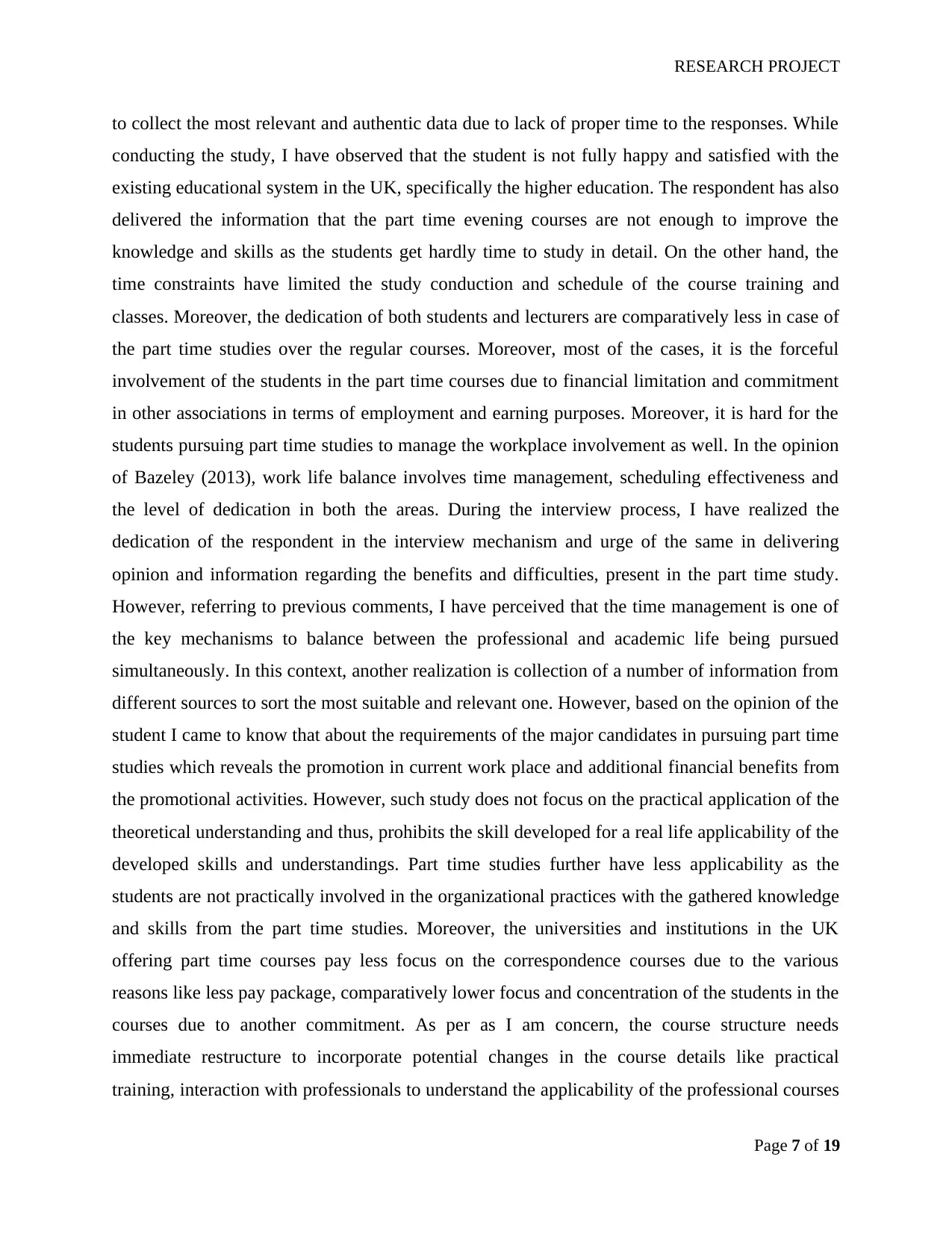
to collect the most relevant and authentic data due to lack of proper time to the responses. While
conducting the study, I have observed that the student is not fully happy and satisfied with the
existing educational system in the UK, specifically the higher education. The respondent has also
delivered the information that the part time evening courses are not enough to improve the
knowledge and skills as the students get hardly time to study in detail. On the other hand, the
time constraints have limited the study conduction and schedule of the course training and
classes. Moreover, the dedication of both students and lecturers are comparatively less in case of
the part time studies over the regular courses. Moreover, most of the cases, it is the forceful
involvement of the students in the part time courses due to financial limitation and commitment
in other associations in terms of employment and earning purposes. Moreover, it is hard for the
students pursuing part time studies to manage the workplace involvement as well. In the opinion
of Bazeley (2013), work life balance involves time management, scheduling effectiveness and
the level of dedication in both the areas. During the interview process, I have realized the
dedication of the respondent in the interview mechanism and urge of the same in delivering
opinion and information regarding the benefits and difficulties, present in the part time study.
However, referring to previous comments, I have perceived that the time management is one of
the key mechanisms to balance between the professional and academic life being pursued
simultaneously. In this context, another realization is collection of a number of information from
different sources to sort the most suitable and relevant one. However, based on the opinion of the
student I came to know that about the requirements of the major candidates in pursuing part time
studies which reveals the promotion in current work place and additional financial benefits from
the promotional activities. However, such study does not focus on the practical application of the
theoretical understanding and thus, prohibits the skill developed for a real life applicability of the
developed skills and understandings. Part time studies further have less applicability as the
students are not practically involved in the organizational practices with the gathered knowledge
and skills from the part time studies. Moreover, the universities and institutions in the UK
offering part time courses pay less focus on the correspondence courses due to the various
reasons like less pay package, comparatively lower focus and concentration of the students in the
courses due to another commitment. As per as I am concern, the course structure needs
immediate restructure to incorporate potential changes in the course details like practical
training, interaction with professionals to understand the applicability of the professional courses
Page 7 of 19
to collect the most relevant and authentic data due to lack of proper time to the responses. While
conducting the study, I have observed that the student is not fully happy and satisfied with the
existing educational system in the UK, specifically the higher education. The respondent has also
delivered the information that the part time evening courses are not enough to improve the
knowledge and skills as the students get hardly time to study in detail. On the other hand, the
time constraints have limited the study conduction and schedule of the course training and
classes. Moreover, the dedication of both students and lecturers are comparatively less in case of
the part time studies over the regular courses. Moreover, most of the cases, it is the forceful
involvement of the students in the part time courses due to financial limitation and commitment
in other associations in terms of employment and earning purposes. Moreover, it is hard for the
students pursuing part time studies to manage the workplace involvement as well. In the opinion
of Bazeley (2013), work life balance involves time management, scheduling effectiveness and
the level of dedication in both the areas. During the interview process, I have realized the
dedication of the respondent in the interview mechanism and urge of the same in delivering
opinion and information regarding the benefits and difficulties, present in the part time study.
However, referring to previous comments, I have perceived that the time management is one of
the key mechanisms to balance between the professional and academic life being pursued
simultaneously. In this context, another realization is collection of a number of information from
different sources to sort the most suitable and relevant one. However, based on the opinion of the
student I came to know that about the requirements of the major candidates in pursuing part time
studies which reveals the promotion in current work place and additional financial benefits from
the promotional activities. However, such study does not focus on the practical application of the
theoretical understanding and thus, prohibits the skill developed for a real life applicability of the
developed skills and understandings. Part time studies further have less applicability as the
students are not practically involved in the organizational practices with the gathered knowledge
and skills from the part time studies. Moreover, the universities and institutions in the UK
offering part time courses pay less focus on the correspondence courses due to the various
reasons like less pay package, comparatively lower focus and concentration of the students in the
courses due to another commitment. As per as I am concern, the course structure needs
immediate restructure to incorporate potential changes in the course details like practical
training, interaction with professionals to understand the applicability of the professional courses
Page 7 of 19
Paraphrase This Document
Need a fresh take? Get an instant paraphrase of this document with our AI Paraphraser
RESEARCH PROJECT
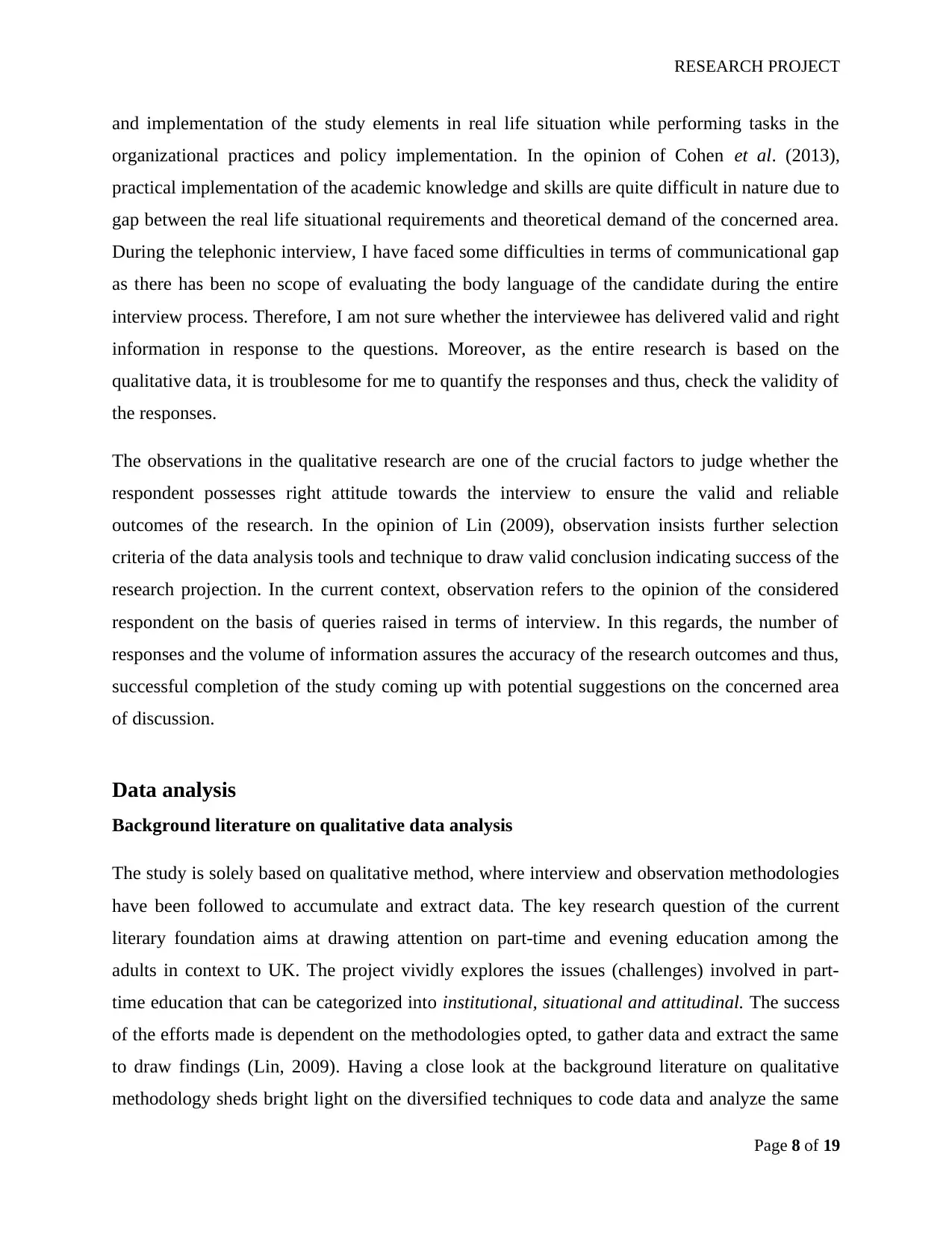
and implementation of the study elements in real life situation while performing tasks in the
organizational practices and policy implementation. In the opinion of Cohen et al. (2013),
practical implementation of the academic knowledge and skills are quite difficult in nature due to
gap between the real life situational requirements and theoretical demand of the concerned area.
During the telephonic interview, I have faced some difficulties in terms of communicational gap
as there has been no scope of evaluating the body language of the candidate during the entire
interview process. Therefore, I am not sure whether the interviewee has delivered valid and right
information in response to the questions. Moreover, as the entire research is based on the
qualitative data, it is troublesome for me to quantify the responses and thus, check the validity of
the responses.
The observations in the qualitative research are one of the crucial factors to judge whether the
respondent possesses right attitude towards the interview to ensure the valid and reliable
outcomes of the research. In the opinion of Lin (2009), observation insists further selection
criteria of the data analysis tools and technique to draw valid conclusion indicating success of the
research projection. In the current context, observation refers to the opinion of the considered
respondent on the basis of queries raised in terms of interview. In this regards, the number of
responses and the volume of information assures the accuracy of the research outcomes and thus,
successful completion of the study coming up with potential suggestions on the concerned area
of discussion.
Data analysis
Background literature on qualitative data analysis
The study is solely based on qualitative method, where interview and observation methodologies
have been followed to accumulate and extract data. The key research question of the current
literary foundation aims at drawing attention on part-time and evening education among the
adults in context to UK. The project vividly explores the issues (challenges) involved in part-
time education that can be categorized into institutional, situational and attitudinal. The success
of the efforts made is dependent on the methodologies opted, to gather data and extract the same
to draw findings (Lin, 2009). Having a close look at the background literature on qualitative
methodology sheds bright light on the diversified techniques to code data and analyze the same
Page 8 of 19
and implementation of the study elements in real life situation while performing tasks in the
organizational practices and policy implementation. In the opinion of Cohen et al. (2013),
practical implementation of the academic knowledge and skills are quite difficult in nature due to
gap between the real life situational requirements and theoretical demand of the concerned area.
During the telephonic interview, I have faced some difficulties in terms of communicational gap
as there has been no scope of evaluating the body language of the candidate during the entire
interview process. Therefore, I am not sure whether the interviewee has delivered valid and right
information in response to the questions. Moreover, as the entire research is based on the
qualitative data, it is troublesome for me to quantify the responses and thus, check the validity of
the responses.
The observations in the qualitative research are one of the crucial factors to judge whether the
respondent possesses right attitude towards the interview to ensure the valid and reliable
outcomes of the research. In the opinion of Lin (2009), observation insists further selection
criteria of the data analysis tools and technique to draw valid conclusion indicating success of the
research projection. In the current context, observation refers to the opinion of the considered
respondent on the basis of queries raised in terms of interview. In this regards, the number of
responses and the volume of information assures the accuracy of the research outcomes and thus,
successful completion of the study coming up with potential suggestions on the concerned area
of discussion.
Data analysis
Background literature on qualitative data analysis
The study is solely based on qualitative method, where interview and observation methodologies
have been followed to accumulate and extract data. The key research question of the current
literary foundation aims at drawing attention on part-time and evening education among the
adults in context to UK. The project vividly explores the issues (challenges) involved in part-
time education that can be categorized into institutional, situational and attitudinal. The success
of the efforts made is dependent on the methodologies opted, to gather data and extract the same
to draw findings (Lin, 2009). Having a close look at the background literature on qualitative
methodology sheds bright light on the diversified techniques to code data and analyze the same
Page 8 of 19
RESEARCH PROJECT
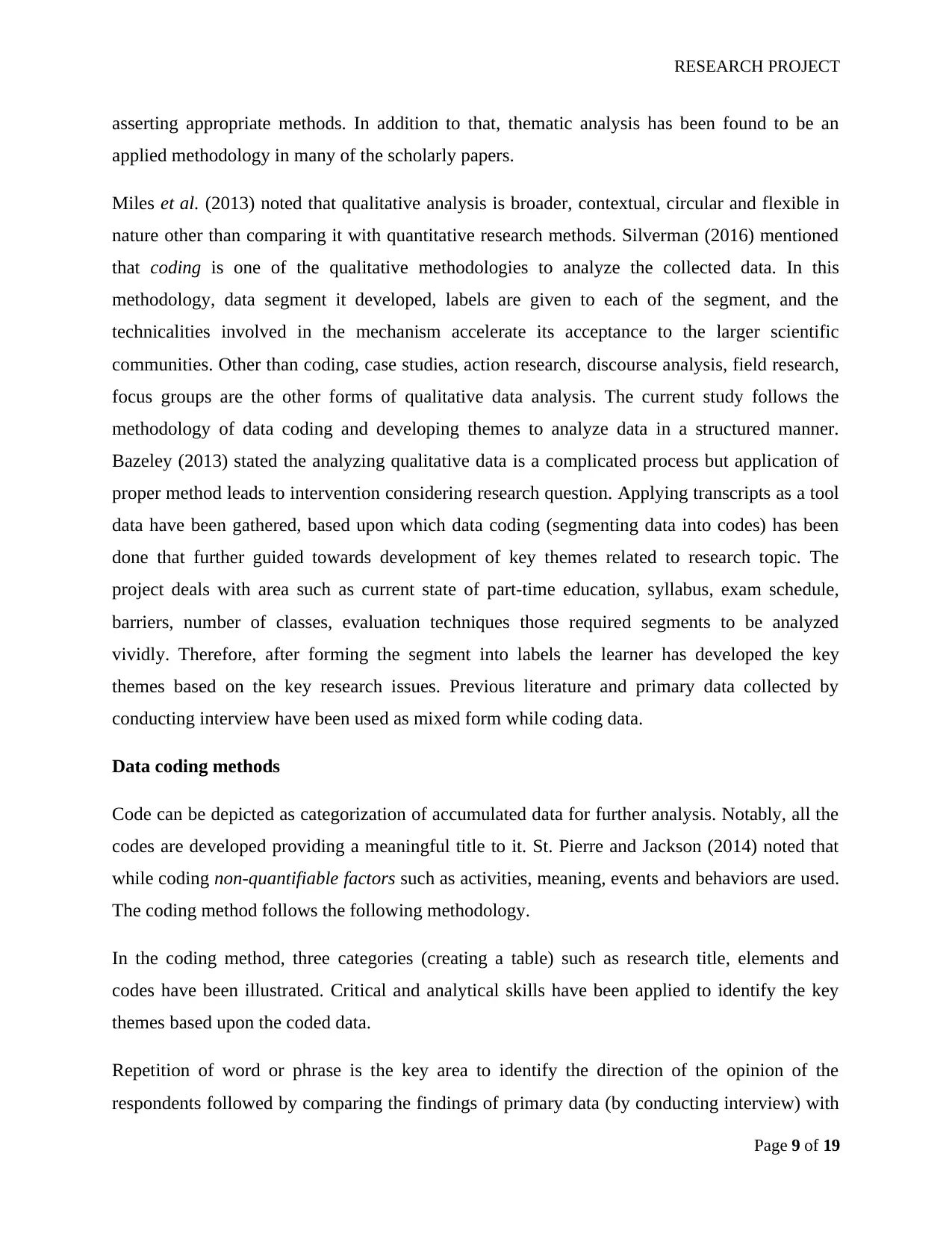
asserting appropriate methods. In addition to that, thematic analysis has been found to be an
applied methodology in many of the scholarly papers.
Miles et al. (2013) noted that qualitative analysis is broader, contextual, circular and flexible in
nature other than comparing it with quantitative research methods. Silverman (2016) mentioned
that coding is one of the qualitative methodologies to analyze the collected data. In this
methodology, data segment it developed, labels are given to each of the segment, and the
technicalities involved in the mechanism accelerate its acceptance to the larger scientific
communities. Other than coding, case studies, action research, discourse analysis, field research,
focus groups are the other forms of qualitative data analysis. The current study follows the
methodology of data coding and developing themes to analyze data in a structured manner.
Bazeley (2013) stated the analyzing qualitative data is a complicated process but application of
proper method leads to intervention considering research question. Applying transcripts as a tool
data have been gathered, based upon which data coding (segmenting data into codes) has been
done that further guided towards development of key themes related to research topic. The
project deals with area such as current state of part-time education, syllabus, exam schedule,
barriers, number of classes, evaluation techniques those required segments to be analyzed
vividly. Therefore, after forming the segment into labels the learner has developed the key
themes based on the key research issues. Previous literature and primary data collected by
conducting interview have been used as mixed form while coding data.
Data coding methods
Code can be depicted as categorization of accumulated data for further analysis. Notably, all the
codes are developed providing a meaningful title to it. St. Pierre and Jackson (2014) noted that
while coding non-quantifiable factors such as activities, meaning, events and behaviors are used.
The coding method follows the following methodology.
In the coding method, three categories (creating a table) such as research title, elements and
codes have been illustrated. Critical and analytical skills have been applied to identify the key
themes based upon the coded data.
Repetition of word or phrase is the key area to identify the direction of the opinion of the
respondents followed by comparing the findings of primary data (by conducting interview) with
Page 9 of 19
asserting appropriate methods. In addition to that, thematic analysis has been found to be an
applied methodology in many of the scholarly papers.
Miles et al. (2013) noted that qualitative analysis is broader, contextual, circular and flexible in
nature other than comparing it with quantitative research methods. Silverman (2016) mentioned
that coding is one of the qualitative methodologies to analyze the collected data. In this
methodology, data segment it developed, labels are given to each of the segment, and the
technicalities involved in the mechanism accelerate its acceptance to the larger scientific
communities. Other than coding, case studies, action research, discourse analysis, field research,
focus groups are the other forms of qualitative data analysis. The current study follows the
methodology of data coding and developing themes to analyze data in a structured manner.
Bazeley (2013) stated the analyzing qualitative data is a complicated process but application of
proper method leads to intervention considering research question. Applying transcripts as a tool
data have been gathered, based upon which data coding (segmenting data into codes) has been
done that further guided towards development of key themes related to research topic. The
project deals with area such as current state of part-time education, syllabus, exam schedule,
barriers, number of classes, evaluation techniques those required segments to be analyzed
vividly. Therefore, after forming the segment into labels the learner has developed the key
themes based on the key research issues. Previous literature and primary data collected by
conducting interview have been used as mixed form while coding data.
Data coding methods
Code can be depicted as categorization of accumulated data for further analysis. Notably, all the
codes are developed providing a meaningful title to it. St. Pierre and Jackson (2014) noted that
while coding non-quantifiable factors such as activities, meaning, events and behaviors are used.
The coding method follows the following methodology.
In the coding method, three categories (creating a table) such as research title, elements and
codes have been illustrated. Critical and analytical skills have been applied to identify the key
themes based upon the coded data.
Repetition of word or phrase is the key area to identify the direction of the opinion of the
respondents followed by comparing the findings of primary data (by conducting interview) with
Page 9 of 19
⊘ This is a preview!⊘
Do you want full access?
Subscribe today to unlock all pages.
Trusted by 1+ million students worldwide
RESEARCH PROJECT
the existing literature in the same field. Most importantly, the respondents may hide or omit the
areas or issues the learner is willing to find; thereby identifying those missing areas have been
taken into account while developing the codes (Edwards and Lampert, 2014).
Once the aforementioned activities are performed and practiced, the learner summarizes the data
to accept or nullify the hypothesis contributing towards research aim and objectives. Open
coding is applied to create the final coded table (Saldana, 2015). Initially, the data are broken
down into master heading, sub categories (if relevant) where different colors have been used.
After highlighting some of the areas with same color, they are used as concepts later on in
addition other related fields act as sub categories (using different colors). Below is the
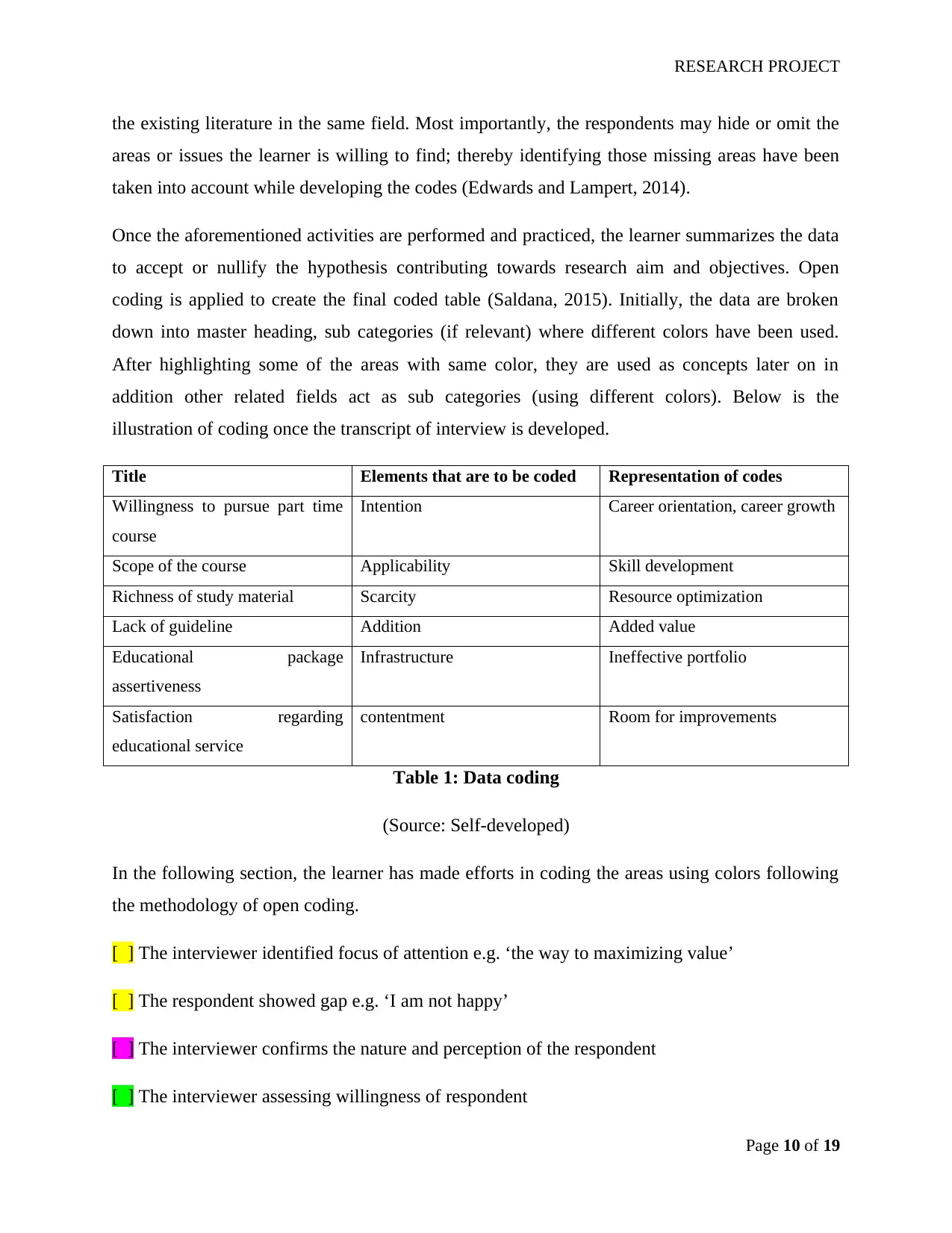
illustration of coding once the transcript of interview is developed.
Title Elements that are to be coded Representation of codes
Willingness to pursue part time
course
Intention Career orientation, career growth
Scope of the course Applicability Skill development
Richness of study material Scarcity Resource optimization
Lack of guideline Addition Added value
Educational package
assertiveness
Infrastructure Ineffective portfolio
Satisfaction regarding
educational service
contentment Room for improvements
Table 1: Data coding
(Source: Self-developed)
In the following section, the learner has made efforts in coding the areas using colors following
the methodology of open coding.
[ ] The interviewer identified focus of attention e.g. ‘the way to maximizing value’
[ ] The respondent showed gap e.g. ‘I am not happy’
[ ] The interviewer confirms the nature and perception of the respondent
[ ] The interviewer assessing willingness of respondent
Page 10 of 19
the existing literature in the same field. Most importantly, the respondents may hide or omit the
areas or issues the learner is willing to find; thereby identifying those missing areas have been
taken into account while developing the codes (Edwards and Lampert, 2014).
Once the aforementioned activities are performed and practiced, the learner summarizes the data
to accept or nullify the hypothesis contributing towards research aim and objectives. Open
coding is applied to create the final coded table (Saldana, 2015). Initially, the data are broken
down into master heading, sub categories (if relevant) where different colors have been used.
After highlighting some of the areas with same color, they are used as concepts later on in
addition other related fields act as sub categories (using different colors). Below is the
illustration of coding once the transcript of interview is developed.
Title Elements that are to be coded Representation of codes
Willingness to pursue part time
course
Intention Career orientation, career growth
Scope of the course Applicability Skill development
Richness of study material Scarcity Resource optimization
Lack of guideline Addition Added value
Educational package
assertiveness
Infrastructure Ineffective portfolio
Satisfaction regarding
educational service
contentment Room for improvements
Table 1: Data coding
(Source: Self-developed)
In the following section, the learner has made efforts in coding the areas using colors following
the methodology of open coding.
[ ] The interviewer identified focus of attention e.g. ‘the way to maximizing value’
[ ] The respondent showed gap e.g. ‘I am not happy’
[ ] The interviewer confirms the nature and perception of the respondent
[ ] The interviewer assessing willingness of respondent
Page 10 of 19
Paraphrase This Document
Need a fresh take? Get an instant paraphrase of this document with our AI Paraphraser
RESEARCH PROJECT
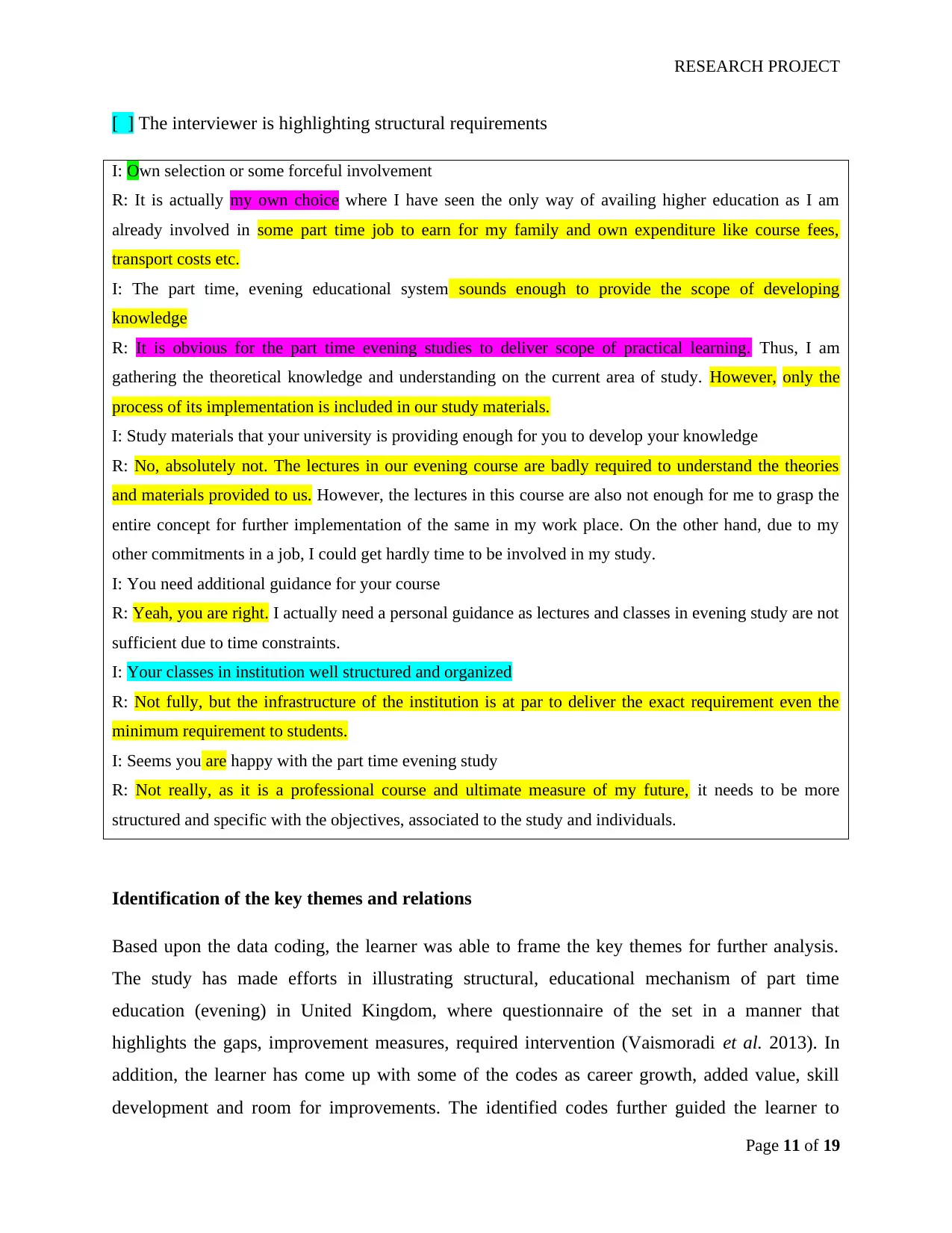
[ ] The interviewer is highlighting structural requirements
I: Own selection or some forceful involvement
R: It is actually my own choice where I have seen the only way of availing higher education as I am
already involved in some part time job to earn for my family and own expenditure like course fees,
transport costs etc.
I: The part time, evening educational system sounds enough to provide the scope of developing
knowledge
R: It is obvious for the part time evening studies to deliver scope of practical learning. Thus, I am
gathering the theoretical knowledge and understanding on the current area of study. However, only the
process of its implementation is included in our study materials.
I: Study materials that your university is providing enough for you to develop your knowledge
R: No, absolutely not. The lectures in our evening course are badly required to understand the theories
and materials provided to us. However, the lectures in this course are also not enough for me to grasp the
entire concept for further implementation of the same in my work place. On the other hand, due to my
other commitments in a job, I could get hardly time to be involved in my study.
I: You need additional guidance for your course
R: Yeah, you are right. I actually need a personal guidance as lectures and classes in evening study are not
sufficient due to time constraints.
I: Your classes in institution well structured and organized
R: Not fully, but the infrastructure of the institution is at par to deliver the exact requirement even the
minimum requirement to students.
I: Seems you are happy with the part time evening study
R: Not really, as it is a professional course and ultimate measure of my future, it needs to be more
structured and specific with the objectives, associated to the study and individuals.
Identification of the key themes and relations
Based upon the data coding, the learner was able to frame the key themes for further analysis.
The study has made efforts in illustrating structural, educational mechanism of part time
education (evening) in United Kingdom, where questionnaire of the set in a manner that
highlights the gaps, improvement measures, required intervention (Vaismoradi et al. 2013). In
addition, the learner has come up with some of the codes as career growth, added value, skill
development and room for improvements. The identified codes further guided the learner to
Page 11 of 19
[ ] The interviewer is highlighting structural requirements
I: Own selection or some forceful involvement
R: It is actually my own choice where I have seen the only way of availing higher education as I am
already involved in some part time job to earn for my family and own expenditure like course fees,
transport costs etc.
I: The part time, evening educational system sounds enough to provide the scope of developing
knowledge
R: It is obvious for the part time evening studies to deliver scope of practical learning. Thus, I am
gathering the theoretical knowledge and understanding on the current area of study. However, only the
process of its implementation is included in our study materials.
I: Study materials that your university is providing enough for you to develop your knowledge
R: No, absolutely not. The lectures in our evening course are badly required to understand the theories
and materials provided to us. However, the lectures in this course are also not enough for me to grasp the
entire concept for further implementation of the same in my work place. On the other hand, due to my
other commitments in a job, I could get hardly time to be involved in my study.
I: You need additional guidance for your course
R: Yeah, you are right. I actually need a personal guidance as lectures and classes in evening study are not
sufficient due to time constraints.
I: Your classes in institution well structured and organized
R: Not fully, but the infrastructure of the institution is at par to deliver the exact requirement even the
minimum requirement to students.
I: Seems you are happy with the part time evening study
R: Not really, as it is a professional course and ultimate measure of my future, it needs to be more
structured and specific with the objectives, associated to the study and individuals.
Identification of the key themes and relations
Based upon the data coding, the learner was able to frame the key themes for further analysis.
The study has made efforts in illustrating structural, educational mechanism of part time
education (evening) in United Kingdom, where questionnaire of the set in a manner that
highlights the gaps, improvement measures, required intervention (Vaismoradi et al. 2013). In
addition, the learner has come up with some of the codes as career growth, added value, skill
development and room for improvements. The identified codes further guided the learner to
Page 11 of 19
RESEARCH PROJECT
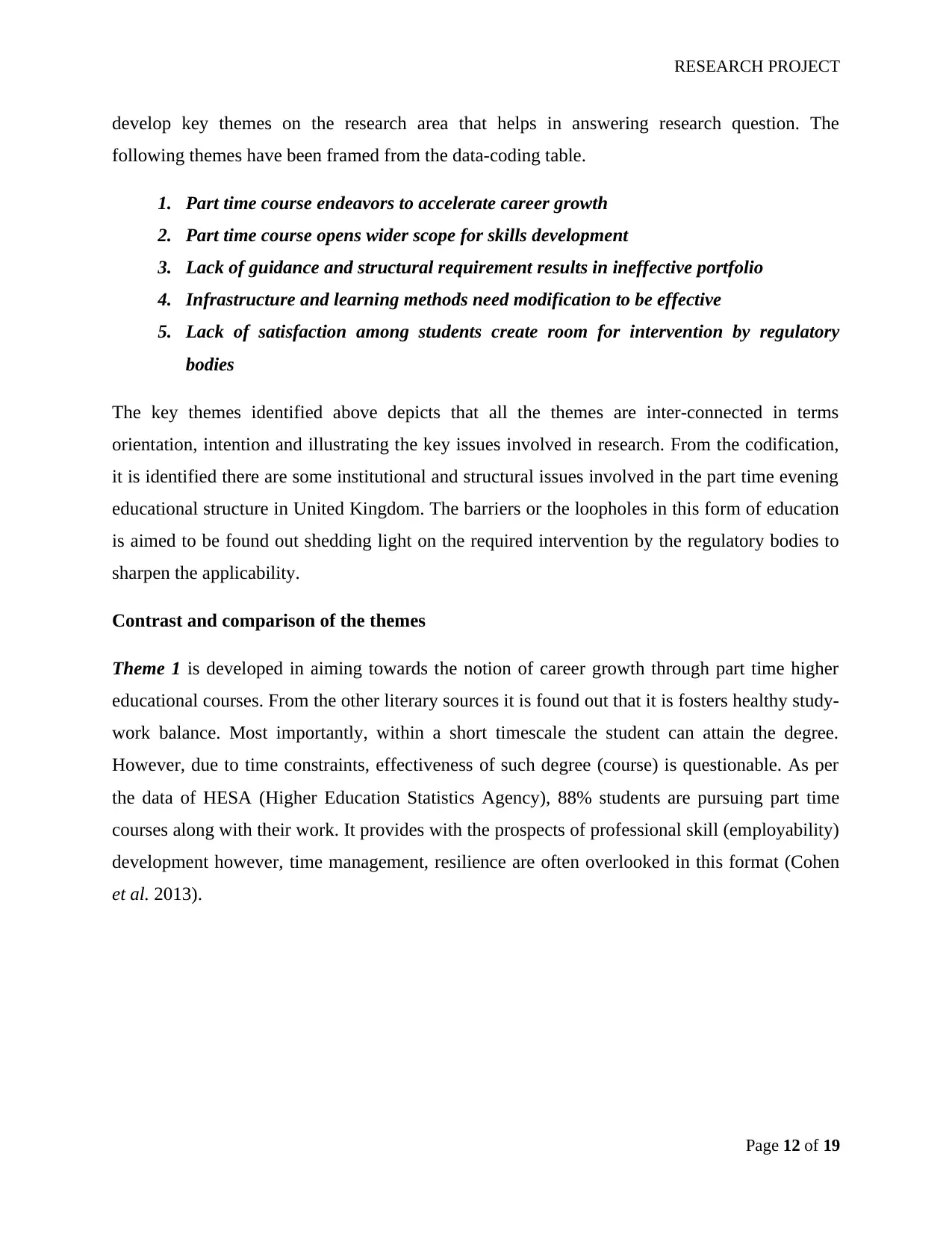
develop key themes on the research area that helps in answering research question. The
following themes have been framed from the data-coding table.
1. Part time course endeavors to accelerate career growth
2. Part time course opens wider scope for skills development
3. Lack of guidance and structural requirement results in ineffective portfolio
4. Infrastructure and learning methods need modification to be effective
5. Lack of satisfaction among students create room for intervention by regulatory
bodies
The key themes identified above depicts that all the themes are inter-connected in terms
orientation, intention and illustrating the key issues involved in research. From the codification,
it is identified there are some institutional and structural issues involved in the part time evening
educational structure in United Kingdom. The barriers or the loopholes in this form of education
is aimed to be found out shedding light on the required intervention by the regulatory bodies to
sharpen the applicability.
Contrast and comparison of the themes
Theme 1 is developed in aiming towards the notion of career growth through part time higher
educational courses. From the other literary sources it is found out that it is fosters healthy study-
work balance. Most importantly, within a short timescale the student can attain the degree.
However, due to time constraints, effectiveness of such degree (course) is questionable. As per
the data of HESA (Higher Education Statistics Agency), 88% students are pursuing part time
courses along with their work. It provides with the prospects of professional skill (employability)
development however, time management, resilience are often overlooked in this format (Cohen
et al. 2013).
Page 12 of 19
develop key themes on the research area that helps in answering research question. The
following themes have been framed from the data-coding table.
1. Part time course endeavors to accelerate career growth
2. Part time course opens wider scope for skills development
3. Lack of guidance and structural requirement results in ineffective portfolio
4. Infrastructure and learning methods need modification to be effective
5. Lack of satisfaction among students create room for intervention by regulatory
bodies
The key themes identified above depicts that all the themes are inter-connected in terms
orientation, intention and illustrating the key issues involved in research. From the codification,
it is identified there are some institutional and structural issues involved in the part time evening
educational structure in United Kingdom. The barriers or the loopholes in this form of education
is aimed to be found out shedding light on the required intervention by the regulatory bodies to
sharpen the applicability.
Contrast and comparison of the themes
Theme 1 is developed in aiming towards the notion of career growth through part time higher
educational courses. From the other literary sources it is found out that it is fosters healthy study-
work balance. Most importantly, within a short timescale the student can attain the degree.
However, due to time constraints, effectiveness of such degree (course) is questionable. As per
the data of HESA (Higher Education Statistics Agency), 88% students are pursuing part time
courses along with their work. It provides with the prospects of professional skill (employability)
development however, time management, resilience are often overlooked in this format (Cohen
et al. 2013).
Page 12 of 19
⊘ This is a preview!⊘
Do you want full access?
Subscribe today to unlock all pages.
Trusted by 1+ million students worldwide

1 out of 19


Related Documents


Your All-in-One AI-Powered Toolkit for Academic Success.
+13062052269
info@desklib.com
Available 24*7 on WhatsApp / Email
![[object Object]](/_next/static/media/star-bottom.7253800d.svg)
Unlock your academic potential
Copyright © 2020–2026 A2Z Services. All Rights Reserved. Developed and managed by ZUCOL.