Components of Partial Economic Evaluation in Health Care

Verified

Added on  2020/04/21

|3
|427
|126
Homework Assignment
AI Summary
The assignment discusses partial economic evaluation in healthcare by examining its components such as cost comparison, cost-outcome description, cost description, outcome description, and cost of illness study. While it emphasizes that these evaluations do not account for alternative interventions or fully justify a program's effectiveness, they provide essential information for understanding specific interventions. Cost comparison equates two health care programs; cost-outcome descriptions analyze costs and consequences without alternatives. Cost description focuses on charges, whereas outcome description considers effects alone. The cost of illness study measures expenses related to a single disease, aiding in economic evaluations and financial burden analysis. Thus, though partial evaluation does not assess efficiency fully, it significantly contributes to describing interventions.
Document Page
Running head: COMPONENTS OF PARTIAL ECONOMIC EVALUATION IN HEALTH
CARE 1
Components of Partial Economic Evaluation
Name:
Institution:
Course:
Date:
tabler-icon-diamond-filled.svg

Paraphrase This Document

Need a fresh take? Get an instant paraphrase of this document with our AI Paraphraser
Document Page
COMPONENTS OF PARTIAL ECONOMIC EVALUATION IN HEALTH CARE 2
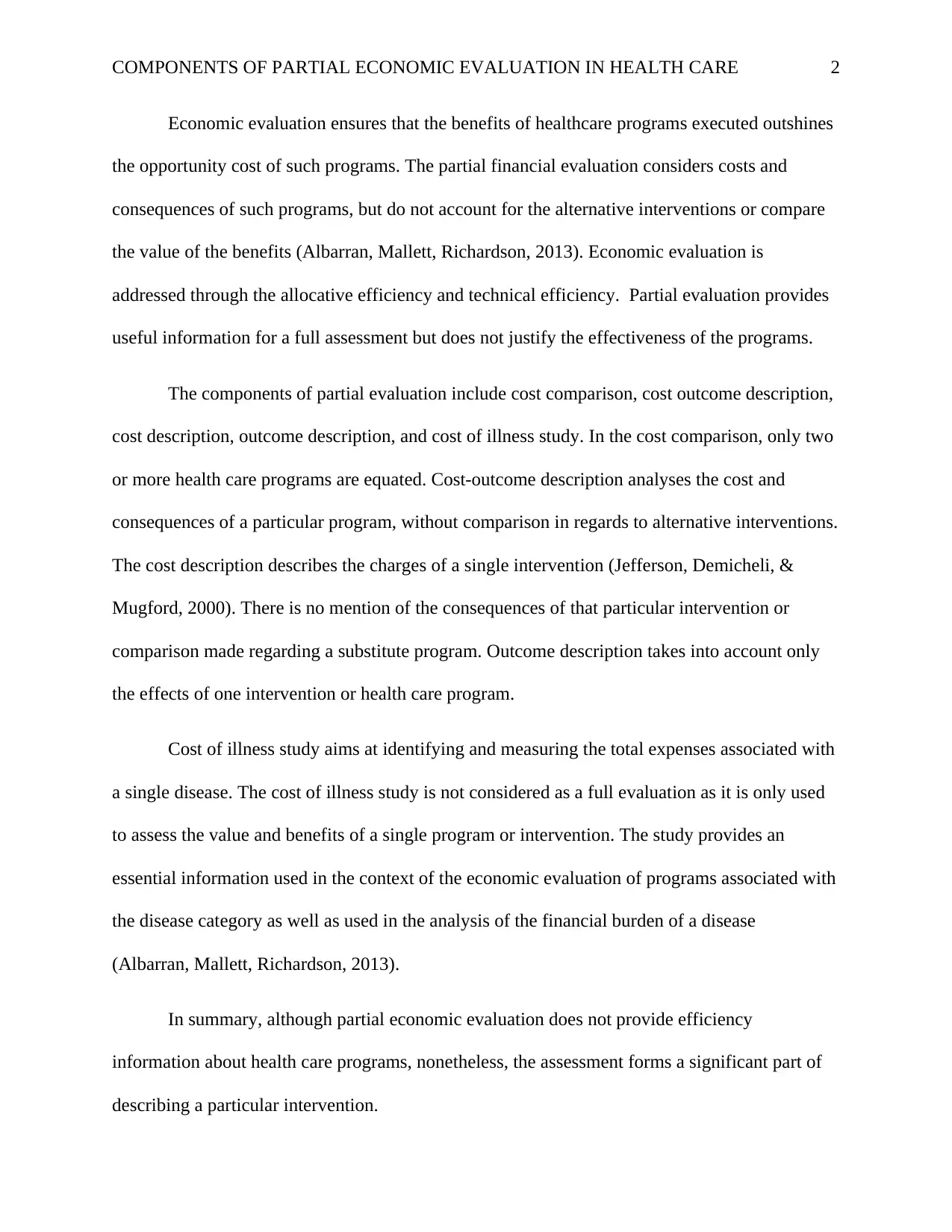
Economic evaluation ensures that the benefits of healthcare programs executed outshines
the opportunity cost of such programs. The partial financial evaluation considers costs and
consequences of such programs, but do not account for the alternative interventions or compare
the value of the benefits (Albarran, Mallett, Richardson, 2013). Economic evaluation is
addressed through the allocative efficiency and technical efficiency. Partial evaluation provides
useful information for a full assessment but does not justify the effectiveness of the programs.
The components of partial evaluation include cost comparison, cost outcome description,
cost description, outcome description, and cost of illness study. In the cost comparison, only two
or more health care programs are equated. Cost-outcome description analyses the cost and
consequences of a particular program, without comparison in regards to alternative interventions.
The cost description describes the charges of a single intervention (Jefferson, Demicheli, &
Mugford, 2000). There is no mention of the consequences of that particular intervention or
comparison made regarding a substitute program. Outcome description takes into account only
the effects of one intervention or health care program.
Cost of illness study aims at identifying and measuring the total expenses associated with
a single disease. The cost of illness study is not considered as a full evaluation as it is only used
to assess the value and benefits of a single program or intervention. The study provides an
essential information used in the context of the economic evaluation of programs associated with
the disease category as well as used in the analysis of the financial burden of a disease
(Albarran, Mallett, Richardson, 2013).
In summary, although partial economic evaluation does not provide efficiency
information about health care programs, nonetheless, the assessment forms a significant part of
describing a particular intervention.
Document Page
COMPONENTS OF PARTIAL ECONOMIC EVALUATION IN HEALTH CARE 3
References
Albarran, J. W., Mallett, J., & Richardson, A. (2013). Critical care manual of clinical procedures
and competencies. Chichester, West Sussex: John Wiley & Sons.
Jefferson, T., Demicheli, V., & Mugford, M. (2000). Elementary Economic Evaluation in Health
Care. Chichester: Wiley-Blackwell [Imprint.
chevron_up_icon
1 out of 3
circle_padding
hide_on_mobile
zoom_out_icon
[object Object]