Analysis of a Passage from LeTourneau's 'Mover of Men and Mountains'

Verified

Added on  2022/08/12

|5
|906
|45
Essay
AI Summary
This essay provides a detailed analysis of a passage from Robert Gilmour LeTourneau's "Mover of Men and Mountains." The analysis focuses on the narrator's internal conflict regarding religious belief and the societal expectations associated with it. The essay explores the narrator's doubts about religious practices, particularly his family's adherence to them, and the repercussions he anticipates. The passage highlights the narrator's struggle to reconcile his personal beliefs with the religious traditions of his family, emphasizing his feelings of alienation and the dilemma of whether or not to believe in God. The essay examines the narrator's use of metaphor and his contemplation of his spiritual state, concluding that the passage subtly highlights the contemporary individual's struggle to reconcile faith and personal autonomy. The essay draws upon the text to illustrate the narrator's perspective and the broader implications of his religious doubts.
Document Page
Running head: PASSAGE ANALYSIS
PASSAGE ANALYSIS
Name of the Student:
Name of the University:
Author’s Note:
tabler-icon-diamond-filled.svg

Paraphrase This Document

Need a fresh take? Get an instant paraphrase of this document with our AI Paraphraser
Document Page
1PASSAGE ANALYSIS
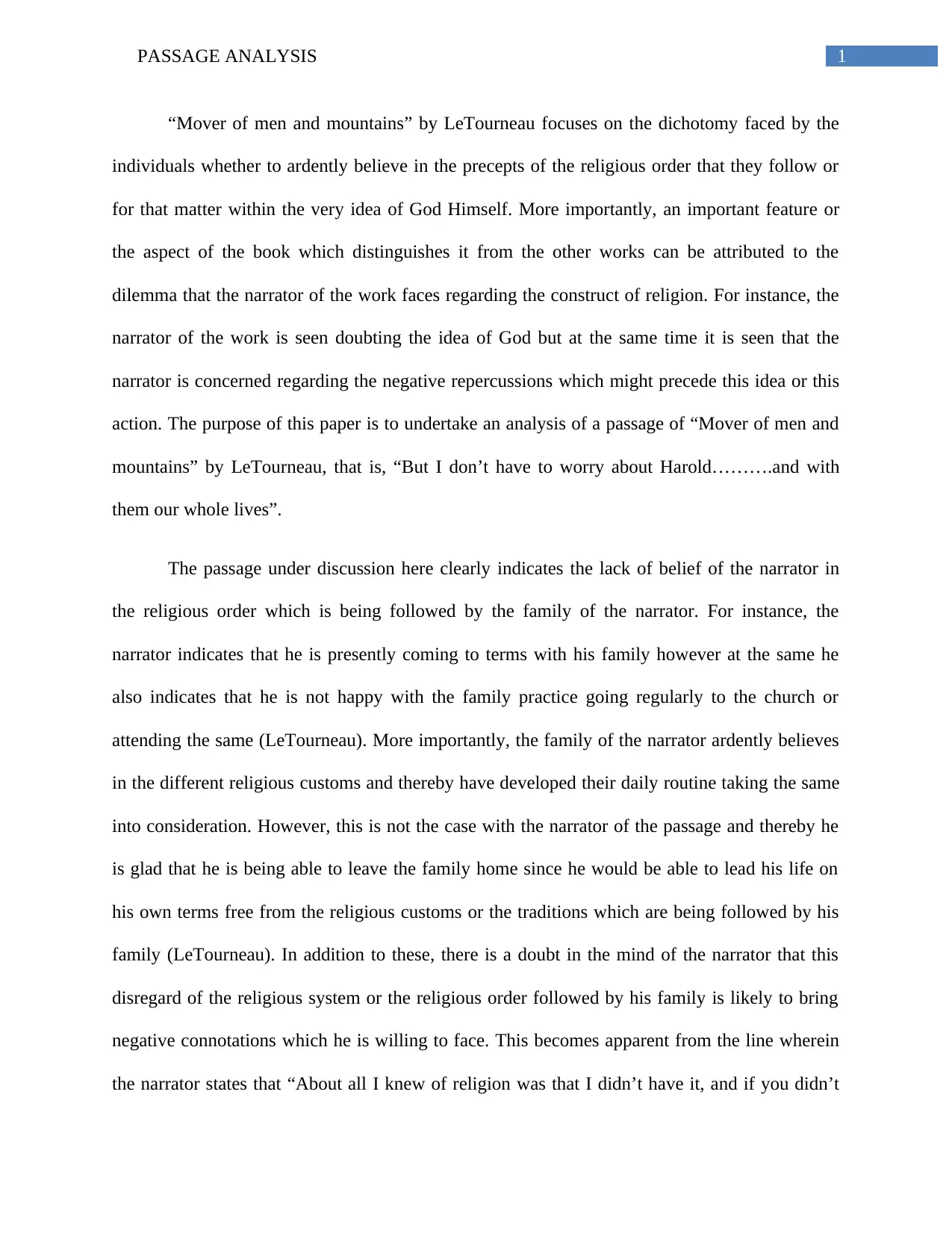
“Mover of men and mountains” by LeTourneau focuses on the dichotomy faced by the
individuals whether to ardently believe in the precepts of the religious order that they follow or
for that matter within the very idea of God Himself. More importantly, an important feature or
the aspect of the book which distinguishes it from the other works can be attributed to the
dilemma that the narrator of the work faces regarding the construct of religion. For instance, the
narrator of the work is seen doubting the idea of God but at the same time it is seen that the
narrator is concerned regarding the negative repercussions which might precede this idea or this
action. The purpose of this paper is to undertake an analysis of a passage of “Mover of men and
mountains” by LeTourneau, that is, “But I don’t have to worry about Harold……….and with
them our whole lives”.
The passage under discussion here clearly indicates the lack of belief of the narrator in
the religious order which is being followed by the family of the narrator. For instance, the
narrator indicates that he is presently coming to terms with his family however at the same he
also indicates that he is not happy with the family practice going regularly to the church or
attending the same (LeTourneau). More importantly, the family of the narrator ardently believes
in the different religious customs and thereby have developed their daily routine taking the same
into consideration. However, this is not the case with the narrator of the passage and thereby he
is glad that he is being able to leave the family home since he would be able to lead his life on
his own terms free from the religious customs or the traditions which are being followed by his
family (LeTourneau). In addition to these, there is a doubt in the mind of the narrator that this
disregard of the religious system or the religious order followed by his family is likely to bring
negative connotations which he is willing to face. This becomes apparent from the line wherein
the narrator states that “About all I knew of religion was that I didn’t have it, and if you didn’t
Document Page
2PASSAGE ANALYSIS
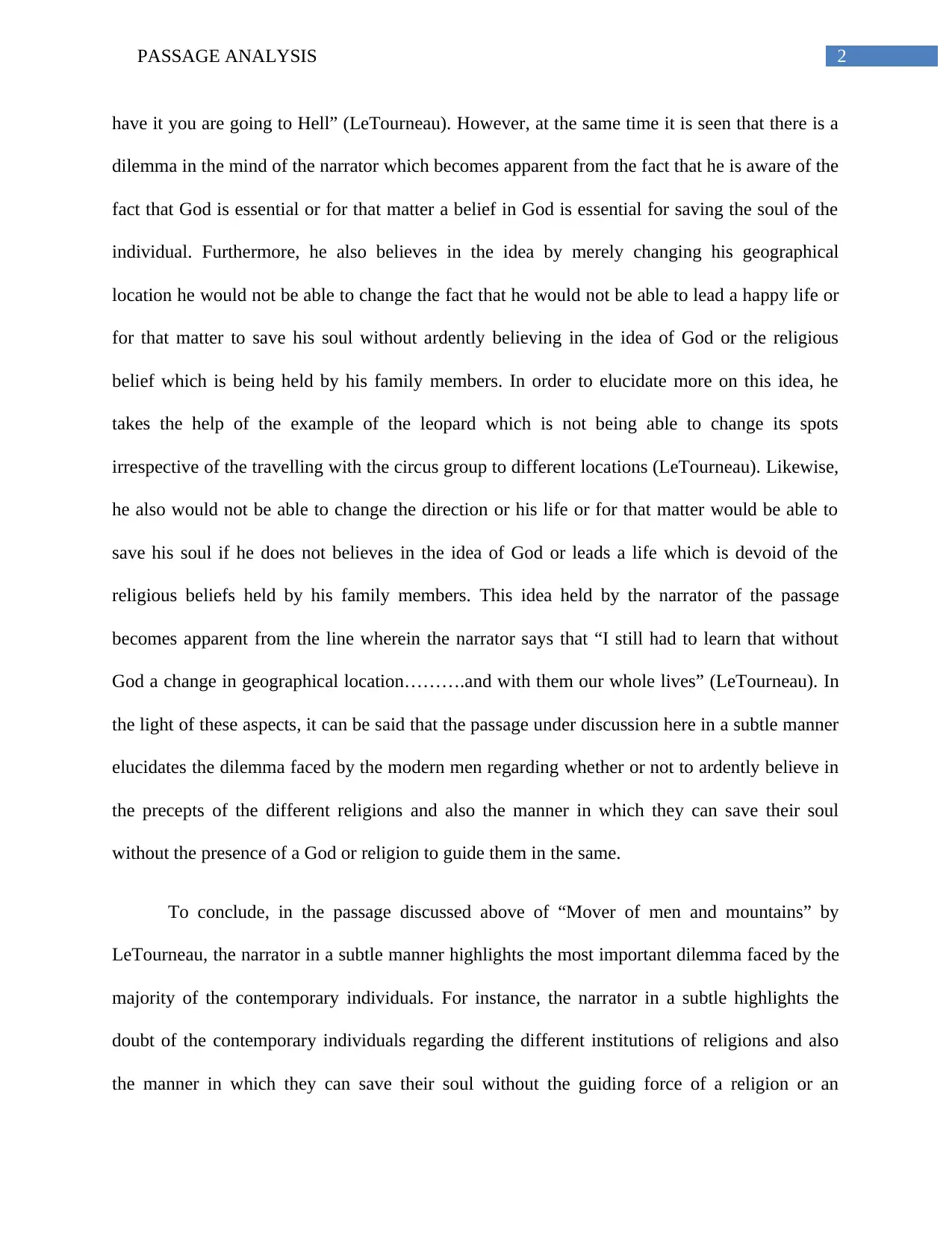
have it you are going to Hell” (LeTourneau). However, at the same time it is seen that there is a
dilemma in the mind of the narrator which becomes apparent from the fact that he is aware of the
fact that God is essential or for that matter a belief in God is essential for saving the soul of the
individual. Furthermore, he also believes in the idea by merely changing his geographical
location he would not be able to change the fact that he would not be able to lead a happy life or
for that matter to save his soul without ardently believing in the idea of God or the religious
belief which is being held by his family members. In order to elucidate more on this idea, he
takes the help of the example of the leopard which is not being able to change its spots
irrespective of the travelling with the circus group to different locations (LeTourneau). Likewise,
he also would not be able to change the direction or his life or for that matter would be able to
save his soul if he does not believes in the idea of God or leads a life which is devoid of the
religious beliefs held by his family members. This idea held by the narrator of the passage
becomes apparent from the line wherein the narrator says that “I still had to learn that without
God a change in geographical location……….and with them our whole lives” (LeTourneau). In
the light of these aspects, it can be said that the passage under discussion here in a subtle manner
elucidates the dilemma faced by the modern men regarding whether or not to ardently believe in
the precepts of the different religions and also the manner in which they can save their soul
without the presence of a God or religion to guide them in the same.
To conclude, in the passage discussed above of “Mover of men and mountains” by
LeTourneau, the narrator in a subtle manner highlights the most important dilemma faced by the
majority of the contemporary individuals. For instance, the narrator in a subtle highlights the
doubt of the contemporary individuals regarding the different institutions of religions and also
the manner in which they can save their soul without the guiding force of a religion or an
Document Page
3PASSAGE ANALYSIS
omnipotent God. These aspects of religion and the lives of the contemporary men become
apparent from the above analysis of the same in the particular context of a passage from “Mover
of men and mountains” by LeTourneau.
tabler-icon-diamond-filled.svg

Paraphrase This Document

Need a fresh take? Get an instant paraphrase of this document with our AI Paraphraser
Document Page
4PASSAGE ANALYSIS
Reference
LeTourneau, Robert Gilmour. Mover of men and mountains. Moody Publishers, 2009.
chevron_up_icon
1 out of 5
circle_padding
hide_on_mobile
zoom_out_icon
[object Object]