Jurisprudence Essay: Analysis of Paternalism in Public Policy and Law
VerifiedAdded on 2022/08/27
|13
|3425
|30
Essay
AI Summary
This jurisprudence essay delves into the concept of paternalism within public policy, examining governmental interference in individual affairs and its justification. The essay focuses on a specific policy: a law mandating that all bars, restaurants, and pubs close at 10 PM. It analyzes whether this law constitutes a paternalistic policy by exploring various types of paternalism, including soft, hard, pure, impure, moral, and welfare paternalism. The essay applies these concepts to the closing time mandate, evaluating its impact on human liberty, intrusiveness, and the balance between justice and societal norms. It also explores the relationship between work and entertainment, and whether work can be valued more than entertainment. The analysis considers the policy's potential for modification and its implications for businesses and individuals, ultimately assessing the policy's justification based on the principles of paternalism.
Running Head: JURISPRUDENCE
JURISPRUDENCE
Name of the Student
Name of the University
Author’s Note
JURISPRUDENCE
Name of the Student
Name of the University
Author’s Note

Paraphrase This Document
Need a fresh take? Get an instant paraphrase of this document with our AI Paraphraser
1JURISPRUDENCE
The paternalistic policy means a system in which the authority undertakes to tend to the
needs of the individuals or regulation of the conduct of individuals including the relation of the
individuals with that of the authority1. However, with respect to the public policy, paternalism
relates to the government or the state interference in the affairs of a person without their wilfull
consent and the interference shall be defended or motivated by the claim that the interference is
made so for the protection of the person interfered from the harm2. In other words, it is an action
which limits the person or group’s liberty in order to promote their own interest3. The aim of the
essay is to bring out the essence of paternalism in the context of public policy and establish
whether the enactment of a law stating the mandate of all bars, restaurants and pubs to close at
10 pm, is a paternalistic policy. The essay further aims to justify whether work can be more
valued than entertainment. The essay is a critical analysis of the legislation passed by the
government with respect to its paternalism and goals.
There are three types of paternalistic policy4. Firstly being the Soft paternalism and Hard
paternalism where in the former explains that the paternalism is acceptable when the action to be
committed is involuntary5. The pioneer of soft paternalism is John Stuart Mill who explains soft
paternalism as the form of extreme interference in order to prevent the person from an
involuntary harm6. However, the hard paternalism is explained as the entitlement to interfere into
the affairs of the person or the group7. Secondly being the Pure and Impure paternalism wherein
1 Roberts, David. Paternalism in Early Victorian England. Routledge, 2016.
2 Dimock, Susan. "Paternalism." Classic Readings and Cases in the Philosophy of Law. Routledge, 2016.
408-417.
3 Scoccia, Danny. "The concept of paternalism." The Routledge Handbook of the Philosophy of
Paternalism. Routledge, 2018. 11-23.
4 Bengtson, Andreas. "On the Possibility of Paternalism towards Future People." (2019).
5 Kirchgässner, Gebhard. "Soft paternalism, merit goods, and normative individualism." European Journal
of Law and Economics 43.1 (2017): 125-152.
6 Schnellenbach, Jan. "A constitutional economics perspective on soft paternalism." Kyklos 69.1
(2016): 135-156.
7 Hanna, Jason. "Hard and soft paternalism." The Routledge Handbook of the Philosophy of Paternalism.
Routledge, 2018. 24-34.
The paternalistic policy means a system in which the authority undertakes to tend to the
needs of the individuals or regulation of the conduct of individuals including the relation of the
individuals with that of the authority1. However, with respect to the public policy, paternalism
relates to the government or the state interference in the affairs of a person without their wilfull
consent and the interference shall be defended or motivated by the claim that the interference is
made so for the protection of the person interfered from the harm2. In other words, it is an action
which limits the person or group’s liberty in order to promote their own interest3. The aim of the
essay is to bring out the essence of paternalism in the context of public policy and establish
whether the enactment of a law stating the mandate of all bars, restaurants and pubs to close at
10 pm, is a paternalistic policy. The essay further aims to justify whether work can be more
valued than entertainment. The essay is a critical analysis of the legislation passed by the
government with respect to its paternalism and goals.
There are three types of paternalistic policy4. Firstly being the Soft paternalism and Hard
paternalism where in the former explains that the paternalism is acceptable when the action to be
committed is involuntary5. The pioneer of soft paternalism is John Stuart Mill who explains soft
paternalism as the form of extreme interference in order to prevent the person from an
involuntary harm6. However, the hard paternalism is explained as the entitlement to interfere into
the affairs of the person or the group7. Secondly being the Pure and Impure paternalism wherein
1 Roberts, David. Paternalism in Early Victorian England. Routledge, 2016.
2 Dimock, Susan. "Paternalism." Classic Readings and Cases in the Philosophy of Law. Routledge, 2016.
408-417.
3 Scoccia, Danny. "The concept of paternalism." The Routledge Handbook of the Philosophy of
Paternalism. Routledge, 2018. 11-23.
4 Bengtson, Andreas. "On the Possibility of Paternalism towards Future People." (2019).
5 Kirchgässner, Gebhard. "Soft paternalism, merit goods, and normative individualism." European Journal
of Law and Economics 43.1 (2017): 125-152.
6 Schnellenbach, Jan. "A constitutional economics perspective on soft paternalism." Kyklos 69.1
(2016): 135-156.
7 Hanna, Jason. "Hard and soft paternalism." The Routledge Handbook of the Philosophy of Paternalism.
Routledge, 2018. 24-34.
2JURISPRUDENCE
it can be explained that the former is explained as the person whose liberty has been taken away
are the ones who are being protected from the harm whereas the later comes into force when the
class of people whose liberty is violated by some means and such means are wider than the
group of person who are protected. Thirdly being the Moral and Welfare paternalism wherein
while one can be explained as the promotion of moral well-being of the person or the group
irrespective of the fact whether or not the welfare of the person could be improved. On the
contrary, the other can be explained as the welfare well being of the person is more important.
The moral paternalism argues to protect the ethical grounds of an act whereas the welfare
paternalism contends to protect the welfare well-being of the person ignoring the ethical grounds
of the person.
Thomas Pogge has argued that the elements for the establishment of a policy as a
paternalistic policy shall not be based on minimum grounds. However, as a general aspect, there
are three elements to establish a policy as a paternalistic policy8.
The policy should relate to the human liberty with respect to the basic freedom involving
varied subjects of religious and social backgrounds.
The policy should be such that it should be minimally inteerfering with the liberty of the
person or the group of persons.
The policy should not be exhaustive as a result of which the socities shall not have the
freedom for modification of the policy based on their needs.
8 Kleinig, John. "Paternalism and Human Dignity." Criminal Law and Philosophy 11.1 (2017): 19-
36.
it can be explained that the former is explained as the person whose liberty has been taken away
are the ones who are being protected from the harm whereas the later comes into force when the
class of people whose liberty is violated by some means and such means are wider than the
group of person who are protected. Thirdly being the Moral and Welfare paternalism wherein
while one can be explained as the promotion of moral well-being of the person or the group
irrespective of the fact whether or not the welfare of the person could be improved. On the
contrary, the other can be explained as the welfare well being of the person is more important.
The moral paternalism argues to protect the ethical grounds of an act whereas the welfare
paternalism contends to protect the welfare well-being of the person ignoring the ethical grounds
of the person.
Thomas Pogge has argued that the elements for the establishment of a policy as a
paternalistic policy shall not be based on minimum grounds. However, as a general aspect, there
are three elements to establish a policy as a paternalistic policy8.
The policy should relate to the human liberty with respect to the basic freedom involving
varied subjects of religious and social backgrounds.
The policy should be such that it should be minimally inteerfering with the liberty of the
person or the group of persons.
The policy should not be exhaustive as a result of which the socities shall not have the
freedom for modification of the policy based on their needs.
8 Kleinig, John. "Paternalism and Human Dignity." Criminal Law and Philosophy 11.1 (2017): 19-
36.
⊘ This is a preview!⊘
Do you want full access?
Subscribe today to unlock all pages.

Trusted by 1+ million students worldwide
3JURISPRUDENCE
The policy should be subject to the justice of the people. However, the aim to impart
justice must not outweigh the modest considerations with respect to the beliefs and norms
of the people affected by the policy9.
In this aspect, it can be explained that the consumption of goods and services can be enforced
with the help of price regimes as well as the option of the obligation for consumption of the
goods and services10. For an instance, the compulsory schooling of the children till the age of 16
regardless of the choice of the parents whether or not to educate the child in the state funded or
the private funded school is a mandate policy and can be explained in terms of paternalism.
However, the price of the school is regulated by the local government with respect to specific
municipal services like the use of swimming pools11. This theory can further be explained with
the help of subsidy of goods wherein the prices are controlled by the government for a specific
group of people to protect them from the harm and their access with regard to poverty. However,
the state intervention is not limited to a specific strategy but is an adoption of various strategies
at the same time in various fields like that of health care, schooling and education12, housing13
and so on. It can be noted that all the three forms of paternalism is present within the institution
of NHS, state schools and the council housing respectively14. However, the intervention is
subject to the necessity and the strategic necessity in the specific field of goods and its
9 Conly, Sarah. "Moral Paternalism." Review of Behavioral Economics 5.3-4 (2018): 291-302.
10 Evert, Vedung, and C. J. van der Doelen Frans. "The sermon: information programs in the
public policy process—choice, effects, and evaluation." Carrots, Sticks and Sermons.
Routledge, 2017. 103-128.
11 Hausman, Daniel, Michael McPherson, and Debra Satz. Economic analysis, moral philosophy,
and public policy. Cambridge University Press, 2016.
12 Drange, Nina, Tarjei Havnes, and Astrid MJ Sandsør. "Kindergarten for all: Long run effects of a
universal intervention." Economics of Education Review 53 (2016): 164-181.
13 Parsell, Cameron, and Greg Marston. "Supportive housing: justifiable paternalism?." Housing,
Theory and Society 33.2 (2016): 195-216.
14 Bartlett, Oliver. "Power, policy ideas and paternalism in non‐communicable disease
prevention." European Law Journal 24.6 (2018): 474-489.
The policy should be subject to the justice of the people. However, the aim to impart
justice must not outweigh the modest considerations with respect to the beliefs and norms
of the people affected by the policy9.
In this aspect, it can be explained that the consumption of goods and services can be enforced
with the help of price regimes as well as the option of the obligation for consumption of the
goods and services10. For an instance, the compulsory schooling of the children till the age of 16
regardless of the choice of the parents whether or not to educate the child in the state funded or
the private funded school is a mandate policy and can be explained in terms of paternalism.
However, the price of the school is regulated by the local government with respect to specific
municipal services like the use of swimming pools11. This theory can further be explained with
the help of subsidy of goods wherein the prices are controlled by the government for a specific
group of people to protect them from the harm and their access with regard to poverty. However,
the state intervention is not limited to a specific strategy but is an adoption of various strategies
at the same time in various fields like that of health care, schooling and education12, housing13
and so on. It can be noted that all the three forms of paternalism is present within the institution
of NHS, state schools and the council housing respectively14. However, the intervention is
subject to the necessity and the strategic necessity in the specific field of goods and its
9 Conly, Sarah. "Moral Paternalism." Review of Behavioral Economics 5.3-4 (2018): 291-302.
10 Evert, Vedung, and C. J. van der Doelen Frans. "The sermon: information programs in the
public policy process—choice, effects, and evaluation." Carrots, Sticks and Sermons.
Routledge, 2017. 103-128.
11 Hausman, Daniel, Michael McPherson, and Debra Satz. Economic analysis, moral philosophy,
and public policy. Cambridge University Press, 2016.
12 Drange, Nina, Tarjei Havnes, and Astrid MJ Sandsør. "Kindergarten for all: Long run effects of a
universal intervention." Economics of Education Review 53 (2016): 164-181.
13 Parsell, Cameron, and Greg Marston. "Supportive housing: justifiable paternalism?." Housing,
Theory and Society 33.2 (2016): 195-216.
14 Bartlett, Oliver. "Power, policy ideas and paternalism in non‐communicable disease
prevention." European Law Journal 24.6 (2018): 474-489.
Paraphrase This Document
Need a fresh take? Get an instant paraphrase of this document with our AI Paraphraser
4JURISPRUDENCE
consumption. Further in certain instances, it can be explained that even if there is no subsidy,
there will an existing policy with respect to the pricing with respect to the element of
consumption. For example, the Post Office charges are at the same rates to all the destinations
which are within the boundaries of the United Kingdoms. However, the prices are subsidised
with the distinction in pricing of the long distance destinations with respect to the short distance
destinations wherein the short distance destinations are cheaper than that of the long distance
destinations for a postal delivery within the boundaries of united Kingdoms. The aim of such
policy is to motivate the people to desire sustainable means of communication. However, the
intervention is not established with the aim to influence the choice of consumption of the people
whereas, the intervention is made with the aim to directly adjust the consumption patterns of the
people and groups. The specification of the state interventions has been discussed with respect to
the influencing of the patterns of consumption. The state paternalism and universal intervention
can be explained with respect to the various methods of transfer payment. For example, child
benefit amount is payable to all the mothers who embrace motherhood under a certain age,
irrespective of the income scales of the mother availaing the benefit. This eligibility is called the
universal intervention and targets the rather small group of mothers who embrace motherhood
under a certain age15. Further, the National Health Service (NHS) is also recognized under the
universal intervention scheme including the state education programs and policies and schemes.
However, the consequence of such program has been explained as the measure in which non-
price mechanisms are required for the balancing of the demand and supply of the goods and
services including the state employees and exercise of delegated authority with respect to the
rationing of resources. Thus, the unique feature of the universal intervention which distinguishes
15 Grill, Kalle. "Anti-paternalism and public health policy: The case of product safety
legislation." The Philosophy of Public Health. Routledge, 2016. 111-120.
consumption. Further in certain instances, it can be explained that even if there is no subsidy,
there will an existing policy with respect to the pricing with respect to the element of
consumption. For example, the Post Office charges are at the same rates to all the destinations
which are within the boundaries of the United Kingdoms. However, the prices are subsidised
with the distinction in pricing of the long distance destinations with respect to the short distance
destinations wherein the short distance destinations are cheaper than that of the long distance
destinations for a postal delivery within the boundaries of united Kingdoms. The aim of such
policy is to motivate the people to desire sustainable means of communication. However, the
intervention is not established with the aim to influence the choice of consumption of the people
whereas, the intervention is made with the aim to directly adjust the consumption patterns of the
people and groups. The specification of the state interventions has been discussed with respect to
the influencing of the patterns of consumption. The state paternalism and universal intervention
can be explained with respect to the various methods of transfer payment. For example, child
benefit amount is payable to all the mothers who embrace motherhood under a certain age,
irrespective of the income scales of the mother availaing the benefit. This eligibility is called the
universal intervention and targets the rather small group of mothers who embrace motherhood
under a certain age15. Further, the National Health Service (NHS) is also recognized under the
universal intervention scheme including the state education programs and policies and schemes.
However, the consequence of such program has been explained as the measure in which non-
price mechanisms are required for the balancing of the demand and supply of the goods and
services including the state employees and exercise of delegated authority with respect to the
rationing of resources. Thus, the unique feature of the universal intervention which distinguishes
15 Grill, Kalle. "Anti-paternalism and public health policy: The case of product safety
legislation." The Philosophy of Public Health. Routledge, 2016. 111-120.
5JURISPRUDENCE
it from the policy intervention is that the policy applies to the people irrespective of the income
of the consumer. It is not established that a person is required to pay a certain amount for a good
because the person’s income level is at a certail level whereas the person regardless of their
income scale shall be required to pay that particular amount as fixed by the state or the
government for that particular goods or the service.
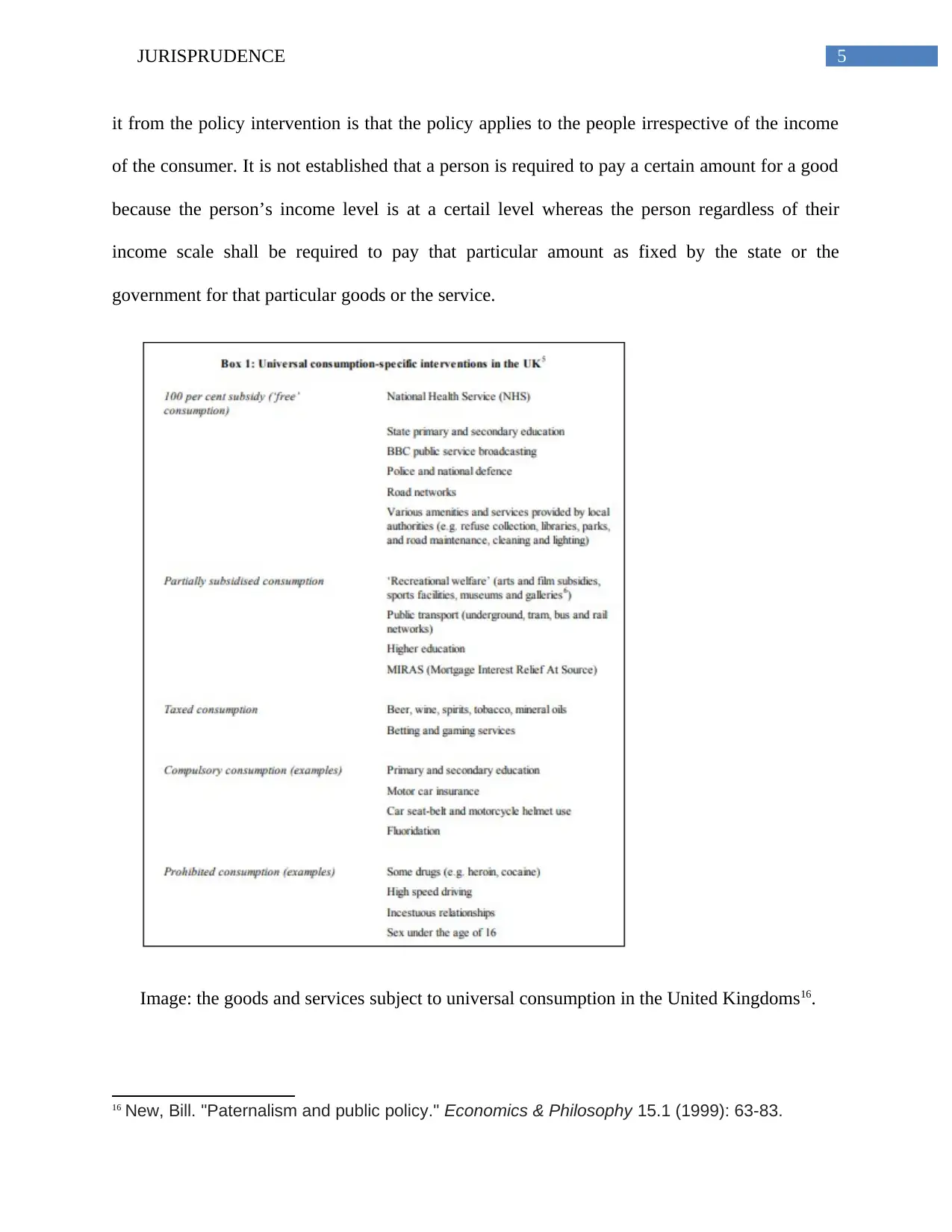
Image: the goods and services subject to universal consumption in the United Kingdoms16.
16 New, Bill. "Paternalism and public policy." Economics & Philosophy 15.1 (1999): 63-83.
it from the policy intervention is that the policy applies to the people irrespective of the income
of the consumer. It is not established that a person is required to pay a certain amount for a good
because the person’s income level is at a certail level whereas the person regardless of their
income scale shall be required to pay that particular amount as fixed by the state or the
government for that particular goods or the service.
Image: the goods and services subject to universal consumption in the United Kingdoms16.
16 New, Bill. "Paternalism and public policy." Economics & Philosophy 15.1 (1999): 63-83.
⊘ This is a preview!⊘
Do you want full access?
Subscribe today to unlock all pages.
Trusted by 1+ million students worldwide
6JURISPRUDENCE
The image above explains the goods and services which are subject to universal intervention
which is applicable to all irrespective of the income of the consumers. This includes all the
complete and partial subsidized goods and services, taxed consumption, compulsory
consumption and lastly the prohibited consumption.
The scenario explains that the government has enacted the law which makes it madatory for
all bars, restaurants and pubs to close at 10pm. The explicit goal of this policy is to assist people
in performing well in their work making late night entertainment inaccessible. The government
makes it clear that while most people appreciate the importance of working efficiently, the facts
that the humans often fail to act rationally prevents them from doing what they consider
themselves worthwhile. Thus, applying the elements of the paternalistic policy, it can be
explained that the policy is primarily made for the people to not attend the bars restaurants and
pubs after the time fixed at 10 pm and it is also established on the social background involving
the people’s time to eat food or enjoy liquor. The policy further intervenes with the liberty of the
people to eat at their own time however, the 10pm is a late night period and people are not
expected to be having their dinner food at that time and hence, the policy can be justified.
Secondly, the criteria is minimally intrusive on the ground, that it only restricts the time for the
people to not have food in restaurants, pub s and bars. However, it does not restrict the liberty of
the people to move freely beyond the time of 10 pm. Further, the policy also does not restrict any
person from having food at their own places at any time which may be earlier or beyond the time
period of 10 pm. It is only the service of bars, pubs and restaurants which are controlled by the
policy and hence, the policy can be justified to be minimally intrusive. Thirdly, the elements
explains the policy not to be understood as an exhaustive means and should be paving way for
the people to be able to modify the criteria based on their needs. Applying this element, it can be
The image above explains the goods and services which are subject to universal intervention
which is applicable to all irrespective of the income of the consumers. This includes all the
complete and partial subsidized goods and services, taxed consumption, compulsory
consumption and lastly the prohibited consumption.
The scenario explains that the government has enacted the law which makes it madatory for
all bars, restaurants and pubs to close at 10pm. The explicit goal of this policy is to assist people
in performing well in their work making late night entertainment inaccessible. The government
makes it clear that while most people appreciate the importance of working efficiently, the facts
that the humans often fail to act rationally prevents them from doing what they consider
themselves worthwhile. Thus, applying the elements of the paternalistic policy, it can be
explained that the policy is primarily made for the people to not attend the bars restaurants and
pubs after the time fixed at 10 pm and it is also established on the social background involving
the people’s time to eat food or enjoy liquor. The policy further intervenes with the liberty of the
people to eat at their own time however, the 10pm is a late night period and people are not
expected to be having their dinner food at that time and hence, the policy can be justified.
Secondly, the criteria is minimally intrusive on the ground, that it only restricts the time for the
people to not have food in restaurants, pub s and bars. However, it does not restrict the liberty of
the people to move freely beyond the time of 10 pm. Further, the policy also does not restrict any
person from having food at their own places at any time which may be earlier or beyond the time
period of 10 pm. It is only the service of bars, pubs and restaurants which are controlled by the
policy and hence, the policy can be justified to be minimally intrusive. Thirdly, the elements
explains the policy not to be understood as an exhaustive means and should be paving way for
the people to be able to modify the criteria based on their needs. Applying this element, it can be
Paraphrase This Document
Need a fresh take? Get an instant paraphrase of this document with our AI Paraphraser
7JURISPRUDENCE
explained that this policy is not exhaustive and does pave way for the society to establish take
away or home delivery systems past the 10 pm which serves as the way of modification tending
to the needs of the people. The fourth element is regarding the conflict of justice and modest
considerations wherein it can be applied and explained that the policy as enacted by the
government aims to provide time for the people to rest and work efficiently and not be engaged
in late night entertainments. At this point the ambition for justice does state that food and liquor
is the choice of the people and the intervention of the state curbing the liberty of the people to
have food and liquor in pubs, restaurants and bars after 10pm is not justified. The food is
person’s own want and wish and the restaurants serving food till late at night past the curfew
time of 10 pm may be a boon for the officers and people who work till late beyond the period of
10 pm. Curfewing then food timings should also be welcomed with the curfew in the work
timing wherein people should not be allowed to work beyond their shifty timing irrespective of
the load of work. But that is not the situation and people may stay in for work and get late to
home. And hence, in such situations,. The food availability beyond the time of 10pm is crucial.
However, the modest consideration does allow the policy to be implemented with certain
flexibility like dine in services may be closed. However, then kitchen shall be running till late
and food may be available for take away or home delivery services. However, the policy
demands the restaurants pubs and bars to be closed down by 10 pm which means the kitchen
shall also be closed down and hence, the modest consideration shall be conflicting with that of
the ambition of justice. Thus the fourth element is contradicted wherein justice shall not
outweigh the modest considerations while in the scenario, the justice outweighs the modest
considerations. However, the flexibility may be offered in the way that the bars and pubs offer
liquor and those can be controlled and be mandated to be closed down at 10 pm to ensure
explained that this policy is not exhaustive and does pave way for the society to establish take
away or home delivery systems past the 10 pm which serves as the way of modification tending
to the needs of the people. The fourth element is regarding the conflict of justice and modest
considerations wherein it can be applied and explained that the policy as enacted by the
government aims to provide time for the people to rest and work efficiently and not be engaged
in late night entertainments. At this point the ambition for justice does state that food and liquor
is the choice of the people and the intervention of the state curbing the liberty of the people to
have food and liquor in pubs, restaurants and bars after 10pm is not justified. The food is
person’s own want and wish and the restaurants serving food till late at night past the curfew
time of 10 pm may be a boon for the officers and people who work till late beyond the period of
10 pm. Curfewing then food timings should also be welcomed with the curfew in the work
timing wherein people should not be allowed to work beyond their shifty timing irrespective of
the load of work. But that is not the situation and people may stay in for work and get late to
home. And hence, in such situations,. The food availability beyond the time of 10pm is crucial.
However, the modest consideration does allow the policy to be implemented with certain
flexibility like dine in services may be closed. However, then kitchen shall be running till late
and food may be available for take away or home delivery services. However, the policy
demands the restaurants pubs and bars to be closed down by 10 pm which means the kitchen
shall also be closed down and hence, the modest consideration shall be conflicting with that of
the ambition of justice. Thus the fourth element is contradicted wherein justice shall not
outweigh the modest considerations while in the scenario, the justice outweighs the modest
considerations. However, the flexibility may be offered in the way that the bars and pubs offer
liquor and those can be controlled and be mandated to be closed down at 10 pm to ensure
8JURISPRUDENCE
people’s work efficiency. However, food is an essential consumption and flexibility regarding its
availability to the people is an important criteria. However, the policy explicitly mentions that
the restaurants shall also be closed and hence, there is no scope for running the kitchen and
making the food available by means of home delivery or the take away methods for people who
may require food late at night. Since the mandate is to improve the efficiency of the people at
work, considering the workplace scenario, it can be explained that people who stay late in office
may suffer health issues due to non-availability of food and this may result in people hurrying
home earlier evading their work for the collection of food before 10pm leading to adversities
related to the work efficiency.
It can be contended that the people who stay late for work may improve efficiency and tend
to finish work faster so as to leave workplace on time so that they can eat before restaurants close
down. However, on the larger scale wherein the stakes are higher and the work demand
substantial pressure, people would actually put in extra effort and may not want to risk the stakes
involved in the work. However, with then policy mandate, it can be explained that the people
would finish the work faster in order to rush for the food and may not attend to the matters
involving high stakes and not put in that extra effort that they were willing to put in with no
worries regarding the availability of food late at night. Thus, the work efficiency and the
availability of food at night is co-related and the policy can be justified with certain flexibilities.
At this stage, the policy cannot be justified on the ground that the work efficiency cannot be
more important than the availability of the food which is the primary and the modest
consideration for the human race and is directly correlated with the work efficiency.
people’s work efficiency. However, food is an essential consumption and flexibility regarding its
availability to the people is an important criteria. However, the policy explicitly mentions that
the restaurants shall also be closed and hence, there is no scope for running the kitchen and
making the food available by means of home delivery or the take away methods for people who
may require food late at night. Since the mandate is to improve the efficiency of the people at
work, considering the workplace scenario, it can be explained that people who stay late in office
may suffer health issues due to non-availability of food and this may result in people hurrying
home earlier evading their work for the collection of food before 10pm leading to adversities
related to the work efficiency.
It can be contended that the people who stay late for work may improve efficiency and tend
to finish work faster so as to leave workplace on time so that they can eat before restaurants close
down. However, on the larger scale wherein the stakes are higher and the work demand
substantial pressure, people would actually put in extra effort and may not want to risk the stakes
involved in the work. However, with then policy mandate, it can be explained that the people
would finish the work faster in order to rush for the food and may not attend to the matters
involving high stakes and not put in that extra effort that they were willing to put in with no
worries regarding the availability of food late at night. Thus, the work efficiency and the
availability of food at night is co-related and the policy can be justified with certain flexibilities.
At this stage, the policy cannot be justified on the ground that the work efficiency cannot be
more important than the availability of the food which is the primary and the modest
consideration for the human race and is directly correlated with the work efficiency.
⊘ This is a preview!⊘
Do you want full access?
Subscribe today to unlock all pages.
Trusted by 1+ million students worldwide
9JURISPRUDENCE
On the other hand, John Locke has criticized the theory of paternalistic policy on the ground
the political and paternal power is not the same17. He has criticized the idea of government or
state paternalism on the ground that the people have the knowledge about their moral equality
than the state or the government. Further, it has proposed that the person demands respect for
other’s liberty and autonomy on the ground that the paternalism disrupts the development of the
independency of the persons and their character to be independent and self-assessed about their
own liberty as well as the respect of rights and liberty towards others. In other words, it can be
explained that the opponents of the theory of paternalism often appeal to the theory of personal
autonomy meaning that the people should have the liberty to protect themselves from the harm
and not the government because the people or the group should be well-independent for then use
of their rights and liberty and its protection. The government shall not be entitled for the
protection of the rights and liberty of the persons, people and the groups.
Paternalism relates to the government or the state interference in the affairs of a person
without their wiful consent and the interference shall be defended or motivated by the claim that
the interference is made so for the protection of the person interfered from the harm. In other
words, it is an action which limits the peerson or group’s liberty in order to promote their own
interest. Thus, it can be concluded that the policy mandate is a thus a paternalistic policy which
restricts the liberty of the people from going to restaurants, bars and pubs after the restricted time
of 10pm. However, the policy cannot be justified on the ground that the food is the basic
necessity of any human race and hence, the availability of food is directly proportionate to that of
work efficiency. However, the the policy focuses on the correlation between the entertainment
and work and hence, it can be explained that both entertainment and work are required for the
17 Wright, Craig S. "The irrationality defense of Paternalism." Available at SSRN 2993306 (2017).
On the other hand, John Locke has criticized the theory of paternalistic policy on the ground
the political and paternal power is not the same17. He has criticized the idea of government or
state paternalism on the ground that the people have the knowledge about their moral equality
than the state or the government. Further, it has proposed that the person demands respect for
other’s liberty and autonomy on the ground that the paternalism disrupts the development of the
independency of the persons and their character to be independent and self-assessed about their
own liberty as well as the respect of rights and liberty towards others. In other words, it can be
explained that the opponents of the theory of paternalism often appeal to the theory of personal
autonomy meaning that the people should have the liberty to protect themselves from the harm
and not the government because the people or the group should be well-independent for then use
of their rights and liberty and its protection. The government shall not be entitled for the
protection of the rights and liberty of the persons, people and the groups.
Paternalism relates to the government or the state interference in the affairs of a person
without their wiful consent and the interference shall be defended or motivated by the claim that
the interference is made so for the protection of the person interfered from the harm. In other
words, it is an action which limits the peerson or group’s liberty in order to promote their own
interest. Thus, it can be concluded that the policy mandate is a thus a paternalistic policy which
restricts the liberty of the people from going to restaurants, bars and pubs after the restricted time
of 10pm. However, the policy cannot be justified on the ground that the food is the basic
necessity of any human race and hence, the availability of food is directly proportionate to that of
work efficiency. However, the the policy focuses on the correlation between the entertainment
and work and hence, it can be explained that both entertainment and work are required for the
17 Wright, Craig S. "The irrationality defense of Paternalism." Available at SSRN 2993306 (2017).
Paraphrase This Document
Need a fresh take? Get an instant paraphrase of this document with our AI Paraphraser
10JURISPRUDENCE
sustainability of human life. As it has been stated, “all work no play makes Jack a dull boy”, it
can be explained that all work and no entertainment shall not be sustainable for the human life
and hence, work and entertainment both are important. However, both should be assessed in
accordance to its necessity and importance. Furtherance, it can be explained that the policy has
restricted the restaurants from being open after 10pm and hence, it can be argued that restaurants
serves food and food is not a part of entertainment. Food is a necessity and a basic right of a
peson and such restriction cannot be imposed on a basic necessity without a similar restriction on
work which may be contradictory to human health in case the food is unavailable late at night
due to extra work in workplace.
sustainability of human life. As it has been stated, “all work no play makes Jack a dull boy”, it
can be explained that all work and no entertainment shall not be sustainable for the human life
and hence, work and entertainment both are important. However, both should be assessed in
accordance to its necessity and importance. Furtherance, it can be explained that the policy has
restricted the restaurants from being open after 10pm and hence, it can be argued that restaurants
serves food and food is not a part of entertainment. Food is a necessity and a basic right of a
peson and such restriction cannot be imposed on a basic necessity without a similar restriction on
work which may be contradictory to human health in case the food is unavailable late at night
due to extra work in workplace.
11JURISPRUDENCE
BIBLIOGRAPHY:
Journals and Scholars:
Bartlett, Oliver. "Power, policy ideas and paternalism in non‐communicable disease
prevention." European Law Journal 24.6 (2018): 474-489.
Bengtson, Andreas. "On the Possibility of Paternalism towards Future People." (2019).
Conly, Sarah. "Moral Paternalism." Review of Behavioral Economics 5.3-4 (2018): 291-302.
Dimock, Susan. "Paternalism." Classic Readings and Cases in the Philosophy of Law.
Routledge, 2016. 408-417.
Drange, Nina, Tarjei Havnes, and Astrid MJ Sandsør. "Kindergarten for all: Long run effects of a
universal intervention." Economics of Education Review 53 (2016): 164-181
Evert, Vedung, and C. J. van der Doelen Frans. "The sermon: information programs in the public
policy process—choice, effects, and evaluation." Carrots, Sticks and Sermons. Routledge, 2017.
103-128.
Grill, Kalle. "Anti-paternalism and public health policy: The case of product safety
legislation." The Philosophy of Public Health. Routledge, 2016. 111-120.
Hausman, Daniel, Michael McPherson, and Debra Satz. Economic analysis, moral philosophy,
and public policy. Cambridge University Press, 2016.
BIBLIOGRAPHY:
Journals and Scholars:
Bartlett, Oliver. "Power, policy ideas and paternalism in non‐communicable disease
prevention." European Law Journal 24.6 (2018): 474-489.
Bengtson, Andreas. "On the Possibility of Paternalism towards Future People." (2019).
Conly, Sarah. "Moral Paternalism." Review of Behavioral Economics 5.3-4 (2018): 291-302.
Dimock, Susan. "Paternalism." Classic Readings and Cases in the Philosophy of Law.
Routledge, 2016. 408-417.
Drange, Nina, Tarjei Havnes, and Astrid MJ Sandsør. "Kindergarten for all: Long run effects of a
universal intervention." Economics of Education Review 53 (2016): 164-181
Evert, Vedung, and C. J. van der Doelen Frans. "The sermon: information programs in the public
policy process—choice, effects, and evaluation." Carrots, Sticks and Sermons. Routledge, 2017.
103-128.
Grill, Kalle. "Anti-paternalism and public health policy: The case of product safety
legislation." The Philosophy of Public Health. Routledge, 2016. 111-120.
Hausman, Daniel, Michael McPherson, and Debra Satz. Economic analysis, moral philosophy,
and public policy. Cambridge University Press, 2016.
⊘ This is a preview!⊘
Do you want full access?
Subscribe today to unlock all pages.
Trusted by 1+ million students worldwide

1 out of 13


Your All-in-One AI-Powered Toolkit for Academic Success.
+13062052269
info@desklib.com
Available 24*7 on WhatsApp / Email
![[object Object]](/_next/static/media/star-bottom.7253800d.svg)
Unlock your academic potential
Copyright © 2020–2026 A2Z Services. All Rights Reserved. Developed and managed by ZUCOL.