Nursing Assessment and Care Plan for Patient Violet Smith, NURSING 19
VerifiedAdded on 2022/09/08
|23
|11324
|14
Report
AI Summary
This report details a nursing assessment and care plan for an 82-year-old female patient named Violet Smith, addressing her high blood pressure and mobility issues. The assessment covers Violet's medical history, vital signs (including a concerning blood pressure reading), and Activities of Daily Living (ADLs). The care plan focuses on improving her hand tremors and mobility, as well as lowering her blood pressure through interventions such as physical therapy, medication, and lifestyle adjustments. The report also discusses the importance of professionalism in nursing practice, ethical considerations, and interprofessional collaboration. The assessment uses a fictional patient and adheres to confidentiality guidelines, as per NMC (2018). The report includes a nursing diagnosis, goals and outcomes, and detailed interventions, referencing relevant literature to support the care plan.
Running head: NURSING
ASSESSMENT OF A PATIENT
Name of the Student
Name of the University
Author Note
ASSESSMENT OF A PATIENT
Name of the Student
Name of the University
Author Note

Paraphrase This Document
Need a fresh take? Get an instant paraphrase of this document with our AI Paraphraser
1NURSING
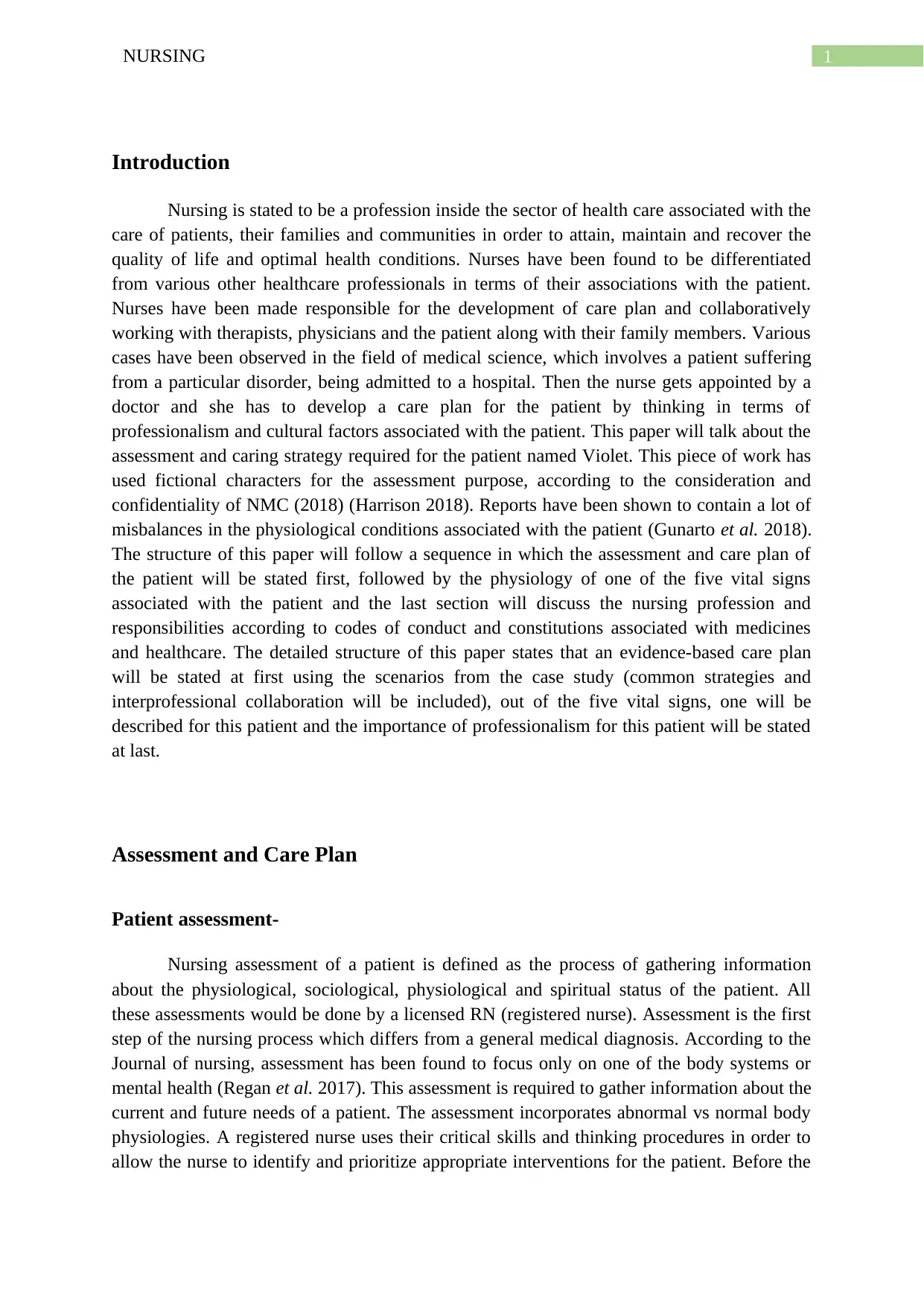
Introduction
Nursing is stated to be a profession inside the sector of health care associated with the
care of patients, their families and communities in order to attain, maintain and recover the
quality of life and optimal health conditions. Nurses have been found to be differentiated
from various other healthcare professionals in terms of their associations with the patient.
Nurses have been made responsible for the development of care plan and collaboratively
working with therapists, physicians and the patient along with their family members. Various
cases have been observed in the field of medical science, which involves a patient suffering
from a particular disorder, being admitted to a hospital. Then the nurse gets appointed by a
doctor and she has to develop a care plan for the patient by thinking in terms of
professionalism and cultural factors associated with the patient. This paper will talk about the
assessment and caring strategy required for the patient named Violet. This piece of work has
used fictional characters for the assessment purpose, according to the consideration and
confidentiality of NMC (2018) (Harrison 2018). Reports have been shown to contain a lot of
misbalances in the physiological conditions associated with the patient (Gunarto et al. 2018).
The structure of this paper will follow a sequence in which the assessment and care plan of
the patient will be stated first, followed by the physiology of one of the five vital signs
associated with the patient and the last section will discuss the nursing profession and
responsibilities according to codes of conduct and constitutions associated with medicines
and healthcare. The detailed structure of this paper states that an evidence-based care plan
will be stated at first using the scenarios from the case study (common strategies and
interprofessional collaboration will be included), out of the five vital signs, one will be
described for this patient and the importance of professionalism for this patient will be stated
at last.
Assessment and Care Plan
Patient assessment-
Nursing assessment of a patient is defined as the process of gathering information
about the physiological, sociological, physiological and spiritual status of the patient. All
these assessments would be done by a licensed RN (registered nurse). Assessment is the first
step of the nursing process which differs from a general medical diagnosis. According to the
Journal of nursing, assessment has been found to focus only on one of the body systems or
mental health (Regan et al. 2017). This assessment is required to gather information about the
current and future needs of a patient. The assessment incorporates abnormal vs normal body
physiologies. A registered nurse uses their critical skills and thinking procedures in order to
allow the nurse to identify and prioritize appropriate interventions for the patient. Before the
Introduction
Nursing is stated to be a profession inside the sector of health care associated with the
care of patients, their families and communities in order to attain, maintain and recover the
quality of life and optimal health conditions. Nurses have been found to be differentiated
from various other healthcare professionals in terms of their associations with the patient.
Nurses have been made responsible for the development of care plan and collaboratively
working with therapists, physicians and the patient along with their family members. Various
cases have been observed in the field of medical science, which involves a patient suffering
from a particular disorder, being admitted to a hospital. Then the nurse gets appointed by a
doctor and she has to develop a care plan for the patient by thinking in terms of
professionalism and cultural factors associated with the patient. This paper will talk about the
assessment and caring strategy required for the patient named Violet. This piece of work has
used fictional characters for the assessment purpose, according to the consideration and
confidentiality of NMC (2018) (Harrison 2018). Reports have been shown to contain a lot of
misbalances in the physiological conditions associated with the patient (Gunarto et al. 2018).
The structure of this paper will follow a sequence in which the assessment and care plan of
the patient will be stated first, followed by the physiology of one of the five vital signs
associated with the patient and the last section will discuss the nursing profession and
responsibilities according to codes of conduct and constitutions associated with medicines
and healthcare. The detailed structure of this paper states that an evidence-based care plan
will be stated at first using the scenarios from the case study (common strategies and
interprofessional collaboration will be included), out of the five vital signs, one will be
described for this patient and the importance of professionalism for this patient will be stated
at last.
Assessment and Care Plan
Patient assessment-
Nursing assessment of a patient is defined as the process of gathering information
about the physiological, sociological, physiological and spiritual status of the patient. All
these assessments would be done by a licensed RN (registered nurse). Assessment is the first
step of the nursing process which differs from a general medical diagnosis. According to the
Journal of nursing, assessment has been found to focus only on one of the body systems or
mental health (Regan et al. 2017). This assessment is required to gather information about the
current and future needs of a patient. The assessment incorporates abnormal vs normal body
physiologies. A registered nurse uses their critical skills and thinking procedures in order to
allow the nurse to identify and prioritize appropriate interventions for the patient. Before the
2NURSING
beginning of an assessment, a nurse establishes a therapeutic and professional mode of
communication (Bauer and Bodenheimer 2017). The most common method of initiating a
communication procedure (therapeutic) is to have the nurse to introduce themselves. The
process of OLDCART (Onset of health concern or complaint, Location of pain and
symptoms, Duration of health complaint and concern), Characteristics, Aggravating factors,
Relieving factors and Treatments required for the patient) are used by a registered nurse to
assess a patient. Thus, it can be stated that the previous section talks about a brief about the
general description of a nursing assessment followed for every patient. Physical and cultural
assessments are integral parts of a patient assessment, which has also been followed for this
patient also. Various assessment tools are used for the assessment of a patient. As a nurse, a
hypothetical tool has been used for the assessment of the patient, which contains various
questions about the characteristics of the patient.
Care plan-
Patient: Mrs. Violet Smith
Care plan by: Registered Nurse
Data initiated: XXX
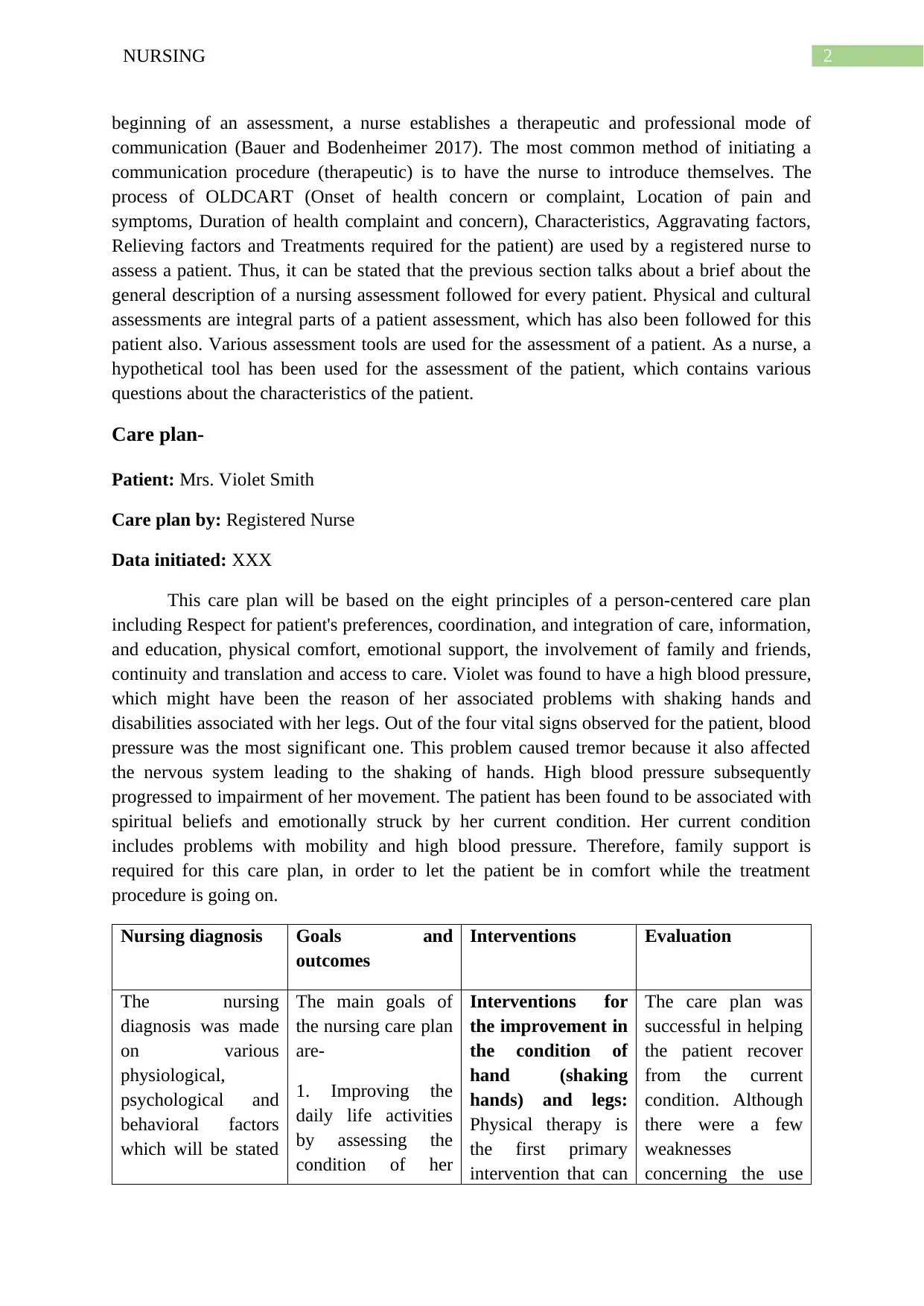
This care plan will be based on the eight principles of a person-centered care plan
including Respect for patient's preferences, coordination, and integration of care, information,
and education, physical comfort, emotional support, the involvement of family and friends,
continuity and translation and access to care. Violet was found to have a high blood pressure,
which might have been the reason of her associated problems with shaking hands and
disabilities associated with her legs. Out of the four vital signs observed for the patient, blood
pressure was the most significant one. This problem caused tremor because it also affected
the nervous system leading to the shaking of hands. High blood pressure subsequently
progressed to impairment of her movement. The patient has been found to be associated with
spiritual beliefs and emotionally struck by her current condition. Her current condition
includes problems with mobility and high blood pressure. Therefore, family support is
required for this care plan, in order to let the patient be in comfort while the treatment
procedure is going on.
Nursing diagnosis Goals and
outcomes
Interventions Evaluation
The nursing
diagnosis was made
on various
physiological,
psychological and
behavioral factors
which will be stated
The main goals of
the nursing care plan
are-
1. Improving the
daily life activities
by assessing the
condition of her
Interventions for
the improvement in
the condition of
hand (shaking
hands) and legs:
Physical therapy is
the first primary
intervention that can
The care plan was
successful in helping
the patient recover
from the current
condition. Although
there were a few
weaknesses
concerning the use
beginning of an assessment, a nurse establishes a therapeutic and professional mode of
communication (Bauer and Bodenheimer 2017). The most common method of initiating a
communication procedure (therapeutic) is to have the nurse to introduce themselves. The
process of OLDCART (Onset of health concern or complaint, Location of pain and
symptoms, Duration of health complaint and concern), Characteristics, Aggravating factors,
Relieving factors and Treatments required for the patient) are used by a registered nurse to
assess a patient. Thus, it can be stated that the previous section talks about a brief about the
general description of a nursing assessment followed for every patient. Physical and cultural
assessments are integral parts of a patient assessment, which has also been followed for this
patient also. Various assessment tools are used for the assessment of a patient. As a nurse, a
hypothetical tool has been used for the assessment of the patient, which contains various
questions about the characteristics of the patient.
Care plan-
Patient: Mrs. Violet Smith
Care plan by: Registered Nurse
Data initiated: XXX
This care plan will be based on the eight principles of a person-centered care plan
including Respect for patient's preferences, coordination, and integration of care, information,
and education, physical comfort, emotional support, the involvement of family and friends,
continuity and translation and access to care. Violet was found to have a high blood pressure,
which might have been the reason of her associated problems with shaking hands and
disabilities associated with her legs. Out of the four vital signs observed for the patient, blood
pressure was the most significant one. This problem caused tremor because it also affected
the nervous system leading to the shaking of hands. High blood pressure subsequently
progressed to impairment of her movement. The patient has been found to be associated with
spiritual beliefs and emotionally struck by her current condition. Her current condition
includes problems with mobility and high blood pressure. Therefore, family support is
required for this care plan, in order to let the patient be in comfort while the treatment
procedure is going on.
Nursing diagnosis Goals and
outcomes
Interventions Evaluation
The nursing
diagnosis was made
on various
physiological,
psychological and
behavioral factors
which will be stated
The main goals of
the nursing care plan
are-
1. Improving the
daily life activities
by assessing the
condition of her
Interventions for
the improvement in
the condition of
hand (shaking
hands) and legs:
Physical therapy is
the first primary
intervention that can
The care plan was
successful in helping
the patient recover
from the current
condition. Although
there were a few
weaknesses
concerning the use
⊘ This is a preview!⊘
Do you want full access?
Subscribe today to unlock all pages.

Trusted by 1+ million students worldwide
3NURSING
below.
Behavioral
diagnosis-
There were no
observable
behavioral problems,
no signs of memory
loss and challenging
behavior has been
observed.
Cognitive
functions-
Violet has not been
observed to use the
phone, had
knowledge about her
age, proper
understanding of
information, and no
problems with
decision making and
speaking.
Mobility-
Violet has been
found to experience
from a fall, a day
before a visit from
the nurses. She had
also been exposed to
suffer from other
falls in a previous
case. However, she
was found to get up
from the fall on her
own. Violet has also
been found to walk
by holding a
furniture chair and
table. However, she
was not observed to
hands. Proper
treatment will be
provided for the
restoration of the
normal functioning
of her hands.
2. The treatment
plan for the
improvement in her
limbs (legs)
conditions has to be
determined to make
her walk properly
instead of holding a
table or chair.
3. Reduction in
blood pressure is the
third goal of this
nursing care plan.
This reduction is
essential for Violet
since she has been
found to be exposed
to high blood
pressure.
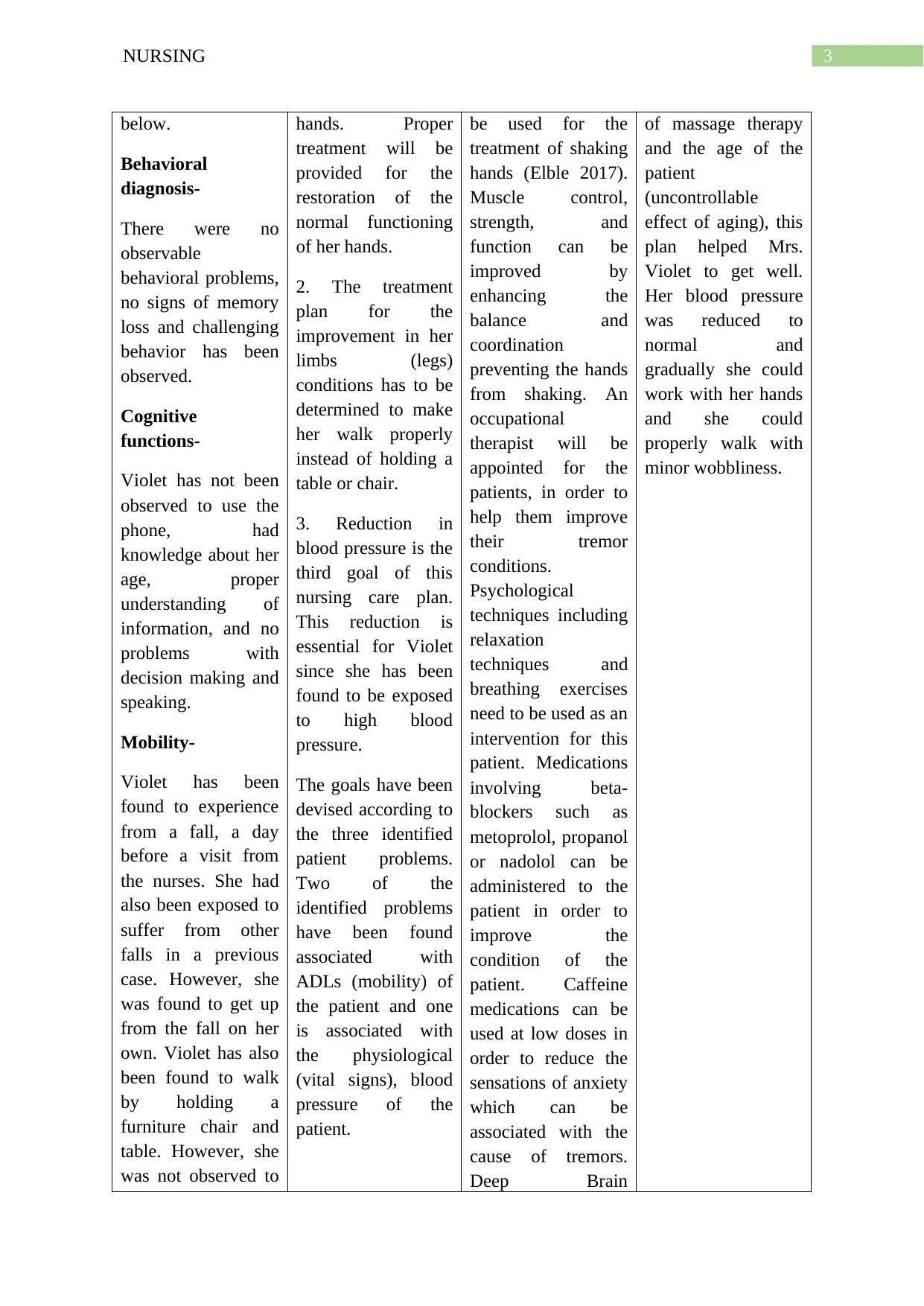
The goals have been
devised according to
the three identified
patient problems.
Two of the
identified problems
have been found
associated with
ADLs (mobility) of
the patient and one
is associated with
the physiological
(vital signs), blood
pressure of the
patient.
be used for the
treatment of shaking
hands (Elble 2017).
Muscle control,
strength, and
function can be
improved by
enhancing the
balance and
coordination
preventing the hands
from shaking. An
occupational
therapist will be
appointed for the
patients, in order to
help them improve
their tremor
conditions.
Psychological
techniques including
relaxation
techniques and
breathing exercises
need to be used as an
intervention for this
patient. Medications
involving beta-
blockers such as
metoprolol, propanol
or nadolol can be
administered to the
patient in order to
improve the
condition of the
patient. Caffeine
medications can be
used at low doses in
order to reduce the
sensations of anxiety
which can be
associated with the
cause of tremors.
Deep Brain
of massage therapy
and the age of the
patient
(uncontrollable
effect of aging), this
plan helped Mrs.
Violet to get well.
Her blood pressure
was reduced to
normal and
gradually she could
work with her hands
and she could
properly walk with
minor wobbliness.
below.
Behavioral
diagnosis-
There were no
observable
behavioral problems,
no signs of memory
loss and challenging
behavior has been
observed.
Cognitive
functions-
Violet has not been
observed to use the
phone, had
knowledge about her
age, proper
understanding of
information, and no
problems with
decision making and
speaking.
Mobility-
Violet has been
found to experience
from a fall, a day
before a visit from
the nurses. She had
also been exposed to
suffer from other
falls in a previous
case. However, she
was found to get up
from the fall on her
own. Violet has also
been found to walk
by holding a
furniture chair and
table. However, she
was not observed to
hands. Proper
treatment will be
provided for the
restoration of the
normal functioning
of her hands.
2. The treatment
plan for the
improvement in her
limbs (legs)
conditions has to be
determined to make
her walk properly
instead of holding a
table or chair.
3. Reduction in
blood pressure is the
third goal of this
nursing care plan.
This reduction is
essential for Violet
since she has been
found to be exposed
to high blood
pressure.
The goals have been
devised according to
the three identified
patient problems.
Two of the
identified problems
have been found
associated with
ADLs (mobility) of
the patient and one
is associated with
the physiological
(vital signs), blood
pressure of the
patient.
be used for the
treatment of shaking
hands (Elble 2017).
Muscle control,
strength, and
function can be
improved by
enhancing the
balance and
coordination
preventing the hands
from shaking. An
occupational
therapist will be
appointed for the
patients, in order to
help them improve
their tremor
conditions.
Psychological
techniques including
relaxation
techniques and
breathing exercises
need to be used as an
intervention for this
patient. Medications
involving beta-
blockers such as
metoprolol, propanol
or nadolol can be
administered to the
patient in order to
improve the
condition of the
patient. Caffeine
medications can be
used at low doses in
order to reduce the
sensations of anxiety
which can be
associated with the
cause of tremors.
Deep Brain
of massage therapy
and the age of the
patient
(uncontrollable
effect of aging), this
plan helped Mrs.
Violet to get well.
Her blood pressure
was reduced to
normal and
gradually she could
work with her hands
and she could
properly walk with
minor wobbliness.
Paraphrase This Document
Need a fresh take? Get an instant paraphrase of this document with our AI Paraphraser
4NURSING
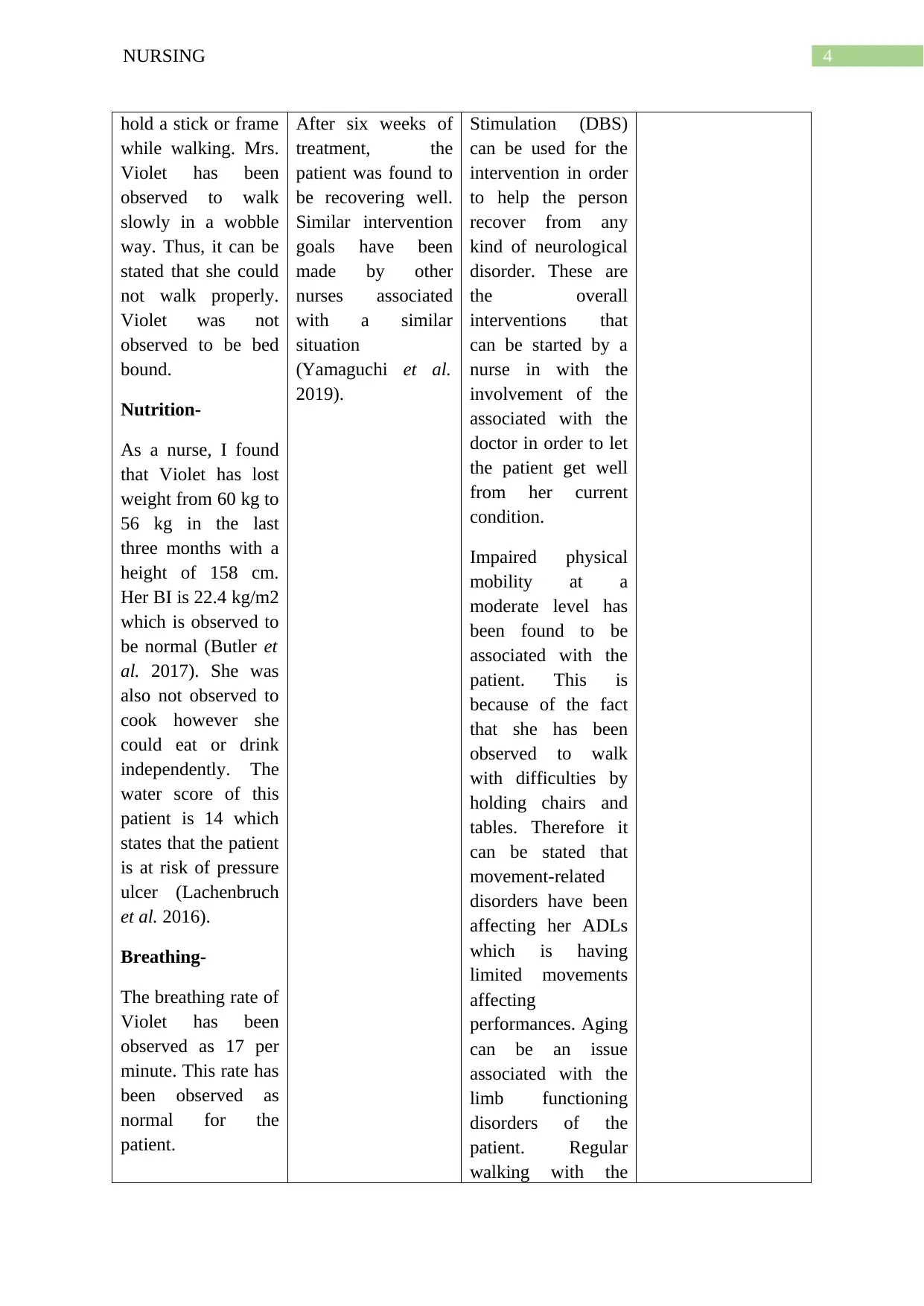
hold a stick or frame
while walking. Mrs.
Violet has been
observed to walk
slowly in a wobble
way. Thus, it can be
stated that she could
not walk properly.
Violet was not
observed to be bed
bound.
Nutrition-
As a nurse, I found
that Violet has lost
weight from 60 kg to
56 kg in the last
three months with a
height of 158 cm.
Her BI is 22.4 kg/m2
which is observed to
be normal (Butler et
al. 2017). She was
also not observed to
cook however she
could eat or drink
independently. The
water score of this
patient is 14 which
states that the patient
is at risk of pressure
ulcer (Lachenbruch
et al. 2016).
Breathing-
The breathing rate of
Violet has been
observed as 17 per
minute. This rate has
been observed as
normal for the
patient.
After six weeks of
treatment, the
patient was found to
be recovering well.
Similar intervention
goals have been
made by other
nurses associated
with a similar
situation
(Yamaguchi et al.
2019).
Stimulation (DBS)
can be used for the
intervention in order
to help the person
recover from any
kind of neurological
disorder. These are
the overall
interventions that
can be started by a
nurse in with the
involvement of the
associated with the
doctor in order to let
the patient get well
from her current
condition.
Impaired physical
mobility at a
moderate level has
been found to be
associated with the
patient. This is
because of the fact
that she has been
observed to walk
with difficulties by
holding chairs and
tables. Therefore it
can be stated that
movement-related
disorders have been
affecting her ADLs
which is having
limited movements
affecting
performances. Aging
can be an issue
associated with the
limb functioning
disorders of the
patient. Regular
walking with the
hold a stick or frame
while walking. Mrs.
Violet has been
observed to walk
slowly in a wobble
way. Thus, it can be
stated that she could
not walk properly.
Violet was not
observed to be bed
bound.
Nutrition-
As a nurse, I found
that Violet has lost
weight from 60 kg to
56 kg in the last
three months with a
height of 158 cm.
Her BI is 22.4 kg/m2
which is observed to
be normal (Butler et
al. 2017). She was
also not observed to
cook however she
could eat or drink
independently. The
water score of this
patient is 14 which
states that the patient
is at risk of pressure
ulcer (Lachenbruch
et al. 2016).
Breathing-
The breathing rate of
Violet has been
observed as 17 per
minute. This rate has
been observed as
normal for the
patient.
After six weeks of
treatment, the
patient was found to
be recovering well.
Similar intervention
goals have been
made by other
nurses associated
with a similar
situation
(Yamaguchi et al.
2019).
Stimulation (DBS)
can be used for the
intervention in order
to help the person
recover from any
kind of neurological
disorder. These are
the overall
interventions that
can be started by a
nurse in with the
involvement of the
associated with the
doctor in order to let
the patient get well
from her current
condition.
Impaired physical
mobility at a
moderate level has
been found to be
associated with the
patient. This is
because of the fact
that she has been
observed to walk
with difficulties by
holding chairs and
tables. Therefore it
can be stated that
movement-related
disorders have been
affecting her ADLs
which is having
limited movements
affecting
performances. Aging
can be an issue
associated with the
limb functioning
disorders of the
patient. Regular
walking with the
5NURSING
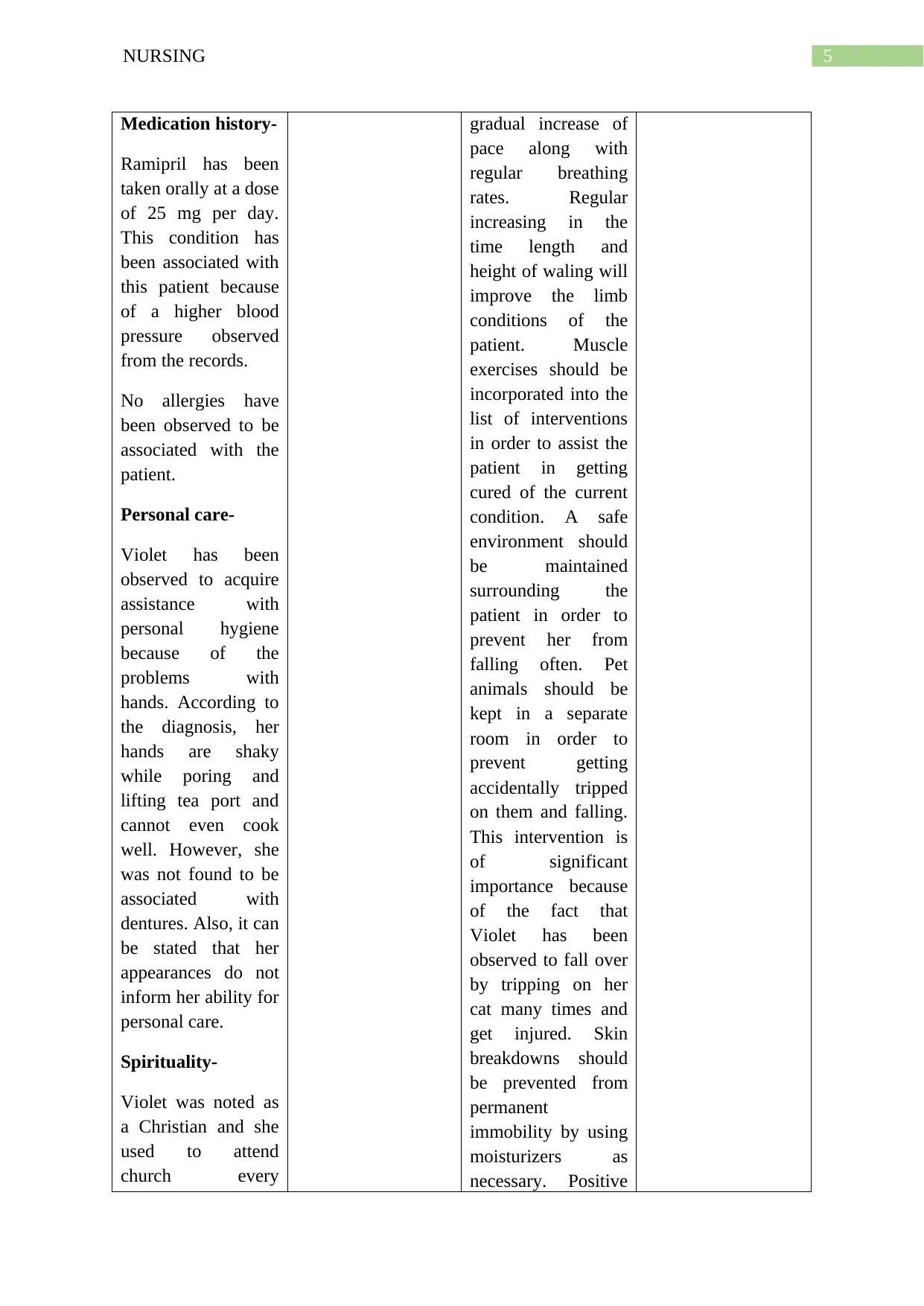
Medication history-
Ramipril has been
taken orally at a dose
of 25 mg per day.
This condition has
been associated with
this patient because
of a higher blood
pressure observed
from the records.
No allergies have
been observed to be
associated with the
patient.
Personal care-
Violet has been
observed to acquire
assistance with
personal hygiene
because of the
problems with
hands. According to
the diagnosis, her
hands are shaky
while poring and
lifting tea port and
cannot even cook
well. However, she
was not found to be
associated with
dentures. Also, it can
be stated that her
appearances do not
inform her ability for
personal care.
Spirituality-
Violet was noted as
a Christian and she
used to attend
church every
gradual increase of
pace along with
regular breathing
rates. Regular
increasing in the
time length and
height of waling will
improve the limb
conditions of the
patient. Muscle
exercises should be
incorporated into the
list of interventions
in order to assist the
patient in getting
cured of the current
condition. A safe
environment should
be maintained
surrounding the
patient in order to
prevent her from
falling often. Pet
animals should be
kept in a separate
room in order to
prevent getting
accidentally tripped
on them and falling.
This intervention is
of significant
importance because
of the fact that
Violet has been
observed to fall over
by tripping on her
cat many times and
get injured. Skin
breakdowns should
be prevented from
permanent
immobility by using
moisturizers as
necessary. Positive
Medication history-
Ramipril has been
taken orally at a dose
of 25 mg per day.
This condition has
been associated with
this patient because
of a higher blood
pressure observed
from the records.
No allergies have
been observed to be
associated with the
patient.
Personal care-
Violet has been
observed to acquire
assistance with
personal hygiene
because of the
problems with
hands. According to
the diagnosis, her
hands are shaky
while poring and
lifting tea port and
cannot even cook
well. However, she
was not found to be
associated with
dentures. Also, it can
be stated that her
appearances do not
inform her ability for
personal care.
Spirituality-
Violet was noted as
a Christian and she
used to attend
church every
gradual increase of
pace along with
regular breathing
rates. Regular
increasing in the
time length and
height of waling will
improve the limb
conditions of the
patient. Muscle
exercises should be
incorporated into the
list of interventions
in order to assist the
patient in getting
cured of the current
condition. A safe
environment should
be maintained
surrounding the
patient in order to
prevent her from
falling often. Pet
animals should be
kept in a separate
room in order to
prevent getting
accidentally tripped
on them and falling.
This intervention is
of significant
importance because
of the fact that
Violet has been
observed to fall over
by tripping on her
cat many times and
get injured. Skin
breakdowns should
be prevented from
permanent
immobility by using
moisturizers as
necessary. Positive
⊘ This is a preview!⊘
Do you want full access?
Subscribe today to unlock all pages.
Trusted by 1+ million students worldwide
6NURSING
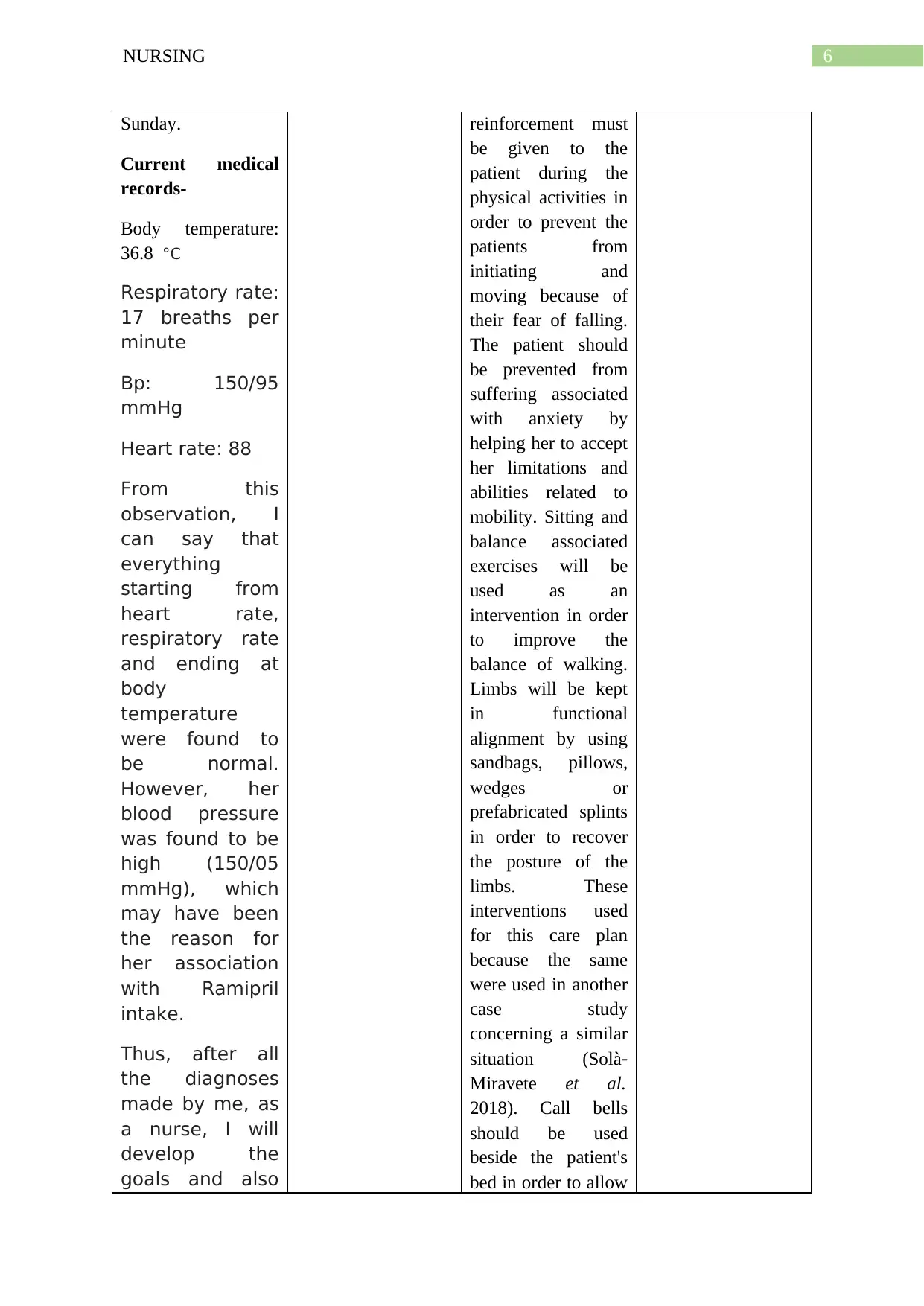
Sunday.
Current medical
records-
Body temperature:
36.8 °C
Respiratory rate:
17 breaths per
minute
Bp: 150/95
mmHg
Heart rate: 88
From this
observation, I
can say that
everything
starting from
heart rate,
respiratory rate
and ending at
body
temperature
were found to
be normal.
However, her
blood pressure
was found to be
high (150/05
mmHg), which
may have been
the reason for
her association
with Ramipril
intake.
Thus, after all
the diagnoses
made by me, as
a nurse, I will
develop the
goals and also
reinforcement must
be given to the
patient during the
physical activities in
order to prevent the
patients from
initiating and
moving because of
their fear of falling.
The patient should
be prevented from
suffering associated
with anxiety by
helping her to accept
her limitations and
abilities related to
mobility. Sitting and
balance associated
exercises will be
used as an
intervention in order
to improve the
balance of walking.
Limbs will be kept
in functional
alignment by using
sandbags, pillows,
wedges or
prefabricated splints
in order to recover
the posture of the
limbs. These
interventions used
for this care plan
because the same
were used in another
case study
concerning a similar
situation (Solà‐
Miravete et al.
2018). Call bells
should be used
beside the patient's
bed in order to allow
Sunday.
Current medical
records-
Body temperature:
36.8 °C
Respiratory rate:
17 breaths per
minute
Bp: 150/95
mmHg
Heart rate: 88
From this
observation, I
can say that
everything
starting from
heart rate,
respiratory rate
and ending at
body
temperature
were found to
be normal.
However, her
blood pressure
was found to be
high (150/05
mmHg), which
may have been
the reason for
her association
with Ramipril
intake.
Thus, after all
the diagnoses
made by me, as
a nurse, I will
develop the
goals and also
reinforcement must
be given to the
patient during the
physical activities in
order to prevent the
patients from
initiating and
moving because of
their fear of falling.
The patient should
be prevented from
suffering associated
with anxiety by
helping her to accept
her limitations and
abilities related to
mobility. Sitting and
balance associated
exercises will be
used as an
intervention in order
to improve the
balance of walking.
Limbs will be kept
in functional
alignment by using
sandbags, pillows,
wedges or
prefabricated splints
in order to recover
the posture of the
limbs. These
interventions used
for this care plan
because the same
were used in another
case study
concerning a similar
situation (Solà‐
Miravete et al.
2018). Call bells
should be used
beside the patient's
bed in order to allow
Paraphrase This Document
Need a fresh take? Get an instant paraphrase of this document with our AI Paraphraser
7NURSING
state the
expected
outcomes after
the
implementation
of the care plan.
the patient to call her
family members of
caretakers to help
her in recovering
from the emergency
situation. Principles
associated with
reinforcements of
physical exercise
emphasizing the
joints should be used
for the patient. The
family members are
also to be taught to
provide a hazard-
free and safe
atmosphere for the
patient to help him
with her recovery.
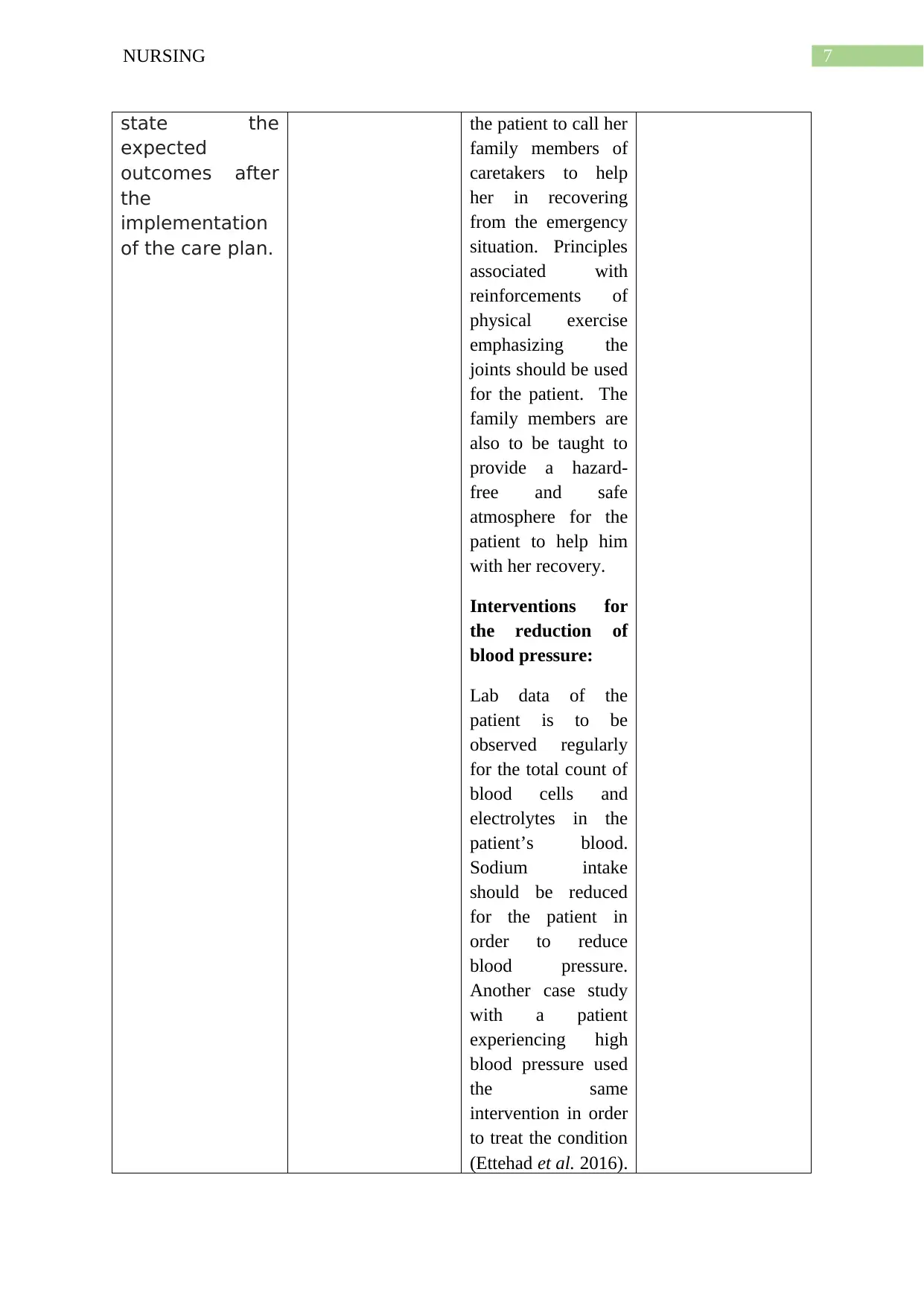
Interventions for
the reduction of
blood pressure:
Lab data of the
patient is to be
observed regularly
for the total count of
blood cells and
electrolytes in the
patient’s blood.
Sodium intake
should be reduced
for the patient in
order to reduce
blood pressure.
Another case study
with a patient
experiencing high
blood pressure used
the same
intervention in order
to treat the condition
(Ettehad et al. 2016).
state the
expected
outcomes after
the
implementation
of the care plan.
the patient to call her
family members of
caretakers to help
her in recovering
from the emergency
situation. Principles
associated with
reinforcements of
physical exercise
emphasizing the
joints should be used
for the patient. The
family members are
also to be taught to
provide a hazard-
free and safe
atmosphere for the
patient to help him
with her recovery.
Interventions for
the reduction of
blood pressure:
Lab data of the
patient is to be
observed regularly
for the total count of
blood cells and
electrolytes in the
patient’s blood.
Sodium intake
should be reduced
for the patient in
order to reduce
blood pressure.
Another case study
with a patient
experiencing high
blood pressure used
the same
intervention in order
to treat the condition
(Ettehad et al. 2016).
8NURSING
Blood pressure
should be measured
in both the hands.
Breath sounds and
heart rhythms should
be maintained well
in order to be aware
of the current level
of blood pressure of
the patient.
The physiology of one vital sign
There are six classic vital signs associated with the human body. These signs are
named as blood pressure, temperature, pulse, respiration rate, height and weight (Bresch et
al. 2014). Every diagnosis of a patient is based on the noting of these vital signs and
assessing the defects in the physiological conditions of the patient and devising the
intervention plans according to it. There are four vital signs reports collected from the
diagnosis of the patient are-
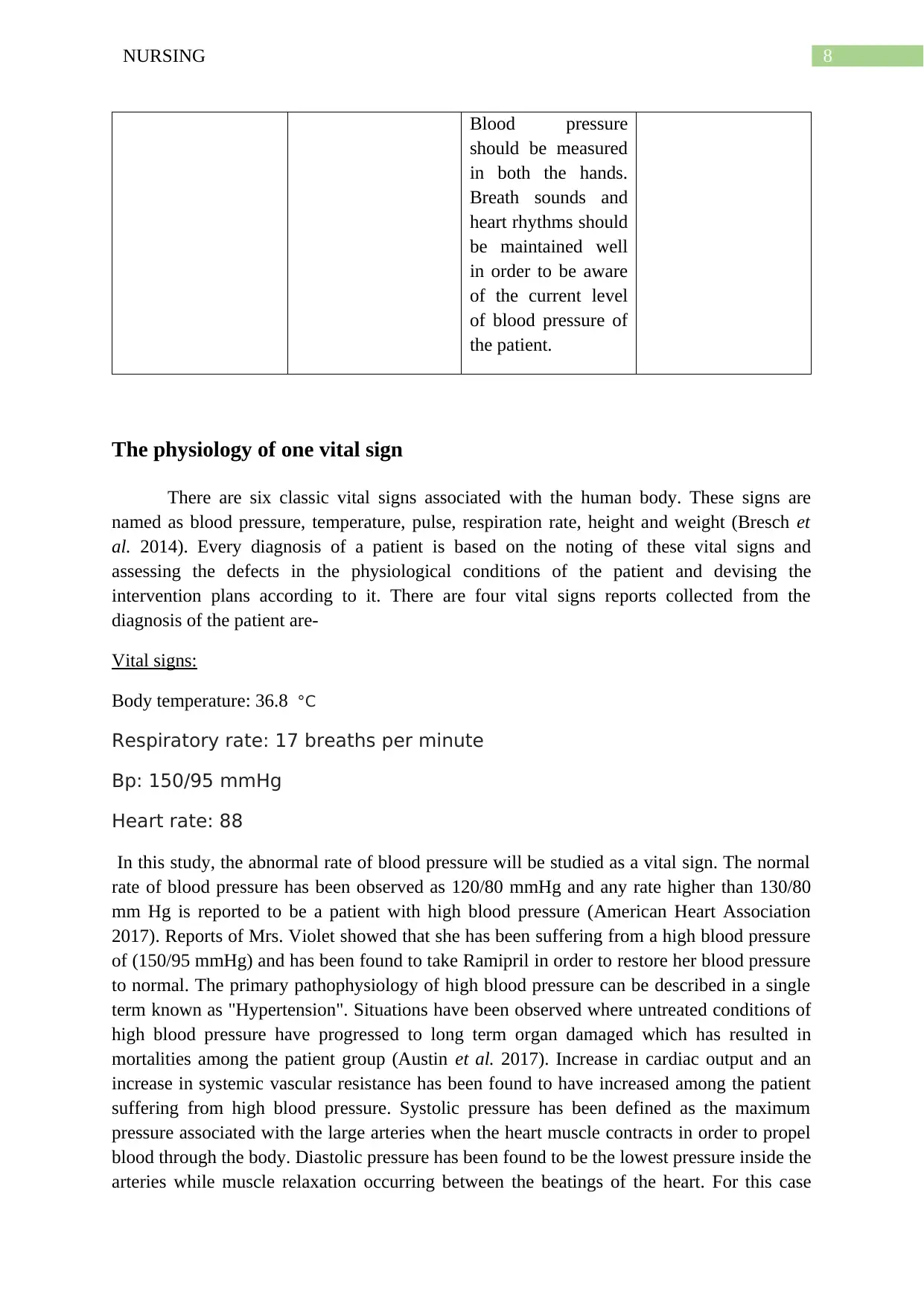
Vital signs:
Body temperature: 36.8 °C
Respiratory rate: 17 breaths per minute
Bp: 150/95 mmHg
Heart rate: 88
In this study, the abnormal rate of blood pressure will be studied as a vital sign. The normal
rate of blood pressure has been observed as 120/80 mmHg and any rate higher than 130/80
mm Hg is reported to be a patient with high blood pressure (American Heart Association
2017). Reports of Mrs. Violet showed that she has been suffering from a high blood pressure
of (150/95 mmHg) and has been found to take Ramipril in order to restore her blood pressure
to normal. The primary pathophysiology of high blood pressure can be described in a single
term known as "Hypertension". Situations have been observed where untreated conditions of
high blood pressure have progressed to long term organ damaged which has resulted in
mortalities among the patient group (Austin et al. 2017). Increase in cardiac output and an
increase in systemic vascular resistance has been found to have increased among the patient
suffering from high blood pressure. Systolic pressure has been defined as the maximum
pressure associated with the large arteries when the heart muscle contracts in order to propel
blood through the body. Diastolic pressure has been found to be the lowest pressure inside the
arteries while muscle relaxation occurring between the beatings of the heart. For this case
Blood pressure
should be measured
in both the hands.
Breath sounds and
heart rhythms should
be maintained well
in order to be aware
of the current level
of blood pressure of
the patient.
The physiology of one vital sign
There are six classic vital signs associated with the human body. These signs are
named as blood pressure, temperature, pulse, respiration rate, height and weight (Bresch et
al. 2014). Every diagnosis of a patient is based on the noting of these vital signs and
assessing the defects in the physiological conditions of the patient and devising the
intervention plans according to it. There are four vital signs reports collected from the
diagnosis of the patient are-
Vital signs:
Body temperature: 36.8 °C
Respiratory rate: 17 breaths per minute
Bp: 150/95 mmHg
Heart rate: 88
In this study, the abnormal rate of blood pressure will be studied as a vital sign. The normal
rate of blood pressure has been observed as 120/80 mmHg and any rate higher than 130/80
mm Hg is reported to be a patient with high blood pressure (American Heart Association
2017). Reports of Mrs. Violet showed that she has been suffering from a high blood pressure
of (150/95 mmHg) and has been found to take Ramipril in order to restore her blood pressure
to normal. The primary pathophysiology of high blood pressure can be described in a single
term known as "Hypertension". Situations have been observed where untreated conditions of
high blood pressure have progressed to long term organ damaged which has resulted in
mortalities among the patient group (Austin et al. 2017). Increase in cardiac output and an
increase in systemic vascular resistance has been found to have increased among the patient
suffering from high blood pressure. Systolic pressure has been defined as the maximum
pressure associated with the large arteries when the heart muscle contracts in order to propel
blood through the body. Diastolic pressure has been found to be the lowest pressure inside the
arteries while muscle relaxation occurring between the beatings of the heart. For this case
⊘ This is a preview!⊘
Do you want full access?
Subscribe today to unlock all pages.
Trusted by 1+ million students worldwide
9NURSING
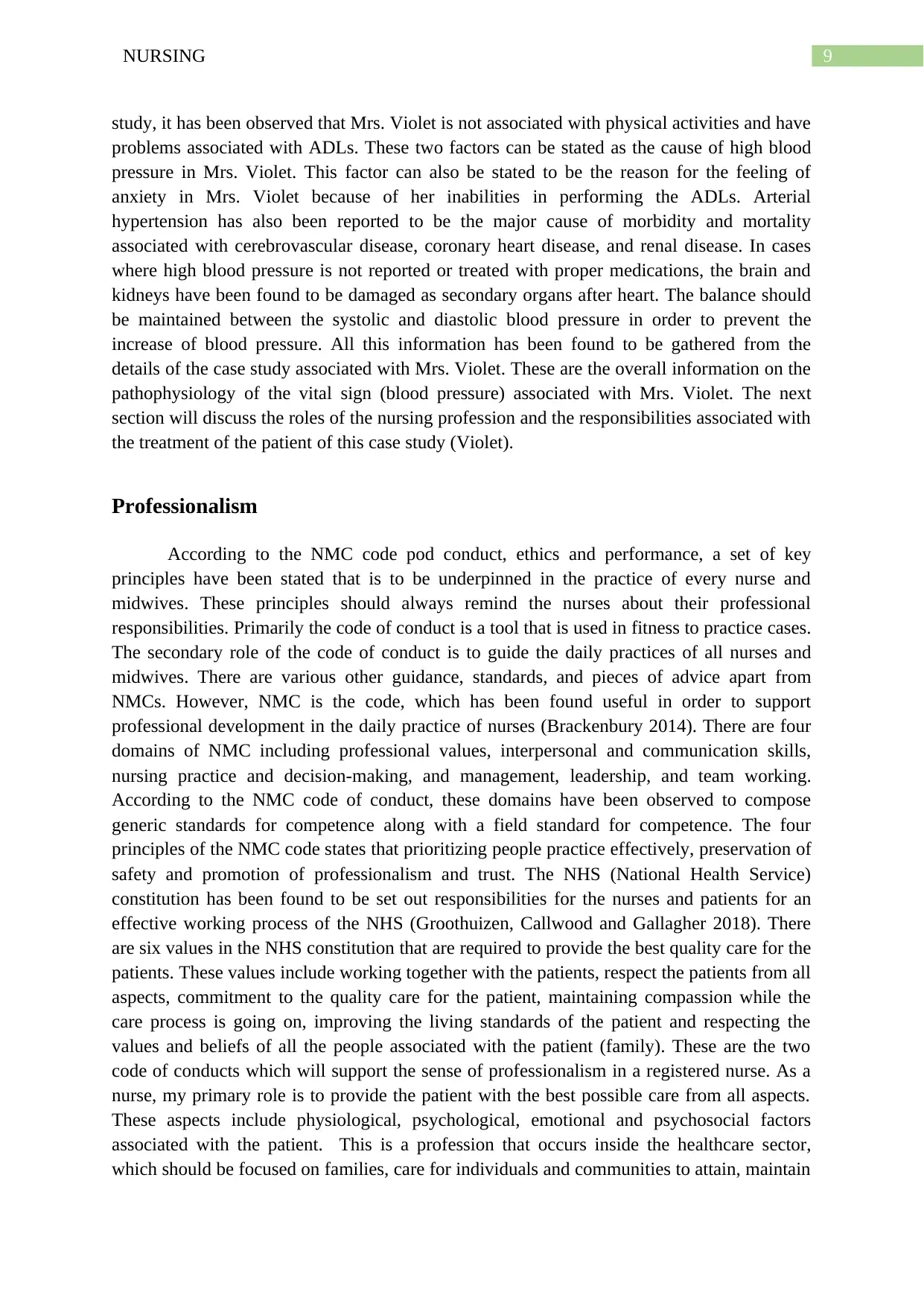
study, it has been observed that Mrs. Violet is not associated with physical activities and have
problems associated with ADLs. These two factors can be stated as the cause of high blood
pressure in Mrs. Violet. This factor can also be stated to be the reason for the feeling of
anxiety in Mrs. Violet because of her inabilities in performing the ADLs. Arterial
hypertension has also been reported to be the major cause of morbidity and mortality
associated with cerebrovascular disease, coronary heart disease, and renal disease. In cases
where high blood pressure is not reported or treated with proper medications, the brain and
kidneys have been found to be damaged as secondary organs after heart. The balance should
be maintained between the systolic and diastolic blood pressure in order to prevent the
increase of blood pressure. All this information has been found to be gathered from the
details of the case study associated with Mrs. Violet. These are the overall information on the
pathophysiology of the vital sign (blood pressure) associated with Mrs. Violet. The next
section will discuss the roles of the nursing profession and the responsibilities associated with
the treatment of the patient of this case study (Violet).
Professionalism
According to the NMC code pod conduct, ethics and performance, a set of key
principles have been stated that is to be underpinned in the practice of every nurse and
midwives. These principles should always remind the nurses about their professional
responsibilities. Primarily the code of conduct is a tool that is used in fitness to practice cases.
The secondary role of the code of conduct is to guide the daily practices of all nurses and
midwives. There are various other guidance, standards, and pieces of advice apart from
NMCs. However, NMC is the code, which has been found useful in order to support
professional development in the daily practice of nurses (Brackenbury 2014). There are four
domains of NMC including professional values, interpersonal and communication skills,
nursing practice and decision-making, and management, leadership, and team working.
According to the NMC code of conduct, these domains have been observed to compose
generic standards for competence along with a field standard for competence. The four
principles of the NMC code states that prioritizing people practice effectively, preservation of
safety and promotion of professionalism and trust. The NHS (National Health Service)
constitution has been found to be set out responsibilities for the nurses and patients for an
effective working process of the NHS (Groothuizen, Callwood and Gallagher 2018). There
are six values in the NHS constitution that are required to provide the best quality care for the
patients. These values include working together with the patients, respect the patients from all
aspects, commitment to the quality care for the patient, maintaining compassion while the
care process is going on, improving the living standards of the patient and respecting the
values and beliefs of all the people associated with the patient (family). These are the two
code of conducts which will support the sense of professionalism in a registered nurse. As a
nurse, my primary role is to provide the patient with the best possible care from all aspects.
These aspects include physiological, psychological, emotional and psychosocial factors
associated with the patient. This is a profession that occurs inside the healthcare sector,
which should be focused on families, care for individuals and communities to attain, maintain
study, it has been observed that Mrs. Violet is not associated with physical activities and have
problems associated with ADLs. These two factors can be stated as the cause of high blood
pressure in Mrs. Violet. This factor can also be stated to be the reason for the feeling of
anxiety in Mrs. Violet because of her inabilities in performing the ADLs. Arterial
hypertension has also been reported to be the major cause of morbidity and mortality
associated with cerebrovascular disease, coronary heart disease, and renal disease. In cases
where high blood pressure is not reported or treated with proper medications, the brain and
kidneys have been found to be damaged as secondary organs after heart. The balance should
be maintained between the systolic and diastolic blood pressure in order to prevent the
increase of blood pressure. All this information has been found to be gathered from the
details of the case study associated with Mrs. Violet. These are the overall information on the
pathophysiology of the vital sign (blood pressure) associated with Mrs. Violet. The next
section will discuss the roles of the nursing profession and the responsibilities associated with
the treatment of the patient of this case study (Violet).
Professionalism
According to the NMC code pod conduct, ethics and performance, a set of key
principles have been stated that is to be underpinned in the practice of every nurse and
midwives. These principles should always remind the nurses about their professional
responsibilities. Primarily the code of conduct is a tool that is used in fitness to practice cases.
The secondary role of the code of conduct is to guide the daily practices of all nurses and
midwives. There are various other guidance, standards, and pieces of advice apart from
NMCs. However, NMC is the code, which has been found useful in order to support
professional development in the daily practice of nurses (Brackenbury 2014). There are four
domains of NMC including professional values, interpersonal and communication skills,
nursing practice and decision-making, and management, leadership, and team working.
According to the NMC code of conduct, these domains have been observed to compose
generic standards for competence along with a field standard for competence. The four
principles of the NMC code states that prioritizing people practice effectively, preservation of
safety and promotion of professionalism and trust. The NHS (National Health Service)
constitution has been found to be set out responsibilities for the nurses and patients for an
effective working process of the NHS (Groothuizen, Callwood and Gallagher 2018). There
are six values in the NHS constitution that are required to provide the best quality care for the
patients. These values include working together with the patients, respect the patients from all
aspects, commitment to the quality care for the patient, maintaining compassion while the
care process is going on, improving the living standards of the patient and respecting the
values and beliefs of all the people associated with the patient (family). These are the two
code of conducts which will support the sense of professionalism in a registered nurse. As a
nurse, my primary role is to provide the patient with the best possible care from all aspects.
These aspects include physiological, psychological, emotional and psychosocial factors
associated with the patient. This is a profession that occurs inside the healthcare sector,
which should be focused on families, care for individuals and communities to attain, maintain
Paraphrase This Document
Need a fresh take? Get an instant paraphrase of this document with our AI Paraphraser
10NURSING
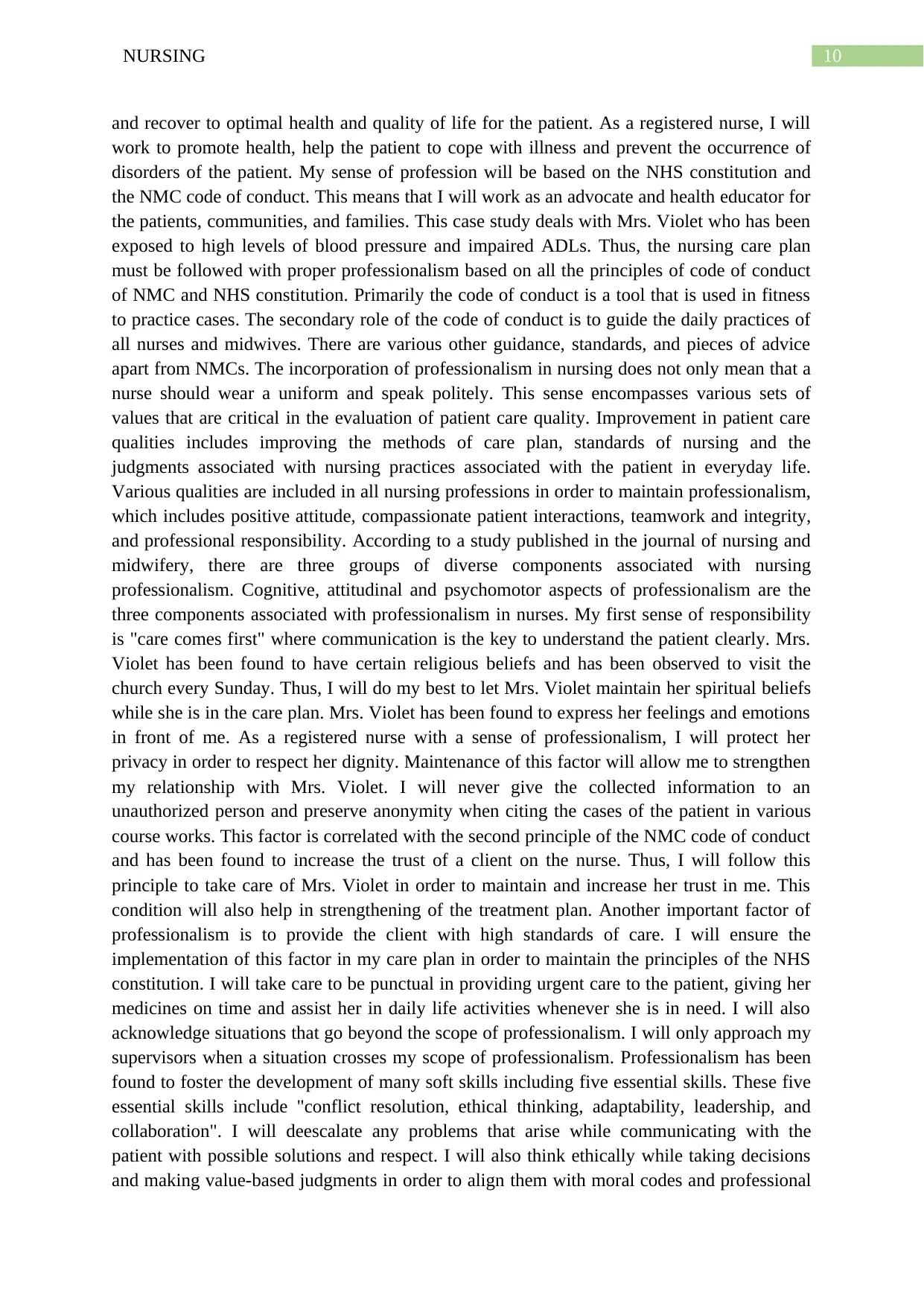
and recover to optimal health and quality of life for the patient. As a registered nurse, I will
work to promote health, help the patient to cope with illness and prevent the occurrence of
disorders of the patient. My sense of profession will be based on the NHS constitution and
the NMC code of conduct. This means that I will work as an advocate and health educator for
the patients, communities, and families. This case study deals with Mrs. Violet who has been
exposed to high levels of blood pressure and impaired ADLs. Thus, the nursing care plan
must be followed with proper professionalism based on all the principles of code of conduct
of NMC and NHS constitution. Primarily the code of conduct is a tool that is used in fitness
to practice cases. The secondary role of the code of conduct is to guide the daily practices of
all nurses and midwives. There are various other guidance, standards, and pieces of advice
apart from NMCs. The incorporation of professionalism in nursing does not only mean that a
nurse should wear a uniform and speak politely. This sense encompasses various sets of
values that are critical in the evaluation of patient care quality. Improvement in patient care
qualities includes improving the methods of care plan, standards of nursing and the
judgments associated with nursing practices associated with the patient in everyday life.
Various qualities are included in all nursing professions in order to maintain professionalism,
which includes positive attitude, compassionate patient interactions, teamwork and integrity,
and professional responsibility. According to a study published in the journal of nursing and
midwifery, there are three groups of diverse components associated with nursing
professionalism. Cognitive, attitudinal and psychomotor aspects of professionalism are the
three components associated with professionalism in nurses. My first sense of responsibility
is "care comes first" where communication is the key to understand the patient clearly. Mrs.
Violet has been found to have certain religious beliefs and has been observed to visit the
church every Sunday. Thus, I will do my best to let Mrs. Violet maintain her spiritual beliefs
while she is in the care plan. Mrs. Violet has been found to express her feelings and emotions
in front of me. As a registered nurse with a sense of professionalism, I will protect her
privacy in order to respect her dignity. Maintenance of this factor will allow me to strengthen
my relationship with Mrs. Violet. I will never give the collected information to an
unauthorized person and preserve anonymity when citing the cases of the patient in various
course works. This factor is correlated with the second principle of the NMC code of conduct
and has been found to increase the trust of a client on the nurse. Thus, I will follow this
principle to take care of Mrs. Violet in order to maintain and increase her trust in me. This
condition will also help in strengthening of the treatment plan. Another important factor of
professionalism is to provide the client with high standards of care. I will ensure the
implementation of this factor in my care plan in order to maintain the principles of the NHS
constitution. I will take care to be punctual in providing urgent care to the patient, giving her
medicines on time and assist her in daily life activities whenever she is in need. I will also
acknowledge situations that go beyond the scope of professionalism. I will only approach my
supervisors when a situation crosses my scope of professionalism. Professionalism has been
found to foster the development of many soft skills including five essential skills. These five
essential skills include "conflict resolution, ethical thinking, adaptability, leadership, and
collaboration". I will deescalate any problems that arise while communicating with the
patient with possible solutions and respect. I will also think ethically while taking decisions
and making value-based judgments in order to align them with moral codes and professional
and recover to optimal health and quality of life for the patient. As a registered nurse, I will
work to promote health, help the patient to cope with illness and prevent the occurrence of
disorders of the patient. My sense of profession will be based on the NHS constitution and
the NMC code of conduct. This means that I will work as an advocate and health educator for
the patients, communities, and families. This case study deals with Mrs. Violet who has been
exposed to high levels of blood pressure and impaired ADLs. Thus, the nursing care plan
must be followed with proper professionalism based on all the principles of code of conduct
of NMC and NHS constitution. Primarily the code of conduct is a tool that is used in fitness
to practice cases. The secondary role of the code of conduct is to guide the daily practices of
all nurses and midwives. There are various other guidance, standards, and pieces of advice
apart from NMCs. The incorporation of professionalism in nursing does not only mean that a
nurse should wear a uniform and speak politely. This sense encompasses various sets of
values that are critical in the evaluation of patient care quality. Improvement in patient care
qualities includes improving the methods of care plan, standards of nursing and the
judgments associated with nursing practices associated with the patient in everyday life.
Various qualities are included in all nursing professions in order to maintain professionalism,
which includes positive attitude, compassionate patient interactions, teamwork and integrity,
and professional responsibility. According to a study published in the journal of nursing and
midwifery, there are three groups of diverse components associated with nursing
professionalism. Cognitive, attitudinal and psychomotor aspects of professionalism are the
three components associated with professionalism in nurses. My first sense of responsibility
is "care comes first" where communication is the key to understand the patient clearly. Mrs.
Violet has been found to have certain religious beliefs and has been observed to visit the
church every Sunday. Thus, I will do my best to let Mrs. Violet maintain her spiritual beliefs
while she is in the care plan. Mrs. Violet has been found to express her feelings and emotions
in front of me. As a registered nurse with a sense of professionalism, I will protect her
privacy in order to respect her dignity. Maintenance of this factor will allow me to strengthen
my relationship with Mrs. Violet. I will never give the collected information to an
unauthorized person and preserve anonymity when citing the cases of the patient in various
course works. This factor is correlated with the second principle of the NMC code of conduct
and has been found to increase the trust of a client on the nurse. Thus, I will follow this
principle to take care of Mrs. Violet in order to maintain and increase her trust in me. This
condition will also help in strengthening of the treatment plan. Another important factor of
professionalism is to provide the client with high standards of care. I will ensure the
implementation of this factor in my care plan in order to maintain the principles of the NHS
constitution. I will take care to be punctual in providing urgent care to the patient, giving her
medicines on time and assist her in daily life activities whenever she is in need. I will also
acknowledge situations that go beyond the scope of professionalism. I will only approach my
supervisors when a situation crosses my scope of professionalism. Professionalism has been
found to foster the development of many soft skills including five essential skills. These five
essential skills include "conflict resolution, ethical thinking, adaptability, leadership, and
collaboration". I will deescalate any problems that arise while communicating with the
patient with possible solutions and respect. I will also think ethically while taking decisions
and making value-based judgments in order to align them with moral codes and professional
11NURSING
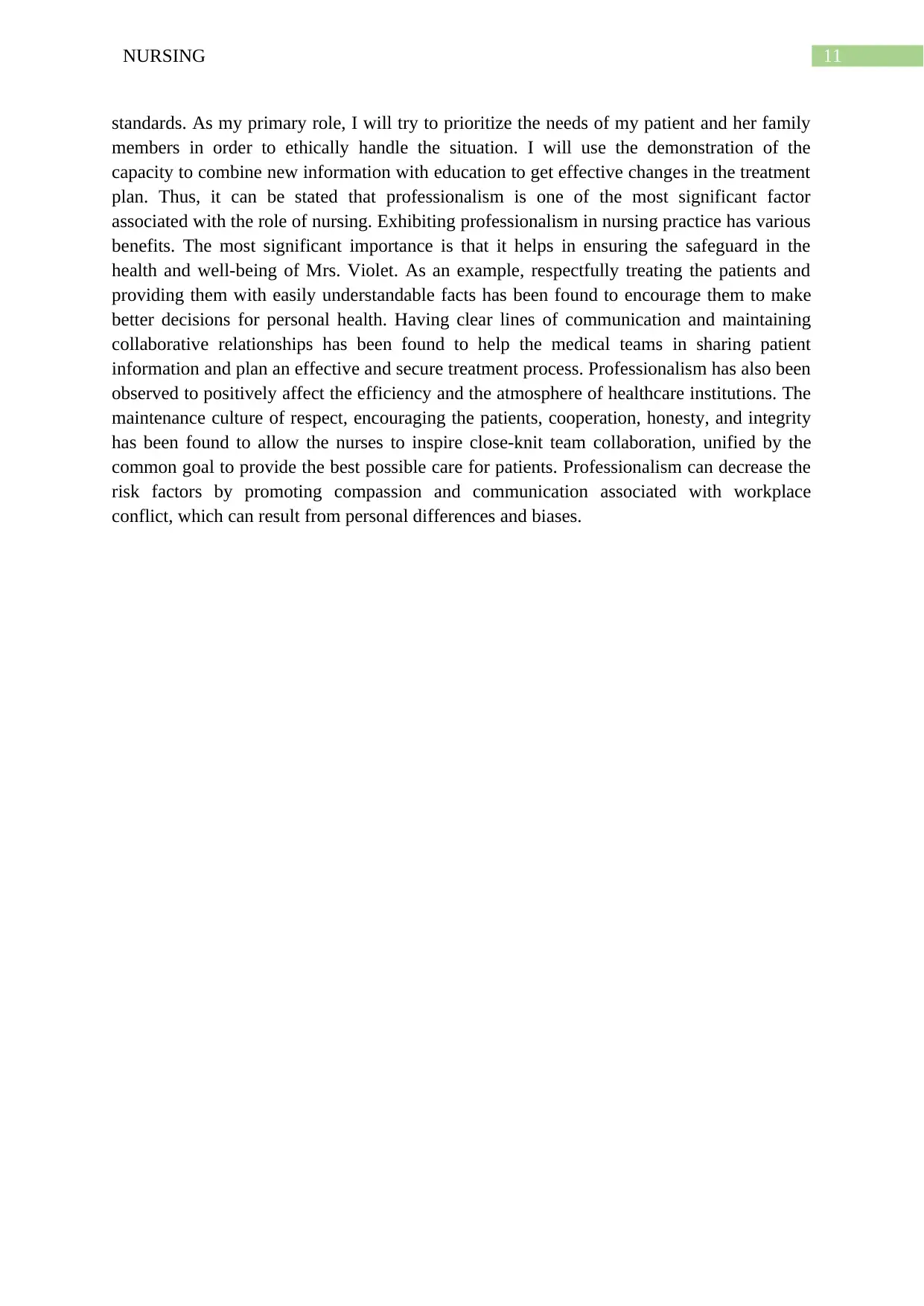
standards. As my primary role, I will try to prioritize the needs of my patient and her family
members in order to ethically handle the situation. I will use the demonstration of the
capacity to combine new information with education to get effective changes in the treatment
plan. Thus, it can be stated that professionalism is one of the most significant factor
associated with the role of nursing. Exhibiting professionalism in nursing practice has various
benefits. The most significant importance is that it helps in ensuring the safeguard in the
health and well-being of Mrs. Violet. As an example, respectfully treating the patients and
providing them with easily understandable facts has been found to encourage them to make
better decisions for personal health. Having clear lines of communication and maintaining
collaborative relationships has been found to help the medical teams in sharing patient
information and plan an effective and secure treatment process. Professionalism has also been
observed to positively affect the efficiency and the atmosphere of healthcare institutions. The
maintenance culture of respect, encouraging the patients, cooperation, honesty, and integrity
has been found to allow the nurses to inspire close-knit team collaboration, unified by the
common goal to provide the best possible care for patients. Professionalism can decrease the
risk factors by promoting compassion and communication associated with workplace
conflict, which can result from personal differences and biases.
standards. As my primary role, I will try to prioritize the needs of my patient and her family
members in order to ethically handle the situation. I will use the demonstration of the
capacity to combine new information with education to get effective changes in the treatment
plan. Thus, it can be stated that professionalism is one of the most significant factor
associated with the role of nursing. Exhibiting professionalism in nursing practice has various
benefits. The most significant importance is that it helps in ensuring the safeguard in the
health and well-being of Mrs. Violet. As an example, respectfully treating the patients and
providing them with easily understandable facts has been found to encourage them to make
better decisions for personal health. Having clear lines of communication and maintaining
collaborative relationships has been found to help the medical teams in sharing patient
information and plan an effective and secure treatment process. Professionalism has also been
observed to positively affect the efficiency and the atmosphere of healthcare institutions. The
maintenance culture of respect, encouraging the patients, cooperation, honesty, and integrity
has been found to allow the nurses to inspire close-knit team collaboration, unified by the
common goal to provide the best possible care for patients. Professionalism can decrease the
risk factors by promoting compassion and communication associated with workplace
conflict, which can result from personal differences and biases.
⊘ This is a preview!⊘
Do you want full access?
Subscribe today to unlock all pages.
Trusted by 1+ million students worldwide

1 out of 23


Related Documents


Your All-in-One AI-Powered Toolkit for Academic Success.
+13062052269
info@desklib.com
Available 24*7 on WhatsApp / Email
![[object Object]](/_next/static/media/star-bottom.7253800d.svg)
Unlock your academic potential
Copyright © 2020–2026 A2Z Services. All Rights Reserved. Developed and managed by ZUCOL.