Walden University: Cultural Sensitivity Program for Memorial Hospital

Verified

Added on  2022/12/19

|10
|754
|73
Presentation
AI Summary
This presentation proposes a cultural sensitivity program tailored for Memorial Hospital, aiming to enhance patient-centered care. It begins by establishing the rationale for such a program, emphasizing its role in addressing healthcare disparities, improving patient outcomes, and fostering stronger therapeutic relationships. The presentation outlines the key steps involved, including a comprehensive cultural competence assessment that involves community and self-assessments, focusing on factors such as the local population demographics, program satisfaction, and staff competence. It then details the necessary actions following the assessment, such as obtaining new assessment tools, opening dialogues with staff, and exploring staff development needs. The presentation also recommends a detailed training program focused on self-assessment of cultural biases, understanding cross-cultural misunderstandings, and guidelines for clinical cultural assessments. Finally, it recommends a rollout plan to implement the program effectively. The presentation draws from several research sources to support the proposed strategies.
Document Page
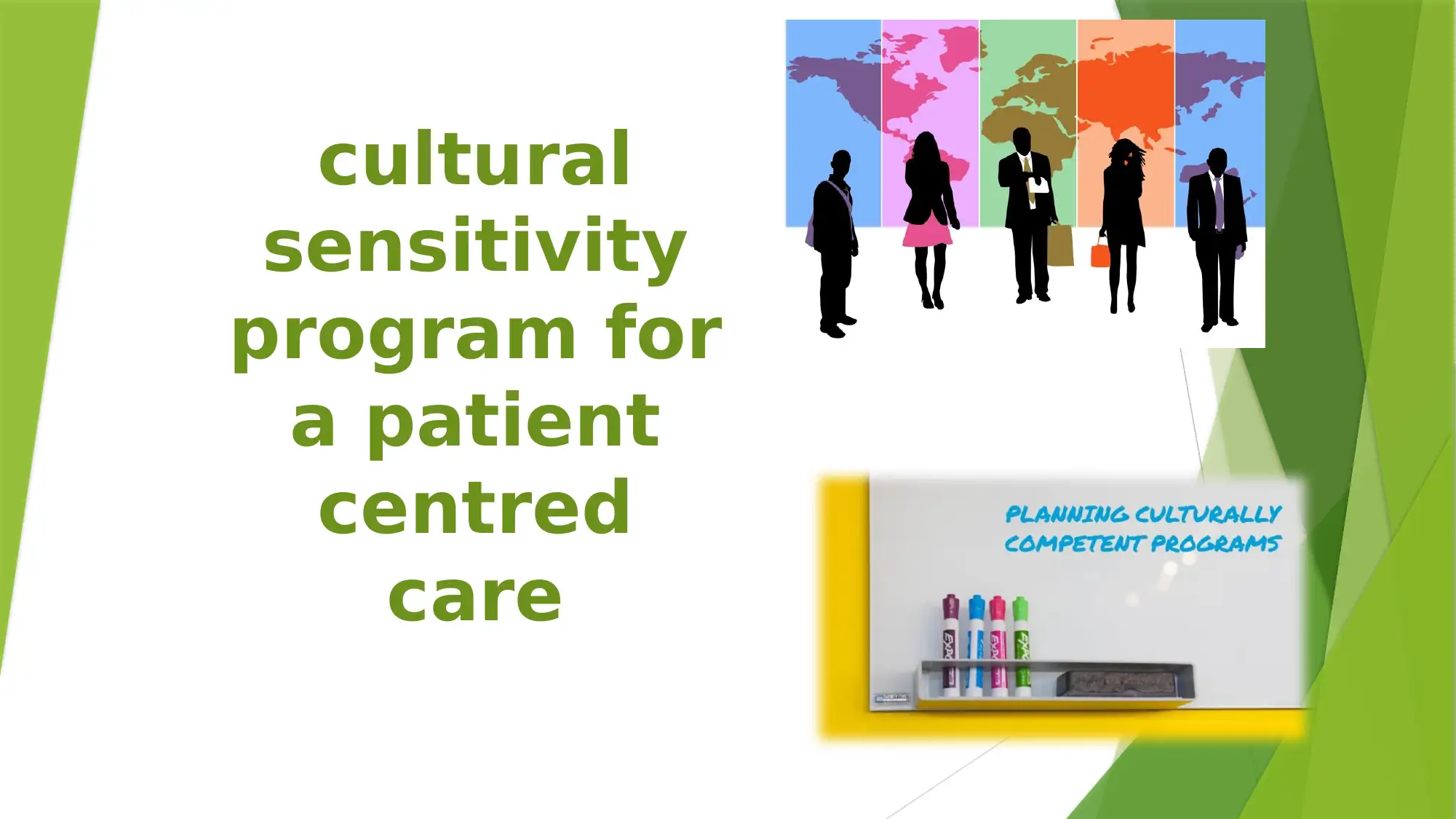
cultural
sensitivity
program for
a patient
centred
care
tabler-icon-diamond-filled.svg

Paraphrase This Document

Need a fresh take? Get an instant paraphrase of this document with our AI Paraphraser
Document Page
Rationale for a cultural
sensitivity program
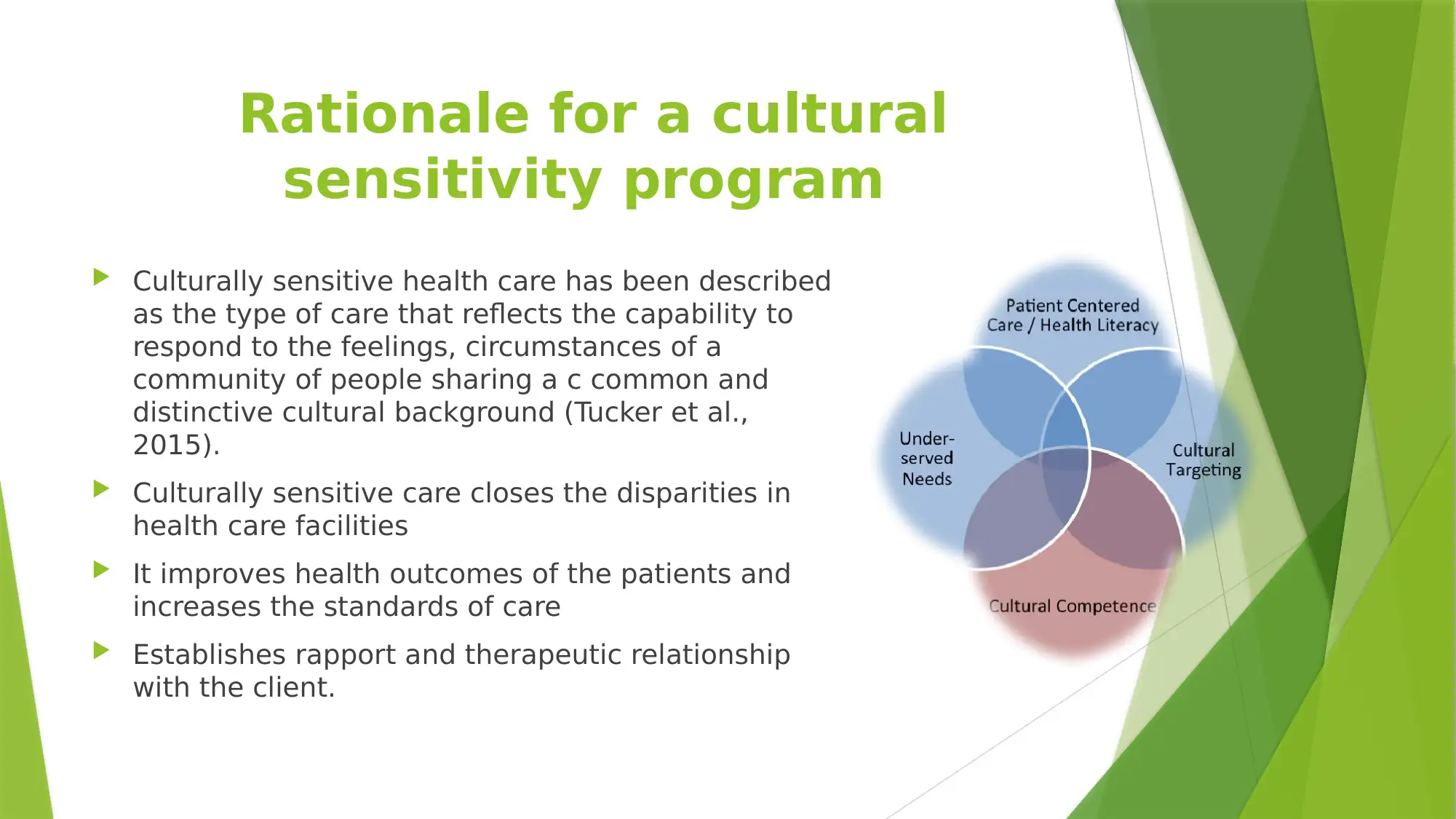
Culturally sensitive health care has been described
as the type of care that reflects the capability to
respond to the feelings, circumstances of a
community of people sharing a c common and
distinctive cultural background (Tucker et al.,
2015).
Culturally sensitive care closes the disparities in
health care facilities
It improves health outcomes of the patients and
increases the standards of care
Establishes rapport and therapeutic relationship
with the client.
Document Page
Outline for a cultural sensitivity program
Steps involved in a cultural sensitivity programs:-
Performing a cultural competence assessment-
The assessment should focus on the following questions :
Who are the main inhabitants of the local population? Are all those
who needs care being involved in the planning?
What is their level of satisfaction from with the program among the
clients from the minority group.
How competent is the program for meeting the treatment needs of
the diverse group present in the community.
Document Page
Community assessment & self-
assessment
A community assessment is required to be done to understand the
percentage of the ethnic minorities living under a particular catchment
area (Loftin et al., 2015).
Self-assessment of the treatment programs should include the following
areas:-
Administration policies
Physical facility
Diversity of staffs
Screening and assessment methods tools
Program design
tabler-icon-diamond-filled.svg

Paraphrase This Document

Need a fresh take? Get an instant paraphrase of this document with our AI Paraphraser
Document Page
Actions after the assessment
Based on the assessment it is required to take the following steps:-
Obtaining new screening and assessment instruments
Opening dialog with the staffs
Exploring the needs for the staff development (Delgado et al., 2013)
Document Page
Actions
Revising the budget
Investigation of the funding opportunities
Removing the barriers
Informing the staffs and the clients of the resources on the diversity
Document Page
Training and a roll out plan
A proper training program helps to address the invisible and he subtle
differences between people of different cultures.
The counsellors shall be trained properly so that he can understand
what to be asked or what not to be asked.
tabler-icon-diamond-filled.svg

Paraphrase This Document

Need a fresh take? Get an instant paraphrase of this document with our AI Paraphraser
Document Page
Training and a roll out plan
Training of the staff members should focus on the following:-
Self-assessment of the attitudes and cultural bias.
Sources of cross cultural misunderstandings.
Sources regarding the social and the psychological conflict between
the bicultural clients.
Guidelines regarding the clinical cultural assessment.
Document Page
References
Delgado, D. A., Ness, S., Ferguson, K., Engstrom, P. L., Gannon, T. M., & Gillett, C. (2013). Cultural
competence training for clinical staff: Measuring the effect of a one-hour class on cultural
competence. Journal of Transcultural Nursing, 24(2), 204-213.
Delphin-Rittmon, M. E., Andres-Hyman, R., Flanagan, E. H., & Davidson, L. (2013). Seven essential
strategies for promoting and sustaining systemic cultural competence. Psychiatric Quarterly, 84(1),
53-64.
Loftin, C., Hartin, V., Branson, M., & Reyes, H. (2013). Measures of cultural competence in nurses: An
integrative review. The Scientific World Journal, 2013.
Owiti, J. A., Ajaz, A., Ascoli, M., De Jongh, B., Palinski, A., & Bhui, K. S. (2014). Cultural consultation as
a model for training multidisciplinary mental healthcare professionals in cultural competence skills:
preliminary results. Journal of psychiatric and mental health nursing, 21(9), 814-826.
Renzaho, A. M. N., Romios, P., Crock, C., & Sønderlund, A. L. (2013). The effectiveness of cultural
competence programs in ethnic minority patient-centered health care—a systematic review of the
literature. International Journal for Quality in Health Care, 25(3), 261-269.
Tucker, C. M., Arthur, T. M., Roncoroni, J., Wall, W., & Sanchez, J. (2015). Patient-centered, culturally
sensitive health care. American Journal of Lifestyle Medicine, 9(1), 63-77.
Document Page
chevron_up_icon
1 out of 10
circle_padding
hide_on_mobile
zoom_out_icon
[object Object]