Discussion: Patient Health Assessment for Respiratory Issues

Verified

Added on  2022/08/23

|4
|465
|26
Discussion Board Post
AI Summary
This assignment presents a discussion forum post analyzing a case study of a 74-year-old patient experiencing breathing difficulties. The student focuses on the patient's presentation, including the tripod position and vital signs such as low oxygen saturation. The core of the post is the formulation of a key subjective question to assess the patient's condition, specifically addressing potential breathing difficulties and history of smoking to aid in diagnosing emphysema. The student emphasizes the importance of subjective assessments in determining appropriate clinical interventions and disease management strategies. The post references Jarvis (2019) to support the analysis of the patient's symptoms and potential diagnoses. The conclusion underscores how the answer to the subjective question will assist in the diagnosis of emphysema and the development of appropriate care interventions.
Document Page
Running head: PATIENT HEALTH ASSESSMENTS
PATIENT HEALTH ASSESSMENTS
Name of the Student:
Name of the University:
Author note:
tabler-icon-diamond-filled.svg

Paraphrase This Document

Need a fresh take? Get an instant paraphrase of this document with our AI Paraphraser
Document Page
1PATIENT HEALTH ASSESSMENTS
Introduction
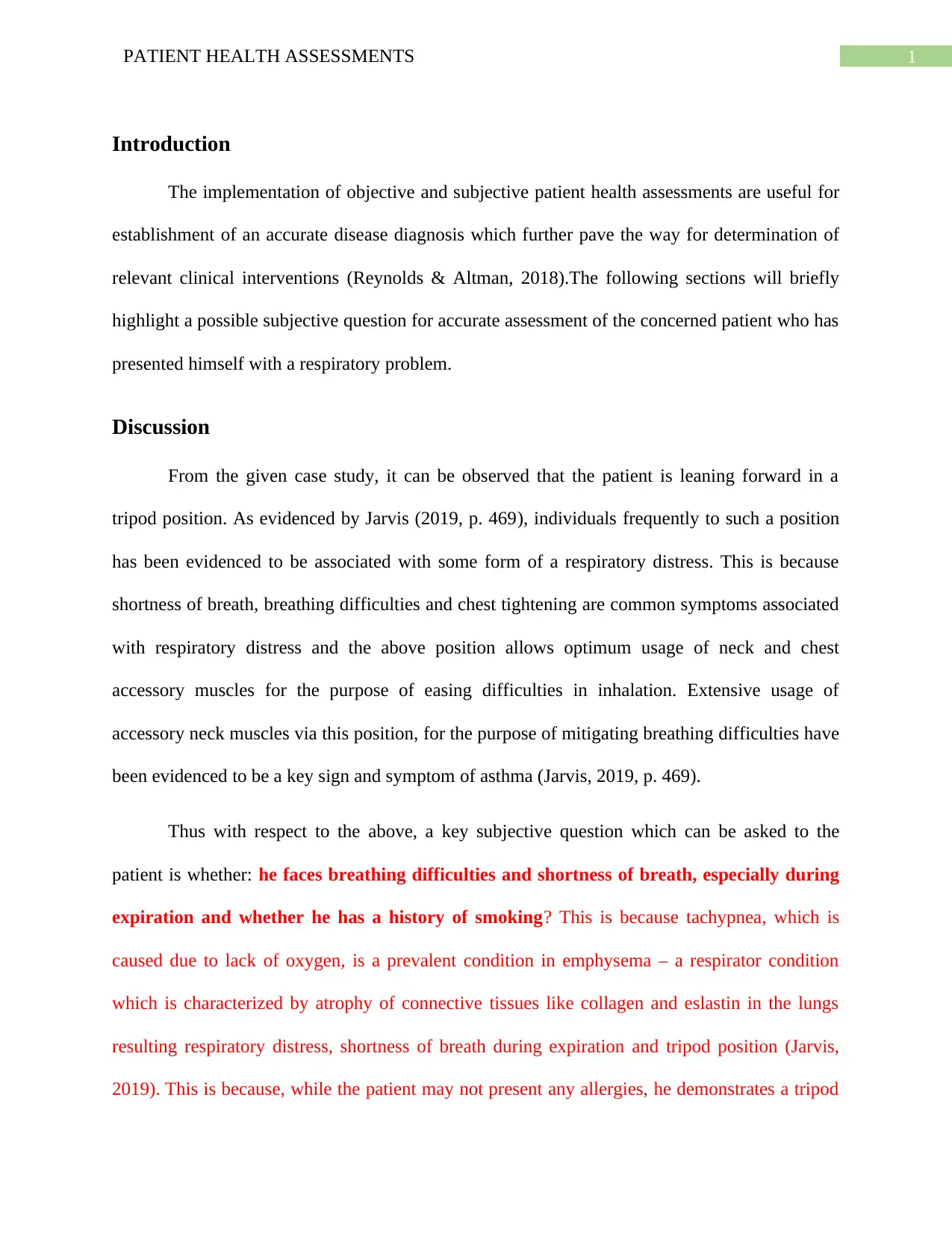
The implementation of objective and subjective patient health assessments are useful for
establishment of an accurate disease diagnosis which further pave the way for determination of
relevant clinical interventions (Reynolds & Altman, 2018).The following sections will briefly
highlight a possible subjective question for accurate assessment of the concerned patient who has
presented himself with a respiratory problem.
Discussion
From the given case study, it can be observed that the patient is leaning forward in a
tripod position. As evidenced by Jarvis (2019, p. 469), individuals frequently to such a position
has been evidenced to be associated with some form of a respiratory distress. This is because
shortness of breath, breathing difficulties and chest tightening are common symptoms associated
with respiratory distress and the above position allows optimum usage of neck and chest
accessory muscles for the purpose of easing difficulties in inhalation. Extensive usage of
accessory neck muscles via this position, for the purpose of mitigating breathing difficulties have
been evidenced to be a key sign and symptom of asthma (Jarvis, 2019, p. 469).
Thus with respect to the above, a key subjective question which can be asked to the
patient is whether: he faces breathing difficulties and shortness of breath, especially during
expiration and whether he has a history of smoking? This is because tachypnea, which is
caused due to lack of oxygen, is a prevalent condition in emphysema – a respirator condition
which is characterized by atrophy of connective tissues like collagen and eslastin in the lungs
resulting respiratory distress, shortness of breath during expiration and tripod position (Jarvis,
2019). This is because, while the patient may not present any allergies, he demonstrates a tripod
Document Page
2PATIENT HEALTH ASSESSMENTS
position and abnormally low oxygen saturation rates (91%) in the presence of room air – which
are signs of a hypoxia, tachypnea, respiratory distress and emphysema (Jarvis, 2019, p.
469). Jarvis (2019, p. 469) also denotes the high association of smoking and emphysema, thus
being the reason for asking the same in the subjective assessment question.
Conclusion
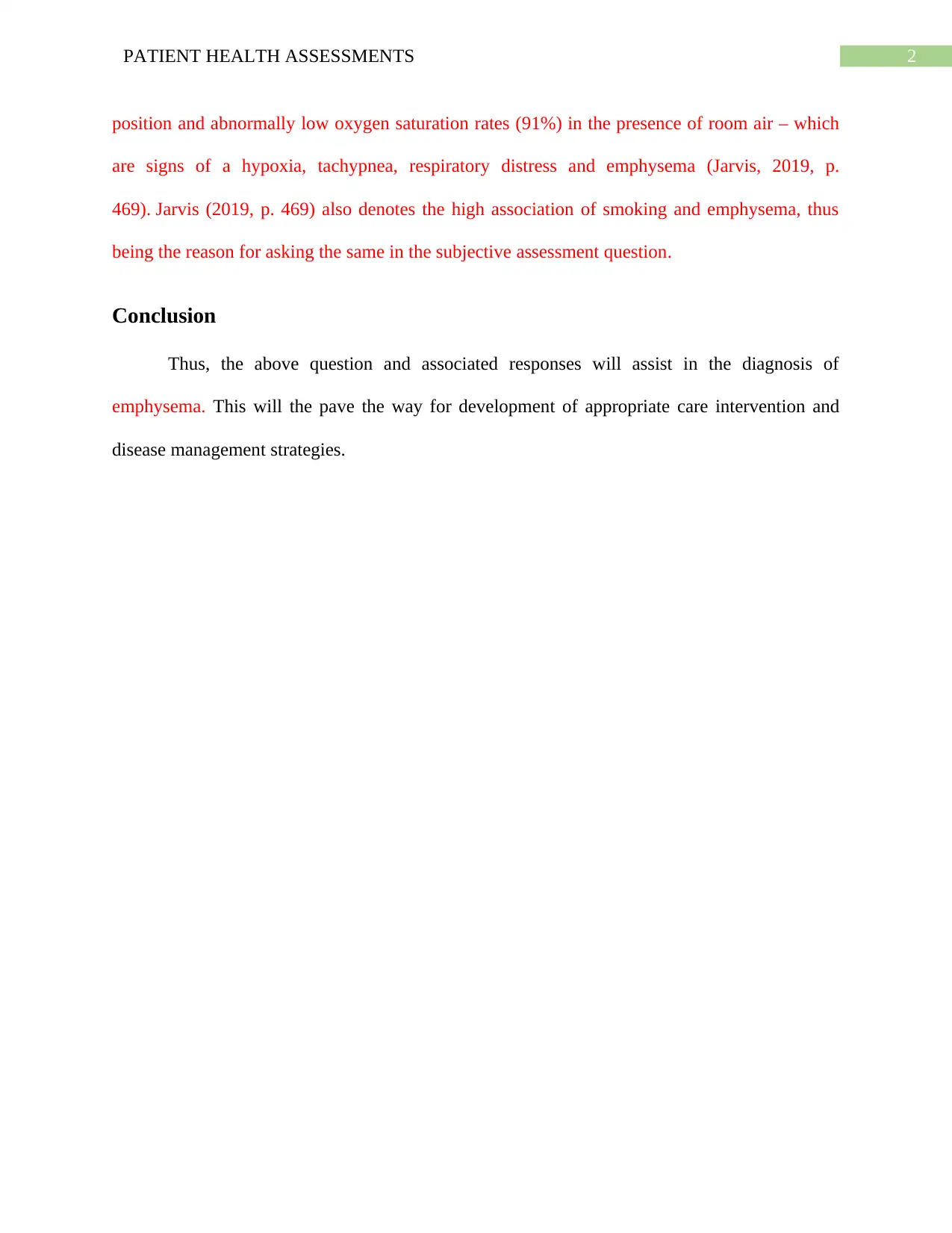
Thus, the above question and associated responses will assist in the diagnosis of
emphysema. This will the pave the way for development of appropriate care intervention and
disease management strategies.
Document Page
3PATIENT HEALTH ASSESSMENTS
References
Jarvis, C. (2019). Physical Examination and Health Assessment E-Book. Elsevier Health
Sciences.
chevron_up_icon
1 out of 4
circle_padding
hide_on_mobile
zoom_out_icon
[object Object]