NRSG-10039: Annotated Bibliography on Patient Safety and Risk in MIS

Verified

Added on  2023/06/04

|4
|651
|432
Annotated Bibliography
AI Summary
This annotated bibliography, prepared for the NRSG-10039 course at Mohawk College, examines current research on patient safety and risk management within the context of Minimally Invasive Surgery (MIS). The assignment involved researching and selecting two recent articles, focusing on studies published within the last five years, to ensure relevance and currency. Each article is summarized with a concise abstract (100-150 words), providing an overview of the research methodology, findings, and implications for patient safety. The chosen articles address key aspects of patient safety, including the impact of nursing care models on patient outcomes and the effectiveness of surgical safety checklists in reducing complications and mortality rates. The bibliography aims to provide a focused and informative resource for understanding and addressing patient safety concerns in the context of MIS procedures. The articles included cover topics such as the impact of functional and professional nursing models on patient safety outcomes, and the use of surgical safety checklists to improve patient outcomes, including post-operative infection and mortality rates.
Document Page
Running head: NURSING ASSIGNMENT
NURSING ASSIGNMENT
Name of the Student:
Name of the University:
Author Note:
tabler-icon-diamond-filled.svg

Paraphrase This Document

Need a fresh take? Get an instant paraphrase of this document with our AI Paraphraser
Document Page
1NURSING ASSIGNMENT
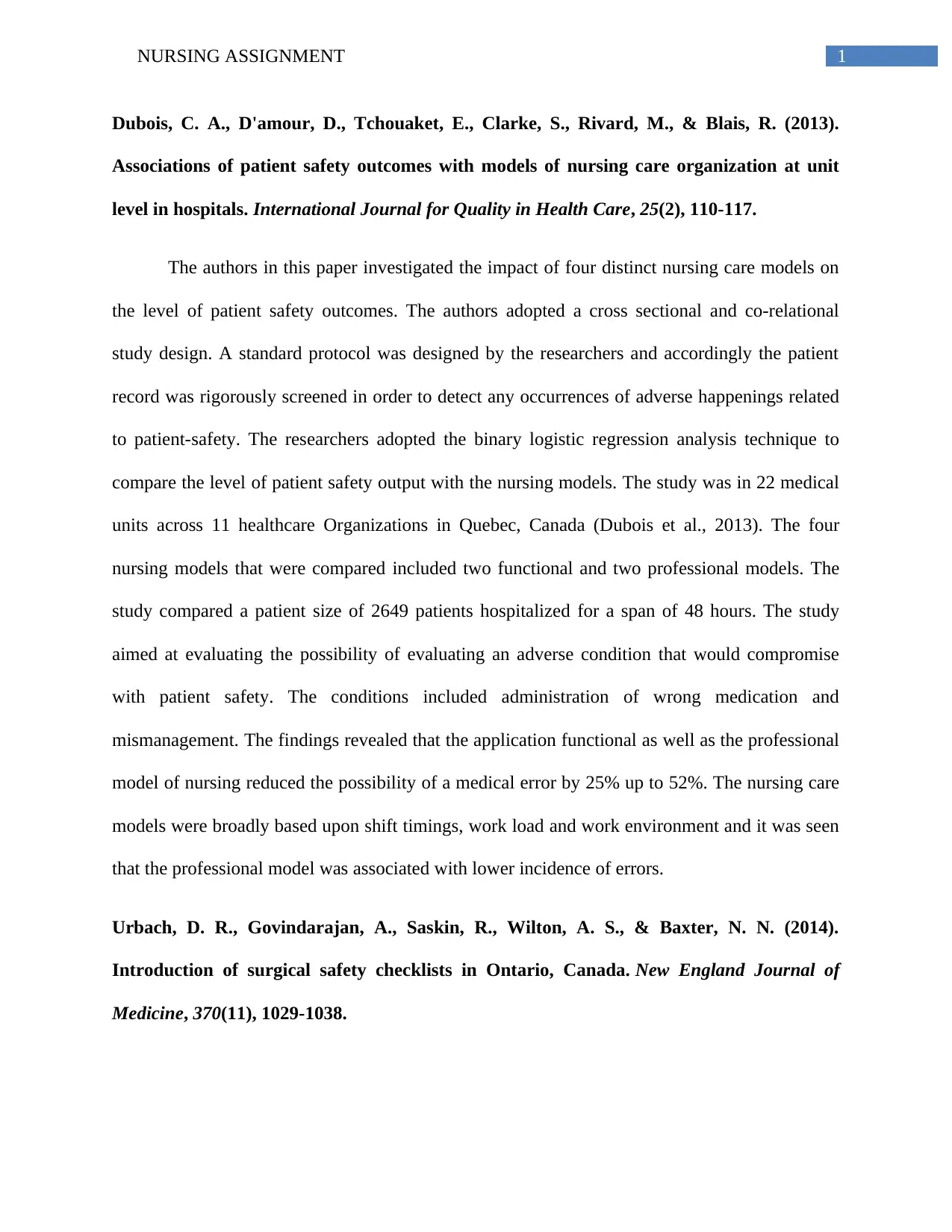
Dubois, C. A., D'amour, D., Tchouaket, E., Clarke, S., Rivard, M., & Blais, R. (2013).
Associations of patient safety outcomes with models of nursing care organization at unit
level in hospitals. International Journal for Quality in Health Care, 25(2), 110-117.
The authors in this paper investigated the impact of four distinct nursing care models on
the level of patient safety outcomes. The authors adopted a cross sectional and co-relational
study design. A standard protocol was designed by the researchers and accordingly the patient
record was rigorously screened in order to detect any occurrences of adverse happenings related
to patient-safety. The researchers adopted the binary logistic regression analysis technique to
compare the level of patient safety output with the nursing models. The study was in 22 medical
units across 11 healthcare Organizations in Quebec, Canada (Dubois et al., 2013). The four
nursing models that were compared included two functional and two professional models. The
study compared a patient size of 2649 patients hospitalized for a span of 48 hours. The study
aimed at evaluating the possibility of evaluating an adverse condition that would compromise
with patient safety. The conditions included administration of wrong medication and
mismanagement. The findings revealed that the application functional as well as the professional
model of nursing reduced the possibility of a medical error by 25% up to 52%. The nursing care
models were broadly based upon shift timings, work load and work environment and it was seen
that the professional model was associated with lower incidence of errors.
Urbach, D. R., Govindarajan, A., Saskin, R., Wilton, A. S., & Baxter, N. N. (2014).
Introduction of surgical safety checklists in Ontario, Canada. New England Journal of
Medicine, 370(11), 1029-1038.
Document Page
2NURSING ASSIGNMENT
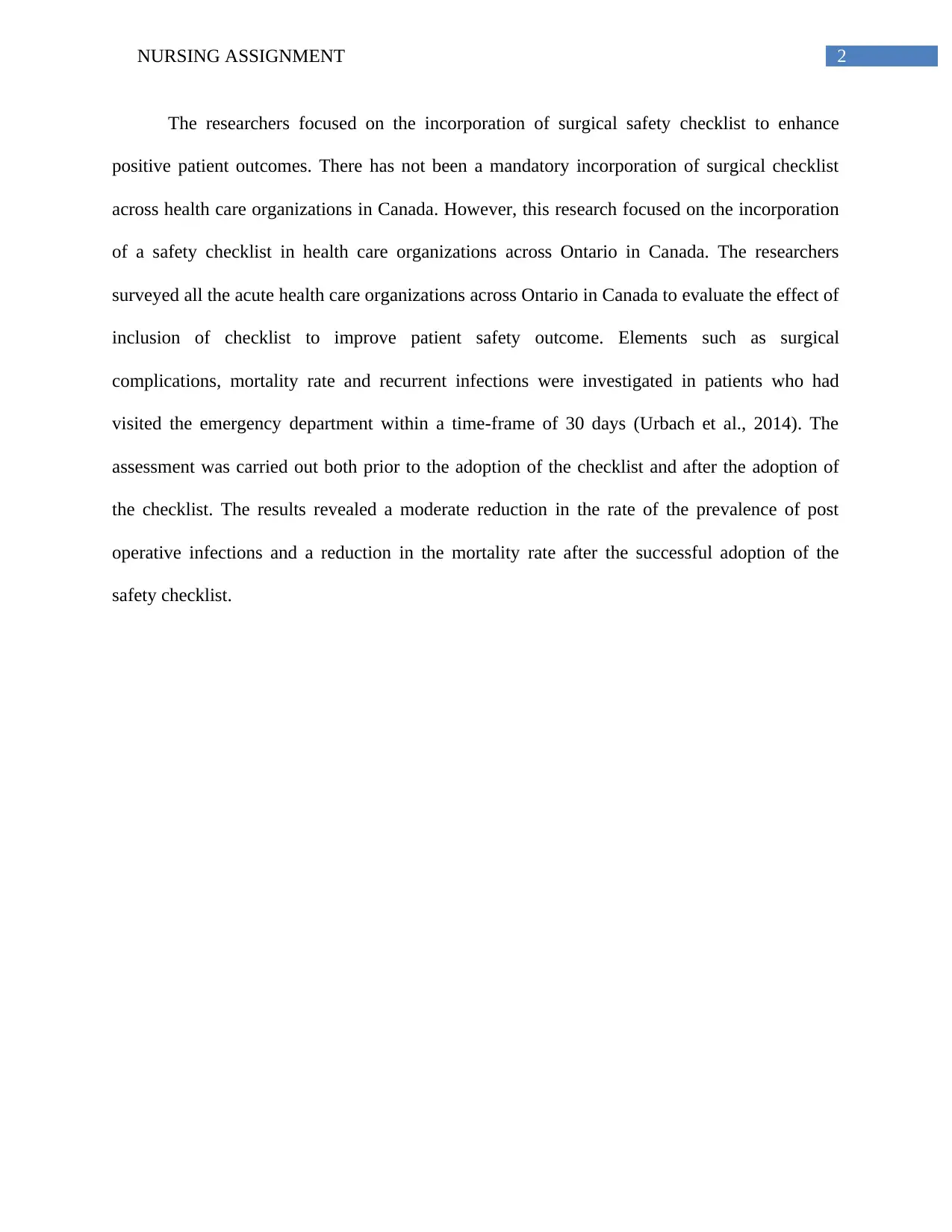
The researchers focused on the incorporation of surgical safety checklist to enhance
positive patient outcomes. There has not been a mandatory incorporation of surgical checklist
across health care organizations in Canada. However, this research focused on the incorporation
of a safety checklist in health care organizations across Ontario in Canada. The researchers
surveyed all the acute health care organizations across Ontario in Canada to evaluate the effect of
inclusion of checklist to improve patient safety outcome. Elements such as surgical
complications, mortality rate and recurrent infections were investigated in patients who had
visited the emergency department within a time-frame of 30 days (Urbach et al., 2014). The
assessment was carried out both prior to the adoption of the checklist and after the adoption of
the checklist. The results revealed a moderate reduction in the rate of the prevalence of post
operative infections and a reduction in the mortality rate after the successful adoption of the
safety checklist.
Document Page
3NURSING ASSIGNMENT
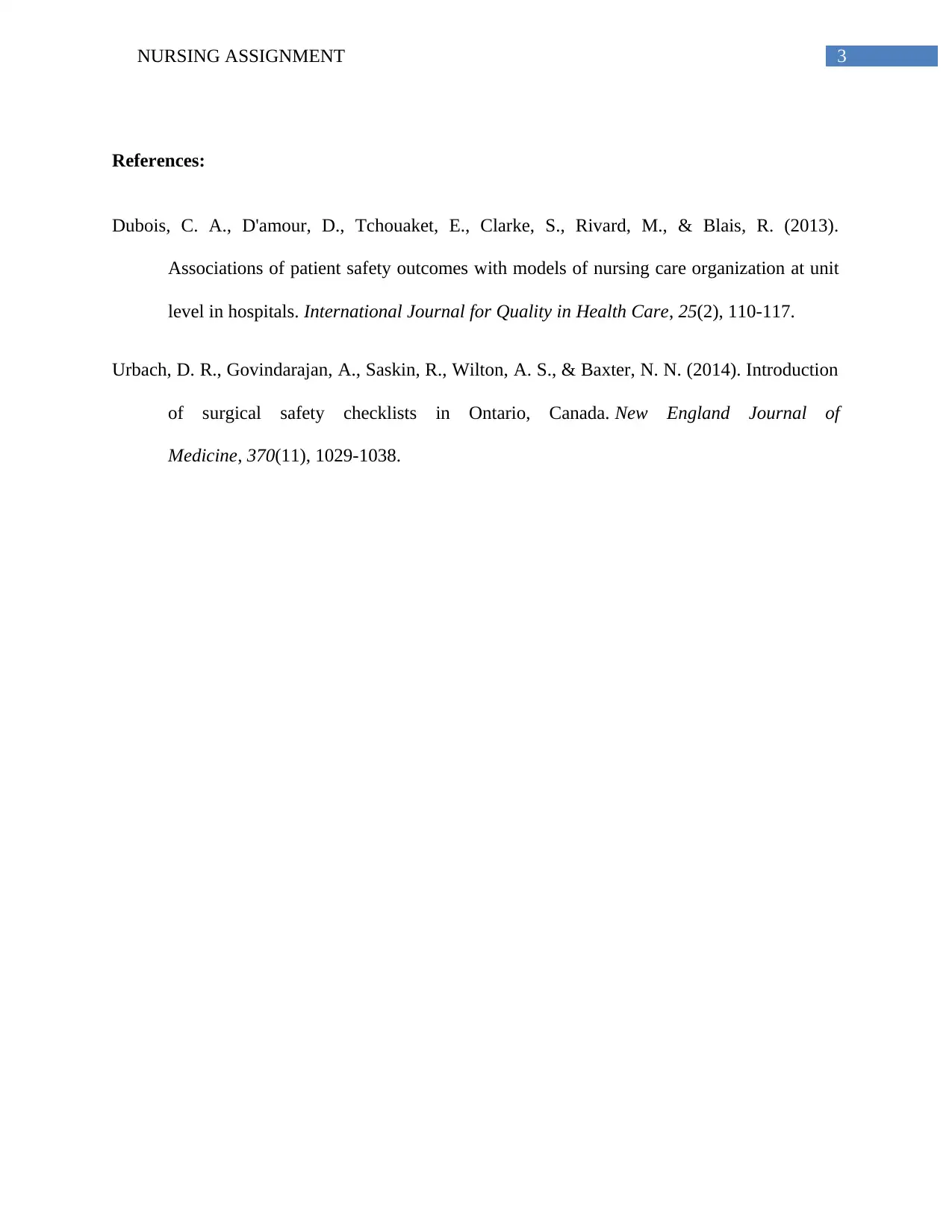
References:
Dubois, C. A., D'amour, D., Tchouaket, E., Clarke, S., Rivard, M., & Blais, R. (2013).
Associations of patient safety outcomes with models of nursing care organization at unit
level in hospitals. International Journal for Quality in Health Care, 25(2), 110-117.
Urbach, D. R., Govindarajan, A., Saskin, R., Wilton, A. S., & Baxter, N. N. (2014). Introduction
of surgical safety checklists in Ontario, Canada. New England Journal of
Medicine, 370(11), 1029-1038.
chevron_up_icon
1 out of 4
circle_padding
hide_on_mobile
zoom_out_icon
[object Object]