Patient Safety Risk Analysis and Prevention Strategy Report - Nursing

Verified

Added on  2022/10/18

|4
|639
|81
Report
AI Summary
This report analyzes patient safety risks within an Australian healthcare context, focusing on cultural safety and the challenges faced by Indigenous populations. The assignment addresses a case study involving a patient and a nurse, highlighting instances of potential racism and cultural insensitivity. The student identifies key events and associated patient safety risks, emphasizing the need for a patient-centered approach. The report underscores the impact of institutional racism and the importance of understanding the communal health approach of Indigenous communities. It proposes educational strategies for healthcare professionals to address cultural differences and implement policies to mitigate racism, drawing on relevant literature to support its recommendations. The report aims to prevent future occurrences of patient safety risks by improving cultural competence and promoting equitable healthcare practices.
Document Page
Runners head: QUESTION TWO AND THREE 1
Question Two and Three
Student’s Name
University
tabler-icon-diamond-filled.svg

Paraphrase This Document

Need a fresh take? Get an instant paraphrase of this document with our AI Paraphraser
Document Page
QUESTION TWO AND THREE 2
Question Two and Three
Question two
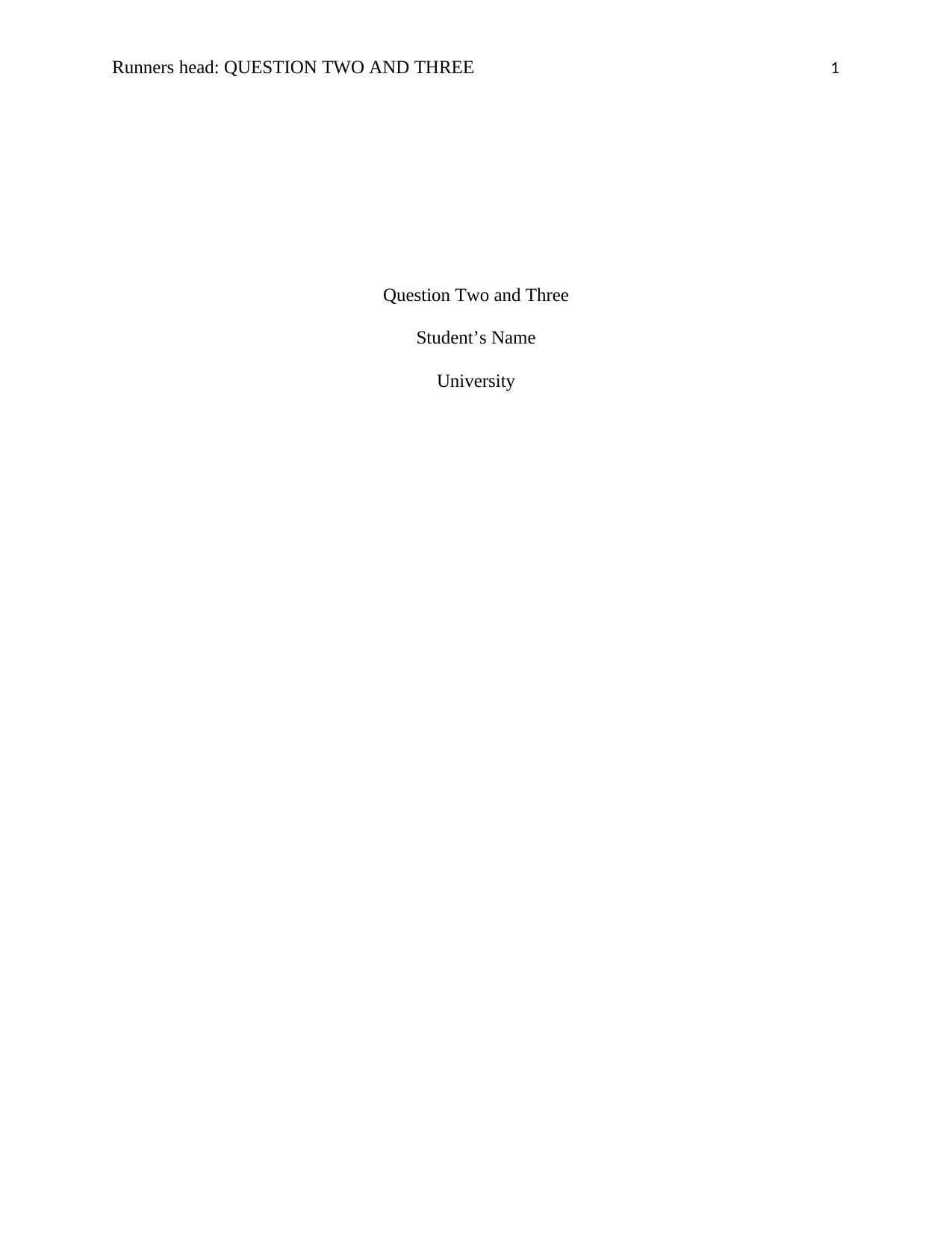
Racism is one of the key challenges in Australian hospitals and the indigenous
population. As seen in the map of events the RN Robyn is culturally discriminative in the way he
introduces himself to Erica by reflecting prejudice and judgment in his tone on the race of the
patient. Institutional racism is also embedded in Australia to the extent that some patients are
denied medical assistance or they are not treated well according to the required standards.
Racism threatens the cultural safety of patients since it allows healthcare professional to
approach patient health from one side of the story rather than using the patient-centered
approach. Culturally indigenous people lie Erica have a communal approach to health as
compared to the non-indigenous people and will thus require the professionals to understand the
needs of these people and how to apply their cultural requirements in the health needs that they
need. Dureyg & Thompson (2012) suggests that racism is deeply embedded in the Australian
healthcare system to the extent that marginalized groups face bigger challenges in health because
their health approach is communally based rather than individual based. This means that
healthcare practitioners need to understand how they can approach the issues that relate to this
population.
Question three
One strategy that can be used address racism in healthcare is through educating
practitioners on the varying needs of the indigenous populations and the non-indigenous ones
(Reading, 2018). This means that healthcare practitioners like the RN Robyn need to be educated
on how to address the issues of the indigenous people like the case of Erica so that they can
understand how the needs of such people vary. We can see the RN treating Erica with racial
Document Page
QUESTION TWO AND THREE 3
prejudice because he seems to lack the understanding that there are differences between the
indigenous and non-indigenous health needs. By ensuring that the healthcare personnel is
individual driven, healthcare priorities will focus on the needs of the Aboriginal population thus
meeting the needs of the population.
Another way to address the issues of racism in the healthcare setting is by developing
policies and guidelines that define the way healthcare professionals need to deal with people
from different cultural backgrounds. Institutional racism is not all about the direct discriminative
acts but rather the embedded racial elements that make it difficult for people from marginalized
racial groups to receive equal treatment. This means that by having policy guidelines that define
the way practitioners engage with marginalized groups and deal with the issues around them, it
becomes easy to address these challenges since policies will define the procedures that need to
be followed when interacting with such populations (Bourke, Marrie, & Marrie, 2018). The
policies can also have monitoring and patient reporting mechanisms where patients can report
the challenges that they face within healthcare settings. This will lead to reduced systemic
challenges that the marginalized populations face within healthcare settings.
Document Page
QUESTION TWO AND THREE 4
References
Bourke, C. J., Marrie, H., & Marrie, A. (2018). Transforming institutional racism at an
Australian hospital. Australian Health Review, 10(5), 1-8.
Dureyg, A., & Thompson, S. C. (2012). Reducing the health disparities of Indigenous
Australians: time to change focus. BMC Health Services Research, 12(151).
Reading, C. (2018). Policies, Programs and Strategies tO Address Aboriginal Racism: A
Canadian Perspective. National Collaboratove Centere for Aboriginal Health.
chevron_up_icon
1 out of 4
circle_padding
hide_on_mobile
zoom_out_icon
[object Object]