Case Study: Analysis of Pebble Technology Corporation's Failure
VerifiedAdded on 2022/11/29
|12
|3119
|422
Case Study
AI Summary
This comprehensive case study examines the business failure of Pebble Technology Corporation. It begins with a detailed introduction and root cause analysis, utilizing the Fishbone diagram and multi-level causal analysis to identify key factors contributing to the company's downfall. The study also includes internal and external environmental analyses employing models like PESTLE and Porter's Five Forces. A comparative analysis with the failure of Jawbone in 2017 further enriches the understanding of the challenges faced by Pebble. The report culminates in strategic recommendations, proposing potential turnaround or exit strategies for Pebble, along with a conclusion summarizing the findings and a list of references.
Pebble Technology
Corporation
CASE STUDY
Corporation
CASE STUDY

Paraphrase This Document
Need a fresh take? Get an instant paraphrase of this document with our AI Paraphraser
Contents
INTRODUCTION.......................................................................................................................................3
MAIN BODY..............................................................................................................................................3
Analysis of why Pebble failed.................................................................................................................3
Compare with the failure of Jawbone in 2017.........................................................................................8
Strategise – Devise a more suitable turnaround or exit for Pebble...........................................................9
Conclusion.................................................................................................................................................11
REFRENCES............................................................................................................................................12
Books and Journal.................................................................................................................................12
INTRODUCTION.......................................................................................................................................3
MAIN BODY..............................................................................................................................................3
Analysis of why Pebble failed.................................................................................................................3
Compare with the failure of Jawbone in 2017.........................................................................................8
Strategise – Devise a more suitable turnaround or exit for Pebble...........................................................9
Conclusion.................................................................................................................................................11
REFRENCES............................................................................................................................................12
Books and Journal.................................................................................................................................12
INTRODUCTION
The proposed report highlights upon the business failure of pebble technology Corporation. It
involves a detailed assessment of root cause analysis in order to identify the potential reasons for
the failure of Pebble technology Corporation. Multilevel casual analysis will also be applied to
the business scenario of the company. Internal as well as external environmental analysis of the
company is also evaluated through the utilisation of effective and appropriate models. In addition
to that comparison between the business failure of Pebble Technology Corporation and Jawbone
is also reflected within the report.
MAIN BODY
Analysis of why Pebble failed
Root Cause Analysis
Root cause analysis can be characterised as a concept that facilitates the assistance to business
firms in identify the potential route cause of a particular issue or problem within the concerned
enterprise. The analysis aids the firms to determine the issue in order to solve the same in an
appropriate manner (Assaad, et,al , 2020). It detects the problem from it origin and tries to find
the prominent reason behind its existence as well. In order to facilitate the root cause analysis of
Pebble Technology Corporation, following below mentioned Fishbone Diagram will be taken
into consideration.
Fishbone Analysis
Fishbone is stated as a diagram that highlights upon the cause of the problem as well as affect
associated with the same. It is helpful in realisation of the prominent issues and implications by
categorising the same into several pointers that has led to the existence of the problem (Lee, et.a ,
2021). In context to Pebble Technology Corporation, the application of Fishbone analysis is as
follows:-
Method
The proposed report highlights upon the business failure of pebble technology Corporation. It
involves a detailed assessment of root cause analysis in order to identify the potential reasons for
the failure of Pebble technology Corporation. Multilevel casual analysis will also be applied to
the business scenario of the company. Internal as well as external environmental analysis of the
company is also evaluated through the utilisation of effective and appropriate models. In addition
to that comparison between the business failure of Pebble Technology Corporation and Jawbone
is also reflected within the report.
MAIN BODY
Analysis of why Pebble failed
Root Cause Analysis
Root cause analysis can be characterised as a concept that facilitates the assistance to business
firms in identify the potential route cause of a particular issue or problem within the concerned
enterprise. The analysis aids the firms to determine the issue in order to solve the same in an
appropriate manner (Assaad, et,al , 2020). It detects the problem from it origin and tries to find
the prominent reason behind its existence as well. In order to facilitate the root cause analysis of
Pebble Technology Corporation, following below mentioned Fishbone Diagram will be taken
into consideration.
Fishbone Analysis
Fishbone is stated as a diagram that highlights upon the cause of the problem as well as affect
associated with the same. It is helpful in realisation of the prominent issues and implications by
categorising the same into several pointers that has led to the existence of the problem (Lee, et.a ,
2021). In context to Pebble Technology Corporation, the application of Fishbone analysis is as
follows:-
Method
⊘ This is a preview!⊘
Do you want full access?
Subscribe today to unlock all pages.

Trusted by 1+ million students worldwide
The methods of operations facilitated by Pebble Technology Corporation were incompetent to
match global business requirements. The company’s functional strategies were not effective at
all. Pebble Technology Corporation decided to introduce three types of different products within
a business year which did not serve despite suffering from severe losses. The company decided
to take this irrelevant step which led to adverse implication from the same (Kim, Soo Young and
Arun Upneja, 2021). Hence, it can be stated that the business practices and methods capitalised
by the respective firm were based upon short term orientation as they took unnecessary risks
which backfired the same.
Machinery
Although, the machinery utilised by Pebble Technology Corporation was quite advance and
effective but there was other business firms in the market such as Apple which also leveraged
upon the same set of technological advancements. Hence, it can be stated that neither machinery
provide any added advantage to the company nor did it led to any possible issues in respect to
failure of the business organisation.
Measurement
The measurement criterions formulated by Pebble Technology Corporation were not up to the
standards and did not serve the company appropriate results. The firm’s risk measurement scale
turned out to be ineffective as it did not map the possible results associated with the strategy
implementation.
Manpower
In the initial phase of establishment, the manpower of the concerned business entity was
facilitated with supreme work environment. This led to reduction in motivation among the
employees. Also, when the company started losing its market reach, it decided to lay off
approximately ¼ of its existing workforce which in turn also enhanced the insecurity among the
staff members serving from the firm. With gradual time, the company started ignoring the
employee development and wellbeing and started focusing upon other essential business aspects.
Material
match global business requirements. The company’s functional strategies were not effective at
all. Pebble Technology Corporation decided to introduce three types of different products within
a business year which did not serve despite suffering from severe losses. The company decided
to take this irrelevant step which led to adverse implication from the same (Kim, Soo Young and
Arun Upneja, 2021). Hence, it can be stated that the business practices and methods capitalised
by the respective firm were based upon short term orientation as they took unnecessary risks
which backfired the same.
Machinery
Although, the machinery utilised by Pebble Technology Corporation was quite advance and
effective but there was other business firms in the market such as Apple which also leveraged
upon the same set of technological advancements. Hence, it can be stated that neither machinery
provide any added advantage to the company nor did it led to any possible issues in respect to
failure of the business organisation.
Measurement
The measurement criterions formulated by Pebble Technology Corporation were not up to the
standards and did not serve the company appropriate results. The firm’s risk measurement scale
turned out to be ineffective as it did not map the possible results associated with the strategy
implementation.
Manpower
In the initial phase of establishment, the manpower of the concerned business entity was
facilitated with supreme work environment. This led to reduction in motivation among the
employees. Also, when the company started losing its market reach, it decided to lay off
approximately ¼ of its existing workforce which in turn also enhanced the insecurity among the
staff members serving from the firm. With gradual time, the company started ignoring the
employee development and wellbeing and started focusing upon other essential business aspects.
Material
Paraphrase This Document
Need a fresh take? Get an instant paraphrase of this document with our AI Paraphraser
When the reports of the company’s market failure started coming in the media and public
domain, the supplier issues started to rise up for the same. The supplier struggle restricted the
company to lead it business operations on a smooth manner (Chen, et.al ,2020). Moreover, the
materials taken into utilisation by the company did have any potential unique proposition which
also affected the customer acquisition of the company within its target market environment.
Mother Earth
Pebble Technology Corporation incorporated plastic designing within its watch range which was
very disappointing for its current line of customer. The unpleasing and unappealing plastic use
for the product of watches also contributed in reducing the interest of the customer segment in
the organisation offering facilitated y the company in its given industry.
Multi-level Causal analysis
Multi-level analysis is an approach through which issues and triggers associated with the
problem are assessed at various different levels of a business institution. The major goal of the
respective analysis is to facilitate the categorisation of potential route problems in the appropriate
levels in a multi dimensional framework in order to understand the prevailing problematic
environment and the respective factors that are enhancing the issues within the same (Jackson
and Gregory, 2021). In context to Pebble, there were several problems underlying within
different and diverse level of the organisation. The top management seemed ineffective in
formulation of relevant and approachable goals that were profitable and flexible enough for
optimisation by the company. The HR section could not boost the performance of the employees
within the market which in turn led to reduction in the productivity and efficiency of the
company. Strategic leader of the company also disappointed the firm by not being able to
integrate creative measures within the operational and productive line-up of the firm. The
marketing team was unsuccessful in promoting and creating a market for the products and
service delivered by payable in its respective industry. The team was also ineffective in capturing
the interest of audiences for a longer period of time which in turn reduce the sales and profits of
the company. The research and development department of Pebble Technology Corporation Also
had underlying problems within the same. The concerned area was unable to facilitate an in-
domain, the supplier issues started to rise up for the same. The supplier struggle restricted the
company to lead it business operations on a smooth manner (Chen, et.al ,2020). Moreover, the
materials taken into utilisation by the company did have any potential unique proposition which
also affected the customer acquisition of the company within its target market environment.
Mother Earth
Pebble Technology Corporation incorporated plastic designing within its watch range which was
very disappointing for its current line of customer. The unpleasing and unappealing plastic use
for the product of watches also contributed in reducing the interest of the customer segment in
the organisation offering facilitated y the company in its given industry.
Multi-level Causal analysis
Multi-level analysis is an approach through which issues and triggers associated with the
problem are assessed at various different levels of a business institution. The major goal of the
respective analysis is to facilitate the categorisation of potential route problems in the appropriate
levels in a multi dimensional framework in order to understand the prevailing problematic
environment and the respective factors that are enhancing the issues within the same (Jackson
and Gregory, 2021). In context to Pebble, there were several problems underlying within
different and diverse level of the organisation. The top management seemed ineffective in
formulation of relevant and approachable goals that were profitable and flexible enough for
optimisation by the company. The HR section could not boost the performance of the employees
within the market which in turn led to reduction in the productivity and efficiency of the
company. Strategic leader of the company also disappointed the firm by not being able to
integrate creative measures within the operational and productive line-up of the firm. The
marketing team was unsuccessful in promoting and creating a market for the products and
service delivered by payable in its respective industry. The team was also ineffective in capturing
the interest of audiences for a longer period of time which in turn reduce the sales and profits of
the company. The research and development department of Pebble Technology Corporation Also
had underlying problems within the same. The concerned area was unable to facilitate an in-
depth research in regard with the market condition and the future tendencies that could impose
threat to the business firm.
External & internal cause theoretical frameworks
Pestle Analysis
Political
The political environment of the countries in which Pebble operated could have majorly
impacted upon the business practices carried out by the business firm. The inability of the
company’s profits also fluctuated various times due to the political implications.
Economic
The economic rate, interest rates, inflation, recession and alterations in exchange rates etc tend to
affect the economic stability of the business institutions. In context to Pebble Technology
Corporation, the firm suffered through serious economic losses in the market domain.
Social
The choices and preferences of the customers are required to be prioritized in order to cater them
with offering that satisfies their requirements and expectations in a desired and effective way.
Pebble Technology Corporation was unable to understand the market dynamics and was busy
introducing basic watches and gadgets (Ha, Kyu Soo and Bae Jin Park, 2021). Whereas in
reality, the market requirement expectations were driven towards health related gadgets.
Technology
Technology can be termed as a factor that hugely impacts the operational efficiency of the
enterprise. The technology optimised by Pebble was optimum but it lacked creativity and
innovation within the same.
Legal
The business institutions are required to obligate to the laws and frameworks regulated by the
governing body. The company’s working standards were in accordance with the legislations.
threat to the business firm.
External & internal cause theoretical frameworks
Pestle Analysis
Political
The political environment of the countries in which Pebble operated could have majorly
impacted upon the business practices carried out by the business firm. The inability of the
company’s profits also fluctuated various times due to the political implications.
Economic
The economic rate, interest rates, inflation, recession and alterations in exchange rates etc tend to
affect the economic stability of the business institutions. In context to Pebble Technology
Corporation, the firm suffered through serious economic losses in the market domain.
Social
The choices and preferences of the customers are required to be prioritized in order to cater them
with offering that satisfies their requirements and expectations in a desired and effective way.
Pebble Technology Corporation was unable to understand the market dynamics and was busy
introducing basic watches and gadgets (Ha, Kyu Soo and Bae Jin Park, 2021). Whereas in
reality, the market requirement expectations were driven towards health related gadgets.
Technology
Technology can be termed as a factor that hugely impacts the operational efficiency of the
enterprise. The technology optimised by Pebble was optimum but it lacked creativity and
innovation within the same.
Legal
The business institutions are required to obligate to the laws and frameworks regulated by the
governing body. The company’s working standards were in accordance with the legislations.
⊘ This is a preview!⊘
Do you want full access?
Subscribe today to unlock all pages.
Trusted by 1+ million students worldwide
Environment
The environment friendly organisations create a positive business image and reputations within
the society and market. The Pebble Technology Corporation’s business practices did not promote
environmental sustainability.
Porters Five Forces Model
Threat of New entry
The threat associated with the emergence of new enterprise within the common industry did
impact the business stability of Pebble Technology Corporation. The emergence of Fitbit as a
successful and popular organisation led to major complication for Pebble (Savino and Brian
2020). Later on, Fitbit also bought the firm due to its inability to exercise business operations in
the market and insolvency of the same as well.
Bargain Power of Buyer
The customers are always willing to bargain for the products and services provided by the
business firms. In order to do the same, they demand lower prices for quality assured goods. The
inability of the companies to respond to the customer expectations further result in the loss of
customers. Pebble Technology Corporation opted for an affordable price range for its customers.
Bargaining Power of Supplier
Pebble Technology Corporation was unable to lead to profitable negotiations with the suppliers.
The company proved to be incompetent in maintenance of a prominent supply network which
also led to implication for the existence of the respective entity.
Threat of Substitution
The company severely faced the brunt of the particular factor within its business industry. There
were several substitutes for the suffering provided by Pebble which divided the market and
reduced the profit generation and market acquisition of the respective company.
Industry Competition
The environment friendly organisations create a positive business image and reputations within
the society and market. The Pebble Technology Corporation’s business practices did not promote
environmental sustainability.
Porters Five Forces Model
Threat of New entry
The threat associated with the emergence of new enterprise within the common industry did
impact the business stability of Pebble Technology Corporation. The emergence of Fitbit as a
successful and popular organisation led to major complication for Pebble (Savino and Brian
2020). Later on, Fitbit also bought the firm due to its inability to exercise business operations in
the market and insolvency of the same as well.
Bargain Power of Buyer
The customers are always willing to bargain for the products and services provided by the
business firms. In order to do the same, they demand lower prices for quality assured goods. The
inability of the companies to respond to the customer expectations further result in the loss of
customers. Pebble Technology Corporation opted for an affordable price range for its customers.
Bargaining Power of Supplier
Pebble Technology Corporation was unable to lead to profitable negotiations with the suppliers.
The company proved to be incompetent in maintenance of a prominent supply network which
also led to implication for the existence of the respective entity.
Threat of Substitution
The company severely faced the brunt of the particular factor within its business industry. There
were several substitutes for the suffering provided by Pebble which divided the market and
reduced the profit generation and market acquisition of the respective company.
Industry Competition
Paraphrase This Document
Need a fresh take? Get an instant paraphrase of this document with our AI Paraphraser
The competition within technology based industry is quite intense and head to head. Pebble was
incompetent in giving a tough fight to its competitors such as Apple watches, Fitbit etc. The
particular factor also added to the shutting down of the firm.
Value Proposition Canvas
It can be defined as a management model that facilitates the business firms with the assistance to
determine their positioning strategies across their target market. The basic objective of this
model is to ensure that the company able to lead ad communicate its value proposition to the
customer line up with effectiveness. It can be applied to identify the prevailing alignment of
market operations of the company with the target customer. According to the respective mode, it
can be realised did not perform its positioning strategies in an optimal manner as it was unable to
acquire the attention of the customers. There was a huge gap between the market needs and
Pebble’s business operations. The fact that business firm could not live up to the expectations of
the customer segment and did not focus upon the niche market led to a vacuum which became
extremely difficult for Pebble to fill in. Thus, the company could not eliminate gap. The value
proposition canvas indicated the insufficiency and lack of the company to generate value
operations in its field of business.
Compare with the failure of Jawbone in 2017
Jawbone Pebble
The root cause behind the failure of Jawbone
can be blamed upon the operational
ineffectiveness and poor service quality of the
firm. The company faced potential problems in
managing its software as well as hardware
inadequacy.
The major cause that led to the failure of
Pebble was its inability to understand the
market requirement and place its products and
services in an optimum manner. The company
was not able to ascertain the business the
customer needs and capitalized on the products
which were not excessively demanded in the
market.
In addition to that, it was also not sufficient
enough to meet the predetermined product
On the other hand, the demand for the
company’s offering touched the bottom.
incompetent in giving a tough fight to its competitors such as Apple watches, Fitbit etc. The
particular factor also added to the shutting down of the firm.
Value Proposition Canvas
It can be defined as a management model that facilitates the business firms with the assistance to
determine their positioning strategies across their target market. The basic objective of this
model is to ensure that the company able to lead ad communicate its value proposition to the
customer line up with effectiveness. It can be applied to identify the prevailing alignment of
market operations of the company with the target customer. According to the respective mode, it
can be realised did not perform its positioning strategies in an optimal manner as it was unable to
acquire the attention of the customers. There was a huge gap between the market needs and
Pebble’s business operations. The fact that business firm could not live up to the expectations of
the customer segment and did not focus upon the niche market led to a vacuum which became
extremely difficult for Pebble to fill in. Thus, the company could not eliminate gap. The value
proposition canvas indicated the insufficiency and lack of the company to generate value
operations in its field of business.
Compare with the failure of Jawbone in 2017
Jawbone Pebble
The root cause behind the failure of Jawbone
can be blamed upon the operational
ineffectiveness and poor service quality of the
firm. The company faced potential problems in
managing its software as well as hardware
inadequacy.
The major cause that led to the failure of
Pebble was its inability to understand the
market requirement and place its products and
services in an optimum manner. The company
was not able to ascertain the business the
customer needs and capitalized on the products
which were not excessively demanded in the
market.
In addition to that, it was also not sufficient
enough to meet the predetermined product
On the other hand, the demand for the
company’s offering touched the bottom.
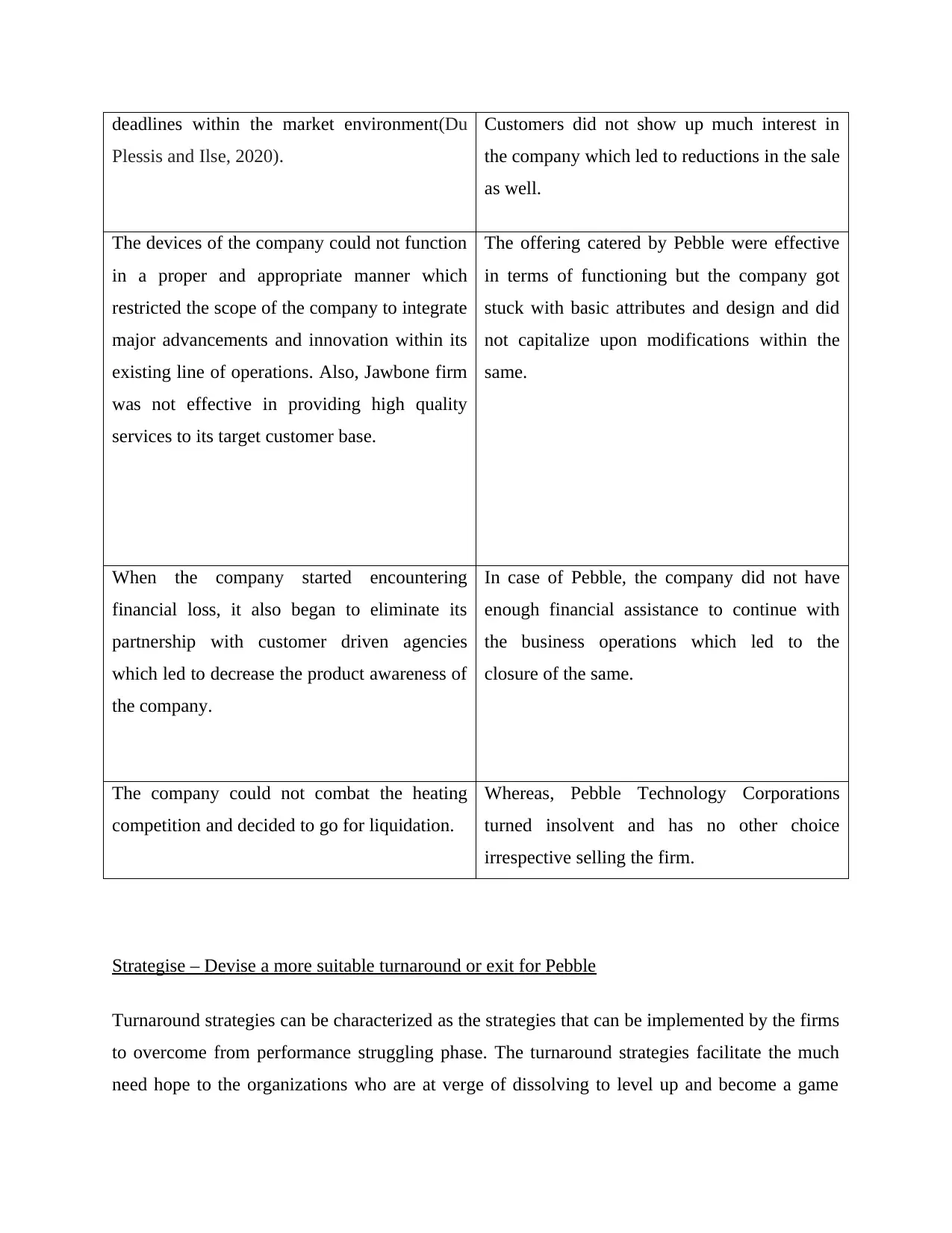
deadlines within the market environment(Du
Plessis and Ilse, 2020).
Customers did not show up much interest in
the company which led to reductions in the sale
as well.
The devices of the company could not function
in a proper and appropriate manner which
restricted the scope of the company to integrate
major advancements and innovation within its
existing line of operations. Also, Jawbone firm
was not effective in providing high quality
services to its target customer base.
The offering catered by Pebble were effective
in terms of functioning but the company got
stuck with basic attributes and design and did
not capitalize upon modifications within the
same.
When the company started encountering
financial loss, it also began to eliminate its
partnership with customer driven agencies
which led to decrease the product awareness of
the company.
In case of Pebble, the company did not have
enough financial assistance to continue with
the business operations which led to the
closure of the same.
The company could not combat the heating
competition and decided to go for liquidation.
Whereas, Pebble Technology Corporations
turned insolvent and has no other choice
irrespective selling the firm.
Strategise – Devise a more suitable turnaround or exit for Pebble
Turnaround strategies can be characterized as the strategies that can be implemented by the firms
to overcome from performance struggling phase. The turnaround strategies facilitate the much
need hope to the organizations who are at verge of dissolving to level up and become a game
Plessis and Ilse, 2020).
Customers did not show up much interest in
the company which led to reductions in the sale
as well.
The devices of the company could not function
in a proper and appropriate manner which
restricted the scope of the company to integrate
major advancements and innovation within its
existing line of operations. Also, Jawbone firm
was not effective in providing high quality
services to its target customer base.
The offering catered by Pebble were effective
in terms of functioning but the company got
stuck with basic attributes and design and did
not capitalize upon modifications within the
same.
When the company started encountering
financial loss, it also began to eliminate its
partnership with customer driven agencies
which led to decrease the product awareness of
the company.
In case of Pebble, the company did not have
enough financial assistance to continue with
the business operations which led to the
closure of the same.
The company could not combat the heating
competition and decided to go for liquidation.
Whereas, Pebble Technology Corporations
turned insolvent and has no other choice
irrespective selling the firm.
Strategise – Devise a more suitable turnaround or exit for Pebble
Turnaround strategies can be characterized as the strategies that can be implemented by the firms
to overcome from performance struggling phase. The turnaround strategies facilitate the much
need hope to the organizations who are at verge of dissolving to level up and become a game
⊘ This is a preview!⊘
Do you want full access?
Subscribe today to unlock all pages.
Trusted by 1+ million students worldwide

changer in their industry. The respective strategies aids the business firms in recovering from the
dull period fight the same and emerge as a much stronger organization within the market.
Asset Retrenchment
The optimization of Asset Retrenchment Strategy could have helped the firm to eliminate the
non productive departments from the same. This would help the firm to concentrate upon the
organizational areas that are doing well and have the potential to be worked upon in order to
achieve much needed success within the market industry (Zhao, Wen and Huihui Zhao, 2020).
The valuation of unproductive assets helps the firm to eliminate or facilitate improvisation of the
same so as to enhance the operational productiveness of the firm.
Leadership
The focus upon changing the existing narrative of leadership in Pebble Technology could have
assisted the firm to lead better business practices within the business environment. The employee
performance and morale could have been boosted with the advance and effective leadership
approaches within the work setting. Leadership has the power to change organizational culture
and climate in a positive and competent manner. Hence, the capitalization of appropriate
leadership theories and models would have helped in stabilizing the business operations of the
company.
Cost Efficiency
In the doom period, the Pebble could have concentrated upon restricting its expenditure and hold
on to its existing line operations in order to maintain financial stability (Chen, et.al , 2020). Cost
cutting can be implemented in order to ensure that company has adequate capital through which
future business funding could have been facilitated without any severe helps and complication.
Decision Making
Pebble Technology Corporation should facilitate more prominent and effective decisions and
should measure the pros and cons of every given strategy before leading the implementation
strange. The company should be more careful about taking risks in the complex environment.
dull period fight the same and emerge as a much stronger organization within the market.
Asset Retrenchment
The optimization of Asset Retrenchment Strategy could have helped the firm to eliminate the
non productive departments from the same. This would help the firm to concentrate upon the
organizational areas that are doing well and have the potential to be worked upon in order to
achieve much needed success within the market industry (Zhao, Wen and Huihui Zhao, 2020).
The valuation of unproductive assets helps the firm to eliminate or facilitate improvisation of the
same so as to enhance the operational productiveness of the firm.
Leadership
The focus upon changing the existing narrative of leadership in Pebble Technology could have
assisted the firm to lead better business practices within the business environment. The employee
performance and morale could have been boosted with the advance and effective leadership
approaches within the work setting. Leadership has the power to change organizational culture
and climate in a positive and competent manner. Hence, the capitalization of appropriate
leadership theories and models would have helped in stabilizing the business operations of the
company.
Cost Efficiency
In the doom period, the Pebble could have concentrated upon restricting its expenditure and hold
on to its existing line operations in order to maintain financial stability (Chen, et.al , 2020). Cost
cutting can be implemented in order to ensure that company has adequate capital through which
future business funding could have been facilitated without any severe helps and complication.
Decision Making
Pebble Technology Corporation should facilitate more prominent and effective decisions and
should measure the pros and cons of every given strategy before leading the implementation
strange. The company should be more careful about taking risks in the complex environment.
Paraphrase This Document
Need a fresh take? Get an instant paraphrase of this document with our AI Paraphraser
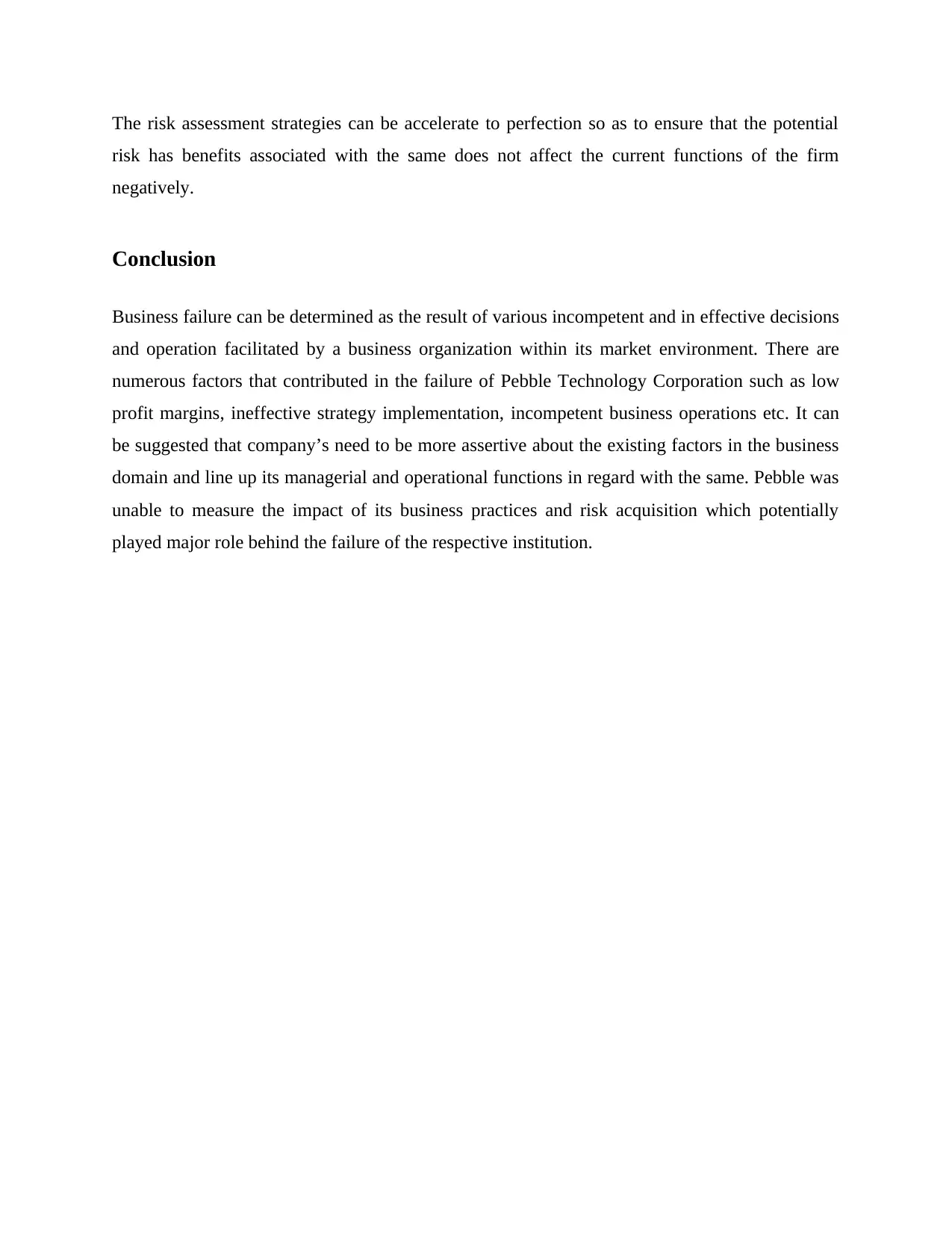
The risk assessment strategies can be accelerate to perfection so as to ensure that the potential
risk has benefits associated with the same does not affect the current functions of the firm
negatively.
Conclusion
Business failure can be determined as the result of various incompetent and in effective decisions
and operation facilitated by a business organization within its market environment. There are
numerous factors that contributed in the failure of Pebble Technology Corporation such as low
profit margins, ineffective strategy implementation, incompetent business operations etc. It can
be suggested that company’s need to be more assertive about the existing factors in the business
domain and line up its managerial and operational functions in regard with the same. Pebble was
unable to measure the impact of its business practices and risk acquisition which potentially
played major role behind the failure of the respective institution.
risk has benefits associated with the same does not affect the current functions of the firm
negatively.
Conclusion
Business failure can be determined as the result of various incompetent and in effective decisions
and operation facilitated by a business organization within its market environment. There are
numerous factors that contributed in the failure of Pebble Technology Corporation such as low
profit margins, ineffective strategy implementation, incompetent business operations etc. It can
be suggested that company’s need to be more assertive about the existing factors in the business
domain and line up its managerial and operational functions in regard with the same. Pebble was
unable to measure the impact of its business practices and risk acquisition which potentially
played major role behind the failure of the respective institution.
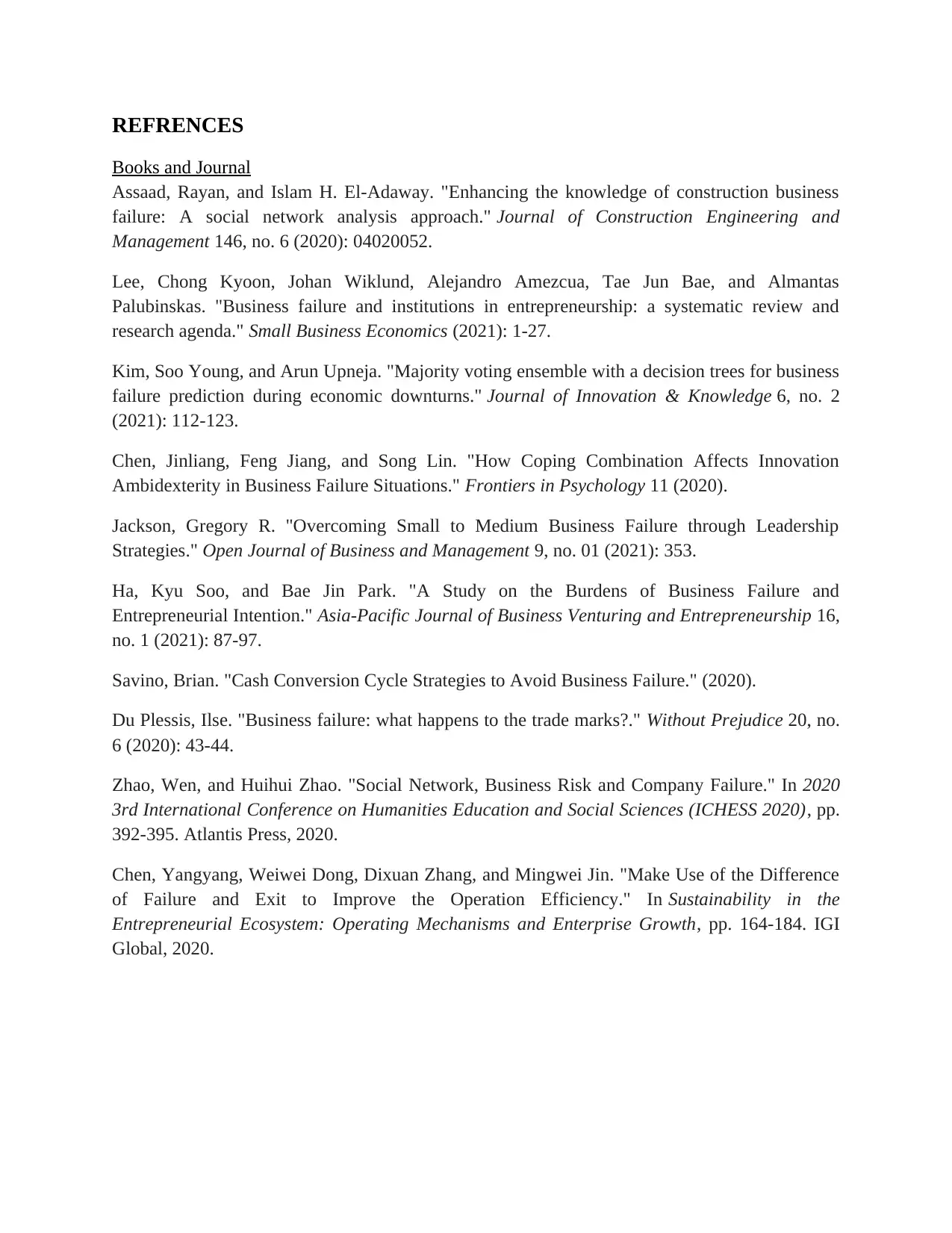
REFRENCES
Books and Journal
Assaad, Rayan, and Islam H. El-Adaway. "Enhancing the knowledge of construction business
failure: A social network analysis approach." Journal of Construction Engineering and
Management 146, no. 6 (2020): 04020052.
Lee, Chong Kyoon, Johan Wiklund, Alejandro Amezcua, Tae Jun Bae, and Almantas
Palubinskas. "Business failure and institutions in entrepreneurship: a systematic review and
research agenda." Small Business Economics (2021): 1-27.
Kim, Soo Young, and Arun Upneja. "Majority voting ensemble with a decision trees for business
failure prediction during economic downturns." Journal of Innovation & Knowledge 6, no. 2
(2021): 112-123.
Chen, Jinliang, Feng Jiang, and Song Lin. "How Coping Combination Affects Innovation
Ambidexterity in Business Failure Situations." Frontiers in Psychology 11 (2020).
Jackson, Gregory R. "Overcoming Small to Medium Business Failure through Leadership
Strategies." Open Journal of Business and Management 9, no. 01 (2021): 353.
Ha, Kyu Soo, and Bae Jin Park. "A Study on the Burdens of Business Failure and
Entrepreneurial Intention." Asia-Pacific Journal of Business Venturing and Entrepreneurship 16,
no. 1 (2021): 87-97.
Savino, Brian. "Cash Conversion Cycle Strategies to Avoid Business Failure." (2020).
Du Plessis, Ilse. "Business failure: what happens to the trade marks?." Without Prejudice 20, no.
6 (2020): 43-44.
Zhao, Wen, and Huihui Zhao. "Social Network, Business Risk and Company Failure." In 2020
3rd International Conference on Humanities Education and Social Sciences (ICHESS 2020), pp.
392-395. Atlantis Press, 2020.
Chen, Yangyang, Weiwei Dong, Dixuan Zhang, and Mingwei Jin. "Make Use of the Difference
of Failure and Exit to Improve the Operation Efficiency." In Sustainability in the
Entrepreneurial Ecosystem: Operating Mechanisms and Enterprise Growth, pp. 164-184. IGI
Global, 2020.
Books and Journal
Assaad, Rayan, and Islam H. El-Adaway. "Enhancing the knowledge of construction business
failure: A social network analysis approach." Journal of Construction Engineering and
Management 146, no. 6 (2020): 04020052.
Lee, Chong Kyoon, Johan Wiklund, Alejandro Amezcua, Tae Jun Bae, and Almantas
Palubinskas. "Business failure and institutions in entrepreneurship: a systematic review and
research agenda." Small Business Economics (2021): 1-27.
Kim, Soo Young, and Arun Upneja. "Majority voting ensemble with a decision trees for business
failure prediction during economic downturns." Journal of Innovation & Knowledge 6, no. 2
(2021): 112-123.
Chen, Jinliang, Feng Jiang, and Song Lin. "How Coping Combination Affects Innovation
Ambidexterity in Business Failure Situations." Frontiers in Psychology 11 (2020).
Jackson, Gregory R. "Overcoming Small to Medium Business Failure through Leadership
Strategies." Open Journal of Business and Management 9, no. 01 (2021): 353.
Ha, Kyu Soo, and Bae Jin Park. "A Study on the Burdens of Business Failure and
Entrepreneurial Intention." Asia-Pacific Journal of Business Venturing and Entrepreneurship 16,
no. 1 (2021): 87-97.
Savino, Brian. "Cash Conversion Cycle Strategies to Avoid Business Failure." (2020).
Du Plessis, Ilse. "Business failure: what happens to the trade marks?." Without Prejudice 20, no.
6 (2020): 43-44.
Zhao, Wen, and Huihui Zhao. "Social Network, Business Risk and Company Failure." In 2020
3rd International Conference on Humanities Education and Social Sciences (ICHESS 2020), pp.
392-395. Atlantis Press, 2020.
Chen, Yangyang, Weiwei Dong, Dixuan Zhang, and Mingwei Jin. "Make Use of the Difference
of Failure and Exit to Improve the Operation Efficiency." In Sustainability in the
Entrepreneurial Ecosystem: Operating Mechanisms and Enterprise Growth, pp. 164-184. IGI
Global, 2020.
⊘ This is a preview!⊘
Do you want full access?
Subscribe today to unlock all pages.
Trusted by 1+ million students worldwide

1 out of 12


Related Documents


Your All-in-One AI-Powered Toolkit for Academic Success.
+13062052269
info@desklib.com
Available 24*7 on WhatsApp / Email
![[object Object]](/_next/static/media/star-bottom.7253800d.svg)
Unlock your academic potential
Copyright © 2020–2026 A2Z Services. All Rights Reserved. Developed and managed by ZUCOL.