Peer Conflicts, Teacher Roles & Personalized Learning Plan Analysis
VerifiedAdded on 2023/06/13
|9
|1870
|313
Report
AI Summary
This report examines the role of peer conflicts in the social-emotional development of toddlers and the pedagogical practices of teachers in managing these conflicts. It reviews a journal article that explores teachers' perspectives on toddler peer conflicts, focusing on their roles in supporting learning and development during these interactions. The report highlights strategies such as positioning conflicts as learning opportunities, fostering positive associations, and employing child-centered mediation. Additionally, the report includes a personalized learning plan, emphasizing the importance of tailoring education to individual strengths, weaknesses, and interests to enhance skills and knowledge. The personalized learning plan focuses on organization, writing skills, and effective work management, aiming to support children in achieving their learning objectives and managing their daily routines effectively. Desklib provides access to this and other solved assignments.
Journal Article & Personalised Learning Plan
Paraphrase This Document
Need a fresh take? Get an instant paraphrase of this document with our AI Paraphraser

CONTENTS
TASK – 1...................................................................................................................................1
INTRODUCTION......................................................................................................................1
ROLE OF PEER CONFLICTS IN THE DEVELOPMENT OF SOCIAL-EMOTIONAL
SKILLS......................................................................................................................................1
TODDLER’S PEER CONFLICTS AND TEACHER’S ROLE................................................1
METHODS................................................................................................................................2
Participants.............................................................................................................................2
Research design......................................................................................................................2
Data collection........................................................................................................................2
Data analysis...........................................................................................................................2
RESULTS & DISCUSSION......................................................................................................3
TASK – 2...................................................................................................................................4
PERSONALIZED LEARNING PLAN.....................................................................................4
REFERENCES...........................................................................................................................7
TASK – 1...................................................................................................................................1
INTRODUCTION......................................................................................................................1
ROLE OF PEER CONFLICTS IN THE DEVELOPMENT OF SOCIAL-EMOTIONAL
SKILLS......................................................................................................................................1
TODDLER’S PEER CONFLICTS AND TEACHER’S ROLE................................................1
METHODS................................................................................................................................2
Participants.............................................................................................................................2
Research design......................................................................................................................2
Data collection........................................................................................................................2
Data analysis...........................................................................................................................2
RESULTS & DISCUSSION......................................................................................................3
TASK – 2...................................................................................................................................4
PERSONALIZED LEARNING PLAN.....................................................................................4
REFERENCES...........................................................................................................................7

TASK – 1
INTRODUCTION
Early year education plays a very crucial role in the evolution and learning of
children. Many researches have been done in past concerning the current topic. Early year
education helps the child in development of social, emotional as well as cognitive needs for
building solid foundation for lifelong learning. Considering this, the present article also deals
with analysing the role of conflicts in promotion of learning in toddler’s peer conflicts. There
are different research questions that the authors intends to answer such as the role of teachers
in toddler’s peer conflicts, pedagogical practices being valued and used by teachers and the
factors influencing their practices. Furthermore, the main reason or purpose of carrying out
this research study by the authors is to discover the self-report of the early childhood teachers
about their pedagogical practices in relation with toddler’s peer conflicts. In the given article,
the significance of the peer conflicts of the toddler along with the role of teachers are
discussed and presented broadly.
ROLE OF PEER CONFLICTS IN THE DEVELOPMENT OF SOCIAL-
EMOTIONAL SKILLS
It has been suggested by the authors such as Gloeckler, Cassell, and Malkus (2014)
that conflicts in the peer toddlers is not an idea rather it is an opportunity for looking at the
viewpoints of others. Further, as per DeVries and Zan (2012), conflicts are being referred as
the events through which toddlers can grasp social-emotional skills. Different studies have
also suggested that by participating in the conflicts, toddlers will be able to augment their
capabilities of communicating, compromising and discover similarities as well as
dissimilarities in social interaction. Consequently, it can be said that for those children whose
social-emotional skills, language and other skills are still developing for them conflicts can
turn out to be potential learning events.
TODDLER’S PEER CONFLICTS AND TEACHER’S ROLE
In the connect of the conflicts between peer toddlers, different strategies are being
selected by the teachers for the purpose of offering suitable response for the promotion of
learning as well as for making sure safety in regards with the children. Several kinds of
strategies such as positioning conflicts as learning events, fostering optimistic association and
meditation which are child centred are some of the strategies being suggested by teachers for
supporting leaning during crisis. In addition to this, the authors has also emphasized on the
1
INTRODUCTION
Early year education plays a very crucial role in the evolution and learning of
children. Many researches have been done in past concerning the current topic. Early year
education helps the child in development of social, emotional as well as cognitive needs for
building solid foundation for lifelong learning. Considering this, the present article also deals
with analysing the role of conflicts in promotion of learning in toddler’s peer conflicts. There
are different research questions that the authors intends to answer such as the role of teachers
in toddler’s peer conflicts, pedagogical practices being valued and used by teachers and the
factors influencing their practices. Furthermore, the main reason or purpose of carrying out
this research study by the authors is to discover the self-report of the early childhood teachers
about their pedagogical practices in relation with toddler’s peer conflicts. In the given article,
the significance of the peer conflicts of the toddler along with the role of teachers are
discussed and presented broadly.
ROLE OF PEER CONFLICTS IN THE DEVELOPMENT OF SOCIAL-
EMOTIONAL SKILLS
It has been suggested by the authors such as Gloeckler, Cassell, and Malkus (2014)
that conflicts in the peer toddlers is not an idea rather it is an opportunity for looking at the
viewpoints of others. Further, as per DeVries and Zan (2012), conflicts are being referred as
the events through which toddlers can grasp social-emotional skills. Different studies have
also suggested that by participating in the conflicts, toddlers will be able to augment their
capabilities of communicating, compromising and discover similarities as well as
dissimilarities in social interaction. Consequently, it can be said that for those children whose
social-emotional skills, language and other skills are still developing for them conflicts can
turn out to be potential learning events.
TODDLER’S PEER CONFLICTS AND TEACHER’S ROLE
In the connect of the conflicts between peer toddlers, different strategies are being
selected by the teachers for the purpose of offering suitable response for the promotion of
learning as well as for making sure safety in regards with the children. Several kinds of
strategies such as positioning conflicts as learning events, fostering optimistic association and
meditation which are child centred are some of the strategies being suggested by teachers for
supporting leaning during crisis. In addition to this, the authors has also emphasized on the
1
⊘ This is a preview!⊘
Do you want full access?
Subscribe today to unlock all pages.

Trusted by 1+ million students worldwide

fact that teachers are required to be directed with the comprehension that conflicts between
the peer toddlers are constructive learning process and must be very supportive to work
effectively at the time of conflicts taking place between the toddlers. There are different
authors such as Majorano, Corsano and Triffoni (2015), who have emphasized that when the
role of a teacher is like a tutor who motivates participation of the children in the process of
supervision, learning in the children can be supported by interventions. Additionally, children
might lose the opportunities of developing social abilities by conflicts.
METHODS
Participants
There are four early childhood education services which caters for toddlers were
being selected for the current research work by the authors. They were being selected by
adopting purposive sample of early childhood education services which were valued as the
best services for placing optimistic learning results for the children by the New Zealand
Education Review Office (ERO). In addition to this, all the participants were involved in the
study according to their will and no one has been forced to contribute their views. Total of 31
female teachers were involved in the focus group for the current research purposes.
Furthermore, four setting were established which involved five teachers in setting one, seven
in setting two, six in setting three and thirteen in setting four. Other than this, there were 22
teachers who answered to the questionnaire.
Research design
For the purpose of collecting qualitative information by focus group interview, the
researcher has made use of convergent mixed methods strategy. Moreover, questionnaire was
also used for collecting quantitative and qualitative information from the participants.
Data collection
Focus group interview was being held by the investigators for each early childhood
education services setting. The questions were being founded as per the themes of the
literatures. Further, qualitative data was also accumulated through seeking help from some
open questions in questionnaire. On the other hand, quantitative data was gathered through
questionnaire in which Likert’s scale and demographic information was being utilized.
Data analysis
For the purpose of analysing the qualitative information being collected in the study,
the researchers have made use of thematic evaluation technique in which different common
2
the peer toddlers are constructive learning process and must be very supportive to work
effectively at the time of conflicts taking place between the toddlers. There are different
authors such as Majorano, Corsano and Triffoni (2015), who have emphasized that when the
role of a teacher is like a tutor who motivates participation of the children in the process of
supervision, learning in the children can be supported by interventions. Additionally, children
might lose the opportunities of developing social abilities by conflicts.
METHODS
Participants
There are four early childhood education services which caters for toddlers were
being selected for the current research work by the authors. They were being selected by
adopting purposive sample of early childhood education services which were valued as the
best services for placing optimistic learning results for the children by the New Zealand
Education Review Office (ERO). In addition to this, all the participants were involved in the
study according to their will and no one has been forced to contribute their views. Total of 31
female teachers were involved in the focus group for the current research purposes.
Furthermore, four setting were established which involved five teachers in setting one, seven
in setting two, six in setting three and thirteen in setting four. Other than this, there were 22
teachers who answered to the questionnaire.
Research design
For the purpose of collecting qualitative information by focus group interview, the
researcher has made use of convergent mixed methods strategy. Moreover, questionnaire was
also used for collecting quantitative and qualitative information from the participants.
Data collection
Focus group interview was being held by the investigators for each early childhood
education services setting. The questions were being founded as per the themes of the
literatures. Further, qualitative data was also accumulated through seeking help from some
open questions in questionnaire. On the other hand, quantitative data was gathered through
questionnaire in which Likert’s scale and demographic information was being utilized.
Data analysis
For the purpose of analysing the qualitative information being collected in the study,
the researchers have made use of thematic evaluation technique in which different common
2
Paraphrase This Document
Need a fresh take? Get an instant paraphrase of this document with our AI Paraphraser

themes, patterns as well as rich accounts were being formulated. On the other hand, for
analysing quantitative information descriptive statistics were being used wherein Statistical
Packages for the Social Sciences (SPSS) version 23 was used. Moreover, the ratings of the
teacher were being evaluated through calculations of means as well as standard deviation.
RESULTS & DISCUSSION
The results of the analysis shows that most of the teachers have described their roles
in conflicts between toddlers as very important and extremely important and there were no
teachers who stated that they need to stop the conflicts arising in toddlers. When the ratings
of the teachers were being amalgamated with the themes from the qualitative information it
has been found out that there were three crucial roles which have been emerged such as
supporting toddlers devoid of any prejudicial judgement, protecting the children both
physically and mentally and finally, teaching as well as role modelling social and emotional
capabilities. It was explored from the study that there are three important pedagogical
practices which the teachers adopts such as coaching which involved scaffolding and
calming, supporting which involves remaining physically close to children and supporting
them mentally and professional judgement practices involves remaining in close proximity
and waiting and taking time to make decisions. Further, there were different factors being
identified which impacts these practice such as association with the professional knowledge
and environment. Overall, the researchers have claimed that it is important that toddlers
should be given opportunities to practice self-sufficiently as it will help in their learning as
well as development.
3
analysing quantitative information descriptive statistics were being used wherein Statistical
Packages for the Social Sciences (SPSS) version 23 was used. Moreover, the ratings of the
teacher were being evaluated through calculations of means as well as standard deviation.
RESULTS & DISCUSSION
The results of the analysis shows that most of the teachers have described their roles
in conflicts between toddlers as very important and extremely important and there were no
teachers who stated that they need to stop the conflicts arising in toddlers. When the ratings
of the teachers were being amalgamated with the themes from the qualitative information it
has been found out that there were three crucial roles which have been emerged such as
supporting toddlers devoid of any prejudicial judgement, protecting the children both
physically and mentally and finally, teaching as well as role modelling social and emotional
capabilities. It was explored from the study that there are three important pedagogical
practices which the teachers adopts such as coaching which involved scaffolding and
calming, supporting which involves remaining physically close to children and supporting
them mentally and professional judgement practices involves remaining in close proximity
and waiting and taking time to make decisions. Further, there were different factors being
identified which impacts these practice such as association with the professional knowledge
and environment. Overall, the researchers have claimed that it is important that toddlers
should be given opportunities to practice self-sufficiently as it will help in their learning as
well as development.
3

TASK – 2
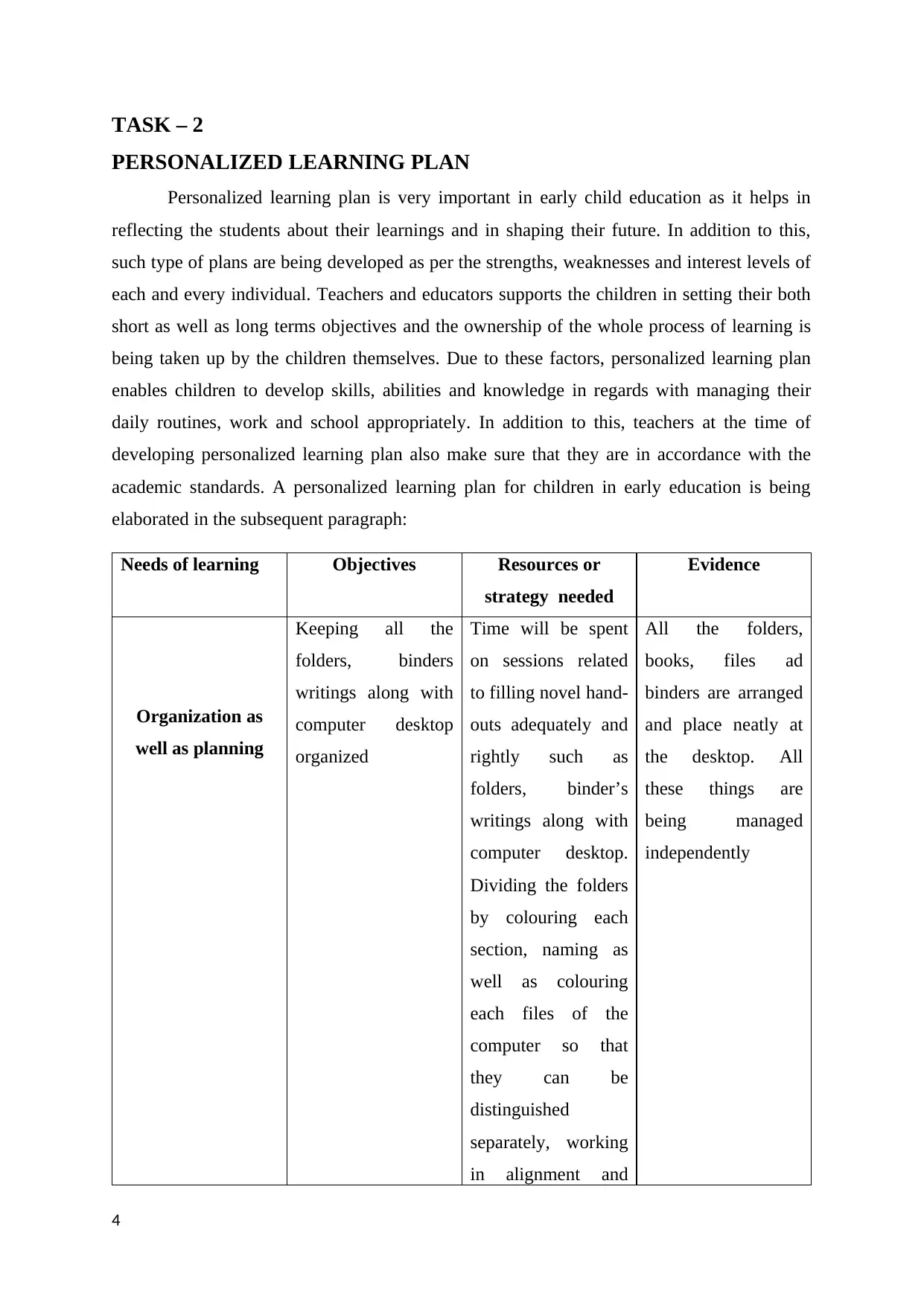
PERSONALIZED LEARNING PLAN
Personalized learning plan is very important in early child education as it helps in
reflecting the students about their learnings and in shaping their future. In addition to this,
such type of plans are being developed as per the strengths, weaknesses and interest levels of
each and every individual. Teachers and educators supports the children in setting their both
short as well as long terms objectives and the ownership of the whole process of learning is
being taken up by the children themselves. Due to these factors, personalized learning plan
enables children to develop skills, abilities and knowledge in regards with managing their
daily routines, work and school appropriately. In addition to this, teachers at the time of
developing personalized learning plan also make sure that they are in accordance with the
academic standards. A personalized learning plan for children in early education is being
elaborated in the subsequent paragraph:
Needs of learning Objectives Resources or
strategy needed
Evidence
Organization as
well as planning
Keeping all the
folders, binders
writings along with
computer desktop
organized
Time will be spent
on sessions related
to filling novel hand-
outs adequately and
rightly such as
folders, binder’s
writings along with
computer desktop.
Dividing the folders
by colouring each
section, naming as
well as colouring
each files of the
computer so that
they can be
distinguished
separately, working
in alignment and
All the folders,
books, files ad
binders are arranged
and place neatly at
the desktop. All
these things are
being managed
independently
4
PERSONALIZED LEARNING PLAN
Personalized learning plan is very important in early child education as it helps in
reflecting the students about their learnings and in shaping their future. In addition to this,
such type of plans are being developed as per the strengths, weaknesses and interest levels of
each and every individual. Teachers and educators supports the children in setting their both
short as well as long terms objectives and the ownership of the whole process of learning is
being taken up by the children themselves. Due to these factors, personalized learning plan
enables children to develop skills, abilities and knowledge in regards with managing their
daily routines, work and school appropriately. In addition to this, teachers at the time of
developing personalized learning plan also make sure that they are in accordance with the
academic standards. A personalized learning plan for children in early education is being
elaborated in the subsequent paragraph:
Needs of learning Objectives Resources or
strategy needed
Evidence
Organization as
well as planning
Keeping all the
folders, binders
writings along with
computer desktop
organized
Time will be spent
on sessions related
to filling novel hand-
outs adequately and
rightly such as
folders, binder’s
writings along with
computer desktop.
Dividing the folders
by colouring each
section, naming as
well as colouring
each files of the
computer so that
they can be
distinguished
separately, working
in alignment and
All the folders,
books, files ad
binders are arranged
and place neatly at
the desktop. All
these things are
being managed
independently
4
⊘ This is a preview!⊘
Do you want full access?
Subscribe today to unlock all pages.

Trusted by 1+ million students worldwide

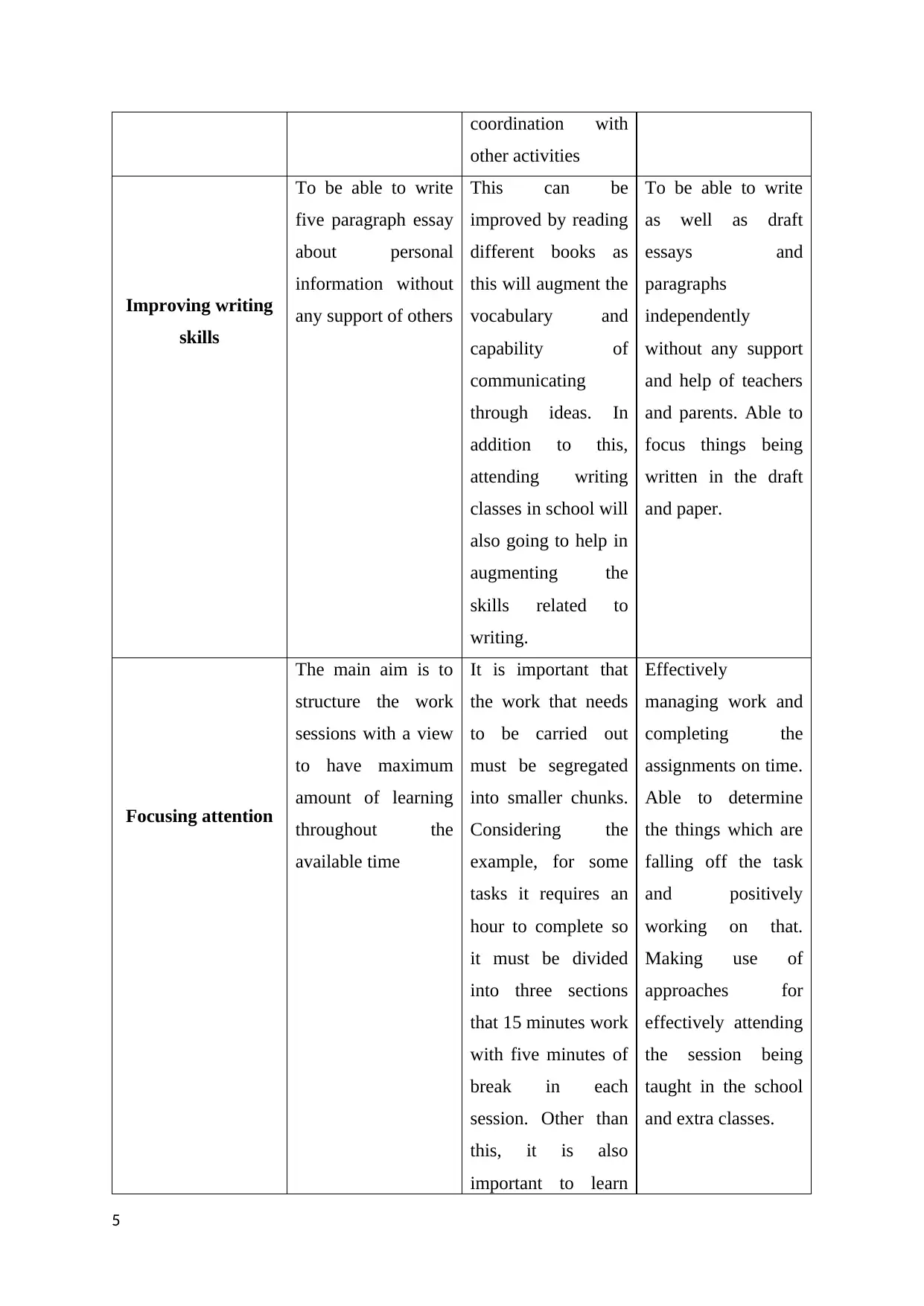
coordination with
other activities
Improving writing
skills
To be able to write
five paragraph essay
about personal
information without
any support of others
This can be
improved by reading
different books as
this will augment the
vocabulary and
capability of
communicating
through ideas. In
addition to this,
attending writing
classes in school will
also going to help in
augmenting the
skills related to
writing.
To be able to write
as well as draft
essays and
paragraphs
independently
without any support
and help of teachers
and parents. Able to
focus things being
written in the draft
and paper.
Focusing attention
The main aim is to
structure the work
sessions with a view
to have maximum
amount of learning
throughout the
available time
It is important that
the work that needs
to be carried out
must be segregated
into smaller chunks.
Considering the
example, for some
tasks it requires an
hour to complete so
it must be divided
into three sections
that 15 minutes work
with five minutes of
break in each
session. Other than
this, it is also
important to learn
Effectively
managing work and
completing the
assignments on time.
Able to determine
the things which are
falling off the task
and positively
working on that.
Making use of
approaches for
effectively attending
the session being
taught in the school
and extra classes.
5
other activities
Improving writing
skills
To be able to write
five paragraph essay
about personal
information without
any support of others
This can be
improved by reading
different books as
this will augment the
vocabulary and
capability of
communicating
through ideas. In
addition to this,
attending writing
classes in school will
also going to help in
augmenting the
skills related to
writing.
To be able to write
as well as draft
essays and
paragraphs
independently
without any support
and help of teachers
and parents. Able to
focus things being
written in the draft
and paper.
Focusing attention
The main aim is to
structure the work
sessions with a view
to have maximum
amount of learning
throughout the
available time
It is important that
the work that needs
to be carried out
must be segregated
into smaller chunks.
Considering the
example, for some
tasks it requires an
hour to complete so
it must be divided
into three sections
that 15 minutes work
with five minutes of
break in each
session. Other than
this, it is also
important to learn
Effectively
managing work and
completing the
assignments on time.
Able to determine
the things which are
falling off the task
and positively
working on that.
Making use of
approaches for
effectively attending
the session being
taught in the school
and extra classes.
5
Paraphrase This Document
Need a fresh take? Get an instant paraphrase of this document with our AI Paraphraser

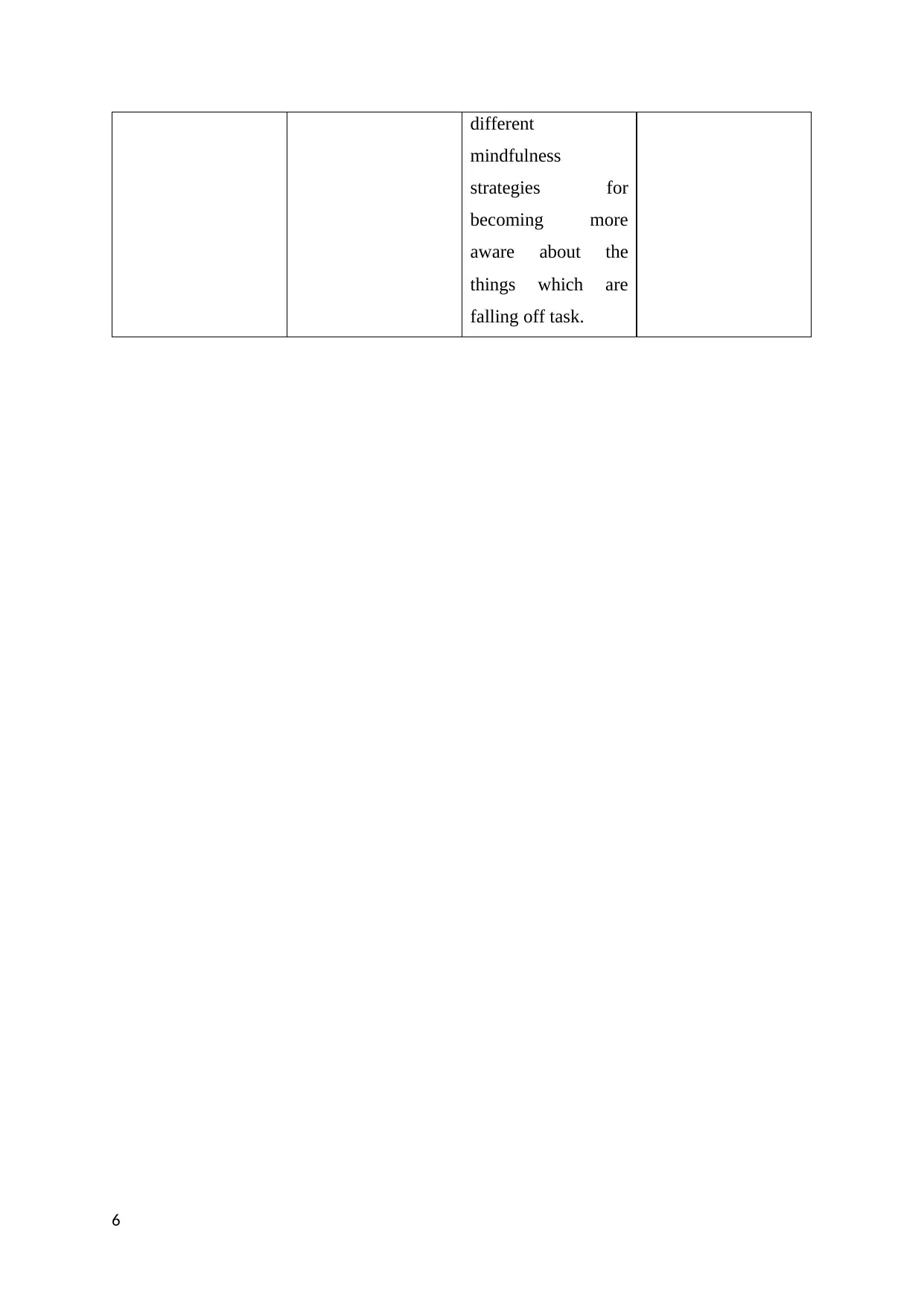
different
mindfulness
strategies for
becoming more
aware about the
things which are
falling off task.
6
mindfulness
strategies for
becoming more
aware about the
things which are
falling off task.
6

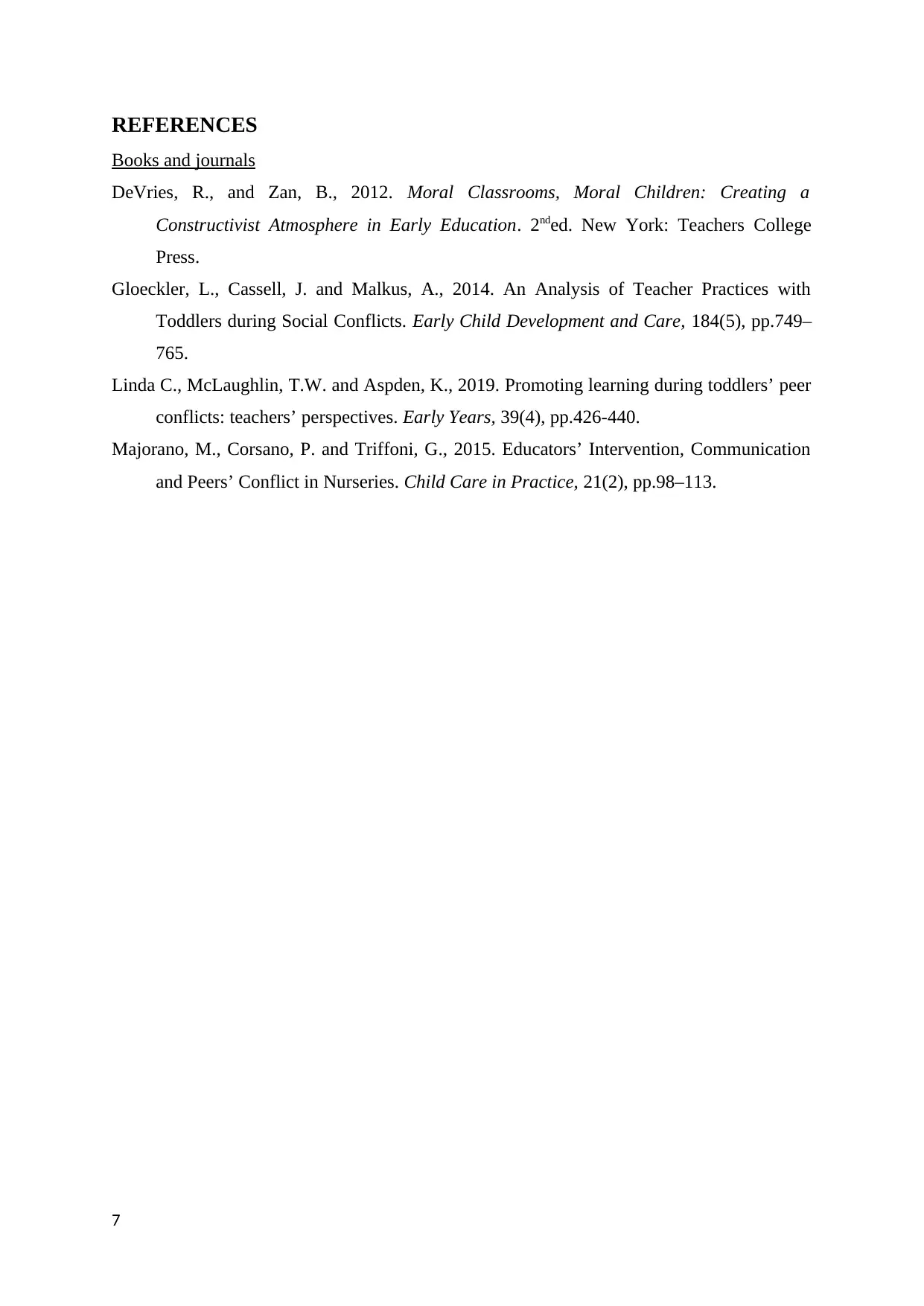
REFERENCES
Books and journals
DeVries, R., and Zan, B., 2012. Moral Classrooms, Moral Children: Creating a
Constructivist Atmosphere in Early Education. 2nded. New York: Teachers College
Press.
Gloeckler, L., Cassell, J. and Malkus, A., 2014. An Analysis of Teacher Practices with
Toddlers during Social Conflicts. Early Child Development and Care, 184(5), pp.749–
765.
Linda C., McLaughlin, T.W. and Aspden, K., 2019. Promoting learning during toddlers’ peer
conflicts: teachers’ perspectives. Early Years, 39(4), pp.426-440.
Majorano, M., Corsano, P. and Triffoni, G., 2015. Educators’ Intervention, Communication
and Peers’ Conflict in Nurseries. Child Care in Practice, 21(2), pp.98–113.
7
Books and journals
DeVries, R., and Zan, B., 2012. Moral Classrooms, Moral Children: Creating a
Constructivist Atmosphere in Early Education. 2nded. New York: Teachers College
Press.
Gloeckler, L., Cassell, J. and Malkus, A., 2014. An Analysis of Teacher Practices with
Toddlers during Social Conflicts. Early Child Development and Care, 184(5), pp.749–
765.
Linda C., McLaughlin, T.W. and Aspden, K., 2019. Promoting learning during toddlers’ peer
conflicts: teachers’ perspectives. Early Years, 39(4), pp.426-440.
Majorano, M., Corsano, P. and Triffoni, G., 2015. Educators’ Intervention, Communication
and Peers’ Conflict in Nurseries. Child Care in Practice, 21(2), pp.98–113.
7
⊘ This is a preview!⊘
Do you want full access?
Subscribe today to unlock all pages.

Trusted by 1+ million students worldwide
1 out of 9
Related Documents
Your All-in-One AI-Powered Toolkit for Academic Success.
+13062052269
info@desklib.com
Available 24*7 on WhatsApp / Email
Unlock your academic potential
Copyright © 2020–2026 A2Z Services. All Rights Reserved. Developed and managed by ZUCOL.