102207 Brain & Learning Essay: Peer Influence on Adolescent Risk
VerifiedAdded on 2023/06/03
|7
|2793
|491
Essay
AI Summary
This essay examines the significant role of peer influence on adolescent risk-taking behavior, highlighting the neurological and psychological factors at play. It discusses how adolescents exhibit a heightened tendency to engage in risky activities, such as alcohol consumption, smoking, and reckless driving, primarily in the presence of peers due to social pressure and the desire for acceptance. The essay contrasts this behavior with their more cautious actions when alone, emphasizing the impact of peer dynamics. It also explores the misconception of parents of their children's behaviour in peer groups. The essay further delves into the impact of social media on increasing peer pressure and competition among teenagers, affecting their self-esteem and creating a sense of constant comparison. The essay concludes by suggesting strategies to redirect peer influence towards positive behaviors, such as peer education and group studies, to foster academic and personal growth. Desklib offers a wide range of resources, including past papers and solved assignments, to support students in understanding these complex topics.

Running Header: English Essay
English Essay
Authors Name:
Authors ID:
English Essay
Authors Name:
Authors ID:

Paraphrase This Document
Need a fresh take? Get an instant paraphrase of this document with our AI Paraphraser
English Essay
Introduction
Adolescent is the stage of life, in which the children encounter many significant changes in their
body and social environment. Along with physical development, there are a lot of changes going
on in the decision making abilities. It all starts when the puberty strikes. The priorities changes;
they are more sensitive about their peer bonds. Now this relationship becomes more important to
them.
Adolescent risk taking
During childhood, the priority was the parental bonds (Geake, 2008). A high level of tendency to
take risks can be seen in their behavior. But the main concern here, like the adolescents do such
kind of risky tasks in the company of peers only, in their absence it is no fun for them. When
they are alone, they generally behave like adults. They show a higher level of risk taking
behavior in the peer presence, maybe just to show them cool. They remain stable when they are
taken into non-affective contexts (e.g. the presence of peers).
They are drawn towards activities like alcohol, smoking and rash driving. They just do such
things to show others. This is the prevalent mentality that people will find you cooler if you are a
rash driver. Adolescence is a more risky stage than childhood or adulthood, as then you are quite
stable. In this age only, the risk taking behavior is at its peak. Teenagers are very keen to
experiment with alcohol, tobacco, drugs, unprotected sexual stuff, and many other violent
activities (Kirschner & Merriënboer, 2013). They like to do all those things which are said to be
wrong. In fact, during a research it was found out that the adolescents are quite aware of the
consequence of their risk taking behaviors, they have the proper knowledge as the adults do. But
they still do the same thing; this shows how strong the peer influence is.
The thing which can be noticed is that when they are by themselves in a room or somewhere,
they do not show same risk taking tendencies. If they are so keen to take risk, then why are they
risk averse in the isolated space? The only answer to it is that there is no body to watch. They
just don’t do it for the sake of doing; they are doing it to show others (Howard-Jones, 2014). This
is the peer pressure. They find it fun when others are there to witness those things and maybe
appreciate them. Like if they are asked to drink in an isolated space, they will do it in a certain
limit, like the adults do. There appear to be risk averse in those situations. But the matter of
concern is that most of the time they are in the company of their peers; they spend a remarkable
amount of time with them. So fundamentally they are more exposed to those things. Company of
other teenagers brings significant changes in their behavior. Teenagers often follow each other;
they adopt their habits from each other. This establishes that they get more pleasure in social
acceptance; this is not the case with adults. This is the reason, not because they are less capable
of making decisions.
Peer influence on Adolescent Behavior
Introduction
Adolescent is the stage of life, in which the children encounter many significant changes in their
body and social environment. Along with physical development, there are a lot of changes going
on in the decision making abilities. It all starts when the puberty strikes. The priorities changes;
they are more sensitive about their peer bonds. Now this relationship becomes more important to
them.
Adolescent risk taking
During childhood, the priority was the parental bonds (Geake, 2008). A high level of tendency to
take risks can be seen in their behavior. But the main concern here, like the adolescents do such
kind of risky tasks in the company of peers only, in their absence it is no fun for them. When
they are alone, they generally behave like adults. They show a higher level of risk taking
behavior in the peer presence, maybe just to show them cool. They remain stable when they are
taken into non-affective contexts (e.g. the presence of peers).
They are drawn towards activities like alcohol, smoking and rash driving. They just do such
things to show others. This is the prevalent mentality that people will find you cooler if you are a
rash driver. Adolescence is a more risky stage than childhood or adulthood, as then you are quite
stable. In this age only, the risk taking behavior is at its peak. Teenagers are very keen to
experiment with alcohol, tobacco, drugs, unprotected sexual stuff, and many other violent
activities (Kirschner & Merriënboer, 2013). They like to do all those things which are said to be
wrong. In fact, during a research it was found out that the adolescents are quite aware of the
consequence of their risk taking behaviors, they have the proper knowledge as the adults do. But
they still do the same thing; this shows how strong the peer influence is.
The thing which can be noticed is that when they are by themselves in a room or somewhere,
they do not show same risk taking tendencies. If they are so keen to take risk, then why are they
risk averse in the isolated space? The only answer to it is that there is no body to watch. They
just don’t do it for the sake of doing; they are doing it to show others (Howard-Jones, 2014). This
is the peer pressure. They find it fun when others are there to witness those things and maybe
appreciate them. Like if they are asked to drink in an isolated space, they will do it in a certain
limit, like the adults do. There appear to be risk averse in those situations. But the matter of
concern is that most of the time they are in the company of their peers; they spend a remarkable
amount of time with them. So fundamentally they are more exposed to those things. Company of
other teenagers brings significant changes in their behavior. Teenagers often follow each other;
they adopt their habits from each other. This establishes that they get more pleasure in social
acceptance; this is not the case with adults. This is the reason, not because they are less capable
of making decisions.
Peer influence on Adolescent Behavior
English Essay
Parents generally believe that their kids behave in the same manner; either they are with them or
with their peer group. But this is a misconception; when they are in the world of teenagers, they
are someone else (Martin, 2015). Parents believe so because it is easy for them to do so. But this
misconception can lead to dangerous results, this is like naïve. There is a particular age, when
parents think that their child is going to do all those things like drinking is smoking. After a
certain age, these voices pops up in your head, “come on, try it”, “I’m with you, try it”, “go
ahead”, “and try it” and one cannot resist these voices (Martin, 2015). There is this trend of being
cool. But there is a huge difference between trying to be cool and being cool. When one is trying
to be cool, he starts doing new things by himself. But in being cool, one actually follows blindly
what others are doing. And in this trend they just end up becoming a flock of sheep; that just
follow one another. They are profoundly affected by peer pressure. They often forgets that
everyone s not same, they have different capabilities and behavior.
In their attempt of being cool, they just garner contempt. They just become a flock of sheep,
followers of somebody else. But all the adolescents’ out there need to get it clearly into their
heads that you don’t have to be a follower every time, nor there is any need to be a leader; just be
yourself. They need to call their own shots (Yeager & Dweck, 2012). Also the age group I peer
influence matters, when a 14 year guy is asked by a 17 year boy to try something new or any
other task. In order to get their acceptance because they know they are elder and mature, they do
that task more readily in order to prove their coolness.
Brain connectivity and specialization
It has been established now that the kids don’t behave in the same manner when are with peers
and friends. So the parents should not generalize how they are going to behave outside. They
should be aware of all those things and leave their misconceptions behind. They should notice
the changes. This is their duty as a parent (Sweller, 2012). If they don’t, then they are living
somewhere in an alien land and are in their own world of illusions. In fact there is no need to tell
them even. We are aware of all these things from our own life experiences. But parents often
forget this at times and they needed to be remembered about all these things again. This is the
case with every parent that they often see everything from the glasses of their own experience.
And it is not necessary that parents are often more intelligent than children. Sometimes they are
not aware of things and that becomes the reason of increased misbehaviors of teenagers.
In today’s time, the parents of the teenagers need to realize that peer pressure has been increased
due to this age of social media. In fact now nothing has remained private. Even when you get in
a fight with somebody, both people is there to share their part of stories (Norrish, Williams,
Connor & Robinson, 2013). Thus everyone get to know everything. In fact those who listen to
both sides of the story, they even get confused which side they have to take. In fact on the very
personal matter, a lot of people are there to express their opinions. People take sides on the
issues. Thus there is no privacy. Every single thing is out there. Another example of this can be
Parents generally believe that their kids behave in the same manner; either they are with them or
with their peer group. But this is a misconception; when they are in the world of teenagers, they
are someone else (Martin, 2015). Parents believe so because it is easy for them to do so. But this
misconception can lead to dangerous results, this is like naïve. There is a particular age, when
parents think that their child is going to do all those things like drinking is smoking. After a
certain age, these voices pops up in your head, “come on, try it”, “I’m with you, try it”, “go
ahead”, “and try it” and one cannot resist these voices (Martin, 2015). There is this trend of being
cool. But there is a huge difference between trying to be cool and being cool. When one is trying
to be cool, he starts doing new things by himself. But in being cool, one actually follows blindly
what others are doing. And in this trend they just end up becoming a flock of sheep; that just
follow one another. They are profoundly affected by peer pressure. They often forgets that
everyone s not same, they have different capabilities and behavior.
In their attempt of being cool, they just garner contempt. They just become a flock of sheep,
followers of somebody else. But all the adolescents’ out there need to get it clearly into their
heads that you don’t have to be a follower every time, nor there is any need to be a leader; just be
yourself. They need to call their own shots (Yeager & Dweck, 2012). Also the age group I peer
influence matters, when a 14 year guy is asked by a 17 year boy to try something new or any
other task. In order to get their acceptance because they know they are elder and mature, they do
that task more readily in order to prove their coolness.
Brain connectivity and specialization
It has been established now that the kids don’t behave in the same manner when are with peers
and friends. So the parents should not generalize how they are going to behave outside. They
should be aware of all those things and leave their misconceptions behind. They should notice
the changes. This is their duty as a parent (Sweller, 2012). If they don’t, then they are living
somewhere in an alien land and are in their own world of illusions. In fact there is no need to tell
them even. We are aware of all these things from our own life experiences. But parents often
forget this at times and they needed to be remembered about all these things again. This is the
case with every parent that they often see everything from the glasses of their own experience.
And it is not necessary that parents are often more intelligent than children. Sometimes they are
not aware of things and that becomes the reason of increased misbehaviors of teenagers.
In today’s time, the parents of the teenagers need to realize that peer pressure has been increased
due to this age of social media. In fact now nothing has remained private. Even when you get in
a fight with somebody, both people is there to share their part of stories (Norrish, Williams,
Connor & Robinson, 2013). Thus everyone get to know everything. In fact those who listen to
both sides of the story, they even get confused which side they have to take. In fact on the very
personal matter, a lot of people are there to express their opinions. People take sides on the
issues. Thus there is no privacy. Every single thing is out there. Another example of this can be
⊘ This is a preview!⊘
Do you want full access?
Subscribe today to unlock all pages.

Trusted by 1+ million students worldwide
English Essay
enhanced sexual activities. Every teenager has done it during their high school time. People even
circulate pictures. So out there, your privacy is hampered.
In fact it adds to a lot of competition in the lives of teenagers. Sometimes it becomes a handle
over which people feel bad about their own life (Pintrich & Schunk, 2002). Nowadays the lives
of people is transparent out there in front of others, they post every single thing of their life. This
has an adverse effect. Like when one is sitting home, and watches on social media that his
friends are partying out there, this makes him feel pathetic about his own life. There is also this
pressure to have an active social life. People compete about posting fun things online. Thus this
age of social media has increased the pressure in the lives of teenagers who were already
suffering a lot due to many other age related issues (Bruning, Schraw & Norby, 2011). Like
everything has been restricted to an online platform, the meaning of real life has been
compromised with. Everything is there to show off.
Now we have come to the understand that this risk taking behavior increases due to peer pressure
and is not there when they are alone. There is a need to find some ways in order to control this
risk taking behaviors of the teenagers (Alloway, Gathercole, Kirkwood & Elliot, 2010). This is
evident now that the behavior of teenagers depends on approval from others and they don’t want
to get socially excluded. This things needs to be taken into account. There should be methods in
which the teenagers can influence each other in a positive way; we should push this peer pressure
to the opposite side; where these young people are influencing each other to do good things like
peer education. Group studies have a very positive effect. Thus this peer influences to enhance
the risk taking tendency, let’s see how they can help in taking positive risks. This can be quite
fruitful in academic learning and career planning. This can prove to be very advantageous.
As Shakespeare has also described about this stage in his “winter’s tale”, that this is the age
between 13 to 20, a person gets all the bad influences. If this is monitored properly, future is
going to be bright (Dehn, 2010). With the help of development in behavioral science, it has
become easy.
More noteworthy consideration regarding scholastic development may give critical
accomplishment and inspiration bolster for an extensive variety of understudies: Although
numerous understudies may not outflank peers, they can beat their past endeavors; comparably,
albeit numerous understudies may exhibit adequate similar accomplishment, there is frequently
space for further individual development (Brewer, 2000). For sure, as per the writing, 'the sign of
human instinct is every individual's awesome ability to adjust, to change, and to grow' various
merging lines of hypothesis propose development ways to deal with understudy improvement as
a possibly energizing heading for psycho-instructive research and practice. To start with,
speculating about 'development outlooks' expresses the versatile impacts of 'incremental'
convictions about knowledge. People with an incremental view (i.e., a development mentality)
see scholarly and non-scholastic results as something that can be tended to through subjective,
enthusiastic, as well as conduct alteration. Interestingly, people holding an 'element' see their
enhanced sexual activities. Every teenager has done it during their high school time. People even
circulate pictures. So out there, your privacy is hampered.
In fact it adds to a lot of competition in the lives of teenagers. Sometimes it becomes a handle
over which people feel bad about their own life (Pintrich & Schunk, 2002). Nowadays the lives
of people is transparent out there in front of others, they post every single thing of their life. This
has an adverse effect. Like when one is sitting home, and watches on social media that his
friends are partying out there, this makes him feel pathetic about his own life. There is also this
pressure to have an active social life. People compete about posting fun things online. Thus this
age of social media has increased the pressure in the lives of teenagers who were already
suffering a lot due to many other age related issues (Bruning, Schraw & Norby, 2011). Like
everything has been restricted to an online platform, the meaning of real life has been
compromised with. Everything is there to show off.
Now we have come to the understand that this risk taking behavior increases due to peer pressure
and is not there when they are alone. There is a need to find some ways in order to control this
risk taking behaviors of the teenagers (Alloway, Gathercole, Kirkwood & Elliot, 2010). This is
evident now that the behavior of teenagers depends on approval from others and they don’t want
to get socially excluded. This things needs to be taken into account. There should be methods in
which the teenagers can influence each other in a positive way; we should push this peer pressure
to the opposite side; where these young people are influencing each other to do good things like
peer education. Group studies have a very positive effect. Thus this peer influences to enhance
the risk taking tendency, let’s see how they can help in taking positive risks. This can be quite
fruitful in academic learning and career planning. This can prove to be very advantageous.
As Shakespeare has also described about this stage in his “winter’s tale”, that this is the age
between 13 to 20, a person gets all the bad influences. If this is monitored properly, future is
going to be bright (Dehn, 2010). With the help of development in behavioral science, it has
become easy.
More noteworthy consideration regarding scholastic development may give critical
accomplishment and inspiration bolster for an extensive variety of understudies: Although
numerous understudies may not outflank peers, they can beat their past endeavors; comparably,
albeit numerous understudies may exhibit adequate similar accomplishment, there is frequently
space for further individual development (Brewer, 2000). For sure, as per the writing, 'the sign of
human instinct is every individual's awesome ability to adjust, to change, and to grow' various
merging lines of hypothesis propose development ways to deal with understudy improvement as
a possibly energizing heading for psycho-instructive research and practice. To start with,
speculating about 'development outlooks' expresses the versatile impacts of 'incremental'
convictions about knowledge. People with an incremental view (i.e., a development mentality)
see scholarly and non-scholastic results as something that can be tended to through subjective,
enthusiastic, as well as conduct alteration. Interestingly, people holding an 'element' see their
Paraphrase This Document
Need a fresh take? Get an instant paraphrase of this document with our AI Paraphraser
English Essay
ability as settled and hard to address, prompting less tendency to make psycho-social changes. In
fact, inquire about has recognized the job of incremental convictions on understudies' scholarly
directions through school (Sweller, 2012). This Special Issue centers around scholastic
development through an examination of accomplishment development, development objective
introductions, development objective setting, self-idea directions, outlooks, and evaluation and
their job in understudies' scholarly advancement.
Examples of peer influences on adolescents
In a family if an elder brother is pursuing or is an engineer then the adolescent will be influenced
positively and will be motivated to pursue the same course .
In second case if the teenager is not influenced or is negative towards his or her elder or any
other family member then he or she may chose the opposite or different course for education.
In the 3rd case, if the adolescent is forcefully motivated to pursue the same course of education,
then this pressure may result in a negative effect over the adolescent. He or she may go reluctant
towards the decision of the family and may chose a wrong path.
Conclusion
After analyzing the above executed research topic it has been evaluated that Adolescent is a
process or stage through of developing or transforming from a child into an adult. The research is
developed and is focused on the Adolescent risk taking factor, peer influence on behavior of
Adolescent and connectivity of brain and specialization.
ability as settled and hard to address, prompting less tendency to make psycho-social changes. In
fact, inquire about has recognized the job of incremental convictions on understudies' scholarly
directions through school (Sweller, 2012). This Special Issue centers around scholastic
development through an examination of accomplishment development, development objective
introductions, development objective setting, self-idea directions, outlooks, and evaluation and
their job in understudies' scholarly advancement.
Examples of peer influences on adolescents
In a family if an elder brother is pursuing or is an engineer then the adolescent will be influenced
positively and will be motivated to pursue the same course .
In second case if the teenager is not influenced or is negative towards his or her elder or any
other family member then he or she may chose the opposite or different course for education.
In the 3rd case, if the adolescent is forcefully motivated to pursue the same course of education,
then this pressure may result in a negative effect over the adolescent. He or she may go reluctant
towards the decision of the family and may chose a wrong path.
Conclusion
After analyzing the above executed research topic it has been evaluated that Adolescent is a
process or stage through of developing or transforming from a child into an adult. The research is
developed and is focused on the Adolescent risk taking factor, peer influence on behavior of
Adolescent and connectivity of brain and specialization.
English Essay
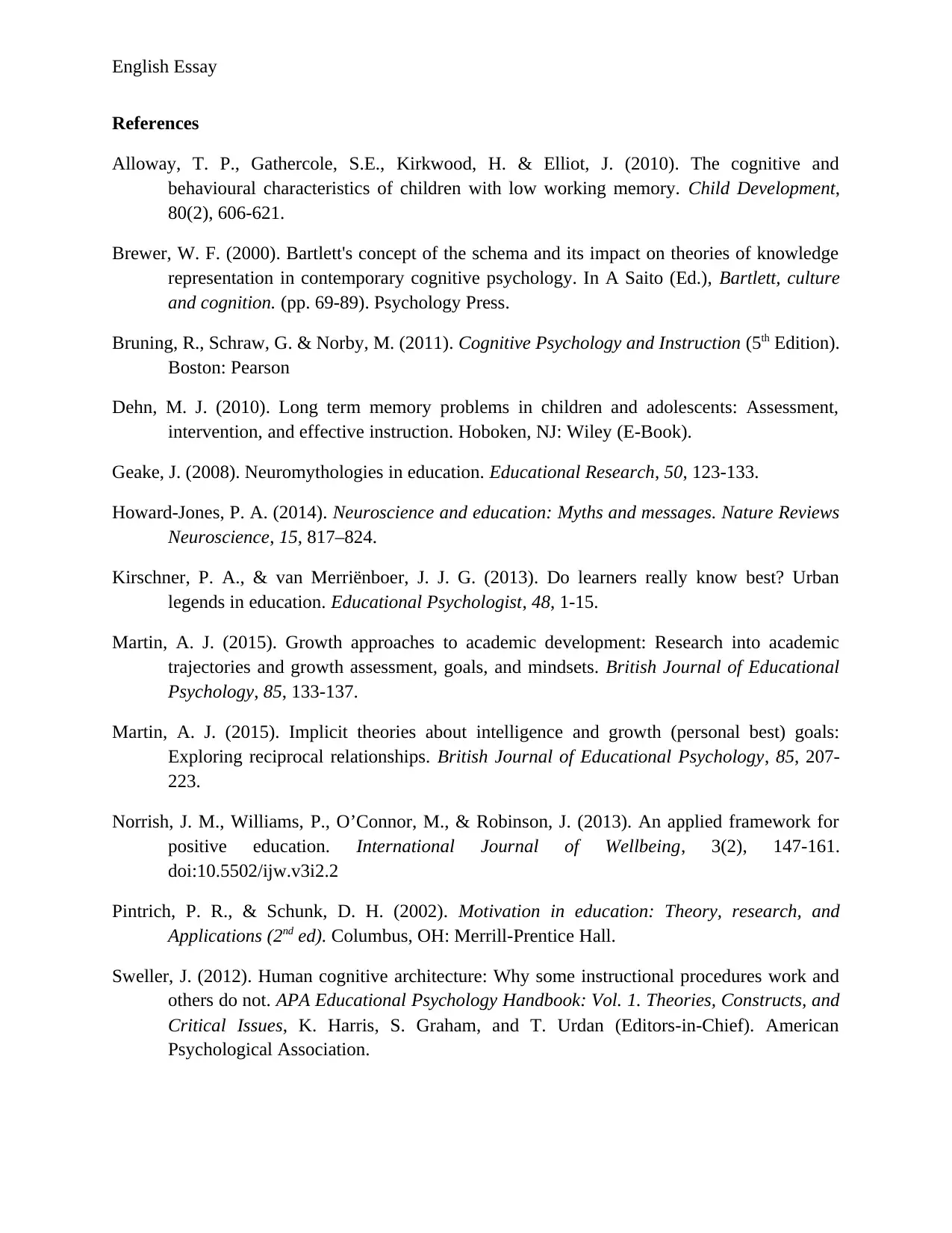
References
Alloway, T. P., Gathercole, S.E., Kirkwood, H. & Elliot, J. (2010). The cognitive and
behavioural characteristics of children with low working memory. Child Development,
80(2), 606-621.
Brewer, W. F. (2000). Bartlett's concept of the schema and its impact on theories of knowledge
representation in contemporary cognitive psychology. In A Saito (Ed.), Bartlett, culture
and cognition. (pp. 69-89). Psychology Press.
Bruning, R., Schraw, G. & Norby, M. (2011). Cognitive Psychology and Instruction (5th Edition).
Boston: Pearson
Dehn, M. J. (2010). Long term memory problems in children and adolescents: Assessment,
intervention, and effective instruction. Hoboken, NJ: Wiley (E-Book).
Geake, J. (2008). Neuromythologies in education. Educational Research, 50, 123-133.
Howard-Jones, P. A. (2014). Neuroscience and education: Myths and messages. Nature Reviews
Neuroscience, 15, 817–824.
Kirschner, P. A., & van Merriënboer, J. J. G. (2013). Do learners really know best? Urban
legends in education. Educational Psychologist, 48, 1-15.
Martin, A. J. (2015). Growth approaches to academic development: Research into academic
trajectories and growth assessment, goals, and mindsets. British Journal of Educational
Psychology, 85, 133-137.
Martin, A. J. (2015). Implicit theories about intelligence and growth (personal best) goals:
Exploring reciprocal relationships. British Journal of Educational Psychology, 85, 207-
223.
Norrish, J. M., Williams, P., O’Connor, M., & Robinson, J. (2013). An applied framework for
positive education. International Journal of Wellbeing, 3(2), 147-161.
doi:10.5502/ijw.v3i2.2
Pintrich, P. R., & Schunk, D. H. (2002). Motivation in education: Theory, research, and
Applications (2nd ed). Columbus, OH: Merrill-Prentice Hall.
Sweller, J. (2012). Human cognitive architecture: Why some instructional procedures work and
others do not. APA Educational Psychology Handbook: Vol. 1. Theories, Constructs, and
Critical Issues, K. Harris, S. Graham, and T. Urdan (Editors-in-Chief). American
Psychological Association.
References
Alloway, T. P., Gathercole, S.E., Kirkwood, H. & Elliot, J. (2010). The cognitive and
behavioural characteristics of children with low working memory. Child Development,
80(2), 606-621.
Brewer, W. F. (2000). Bartlett's concept of the schema and its impact on theories of knowledge
representation in contemporary cognitive psychology. In A Saito (Ed.), Bartlett, culture
and cognition. (pp. 69-89). Psychology Press.
Bruning, R., Schraw, G. & Norby, M. (2011). Cognitive Psychology and Instruction (5th Edition).
Boston: Pearson
Dehn, M. J. (2010). Long term memory problems in children and adolescents: Assessment,
intervention, and effective instruction. Hoboken, NJ: Wiley (E-Book).
Geake, J. (2008). Neuromythologies in education. Educational Research, 50, 123-133.
Howard-Jones, P. A. (2014). Neuroscience and education: Myths and messages. Nature Reviews
Neuroscience, 15, 817–824.
Kirschner, P. A., & van Merriënboer, J. J. G. (2013). Do learners really know best? Urban
legends in education. Educational Psychologist, 48, 1-15.
Martin, A. J. (2015). Growth approaches to academic development: Research into academic
trajectories and growth assessment, goals, and mindsets. British Journal of Educational
Psychology, 85, 133-137.
Martin, A. J. (2015). Implicit theories about intelligence and growth (personal best) goals:
Exploring reciprocal relationships. British Journal of Educational Psychology, 85, 207-
223.
Norrish, J. M., Williams, P., O’Connor, M., & Robinson, J. (2013). An applied framework for
positive education. International Journal of Wellbeing, 3(2), 147-161.
doi:10.5502/ijw.v3i2.2
Pintrich, P. R., & Schunk, D. H. (2002). Motivation in education: Theory, research, and
Applications (2nd ed). Columbus, OH: Merrill-Prentice Hall.
Sweller, J. (2012). Human cognitive architecture: Why some instructional procedures work and
others do not. APA Educational Psychology Handbook: Vol. 1. Theories, Constructs, and
Critical Issues, K. Harris, S. Graham, and T. Urdan (Editors-in-Chief). American
Psychological Association.
⊘ This is a preview!⊘
Do you want full access?
Subscribe today to unlock all pages.
Trusted by 1+ million students worldwide
English Essay
Sweller, J. (2012). Human cognitive architecture: Why some instructional procedures work and
others do not. APA Educational Psychology Handbook: Vol. 1. Theories, Constructs, and
Critical Issues, K. Harris, S. Graham, and T. Urdan (Editors-in-Chief). American
Psychological Association.
Yeager, D. S., & Dweck, D. S. (2012). Mindsets that promote resilience: When students believe
that personal characteristics can be developed. Educational Psychologist, 47, 302-314.
Sweller, J. (2012). Human cognitive architecture: Why some instructional procedures work and
others do not. APA Educational Psychology Handbook: Vol. 1. Theories, Constructs, and
Critical Issues, K. Harris, S. Graham, and T. Urdan (Editors-in-Chief). American
Psychological Association.
Yeager, D. S., & Dweck, D. S. (2012). Mindsets that promote resilience: When students believe
that personal characteristics can be developed. Educational Psychologist, 47, 302-314.

1 out of 7


Your All-in-One AI-Powered Toolkit for Academic Success.
+13062052269
info@desklib.com
Available 24*7 on WhatsApp / Email
![[object Object]](/_next/static/media/star-bottom.7253800d.svg)
Unlock your academic potential
Copyright © 2020–2026 A2Z Services. All Rights Reserved. Developed and managed by ZUCOL.