Analyzing and Reflecting on Peer Review Feedback in Teaching
VerifiedAdded on 2023/04/20
|9
|1952
|389
Essay
AI Summary
This essay delves into a reflective analysis of peer review feedback concerning a university teaching session. The formative peer review, focusing on presentation, assessment, and classroom management, is evaluated based on feedback received from a colleague. The analysis aims to identify strengths and weaknesses in the teaching process, facilitating improvements in future teaching plans. The author reflects on the chosen peer reviewer, self-assesses the feedback, and discusses both positive and negative aspects of the teaching session. The essay also highlights strategies for capitalizing on strengths and plans for improving identified weaknesses, ultimately aiming for a better teaching and learning experience. The document is contributed by a student and available on Desklib, a platform offering AI-based study tools and resources.
Running head: Peer review feedback
ASSIGNMENT 6.2
PEER REVIEW FEEDBACK
ASSIGNMENT 6.2
PEER REVIEW FEEDBACK

Paraphrase This Document
Need a fresh take? Get an instant paraphrase of this document with our AI Paraphraser
1
Peer review feedback
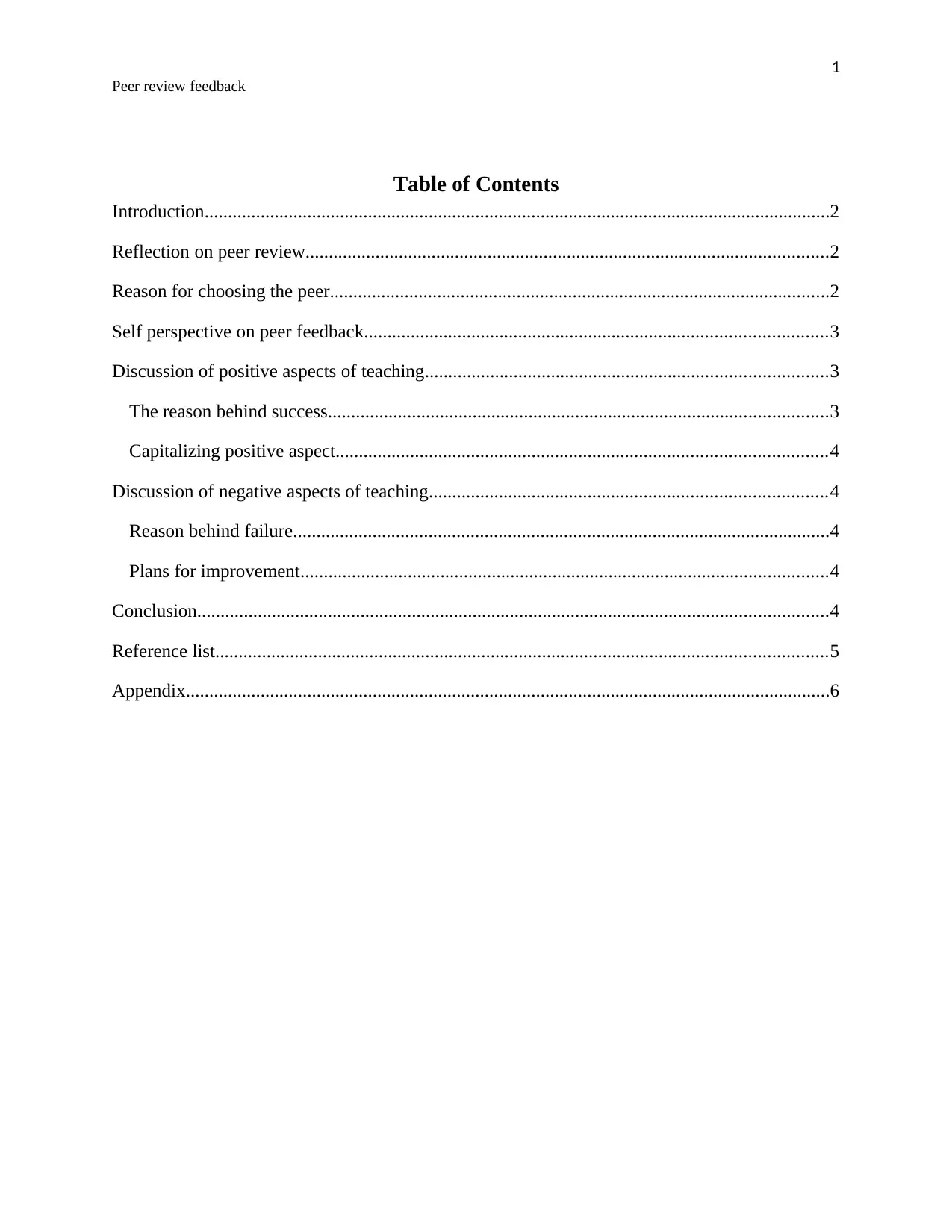
Table of Contents
Introduction......................................................................................................................................2
Reflection on peer review................................................................................................................2
Reason for choosing the peer...........................................................................................................2
Self perspective on peer feedback...................................................................................................3
Discussion of positive aspects of teaching......................................................................................3
The reason behind success...........................................................................................................3
Capitalizing positive aspect.........................................................................................................4
Discussion of negative aspects of teaching.....................................................................................4
Reason behind failure...................................................................................................................4
Plans for improvement.................................................................................................................4
Conclusion.......................................................................................................................................4
Reference list...................................................................................................................................5
Appendix..........................................................................................................................................6
Peer review feedback
Table of Contents
Introduction......................................................................................................................................2
Reflection on peer review................................................................................................................2
Reason for choosing the peer...........................................................................................................2
Self perspective on peer feedback...................................................................................................3
Discussion of positive aspects of teaching......................................................................................3
The reason behind success...........................................................................................................3
Capitalizing positive aspect.........................................................................................................4
Discussion of negative aspects of teaching.....................................................................................4
Reason behind failure...................................................................................................................4
Plans for improvement.................................................................................................................4
Conclusion.......................................................................................................................................4
Reference list...................................................................................................................................5
Appendix..........................................................................................................................................6
2
Peer review feedback
Introduction
This study revolves around reflection and critical analysis of such a peer review
performed by one of my colleagues of university. The formative peer review has been analyzed
on the basis of the given feedbacks on various aspects of teaching process. This has been done so
that I, as a teacher, can be benefitted from the given feedbacks and can make better teaching
plans in future for having a better teaching and learning experience.
Reflection on peer review
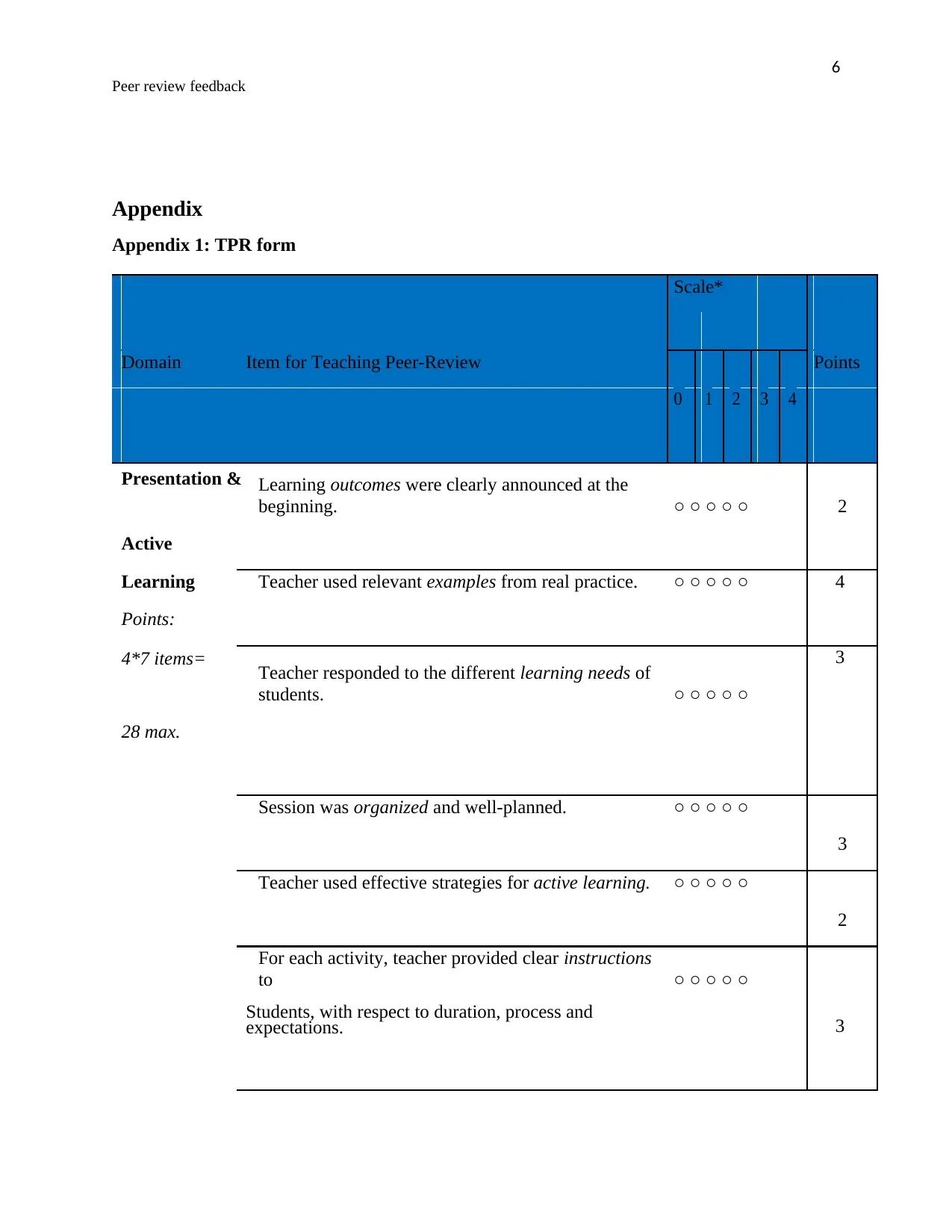
The peer review form has three sets of domain that over all deals with presentation of
teaching, assessment of teaching and review on classroom management. In addition, there is a
place for descriptive feedback from the part of the peer and for a self assessment review from the
part of myself (Fernandez & Yu, 2007). After observing the feedback, I can say that my
colleague has judged my teaching session by evaluating its worth as per the background
information about the teaching session that I discussed with him earlier
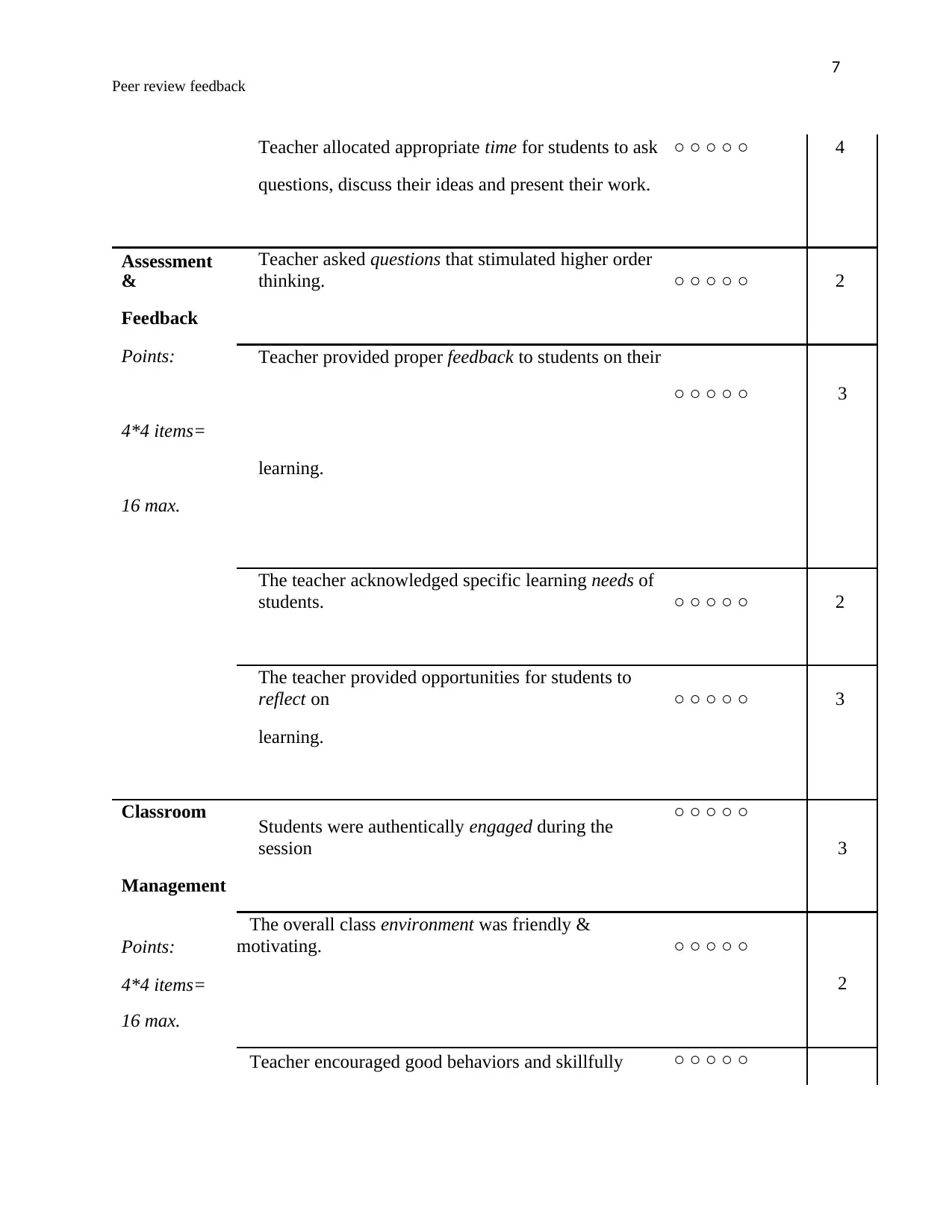
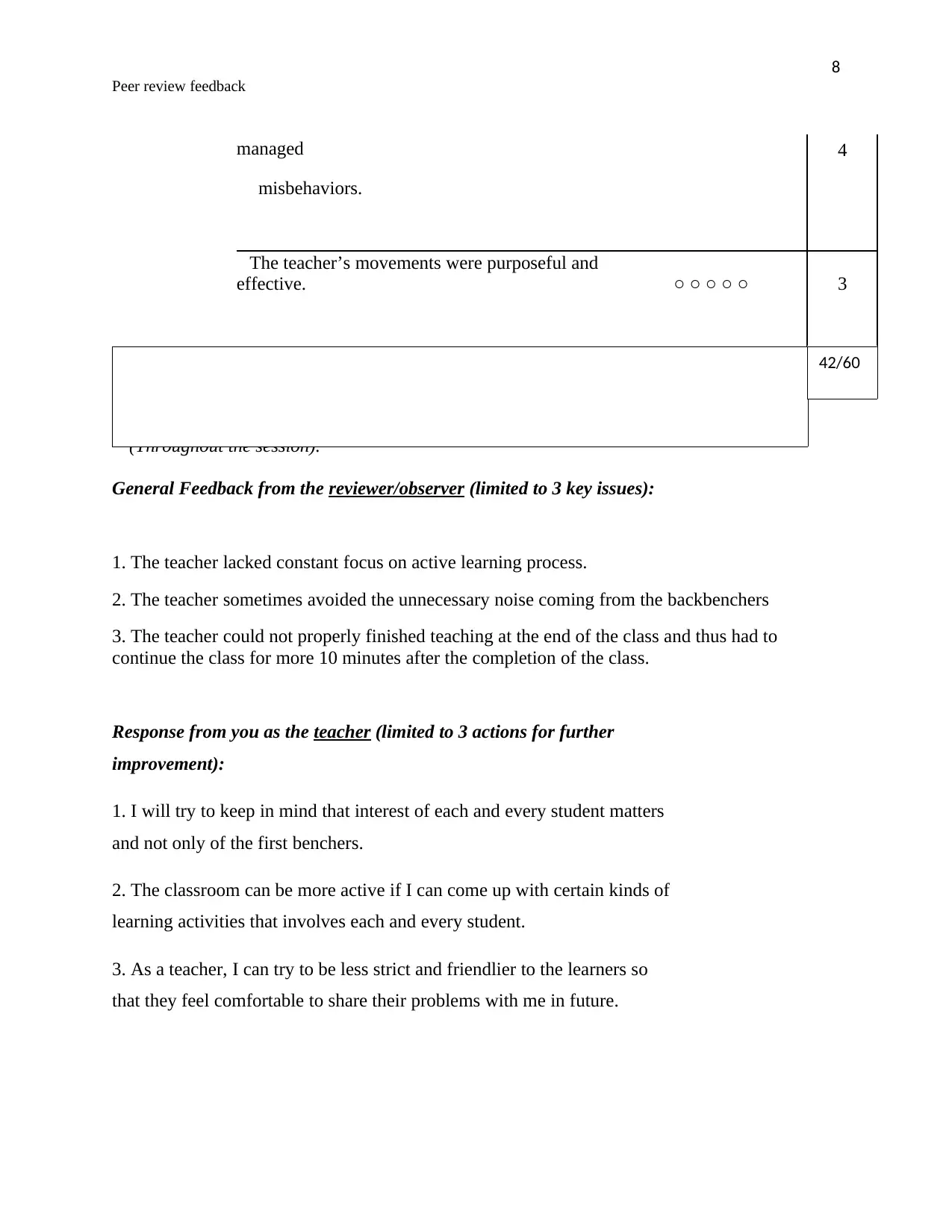
(communicationtheory.org, 2019). The total score of my performance has been based on a five
point scale where zero stands for never and four stands for always and so on. My overall score,
as per review of my colleague, is 42 out of 60. I have seen that most of my score for individual
items in each domain revolves around 3 that denotes usually. As per this observation, I can say
that my overall performance was good. [Refer to Appendix 1]
Reason for choosing the peer
I work in a university where I teach both graduate and post graduate students. The
colleague that I chose also works in my institution as a teacher. This particular colleague is not
my friend and he very recently joined my institution. This is one of the reasons for choosing him
as my reviewer. This is so because I think that an unfamiliar person can be more eligible to
perceive things from an unbiased outlook (Sullivan, Buckle, Nicky & Atkinson, 2012). On the
other hand, I have researched about this person before selecting him as my reviewer and I have
found that students enjoy his classes and they claim that he allows the notion of active learning
Peer review feedback
Introduction
This study revolves around reflection and critical analysis of such a peer review
performed by one of my colleagues of university. The formative peer review has been analyzed
on the basis of the given feedbacks on various aspects of teaching process. This has been done so
that I, as a teacher, can be benefitted from the given feedbacks and can make better teaching
plans in future for having a better teaching and learning experience.
Reflection on peer review
The peer review form has three sets of domain that over all deals with presentation of
teaching, assessment of teaching and review on classroom management. In addition, there is a
place for descriptive feedback from the part of the peer and for a self assessment review from the
part of myself (Fernandez & Yu, 2007). After observing the feedback, I can say that my
colleague has judged my teaching session by evaluating its worth as per the background
information about the teaching session that I discussed with him earlier
(communicationtheory.org, 2019). The total score of my performance has been based on a five
point scale where zero stands for never and four stands for always and so on. My overall score,
as per review of my colleague, is 42 out of 60. I have seen that most of my score for individual
items in each domain revolves around 3 that denotes usually. As per this observation, I can say
that my overall performance was good. [Refer to Appendix 1]
Reason for choosing the peer
I work in a university where I teach both graduate and post graduate students. The
colleague that I chose also works in my institution as a teacher. This particular colleague is not
my friend and he very recently joined my institution. This is one of the reasons for choosing him
as my reviewer. This is so because I think that an unfamiliar person can be more eligible to
perceive things from an unbiased outlook (Sullivan, Buckle, Nicky & Atkinson, 2012). On the
other hand, I have researched about this person before selecting him as my reviewer and I have
found that students enjoy his classes and they claim that he allows the notion of active learning
⊘ This is a preview!⊘
Do you want full access?
Subscribe today to unlock all pages.

Trusted by 1+ million students worldwide
3
Peer review feedback
in his class. Thus, I assumed that he will be perfect in analyzing me as a teacher and my teaching
process under the above mentioned domains.
Self perspective on peer feedback
After reflecting on the feedback form, I can state that my colleague has properly observed
me during the whole teaching session. I think that he is right about most of his remarks except
some. For example, he said that I lacked constant focus on active learning process but I had to
teach them passively for certain time because I thought that it was needed for a better
understanding of the learners. On the other hand, there is one contradiction in the feedback as the
colleague remarked that I responded to every learning need of the learners while said that I
sometimes acknowledged their learning needs. It is not possible to respond to all learning needs
without acknowledging all of them. I think that it would have been better if my colleague would
jot down all his observations during the class in order to avoid any confusion (Siddiqui, Jonas-
Dwyer & Carr, 2007). Moreover, I agree with the other observations as I think that they are
relevant and appropriate and unbiased as well.
Discussion of positive aspects of teaching
The reason behind success
Before the teaching session, I recorded some of my expectations from my teaching
process so that I could match those with the feedback given by my colleague after the end of my
teaching session (van der Leeuw & Slootweg, 2013). I found out that I performed very well in
three items where two of the areas were matched with my expectations except the one that is
about using enough real life examples while teaching. I generally expected that it would be
difficult for me to relate the content of the class with real life practices as that needs spontaneous
efforts. On the contrary, it turned out that I was able to bring real life examples to the learners
that I think is one of the backbones of active learning as learners can relate themselves with the
knowledge imparted in the class.
Peer review feedback
in his class. Thus, I assumed that he will be perfect in analyzing me as a teacher and my teaching
process under the above mentioned domains.
Self perspective on peer feedback
After reflecting on the feedback form, I can state that my colleague has properly observed
me during the whole teaching session. I think that he is right about most of his remarks except
some. For example, he said that I lacked constant focus on active learning process but I had to
teach them passively for certain time because I thought that it was needed for a better
understanding of the learners. On the other hand, there is one contradiction in the feedback as the
colleague remarked that I responded to every learning need of the learners while said that I
sometimes acknowledged their learning needs. It is not possible to respond to all learning needs
without acknowledging all of them. I think that it would have been better if my colleague would
jot down all his observations during the class in order to avoid any confusion (Siddiqui, Jonas-
Dwyer & Carr, 2007). Moreover, I agree with the other observations as I think that they are
relevant and appropriate and unbiased as well.
Discussion of positive aspects of teaching
The reason behind success
Before the teaching session, I recorded some of my expectations from my teaching
process so that I could match those with the feedback given by my colleague after the end of my
teaching session (van der Leeuw & Slootweg, 2013). I found out that I performed very well in
three items where two of the areas were matched with my expectations except the one that is
about using enough real life examples while teaching. I generally expected that it would be
difficult for me to relate the content of the class with real life practices as that needs spontaneous
efforts. On the contrary, it turned out that I was able to bring real life examples to the learners
that I think is one of the backbones of active learning as learners can relate themselves with the
knowledge imparted in the class.
Paraphrase This Document
Need a fresh take? Get an instant paraphrase of this document with our AI Paraphraser
4
Peer review feedback
Capitalizing positive aspect
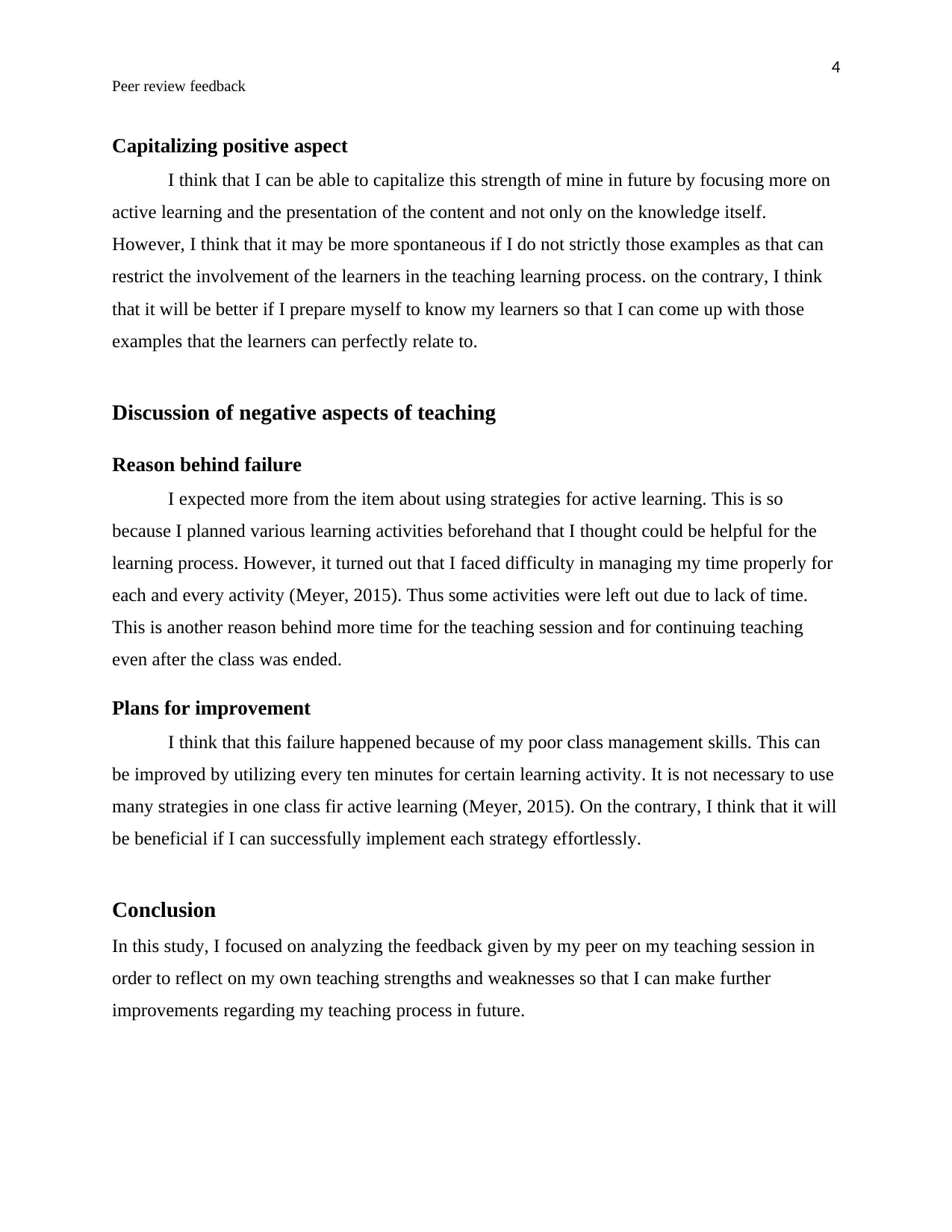
I think that I can be able to capitalize this strength of mine in future by focusing more on
active learning and the presentation of the content and not only on the knowledge itself.
However, I think that it may be more spontaneous if I do not strictly those examples as that can
restrict the involvement of the learners in the teaching learning process. on the contrary, I think
that it will be better if I prepare myself to know my learners so that I can come up with those
examples that the learners can perfectly relate to.
Discussion of negative aspects of teaching
Reason behind failure
I expected more from the item about using strategies for active learning. This is so
because I planned various learning activities beforehand that I thought could be helpful for the
learning process. However, it turned out that I faced difficulty in managing my time properly for
each and every activity (Meyer, 2015). Thus some activities were left out due to lack of time.
This is another reason behind more time for the teaching session and for continuing teaching
even after the class was ended.
Plans for improvement
I think that this failure happened because of my poor class management skills. This can
be improved by utilizing every ten minutes for certain learning activity. It is not necessary to use
many strategies in one class fir active learning (Meyer, 2015). On the contrary, I think that it will
be beneficial if I can successfully implement each strategy effortlessly.
Conclusion
In this study, I focused on analyzing the feedback given by my peer on my teaching session in
order to reflect on my own teaching strengths and weaknesses so that I can make further
improvements regarding my teaching process in future.
Peer review feedback
Capitalizing positive aspect
I think that I can be able to capitalize this strength of mine in future by focusing more on
active learning and the presentation of the content and not only on the knowledge itself.
However, I think that it may be more spontaneous if I do not strictly those examples as that can
restrict the involvement of the learners in the teaching learning process. on the contrary, I think
that it will be better if I prepare myself to know my learners so that I can come up with those
examples that the learners can perfectly relate to.
Discussion of negative aspects of teaching
Reason behind failure
I expected more from the item about using strategies for active learning. This is so
because I planned various learning activities beforehand that I thought could be helpful for the
learning process. However, it turned out that I faced difficulty in managing my time properly for
each and every activity (Meyer, 2015). Thus some activities were left out due to lack of time.
This is another reason behind more time for the teaching session and for continuing teaching
even after the class was ended.
Plans for improvement
I think that this failure happened because of my poor class management skills. This can
be improved by utilizing every ten minutes for certain learning activity. It is not necessary to use
many strategies in one class fir active learning (Meyer, 2015). On the contrary, I think that it will
be beneficial if I can successfully implement each strategy effortlessly.
Conclusion
In this study, I focused on analyzing the feedback given by my peer on my teaching session in
order to reflect on my own teaching strengths and weaknesses so that I can make further
improvements regarding my teaching process in future.
5
Peer review feedback
Reference list
communicationtheory.org, (2019), Communication Theory, Retrieved on: 11th Feb, 2019, From:
https://www.communicationtheory.org/the-johari-window-model/
Fernandez, C. E., & Yu, J. (2007). Peer review of teaching. Journal of Chiropractic
Education, 21(2), 154-161. Retrieved on: 11th Feb, 2019,
From:http://www.journalchiroed.com/doi/pdf/10.7899/1042-5055-21.2.154
Meyer, O. (2015). Towards quality CLIL: successful planning and teaching strategies. PULSO.
Revista de Educación, (33), 11-29. Retrieved on: 11th Feb, 2019,
http://revistas.cardenalcisneros.es/index.php/PULSO/article/download/92/68
Siddiqui, Z. S., Jonas-Dwyer, D., & Carr, S. E. (2007). Twelve tips for peer observation of
teaching. Medical Teacher, 29(4), 297-300. Retrieved on: 11th Feb, 2019,
From:http://www.maths.qmul.ac.uk/~beheshti/index_files/12TipsforPOT.pdf
Sullivan, P. B., Buckle, A., Nicky, G., & Atkinson, S. H. (2012). Peer observation of teaching as
a faculty development tool. BMC medical education, 12(1), 26. Retrieved on: 11th Feb,
2019, From:https://bmcmededuc.biomedcentral.com/articles/10.1186/1472-6920-12-26
van der Leeuw, R. M., & Slootweg, I. A. (2013). Twelve tips for making the best use of
feedback. Medical teacher, 35(5), 348-351. Retrieved on: 11th Feb, 2019,
From:https://website.professionalperformanceonline.nl/wp-content/uploads/2016/03/
thesis-Renee-leeuw.pdf#page=161
Peer review feedback
Reference list
communicationtheory.org, (2019), Communication Theory, Retrieved on: 11th Feb, 2019, From:
https://www.communicationtheory.org/the-johari-window-model/
Fernandez, C. E., & Yu, J. (2007). Peer review of teaching. Journal of Chiropractic
Education, 21(2), 154-161. Retrieved on: 11th Feb, 2019,
From:http://www.journalchiroed.com/doi/pdf/10.7899/1042-5055-21.2.154
Meyer, O. (2015). Towards quality CLIL: successful planning and teaching strategies. PULSO.
Revista de Educación, (33), 11-29. Retrieved on: 11th Feb, 2019,
http://revistas.cardenalcisneros.es/index.php/PULSO/article/download/92/68
Siddiqui, Z. S., Jonas-Dwyer, D., & Carr, S. E. (2007). Twelve tips for peer observation of
teaching. Medical Teacher, 29(4), 297-300. Retrieved on: 11th Feb, 2019,
From:http://www.maths.qmul.ac.uk/~beheshti/index_files/12TipsforPOT.pdf
Sullivan, P. B., Buckle, A., Nicky, G., & Atkinson, S. H. (2012). Peer observation of teaching as
a faculty development tool. BMC medical education, 12(1), 26. Retrieved on: 11th Feb,
2019, From:https://bmcmededuc.biomedcentral.com/articles/10.1186/1472-6920-12-26
van der Leeuw, R. M., & Slootweg, I. A. (2013). Twelve tips for making the best use of
feedback. Medical teacher, 35(5), 348-351. Retrieved on: 11th Feb, 2019,
From:https://website.professionalperformanceonline.nl/wp-content/uploads/2016/03/
thesis-Renee-leeuw.pdf#page=161
⊘ This is a preview!⊘
Do you want full access?
Subscribe today to unlock all pages.
Trusted by 1+ million students worldwide
6
Peer review feedback
Appendix
Appendix 1: TPR form
Domain Item for Teaching Peer-Review
Scale*
Points
0 1 2 3 4
Presentation &
Learning outcomes were clearly announced at the
beginning. ○ ○ ○ ○ ○ 2
Active
Learning Teacher used relevant examples from real practice. ○ ○ ○ ○ ○ 4
Points:
4*7 items=
Teacher responded to the different learning needs of
students. ○ ○ ○ ○ ○
3
28 max.
Session was organized and well-planned. ○ ○ ○ ○ ○
3
Teacher used effective strategies for active learning. ○ ○ ○ ○ ○
2
For each activity, teacher provided clear instructions
to ○ ○ ○ ○ ○
Students, with respect to duration, process and
expectations. 3
Peer review feedback
Appendix
Appendix 1: TPR form
Domain Item for Teaching Peer-Review
Scale*
Points
0 1 2 3 4
Presentation &
Learning outcomes were clearly announced at the
beginning. ○ ○ ○ ○ ○ 2
Active
Learning Teacher used relevant examples from real practice. ○ ○ ○ ○ ○ 4
Points:
4*7 items=
Teacher responded to the different learning needs of
students. ○ ○ ○ ○ ○
3
28 max.
Session was organized and well-planned. ○ ○ ○ ○ ○
3
Teacher used effective strategies for active learning. ○ ○ ○ ○ ○
2
For each activity, teacher provided clear instructions
to ○ ○ ○ ○ ○
Students, with respect to duration, process and
expectations. 3
Paraphrase This Document
Need a fresh take? Get an instant paraphrase of this document with our AI Paraphraser
7
Peer review feedback
Teacher allocated appropriate time for students to ask ○ ○ ○ ○ ○ 4
questions, discuss their ideas and present their work.
Assessment
&
Teacher asked questions that stimulated higher order
thinking. ○ ○ ○ ○ ○ 2
Feedback
Points: Teacher provided proper feedback to students on their
○ ○ ○ ○ ○
4*4 items=
3
learning.
16 max.
The teacher acknowledged specific learning needs of
students. ○ ○ ○ ○ ○ 2
The teacher provided opportunities for students to
reflect on ○ ○ ○ ○ ○ 3
learning.
Classroom Students were authentically engaged during the
session
○ ○ ○ ○ ○
Management
3
Points:
The overall class environment was friendly &
motivating. ○ ○ ○ ○ ○
4*4 items= 2
16 max.
Teacher encouraged good behaviors and skillfully ○ ○ ○ ○ ○
Peer review feedback
Teacher allocated appropriate time for students to ask ○ ○ ○ ○ ○ 4
questions, discuss their ideas and present their work.
Assessment
&
Teacher asked questions that stimulated higher order
thinking. ○ ○ ○ ○ ○ 2
Feedback
Points: Teacher provided proper feedback to students on their
○ ○ ○ ○ ○
4*4 items=
3
learning.
16 max.
The teacher acknowledged specific learning needs of
students. ○ ○ ○ ○ ○ 2
The teacher provided opportunities for students to
reflect on ○ ○ ○ ○ ○ 3
learning.
Classroom Students were authentically engaged during the
session
○ ○ ○ ○ ○
Management
3
Points:
The overall class environment was friendly &
motivating. ○ ○ ○ ○ ○
4*4 items= 2
16 max.
Teacher encouraged good behaviors and skillfully ○ ○ ○ ○ ○
8
Peer review feedback
managed 4
misbehaviors.
The teacher’s movements were purposeful and
effective. ○ ○ ○ ○ ○ 3
*0 = Never . 1 = Rarely. 2 = Sometimes . 3 = Usually (Most of time) . 4 = Always
(Throughout the session).
General Feedback from the reviewer/observer (limited to 3 key issues):
1. The teacher lacked constant focus on active learning process.
2. The teacher sometimes avoided the unnecessary noise coming from the backbenchers
3. The teacher could not properly finished teaching at the end of the class and thus had to
continue the class for more 10 minutes after the completion of the class.
Response from you as the teacher (limited to 3 actions for further
improvement):
1. I will try to keep in mind that interest of each and every student matters
and not only of the first benchers.
2. The classroom can be more active if I can come up with certain kinds of
learning activities that involves each and every student.
3. As a teacher, I can try to be less strict and friendlier to the learners so
that they feel comfortable to share their problems with me in future.
42/60
Peer review feedback
managed 4
misbehaviors.
The teacher’s movements were purposeful and
effective. ○ ○ ○ ○ ○ 3
*0 = Never . 1 = Rarely. 2 = Sometimes . 3 = Usually (Most of time) . 4 = Always
(Throughout the session).
General Feedback from the reviewer/observer (limited to 3 key issues):
1. The teacher lacked constant focus on active learning process.
2. The teacher sometimes avoided the unnecessary noise coming from the backbenchers
3. The teacher could not properly finished teaching at the end of the class and thus had to
continue the class for more 10 minutes after the completion of the class.
Response from you as the teacher (limited to 3 actions for further
improvement):
1. I will try to keep in mind that interest of each and every student matters
and not only of the first benchers.
2. The classroom can be more active if I can come up with certain kinds of
learning activities that involves each and every student.
3. As a teacher, I can try to be less strict and friendlier to the learners so
that they feel comfortable to share their problems with me in future.
42/60
⊘ This is a preview!⊘
Do you want full access?
Subscribe today to unlock all pages.
Trusted by 1+ million students worldwide

1 out of 9


Related Documents


Your All-in-One AI-Powered Toolkit for Academic Success.
+13062052269
info@desklib.com
Available 24*7 on WhatsApp / Email
![[object Object]](/_next/static/media/star-bottom.7253800d.svg)
Unlock your academic potential
Copyright © 2020–2026 A2Z Services. All Rights Reserved. Developed and managed by ZUCOL.