Introduction to People Management
VerifiedAdded on 2020/10/23
|12
|2710
|418
Report
AI Summary
This report analyzes people management within the NHS, focusing on leadership, training, and talent management. It discusses the challenges faced by NHS in staffing and offers recommendations for improvement. The report emphasizes the importance of effective human resource practices in sustaining healthcare services.

Introduction to People
Management
Management

Paraphrase This Document
Need a fresh take? Get an instant paraphrase of this document with our AI Paraphraser
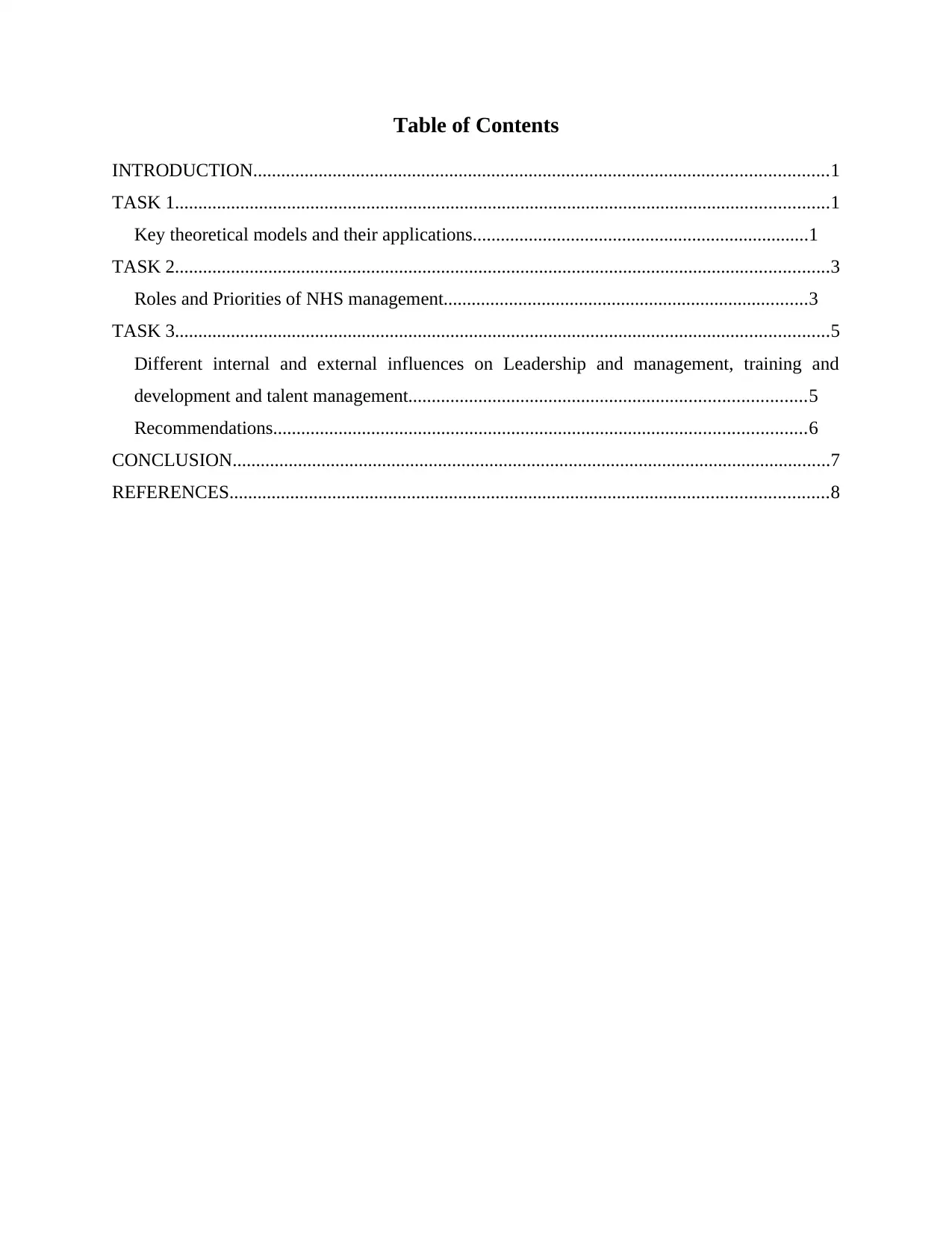
Table of Contents
INTRODUCTION...........................................................................................................................1
TASK 1............................................................................................................................................1
Key theoretical models and their applications........................................................................1
TASK 2............................................................................................................................................3
Roles and Priorities of NHS management..............................................................................3
TASK 3............................................................................................................................................5
Different internal and external influences on Leadership and management, training and
development and talent management.....................................................................................5
Recommendations..................................................................................................................6
CONCLUSION................................................................................................................................7
REFERENCES................................................................................................................................8
INTRODUCTION...........................................................................................................................1
TASK 1............................................................................................................................................1
Key theoretical models and their applications........................................................................1
TASK 2............................................................................................................................................3
Roles and Priorities of NHS management..............................................................................3
TASK 3............................................................................................................................................5
Different internal and external influences on Leadership and management, training and
development and talent management.....................................................................................5
Recommendations..................................................................................................................6
CONCLUSION................................................................................................................................7
REFERENCES................................................................................................................................8
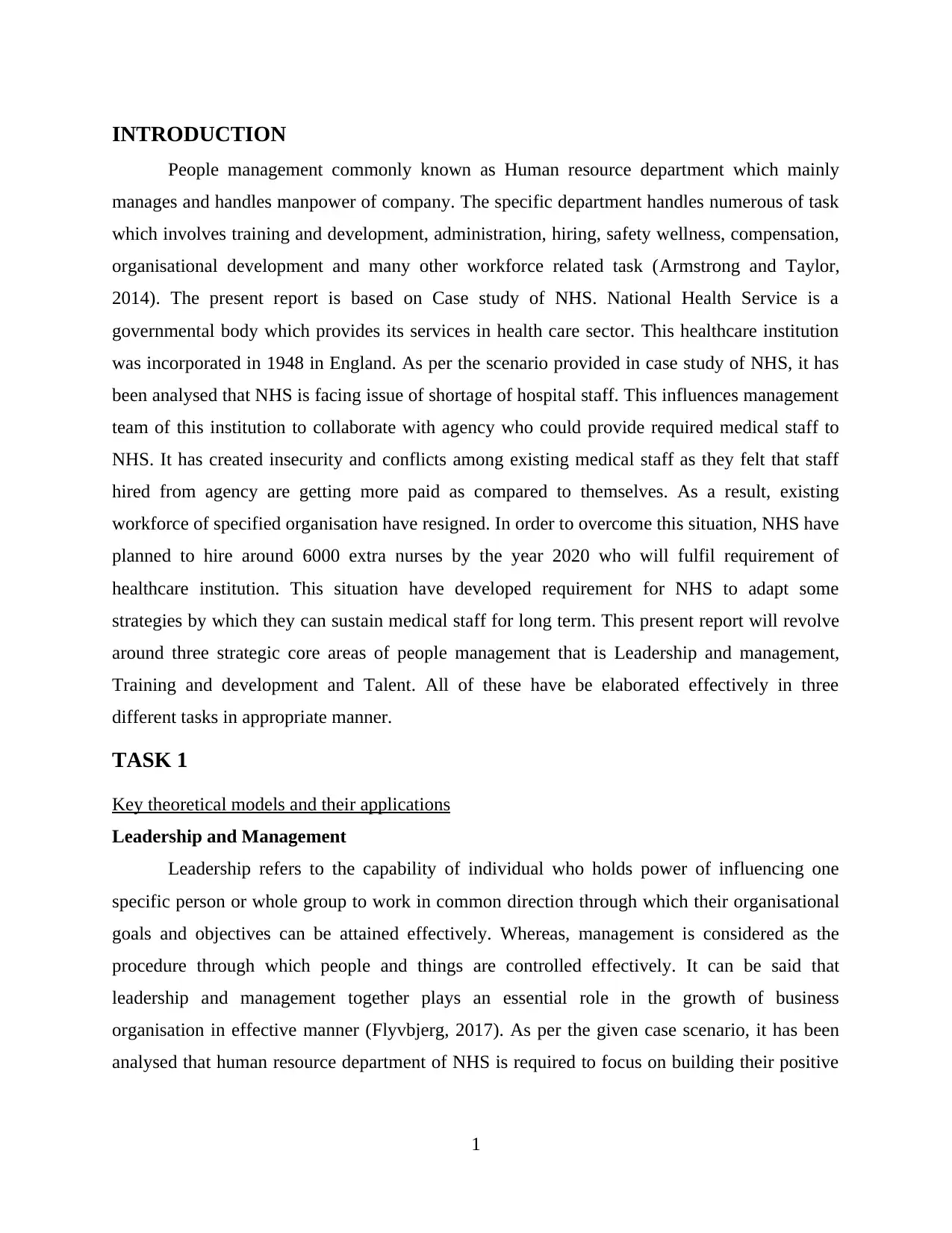
INTRODUCTION
People management commonly known as Human resource department which mainly
manages and handles manpower of company. The specific department handles numerous of task
which involves training and development, administration, hiring, safety wellness, compensation,
organisational development and many other workforce related task (Armstrong and Taylor,
2014). The present report is based on Case study of NHS. National Health Service is a
governmental body which provides its services in health care sector. This healthcare institution
was incorporated in 1948 in England. As per the scenario provided in case study of NHS, it has
been analysed that NHS is facing issue of shortage of hospital staff. This influences management
team of this institution to collaborate with agency who could provide required medical staff to
NHS. It has created insecurity and conflicts among existing medical staff as they felt that staff
hired from agency are getting more paid as compared to themselves. As a result, existing
workforce of specified organisation have resigned. In order to overcome this situation, NHS have
planned to hire around 6000 extra nurses by the year 2020 who will fulfil requirement of
healthcare institution. This situation have developed requirement for NHS to adapt some
strategies by which they can sustain medical staff for long term. This present report will revolve
around three strategic core areas of people management that is Leadership and management,
Training and development and Talent. All of these have be elaborated effectively in three
different tasks in appropriate manner.
TASK 1
Key theoretical models and their applications
Leadership and Management
Leadership refers to the capability of individual who holds power of influencing one
specific person or whole group to work in common direction through which their organisational
goals and objectives can be attained effectively. Whereas, management is considered as the
procedure through which people and things are controlled effectively. It can be said that
leadership and management together plays an essential role in the growth of business
organisation in effective manner (Flyvbjerg, 2017). As per the given case scenario, it has been
analysed that human resource department of NHS is required to focus on building their positive
1
People management commonly known as Human resource department which mainly
manages and handles manpower of company. The specific department handles numerous of task
which involves training and development, administration, hiring, safety wellness, compensation,
organisational development and many other workforce related task (Armstrong and Taylor,
2014). The present report is based on Case study of NHS. National Health Service is a
governmental body which provides its services in health care sector. This healthcare institution
was incorporated in 1948 in England. As per the scenario provided in case study of NHS, it has
been analysed that NHS is facing issue of shortage of hospital staff. This influences management
team of this institution to collaborate with agency who could provide required medical staff to
NHS. It has created insecurity and conflicts among existing medical staff as they felt that staff
hired from agency are getting more paid as compared to themselves. As a result, existing
workforce of specified organisation have resigned. In order to overcome this situation, NHS have
planned to hire around 6000 extra nurses by the year 2020 who will fulfil requirement of
healthcare institution. This situation have developed requirement for NHS to adapt some
strategies by which they can sustain medical staff for long term. This present report will revolve
around three strategic core areas of people management that is Leadership and management,
Training and development and Talent. All of these have be elaborated effectively in three
different tasks in appropriate manner.
TASK 1
Key theoretical models and their applications
Leadership and Management
Leadership refers to the capability of individual who holds power of influencing one
specific person or whole group to work in common direction through which their organisational
goals and objectives can be attained effectively. Whereas, management is considered as the
procedure through which people and things are controlled effectively. It can be said that
leadership and management together plays an essential role in the growth of business
organisation in effective manner (Flyvbjerg, 2017). As per the given case scenario, it has been
analysed that human resource department of NHS is required to focus on building their positive
1
⊘ This is a preview!⊘
Do you want full access?
Subscribe today to unlock all pages.

Trusted by 1+ million students worldwide
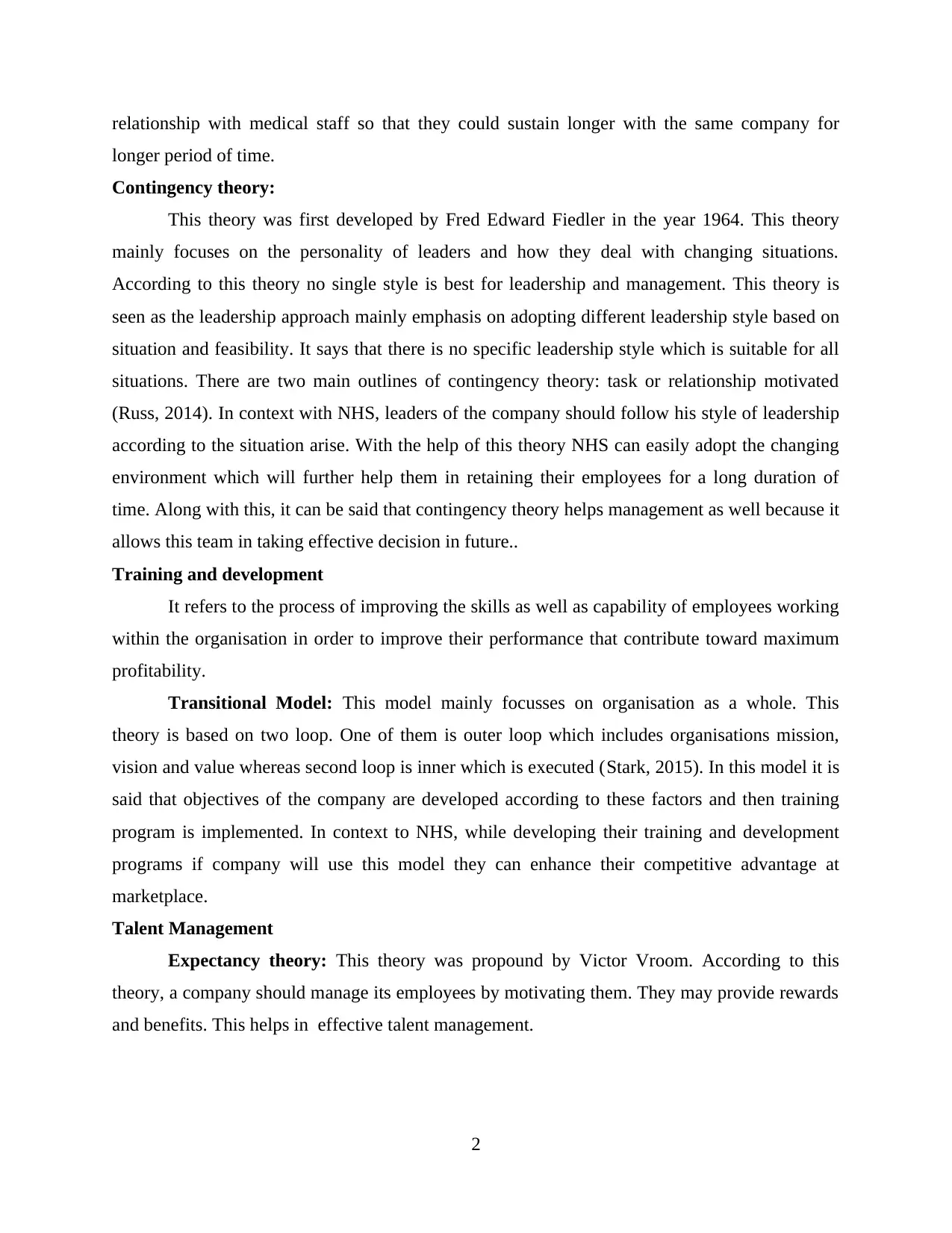
relationship with medical staff so that they could sustain longer with the same company for
longer period of time.
Contingency theory:
This theory was first developed by Fred Edward Fiedler in the year 1964. This theory
mainly focuses on the personality of leaders and how they deal with changing situations.
According to this theory no single style is best for leadership and management. This theory is
seen as the leadership approach mainly emphasis on adopting different leadership style based on
situation and feasibility. It says that there is no specific leadership style which is suitable for all
situations. There are two main outlines of contingency theory: task or relationship motivated
(Russ, 2014). In context with NHS, leaders of the company should follow his style of leadership
according to the situation arise. With the help of this theory NHS can easily adopt the changing
environment which will further help them in retaining their employees for a long duration of
time. Along with this, it can be said that contingency theory helps management as well because it
allows this team in taking effective decision in future..
Training and development
It refers to the process of improving the skills as well as capability of employees working
within the organisation in order to improve their performance that contribute toward maximum
profitability.
Transitional Model: This model mainly focusses on organisation as a whole. This
theory is based on two loop. One of them is outer loop which includes organisations mission,
vision and value whereas second loop is inner which is executed (Stark, 2015). In this model it is
said that objectives of the company are developed according to these factors and then training
program is implemented. In context to NHS, while developing their training and development
programs if company will use this model they can enhance their competitive advantage at
marketplace.
Talent Management
Expectancy theory: This theory was propound by Victor Vroom. According to this
theory, a company should manage its employees by motivating them. They may provide rewards
and benefits. This helps in effective talent management.
2
longer period of time.
Contingency theory:
This theory was first developed by Fred Edward Fiedler in the year 1964. This theory
mainly focuses on the personality of leaders and how they deal with changing situations.
According to this theory no single style is best for leadership and management. This theory is
seen as the leadership approach mainly emphasis on adopting different leadership style based on
situation and feasibility. It says that there is no specific leadership style which is suitable for all
situations. There are two main outlines of contingency theory: task or relationship motivated
(Russ, 2014). In context with NHS, leaders of the company should follow his style of leadership
according to the situation arise. With the help of this theory NHS can easily adopt the changing
environment which will further help them in retaining their employees for a long duration of
time. Along with this, it can be said that contingency theory helps management as well because it
allows this team in taking effective decision in future..
Training and development
It refers to the process of improving the skills as well as capability of employees working
within the organisation in order to improve their performance that contribute toward maximum
profitability.
Transitional Model: This model mainly focusses on organisation as a whole. This
theory is based on two loop. One of them is outer loop which includes organisations mission,
vision and value whereas second loop is inner which is executed (Stark, 2015). In this model it is
said that objectives of the company are developed according to these factors and then training
program is implemented. In context to NHS, while developing their training and development
programs if company will use this model they can enhance their competitive advantage at
marketplace.
Talent Management
Expectancy theory: This theory was propound by Victor Vroom. According to this
theory, a company should manage its employees by motivating them. They may provide rewards
and benefits. This helps in effective talent management.
2
Paraphrase This Document
Need a fresh take? Get an instant paraphrase of this document with our AI Paraphraser
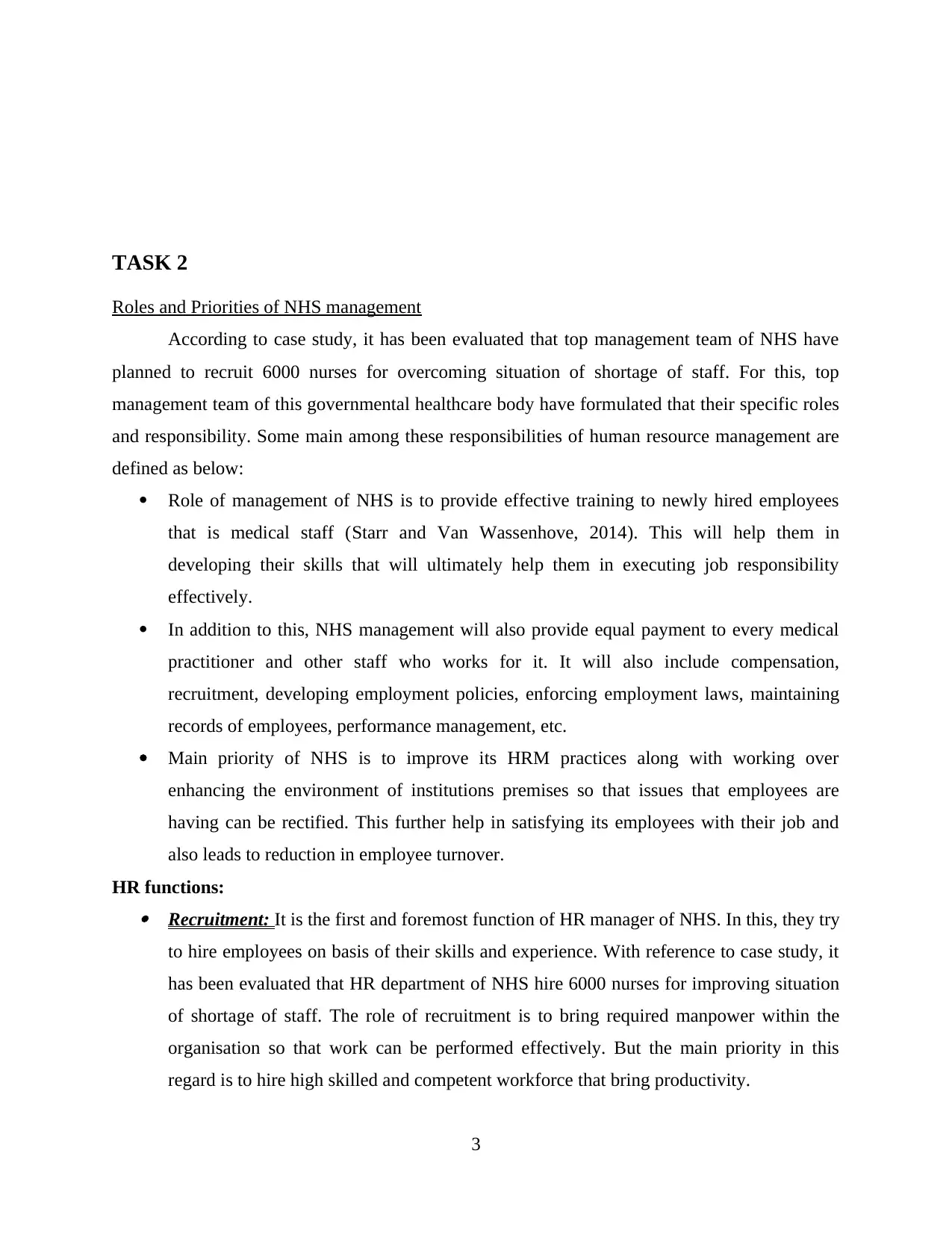
TASK 2
Roles and Priorities of NHS management
According to case study, it has been evaluated that top management team of NHS have
planned to recruit 6000 nurses for overcoming situation of shortage of staff. For this, top
management team of this governmental healthcare body have formulated that their specific roles
and responsibility. Some main among these responsibilities of human resource management are
defined as below:
Role of management of NHS is to provide effective training to newly hired employees
that is medical staff (Starr and Van Wassenhove, 2014). This will help them in
developing their skills that will ultimately help them in executing job responsibility
effectively.
In addition to this, NHS management will also provide equal payment to every medical
practitioner and other staff who works for it. It will also include compensation,
recruitment, developing employment policies, enforcing employment laws, maintaining
records of employees, performance management, etc.
Main priority of NHS is to improve its HRM practices along with working over
enhancing the environment of institutions premises so that issues that employees are
having can be rectified. This further help in satisfying its employees with their job and
also leads to reduction in employee turnover.
HR functions: Recruitment: It is the first and foremost function of HR manager of NHS. In this, they try
to hire employees on basis of their skills and experience. With reference to case study, it
has been evaluated that HR department of NHS hire 6000 nurses for improving situation
of shortage of staff. The role of recruitment is to bring required manpower within the
organisation so that work can be performed effectively. But the main priority in this
regard is to hire high skilled and competent workforce that bring productivity.
3
Roles and Priorities of NHS management
According to case study, it has been evaluated that top management team of NHS have
planned to recruit 6000 nurses for overcoming situation of shortage of staff. For this, top
management team of this governmental healthcare body have formulated that their specific roles
and responsibility. Some main among these responsibilities of human resource management are
defined as below:
Role of management of NHS is to provide effective training to newly hired employees
that is medical staff (Starr and Van Wassenhove, 2014). This will help them in
developing their skills that will ultimately help them in executing job responsibility
effectively.
In addition to this, NHS management will also provide equal payment to every medical
practitioner and other staff who works for it. It will also include compensation,
recruitment, developing employment policies, enforcing employment laws, maintaining
records of employees, performance management, etc.
Main priority of NHS is to improve its HRM practices along with working over
enhancing the environment of institutions premises so that issues that employees are
having can be rectified. This further help in satisfying its employees with their job and
also leads to reduction in employee turnover.
HR functions: Recruitment: It is the first and foremost function of HR manager of NHS. In this, they try
to hire employees on basis of their skills and experience. With reference to case study, it
has been evaluated that HR department of NHS hire 6000 nurses for improving situation
of shortage of staff. The role of recruitment is to bring required manpower within the
organisation so that work can be performed effectively. But the main priority in this
regard is to hire high skilled and competent workforce that bring productivity.
3
Training and development: This HR function helps workforce in improving skills of
staff members. In NHS, its manager will conduct regular based training and development
sessions that will enhance their skills. These sessions will also make each and every staff
member in enjoying their own work (Uspensky, 2014). As a result, it will improve their
performance and also deliver high quality services to patients. In addition to this, training
will also guide nurses about using equipments effectively so that chances of infection can
be avoided. Main role of Training & development is to provide employees a source
through which their weaknesses can be removed. But the priority of Training &
Development is work toward personal and professional development of employees to
make them capable for accomplishing business objectives. Managing compensation: At next function, HR manager manages all payable and other
salary related work. It mainly includes salary, incentive, compensation, overtime and
other matter. The priority of NHS is to offer that much compensation which can satisfy
its employees with their job and management. So in this regard the main role of NHS is
to discuss with its employees and work over their salary issues to make them satisfy. Employee relations: Another HR function is to develop positive relationship between
employer and employees. With reference to present case scenario, HR manager of NHS
will organise improvement hub in which all medical staff member will share their
experiences which other. Main role of employee relation is to improve hub that includes
various activities like interaction with colleagues, sharing of improvement stories etc. It
can be said that this HR function will influence medical staff to sustain longer. But the
priority of employee relation is to develop positive bonding between NHS and its
employees.
Legal responsibilities: Human resource department also handles legal matter of
company. In context to case scenario, it can be said that HR manager of NHS handles
legal responsibility of this healthcare institution (Vom Brocke and Rosemann, 2014).
Main role of this HR function is to ensures medical staff that will get their employment
rights as well as opportunities through which they could grow faster. But the priority of
this function is to avoid discrimination from workplace.
As per the above specified HR functions and roles and priorities of management of NHS,
it can said that all of them are helpful for its growth.
4
staff members. In NHS, its manager will conduct regular based training and development
sessions that will enhance their skills. These sessions will also make each and every staff
member in enjoying their own work (Uspensky, 2014). As a result, it will improve their
performance and also deliver high quality services to patients. In addition to this, training
will also guide nurses about using equipments effectively so that chances of infection can
be avoided. Main role of Training & development is to provide employees a source
through which their weaknesses can be removed. But the priority of Training &
Development is work toward personal and professional development of employees to
make them capable for accomplishing business objectives. Managing compensation: At next function, HR manager manages all payable and other
salary related work. It mainly includes salary, incentive, compensation, overtime and
other matter. The priority of NHS is to offer that much compensation which can satisfy
its employees with their job and management. So in this regard the main role of NHS is
to discuss with its employees and work over their salary issues to make them satisfy. Employee relations: Another HR function is to develop positive relationship between
employer and employees. With reference to present case scenario, HR manager of NHS
will organise improvement hub in which all medical staff member will share their
experiences which other. Main role of employee relation is to improve hub that includes
various activities like interaction with colleagues, sharing of improvement stories etc. It
can be said that this HR function will influence medical staff to sustain longer. But the
priority of employee relation is to develop positive bonding between NHS and its
employees.
Legal responsibilities: Human resource department also handles legal matter of
company. In context to case scenario, it can be said that HR manager of NHS handles
legal responsibility of this healthcare institution (Vom Brocke and Rosemann, 2014).
Main role of this HR function is to ensures medical staff that will get their employment
rights as well as opportunities through which they could grow faster. But the priority of
this function is to avoid discrimination from workplace.
As per the above specified HR functions and roles and priorities of management of NHS,
it can said that all of them are helpful for its growth.
4
⊘ This is a preview!⊘
Do you want full access?
Subscribe today to unlock all pages.
Trusted by 1+ million students worldwide
TASK 3
Different internal and external influences on Leadership and management, training and
development and talent management
Management of workforce at workplace is considered as the most difficult task which is
being handled by human resource department of organisation. In context to present case
scenario, it can be said that management team of NHS is required to evaluate all of the internal
as well as external factors which have influence over three core strategic areas that is training
and development, Leadership and management and talent management (Wild, 2017). Some of
these factors are defined as below:
Leadership and management: Leadership and management both holds strong position
in the growth of business organisation. With reference to current case scenario of NHS, it has
been analysed that internal factors & external factors which influences leadership and
management team of this healthcare institution is
Internal factor: For NHS, its employees are main internal factor which affects its
leadership and management performance. In context to case study, it has been analysed
that employees of this company are not sustaining longer at workplace because
ineffective recruitment. It can be said that if employee does not support management
team then it would not be possible for them to bring any change at workplace or sustain
them longer in company.
External factor: Social factors is seen as the most influential external factor that
influences leadership and management team of NHS. It can said that managers of this
healthcare organisation have to modify their strategies according to the changes which
took place in society.
Training and development:
Internal factor: Organisational resources of NHS are main internal factor that holds
capacity of affecting training and development sessions of NHS. This is because, any
organisation requires some resources like basic equipment, infrastructure, sitting space
and many other things so that could conduct an effective training session (Wilton, 2016).
5
Different internal and external influences on Leadership and management, training and
development and talent management
Management of workforce at workplace is considered as the most difficult task which is
being handled by human resource department of organisation. In context to present case
scenario, it can be said that management team of NHS is required to evaluate all of the internal
as well as external factors which have influence over three core strategic areas that is training
and development, Leadership and management and talent management (Wild, 2017). Some of
these factors are defined as below:
Leadership and management: Leadership and management both holds strong position
in the growth of business organisation. With reference to current case scenario of NHS, it has
been analysed that internal factors & external factors which influences leadership and
management team of this healthcare institution is
Internal factor: For NHS, its employees are main internal factor which affects its
leadership and management performance. In context to case study, it has been analysed
that employees of this company are not sustaining longer at workplace because
ineffective recruitment. It can be said that if employee does not support management
team then it would not be possible for them to bring any change at workplace or sustain
them longer in company.
External factor: Social factors is seen as the most influential external factor that
influences leadership and management team of NHS. It can said that managers of this
healthcare organisation have to modify their strategies according to the changes which
took place in society.
Training and development:
Internal factor: Organisational resources of NHS are main internal factor that holds
capacity of affecting training and development sessions of NHS. This is because, any
organisation requires some resources like basic equipment, infrastructure, sitting space
and many other things so that could conduct an effective training session (Wilton, 2016).
5
Paraphrase This Document
Need a fresh take? Get an instant paraphrase of this document with our AI Paraphraser
In context to NHS, if the company does not have these resources then it will be harder for
them to conduct better training session.
External factor: Changes in healthcare laws which influences the topic of discussion of
training and development session. It can be said that if government has modified legal
laws related to medical staff or their practice, then it will be required by its management
team to conduct training and development sessions according to the changing laws as it
will affect working practices.
Talent management:
Internal factors:
Working environment: In order to implement talent management in NHS, working
environment is an internal factor which can affect the overall working of the company. There are
various factors which influences the working culture of an organisation. The main reason behind
the affected working environment is that NHS is hiring people from agencies in order to
overcome their issue related with lack of employment. But this decision has badly affected the
existing employees as they get dissatisfied from these decision of management as they feel less
valuable themselves. External Factor:
Demand & Supply: one of the most influential external factor is demand and supply of
talented employees. In reference to NHS, there is a high demand for skilled employees at
marketplace. Shortage of skilled employees can affect the overall working of the company.
This factor influence the market share and goodwill of the company at competitive
marketplace (Wright, 2018).
Recommendations
On the basis of above specified report on people management, it has been evaluated that
NHS have to adopt various strategies so that they can sustain longer at marketplace and improve
their functions. On the basis of case study of NHS, there are some specific recommendations
through which this healthcare institution can overcome situation of shortage of staff. These
recommendation are provided as per three core areas which are explained below:
For the first and foremost area that is leadership and management, it is recommended to
management team of NHS to adopt contingency leadership style as it helps them in managing
all kind of different situation in NHS. .
6
them to conduct better training session.
External factor: Changes in healthcare laws which influences the topic of discussion of
training and development session. It can be said that if government has modified legal
laws related to medical staff or their practice, then it will be required by its management
team to conduct training and development sessions according to the changing laws as it
will affect working practices.
Talent management:
Internal factors:
Working environment: In order to implement talent management in NHS, working
environment is an internal factor which can affect the overall working of the company. There are
various factors which influences the working culture of an organisation. The main reason behind
the affected working environment is that NHS is hiring people from agencies in order to
overcome their issue related with lack of employment. But this decision has badly affected the
existing employees as they get dissatisfied from these decision of management as they feel less
valuable themselves. External Factor:
Demand & Supply: one of the most influential external factor is demand and supply of
talented employees. In reference to NHS, there is a high demand for skilled employees at
marketplace. Shortage of skilled employees can affect the overall working of the company.
This factor influence the market share and goodwill of the company at competitive
marketplace (Wright, 2018).
Recommendations
On the basis of above specified report on people management, it has been evaluated that
NHS have to adopt various strategies so that they can sustain longer at marketplace and improve
their functions. On the basis of case study of NHS, there are some specific recommendations
through which this healthcare institution can overcome situation of shortage of staff. These
recommendation are provided as per three core areas which are explained below:
For the first and foremost area that is leadership and management, it is recommended to
management team of NHS to adopt contingency leadership style as it helps them in managing
all kind of different situation in NHS. .
6
Recommendation for training and development area is that management of NHS should
organise training sessions at regular intervals to equip the practitioners with the right skills and
competence so that they can perform the professional healthcare practices in ethical manner.
In relation to talent management, it is suggested that HR department of NHS should hire
only skilled and qualified nurses and medical staff to ensure that work is being carried out in
accordance with regulations given by care quality commission (SQC).
CONCLUSION
As per the above specified report, it has been concluded that people management is
considered as one of the most important work organisation belonging to healthcare sector. This is
because, without medical staff it would not be possible for hospitals to sustain longer and
provide effective and curing medical services to patients.
7
organise training sessions at regular intervals to equip the practitioners with the right skills and
competence so that they can perform the professional healthcare practices in ethical manner.
In relation to talent management, it is suggested that HR department of NHS should hire
only skilled and qualified nurses and medical staff to ensure that work is being carried out in
accordance with regulations given by care quality commission (SQC).
CONCLUSION
As per the above specified report, it has been concluded that people management is
considered as one of the most important work organisation belonging to healthcare sector. This is
because, without medical staff it would not be possible for hospitals to sustain longer and
provide effective and curing medical services to patients.
7
⊘ This is a preview!⊘
Do you want full access?
Subscribe today to unlock all pages.
Trusted by 1+ million students worldwide
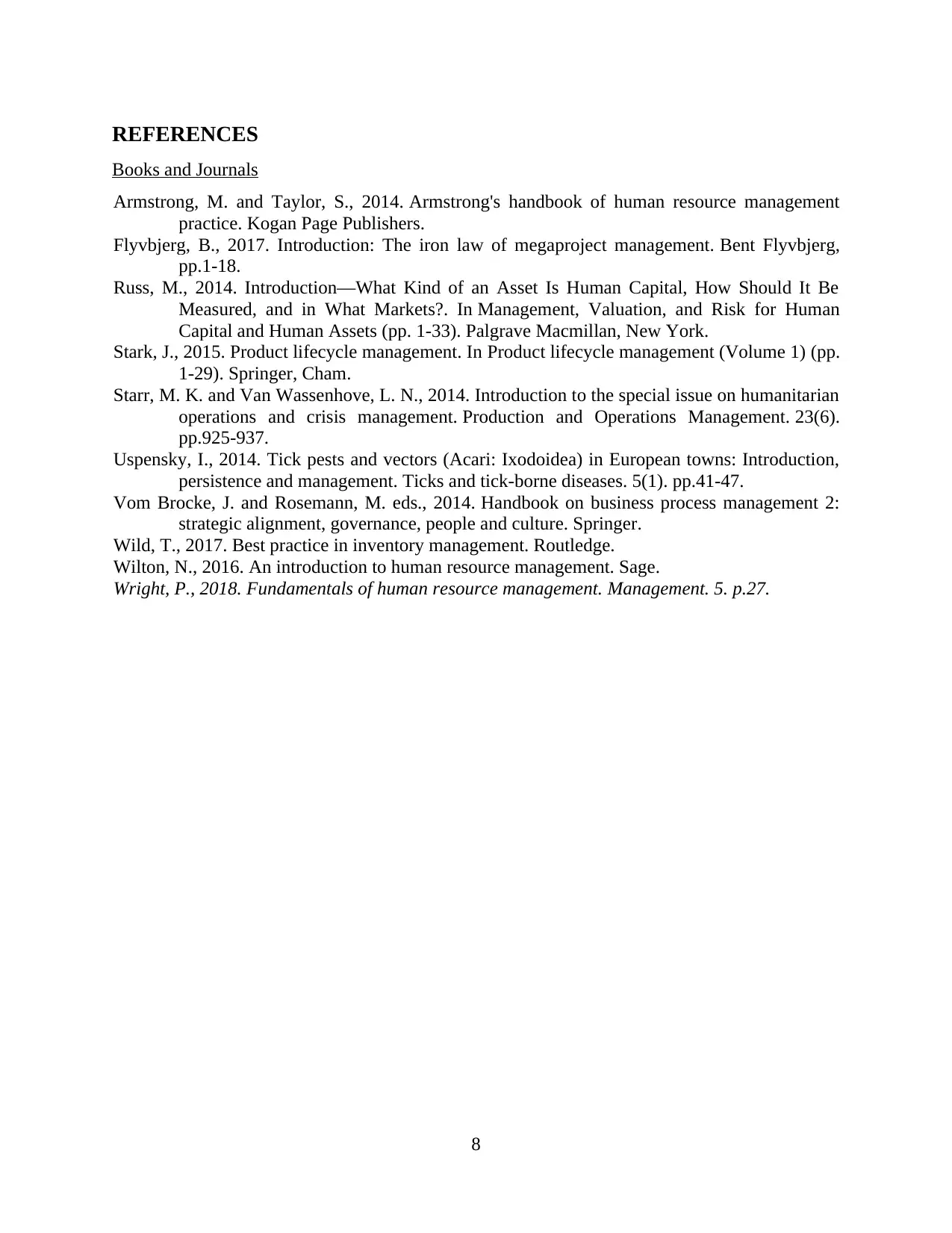
REFERENCES
Books and Journals
Armstrong, M. and Taylor, S., 2014. Armstrong's handbook of human resource management
practice. Kogan Page Publishers.
Flyvbjerg, B., 2017. Introduction: The iron law of megaproject management. Bent Flyvbjerg,
pp.1-18.
Russ, M., 2014. Introduction—What Kind of an Asset Is Human Capital, How Should It Be
Measured, and in What Markets?. In Management, Valuation, and Risk for Human
Capital and Human Assets (pp. 1-33). Palgrave Macmillan, New York.
Stark, J., 2015. Product lifecycle management. In Product lifecycle management (Volume 1) (pp.
1-29). Springer, Cham.
Starr, M. K. and Van Wassenhove, L. N., 2014. Introduction to the special issue on humanitarian
operations and crisis management. Production and Operations Management. 23(6).
pp.925-937.
Uspensky, I., 2014. Tick pests and vectors (Acari: Ixodoidea) in European towns: Introduction,
persistence and management. Ticks and tick-borne diseases. 5(1). pp.41-47.
Vom Brocke, J. and Rosemann, M. eds., 2014. Handbook on business process management 2:
strategic alignment, governance, people and culture. Springer.
Wild, T., 2017. Best practice in inventory management. Routledge.
Wilton, N., 2016. An introduction to human resource management. Sage.
Wright, P., 2018. Fundamentals of human resource management. Management. 5. p.27.
8
Books and Journals
Armstrong, M. and Taylor, S., 2014. Armstrong's handbook of human resource management
practice. Kogan Page Publishers.
Flyvbjerg, B., 2017. Introduction: The iron law of megaproject management. Bent Flyvbjerg,
pp.1-18.
Russ, M., 2014. Introduction—What Kind of an Asset Is Human Capital, How Should It Be
Measured, and in What Markets?. In Management, Valuation, and Risk for Human
Capital and Human Assets (pp. 1-33). Palgrave Macmillan, New York.
Stark, J., 2015. Product lifecycle management. In Product lifecycle management (Volume 1) (pp.
1-29). Springer, Cham.
Starr, M. K. and Van Wassenhove, L. N., 2014. Introduction to the special issue on humanitarian
operations and crisis management. Production and Operations Management. 23(6).
pp.925-937.
Uspensky, I., 2014. Tick pests and vectors (Acari: Ixodoidea) in European towns: Introduction,
persistence and management. Ticks and tick-borne diseases. 5(1). pp.41-47.
Vom Brocke, J. and Rosemann, M. eds., 2014. Handbook on business process management 2:
strategic alignment, governance, people and culture. Springer.
Wild, T., 2017. Best practice in inventory management. Routledge.
Wilton, N., 2016. An introduction to human resource management. Sage.
Wright, P., 2018. Fundamentals of human resource management. Management. 5. p.27.
8
Paraphrase This Document
Need a fresh take? Get an instant paraphrase of this document with our AI Paraphraser

9

10
⊘ This is a preview!⊘
Do you want full access?
Subscribe today to unlock all pages.
Trusted by 1+ million students worldwide

1 out of 12


Related Documents


Your All-in-One AI-Powered Toolkit for Academic Success.
+13062052269
info@desklib.com
Available 24*7 on WhatsApp / Email
![[object Object]](/_next/static/media/star-bottom.7253800d.svg)
Unlock your academic potential
Copyright © 2020–2026 A2Z Services. All Rights Reserved. Developed and managed by ZUCOL.