People and Performance: Management Tools for Effectiveness
VerifiedAdded on 2023/06/09
|10
|2747
|186
Report
AI Summary
This report explores the crucial role of people management in organizational effectiveness, emphasizing the significance of the human resource department in shaping business strategies and fostering employee growth. It highlights the importance of utilizing management tools like goal setting, feedback mechanisms, employee appreciation, HR management software, and performance appraisals to cultivate a motivating work culture. Various management techniques, including planning, monitoring, rating, rewarding, upgrading, and mentoring, are discussed in detail. The report also delves into the impact of employee well-being on organizational output, emphasizing the company's role in providing mental health support, encouraging workplace friendships, offering financial education, providing health benefits, fostering a culture of recognition, and promoting work-life balance. The report concludes that prioritizing employee well-being and implementing effective people management practices are essential for achieving organizational success, and it uses a PESTEL analysis in the appendix to contextualize the factors that are considered while operating an organization.
People and Performance

Paraphrase This Document
Need a fresh take? Get an instant paraphrase of this document with our AI Paraphraser
Table of Contents
INTRODUCTION...........................................................................................................................3
MAIN BODY...................................................................................................................................3
Management tools:.................................................................................................................4
Management Techniques:.......................................................................................................5
Company role in employee’s well being:...............................................................................6
CONCLUSION................................................................................................................................7
REFERENCES................................................................................................................................8
Appendix..........................................................................................................................................9
A PESTEL analysis for Crystal Travel..................................................................................9
INTRODUCTION...........................................................................................................................3
MAIN BODY...................................................................................................................................3
Management tools:.................................................................................................................4
Management Techniques:.......................................................................................................5
Company role in employee’s well being:...............................................................................6
CONCLUSION................................................................................................................................7
REFERENCES................................................................................................................................8
Appendix..........................................................................................................................................9
A PESTEL analysis for Crystal Travel..................................................................................9
INTRODUCTION
The efficacy of a business can be easily related to effectiveness in an organization.
However the focus on quality service is must considered. The human resource department of any
organization have a effective role in in credibility of any organization. The organizational human
resource department helps by constructing and enforcing the changes within the company in
order to improve the organization. Consideration of educational qualification, abilities, skills and
strengths. Recruitment of different persons from multiple fields and involving them in decision
making procedure, results in multiple perspectives and better ways to upgrade the organization.
Basically, effectiveness of organisation is strategy of business developed to enhance the efficacy
of the company, without reducing the quality of goods and services.
MAIN BODY
The right tool and strategies to get the specific goal is the actual key for effectiveness in business
organization. Human resource department of any organization must be utilized to great extent.
Human resource provide assistance in effectiveness of organization by helping in constructing
the new business strategies(Nurilloyevna, 2021). Human resource professional have also a role of
hiring new employees which also influence the goals of company. The organization must focus
on education and growth of the employees. Leaders may overlook for the unique prospectives
and the right candidate for the offered position in the organization, this all are offered by the
human resource professionals. Any organization needs an active action plans in working with
different groups and individuals(Ikechukwu, Okechukwu, Erastus and Epelle, 2019). Before
making any action plan for effectiveness of an organization, a leader must acknowledge the
strengths and weakness of different professionals. Consideration of educational background,
liabilities and skills are also considered. The organization must focus on developing team which
has commendatory skills and knowledge(Coleman, 2018). For the efficacy in the company, the
human resource professional should have good knowledge of different professional and their role
in company and enhance the abilities. When the organization works according to the customer
needs and interest then it will get benefited. When the company does not provide a quality of
goods and services then customer will go for alternatives available in market for their
requirement. Using online tools such as social media platform for the feedback from the clients
or direct interaction to the clients will result in positive manner(Singh, Gupta, Mia and Sharma,
The efficacy of a business can be easily related to effectiveness in an organization.
However the focus on quality service is must considered. The human resource department of any
organization have a effective role in in credibility of any organization. The organizational human
resource department helps by constructing and enforcing the changes within the company in
order to improve the organization. Consideration of educational qualification, abilities, skills and
strengths. Recruitment of different persons from multiple fields and involving them in decision
making procedure, results in multiple perspectives and better ways to upgrade the organization.
Basically, effectiveness of organisation is strategy of business developed to enhance the efficacy
of the company, without reducing the quality of goods and services.
MAIN BODY
The right tool and strategies to get the specific goal is the actual key for effectiveness in business
organization. Human resource department of any organization must be utilized to great extent.
Human resource provide assistance in effectiveness of organization by helping in constructing
the new business strategies(Nurilloyevna, 2021). Human resource professional have also a role of
hiring new employees which also influence the goals of company. The organization must focus
on education and growth of the employees. Leaders may overlook for the unique prospectives
and the right candidate for the offered position in the organization, this all are offered by the
human resource professionals. Any organization needs an active action plans in working with
different groups and individuals(Ikechukwu, Okechukwu, Erastus and Epelle, 2019). Before
making any action plan for effectiveness of an organization, a leader must acknowledge the
strengths and weakness of different professionals. Consideration of educational background,
liabilities and skills are also considered. The organization must focus on developing team which
has commendatory skills and knowledge(Coleman, 2018). For the efficacy in the company, the
human resource professional should have good knowledge of different professional and their role
in company and enhance the abilities. When the organization works according to the customer
needs and interest then it will get benefited. When the company does not provide a quality of
goods and services then customer will go for alternatives available in market for their
requirement. Using online tools such as social media platform for the feedback from the clients
or direct interaction to the clients will result in positive manner(Singh, Gupta, Mia and Sharma,
⊘ This is a preview!⊘
Do you want full access?
Subscribe today to unlock all pages.

Trusted by 1+ million students worldwide
2018). Enriching the product without exceeding the set budget is the initial goal of any
organization. Professional from different area must be involved and advice the company in
improving the products without increasing the price of goods, and also reduce the time in
reaching the specific setted goals and fulfil the customer needs. For the efficiency and effective
outcome, company must make use of technology as tool(Singh and et.al., 2020). The best way
for business and client protection is the idea of working with technological professionals. By
working with different individual with different education qualification, the gets a new idea and
concepts for reducing the overall cost, improve the level of product and deliver a quality to
customer.
Performance Management is a procedure of substantiating a motivating work culture in
an organization, where for a common goals leaders and workers continuously evaluate
themselves. This basically includes tracking and setting of goals, 360 degree feedback,
development and talents analytics, recognition and rewards. When organization work without
performance management then it leaves the worker disengaged and directionless.
Some tools and techniques for best results are listed below:
Management tools:
Goal setting Tools: the initial step for enhancing the productivity of an organisation is
setting a goal. Unclear plan and objectives results in lack of interest among the
employees(Clifton and Harter, 2021). The goals must be challenging and smart so that the
individuals goals can align with that of organization.
Feedback tools: employee as well as organization, both will get benefited by practising
this tools as it track employee progress and helps in time to time improvement. Feedback
tool include 360 degree feedback and peer-to-peer feedback which promote employee
engagement. Which make the employee’s to claim, take and ask feedback from their
manger and team members. This practice build a nature of trust and continuous
development.
Employee’s appreciation tools: It initiates the culture that promote appreciation and
acknowledge employee’s effort even for the smallest progress. One should always
remember to cherish and behold the good work of other employee’s(Sonar and
Kambekar, 2020).
organization. Professional from different area must be involved and advice the company in
improving the products without increasing the price of goods, and also reduce the time in
reaching the specific setted goals and fulfil the customer needs. For the efficiency and effective
outcome, company must make use of technology as tool(Singh and et.al., 2020). The best way
for business and client protection is the idea of working with technological professionals. By
working with different individual with different education qualification, the gets a new idea and
concepts for reducing the overall cost, improve the level of product and deliver a quality to
customer.
Performance Management is a procedure of substantiating a motivating work culture in
an organization, where for a common goals leaders and workers continuously evaluate
themselves. This basically includes tracking and setting of goals, 360 degree feedback,
development and talents analytics, recognition and rewards. When organization work without
performance management then it leaves the worker disengaged and directionless.
Some tools and techniques for best results are listed below:
Management tools:
Goal setting Tools: the initial step for enhancing the productivity of an organisation is
setting a goal. Unclear plan and objectives results in lack of interest among the
employees(Clifton and Harter, 2021). The goals must be challenging and smart so that the
individuals goals can align with that of organization.
Feedback tools: employee as well as organization, both will get benefited by practising
this tools as it track employee progress and helps in time to time improvement. Feedback
tool include 360 degree feedback and peer-to-peer feedback which promote employee
engagement. Which make the employee’s to claim, take and ask feedback from their
manger and team members. This practice build a nature of trust and continuous
development.
Employee’s appreciation tools: It initiates the culture that promote appreciation and
acknowledge employee’s effort even for the smallest progress. One should always
remember to cherish and behold the good work of other employee’s(Sonar and
Kambekar, 2020).
Paraphrase This Document
Need a fresh take? Get an instant paraphrase of this document with our AI Paraphraser
HR management tools: An automated HR management software in an organisation can
facilitate the many activities and solve many issue of HR management. The human
resource professionals have to account for strong data security, powerful management
support, easy set-ups and so on.
Performance Appraisal tools: when the appraisal process is regular and constructive
between the employee’s then it is a powerful tool for an organization that helps to align
the individual goal and track the progress and performance over time(Saad, Sudin and
Shamsuddin, 2018).
Personal Development Plan: It helps in identifying the goals and tracking it,identifying
the growth area and strategies to achieve the growth. It encourage and motivate the
employee’s towards their growth in organizational progress.
Management Techniques:
Plan: the initial phase is planning. while planning, individual goals are defined properly,
strategies to communicate world-wide as these all contribute to organizational goals.
Planning should be made with the coordination of employee’s and plan should be
SMART(specific, measurable, achievable, relevant and time bound).
Monitor: Monitoring means providing current feedback and regularly tracking the
employee’s performance. It help is evaluating that the goals set by the employees are
achieving or not.
Rate: it includes analysing employee’s according to their standard performance. It helps
employees to help themselves and helps manger to analyse and compare the performance.
Reward: when the work of an employee is recognised it motivated and empower him. A
good manger know the importance of rewarding the employee who perform well. This
leads to increase in productivity of an organization(MERCY and CHOUDHARY, 2019).
Upgrade: the goals and strategies need to be upgraded at accurate intervals. The leader
should coordinate and change the setted goals which looks unattainable or giving
negative impacts on organization.
Mentor and Coach: when mentoring and coaching tools, the organisation can bring out
the best from each employee’s.
Well being is how someone feels various facets of their respective life like health,
relationship and their job. Good well being is considered when someone as control over their
facilitate the many activities and solve many issue of HR management. The human
resource professionals have to account for strong data security, powerful management
support, easy set-ups and so on.
Performance Appraisal tools: when the appraisal process is regular and constructive
between the employee’s then it is a powerful tool for an organization that helps to align
the individual goal and track the progress and performance over time(Saad, Sudin and
Shamsuddin, 2018).
Personal Development Plan: It helps in identifying the goals and tracking it,identifying
the growth area and strategies to achieve the growth. It encourage and motivate the
employee’s towards their growth in organizational progress.
Management Techniques:
Plan: the initial phase is planning. while planning, individual goals are defined properly,
strategies to communicate world-wide as these all contribute to organizational goals.
Planning should be made with the coordination of employee’s and plan should be
SMART(specific, measurable, achievable, relevant and time bound).
Monitor: Monitoring means providing current feedback and regularly tracking the
employee’s performance. It help is evaluating that the goals set by the employees are
achieving or not.
Rate: it includes analysing employee’s according to their standard performance. It helps
employees to help themselves and helps manger to analyse and compare the performance.
Reward: when the work of an employee is recognised it motivated and empower him. A
good manger know the importance of rewarding the employee who perform well. This
leads to increase in productivity of an organization(MERCY and CHOUDHARY, 2019).
Upgrade: the goals and strategies need to be upgraded at accurate intervals. The leader
should coordinate and change the setted goals which looks unattainable or giving
negative impacts on organization.
Mentor and Coach: when mentoring and coaching tools, the organisation can bring out
the best from each employee’s.
Well being is how someone feels various facets of their respective life like health,
relationship and their job. Good well being is considered when someone as control over their
happiness, sense of purpose and health. When talking from employee’s perspective, it involve
how someone feels at their job and at their work. The basic well being includes- financial well
being, emotional well being, stress management, mental and physical health, professional
development and nutrition. Workplace factor that effects well being include- Environmental
factor like temperature, comfort, natural light, physical activity factor, social- relationship with
manager and teammates, psychological factor like stress, goals, purpose and rest. A culture of
well being helps, inspire and support employee’s to practice of healthy behaviour in office. It
benefited the workplace in numerous ways. Company get enhance team morale, productivity,
staff satisfaction and sense of loyalty.
Company role in employee’s well being:
Provide support and training program regarding mental health: company should
create a mental health program and make sure that there will be a clear communication
between everyone in business. It is important to inspire a open and positive
communication in context to mental health and initiate the steps in removing any trigger
of mental health issue(Choudhury, Dutta and Dutta, 2019). Manager should take the
responsibilities and make it sure that each employee’s have access to mental health tools
to cope.
Cheer up the colleagues to make friends: setting of bonds and friendship at workplace
is necessary for employee to feel supported. Those who work in team are hard worker as
they feel responsible to their friends or teammates. It improves enjoyment and
performance thus increases the productivity.
Educate the staffs about financial acknowledging: knowledge can bring a positive
difference in well being of an employee financially. Company should help the staff
member in understanding the budgeting system, child care costs and pension plans. It
take away the tension from the staff member and give them to right tools to deal with.
Health and well-being benefits: offering health benefits to employee’s like gym
membership, health insurance ensures that employee’s have access to the most valyuable
benefits and tackle their personal concern.
Culture of reward and recognition: by recognizing the efforts and good work of
teammates, prioritizing positive communication at workplace inspire everyone in
company and maximise the results. This will allow a friendly competition in order to
how someone feels at their job and at their work. The basic well being includes- financial well
being, emotional well being, stress management, mental and physical health, professional
development and nutrition. Workplace factor that effects well being include- Environmental
factor like temperature, comfort, natural light, physical activity factor, social- relationship with
manager and teammates, psychological factor like stress, goals, purpose and rest. A culture of
well being helps, inspire and support employee’s to practice of healthy behaviour in office. It
benefited the workplace in numerous ways. Company get enhance team morale, productivity,
staff satisfaction and sense of loyalty.
Company role in employee’s well being:
Provide support and training program regarding mental health: company should
create a mental health program and make sure that there will be a clear communication
between everyone in business. It is important to inspire a open and positive
communication in context to mental health and initiate the steps in removing any trigger
of mental health issue(Choudhury, Dutta and Dutta, 2019). Manager should take the
responsibilities and make it sure that each employee’s have access to mental health tools
to cope.
Cheer up the colleagues to make friends: setting of bonds and friendship at workplace
is necessary for employee to feel supported. Those who work in team are hard worker as
they feel responsible to their friends or teammates. It improves enjoyment and
performance thus increases the productivity.
Educate the staffs about financial acknowledging: knowledge can bring a positive
difference in well being of an employee financially. Company should help the staff
member in understanding the budgeting system, child care costs and pension plans. It
take away the tension from the staff member and give them to right tools to deal with.
Health and well-being benefits: offering health benefits to employee’s like gym
membership, health insurance ensures that employee’s have access to the most valyuable
benefits and tackle their personal concern.
Culture of reward and recognition: by recognizing the efforts and good work of
teammates, prioritizing positive communication at workplace inspire everyone in
company and maximise the results. This will allow a friendly competition in order to
⊘ This is a preview!⊘
Do you want full access?
Subscribe today to unlock all pages.
Trusted by 1+ million students worldwide
enhance the motivation and morale so long as working towards company goals and
targets.
Flexibility in work- life balance of an employee: by offering the flexibility and
focusing on targets, company can assure their employee that they trust them while
allowing them to manage work-life balance.
Allowing unwell employee’s to stay at home: exhort the company employee's to stay
home if they are feeling unwell. By allowing this leave guilt which employee's are feeling
can be removed.
CONCLUSION
From the above report, It can be easily concluded that employee's are highly responsible
for the growth of an organisation. The overall performance of an organisation is influenced by
the good people management. In context to the enterprises, practising the culture of recognition
and rewards to the employee's and the strategies of appraisal giving will be results in greater
advantages. Employee's get motivated to perform premium and standard, also show loyalty
towards the company. Employee's satisfaction and well-being are well related to the output of the
company and this must be understood by the company. So the organisation must create a
working environment and facilitates its best for the employee's within the company. Employee's
gets encouraged for day to day work when proper people management performed. Moreover, the
information related to factor which needed to be considered while operating a organization is
analysed by PESTEL analysis.
targets.
Flexibility in work- life balance of an employee: by offering the flexibility and
focusing on targets, company can assure their employee that they trust them while
allowing them to manage work-life balance.
Allowing unwell employee’s to stay at home: exhort the company employee's to stay
home if they are feeling unwell. By allowing this leave guilt which employee's are feeling
can be removed.
CONCLUSION
From the above report, It can be easily concluded that employee's are highly responsible
for the growth of an organisation. The overall performance of an organisation is influenced by
the good people management. In context to the enterprises, practising the culture of recognition
and rewards to the employee's and the strategies of appraisal giving will be results in greater
advantages. Employee's get motivated to perform premium and standard, also show loyalty
towards the company. Employee's satisfaction and well-being are well related to the output of the
company and this must be understood by the company. So the organisation must create a
working environment and facilitates its best for the employee's within the company. Employee's
gets encouraged for day to day work when proper people management performed. Moreover, the
information related to factor which needed to be considered while operating a organization is
analysed by PESTEL analysis.
Paraphrase This Document
Need a fresh take? Get an instant paraphrase of this document with our AI Paraphraser
REFERENCES
Books and Journals
Choudhury, A., Dutta, A. and Dutta, S., 2019. Employee Happiness, Employee Engagement and
Organisational Commitment: A Literature Review. ITIHAS-The Journal of Indian
Management, 9(1).
Clifton, J. and Harter, J., 2021. Wellbeing at Work. Simon and Schuster.
Coleman, E., 2018. The new organic grower: A master's manual of tools and techniques for the
home and market gardener. Chelsea Green Publishing.
Ikechukwu, N.P., Okechukwu, A., Erastus, B. and Epelle, S.E., 2019. Management Information
System and Organizational Success in a Competitive Environment: A Study of Small
Scale Businesses in Port Harcourt. International Journal of Engineering and
Management Research (IJEMR), 9(4), pp.93-101.
MERCY, R.J. and CHOUDHARY, J.K., 2019. AN EXPLORATORY STUDY ON
ORGANIZATIONAL FACTORS AFFECTING EMPLOYEE ENGAGEMENT.
CLEAR International Journal of Research in Commerce & Management, 10(1).
Nurilloyevna, M.O., 2021. Forming technological competence using visual tools in technology
lessons. ACADEMICIA: An International Multidisciplinary Research Journal, 11(1),
pp.852-855.
Saad, Z.M., Sudin, S. and Shamsuddin, N., 2018. The influence of leadership style, personality
attributes and employee communication on employee engagement. Global Business and
Management Research, 10(3), p.743.
Singh, A and et.al., 2020. Blockchain smart contracts formalization: Approaches and challenges
to address vulnerabilities. Computers & Security, 88, p.101654.
Singh, G., Gupta, M.K., Mia, M. and Sharma, V.S., 2018. Modeling and optimization of tool
wear in MQL-assisted milling of Inconel 718 superalloy using evolutionary techniques.
The International Journal of Advanced Manufacturing Technology, 97(1), pp.481-494.
Sonar, N. and Kambekar, A.R., 2020. Emotional Wellbeing and Its Impact on Work
Environment: A Case Study. NOLEGEIN-Journal of Performance Management &
Retention Strategies, 3(2), pp.11-16.
Books and Journals
Choudhury, A., Dutta, A. and Dutta, S., 2019. Employee Happiness, Employee Engagement and
Organisational Commitment: A Literature Review. ITIHAS-The Journal of Indian
Management, 9(1).
Clifton, J. and Harter, J., 2021. Wellbeing at Work. Simon and Schuster.
Coleman, E., 2018. The new organic grower: A master's manual of tools and techniques for the
home and market gardener. Chelsea Green Publishing.
Ikechukwu, N.P., Okechukwu, A., Erastus, B. and Epelle, S.E., 2019. Management Information
System and Organizational Success in a Competitive Environment: A Study of Small
Scale Businesses in Port Harcourt. International Journal of Engineering and
Management Research (IJEMR), 9(4), pp.93-101.
MERCY, R.J. and CHOUDHARY, J.K., 2019. AN EXPLORATORY STUDY ON
ORGANIZATIONAL FACTORS AFFECTING EMPLOYEE ENGAGEMENT.
CLEAR International Journal of Research in Commerce & Management, 10(1).
Nurilloyevna, M.O., 2021. Forming technological competence using visual tools in technology
lessons. ACADEMICIA: An International Multidisciplinary Research Journal, 11(1),
pp.852-855.
Saad, Z.M., Sudin, S. and Shamsuddin, N., 2018. The influence of leadership style, personality
attributes and employee communication on employee engagement. Global Business and
Management Research, 10(3), p.743.
Singh, A and et.al., 2020. Blockchain smart contracts formalization: Approaches and challenges
to address vulnerabilities. Computers & Security, 88, p.101654.
Singh, G., Gupta, M.K., Mia, M. and Sharma, V.S., 2018. Modeling and optimization of tool
wear in MQL-assisted milling of Inconel 718 superalloy using evolutionary techniques.
The International Journal of Advanced Manufacturing Technology, 97(1), pp.481-494.
Sonar, N. and Kambekar, A.R., 2020. Emotional Wellbeing and Its Impact on Work
Environment: A Case Study. NOLEGEIN-Journal of Performance Management &
Retention Strategies, 3(2), pp.11-16.
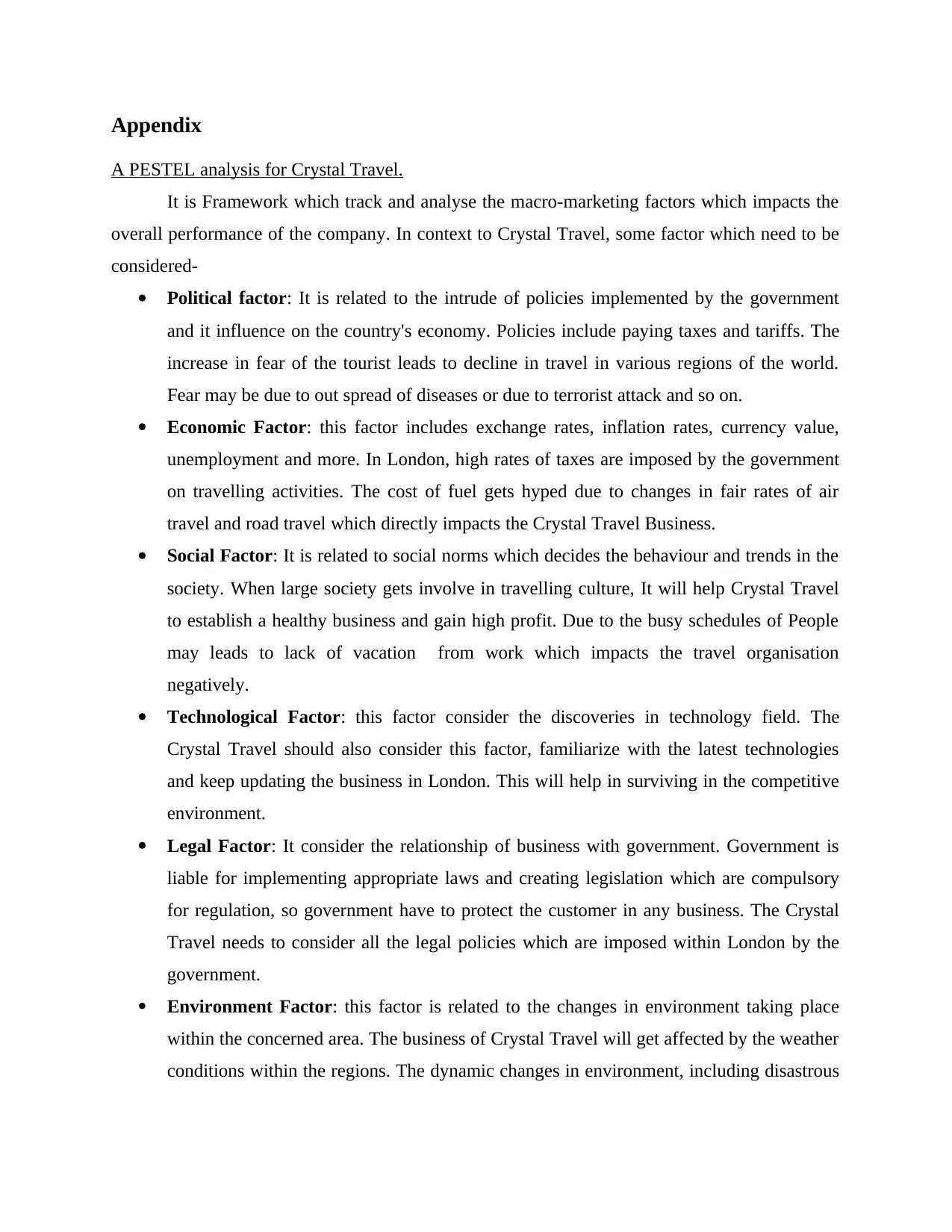
Appendix
A PESTEL analysis for Crystal Travel.
It is Framework which track and analyse the macro-marketing factors which impacts the
overall performance of the company. In context to Crystal Travel, some factor which need to be
considered-
Political factor: It is related to the intrude of policies implemented by the government
and it influence on the country's economy. Policies include paying taxes and tariffs. The
increase in fear of the tourist leads to decline in travel in various regions of the world.
Fear may be due to out spread of diseases or due to terrorist attack and so on.
Economic Factor: this factor includes exchange rates, inflation rates, currency value,
unemployment and more. In London, high rates of taxes are imposed by the government
on travelling activities. The cost of fuel gets hyped due to changes in fair rates of air
travel and road travel which directly impacts the Crystal Travel Business.
Social Factor: It is related to social norms which decides the behaviour and trends in the
society. When large society gets involve in travelling culture, It will help Crystal Travel
to establish a healthy business and gain high profit. Due to the busy schedules of People
may leads to lack of vacation from work which impacts the travel organisation
negatively.
Technological Factor: this factor consider the discoveries in technology field. The
Crystal Travel should also consider this factor, familiarize with the latest technologies
and keep updating the business in London. This will help in surviving in the competitive
environment.
Legal Factor: It consider the relationship of business with government. Government is
liable for implementing appropriate laws and creating legislation which are compulsory
for regulation, so government have to protect the customer in any business. The Crystal
Travel needs to consider all the legal policies which are imposed within London by the
government.
Environment Factor: this factor is related to the changes in environment taking place
within the concerned area. The business of Crystal Travel will get affected by the weather
conditions within the regions. The dynamic changes in environment, including disastrous
A PESTEL analysis for Crystal Travel.
It is Framework which track and analyse the macro-marketing factors which impacts the
overall performance of the company. In context to Crystal Travel, some factor which need to be
considered-
Political factor: It is related to the intrude of policies implemented by the government
and it influence on the country's economy. Policies include paying taxes and tariffs. The
increase in fear of the tourist leads to decline in travel in various regions of the world.
Fear may be due to out spread of diseases or due to terrorist attack and so on.
Economic Factor: this factor includes exchange rates, inflation rates, currency value,
unemployment and more. In London, high rates of taxes are imposed by the government
on travelling activities. The cost of fuel gets hyped due to changes in fair rates of air
travel and road travel which directly impacts the Crystal Travel Business.
Social Factor: It is related to social norms which decides the behaviour and trends in the
society. When large society gets involve in travelling culture, It will help Crystal Travel
to establish a healthy business and gain high profit. Due to the busy schedules of People
may leads to lack of vacation from work which impacts the travel organisation
negatively.
Technological Factor: this factor consider the discoveries in technology field. The
Crystal Travel should also consider this factor, familiarize with the latest technologies
and keep updating the business in London. This will help in surviving in the competitive
environment.
Legal Factor: It consider the relationship of business with government. Government is
liable for implementing appropriate laws and creating legislation which are compulsory
for regulation, so government have to protect the customer in any business. The Crystal
Travel needs to consider all the legal policies which are imposed within London by the
government.
Environment Factor: this factor is related to the changes in environment taking place
within the concerned area. The business of Crystal Travel will get affected by the weather
conditions within the regions. The dynamic changes in environment, including disastrous
⊘ This is a preview!⊘
Do you want full access?
Subscribe today to unlock all pages.
Trusted by 1+ million students worldwide

condition, at a place where large number of tourist prefer to visit affects the Travel
business functioning in that particular area leading to heavy loss.
business functioning in that particular area leading to heavy loss.

1 out of 10


Related Documents


Your All-in-One AI-Powered Toolkit for Academic Success.
+13062052269
info@desklib.com
Available 24*7 on WhatsApp / Email
![[object Object]](/_next/static/media/star-bottom.7253800d.svg)
Unlock your academic potential
Copyright © 2020–2026 A2Z Services. All Rights Reserved. Developed and managed by ZUCOL.