University of Central Lancashire: Peplau's Theory in Nursing Practice
VerifiedAdded on 2022/10/10
|16
|4200
|194
Essay
AI Summary
This essay delves into Hildegard Peplau's theory of interpersonal relations in nursing, emphasizing its significance in clinical practice and patient outcomes. It defines nursing as a therapeutic process involving a nurse-patient relationship progressing through orientation, working, and termination phases. The essay examines nurses' contributions to patient experiences, highlighting the importance of effective communication, trust, and education. It discusses the implementation of Peplau's theory in healthcare practices, focusing on evidence-based approaches to enhance patient care and the role of nurses in promoting patient well-being. The research methodology includes literature reviews from various databases, aiming to understand the impact of nursing theory on contemporary practice and patient outcomes, with a focus on the nurse's role in improving patient experiences and healthcare delivery.
Running Head: PEPLAU’S THEORY
NURSING THEORY AND PRACTICE
Name
Professor
Institution
Course
Date
NURSING THEORY AND PRACTICE
Name
Professor
Institution
Course
Date

Paraphrase This Document
Need a fresh take? Get an instant paraphrase of this document with our AI Paraphraser
PEPLAU’S THEORY 2
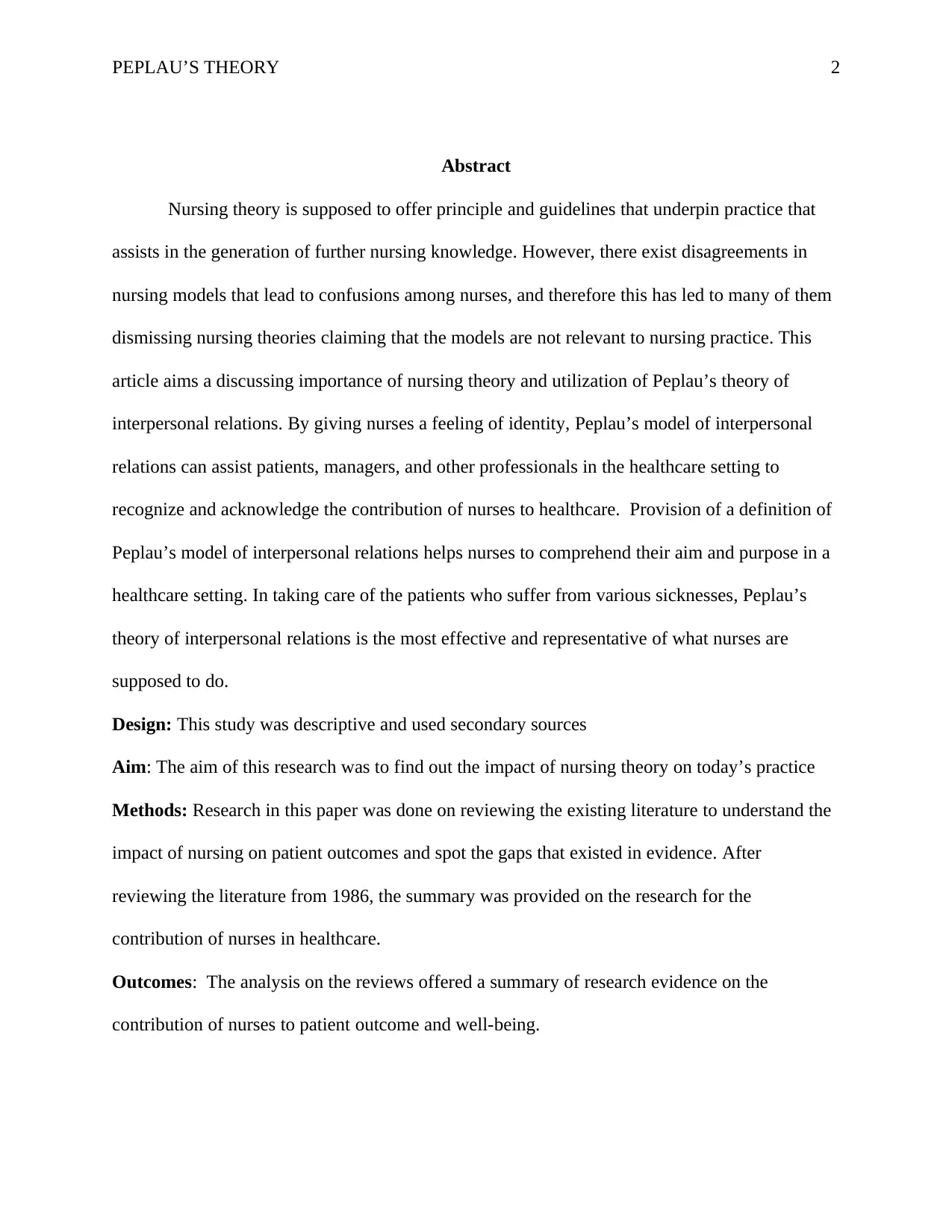
Abstract
Nursing theory is supposed to offer principle and guidelines that underpin practice that
assists in the generation of further nursing knowledge. However, there exist disagreements in
nursing models that lead to confusions among nurses, and therefore this has led to many of them
dismissing nursing theories claiming that the models are not relevant to nursing practice. This
article aims a discussing importance of nursing theory and utilization of Peplau’s theory of
interpersonal relations. By giving nurses a feeling of identity, Peplau’s model of interpersonal
relations can assist patients, managers, and other professionals in the healthcare setting to
recognize and acknowledge the contribution of nurses to healthcare. Provision of a definition of
Peplau’s model of interpersonal relations helps nurses to comprehend their aim and purpose in a
healthcare setting. In taking care of the patients who suffer from various sicknesses, Peplau’s
theory of interpersonal relations is the most effective and representative of what nurses are
supposed to do.
Design: This study was descriptive and used secondary sources
Aim: The aim of this research was to find out the impact of nursing theory on today’s practice
Methods: Research in this paper was done on reviewing the existing literature to understand the
impact of nursing on patient outcomes and spot the gaps that existed in evidence. After
reviewing the literature from 1986, the summary was provided on the research for the
contribution of nurses in healthcare.
Outcomes: The analysis on the reviews offered a summary of research evidence on the
contribution of nurses to patient outcome and well-being.
Abstract
Nursing theory is supposed to offer principle and guidelines that underpin practice that
assists in the generation of further nursing knowledge. However, there exist disagreements in
nursing models that lead to confusions among nurses, and therefore this has led to many of them
dismissing nursing theories claiming that the models are not relevant to nursing practice. This
article aims a discussing importance of nursing theory and utilization of Peplau’s theory of
interpersonal relations. By giving nurses a feeling of identity, Peplau’s model of interpersonal
relations can assist patients, managers, and other professionals in the healthcare setting to
recognize and acknowledge the contribution of nurses to healthcare. Provision of a definition of
Peplau’s model of interpersonal relations helps nurses to comprehend their aim and purpose in a
healthcare setting. In taking care of the patients who suffer from various sicknesses, Peplau’s
theory of interpersonal relations is the most effective and representative of what nurses are
supposed to do.
Design: This study was descriptive and used secondary sources
Aim: The aim of this research was to find out the impact of nursing theory on today’s practice
Methods: Research in this paper was done on reviewing the existing literature to understand the
impact of nursing on patient outcomes and spot the gaps that existed in evidence. After
reviewing the literature from 1986, the summary was provided on the research for the
contribution of nurses in healthcare.
Outcomes: The analysis on the reviews offered a summary of research evidence on the
contribution of nurses to patient outcome and well-being.
PEPLAU’S THEORY 3
Keywords: Nursing, Peplau, Patient Care, Interpersonal Relations, Clinical Practice,
matriculation, Termination, Therapeutic knowledge,working phase.
Introduction
There exist constant arguments that surround nursing practice and what comprises
nursing setting, but there is no definite conclusion that has been reached. Lack of a particular
definition serves as confusion to nurses and has made lots of nurses to discharge nursing
philosophy as an extraneous practice (Armstrong, 2007). Nursing philosophy is supposed to offer
philosophies that underpin practice. A theory is described as founded statements that can be
tested. Nursing theory is based around and advanced alongside therapeutic knowledge. Scholars
in the recent past agreed that the discipline needs to be validated via the creation of its verified
and approved acquaintance. Some nurses disagree that nursing existed before the beginning of
the conception of nursing principle. The nursing theory remains vital, although very few nurses
know about the healthcare theories of practice (Benner, 1984). If the theories were in existence at
the same time as the ancient scientific theories, it would, therefore, be hard to practice nursing
without the prior comprehension of the nursing theory. Due to the diverse culture of nursing
practice and its final results, it is not easy to test and authenticate the inputs that nurses make in
the healthcare career (Benner & Wrubel, 1989). Nursing models purpose to describe, foresee,
and expound on the field of nursing. The latter is meant to provide detailed knowledge and also
propose the direction that the nursing profession should follow in the future.
Practice research and theories are the backbones of the nursing profession. Clinical
practice creates research questions and knowledge for models. Research acts as a guide that
builds our knowledge and via the development of theory. On the other hand, the theory is used to
guide research and improve practice (Broadbent & Moxham, 2014). Practical nursing requires a
Keywords: Nursing, Peplau, Patient Care, Interpersonal Relations, Clinical Practice,
matriculation, Termination, Therapeutic knowledge,working phase.
Introduction
There exist constant arguments that surround nursing practice and what comprises
nursing setting, but there is no definite conclusion that has been reached. Lack of a particular
definition serves as confusion to nurses and has made lots of nurses to discharge nursing
philosophy as an extraneous practice (Armstrong, 2007). Nursing philosophy is supposed to offer
philosophies that underpin practice. A theory is described as founded statements that can be
tested. Nursing theory is based around and advanced alongside therapeutic knowledge. Scholars
in the recent past agreed that the discipline needs to be validated via the creation of its verified
and approved acquaintance. Some nurses disagree that nursing existed before the beginning of
the conception of nursing principle. The nursing theory remains vital, although very few nurses
know about the healthcare theories of practice (Benner, 1984). If the theories were in existence at
the same time as the ancient scientific theories, it would, therefore, be hard to practice nursing
without the prior comprehension of the nursing theory. Due to the diverse culture of nursing
practice and its final results, it is not easy to test and authenticate the inputs that nurses make in
the healthcare career (Benner & Wrubel, 1989). Nursing models purpose to describe, foresee,
and expound on the field of nursing. The latter is meant to provide detailed knowledge and also
propose the direction that the nursing profession should follow in the future.
Practice research and theories are the backbones of the nursing profession. Clinical
practice creates research questions and knowledge for models. Research acts as a guide that
builds our knowledge and via the development of theory. On the other hand, the theory is used to
guide research and improve practice (Broadbent & Moxham, 2014). Practical nursing requires a
⊘ This is a preview!⊘
Do you want full access?
Subscribe today to unlock all pages.

Trusted by 1+ million students worldwide
PEPLAU’S THEORY 4
detailed application of knowledge and skills, application of care for the patients in the most
effective and considerate manner. All patient care choices are ideally grounded on research
evidence. The research outcomes are used in the development of the daily protocol, which is
followed in the routine running of the nursing practices (Chalmer , 1999).
Aim
The aim of this research is to find out the impact of nursing theory on today’s practice.
The research also gives an overview of the existing evidence on the effects on nursing practice
on the patient outcomes. The particular question answered is ‘what is the contribution of nurses
in the improvement of the wellbeing of patients.
Design: This study was a descriptive one using secondary sources
Methods
This research used literature from 1986 by use of Google Scholar, Cochrane Library and
NICE evidence database by using keywords like; Nursing, Peplau, Patient Care, Interpersonal
Relations, Clinical Practice, matriculation, Termination, Therapeutic knowledge, working phase.
.
Peplau’s Theory
According to Peplau, nursing is defined as an interpersonal therapeutic progression that
occurs when nurses involve themselves in healing relations with patients (McKenna & Slevin,
2008). Peplau hypothesized that the relationship between nurses and patients should pass through
three phases for it to be successful. The phases included; matriculation, working, and termination
(Philips, 2007).
detailed application of knowledge and skills, application of care for the patients in the most
effective and considerate manner. All patient care choices are ideally grounded on research
evidence. The research outcomes are used in the development of the daily protocol, which is
followed in the routine running of the nursing practices (Chalmer , 1999).
Aim
The aim of this research is to find out the impact of nursing theory on today’s practice.
The research also gives an overview of the existing evidence on the effects on nursing practice
on the patient outcomes. The particular question answered is ‘what is the contribution of nurses
in the improvement of the wellbeing of patients.
Design: This study was a descriptive one using secondary sources
Methods
This research used literature from 1986 by use of Google Scholar, Cochrane Library and
NICE evidence database by using keywords like; Nursing, Peplau, Patient Care, Interpersonal
Relations, Clinical Practice, matriculation, Termination, Therapeutic knowledge, working phase.
.
Peplau’s Theory
According to Peplau, nursing is defined as an interpersonal therapeutic progression that
occurs when nurses involve themselves in healing relations with patients (McKenna & Slevin,
2008). Peplau hypothesized that the relationship between nurses and patients should pass through
three phases for it to be successful. The phases included; matriculation, working, and termination
(Philips, 2007).
Paraphrase This Document
Need a fresh take? Get an instant paraphrase of this document with our AI Paraphraser
PEPLAU’S THEORY 5
At the first case of the phase of orientation, the patients who are hospitalized realize the
need to assist and adjust to their ongoing experiences. At the same time, the caretakers meet
patients and gather vital information concerning them as patients with special needs and who
require special attention (Roy & Jones, 2006). Nurses assume many roles when interacting with
patients. For instance, during enrollment, a nurse is expected to say hi to the patients with all
respect and positive interest being accorded to the strangers. Patients and nurses pass through the
greeting phase quickly, but nurses are supposed to show continued courtesy and respect in all
three phases. If the characteristics of orientation phase are displayed in all the three phases, then
the orientation phase proves to be a latent factor (Street, 1990).
The next stage is the working phase. The working phase accounts for most of the
caretaker’s time with the patients. In this stage, there are assessments made by nurses concerning
patients. The nurses use these assessments at the time of teaching and when making
contributions to the interdisciplinary plan care (Sullivan, 2014). It is during this phase when
patients familiarize themselves with the roles played by nurses. The patients start accepting the
caregivers as their wellbeing trainers, resource individuals, and counselors. Nurses utilize in-
directive listening to facilitate an increased awareness for the patients concerning their feelings
on their well-being (Watson, 2005). By making use of the therapeutic form of communication,
the nurse provides reflective and nonjudgmental responses to patients so that they can assist them
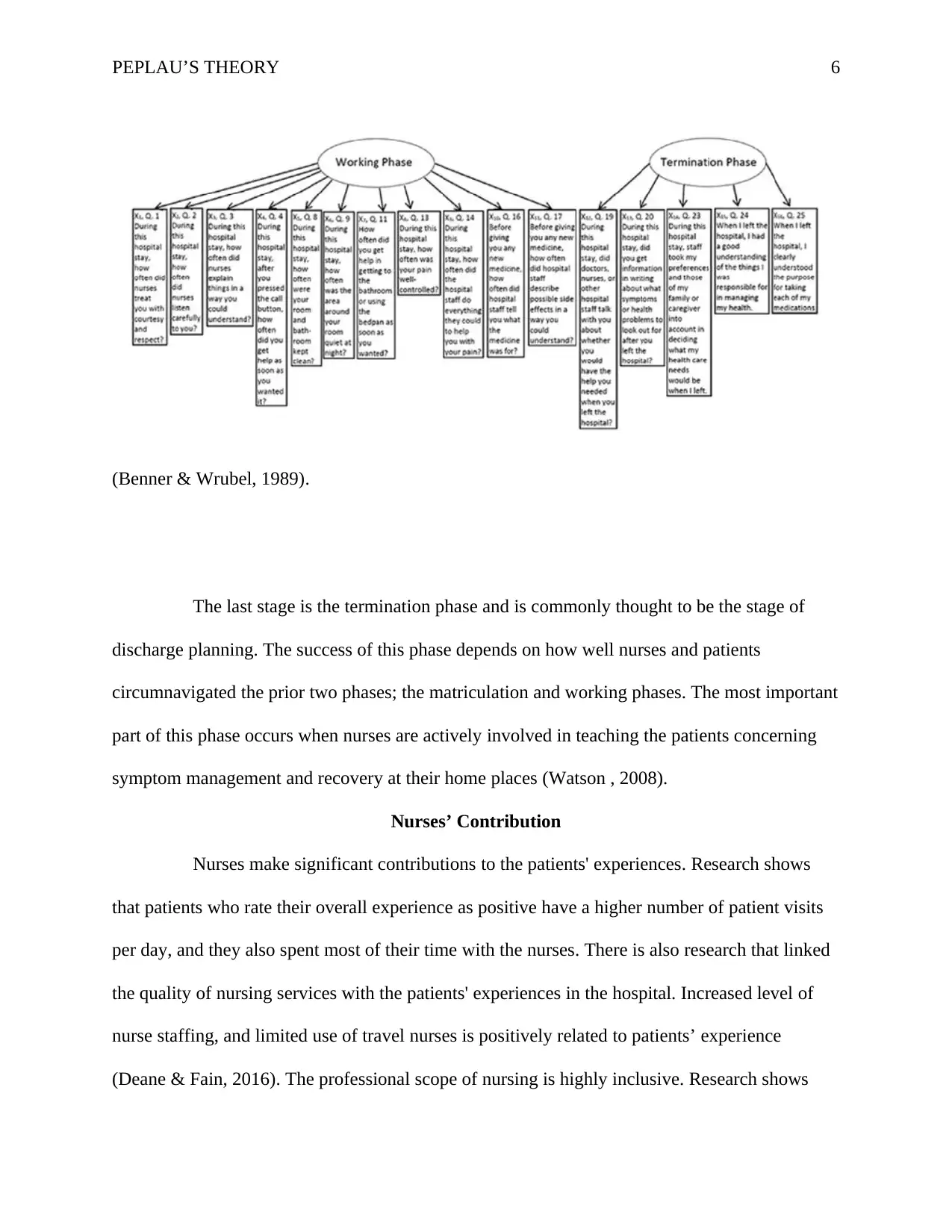
in the clarification of their thoughts and feelings. The table below is used to show the three
phases as depicted by Peplau.
At the first case of the phase of orientation, the patients who are hospitalized realize the
need to assist and adjust to their ongoing experiences. At the same time, the caretakers meet
patients and gather vital information concerning them as patients with special needs and who
require special attention (Roy & Jones, 2006). Nurses assume many roles when interacting with
patients. For instance, during enrollment, a nurse is expected to say hi to the patients with all
respect and positive interest being accorded to the strangers. Patients and nurses pass through the
greeting phase quickly, but nurses are supposed to show continued courtesy and respect in all
three phases. If the characteristics of orientation phase are displayed in all the three phases, then
the orientation phase proves to be a latent factor (Street, 1990).
The next stage is the working phase. The working phase accounts for most of the
caretaker’s time with the patients. In this stage, there are assessments made by nurses concerning
patients. The nurses use these assessments at the time of teaching and when making
contributions to the interdisciplinary plan care (Sullivan, 2014). It is during this phase when
patients familiarize themselves with the roles played by nurses. The patients start accepting the
caregivers as their wellbeing trainers, resource individuals, and counselors. Nurses utilize in-
directive listening to facilitate an increased awareness for the patients concerning their feelings
on their well-being (Watson, 2005). By making use of the therapeutic form of communication,
the nurse provides reflective and nonjudgmental responses to patients so that they can assist them
in the clarification of their thoughts and feelings. The table below is used to show the three
phases as depicted by Peplau.
PEPLAU’S THEORY 6
(Benner & Wrubel, 1989).
The last stage is the termination phase and is commonly thought to be the stage of
discharge planning. The success of this phase depends on how well nurses and patients
circumnavigated the prior two phases; the matriculation and working phases. The most important
part of this phase occurs when nurses are actively involved in teaching the patients concerning
symptom management and recovery at their home places (Watson , 2008).
Nurses’ Contribution
Nurses make significant contributions to the patients' experiences. Research shows
that patients who rate their overall experience as positive have a higher number of patient visits
per day, and they also spent most of their time with the nurses. There is also research that linked
the quality of nursing services with the patients' experiences in the hospital. Increased level of
nurse staffing, and limited use of travel nurses is positively related to patients’ experience
(Deane & Fain, 2016). The professional scope of nursing is highly inclusive. Research shows
(Benner & Wrubel, 1989).
The last stage is the termination phase and is commonly thought to be the stage of
discharge planning. The success of this phase depends on how well nurses and patients
circumnavigated the prior two phases; the matriculation and working phases. The most important
part of this phase occurs when nurses are actively involved in teaching the patients concerning
symptom management and recovery at their home places (Watson , 2008).
Nurses’ Contribution
Nurses make significant contributions to the patients' experiences. Research shows
that patients who rate their overall experience as positive have a higher number of patient visits
per day, and they also spent most of their time with the nurses. There is also research that linked
the quality of nursing services with the patients' experiences in the hospital. Increased level of
nurse staffing, and limited use of travel nurses is positively related to patients’ experience
(Deane & Fain, 2016). The professional scope of nursing is highly inclusive. Research shows
⊘ This is a preview!⊘
Do you want full access?
Subscribe today to unlock all pages.
Trusted by 1+ million students worldwide
PEPLAU’S THEORY 7
that nurses play a vital role in the transformation of the healthcare system and create a more
accessible high eminence and value-driven milieu for the patients. Nursing has the most
influential aspect for patients than any other thing in the hospital setting (Hagerty, Samuels,
Norcini-Pala, & Gigliotti, 2017).
Implementation Peplau’s theory in Healthcare Practices
Healthcare research has been used in the production of large amounts of outcomes and
revised methods of care for the patients which if applied in practice can save many lives and
improve the quality of live for patients (Chinn, Kramer, & Maeona , 2007). Upsurge in the
quantity of research can result to improved patient care. Research shows that there is a huge gap
amid the quality of healthcare that is received by patients and the recommended practice.
Evidence suggests that it takes more than ten years to implement research outcomes in a clinical
setting and it is not easy to withstand innovations over time. The latter is important for the
patients who do not receive improved healthcare and also for the healthcare organizations that do
not get the value gains on investment (Chinn, Kramer, & Maeona , 2007).
The implementation science is the basic field of research which is dedicated to the
techniques of implementing research evidence into practice. Several studies in this field explored
the methods that can be used to stimulate the integration of scientific discoveries through
policymaking and a planned implementation initiative including a consolidated framework for
the implementation of research (Delaney & Ferguson, 2014). The methods used in bridging the
gap between research and practice primarily focus on the exploration and transfer of evidence
based knowledge to caregivers in the healthcare settings (Hagerty, Samuels, Norcini-Pala, &
Gigliotti, 2017). Research shows that practice is mediated through interplay amid individuals, the
new knowledge and the actual context in which evidence is to be operationalized and used in the
that nurses play a vital role in the transformation of the healthcare system and create a more
accessible high eminence and value-driven milieu for the patients. Nursing has the most
influential aspect for patients than any other thing in the hospital setting (Hagerty, Samuels,
Norcini-Pala, & Gigliotti, 2017).
Implementation Peplau’s theory in Healthcare Practices
Healthcare research has been used in the production of large amounts of outcomes and
revised methods of care for the patients which if applied in practice can save many lives and
improve the quality of live for patients (Chinn, Kramer, & Maeona , 2007). Upsurge in the
quantity of research can result to improved patient care. Research shows that there is a huge gap
amid the quality of healthcare that is received by patients and the recommended practice.
Evidence suggests that it takes more than ten years to implement research outcomes in a clinical
setting and it is not easy to withstand innovations over time. The latter is important for the
patients who do not receive improved healthcare and also for the healthcare organizations that do
not get the value gains on investment (Chinn, Kramer, & Maeona , 2007).
The implementation science is the basic field of research which is dedicated to the
techniques of implementing research evidence into practice. Several studies in this field explored
the methods that can be used to stimulate the integration of scientific discoveries through
policymaking and a planned implementation initiative including a consolidated framework for
the implementation of research (Delaney & Ferguson, 2014). The methods used in bridging the
gap between research and practice primarily focus on the exploration and transfer of evidence
based knowledge to caregivers in the healthcare settings (Hagerty, Samuels, Norcini-Pala, &
Gigliotti, 2017). Research shows that practice is mediated through interplay amid individuals, the
new knowledge and the actual context in which evidence is to be operationalized and used in the
Paraphrase This Document
Need a fresh take? Get an instant paraphrase of this document with our AI Paraphraser
PEPLAU’S THEORY 8
healthcare and particularly in the nursing practice (Broadbent & Moxham, 2014). Professional
opinion and leadership has a significant impact on the implementation process. The latter means
that new research outcomes are not transferred on a one on one basis from academia to practice
but the outcomes are first evaluated before being implemented by the caregivers and the other
stakeholders in healthcare.
The nurses can utilize Peplau's theory in the identification of what the patients are
asking to be helped with. The latter means that they are supposed to listen to the patients'
concerns with keenness and explore their experiences and conducts. Nurses are supposed to be
aware of their conducts since this will help them in making decisions professionally, ethically,
and intelligently to avoid judgment. There is a need to build trust and respect for all patients and
provide equal services without discrimination based on color, ethnicity, or religion. Peplau's
theory is essential in nursing practice since it helps the nurses to educate the patients on the
issues that affect them (Delaney & Ferguson, 2014). It ensures that there is utilization of
evidence-based approaches to the education fed to the patients. The theory helps the nurses to be
person centered in their teaching approach and asks the patients how they can learn best. Peplaus
theory is vital since it equips the patients with a behavioral modification that involves the
application of evidence based teaching and behaviorist coaching techniques (Fernandes & Naidu,
2017).
In the termination phase, a nurse may need to make sure that the patient has the skills
and knowledge to manage them. For instance, a nurse may wish to observe the patients'
demonstration of their plans for self-management (Adams, 2017). It is vital in a nursing care to
have a contingency plan. The latter will assist the client in seeking assistance from the relevant
authorities or individuals in case they are stuck in their daily management. The theory is also
healthcare and particularly in the nursing practice (Broadbent & Moxham, 2014). Professional
opinion and leadership has a significant impact on the implementation process. The latter means
that new research outcomes are not transferred on a one on one basis from academia to practice
but the outcomes are first evaluated before being implemented by the caregivers and the other
stakeholders in healthcare.
The nurses can utilize Peplau's theory in the identification of what the patients are
asking to be helped with. The latter means that they are supposed to listen to the patients'
concerns with keenness and explore their experiences and conducts. Nurses are supposed to be
aware of their conducts since this will help them in making decisions professionally, ethically,
and intelligently to avoid judgment. There is a need to build trust and respect for all patients and
provide equal services without discrimination based on color, ethnicity, or religion. Peplau's
theory is essential in nursing practice since it helps the nurses to educate the patients on the
issues that affect them (Delaney & Ferguson, 2014). It ensures that there is utilization of
evidence-based approaches to the education fed to the patients. The theory helps the nurses to be
person centered in their teaching approach and asks the patients how they can learn best. Peplaus
theory is vital since it equips the patients with a behavioral modification that involves the
application of evidence based teaching and behaviorist coaching techniques (Fernandes & Naidu,
2017).
In the termination phase, a nurse may need to make sure that the patient has the skills
and knowledge to manage them. For instance, a nurse may wish to observe the patients'
demonstration of their plans for self-management (Adams, 2017). It is vital in a nursing care to
have a contingency plan. The latter will assist the client in seeking assistance from the relevant
authorities or individuals in case they are stuck in their daily management. The theory is also
PEPLAU’S THEORY 9
essential since it ensures that there is proper documentation throughout the entire process
(Hochberger & Lingham, 2017). Termination phase occurs when the goals of the client have
been achieved. The nurse and the client in this stage conclude and end their relationship. One of
the primary aspects of a client-patient relationship is that it occurs for a short time. In the case of
a long term relationship, the termination happens when the client has been discharged from the
healthcare vicinity or when the patient passes on.
However, on most occasions, the relationship is supposed to be terminated only when
the client has established improved self-reliance to deal with their challenges. The latter is
important since it would help the clients not to be dependent on the other people and hence not to
be a burden to the family members.
Results
The research revealed that in almost all disciplines, science comes up as an outcome of
the rapport amid the development of research and the product of the theories. In addition to the
nursing practice, the primary objective of the study was to create knowledge in a subject via the
generation of the model and or in the examination of the model (Chinn, Kramer, & Maeona ,
2007). The relationships that exist between research and philosophy are reciprocated when
exploration generates a more developed acquaintance and model. The hypothesis is more integral
to the process of carrying out research and is vital to utilize hypothesis as a framework in the
provision of viewpoint and study to the examination. The research also revealed that theory can
be utilized in guiding the exploration procedure through the generation (Edwards, 2014). The
principal aim of this model in the nursing career is to advance practice through influencing the
essential since it ensures that there is proper documentation throughout the entire process
(Hochberger & Lingham, 2017). Termination phase occurs when the goals of the client have
been achieved. The nurse and the client in this stage conclude and end their relationship. One of
the primary aspects of a client-patient relationship is that it occurs for a short time. In the case of
a long term relationship, the termination happens when the client has been discharged from the
healthcare vicinity or when the patient passes on.
However, on most occasions, the relationship is supposed to be terminated only when
the client has established improved self-reliance to deal with their challenges. The latter is
important since it would help the clients not to be dependent on the other people and hence not to
be a burden to the family members.
Results
The research revealed that in almost all disciplines, science comes up as an outcome of
the rapport amid the development of research and the product of the theories. In addition to the
nursing practice, the primary objective of the study was to create knowledge in a subject via the
generation of the model and or in the examination of the model (Chinn, Kramer, & Maeona ,
2007). The relationships that exist between research and philosophy are reciprocated when
exploration generates a more developed acquaintance and model. The hypothesis is more integral
to the process of carrying out research and is vital to utilize hypothesis as a framework in the
provision of viewpoint and study to the examination. The research also revealed that theory can
be utilized in guiding the exploration procedure through the generation (Edwards, 2014). The
principal aim of this model in the nursing career is to advance practice through influencing the
⊘ This is a preview!⊘
Do you want full access?
Subscribe today to unlock all pages.
Trusted by 1+ million students worldwide
PEPLAU’S THEORY 10
well-being and eminence of the patient’s life. The association amid philosophy and investigation
is mutual.
Practice form the foundations for the establishment of nursing philosophy while a nursing
theory is certified by practice. In spite of the development and the examination of the nursing
theory, the gap existing amid theory and practice on the interrelations between nursing theory
and practice has been a common perception among most nurses (Freshwater & Rolfe, 2004).
Practicing nurses hardly utilize the language of nursing philosophy unless when instructed to do
so by the accredited bodies. Research found out that numerous aspects can be used to explain the
reason for the existence of the gap amid theory and practice. The development of doctrine is the
primary domain of the nursing trainers instead of the concerns in the concerns of practicing
caregivers. Nursing model and practice are seen as two different and discrete events in nursing.
The nursing philosophies possess conceptions that need detailed explanation before they are put
into practice. In most cases, practices develop in the absence of philosophy, and the knowledge
of theory is not mandatory for competent nursing practice (Freshwater, Taylor , & Sherwood,
2008).
Scholars advocate for learners to relate theory, research, and practice. Nevertheless,
the triangle in the profession has not been recognized for a long time. There is a need for a
persistent cyclical connection between the hypothesis, practice, and science. The latter will assist
in closing the gap amid theory and practice and lead to the promotion of a philosophy guided
practice (Jolley & Brykczynska, 1993). Nursing leaders are supposed to work to maintain the
cyclical connection between philosophy, practice, and science. This can be managed through
continuous interaction amid researchers, leaners, and practicing nurses. There is also a need to
increase the exposure for the undergraduates, graduates to the theoretical principles (Leininger,
well-being and eminence of the patient’s life. The association amid philosophy and investigation
is mutual.
Practice form the foundations for the establishment of nursing philosophy while a nursing
theory is certified by practice. In spite of the development and the examination of the nursing
theory, the gap existing amid theory and practice on the interrelations between nursing theory
and practice has been a common perception among most nurses (Freshwater & Rolfe, 2004).
Practicing nurses hardly utilize the language of nursing philosophy unless when instructed to do
so by the accredited bodies. Research found out that numerous aspects can be used to explain the
reason for the existence of the gap amid theory and practice. The development of doctrine is the
primary domain of the nursing trainers instead of the concerns in the concerns of practicing
caregivers. Nursing model and practice are seen as two different and discrete events in nursing.
The nursing philosophies possess conceptions that need detailed explanation before they are put
into practice. In most cases, practices develop in the absence of philosophy, and the knowledge
of theory is not mandatory for competent nursing practice (Freshwater, Taylor , & Sherwood,
2008).
Scholars advocate for learners to relate theory, research, and practice. Nevertheless,
the triangle in the profession has not been recognized for a long time. There is a need for a
persistent cyclical connection between the hypothesis, practice, and science. The latter will assist
in closing the gap amid theory and practice and lead to the promotion of a philosophy guided
practice (Jolley & Brykczynska, 1993). Nursing leaders are supposed to work to maintain the
cyclical connection between philosophy, practice, and science. This can be managed through
continuous interaction amid researchers, leaners, and practicing nurses. There is also a need to
increase the exposure for the undergraduates, graduates to the theoretical principles (Leininger,
Paraphrase This Document
Need a fresh take? Get an instant paraphrase of this document with our AI Paraphraser
PEPLAU’S THEORY 11
2002). It is important to put more emphasis on the theoretical concepts and principles after the
completion of formal education. The public is supposed to provide the nursing researchers with
the opportunity to involve themselves in the clinical matters to minimize the differences amid the
world of nursing philosophies and the world of nursing practices. There is also the need to
address the ongoing issues in healthcare and nursing from the theoretical perspective. The
guiding hypothesis in the form of practice hypothesis forms the basis of the future of nursing
(MacLachlan, 2006).
Discussion
The patients who are hospitalized understand the need to help and change in
accordance with their continuous encounters. Simultaneously, the nurses meet patients and
accumulate imperative data concerning them as patients with exceptional needs and who require
uncommon consideration. Medical caretakers expect numerous jobs when interfacing with
patients. For example, during enlistment, a medical caretaker is relied upon to express hello there
to the patients with all regard and positive enthusiasm being agreed to the outsiders. Patients and
medical caretakers go through the orientation stage hastily, yet attendants should be preceded
with kindness and regard in each of the three stages. Given that the qualities of direction stage
are shown in all the three stages, at that point the direction stage appears to be an inactive factor.
Peplau’s theory has been implementation in various departments and in various occasions in the
healthcare setting.
Limitation
This research was limited in that it used sources that were outdated .The research also
did not use many sources to acquire vivid information since secondary sources are in biased. The
utilization of secondary sources alone would also be a form of limitation.
2002). It is important to put more emphasis on the theoretical concepts and principles after the
completion of formal education. The public is supposed to provide the nursing researchers with
the opportunity to involve themselves in the clinical matters to minimize the differences amid the
world of nursing philosophies and the world of nursing practices. There is also the need to
address the ongoing issues in healthcare and nursing from the theoretical perspective. The
guiding hypothesis in the form of practice hypothesis forms the basis of the future of nursing
(MacLachlan, 2006).
Discussion
The patients who are hospitalized understand the need to help and change in
accordance with their continuous encounters. Simultaneously, the nurses meet patients and
accumulate imperative data concerning them as patients with exceptional needs and who require
uncommon consideration. Medical caretakers expect numerous jobs when interfacing with
patients. For example, during enlistment, a medical caretaker is relied upon to express hello there
to the patients with all regard and positive enthusiasm being agreed to the outsiders. Patients and
medical caretakers go through the orientation stage hastily, yet attendants should be preceded
with kindness and regard in each of the three stages. Given that the qualities of direction stage
are shown in all the three stages, at that point the direction stage appears to be an inactive factor.
Peplau’s theory has been implementation in various departments and in various occasions in the
healthcare setting.
Limitation
This research was limited in that it used sources that were outdated .The research also
did not use many sources to acquire vivid information since secondary sources are in biased. The
utilization of secondary sources alone would also be a form of limitation.
PEPLAU’S THEORY 12
Conflict of interest
None
Contributions of the Author
Titus Mbithi: Preparing the draft, analyzing and preparing the manuscript
Conclusion
In the interpersonal relationship theory, Peplau put more emphasis on the relationship
between the client and nurse. Nurses are supposed to validate their inferences by checking with
their patients for exactness. The main objective of nurses is to assist clients and apply human
principles to the challenges that they face in their daily lives. Nurses and patients work together
and hence develop a relationship, and in the process, both become mature and gain knowledge in
the care progression. The Peplau theory uses different approaches which are aimed at developing
a good relationship and maintain proper care for the patients. As discussed above, a nurse is a
resource person who provides information that is needed by the patient so that the patient can
integrate the daily challenges and also act as a stepping stone for the patients to tackle problems
and make changes easier.
Acknowledgement
This research was immensely supported by Dr. Wiley Johnson. The Dr. gave me valuable
advice and corrected me accordingly when I made errors. I would like to pay much gratitude to
him for giving me the support. The research, views and findings in this research paper were
based on my personal research.
Conflict of interest
None
Contributions of the Author
Titus Mbithi: Preparing the draft, analyzing and preparing the manuscript
Conclusion
In the interpersonal relationship theory, Peplau put more emphasis on the relationship
between the client and nurse. Nurses are supposed to validate their inferences by checking with
their patients for exactness. The main objective of nurses is to assist clients and apply human
principles to the challenges that they face in their daily lives. Nurses and patients work together
and hence develop a relationship, and in the process, both become mature and gain knowledge in
the care progression. The Peplau theory uses different approaches which are aimed at developing
a good relationship and maintain proper care for the patients. As discussed above, a nurse is a
resource person who provides information that is needed by the patient so that the patient can
integrate the daily challenges and also act as a stepping stone for the patients to tackle problems
and make changes easier.
Acknowledgement
This research was immensely supported by Dr. Wiley Johnson. The Dr. gave me valuable
advice and corrected me accordingly when I made errors. I would like to pay much gratitude to
him for giving me the support. The research, views and findings in this research paper were
based on my personal research.
⊘ This is a preview!⊘
Do you want full access?
Subscribe today to unlock all pages.
Trusted by 1+ million students worldwide

1 out of 16


Related Documents


Your All-in-One AI-Powered Toolkit for Academic Success.
+13062052269
info@desklib.com
Available 24*7 on WhatsApp / Email
![[object Object]](/_next/static/media/star-bottom.7253800d.svg)
Unlock your academic potential
Copyright © 2020–2026 A2Z Services. All Rights Reserved. Developed and managed by ZUCOL.