A Study on Pepper Export Performance and Cost Optimization in India
VerifiedAdded on 2023/01/06
|26
|8251
|68
Project
AI Summary
This research project comprehensively analyzes the export performance of pepper and cost optimization strategies within the Indian context. The study delves into the background of the pepper trade in India, highlighting its significance as a major spice producer and exporter. It establishes the research aim to analyze export performance and cost optimization, supported by specific objectives and research questions addressing opportunities, challenges, market values, production factors, and the contribution of pepper exports to the Indian economy. The literature review synthesizes existing research on pepper exports, challenges, and market dynamics, drawing from various sources like books, journals, and online resources. The research employs a qualitative methodology with an interpretivist philosophy and exploratory design, utilizing secondary data collection methods. The results and discussion section focuses on analyzing profit margins in both export and domestic markets and identifying the reasons behind issues. The project concludes with recommendations aimed at improving pepper production and enhancing exports, contributing valuable insights for stakeholders in the spice industry. The project is a valuable resource for students seeking to understand the complexities of the pepper export market in India and the strategies for optimizing costs and performance.
Research project

Paraphrase This Document
Need a fresh take? Get an instant paraphrase of this document with our AI Paraphraser
EXECUTIVE SUMMARY
India is largest producer and exporter of the spices in world. This country produces
around 75 of 109 varieties that listed through International Organization for Standardization
(ISO) and also accounts for half of global trading in spices. Pepper is popular spices in India that
cultivated in different states. Aim of the present research is study on analysing the export
performance of pepper and cost optimization in India. In year 2018, pepper export from the India
plummeted through 35% as comparison to 2016 to 16840 tonnes. The objectives have been
developed on the basis of research title and aim. There has been literature review conducted for
attaining the research questions. The collection of information in literature review part, there has
been different sources consists books, articles, journals, internet sources and others. The opinions
and viewpoints of different authors has been considered. Research methodology is one of the
most important part in an investigation that provides the details about sources to collect data and
analyse them effectively by using the effective sources. There has been qualitative research
method, interpretivisim research philosophy, exploratory research design and the secondary
method of data collection used. For analysis of data collected related to analysing the export
performance of pepper and cost optimization in India by using the graphs, tables and data.
Analysis and findings provide the proper examination of information collected. At last, there has
been recommendations provided which help in improving the production of pepper and also
enhance the export.
India is largest producer and exporter of the spices in world. This country produces
around 75 of 109 varieties that listed through International Organization for Standardization
(ISO) and also accounts for half of global trading in spices. Pepper is popular spices in India that
cultivated in different states. Aim of the present research is study on analysing the export
performance of pepper and cost optimization in India. In year 2018, pepper export from the India
plummeted through 35% as comparison to 2016 to 16840 tonnes. The objectives have been
developed on the basis of research title and aim. There has been literature review conducted for
attaining the research questions. The collection of information in literature review part, there has
been different sources consists books, articles, journals, internet sources and others. The opinions
and viewpoints of different authors has been considered. Research methodology is one of the
most important part in an investigation that provides the details about sources to collect data and
analyse them effectively by using the effective sources. There has been qualitative research
method, interpretivisim research philosophy, exploratory research design and the secondary
method of data collection used. For analysis of data collected related to analysing the export
performance of pepper and cost optimization in India by using the graphs, tables and data.
Analysis and findings provide the proper examination of information collected. At last, there has
been recommendations provided which help in improving the production of pepper and also
enhance the export.
Table of Contents
EXECUTIVE SUMMARY.............................................................................................................2
INTRODUCTION...........................................................................................................................5
Background of Study...................................................................................................................5
Rationale of Study.......................................................................................................................5
Research Aim..............................................................................................................................6
Research Objectives....................................................................................................................6
Research questions......................................................................................................................6
LITERATURE REVIEW................................................................................................................7
Opportunities and challenges involved in pepper export from India..........................................7
Market value of pepper in domestic and international market....................................................8
Factors influencing the pepper production in other countries and states of India......................9
Different practices followed to increase the production of pepper in different parts of the
world.........................................................................................................................................11
Pepper export contribute to the Indian economy......................................................................13
RESEARCH METHODOLOGY...................................................................................................14
Types of investigation...............................................................................................................14
Research philosophy.................................................................................................................14
Research design.........................................................................................................................15
Research approach....................................................................................................................15
Data collection method.............................................................................................................15
Research strategy......................................................................................................................16
Ethics.........................................................................................................................................16
RESULTS AND DISCUSSION....................................................................................................17
Analysing the profit from both export and domestic market....................................................17
Identifying the reasons for the issues........................................................................................21
CONCLUSION..............................................................................................................................23
RECOMMENDATIONS...............................................................................................................23
REFERENCES..............................................................................................................................25
EXECUTIVE SUMMARY.............................................................................................................2
INTRODUCTION...........................................................................................................................5
Background of Study...................................................................................................................5
Rationale of Study.......................................................................................................................5
Research Aim..............................................................................................................................6
Research Objectives....................................................................................................................6
Research questions......................................................................................................................6
LITERATURE REVIEW................................................................................................................7
Opportunities and challenges involved in pepper export from India..........................................7
Market value of pepper in domestic and international market....................................................8
Factors influencing the pepper production in other countries and states of India......................9
Different practices followed to increase the production of pepper in different parts of the
world.........................................................................................................................................11
Pepper export contribute to the Indian economy......................................................................13
RESEARCH METHODOLOGY...................................................................................................14
Types of investigation...............................................................................................................14
Research philosophy.................................................................................................................14
Research design.........................................................................................................................15
Research approach....................................................................................................................15
Data collection method.............................................................................................................15
Research strategy......................................................................................................................16
Ethics.........................................................................................................................................16
RESULTS AND DISCUSSION....................................................................................................17
Analysing the profit from both export and domestic market....................................................17
Identifying the reasons for the issues........................................................................................21
CONCLUSION..............................................................................................................................23
RECOMMENDATIONS...............................................................................................................23
REFERENCES..............................................................................................................................25
⊘ This is a preview!⊘
Do you want full access?
Subscribe today to unlock all pages.

Trusted by 1+ million students worldwide
Topic: A study on analysing the export performance of pepper and cost optimization in
India.
INTRODUCTION
Background of Study
India has been world's most necessary spice land and this produced more than the 60
int6rincis spices consisting pepper, ginger, chilly, cardamom and many seed species. Pepper is
dehydrated grown berry of the Piper niygrum, perpectual shrub and mountaineering that found in
the places like Southern India. In process of pepper vines growth are to be stalked over the
support as to columns that developed up to the 5 to 6 mtrs tall and also 1 to 2 mtr diameter.
Mountaineering woody mainly stems have inflated the nods with the clinging roots at each node
that assist in strengthening vine to maintain the standards. This has upwards producing the main
stem and also have the shoots from axils of leaves that having less internodes without
adventitious roots. Pepper is strong spice and refreshment-that has more treasured for the
centuries. The demand of European for pepper played more in searching sea routes to spice that
is being cultivated in East during 15 century. When the pepper was to be brought to Roman ports
this was bought from the ounce for the ounce with the expensive metals. The black peeper is the
nature to Kerala in the South India and cultivated in the tropical regions. Vietnam is largest
producer as well as exporter of pepper in world during 34% of world crop (Chaurasia, Garg and
Agarwal, 2016). Production of pepper has enhanced and also cost reduced slightly, scarcity sense
continues in pepper sector. The European firm are looking for the suppliers which can provide
the sustainable supplies of the better quality of pepper that comply with the needs of food safety.
From perspective of data on export of Black Pepper, India is the top 5 trade partners which
import the Black pepper from exports of India although total value of export of 5 countries is
13.73 USD million that is 69.55% of total export value of Black Pepper.
Rationale of Study
The present study is related to examine the export performance of pepper and cost
optimization in India. The pepper plants are indigenous to Malabar Coast of India. This country
has plays dominant role in the global trade of pepper. Pepper is one of the most valuable item in
International spices trade and activities of behalf are organised in better way. Export
performance through India as main producing countries is enhancing due to high pepper
India.
INTRODUCTION
Background of Study
India has been world's most necessary spice land and this produced more than the 60
int6rincis spices consisting pepper, ginger, chilly, cardamom and many seed species. Pepper is
dehydrated grown berry of the Piper niygrum, perpectual shrub and mountaineering that found in
the places like Southern India. In process of pepper vines growth are to be stalked over the
support as to columns that developed up to the 5 to 6 mtrs tall and also 1 to 2 mtr diameter.
Mountaineering woody mainly stems have inflated the nods with the clinging roots at each node
that assist in strengthening vine to maintain the standards. This has upwards producing the main
stem and also have the shoots from axils of leaves that having less internodes without
adventitious roots. Pepper is strong spice and refreshment-that has more treasured for the
centuries. The demand of European for pepper played more in searching sea routes to spice that
is being cultivated in East during 15 century. When the pepper was to be brought to Roman ports
this was bought from the ounce for the ounce with the expensive metals. The black peeper is the
nature to Kerala in the South India and cultivated in the tropical regions. Vietnam is largest
producer as well as exporter of pepper in world during 34% of world crop (Chaurasia, Garg and
Agarwal, 2016). Production of pepper has enhanced and also cost reduced slightly, scarcity sense
continues in pepper sector. The European firm are looking for the suppliers which can provide
the sustainable supplies of the better quality of pepper that comply with the needs of food safety.
From perspective of data on export of Black Pepper, India is the top 5 trade partners which
import the Black pepper from exports of India although total value of export of 5 countries is
13.73 USD million that is 69.55% of total export value of Black Pepper.
Rationale of Study
The present study is related to examine the export performance of pepper and cost
optimization in India. The pepper plants are indigenous to Malabar Coast of India. This country
has plays dominant role in the global trade of pepper. Pepper is one of the most valuable item in
International spices trade and activities of behalf are organised in better way. Export
performance through India as main producing countries is enhancing due to high pepper
Paraphrase This Document
Need a fresh take? Get an instant paraphrase of this document with our AI Paraphraser
consumption in food and the other goods such as cosmetics, pharmaceuticals etc. It has lead to
countries to be concentrate on export of products through increasing area, yield and output under
crop that emerging as rivals to India. This study examined about export of the pepper in world is
maiden attempt. There are some words which separately in the performance of exports and the
cost optimization in India (Dissanayake and et. al., 2016). There is the personal and professional
context to conduct this present study. The personal context is that skill and understanding about
the specific subject area to an investigator can be enhanced and it can able to enhance the
knowledge area. Other than this, in professional context, core competences and abilities of a
researcher will be enhanced in order to performing the research activities in future in better
manner and getting the positive outcomes effectively.
Research Aim
The aim of this research is “To analyse the export performance of pepper and cost
optimization.” A study on India.
Research Objectives
To examine opportunities and challenges involved in pepper export from India.
To determine the market value of pepper in domestic and international market.
To identify the factors influencing the pepper production in other countries and states of
India.
To determine the various practices followed to increase the production of pepper in
different parts of the world.
To examine the contribution of pepper export to Indian economy.
Research questions
What are all the opportunities and challenges involved in pepper export from India?
What is the market value of pepper in domestic and international market?
What are all the factors influencing the pepper production in other countries and states of
India?
What are all the different practices followed to increase the production of pepper in
different parts of the world?
How does the pepper export contribute to the Indian economy?
countries to be concentrate on export of products through increasing area, yield and output under
crop that emerging as rivals to India. This study examined about export of the pepper in world is
maiden attempt. There are some words which separately in the performance of exports and the
cost optimization in India (Dissanayake and et. al., 2016). There is the personal and professional
context to conduct this present study. The personal context is that skill and understanding about
the specific subject area to an investigator can be enhanced and it can able to enhance the
knowledge area. Other than this, in professional context, core competences and abilities of a
researcher will be enhanced in order to performing the research activities in future in better
manner and getting the positive outcomes effectively.
Research Aim
The aim of this research is “To analyse the export performance of pepper and cost
optimization.” A study on India.
Research Objectives
To examine opportunities and challenges involved in pepper export from India.
To determine the market value of pepper in domestic and international market.
To identify the factors influencing the pepper production in other countries and states of
India.
To determine the various practices followed to increase the production of pepper in
different parts of the world.
To examine the contribution of pepper export to Indian economy.
Research questions
What are all the opportunities and challenges involved in pepper export from India?
What is the market value of pepper in domestic and international market?
What are all the factors influencing the pepper production in other countries and states of
India?
What are all the different practices followed to increase the production of pepper in
different parts of the world?
How does the pepper export contribute to the Indian economy?
LITERATURE REVIEW
Literature review refers to the comprehensive summary of the previous investigation on
topic. For collect information in literature review, there has been secondary sources used such as
books, articles, journals, internet sources and others. The main goal of literature review is to
synthesise information in literature into summary. It determine areas related to previous study in
order to prevent the duplication and provide credit to the other investigators. This determined the
gap in an investigation, conflict in past study and open the questions left from the other
investigation (Hashim and et. al., 2020). On the other hand, literature review is summary of
sources but this has organisational pattern and also combines synthesis and summary. This might
provide the new interpretation of the old material or combine the new with using old
interpretation.
Opportunities and challenges involved in pepper export from India
As per opinion of P K Krishnakumar, (2020) Pepper is called as King of spices and Black
gold that occupies supreme and unique position in World. Kerala is native place of the black
pepper and contributes to country. It is healthiest spices as comparison to the other seasoning. It
surging use of the black pepper in the bakery as well as the confectionery goods for an instance
chocolates, snacks and cakes that proliferating global demand of market of black pepper. Black
Pepper in India continues to lose the ground to cheaper variety of Vietnamese in world market
while enhancing the illegal imports by Nepal keeping domestic costs. Vietnam is selling
commodity at $2,800 tonne and this is less than half price of $6,000 per tonne commanded
through Indian variety. Import of the pepper reduced over years because of initiates which taken
to protect farmers interest from year 207-18 to 2018-19. main focus area for self -reliance should
be on enhancing the piperine or oleoresin content. India produces wide range of the spices and
this holds prominent position in the spice production. In context to exporting of Pepper from
India, some opportunities as well as challenges arisen. In context to opportunity, India is leading
exporter of the pepper. It is produced in the Southern India and exported 17600 per tons of the
pepper at Rs 114312.50 lakhs. Sweden, USA, Germany and UK are the main leading importers
of the Indian pepper. India exported biggest pepper supply to USA. 9700 tons of pepper was to
be exported to USA at Rs 58200 lakhs (Larrea-Gallegos and Vázquez-Rowe, 2020). In FY 2015-
16, India exported 28100 tons of the black pepper at Rs 173041.50 lakhs. To export the pepper
Literature review refers to the comprehensive summary of the previous investigation on
topic. For collect information in literature review, there has been secondary sources used such as
books, articles, journals, internet sources and others. The main goal of literature review is to
synthesise information in literature into summary. It determine areas related to previous study in
order to prevent the duplication and provide credit to the other investigators. This determined the
gap in an investigation, conflict in past study and open the questions left from the other
investigation (Hashim and et. al., 2020). On the other hand, literature review is summary of
sources but this has organisational pattern and also combines synthesis and summary. This might
provide the new interpretation of the old material or combine the new with using old
interpretation.
Opportunities and challenges involved in pepper export from India
As per opinion of P K Krishnakumar, (2020) Pepper is called as King of spices and Black
gold that occupies supreme and unique position in World. Kerala is native place of the black
pepper and contributes to country. It is healthiest spices as comparison to the other seasoning. It
surging use of the black pepper in the bakery as well as the confectionery goods for an instance
chocolates, snacks and cakes that proliferating global demand of market of black pepper. Black
Pepper in India continues to lose the ground to cheaper variety of Vietnamese in world market
while enhancing the illegal imports by Nepal keeping domestic costs. Vietnam is selling
commodity at $2,800 tonne and this is less than half price of $6,000 per tonne commanded
through Indian variety. Import of the pepper reduced over years because of initiates which taken
to protect farmers interest from year 207-18 to 2018-19. main focus area for self -reliance should
be on enhancing the piperine or oleoresin content. India produces wide range of the spices and
this holds prominent position in the spice production. In context to exporting of Pepper from
India, some opportunities as well as challenges arisen. In context to opportunity, India is leading
exporter of the pepper. It is produced in the Southern India and exported 17600 per tons of the
pepper at Rs 114312.50 lakhs. Sweden, USA, Germany and UK are the main leading importers
of the Indian pepper. India exported biggest pepper supply to USA. 9700 tons of pepper was to
be exported to USA at Rs 58200 lakhs (Larrea-Gallegos and Vázquez-Rowe, 2020). In FY 2015-
16, India exported 28100 tons of the black pepper at Rs 173041.50 lakhs. To export the pepper
⊘ This is a preview!⊘
Do you want full access?
Subscribe today to unlock all pages.
Trusted by 1+ million students worldwide
from India is beneficial in gaining the profit and also contribute towards economy of country
effectively.
As contrary to this V Sajeev Kumar (2020) main challenges faced through exports of
India pepper are low growth and enhancing the domestic consumption of commodity. In past
years, any of the Indian origin pepper has been exported hardly out of country. In regards to this,
government of Sri Lanka has taken the steps for preventing the routing third country origin
pepper to the India that following request of Indian government. It has been stated by Commerce
Ministry that Sri Lanka has suspended the spices import consisting arecanut and pepper to Sri
Lanka by Commercial Hub operations and Entry port trade in order to prevent spices reshipped
to the India as products of Sri Lanka. Spices Board related to India Ministry of Commerce and
Industry could be examine less piperine content in the pepper that imported from the Vietnam
and negatively impact Vietnamese pepper reputation and causing the challenges for pepper
export of Vietnam. On the other hand, there was reduction in production and productivity oh the
pepper in Kerala. Incident of the disease and pest was mainly found to be main reason for reduce
in pepper production. Export quantity as well as value of the pepper exemplified the more
instability where the manufacturing and growth were low.
Market value of pepper in domestic and international market
As per opinion of V P Sreelan (2020) market price if the black pepper has been touched
Rs. 350 kilogram in India and it imported from the Sri Lanka costs Rs. 550 kilogram. There is a
more difference in the cost, 1445 tonnes of the pepper was imported within the 6 months from
Sri Lanka. In regards to this, merchants are mainly questioning import of the pepper for high
cost. Total of the 738 tonnes of the pepper was mainly imported from the Sri Lanka in July.
Centre is mainly decide to be regulate the import to assist the farmers get better cost. Minimum
cost to import the pepper was mainly fixed Rs. 500 kilogram. On the basis of South Asian Free
Trade Area (SAFTA), 8% tax should be paid to cost and this enhanced cost to Rs. 550. Within
the 7 months, 12991 tons of the pepper was mainly imported from the many foreign countries.
Many of them imported to be extract essence from the residue and pepper send back (Razmjooy,
Sheykhahmad and Ghadimi, 2018). Remnants of pepper after extracting is mainly brought to
markets. Merchants are pointed out. 10% of pepper includes essence as well as remaining 99% is
wastage. On the basis of rules, wastage of the pepper should be destruct and the cost of pepper
reduced from this. In Kerala, farmers are in the crisis as cost do not enhance when the pepper has
effectively.
As contrary to this V Sajeev Kumar (2020) main challenges faced through exports of
India pepper are low growth and enhancing the domestic consumption of commodity. In past
years, any of the Indian origin pepper has been exported hardly out of country. In regards to this,
government of Sri Lanka has taken the steps for preventing the routing third country origin
pepper to the India that following request of Indian government. It has been stated by Commerce
Ministry that Sri Lanka has suspended the spices import consisting arecanut and pepper to Sri
Lanka by Commercial Hub operations and Entry port trade in order to prevent spices reshipped
to the India as products of Sri Lanka. Spices Board related to India Ministry of Commerce and
Industry could be examine less piperine content in the pepper that imported from the Vietnam
and negatively impact Vietnamese pepper reputation and causing the challenges for pepper
export of Vietnam. On the other hand, there was reduction in production and productivity oh the
pepper in Kerala. Incident of the disease and pest was mainly found to be main reason for reduce
in pepper production. Export quantity as well as value of the pepper exemplified the more
instability where the manufacturing and growth were low.
Market value of pepper in domestic and international market
As per opinion of V P Sreelan (2020) market price if the black pepper has been touched
Rs. 350 kilogram in India and it imported from the Sri Lanka costs Rs. 550 kilogram. There is a
more difference in the cost, 1445 tonnes of the pepper was imported within the 6 months from
Sri Lanka. In regards to this, merchants are mainly questioning import of the pepper for high
cost. Total of the 738 tonnes of the pepper was mainly imported from the Sri Lanka in July.
Centre is mainly decide to be regulate the import to assist the farmers get better cost. Minimum
cost to import the pepper was mainly fixed Rs. 500 kilogram. On the basis of South Asian Free
Trade Area (SAFTA), 8% tax should be paid to cost and this enhanced cost to Rs. 550. Within
the 7 months, 12991 tons of the pepper was mainly imported from the many foreign countries.
Many of them imported to be extract essence from the residue and pepper send back (Razmjooy,
Sheykhahmad and Ghadimi, 2018). Remnants of pepper after extracting is mainly brought to
markets. Merchants are pointed out. 10% of pepper includes essence as well as remaining 99% is
wastage. On the basis of rules, wastage of the pepper should be destruct and the cost of pepper
reduced from this. In Kerala, farmers are in the crisis as cost do not enhance when the pepper has
Paraphrase This Document
Need a fresh take? Get an instant paraphrase of this document with our AI Paraphraser
more demand in states of North India. On the other hand, pepper is available for minimum cost
in country, importing this from the foreign countries for high cost is inscrutable. Complaint has
filed with government that requesting for appoint central agencies in order to investigate the
transactions.
As contrary to this Rajesh Ravi (2020) Production of pepper has enhanced and the cost
have reduces lightly, scarcity sense continues in pepper sector. In year 2018, international global
market revenue is estimated at $4.1B, reduce of -1.7%. It reflects total revenue of the importers
and producers. The consumption of the pepper continues to be indicate strong expansion.
Prominent growth rate was mainly recorded in year 2011 when market value enhanced by 26%
against previous year. Consumption of global pepper peaked at $4.2B in year 2017 and reduced
slightly. Cost of pepper have enhanced many markets with demand robust despite constraints of
global pandemic. In year 2017, global price for the pepper is amounted to USD 4,100. Until year
2015, global market for the pepper was witnessed unprecedented the rising cost cycle. Cost
development is defined through in the supply as comparison to the demand. The supply is rapidly
in the emerging Brazil, Cambodia and Vietnam. In year 2017, the global production of the
pepper amounted to around 523 thousand tonnes up from the 434 thousand tonnes in past year.
Available supplies of the pepper comply with the limited needs of European food safety. It is
result of developing issues with use of the pesticides in pepper mainly in Vietnam. The pepper
does not comply with needs for more residue of the pesticides that many attract more premium.
Driven through enhancing pepper demand in all over the world, market is mainly expected to
continue the upward consumption that trend over next seven-year period. Performance of market
is to be forecast for decelerate and expansing with anticipated CAGR of +1.2% for period of
sever year from year 2018 to 2025 that is projected for bringing market volume to 840K tonnes
throughout end of 2025 (Paramesh and et. al., 2018).
Factors influencing the pepper production in other countries and states of India
Yudiyanto Yudiyanto, Akhmad Rizali, Abdul Munif, Dede Setiadi, Ibnul Qayim (2016)
stated that Plantation area of black pepper in Lampung province gas reduced from timely basis
that might concerned to the unfavourable condition of environment. Farmers face the several
challenges in production of pepper. Due to it, there are some challenges in production of pepper
like pesticides, labour, seed, lack of the capital and others. Most of pepper in words
manufactured through the small farmers and sell crops to the traders or middleman which sell to
in country, importing this from the foreign countries for high cost is inscrutable. Complaint has
filed with government that requesting for appoint central agencies in order to investigate the
transactions.
As contrary to this Rajesh Ravi (2020) Production of pepper has enhanced and the cost
have reduces lightly, scarcity sense continues in pepper sector. In year 2018, international global
market revenue is estimated at $4.1B, reduce of -1.7%. It reflects total revenue of the importers
and producers. The consumption of the pepper continues to be indicate strong expansion.
Prominent growth rate was mainly recorded in year 2011 when market value enhanced by 26%
against previous year. Consumption of global pepper peaked at $4.2B in year 2017 and reduced
slightly. Cost of pepper have enhanced many markets with demand robust despite constraints of
global pandemic. In year 2017, global price for the pepper is amounted to USD 4,100. Until year
2015, global market for the pepper was witnessed unprecedented the rising cost cycle. Cost
development is defined through in the supply as comparison to the demand. The supply is rapidly
in the emerging Brazil, Cambodia and Vietnam. In year 2017, the global production of the
pepper amounted to around 523 thousand tonnes up from the 434 thousand tonnes in past year.
Available supplies of the pepper comply with the limited needs of European food safety. It is
result of developing issues with use of the pesticides in pepper mainly in Vietnam. The pepper
does not comply with needs for more residue of the pesticides that many attract more premium.
Driven through enhancing pepper demand in all over the world, market is mainly expected to
continue the upward consumption that trend over next seven-year period. Performance of market
is to be forecast for decelerate and expansing with anticipated CAGR of +1.2% for period of
sever year from year 2018 to 2025 that is projected for bringing market volume to 840K tonnes
throughout end of 2025 (Paramesh and et. al., 2018).
Factors influencing the pepper production in other countries and states of India
Yudiyanto Yudiyanto, Akhmad Rizali, Abdul Munif, Dede Setiadi, Ibnul Qayim (2016)
stated that Plantation area of black pepper in Lampung province gas reduced from timely basis
that might concerned to the unfavourable condition of environment. Farmers face the several
challenges in production of pepper. Due to it, there are some challenges in production of pepper
like pesticides, labour, seed, lack of the capital and others. Most of pepper in words
manufactured through the small farmers and sell crops to the traders or middleman which sell to
processors. Disease and pests attack are main issue that the farmer mainly facing. Pepper is
necessary agricultural crop not because of economic importance but also because to medical and
nutritional vale of fruits and being the most necessary sources of the natural compounds. Black
pepper is plant species that is used as possesses and spice many of the medicinal properties for
an instance anti- carcinogenic, anti-amoebic, anti-inflammatory and asthmatic effects. In
Indonesia, black pepper is oldest cultivated plants and necessary non- oil export goods after tea,
coffee, rubber and palm oil. The plants of black pepper are cultivated through the small holder
farmers. In regards to this, cultivation of black pepper is impacted through different
environmental factors for an instance light intensity and temperature. In the Lampung province,
area of pepper plantation has reduced the coinciding with less growth (Sanny, Polla and
Fatmawati, 2018). Other than this, in Lampung area of black pepper does not fit available black
pepper varieties within region to support the production of plan and develops the different
constraints of varieties. Chosen of the effective land through including number of the soil
characteristic such as chemical composition and physical properties. On the other hand,
knowledge on characteristics of the black pepper, environmental conditions and climate where
pepper plants grow is consideration in cultivation of the black pepper. By respective knowledge,
cultivation practices, black pepper maintenance and fertilization could match particular
requirements of black pepper cultivation success in the Lampung province.
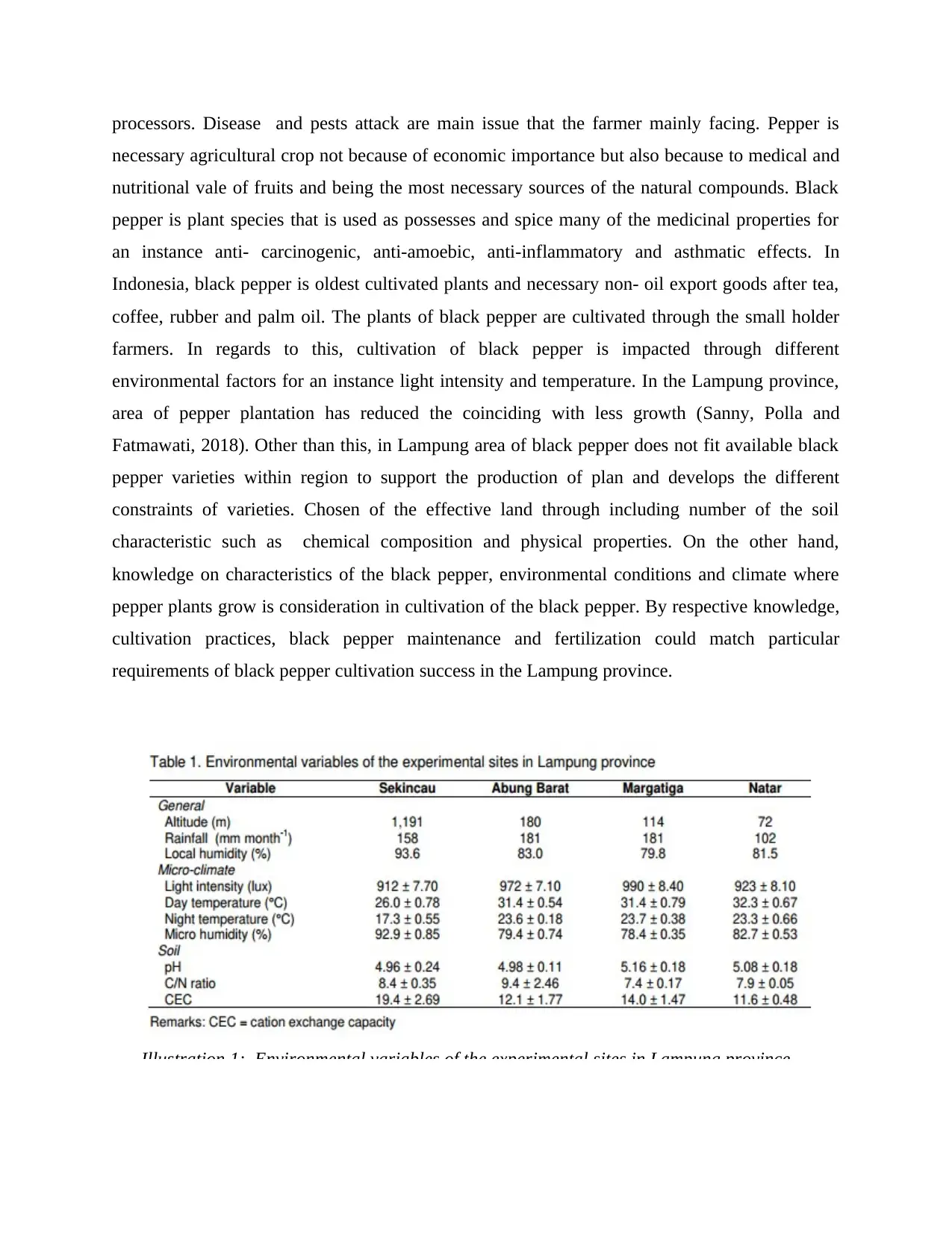
Illustration 1: Environmental variables of the experimental sites in Lampung province
necessary agricultural crop not because of economic importance but also because to medical and
nutritional vale of fruits and being the most necessary sources of the natural compounds. Black
pepper is plant species that is used as possesses and spice many of the medicinal properties for
an instance anti- carcinogenic, anti-amoebic, anti-inflammatory and asthmatic effects. In
Indonesia, black pepper is oldest cultivated plants and necessary non- oil export goods after tea,
coffee, rubber and palm oil. The plants of black pepper are cultivated through the small holder
farmers. In regards to this, cultivation of black pepper is impacted through different
environmental factors for an instance light intensity and temperature. In the Lampung province,
area of pepper plantation has reduced the coinciding with less growth (Sanny, Polla and
Fatmawati, 2018). Other than this, in Lampung area of black pepper does not fit available black
pepper varieties within region to support the production of plan and develops the different
constraints of varieties. Chosen of the effective land through including number of the soil
characteristic such as chemical composition and physical properties. On the other hand,
knowledge on characteristics of the black pepper, environmental conditions and climate where
pepper plants grow is consideration in cultivation of the black pepper. By respective knowledge,
cultivation practices, black pepper maintenance and fertilization could match particular
requirements of black pepper cultivation success in the Lampung province.
Illustration 1: Environmental variables of the experimental sites in Lampung province
⊘ This is a preview!⊘
Do you want full access?
Subscribe today to unlock all pages.
Trusted by 1+ million students worldwide
The above mention table examined number of the environmental variables in different
observational sites stated various characteristic in every location. Sekincau was high land area
and had more relatively humidity between the other locations. At all the locations, average
monthly rainfall was more than 100 mm (Thomas and Sanil, 2019). In context to micro- climate
variables, Sekincau was unique as compare to the other locations. In this, intensity of light and
temperature were less. There are some of the other locations like Natar, Abung Barat and
Margatiga similar for micro – climate variables. In regards to this, Abung Barat appeared to
fertile as comparison to the other in context to C/N ratio while the Sekincau has more cation
exchange capacity (CEC). In India, primary constraint impacting the production of pepper is less
productivity. The main reason behind less productivity is cultivation of the poor yielding,
changing climate, reduce soil fertility, existence of the unproductive vines and senile, losses
because of drought and pest etc.
Different practices followed to increase the production of pepper in different parts of the world
As per opinion of Jagdish Reddy (2020) Pepper varieties can be varied in the
characteristics of food production and responses to the environmental condition and production
practices. In evaluation of the 15 varieties of pepper grown under similar conditions of
greenhouse. First time to harvest pepper varies from the 74 to 83 days, number of fruit of
premium quality varied from the 2.0 to 7.25 per plant. The growers of pepper should be examine
the varieties and identify the highest potential for the marketable yield in manufacturing system
environments. Selecting the varieties on the basis of estimation of total yield may result in
manufacturing of large percentage of the non- marketable goods. There are various practices
given below to increase the production of pepper in different parts of world:
Soil requirement and climate- Pepper is humid tropic plant that needs humidity and
rainfall. Humid and hot climate of the submountanous tracts of the Eastern Ghats and Western
Ghats is deal for development. This produces among 20o successfully, south latitude and from
the sea level upto 1500 meters above the MSL. In regards to this, temperature ranges among 10o
and 40oC. There is 125-200 annual rainfall is regarded ideal for the pepper.
Propagation- In farming of black pepper, mainly propagation is done through cuttings.
This can propagated through seeds as it takes the long process and not preferred method for the
commercial cultivation. In context to vegetative propagation method, cutting of pepper with the
2 to 3 nodes are mainly done from the vines put in bamboo basket during month of March to
observational sites stated various characteristic in every location. Sekincau was high land area
and had more relatively humidity between the other locations. At all the locations, average
monthly rainfall was more than 100 mm (Thomas and Sanil, 2019). In context to micro- climate
variables, Sekincau was unique as compare to the other locations. In this, intensity of light and
temperature were less. There are some of the other locations like Natar, Abung Barat and
Margatiga similar for micro – climate variables. In regards to this, Abung Barat appeared to
fertile as comparison to the other in context to C/N ratio while the Sekincau has more cation
exchange capacity (CEC). In India, primary constraint impacting the production of pepper is less
productivity. The main reason behind less productivity is cultivation of the poor yielding,
changing climate, reduce soil fertility, existence of the unproductive vines and senile, losses
because of drought and pest etc.
Different practices followed to increase the production of pepper in different parts of the world
As per opinion of Jagdish Reddy (2020) Pepper varieties can be varied in the
characteristics of food production and responses to the environmental condition and production
practices. In evaluation of the 15 varieties of pepper grown under similar conditions of
greenhouse. First time to harvest pepper varies from the 74 to 83 days, number of fruit of
premium quality varied from the 2.0 to 7.25 per plant. The growers of pepper should be examine
the varieties and identify the highest potential for the marketable yield in manufacturing system
environments. Selecting the varieties on the basis of estimation of total yield may result in
manufacturing of large percentage of the non- marketable goods. There are various practices
given below to increase the production of pepper in different parts of world:
Soil requirement and climate- Pepper is humid tropic plant that needs humidity and
rainfall. Humid and hot climate of the submountanous tracts of the Eastern Ghats and Western
Ghats is deal for development. This produces among 20o successfully, south latitude and from
the sea level upto 1500 meters above the MSL. In regards to this, temperature ranges among 10o
and 40oC. There is 125-200 annual rainfall is regarded ideal for the pepper.
Propagation- In farming of black pepper, mainly propagation is done through cuttings.
This can propagated through seeds as it takes the long process and not preferred method for the
commercial cultivation. In context to vegetative propagation method, cutting of pepper with the
2 to 3 nodes are mainly done from the vines put in bamboo basket during month of March to
Paraphrase This Document
Need a fresh take? Get an instant paraphrase of this document with our AI Paraphraser
April. These cuttings will ready to be transplanting in main area in around 3 months (Wang and
et. al., 2018).
Planting methods- Due to climbing nature, plants of pepper requires some support. In the
monocrop, support might be tree or fixed pole. The plants of black pepper should planted at
distance of 3 to 4 m. from the climbing nature, there is a requirement of pepper plant to some
support. In regards to this, pits with the size of 0.5m*0.5 m should dug @ distance of the 25 to
30 cm away from the support. Before start of monsoon, the 2 to 3 rooted of tree cuttings planted
in pits that made in the soil. Assure that node of one plant cutting will go underground and
remaining nodes should be 40 to 45 cm above the ground level.
Irrigation- In this, frequent irrigation from the Nov- Dec months till march end is
recommended, irrigation should be till the Break of monsoon in the cultivation in the black
pepper. It will enhance pepper yield regarding 50%. In regards to this, irrigation must be given
@interval of the one week in winter and @ 2 days during the summer. The soil should mulched
with the dried or grass leaves that will sustain some moisture extent in soil in the hot summer
season (Ashajyothi and et. al., 2020).
Harvesting- Black pepper will ready for the harvesting when berry in the cluster shows
scarlet red colour. In regards to this, the black pepper berries will ready for picking the 6 months
to the 7 months of the planting in main field. In regards to this, spikes can harvested when
around 90% of the berried matured. Harvesting mainly begins from the Nov and then continues
up to the month of March.
Diseases and Pests- Main pest that found in the farming of black pepper are flea- beetle
and the scale insects. In order to control the pests, spray Dimecron 85 EC @4 tea spoon in 1 tin
of Kerosene full of the water @12 to 14 interval days (Goon and et. al., 2018).
Pepper export contribute to the Indian economy
P C Sanil L Thomas (2020) stated that products of Indian spices products have come to
be occupy the supreme position in market. Pepper is one of the necessary group that plays
necessary role in economy of country through meeting the export demands. This contributes to
industry and agriculture both in context of employment, export earning and income level. In
regards to this, Indian economy itself has undergone rapid transformation after inception of the
economic reforms in year 1991. On the other hand, production of the black pepper provides
better sources of generation of cash for the farmers in the developing countries and also rate of
et. al., 2018).
Planting methods- Due to climbing nature, plants of pepper requires some support. In the
monocrop, support might be tree or fixed pole. The plants of black pepper should planted at
distance of 3 to 4 m. from the climbing nature, there is a requirement of pepper plant to some
support. In regards to this, pits with the size of 0.5m*0.5 m should dug @ distance of the 25 to
30 cm away from the support. Before start of monsoon, the 2 to 3 rooted of tree cuttings planted
in pits that made in the soil. Assure that node of one plant cutting will go underground and
remaining nodes should be 40 to 45 cm above the ground level.
Irrigation- In this, frequent irrigation from the Nov- Dec months till march end is
recommended, irrigation should be till the Break of monsoon in the cultivation in the black
pepper. It will enhance pepper yield regarding 50%. In regards to this, irrigation must be given
@interval of the one week in winter and @ 2 days during the summer. The soil should mulched
with the dried or grass leaves that will sustain some moisture extent in soil in the hot summer
season (Ashajyothi and et. al., 2020).
Harvesting- Black pepper will ready for the harvesting when berry in the cluster shows
scarlet red colour. In regards to this, the black pepper berries will ready for picking the 6 months
to the 7 months of the planting in main field. In regards to this, spikes can harvested when
around 90% of the berried matured. Harvesting mainly begins from the Nov and then continues
up to the month of March.
Diseases and Pests- Main pest that found in the farming of black pepper are flea- beetle
and the scale insects. In order to control the pests, spray Dimecron 85 EC @4 tea spoon in 1 tin
of Kerosene full of the water @12 to 14 interval days (Goon and et. al., 2018).
Pepper export contribute to the Indian economy
P C Sanil L Thomas (2020) stated that products of Indian spices products have come to
be occupy the supreme position in market. Pepper is one of the necessary group that plays
necessary role in economy of country through meeting the export demands. This contributes to
industry and agriculture both in context of employment, export earning and income level. In
regards to this, Indian economy itself has undergone rapid transformation after inception of the
economic reforms in year 1991. On the other hand, production of the black pepper provides
better sources of generation of cash for the farmers in the developing countries and also rate of
the development in production and also yield has enhanced effectively from 1% to 17.6% in all
over the world (Preethy and et. al., 2018).
over the world (Preethy and et. al., 2018).
⊘ This is a preview!⊘
Do you want full access?
Subscribe today to unlock all pages.
Trusted by 1+ million students worldwide

1 out of 26


Related Documents


Your All-in-One AI-Powered Toolkit for Academic Success.
+13062052269
info@desklib.com
Available 24*7 on WhatsApp / Email
![[object Object]](/_next/static/media/star-bottom.7253800d.svg)
Unlock your academic potential
Copyright © 2020–2026 A2Z Services. All Rights Reserved. Developed and managed by ZUCOL.