Managing People: Performance Appraisal Case Study - Cavendish Hotel

Verified

Added on  2022/08/19

|7
|1826
|9
Case Study
AI Summary
This case study examines the performance management challenges at the Cavendish Hall Hotel, a four-star establishment facing issues related to customer satisfaction and employee productivity. The analysis focuses on the hotel's performance appraisal system, identifying weaknesses in areas such as customer focus, work organization, team development, and trust-building. The case study explores the significance of performance appraisals for both managers and employees, highlighting their role in career development, motivation, and clarity of responsibilities. It then proposes a strategic approach to redesign the appraisal system, emphasizing the need for clear objectives, reliable criteria, and evaluator training. The study also discusses potential barriers to effective appraisals, such as faulty assumptions and design flaws, and emphasizes the crucial role of line managers in implementing the appraisal process. Line managers are responsible for daily employee supervision, training, and feedback, making them key to successful performance appraisal implementation. The analysis includes references to academic literature supporting the findings and recommendations for improving the hotel's performance management practices.
Document Page
Running head: MANAGING PEOPLE CASE STUDY
MANAGING PEOPLE CASE STUDY
Name of the Student:
Name of the University:
Author Note:
tabler-icon-diamond-filled.svg

Paraphrase This Document

Need a fresh take? Get an instant paraphrase of this document with our AI Paraphraser
Document Page
1MANAGING PEOPLE CASE STUDY
Question 1:
Effective management of performance is extremely significant to every type of
business. This effective management of performance helps in aligning resources, employees
and systems through informal as well as formal processes in order to be able to meet their
strategic objectives. An effective management would serve as a dashboard too, since it would
provide an early warning about any upcoming potential issues and allows the managers to
know when to make certain adjustments which will help them to keep their business stable
and in track. Cavendish Hotel Group has issues with their performance management due to
some poor performance indicators and thus it is making their customers unsatisfied and thus
their productivity is getting affected. Human capital is also an issue that is preventing the
hotel group from having an effective performance management. The young Manager of the
Hotel, for instance, is capable but is sensitive to criticism and thus becomes unwilling to take
appropriate risks that would meet the needs of their customer. The HR manager of the hotel
also has some performance problem that is affecting the business of the hotel; people are
giving reviews mainly of negative nature and in turn these reviews are attracting negative
attention from their head office. The hotel needs to improve their performance on customer
focus, organizing work, proper development of a successful team, and finally they need to
perform well through building of trust. The hotel must be aware of their performance
indicators in order to have their performance management improved and enhanced and be
able to acquire positive outcomes.
Question 2:
For both managers and the employees, performance appraisal is a significant tool for
career development. The manager can aid the employees by guiding on a way to
advancement in the corporate sector and the workers are able to achieve a clearer
understanding of their responsibilities and what is expected of them (Austin 2013).
Document Page
2MANAGING PEOPLE CASE STUDY
Performance appraisals have wide impacts on the employees which the managers are
expected to identify. Performance appraisal can work as a source of motivation for the
employees and thus help them in improving their productivity. After a worker recognizes his
goals and receives challenges in the way of his career advancement, these performance
appraisals would help to motivate them and encourage them to achieve their destined goals
(Xu et al. 2013). Performance appraisals also help an employee to get clarity about his/her
duties and responsibilities so that they can clearly focus on their goals and be productive in
their area; this will hep them perform better. Performance appraisals are decided after
analyzing the annual review where every employee’s challenges and accomplishments are
recorder. In the time of presenting the performance appraisals, these reports are also
presented and it gives the other employees the chance to reflect on their performance issues
and then take responsibility for the challenges that they face in their work. This helps most of
the workers to be more committed to their career and thus their performance is automatically
improved (DeNisi and Murphy 2017). Finally, the performance appraisal shows how an
employee’s performance affect the performance of the whole team and the organization; this
makes the workers improve their performance in the teamwork.
Question 3:
Only after reframing and re- examining about the management of employee
performance, the insights must be compiled and then it should be used to create a new
approach of strategy that would help in forming the new performance appraisal system which
not only would appraise the performance of the workers, but it would also motivate theme
and the other employees to perform better the next time (Novaković et al. 2013). Firstly, the
basic principle of the appraisal system must be discussed with some key workers in the
organization, then certain specific questions about appraisals must be prepared to gain an
insight of the needs and wants of the workers. The technicalities and content should be
Document Page
3MANAGING PEOPLE CASE STUDY
informed about the appraisal system after which a small and simple appraisal can be
conducted in order to introduce the workers with the technicalities. After a test appraisal, the
appraisal can be modified and implemented in order to acquire better performance and
performance management. The Cavendish Hotel Group do need to put certain performance
appraisal practice that they are lacking in; their appraisal practice needs to have a clear
objective and must be reliable and valid so that the workers can perform accordingly and be
motivated to improve their performance (Sikora, Ferris and Van Iddekinge 2015). Most
importantly, Cavendish hotel group requires training for the evaluators so that they have the
knowledge and the skill that is needed to design appraisal. This is the reason that employees
in the hotel fail to satisfy the customers in meeting their needs and perform poorly; they need
to have clear objectives, mutual trust and motivation that only a well framed appraisal form
can provide.
Question 4:
Appraisals usually have a positive impact on the performance of the employees, yet
there are certain barriers that prevent this from happening and it impacts either negatively or
does not have any impact at all. The first barrier is faulty assumptions that is attempted by the
parties which are concerned with the appraisals. This happens when the superiors tend to
avoid the formal process of implementing appraisal and also when the manager assume that
the appraisal program is without fault and would continue for a long period of time (Sumelius
et al. 2014). Another barrier is that the design of the performance appraisal is made such that
the problem of recognizing adequate criteria still exists. This kind of technical pitfall stands
as a barrier in improvement of the performance; instead it impacts on the attitudes of the
employee. Such kind of appraisals fail to describe the goals and objectives of the workers and
it might impose wrong notion about the behavior of the employees which would be affecting
the productivity of the organization as a whole (DeNisi and Smith 2014). A well framed
tabler-icon-diamond-filled.svg

Paraphrase This Document

Need a fresh take? Get an instant paraphrase of this document with our AI Paraphraser
Document Page
4MANAGING PEOPLE CASE STUDY
appraisal would not only guide employees in their attitudes and behavior with the customers
and other workers but it would also encourage them in their good performance. A well
framed appraisal form would induce productivity and this would in turn also motivate the
evaluator and the superior about the creation of the appraisal form and help them overcome
any kind of insecurity that they may have been in regarding the design of the appraisal. They
would design the appraisal better the next time.
Question 5:
A line manager has the responsibility of overseeing other employees as well as
operations of a business and then report it to the higher position authority. This line manager
has a significant role to play in supervising and managing the employees every day as all the
while they have to act as the liaison in between upper management and the employees. This
shows how important their role is whilst implementing the performance appraisal effectively
(Sanyal and Biswas 2014). A line manager is good for this implementation since they are
responsible for hiring of new talent in the team; they provide training and support to the new
joiners; they cross- train the employees and minimize the assignment coverage gap as well as
ensure rotation of jobs. Line managers are also responsible for provision of coaching and
feedback on performance of the other employees to all the members of the team. Hence the
line managers are well aware of the performance of the employees in every team of the
organization and hence when they would implement the new appraisal form, they would be
well aware of the fact and figures about the employees of the organization and their
performance. It is their responsibility to ensure quality standards for all the processes and this
is what they will do regarding the implementation of the appraisal program and they are also
expected to recognize the need for the corrective actions in the required arenas; thus, it would
be beneficial when they would implement the appraisal program in the organization and have
effective outcomes.
Document Page
5MANAGING PEOPLE CASE STUDY
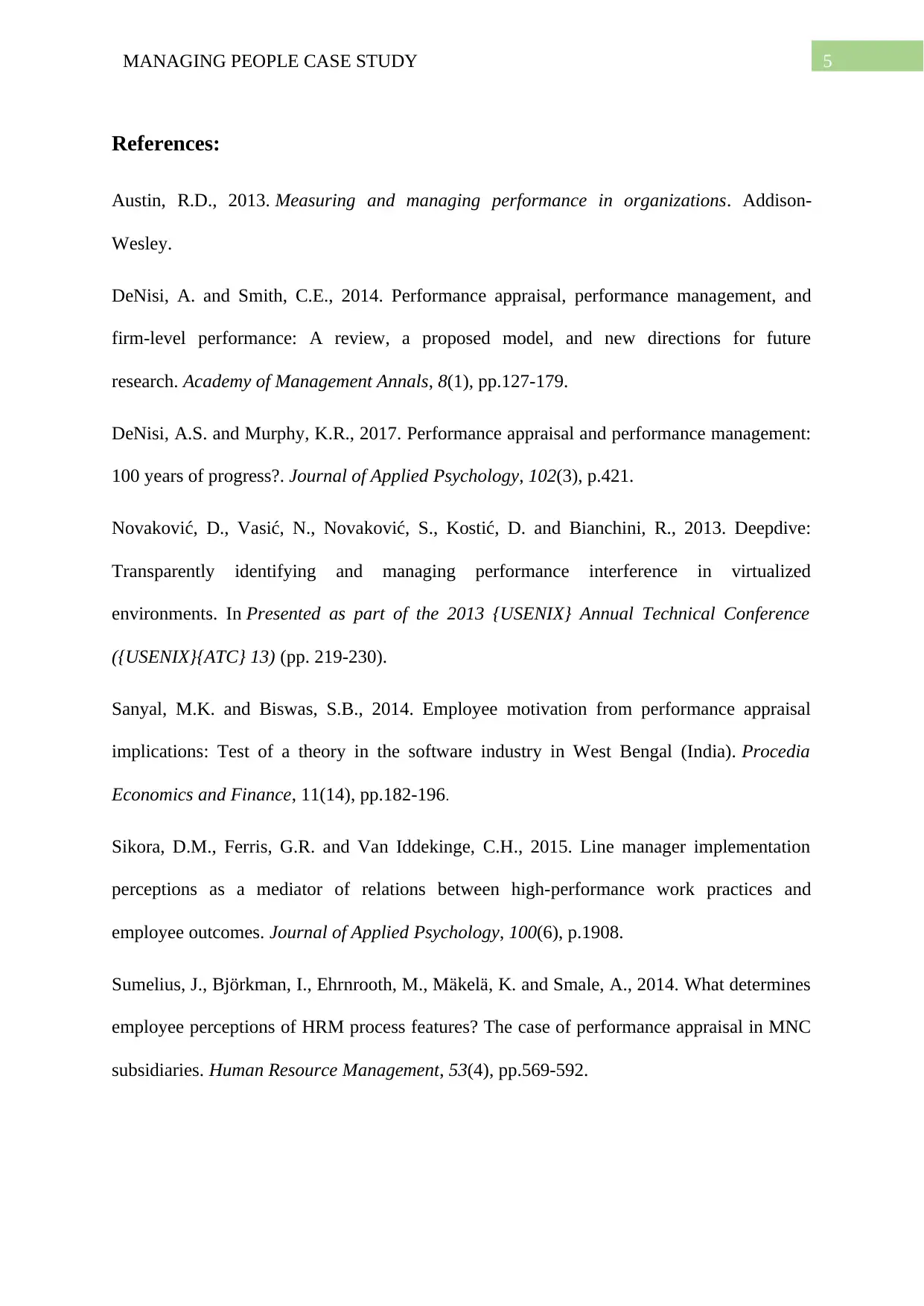
References:
Austin, R.D., 2013. Measuring and managing performance in organizations. Addison-
Wesley.
DeNisi, A. and Smith, C.E., 2014. Performance appraisal, performance management, and
firm-level performance: A review, a proposed model, and new directions for future
research. Academy of Management Annals, 8(1), pp.127-179.
DeNisi, A.S. and Murphy, K.R., 2017. Performance appraisal and performance management:
100 years of progress?. Journal of Applied Psychology, 102(3), p.421.
Novaković, D., Vasić, N., Novaković, S., Kostić, D. and Bianchini, R., 2013. Deepdive:
Transparently identifying and managing performance interference in virtualized
environments. In Presented as part of the 2013 {USENIX} Annual Technical Conference
({USENIX}{ATC} 13) (pp. 219-230).
Sanyal, M.K. and Biswas, S.B., 2014. Employee motivation from performance appraisal
implications: Test of a theory in the software industry in West Bengal (India). Procedia
Economics and Finance, 11(14), pp.182-196.
Sikora, D.M., Ferris, G.R. and Van Iddekinge, C.H., 2015. Line manager implementation
perceptions as a mediator of relations between high-performance work practices and
employee outcomes. Journal of Applied Psychology, 100(6), p.1908.
Sumelius, J., Björkman, I., Ehrnrooth, M., Mäkelä, K. and Smale, A., 2014. What determines
employee perceptions of HRM process features? The case of performance appraisal in MNC
subsidiaries. Human Resource Management, 53(4), pp.569-592.
Document Page
6MANAGING PEOPLE CASE STUDY
Xu, F., Liu, F., Jin, H. and Vasilakos, A.V., 2013. Managing performance overhead of virtual
machines in cloud computing: A survey, state of the art, and future directions. Proceedings of
the IEEE, 102(1), pp.11-31.
chevron_up_icon
1 out of 7
circle_padding
hide_on_mobile
zoom_out_icon
[object Object]