Organisational Behaviour Report: Performance, Barriers, and Path Goals
VerifiedAdded on 2020/11/23
|15
|4507
|50
Report
AI Summary
This report on organisational behaviour examines key concepts through a case study of the BBC. It begins by exploring the influence of organisational culture, power dynamics, and politics on individuals, applying Handy's typology of culture and French and Raven's power types. The report then delves into motivational theories, including Maslow's hierarchy of needs and Vroom's expectancy theory, and discusses techniques for improving motivation within the BBC. The analysis extends to different types of teams, factors contributing to effective teamwork, and the role of team members. Finally, it explores path-goal theory and identifies barriers to effective performance, providing a comprehensive overview of organisational behaviour principles and their application in a real-world context, offering insights into how these concepts impact employee behaviour and organisational success.
Organisational
Behaviour
Behaviour

Paraphrase This Document
Need a fresh take? Get an instant paraphrase of this document with our AI Paraphraser
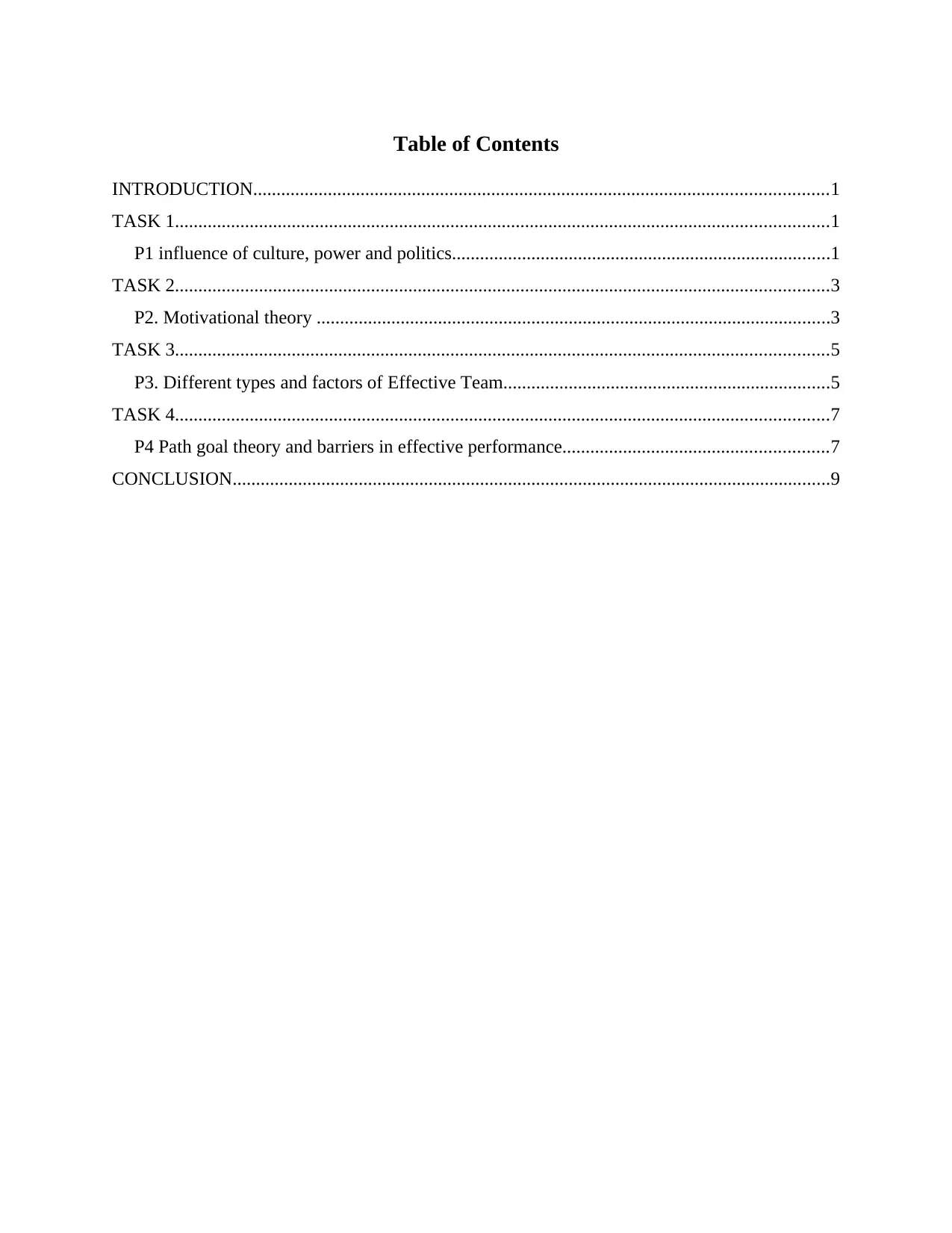
Table of Contents
INTRODUCTION...........................................................................................................................1
TASK 1............................................................................................................................................1
P1 influence of culture, power and politics.................................................................................1
TASK 2............................................................................................................................................3
P2. Motivational theory ..............................................................................................................3
TASK 3............................................................................................................................................5
P3. Different types and factors of Effective Team......................................................................5
TASK 4............................................................................................................................................7
P4 Path goal theory and barriers in effective performance.........................................................7
CONCLUSION................................................................................................................................9
INTRODUCTION...........................................................................................................................1
TASK 1............................................................................................................................................1
P1 influence of culture, power and politics.................................................................................1
TASK 2............................................................................................................................................3
P2. Motivational theory ..............................................................................................................3
TASK 3............................................................................................................................................5
P3. Different types and factors of Effective Team......................................................................5
TASK 4............................................................................................................................................7
P4 Path goal theory and barriers in effective performance.........................................................7
CONCLUSION................................................................................................................................9

⊘ This is a preview!⊘
Do you want full access?
Subscribe today to unlock all pages.

Trusted by 1+ million students worldwide
INTRODUCTION
Organisational behaviour refers to predicting, understanding and influencing behaviour of
employees in an organisation. It is all about how individuals act and behave in the organization.
It involves two main elements which are – nature of employees and the firm in which they are
working(Coccia, 2014) established on 18 October 1922 which is a commercial company has
been considered. Impact of culture, power and politics on individuals is mentioned above. Along
with this, motivational theories are also discussed here. Different teams and ways to motivate
them are explained in this report. Further, how path goal theory influences employees, their
performance and different barriers in effective performance are all mentioned in this report.
TASK 1
P1 Influence of organisation culture, power and politics
Organisation culture:- Organisation culture refers to company's concepts and beliefs
which creates an organisation's psychological and cultural environment. Culture of a company
has important role in success of a business. There is strong impact of strong culture on members
of organisation and by introducing clear beliefs and values it creates committed individuals.
Weak culture leads to resentment and unproductive employees. In an organisation- culture refers
to the internal environment and employees humour which is operated deliberately or
unintentionally by management. Organisation culture is determined as the process through which
organisations compare and relate their work with other organisations and external world. It
involves an organisation's sociology, values and psychology. In BBC Handy's typology of
culture is applied which is mentioned under.
Handy's typology
Role culture:- In role culture organisations have assumptions that there are rational
individuals and their roles can be determined and released through clear understanding of
procedures. The employees are assigned responsibilities by determining their interests and
qualifications (Dickens, L. ed., 2012) . In this report BBC (British Broadcasting Corporation). In
BBC role culture will encourage works to perform challenging tasks.
Task culture:- Task culture is found in different organisations where management
concentrates more on solving managerial problems. In this type of culture task forces, working
1
Organisational behaviour refers to predicting, understanding and influencing behaviour of
employees in an organisation. It is all about how individuals act and behave in the organization.
It involves two main elements which are – nature of employees and the firm in which they are
working(Coccia, 2014) established on 18 October 1922 which is a commercial company has
been considered. Impact of culture, power and politics on individuals is mentioned above. Along
with this, motivational theories are also discussed here. Different teams and ways to motivate
them are explained in this report. Further, how path goal theory influences employees, their
performance and different barriers in effective performance are all mentioned in this report.
TASK 1
P1 Influence of organisation culture, power and politics
Organisation culture:- Organisation culture refers to company's concepts and beliefs
which creates an organisation's psychological and cultural environment. Culture of a company
has important role in success of a business. There is strong impact of strong culture on members
of organisation and by introducing clear beliefs and values it creates committed individuals.
Weak culture leads to resentment and unproductive employees. In an organisation- culture refers
to the internal environment and employees humour which is operated deliberately or
unintentionally by management. Organisation culture is determined as the process through which
organisations compare and relate their work with other organisations and external world. It
involves an organisation's sociology, values and psychology. In BBC Handy's typology of
culture is applied which is mentioned under.
Handy's typology
Role culture:- In role culture organisations have assumptions that there are rational
individuals and their roles can be determined and released through clear understanding of
procedures. The employees are assigned responsibilities by determining their interests and
qualifications (Dickens, L. ed., 2012) . In this report BBC (British Broadcasting Corporation). In
BBC role culture will encourage works to perform challenging tasks.
Task culture:- Task culture is found in different organisations where management
concentrates more on solving managerial problems. In this type of culture task forces, working
1
Paraphrase This Document
Need a fresh take? Get an instant paraphrase of this document with our AI Paraphraser
parties, study groups and sub-committees are defined to provide appropriate solutions for
problems. In BBC task culture will be beneficial in the condition of flexibility requirement.
Power culture:- In power culture power is assigned to few persons and they take all
decisions of an organisation and their impact can be negative or positive both. Employees are
observed while working and judged by their work and daily performance. In BBC applying
power culture will lead to quick decision making but its impact can be both pleasing and
unfavourable.
Person culture:- In person culture individuals feels that they are served by the
organisations and their purpose is only to come office for money sake(Dobrow, 2013) . In such
organisations employees feels that they are more essential than their work. In BBC following
person culture will be unfavourable and the organisation will suffer.
Thus, the type of culture which can be adopted by manager of BBC company is task
culture, as through this type of culture company can easily achieve organisation aims and
objectives. In addition to this of such culture will be adopted by the company then it will help
employees also to become specialised in their respective task.
Organisation power:-
Organisation power refers to the capacity and ability to influence people. It is a dealing
relationship which occurs proceedings between a representative and a target. The representative
refers to the individual who utilises target and power as a acknowledgement to use cognition.
Power is not legitimate and it does not need to be legitimate. Power is a way or process to control
the individuals in an organisation. Power can be exercised in different ways and particularly in
motivating employees. In BBC French and Raven's power types will play different roles which
are mentioned above.
French and Raven's power:
Coercive power:- In coercive power employees are pressurized to do work without their
willingness or wishes. This leads to individuals frustration and increase problems in organisation.
In BBC this type of power will demotivate employees and it is not good for the organisation.
Reward power:- Reward power includes incentives, bonus, and appreciation provided to
employees which encourages and motivate them to work effectively(Gold and et. al., 2013) . In
BBC the manager can use this power to motivate employees so they will perform effectively.
2
problems. In BBC task culture will be beneficial in the condition of flexibility requirement.
Power culture:- In power culture power is assigned to few persons and they take all
decisions of an organisation and their impact can be negative or positive both. Employees are
observed while working and judged by their work and daily performance. In BBC applying
power culture will lead to quick decision making but its impact can be both pleasing and
unfavourable.
Person culture:- In person culture individuals feels that they are served by the
organisations and their purpose is only to come office for money sake(Dobrow, 2013) . In such
organisations employees feels that they are more essential than their work. In BBC following
person culture will be unfavourable and the organisation will suffer.
Thus, the type of culture which can be adopted by manager of BBC company is task
culture, as through this type of culture company can easily achieve organisation aims and
objectives. In addition to this of such culture will be adopted by the company then it will help
employees also to become specialised in their respective task.
Organisation power:-
Organisation power refers to the capacity and ability to influence people. It is a dealing
relationship which occurs proceedings between a representative and a target. The representative
refers to the individual who utilises target and power as a acknowledgement to use cognition.
Power is not legitimate and it does not need to be legitimate. Power is a way or process to control
the individuals in an organisation. Power can be exercised in different ways and particularly in
motivating employees. In BBC French and Raven's power types will play different roles which
are mentioned above.
French and Raven's power:
Coercive power:- In coercive power employees are pressurized to do work without their
willingness or wishes. This leads to individuals frustration and increase problems in organisation.
In BBC this type of power will demotivate employees and it is not good for the organisation.
Reward power:- Reward power includes incentives, bonus, and appreciation provided to
employees which encourages and motivate them to work effectively(Gold and et. al., 2013) . In
BBC the manager can use this power to motivate employees so they will perform effectively.
2
Legitimate power:- Title power is knowns as legitimate power. This type of power is
authorised to different individual's according to their positions like Executive, CEO, etc. In
context to BBC, legitimate power delegated to members of organisation will influence the
individuals working.
Expert power:- Expert power refers to the talent and skills an individual consists and are
required by others. It involves doing extra-ordinary activities, interpersonal relations, developing
innovative products, etc. In BBC expert power will be efficient and effective for the
organisation.
Referent power:- Individuals having referent power have big impact on others and are
appreciated by others. They posses various qualities - charm, good looks and people like them by
their attitude. In context to BBC, referent power will influence employees.
Organisation politics:-
Power and politics have essential roles in an organisation. It influences individuals in
both positive and negative way. Organisational politics can be unofficial, informal, and
accomplish other prescribed goals(Hashim and Wok, 2014) . For example earlier BBC company
staff members used to adopt the political behaviour of bullying and harassment in order to get
work done forcefully from others. Thus, if the company wants to achieve its competitive
advantage in market place it is very much essential to perform every task through proper
communication and coordination among each others. Thus, as per Chanlats characteristics
healthy politics in an organisation will be helpful in maintaining interpersonal relations and
attaining desired objectives. There should be political awareness in an organisation, otherwise it
will affect its performance negatively. In BBC having healthy politics will be effective for the
company so as to achieve organisations aims and objectives on stipulated time period.
TASK 2
P2.
A. Motivational theory
Motivation:
Motivation is the process of psychological, social and biological states which drives an
individual towards a particular action. It describe the inner state of the mind that directs and
activates the behaviour of an individual. It is a internal process in which an individual move
3
authorised to different individual's according to their positions like Executive, CEO, etc. In
context to BBC, legitimate power delegated to members of organisation will influence the
individuals working.
Expert power:- Expert power refers to the talent and skills an individual consists and are
required by others. It involves doing extra-ordinary activities, interpersonal relations, developing
innovative products, etc. In BBC expert power will be efficient and effective for the
organisation.
Referent power:- Individuals having referent power have big impact on others and are
appreciated by others. They posses various qualities - charm, good looks and people like them by
their attitude. In context to BBC, referent power will influence employees.
Organisation politics:-
Power and politics have essential roles in an organisation. It influences individuals in
both positive and negative way. Organisational politics can be unofficial, informal, and
accomplish other prescribed goals(Hashim and Wok, 2014) . For example earlier BBC company
staff members used to adopt the political behaviour of bullying and harassment in order to get
work done forcefully from others. Thus, if the company wants to achieve its competitive
advantage in market place it is very much essential to perform every task through proper
communication and coordination among each others. Thus, as per Chanlats characteristics
healthy politics in an organisation will be helpful in maintaining interpersonal relations and
attaining desired objectives. There should be political awareness in an organisation, otherwise it
will affect its performance negatively. In BBC having healthy politics will be effective for the
company so as to achieve organisations aims and objectives on stipulated time period.
TASK 2
P2.
A. Motivational theory
Motivation:
Motivation is the process of psychological, social and biological states which drives an
individual towards a particular action. It describe the inner state of the mind that directs and
activates the behaviour of an individual. It is a internal process in which an individual move
3
⊘ This is a preview!⊘
Do you want full access?
Subscribe today to unlock all pages.
Trusted by 1+ million students worldwide
towards a target. A persons motivation can be inspired by other individual, group of individual or
any event. It is a most important factor which is motivate and inspire an individual to move
forward. In the context of BBC, managers are motivate their employees to attain desired goal. If
they fail in perform to work then they motivate and encourage them towards their better
performance of work.
Theories of motivation:
There are various types of motivational theories which are developed to define the
motivation. In this include two types of theories such as content theory and process theory of
motivation(Hyde, Harris and Boaden, 2013) . Content theory reflects that “What” motivates the
employees in an organisation. While process theory reflects the “How” motivation is occurs.
Content theory:
BBC want to find the solution of that what motivates the employees in their company. In
content theory include various types of theories such as Herzberg's motivational theory,
Alderfer's theory, Maslow's need theory and McClelland's theory. BBC
Maslow's need Hierarchy theory: This theory is introduced by Abraham Maslow, who
define the strengths of particular needs at the various point of time. The BBC company should
fulfil their employees basic needs(LA, 2013) . Maslow define this theory in hierarchy form
which can be easily understandable and are as follows:
Physiological needs: Physiological needs are the basic necessity of survival of the
people. In this include many types of needs such as air, water, food, shelter, clothes, sleep and
other necessity of life. The BBC company can easily fulfil these basic needs of their employees
by giving them basic salary for satisfy their needs.
Security needs: When physiological needs are fulfil then safety needs take place.
Employees of this company wants to economic security, safety from physical risk, job security,
health insurance etc.
Social needs: After fulfilling the above both needs, employees' social needs are come.
They want love, belongingness and affection from the BBC company. They want to interact with
their supervisors, clients, teams, co-workers etc.
Self-esteem needs: In this needs include honour, respect from others. This company's
employees concerned with self-confidence, self-respect, feeling of uniqueness, personal worth,
social recognition etc.
4
any event. It is a most important factor which is motivate and inspire an individual to move
forward. In the context of BBC, managers are motivate their employees to attain desired goal. If
they fail in perform to work then they motivate and encourage them towards their better
performance of work.
Theories of motivation:
There are various types of motivational theories which are developed to define the
motivation. In this include two types of theories such as content theory and process theory of
motivation(Hyde, Harris and Boaden, 2013) . Content theory reflects that “What” motivates the
employees in an organisation. While process theory reflects the “How” motivation is occurs.
Content theory:
BBC want to find the solution of that what motivates the employees in their company. In
content theory include various types of theories such as Herzberg's motivational theory,
Alderfer's theory, Maslow's need theory and McClelland's theory. BBC
Maslow's need Hierarchy theory: This theory is introduced by Abraham Maslow, who
define the strengths of particular needs at the various point of time. The BBC company should
fulfil their employees basic needs(LA, 2013) . Maslow define this theory in hierarchy form
which can be easily understandable and are as follows:
Physiological needs: Physiological needs are the basic necessity of survival of the
people. In this include many types of needs such as air, water, food, shelter, clothes, sleep and
other necessity of life. The BBC company can easily fulfil these basic needs of their employees
by giving them basic salary for satisfy their needs.
Security needs: When physiological needs are fulfil then safety needs take place.
Employees of this company wants to economic security, safety from physical risk, job security,
health insurance etc.
Social needs: After fulfilling the above both needs, employees' social needs are come.
They want love, belongingness and affection from the BBC company. They want to interact with
their supervisors, clients, teams, co-workers etc.
Self-esteem needs: In this needs include honour, respect from others. This company's
employees concerned with self-confidence, self-respect, feeling of uniqueness, personal worth,
social recognition etc.
4
Paraphrase This Document
Need a fresh take? Get an instant paraphrase of this document with our AI Paraphraser
Self-actualisation needs: After fulfil the above all needs, employees' desires are more
higher. Employees' of BBC company wants to develop and grow their fullest potential for face
the various situation in the organisation(McLennan, 2013) . In self-actualisation include
advancement, creativity, training and growth of an employee.
Process theory of motivation:
Process theory is about how can motivate the people in the organisation. In this include
Vroom's theory, Reinforcement theory, Adam's equity and stick and carrot approach. BBC
company use the Vroom's Expectancy Theory to motivate their workers which is as follow:
Vroom's Expectancy Theory: This theory was introduced by Victor. H. Vroom, who
think that individuals are motivated by their performance and think that they help the
organisation to achieving the goals.
Valence: Valence describe the value that a person place on a specific result for the
awaited rewards of the results. If the Employees' of BBC company put more efforts for the
performing of the job then they can achieve effective outcomes or results.
Instrumentality: In this level, employees think that if they contribute effective efforts to
achieving the goals of the company then they can get promotion, rewards etc. from the
company(Mester and et. al., 2018) . Thus, a person can motivated towards effective performance
for getting the rewards and promotion.
Expectancy: It is like a probability for a particular action which leads the results of the
better performance. In this, employees are give attention to the promotion system then success of
better performance is automatically generated.
B. Evaluation about how improved level of motivation within the BBC can help to achieve
organisational goal
Techniques of motivation:
Techniques of motivations are various types but the BBC company choose two types of
motivational techniques i.e. financial motivation and non-financial motivation techniques which
are as follows:
Financial motivational techniques: These techniques are related with monetary system.
Mostly employees work for money thus, it is an effective part of motivation. BBC company
motivates their employees through monetary system such as providing wages, salary, bonus, pay
with leaves, housing facility, sharing profits etc.
5
higher. Employees' of BBC company wants to develop and grow their fullest potential for face
the various situation in the organisation(McLennan, 2013) . In self-actualisation include
advancement, creativity, training and growth of an employee.
Process theory of motivation:
Process theory is about how can motivate the people in the organisation. In this include
Vroom's theory, Reinforcement theory, Adam's equity and stick and carrot approach. BBC
company use the Vroom's Expectancy Theory to motivate their workers which is as follow:
Vroom's Expectancy Theory: This theory was introduced by Victor. H. Vroom, who
think that individuals are motivated by their performance and think that they help the
organisation to achieving the goals.
Valence: Valence describe the value that a person place on a specific result for the
awaited rewards of the results. If the Employees' of BBC company put more efforts for the
performing of the job then they can achieve effective outcomes or results.
Instrumentality: In this level, employees think that if they contribute effective efforts to
achieving the goals of the company then they can get promotion, rewards etc. from the
company(Mester and et. al., 2018) . Thus, a person can motivated towards effective performance
for getting the rewards and promotion.
Expectancy: It is like a probability for a particular action which leads the results of the
better performance. In this, employees are give attention to the promotion system then success of
better performance is automatically generated.
B. Evaluation about how improved level of motivation within the BBC can help to achieve
organisational goal
Techniques of motivation:
Techniques of motivations are various types but the BBC company choose two types of
motivational techniques i.e. financial motivation and non-financial motivation techniques which
are as follows:
Financial motivational techniques: These techniques are related with monetary system.
Mostly employees work for money thus, it is an effective part of motivation. BBC company
motivates their employees through monetary system such as providing wages, salary, bonus, pay
with leaves, housing facility, sharing profits etc.
5
Non-financial motivational techniques: In this no function of money but provide
psychological satisfaction to the people. BBC company encourage their employees towards
better performance of work by providing safety of job, respect, status, respect, job enrichment,
recognition etc.
Thus, by rendering such motivation BBC company tries to encourage the workforce so that they
can give their best to accomplish organisation aims and objectives on a stipulated time period. In
addition to this BBC company render such monetary and non monetary benefits to its workforce
in order to retain the talented and skilled workforce. Thus, it also help to increase the
productivity and profitability ratio of the organisation.
TASK 3
P3.
A. Different types Team
It is a group of people working together to complete a project for the achieving the
organisational goals(Millar, Hind and Magala, 2012) . Teams have some members with extra
ordinary quality, ability to perform effective work and knowledgable people to complete a task
or project of the company. Mangers of BBC company, should make effective teams in which
group members have superior quality to complete the task in effective manner and complete the
organisational goals. When a strong awareness of common commitments makes synergy then
group becomes more than a collection of individuals.
Difference types of teams:
Teams are various types such as situational teams, functional team, project team, problem
solving teams etc. which are as follows:
Problem solving teams: It is a group of people who are come together to solve real-time
task issues. This team members are belongs to the different departments in the BBC
company(Robbins and et. al., 2013) . All members are choose from various departments because
they all have different ideas and skills who are effectively and easily solve a particular problem
and issue of the company.
Virtual teams: It is a group of individuals who perform together for achieving a common
goal but they are not situated in the same area. Virtual team of individuals who perform in their
home or work in their different office. They communicate via different technology such as email,
6
psychological satisfaction to the people. BBC company encourage their employees towards
better performance of work by providing safety of job, respect, status, respect, job enrichment,
recognition etc.
Thus, by rendering such motivation BBC company tries to encourage the workforce so that they
can give their best to accomplish organisation aims and objectives on a stipulated time period. In
addition to this BBC company render such monetary and non monetary benefits to its workforce
in order to retain the talented and skilled workforce. Thus, it also help to increase the
productivity and profitability ratio of the organisation.
TASK 3
P3.
A. Different types Team
It is a group of people working together to complete a project for the achieving the
organisational goals(Millar, Hind and Magala, 2012) . Teams have some members with extra
ordinary quality, ability to perform effective work and knowledgable people to complete a task
or project of the company. Mangers of BBC company, should make effective teams in which
group members have superior quality to complete the task in effective manner and complete the
organisational goals. When a strong awareness of common commitments makes synergy then
group becomes more than a collection of individuals.
Difference types of teams:
Teams are various types such as situational teams, functional team, project team, problem
solving teams etc. which are as follows:
Problem solving teams: It is a group of people who are come together to solve real-time
task issues. This team members are belongs to the different departments in the BBC
company(Robbins and et. al., 2013) . All members are choose from various departments because
they all have different ideas and skills who are effectively and easily solve a particular problem
and issue of the company.
Virtual teams: It is a group of individuals who perform together for achieving a common
goal but they are not situated in the same area. Virtual team of individuals who perform in their
home or work in their different office. They communicate via different technology such as email,
6
⊘ This is a preview!⊘
Do you want full access?
Subscribe today to unlock all pages.
Trusted by 1+ million students worldwide
video conferencing and other means of technology. BBC company search those types of people
and use their talent and skills for increase productivity and decrease work load of the company.
Project team: In this include a team who perform on a task or project for the specific
time period. Once this project is complete, team is dissolved. BBC company choose skilled
people for this type of projects who are complete the project in a particular time.
Functional team: Members of functional team belongs to the same department and
respond to the management of BBC company. This type of team perform the task of particular
department of the company.
B. Evaluation about what makes an effective team
Importance of the teams:
Teamwork is very important for any organisation because it increase the productivity and
decrease the work load of the company(Shore and Wright, 2015). Mostly, team individuals have
different skills and abilities which is useful and helpful to the accomplishing the task of the BBC
company. Thus, BBC company takes into consideration Tuckman's model in order to explain
how the effective team within the organisation and develops with the helps of fives stages
through which team members passes through.
Tuckman and Jensen’s model of team development:
This theory is introduced in 1965 by Dr Bruce Tuckman. This theory is categorised into
five parts which are as under:
Forming: In performing stage, team is formed and work allotted to the team members. In
the BBC company, members are extremely depended upon the leader for direction. They are not
having clear idea about their roles and responsibilities in the group. They behave strangely from
each others.
Storming: In this stage, employees communicate their opinions and skills but sometimes
conflicts are arises between communication. Employees of BBC company tries to form relation
with their team members (Thomson, and Van Niekerk, 2012) . Leader encourage their group
members towards work and reduce the conflicts between them.
Norming: In this phase, leader of the BBC company give power to their group members
to work freely and independently which leads the efficiency of members and they can successful
in develop their identity in the team.
7
and use their talent and skills for increase productivity and decrease work load of the company.
Project team: In this include a team who perform on a task or project for the specific
time period. Once this project is complete, team is dissolved. BBC company choose skilled
people for this type of projects who are complete the project in a particular time.
Functional team: Members of functional team belongs to the same department and
respond to the management of BBC company. This type of team perform the task of particular
department of the company.
B. Evaluation about what makes an effective team
Importance of the teams:
Teamwork is very important for any organisation because it increase the productivity and
decrease the work load of the company(Shore and Wright, 2015). Mostly, team individuals have
different skills and abilities which is useful and helpful to the accomplishing the task of the BBC
company. Thus, BBC company takes into consideration Tuckman's model in order to explain
how the effective team within the organisation and develops with the helps of fives stages
through which team members passes through.
Tuckman and Jensen’s model of team development:
This theory is introduced in 1965 by Dr Bruce Tuckman. This theory is categorised into
five parts which are as under:
Forming: In performing stage, team is formed and work allotted to the team members. In
the BBC company, members are extremely depended upon the leader for direction. They are not
having clear idea about their roles and responsibilities in the group. They behave strangely from
each others.
Storming: In this stage, employees communicate their opinions and skills but sometimes
conflicts are arises between communication. Employees of BBC company tries to form relation
with their team members (Thomson, and Van Niekerk, 2012) . Leader encourage their group
members towards work and reduce the conflicts between them.
Norming: In this phase, leader of the BBC company give power to their group members
to work freely and independently which leads the efficiency of members and they can successful
in develop their identity in the team.
7
Paraphrase This Document
Need a fresh take? Get an instant paraphrase of this document with our AI Paraphraser
Performing: In performing stage, group become cooperative and effective. They can
easily understand their tasks and goals and perform together to accomplish them. Team
members of BBC company, perform tasks and goals effectively and more quality is generated for
making decision.
Adjourning: Adjourning is the last stage of this theory. Teams of BBC company is
dissolve after achieving the tasks and goals of the group. Members create distance from each
members of the group.
TASK 4
P4
A. Organisation behaviour concept and philosophies
Concept of organisation: Organisation behaviours refers to the field of study which help to
investigate about the impact that the groups, individuals and structure have on behaviours within
the business concern. Therefore, concept of organisation behaviour is based on two basic
concepts that is nature of people and nature of organisation. For example if the nature of people
within the BBC organisation is corporative and friendly then it will help the organisation as well
to develop flexible environment within the organisation. Therefore it will help to achieve
increase in productivity and profitability ration of the organisation within the stipulated time
period. Thus, it can be said that the nature of an organisation is totally dependent upon the nature
of people working within the organisation.
Philosophies of organisation behaviour:
Path goal theory:-
Path goal theory is concerned about leaders behaviour and their efforts to inspire
employees to attain desired goals. In this theory the leader focus on employees motivation and
satisfaction. Leaders make efforts to provide best paths to individuals so they can perform daily
operations and achieve prescribed goals. In BBC applying this theory will offer various skills
required to encourage employees and strengthen the team and leaders. In this theory the leader
should focus on three points which are described here.
Defining employees characteristics and problems of environment:- In first step the
leader should provide proper guidance and support which is required to perform business
operations. Sometimes the leader should help individuals to determine their objectives and goals.
8
easily understand their tasks and goals and perform together to accomplish them. Team
members of BBC company, perform tasks and goals effectively and more quality is generated for
making decision.
Adjourning: Adjourning is the last stage of this theory. Teams of BBC company is
dissolve after achieving the tasks and goals of the group. Members create distance from each
members of the group.
TASK 4
P4
A. Organisation behaviour concept and philosophies
Concept of organisation: Organisation behaviours refers to the field of study which help to
investigate about the impact that the groups, individuals and structure have on behaviours within
the business concern. Therefore, concept of organisation behaviour is based on two basic
concepts that is nature of people and nature of organisation. For example if the nature of people
within the BBC organisation is corporative and friendly then it will help the organisation as well
to develop flexible environment within the organisation. Therefore it will help to achieve
increase in productivity and profitability ration of the organisation within the stipulated time
period. Thus, it can be said that the nature of an organisation is totally dependent upon the nature
of people working within the organisation.
Philosophies of organisation behaviour:
Path goal theory:-
Path goal theory is concerned about leaders behaviour and their efforts to inspire
employees to attain desired goals. In this theory the leader focus on employees motivation and
satisfaction. Leaders make efforts to provide best paths to individuals so they can perform daily
operations and achieve prescribed goals. In BBC applying this theory will offer various skills
required to encourage employees and strengthen the team and leaders. In this theory the leader
should focus on three points which are described here.
Defining employees characteristics and problems of environment:- In first step the
leader should provide proper guidance and support which is required to perform business
operations. Sometimes the leader should help individuals to determine their objectives and goals.
8
It is essential to solve environmental obstacles and provide appropriate tools to employees, in
order to solve problems. Their main ail is to remove hurdles while achieving prescribed goals.
Selecting leadership style:- In second step the leader should select an appropriate style of
leadership. There are different leadership styles – supportive, directive, participative, and
achievement style. According to supportive behaviour the leader should provide proper support
to individuals to solve critical problems. In directive behaviour the leader provide directions for
completing the task. According to achievement style leader set objectives for employees and
motivates them to give their best. In participative style the leader discuss employees views and
suggestions before making decisions.
Emphasize motivational factors:- In third step the leader should provide appropriate
courses of action by overcoming obstacles and supporting individuals in effective manner.
People are flexible according to this theory and their behaviour can be changed. This theory
improves team's productivity and provides supportive system which is essential to achieve
desired objectives(Wong, Wong and Ngo, 2012) . In BBC the path goal theory will be beneficial
for the members of organisation, it motivate the employees and make them succeed in different
ways.
Thus, team performance and effectiveness of Bbc company can be improved if the
manager of BBC company takes into the consideration the concept of path goal theory. As per
this theory leader of team members of Bbc company must adopt the style of leadership as per the
situation demand. For example in case when the employees of of Bbc company are not satisfied
because they are not being considered in any of the activities and in decision making process of
an organisation, then in that case leader must adopt the democratic leadership style. Thus,
adoption of leadership style as per the situation will help the organisation to accomplish goals of
an organisation on predetermined time period.
B. Barriers to effective performance within the BBC.
Barriers in effective performance:-
Barriers are the problems or issues which influences individuals performance and daily
operations of an organisation. There are several barriers in effective performance which are
described here.
Lack of leadership:- Having inappropriate leadership in an organisation leads to
company's destruction and affect employees negatively. It reduces employees team spirit,
9
order to solve problems. Their main ail is to remove hurdles while achieving prescribed goals.
Selecting leadership style:- In second step the leader should select an appropriate style of
leadership. There are different leadership styles – supportive, directive, participative, and
achievement style. According to supportive behaviour the leader should provide proper support
to individuals to solve critical problems. In directive behaviour the leader provide directions for
completing the task. According to achievement style leader set objectives for employees and
motivates them to give their best. In participative style the leader discuss employees views and
suggestions before making decisions.
Emphasize motivational factors:- In third step the leader should provide appropriate
courses of action by overcoming obstacles and supporting individuals in effective manner.
People are flexible according to this theory and their behaviour can be changed. This theory
improves team's productivity and provides supportive system which is essential to achieve
desired objectives(Wong, Wong and Ngo, 2012) . In BBC the path goal theory will be beneficial
for the members of organisation, it motivate the employees and make them succeed in different
ways.
Thus, team performance and effectiveness of Bbc company can be improved if the
manager of BBC company takes into the consideration the concept of path goal theory. As per
this theory leader of team members of Bbc company must adopt the style of leadership as per the
situation demand. For example in case when the employees of of Bbc company are not satisfied
because they are not being considered in any of the activities and in decision making process of
an organisation, then in that case leader must adopt the democratic leadership style. Thus,
adoption of leadership style as per the situation will help the organisation to accomplish goals of
an organisation on predetermined time period.
B. Barriers to effective performance within the BBC.
Barriers in effective performance:-
Barriers are the problems or issues which influences individuals performance and daily
operations of an organisation. There are several barriers in effective performance which are
described here.
Lack of leadership:- Having inappropriate leadership in an organisation leads to
company's destruction and affect employees negatively. It reduces employees team spirit,
9
⊘ This is a preview!⊘
Do you want full access?
Subscribe today to unlock all pages.
Trusted by 1+ million students worldwide

1 out of 15


Related Documents


Your All-in-One AI-Powered Toolkit for Academic Success.
+13062052269
info@desklib.com
Available 24*7 on WhatsApp / Email
![[object Object]](/_next/static/media/star-bottom.7253800d.svg)
Unlock your academic potential
Copyright © 2020–2026 A2Z Services. All Rights Reserved. Developed and managed by ZUCOL.