EHR303 Performance Management: Managing Underperforming Employees
VerifiedAdded on 2023/04/25
|12
|2662
|359
Report
AI Summary
This report provides a comprehensive analysis of managing poor performance in organizations, emphasizing the importance of performance management for overall productivity. It identifies key issues such as task interference and consequence imbalance, and outlines strategies for identifying and diagnosing performance problems. The report details the design and implementation of performance improvement plans, highlighting the crucial role of supervisors in providing guidance, motivation, and coaching. It also explores informal and formal counseling methods, along with the GROW model, as additional tools for enhancing employee performance. The conclusion underscores the significance of proactive performance management and the supervisor's role in fostering a productive work environment. Desklib provides this document and many other solved assignments for students.
Managing Poor Performing Individuals

Paraphrase This Document
Need a fresh take? Get an instant paraphrase of this document with our AI Paraphraser
1
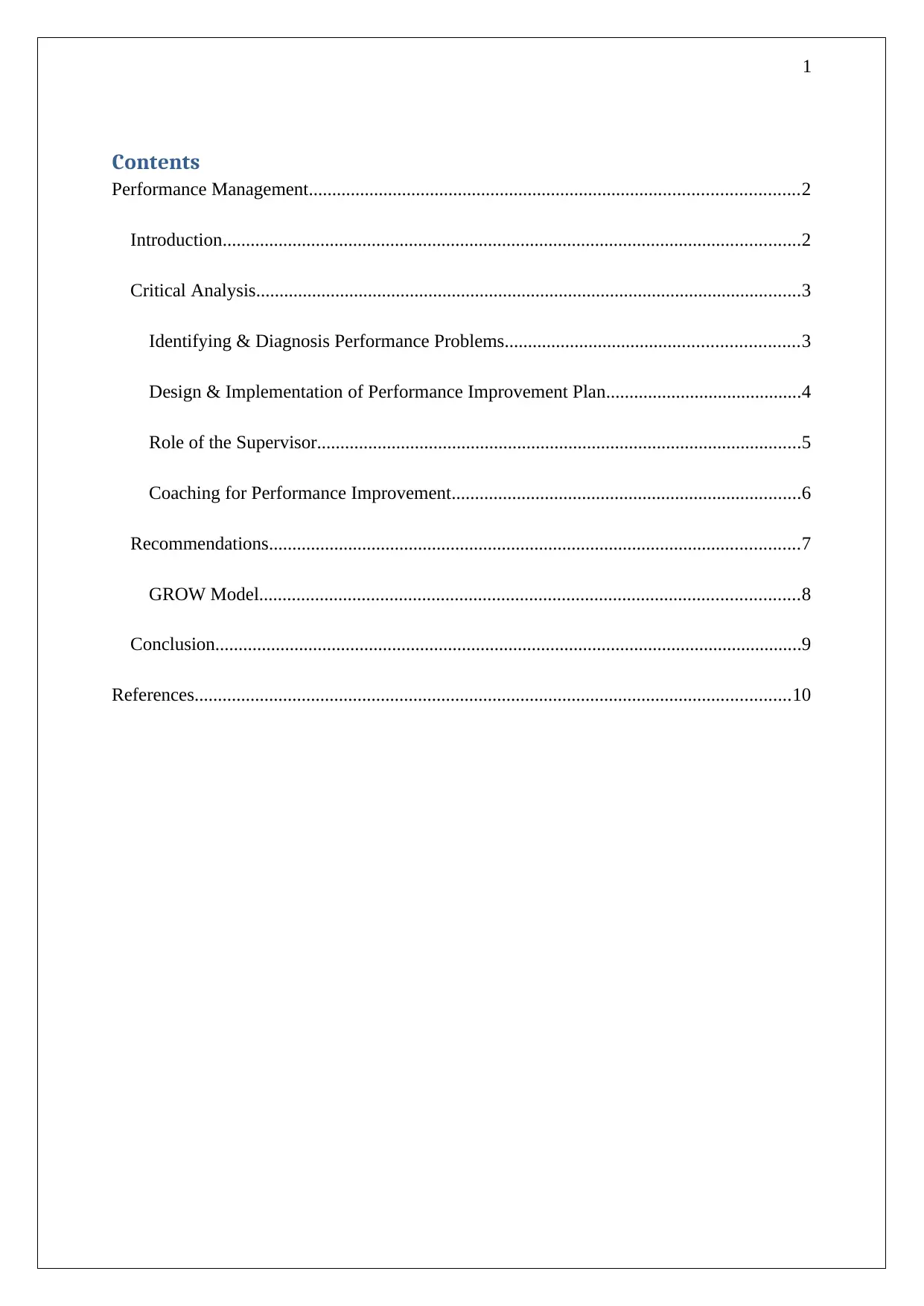
Contents
Performance Management.........................................................................................................2
Introduction............................................................................................................................2
Critical Analysis.....................................................................................................................3
Identifying & Diagnosis Performance Problems...............................................................3
Design & Implementation of Performance Improvement Plan..........................................4
Role of the Supervisor........................................................................................................5
Coaching for Performance Improvement...........................................................................6
Recommendations..................................................................................................................7
GROW Model....................................................................................................................8
Conclusion..............................................................................................................................9
References................................................................................................................................10
Contents
Performance Management.........................................................................................................2
Introduction............................................................................................................................2
Critical Analysis.....................................................................................................................3
Identifying & Diagnosis Performance Problems...............................................................3
Design & Implementation of Performance Improvement Plan..........................................4
Role of the Supervisor........................................................................................................5
Coaching for Performance Improvement...........................................................................6
Recommendations..................................................................................................................7
GROW Model....................................................................................................................8
Conclusion..............................................................................................................................9
References................................................................................................................................10
2
Performance Management
Introduction
Performance management system for employee is way of ensuring that each and every
employee does their job in a way which is defined by organizational goals and it also assures
maximum potential and efforts made by employee on the job which leads to maximum
employee and organization’s productivity. But there are some reasons or conditions occurs
which results in poor performance of employees and thus causing harm or loss to the
organization. This situation of poor performance by employees is known as
underperformance too (Aguinis, 2013).
It is a part of every manager’s job to manage performance of employees and thus managers
have to deal with underperformance too. Managers consider this responsibility of
performance management as one of the most undesirable conditions of their job. This is so
because managing poor performance has perception of thoughts of stress, pointing finger on
someone, denial, and anger which leads to uncomfortable situations for managers. However,
dealing with poor performances is at their first sign would save time of everyone and also less
stressful (Dimon, 2013).
When underperformance of employees is not addressed on time and the situation continues
for longer periods then it might create major problems and difficult to manage. More
importantly, not addressing poor performance impacts other staff negatively which worsen
performance further (Paladino, 2011).
Performance Management
Introduction
Performance management system for employee is way of ensuring that each and every
employee does their job in a way which is defined by organizational goals and it also assures
maximum potential and efforts made by employee on the job which leads to maximum
employee and organization’s productivity. But there are some reasons or conditions occurs
which results in poor performance of employees and thus causing harm or loss to the
organization. This situation of poor performance by employees is known as
underperformance too (Aguinis, 2013).
It is a part of every manager’s job to manage performance of employees and thus managers
have to deal with underperformance too. Managers consider this responsibility of
performance management as one of the most undesirable conditions of their job. This is so
because managing poor performance has perception of thoughts of stress, pointing finger on
someone, denial, and anger which leads to uncomfortable situations for managers. However,
dealing with poor performances is at their first sign would save time of everyone and also less
stressful (Dimon, 2013).
When underperformance of employees is not addressed on time and the situation continues
for longer periods then it might create major problems and difficult to manage. More
importantly, not addressing poor performance impacts other staff negatively which worsen
performance further (Paladino, 2011).
⊘ This is a preview!⊘
Do you want full access?
Subscribe today to unlock all pages.

Trusted by 1+ million students worldwide
3
Critical Analysis
Identifying & Diagnosis Performance Problems
When an employee is not performing up to the company expectations, it is obvious that every
manager ask a question to themselves, “What is wrong with that person?” And as soon as this
question comes to mind, managers often start accusing employee personally or attack them
verbally. But instead of that managers should focus on employee behaviour and work on
being objective. They should ask themselves “Why the employee is not performing up to the
organization’s expectation?” In this scenario, managers need to identify the issues that are
causing poor performance. Is this because of some consequence imbalance or task
interference occurring? (UN, 2011)
Anything that is hindering employee from performing their task to an expected level is
referred as task interference. This can be anything like a new system or procedure which
results in less productivity of employee, or it can be due to inadequate resources like tools, or
lack of training and skills. (Axson, 2010)
Consequence imbalance occurs mainly when managers do not follow up the team
performance when they said to do so specifically performance of individual. Managers keep
watch on team performance and often miss observing the performance of individual. They
praise everyone for the task completion. This result in strengthening the behaviour of poor
performers and the top performers feel underrated and their deserved recognition is given to
others (Gruman & Saks, 2011).
Once poor performances are identified, it requires the diagnosis of those problems on time
before it gets worse. First the manager should meet with underperforming employees and
discuss problem with them. Meeting should take place in private where employee feels
comfortable and non-threatening. Then employer should explain the problem to the employee
Critical Analysis
Identifying & Diagnosis Performance Problems
When an employee is not performing up to the company expectations, it is obvious that every
manager ask a question to themselves, “What is wrong with that person?” And as soon as this
question comes to mind, managers often start accusing employee personally or attack them
verbally. But instead of that managers should focus on employee behaviour and work on
being objective. They should ask themselves “Why the employee is not performing up to the
organization’s expectation?” In this scenario, managers need to identify the issues that are
causing poor performance. Is this because of some consequence imbalance or task
interference occurring? (UN, 2011)
Anything that is hindering employee from performing their task to an expected level is
referred as task interference. This can be anything like a new system or procedure which
results in less productivity of employee, or it can be due to inadequate resources like tools, or
lack of training and skills. (Axson, 2010)
Consequence imbalance occurs mainly when managers do not follow up the team
performance when they said to do so specifically performance of individual. Managers keep
watch on team performance and often miss observing the performance of individual. They
praise everyone for the task completion. This result in strengthening the behaviour of poor
performers and the top performers feel underrated and their deserved recognition is given to
others (Gruman & Saks, 2011).
Once poor performances are identified, it requires the diagnosis of those problems on time
before it gets worse. First the manager should meet with underperforming employees and
discuss problem with them. Meeting should take place in private where employee feels
comfortable and non-threatening. Then employer should explain the problem to the employee
Paraphrase This Document
Need a fresh take? Get an instant paraphrase of this document with our AI Paraphraser
4
and it makes the employee to understand: what is the problem; why it is occurring; what are
its impacts; and why it needs to be concerned (Silberman, 2013). The manager should discuss
the results they want from the meeting and also hear the point of view and other comments of
employee.
It is important to consider a solution which is jointly devised with employee because it will
make easy for employee to act and accept his own contributed solutions. Ask employee if
he/she need any assistance like mentoring, training, redefining roles or flexible work
practices, and expectations (Pulakos, 2009).
Design & Implementation of Performance Improvement Plan
Then it is required to develop a performance improvement action plan with the employee and
its implementation (Colquitt et al., 2011). An action plan can be in the form of performance
agreement. An action plan or performance agreement should clearly consist of:
What are the performance expectations from the employee and what are the objectives
that need to be achieved in specific duration;
Clearly mention employee’s responsibilities and roles;
Consist of career development and training strategies;
Consist of time period required for improvement. Timeframe may vary depending
upon the needs and issue of business. However, an employee should be provided
proper timeframe to improve his/her performance;
Motivate employee of their worth and value for the job being done by them.
To review the progress of employee, set date for another meeting and discuss the
performance of employee as per the agreed action plan.
and it makes the employee to understand: what is the problem; why it is occurring; what are
its impacts; and why it needs to be concerned (Silberman, 2013). The manager should discuss
the results they want from the meeting and also hear the point of view and other comments of
employee.
It is important to consider a solution which is jointly devised with employee because it will
make easy for employee to act and accept his own contributed solutions. Ask employee if
he/she need any assistance like mentoring, training, redefining roles or flexible work
practices, and expectations (Pulakos, 2009).
Design & Implementation of Performance Improvement Plan
Then it is required to develop a performance improvement action plan with the employee and
its implementation (Colquitt et al., 2011). An action plan can be in the form of performance
agreement. An action plan or performance agreement should clearly consist of:
What are the performance expectations from the employee and what are the objectives
that need to be achieved in specific duration;
Clearly mention employee’s responsibilities and roles;
Consist of career development and training strategies;
Consist of time period required for improvement. Timeframe may vary depending
upon the needs and issue of business. However, an employee should be provided
proper timeframe to improve his/her performance;
Motivate employee of their worth and value for the job being done by them.
To review the progress of employee, set date for another meeting and discuss the
performance of employee as per the agreed action plan.
5
Role of the Supervisor
A supervisor play important role in the performance improvement of an employee. A
supervisor can motivate an employee to an extent where he/she can be top performers of the
team. There are several examples of people whose leadership motivated their followers to
achieve huge success. Similarly, after development and implementation of an action plan, it
requires proper monitoring from the manager or the supervisor. A supervisor should monitor
the performance of the employee frequently and provide him/her necessary feedback and
motivation (Lin & Lee, 2011).
Roles of supervisor includes communicate needs of organization, oversee performance of
employees, provide support and guidance to employees, identify performance problems,
design development plans, and manage a balanced relationship between organization and
staff so that each can grow (Siop, 2016).
Source: (Silberman, 2013)
Role of the Supervisor
A supervisor play important role in the performance improvement of an employee. A
supervisor can motivate an employee to an extent where he/she can be top performers of the
team. There are several examples of people whose leadership motivated their followers to
achieve huge success. Similarly, after development and implementation of an action plan, it
requires proper monitoring from the manager or the supervisor. A supervisor should monitor
the performance of the employee frequently and provide him/her necessary feedback and
motivation (Lin & Lee, 2011).
Roles of supervisor includes communicate needs of organization, oversee performance of
employees, provide support and guidance to employees, identify performance problems,
design development plans, and manage a balanced relationship between organization and
staff so that each can grow (Siop, 2016).
Source: (Silberman, 2013)
⊘ This is a preview!⊘
Do you want full access?
Subscribe today to unlock all pages.
Trusted by 1+ million students worldwide
6
A supervisor should conduct frequent meeting with employee in order to review and discuss
the performance of employee even if there exist no issues longer. This will ensure that the
problem has been resolved to both the employee and the supervisor. The supervisor should
provide both the feedbacks that are negative and positive to the employee and provide
necessary guidance regarding the area which is lacking (Richard et al., 2009). He/she should
ensure the employee about his work and support further in order to sustain the performance
improvements in future.
Even after the development and implementation of action plan, if the performance of an
employee does not improve then it requires managers to take serious action which includes
termination of employee from job (Lra, 2016). If an employee fails to improve his/her
performance to an acceptable standard then supervisor remains only option of his/her
termination.
Coaching for Performance Improvement
Providing necessary coaching to employee to improve his/her performance is also known as
counselling. When negative feedback comes repeatedly on the same issue then it requires
providing some kind of coaching or training to employee in order to enhance his/her
performance (Qureshi & Hassan, 2013). Counselling is of two types: informal and formal.
Informal Counselling: There are some issues which can be resolved only by having
conversation with employee, this is known as informal counselling. While there are some key
points that supervisor should keep in mind while discussing the issue with employee
(Pulakos, 2009). These are:
Never confront employee in anger. Avoid making it an emotional situation;
Resolve issue on priority;
It should be done in private as it helps in creating less tense atmosphere;
A supervisor should conduct frequent meeting with employee in order to review and discuss
the performance of employee even if there exist no issues longer. This will ensure that the
problem has been resolved to both the employee and the supervisor. The supervisor should
provide both the feedbacks that are negative and positive to the employee and provide
necessary guidance regarding the area which is lacking (Richard et al., 2009). He/she should
ensure the employee about his work and support further in order to sustain the performance
improvements in future.
Even after the development and implementation of action plan, if the performance of an
employee does not improve then it requires managers to take serious action which includes
termination of employee from job (Lra, 2016). If an employee fails to improve his/her
performance to an acceptable standard then supervisor remains only option of his/her
termination.
Coaching for Performance Improvement
Providing necessary coaching to employee to improve his/her performance is also known as
counselling. When negative feedback comes repeatedly on the same issue then it requires
providing some kind of coaching or training to employee in order to enhance his/her
performance (Qureshi & Hassan, 2013). Counselling is of two types: informal and formal.
Informal Counselling: There are some issues which can be resolved only by having
conversation with employee, this is known as informal counselling. While there are some key
points that supervisor should keep in mind while discussing the issue with employee
(Pulakos, 2009). These are:
Never confront employee in anger. Avoid making it an emotional situation;
Resolve issue on priority;
It should be done in private as it helps in creating less tense atmosphere;
Paraphrase This Document
Need a fresh take? Get an instant paraphrase of this document with our AI Paraphraser
7
Provide specific data to support feedback. Avoid perceptions and impressions as it
will take nowhere and dispute details;
Be it clear the purpose of discussion. Also do not forget to appraise the good work
area of employee if any as it reinforce his/her enthusiasm;
Formal Counselling: There are issues which cannot be resolved only with informal
conversation. In that case manager needs to conduct a formal meeting with employee and try
to understand the causes of problems. After identification of problems, supervisor develops a
performance improvement plan with inclusion of employee. Training should be both
productive as well as enjoyable (Gruman & Saks, 2011). Employee learns better if learning is
interesting and engaging. Here are some coaching steps to improve employee’s performance:
Divide Information in Blocks: A supervisor should divide the information into
memorable parts. A human brain remembers only first and last presented best and
what is presented in middle session of training is remembered least (Lin & Lee,
2011);
Training should be Interesting: Supervisor should include novelty in order to make
training more interesting as it is also easy to remember for human brains. Changes can
also include to make sessions more interesting such as change in presentation, change
of state, and change of activities;
Form Groups: Some of the studies and researches have proved that trainee’s retention
of information increases if they are put in pairs or small groups (Lin & Lee, 2011).
Hence, put them in pairs or make them in groups of three or four for better learning.
Recommendations
As discussed above, performance management is significant part of job of every manager
undoubtedly. By using the peak potential of every employee to deliver the high productivity
Provide specific data to support feedback. Avoid perceptions and impressions as it
will take nowhere and dispute details;
Be it clear the purpose of discussion. Also do not forget to appraise the good work
area of employee if any as it reinforce his/her enthusiasm;
Formal Counselling: There are issues which cannot be resolved only with informal
conversation. In that case manager needs to conduct a formal meeting with employee and try
to understand the causes of problems. After identification of problems, supervisor develops a
performance improvement plan with inclusion of employee. Training should be both
productive as well as enjoyable (Gruman & Saks, 2011). Employee learns better if learning is
interesting and engaging. Here are some coaching steps to improve employee’s performance:
Divide Information in Blocks: A supervisor should divide the information into
memorable parts. A human brain remembers only first and last presented best and
what is presented in middle session of training is remembered least (Lin & Lee,
2011);
Training should be Interesting: Supervisor should include novelty in order to make
training more interesting as it is also easy to remember for human brains. Changes can
also include to make sessions more interesting such as change in presentation, change
of state, and change of activities;
Form Groups: Some of the studies and researches have proved that trainee’s retention
of information increases if they are put in pairs or small groups (Lin & Lee, 2011).
Hence, put them in pairs or make them in groups of three or four for better learning.
Recommendations
As discussed above, performance management is significant part of job of every manager
undoubtedly. By using the peak potential of every employee to deliver the high productivity
8
is primary task of every manager. And even with enough resources, effective management,
healthy work environment, and motivated employees, there are some situations when
employees do not perform as per the expectations. Addition to the above discussed ways and
strategies of managing poor performance of employees, there are some recommended models
that will be helpful in performance improvement further. These models are as follows:
GROW Model
The name of the model is an acronym, where each letter defines the different phase of model.
G is for Goal, R is for Reality, O is for Options, and W is for Forward.
It is recommended to set goals for team and individual. Goals just not define a list but it
should be vision which is mutually agreed by each team member. This helps employees in
making clear them about their objectives. This could be helpful in addressing their lacking
area and what they need to improve to achieve the present target.
Make employees aware about their real position in the journey of achieving the goals that
they set together. This will help employees in identify what more efforts they need to make in
order to complete the journey ahead.
Providing employees with different alternatives for reaching to the goal comes under options.
This requires telling employees their current position and what they need to do to achieve
their goal. If employees are facing problems in understanding one method or strategy to meet
the target then providing them alternatives will help them morally and make it easy for them
in achieving the goal. Thus, assist employees in alternative options improve their
performance. Some of the options include: coaching, enhancing education level, mentoring,
training, enhancing experience level, and personal research.
is primary task of every manager. And even with enough resources, effective management,
healthy work environment, and motivated employees, there are some situations when
employees do not perform as per the expectations. Addition to the above discussed ways and
strategies of managing poor performance of employees, there are some recommended models
that will be helpful in performance improvement further. These models are as follows:
GROW Model
The name of the model is an acronym, where each letter defines the different phase of model.
G is for Goal, R is for Reality, O is for Options, and W is for Forward.
It is recommended to set goals for team and individual. Goals just not define a list but it
should be vision which is mutually agreed by each team member. This helps employees in
making clear them about their objectives. This could be helpful in addressing their lacking
area and what they need to improve to achieve the present target.
Make employees aware about their real position in the journey of achieving the goals that
they set together. This will help employees in identify what more efforts they need to make in
order to complete the journey ahead.
Providing employees with different alternatives for reaching to the goal comes under options.
This requires telling employees their current position and what they need to do to achieve
their goal. If employees are facing problems in understanding one method or strategy to meet
the target then providing them alternatives will help them morally and make it easy for them
in achieving the goal. Thus, assist employees in alternative options improve their
performance. Some of the options include: coaching, enhancing education level, mentoring,
training, enhancing experience level, and personal research.
⊘ This is a preview!⊘
Do you want full access?
Subscribe today to unlock all pages.
Trusted by 1+ million students worldwide
9
Conclusion
From the above discussion it can be concluded that performance management is the key
requirement for every organization to increase its overall productivity. Poor performance of
employees creates several problems and decrease in performance of individual and
organization’s productivity. It is challenging for every manager to manage performance of
employees but also the most significant part of their job role. There is a proper tool kit for
managing poor performance of individual employee. This consists of several steps which
includes identification and diagnosis of performance problem. Two ways are defined for
causing poor performance: task interference and consequence imbalance. Diagnosis of poor
performance involves conversation with employees and provides them necessary assistance.
Supervisor’s role is important in designing and implementation of performance improvement
plan. In improving performance of an individual employee, supervisor plays an important
role. He provide employee with guidance, motivation, training, coaching, and assistance in
order to make improve performance of employee. Therefore, a manger or supervisor is the
key factor in an employee’s performance improvement or managing poor performance of an
employee.
Conclusion
From the above discussion it can be concluded that performance management is the key
requirement for every organization to increase its overall productivity. Poor performance of
employees creates several problems and decrease in performance of individual and
organization’s productivity. It is challenging for every manager to manage performance of
employees but also the most significant part of their job role. There is a proper tool kit for
managing poor performance of individual employee. This consists of several steps which
includes identification and diagnosis of performance problem. Two ways are defined for
causing poor performance: task interference and consequence imbalance. Diagnosis of poor
performance involves conversation with employees and provides them necessary assistance.
Supervisor’s role is important in designing and implementation of performance improvement
plan. In improving performance of an individual employee, supervisor plays an important
role. He provide employee with guidance, motivation, training, coaching, and assistance in
order to make improve performance of employee. Therefore, a manger or supervisor is the
key factor in an employee’s performance improvement or managing poor performance of an
employee.
Paraphrase This Document
Need a fresh take? Get an instant paraphrase of this document with our AI Paraphraser
10
References
Aguinis, H., 2013. Performance Management. Boston: Pearson.
Axson, D.A.J., 2010. Best Practices in Planning and Performance Management: Radically
Rethinking Management for a Volatile World. New Jersey: John Wiley & Sons.
Beeri, I., 2012. Turnaround Management Strategies in Local Authorities: Not only for Poor
Performers. Local Government Studies, 38(4), pp.461-83.
Colquitt, J., Lepine, J.A., Wesson, M.J. & Gellatly, I.R., 2011. Organizational Behaviour:
Improving Performance and Commitmentt in the Workplace. Irwin: McGraw-Hill.
Dimon, R., 2013. Enterprise Performance Management Done Right: An Operating System
for Your Organization. New Jersey: John Wiley & Sons.
Gruman, J.A. & Saks, A.M., 2011. Performance Management and Employee Engagement.
Human Resource Management Review, 21(2), pp.123-36.
Lin, J.S. & Lee, P.Y., 2011. Performance Management in Public Organizations: A
Complexity Perspective. International Public Management Review, 12(2).
Lra, 2016. Advice on Managing Poor Performance. [Online] Available at:
https://www.lra.org.uk/images/publications/Advisory_Guide-Managing_Poor_Performance_-
_February_2016.pdf.
MidTraining, 2010. Performance Management. [Online] Available at:
http://promeng.eu/downloads/training-materials/ebooks/soft-skills/performance-
management.pdf.
References
Aguinis, H., 2013. Performance Management. Boston: Pearson.
Axson, D.A.J., 2010. Best Practices in Planning and Performance Management: Radically
Rethinking Management for a Volatile World. New Jersey: John Wiley & Sons.
Beeri, I., 2012. Turnaround Management Strategies in Local Authorities: Not only for Poor
Performers. Local Government Studies, 38(4), pp.461-83.
Colquitt, J., Lepine, J.A., Wesson, M.J. & Gellatly, I.R., 2011. Organizational Behaviour:
Improving Performance and Commitmentt in the Workplace. Irwin: McGraw-Hill.
Dimon, R., 2013. Enterprise Performance Management Done Right: An Operating System
for Your Organization. New Jersey: John Wiley & Sons.
Gruman, J.A. & Saks, A.M., 2011. Performance Management and Employee Engagement.
Human Resource Management Review, 21(2), pp.123-36.
Lin, J.S. & Lee, P.Y., 2011. Performance Management in Public Organizations: A
Complexity Perspective. International Public Management Review, 12(2).
Lra, 2016. Advice on Managing Poor Performance. [Online] Available at:
https://www.lra.org.uk/images/publications/Advisory_Guide-Managing_Poor_Performance_-
_February_2016.pdf.
MidTraining, 2010. Performance Management. [Online] Available at:
http://promeng.eu/downloads/training-materials/ebooks/soft-skills/performance-
management.pdf.
11
Paladino, B., 2011. Five Key Principles of Corporate Performance Management. New
Jersey: John Wiley & Sons.
Pulakos, E.D., 2009. Performance Management: A New Approach for Driving Business
Results. New Jersey: John Wiley & Sons.
Qureshi, A. & Hassan, M., 2013. Impact of performance management on the organisational
performance: An analytical investigation of the business model of McDonalds. International
Journal of Academic Research in Economics and Management Sciences, 2(5), p.54.
Richard, P.J., Devinney, T.M., Yip, G.S. & Johnson, G., 2009. Measuring Organizational
Performance: Towards Methodological Best Practice. Journal of Management, 35(3), pp.718-
804.
Silberman, J., 2013. How To Deal With Poor Employee Performance. [Online] Available at:
https://elearningindustry.com/how-to-deal-with-poor-employee-performance.
Siop, 2016. Encouraging Effective Performance. [Online] Available at:
http://www.siop.org/whitepapers/perfmgmt.pdf.
UN, 2011. Addressing and Resolving Underperformance. [Online] Available at:
https://hr.un.org/sites/hr.un.org/files/Addressing_and_Resolving_Underperformance.pdf.
Paladino, B., 2011. Five Key Principles of Corporate Performance Management. New
Jersey: John Wiley & Sons.
Pulakos, E.D., 2009. Performance Management: A New Approach for Driving Business
Results. New Jersey: John Wiley & Sons.
Qureshi, A. & Hassan, M., 2013. Impact of performance management on the organisational
performance: An analytical investigation of the business model of McDonalds. International
Journal of Academic Research in Economics and Management Sciences, 2(5), p.54.
Richard, P.J., Devinney, T.M., Yip, G.S. & Johnson, G., 2009. Measuring Organizational
Performance: Towards Methodological Best Practice. Journal of Management, 35(3), pp.718-
804.
Silberman, J., 2013. How To Deal With Poor Employee Performance. [Online] Available at:
https://elearningindustry.com/how-to-deal-with-poor-employee-performance.
Siop, 2016. Encouraging Effective Performance. [Online] Available at:
http://www.siop.org/whitepapers/perfmgmt.pdf.
UN, 2011. Addressing and Resolving Underperformance. [Online] Available at:
https://hr.un.org/sites/hr.un.org/files/Addressing_and_Resolving_Underperformance.pdf.
⊘ This is a preview!⊘
Do you want full access?
Subscribe today to unlock all pages.
Trusted by 1+ million students worldwide

1 out of 12


Related Documents


Your All-in-One AI-Powered Toolkit for Academic Success.
+13062052269
info@desklib.com
Available 24*7 on WhatsApp / Email
![[object Object]](/_next/static/media/star-bottom.7253800d.svg)
Unlock your academic potential
Copyright © 2020–2026 A2Z Services. All Rights Reserved. Developed and managed by ZUCOL.