A Report on Performance Management and its Pervasive Characteristics

Verified

Added on  2020/12/26

|9
|1590
|391
Report
AI Summary
This report provides a comprehensive overview of performance management, emphasizing its role in enhancing organizational effectiveness. It examines the concept of performance management, its two types (intra and extra), and the pervasive characteristics that influence employee productivity. The report highlights key theories such as goal setting and social cognitive theory, illustrating their application in performance evaluation. Furthermore, it discusses how pervasive characteristics, including strategic business plans and continuous sensitivity, contribute to improved employee behavior and goal attainment. The conclusion summarizes the benefits of effective performance management, including increased employee satisfaction and long-term organizational success. The report also includes references to relevant books and journals.

Document Page
Assignment
tabler-icon-diamond-filled.svg

Paraphrase This Document

Need a fresh take? Get an instant paraphrase of this document with our AI Paraphraser
Document Page
Table of Contents
INTRODUCTION AND OVERVIEW...........................................................................................1
DEMONSTRATION OF KNOWLEDGE......................................................................................1
DEVELOPMENT OF ANSWER....................................................................................................3
CONCLUSION................................................................................................................................4
REFERENCES................................................................................................................................5
Document Page
INTRODUCTION AND OVERVIEW
An organisation consists of a diversified workforce in which each one of them possesses
different characteristics (Arnaboldi, Lapsley and Steccolini, 2015). Every organisation
performance depends on its organisational culture is. It helps in enhancing productivity of
employees. The management is responsible for evaluating performance of employees through
systems established. The effectiveness of performance management system reflects on overall
organisation productivity. So, any change in system influences overall effectiveness. Also, when
management focuses on specific group features it directly impacts efficiency (Muduli, 2015).
There are certain criteria set on basis of which performance is evaluated. It can be on basis of
task and contextual. Performance management refers to developing an environment to enhance
productivity of employees. It is a concept which ensures that goals and objectives are attained in
effective manner (Bourne and Bourne, 2012). There are two types of performance management
that is intra and extra. Intra refers to improving decision making by taking feedback of
employees, providing training, etc. Whereas extra refers to providing benefits, incentives, etc. to
enhance performance. The pervasive characteristics of performance management includes
communication, targets, continuous sensitivity, etc.
DEMONSTRATION OF KNOWLEDGE
It is important for business to maintain their effectiveness so that competitive advantage
can be gained. It is done by using performance management. The main purpose of organisational
performance management is to attain results through development of employees and maintaining
the culture of workplace (Kuvaas, Buch and Dysvik, 2016). This depends on overall assessment
of pervasive characteristics at optimum level. It includes specified way such as strategic business
plan, review and evaluation, etc. through which performance is evaluated (Bititci, Cocca and
Ates, 2016). A pervasive characteristic influence in enhancing performance of employees. It can
of different types like targets, monitoring, communication, etc. So, all these are integrated within
performance management. There are several theories related to performance management which
are as follows:-
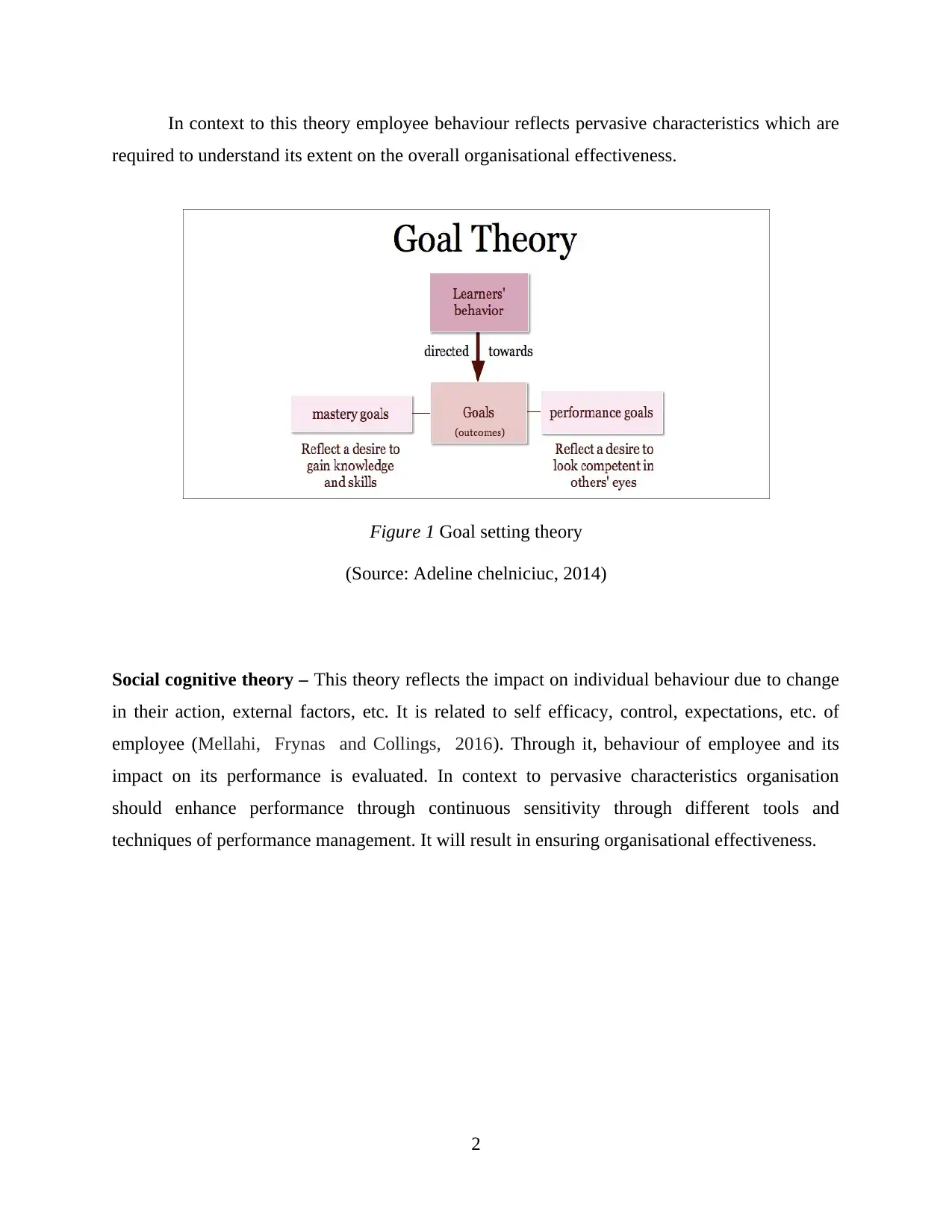
Goal setting theory- This theory is gives answer of question that are what, when, how, who etc.
of expectation of goal. it helps in setting SMART goals for employees. Here, the main aim is to
set higher level goals (Pulakos and et.al., 2015). this helps in improving their performance.
Besides this, setting of goals will be useful in increasing organisational effectiveness.
1
Document Page
In context to this theory employee behaviour reflects pervasive characteristics which are
required to understand its extent on the overall organisational effectiveness.
Figure 1 Goal setting theory
(Source: Adeline chelniciuc, 2014)
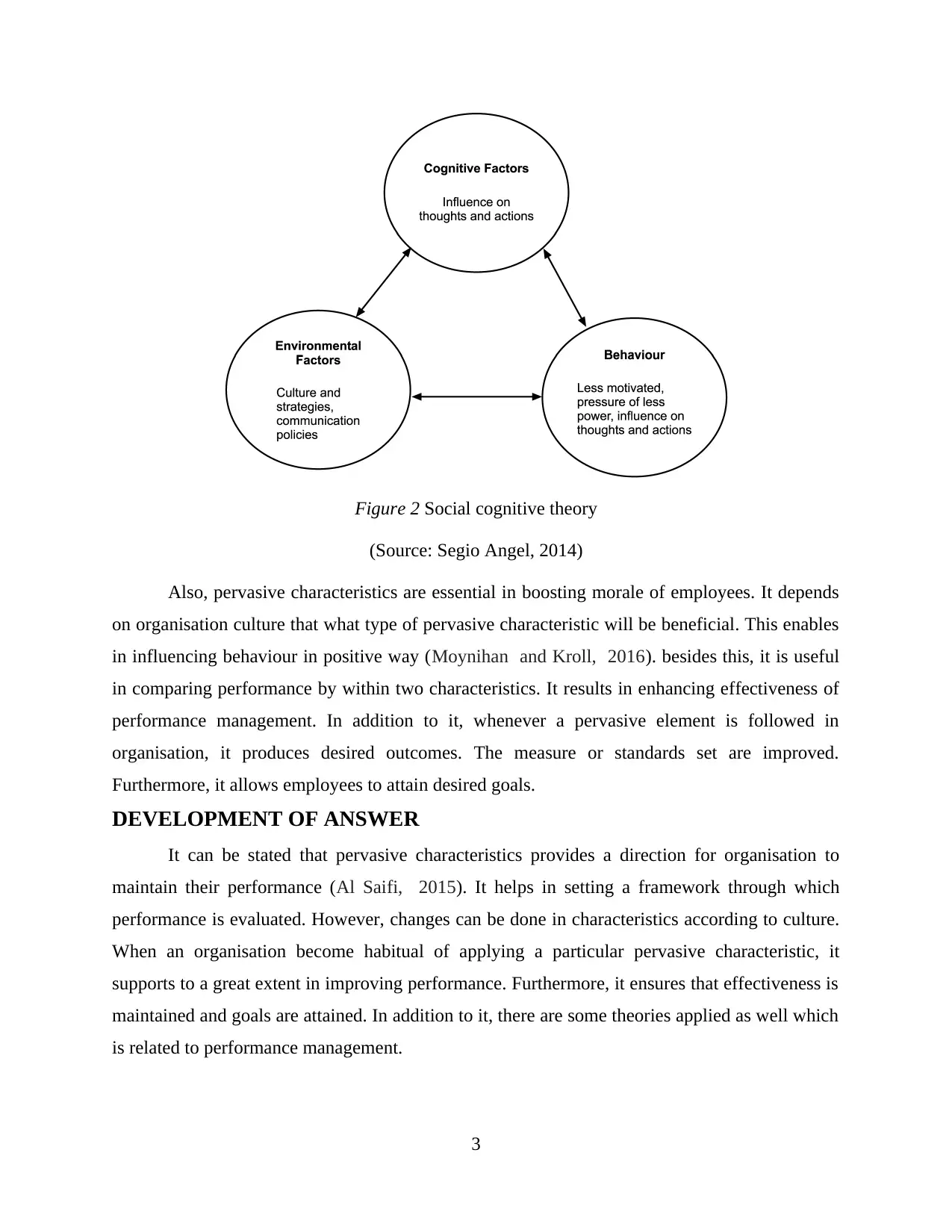
Social cognitive theory – This theory reflects the impact on individual behaviour due to change
in their action, external factors, etc. It is related to self efficacy, control, expectations, etc. of
employee (Mellahi, Frynas and Collings, 2016). Through it, behaviour of employee and its
impact on its performance is evaluated. In context to pervasive characteristics organisation
should enhance performance through continuous sensitivity through different tools and
techniques of performance management. It will result in ensuring organisational effectiveness.
2
tabler-icon-diamond-filled.svg

Paraphrase This Document

Need a fresh take? Get an instant paraphrase of this document with our AI Paraphraser
Document Page
Figure 2 Social cognitive theory
(Source: Segio Angel, 2014)
Also, pervasive characteristics are essential in boosting morale of employees. It depends
on organisation culture that what type of pervasive characteristic will be beneficial. This enables
in influencing behaviour in positive way (Moynihan and Kroll, 2016). besides this, it is useful
in comparing performance by within two characteristics. It results in enhancing effectiveness of
performance management. In addition to it, whenever a pervasive element is followed in
organisation, it produces desired outcomes. The measure or standards set are improved.
Furthermore, it allows employees to attain desired goals.
DEVELOPMENT OF ANSWER
It can be stated that pervasive characteristics provides a direction for organisation to
maintain their performance (Al Saifi, 2015). It helps in setting a framework through which
performance is evaluated. However, changes can be done in characteristics according to culture.
When an organisation become habitual of applying a particular pervasive characteristic, it
supports to a great extent in improving performance. Furthermore, it ensures that effectiveness is
maintained and goals are attained. In addition to it, there are some theories applied as well which
is related to performance management.
3
Document Page
Apart from this, pervasive characteristics reflects on how employee’s behaviour change
towards their performance (Heffernan and Dundon, 2016). It gives an insight about to which
pervasive feature is best suited for performance management. However, through strategic
business plan and measuring results are two features that has helped to great extent. This is
because it has been easy for business to make changes in way of measuring productivity.
Consequently, continuous sensitivity support in changing process, procedures, etc. which brings
creativity and efficiency (Ishizaka and Pereira, 2016). From this goal are attained within less
time and in effective manner. Thus, it brings enhancement in performance and also allows
employees to achieve their targets. It is necessary to frequently improve performance so that
positive culture is developed (Daud and et.al., 2018). Also, organisational effectiveness is
ensured only when performance management is implemented in proper way. It has been
successful in evaluating business as well as employee productivity. Pervasive characteristics not
only develop culture but also increases satisfaction of employees. They know what their goals
are how it will contribute towards overall organisation.
CONCLUSION
Hereby, it is concluded that pervasive characteristics of performance management is
useful in enhancing effectiveness of organisation. There are two types of performance
management that is intra and extra. It contains various types of pervasive features like
monitoring, measuring results, review, etc. Also, different theories are applied in evaluating
performance such as goal setting and social cognitive theory. Besides this, ensuring performance
is beneficial for long term. It results in increasing satisfaction of employees and retaining them.
Furthermore, it is useful in setting specific goals and comparing with outcomes. This assist in
ensuring whether performance has enhanced or not.
4
Document Page
REFERENCES
Books and journals
Al Saifi, S.A., 2015. Positioning organisational culture in knowledge management
research. Journal of Knowledge Management. 19(2). pp.164-189.
Arnaboldi, M., Lapsley, I. and Steccolini, I., 2015. Performance management in the public
sector: The ultimate challenge. Financial Accountability & Management. 31(1). pp.1-22.
Bititci, U., Cocca, P. and Ates, A., 2016. Impact of visual performance management systems on
the performance management practices of organisations. International Journal of
Production Research. 54(6). pp.1571-1593.
Bourne, M. and Bourne, P., 2012. Handbook of corporate performance management. John Wiley
& Sons.
Daud, W.N.W. and et.al., 2018. Leader's qualities and organisational performance: a case of
Malaysian Takaful operator. International Journal of Business Performance
Management. 19(2). pp.189-208.
Heffernan, M. and Dundon, T., 2016. Crosslevel effects of highperformance work systems
(HPWS) and employee wellbeing: the mediating effect of organisational justice. Human
Resource Management Journal. 26(2). pp.211-231.
Ishizaka, A. and Pereira, V.E., 2016. Portraying an employee performance management system
based on multi-criteria decision analysis and visual techniques. International Journal of
Manpower. 37(4). pp.628-659.
Kuvaas, B., Buch, R. and Dysvik, A., 2016. Performance management: Perceiving goals as
invariable and implications for perceived job autonomy and work performance. Human
Resource Management. 55(3). pp.401-412.
Mellahi, K., Frynas, J.G. and Collings, D.G., 2016. Performance management practices within
emerging market multinational enterprises: the case of Brazilian multinationals. The
International Journal of Human Resource Management. 27(8). pp.876-905.
Moynihan, D.P. and Kroll, A., 2016. Performance management routines that work? An early
assessment of the GPRA Modernization Act. Public Administration Review. 76(2).
pp.314-323.
Muduli, A., 2015. High performance work system, HRD climate and organisational
performance: An empirical study. European journal of Training and development. 39(3).
pp.239-257.
Pulakos, E.D. and et.al., 2015. Performance management can be fixed: An on-the-job
experiential learning approach for complex behavior change. Industrial and
Organizational Psychology. 8(1). pp.51-76.
5
tabler-icon-diamond-filled.svg

Paraphrase This Document

Need a fresh take? Get an instant paraphrase of this document with our AI Paraphraser
Document Page
6
Document Page
7
chevron_up_icon
1 out of 9
circle_padding
hide_on_mobile
zoom_out_icon
[object Object]