Analyzing Performance Related Pay and Employee Motivation in Australia
VerifiedAdded on 2020/05/16
|28
|5108
|35
Report
AI Summary
This research paper investigates the impact of performance-related pay on employee motivation within Australian companies, particularly in the auditing sector. It begins by establishing the economic context and the existing levels of employee motivation in Australia. The problem statement highlights the issues related to employee motivation and its effect on company performance. The research aims to determine the relationship between performance-related pay and motivation. The literature review explores existing theories and studies on the subject, including the motivational effects of pay, both positive and negative, and the distinction between intrinsic and extrinsic motivation. The methodology section details the use of secondary data collection and descriptive research design to analyze the correlation and regression between performance-related pay and employee motivation. The discussion section interprets the data analysis to address the research question, and the conclusion summarizes the findings, provides recommendations, and acknowledges the limitations of the study. This paper aims to contribute to a better understanding of how performance-related pay can be effectively used to enhance employee motivation in Australian companies. Desklib provides access to this report and a wealth of other study resources for students.

Running head: BUSINESS PROFESSIONAL PROJECT
The impact of performance related pay on the employee’s motivation in Australian Companies
Name of the Student:
Name of the University:
Author’s Note:
The impact of performance related pay on the employee’s motivation in Australian Companies
Name of the Student:
Name of the University:
Author’s Note:

Paraphrase This Document
Need a fresh take? Get an instant paraphrase of this document with our AI Paraphraser
1
BUSINESS PROFESSIONAL PROJECT
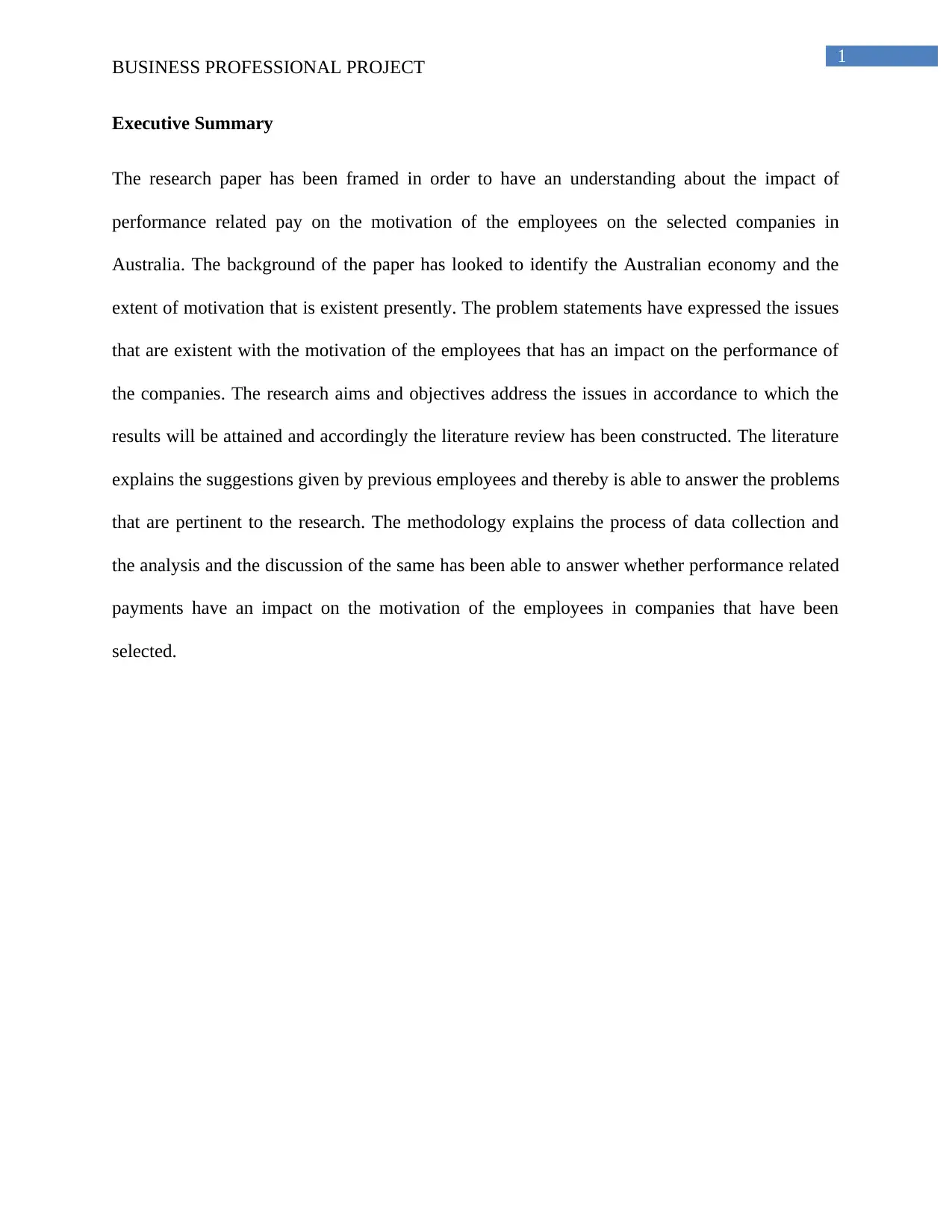
Executive Summary
The research paper has been framed in order to have an understanding about the impact of
performance related pay on the motivation of the employees on the selected companies in
Australia. The background of the paper has looked to identify the Australian economy and the
extent of motivation that is existent presently. The problem statements have expressed the issues
that are existent with the motivation of the employees that has an impact on the performance of
the companies. The research aims and objectives address the issues in accordance to which the
results will be attained and accordingly the literature review has been constructed. The literature
explains the suggestions given by previous employees and thereby is able to answer the problems
that are pertinent to the research. The methodology explains the process of data collection and
the analysis and the discussion of the same has been able to answer whether performance related
payments have an impact on the motivation of the employees in companies that have been
selected.
BUSINESS PROFESSIONAL PROJECT
Executive Summary
The research paper has been framed in order to have an understanding about the impact of
performance related pay on the motivation of the employees on the selected companies in
Australia. The background of the paper has looked to identify the Australian economy and the
extent of motivation that is existent presently. The problem statements have expressed the issues
that are existent with the motivation of the employees that has an impact on the performance of
the companies. The research aims and objectives address the issues in accordance to which the
results will be attained and accordingly the literature review has been constructed. The literature
explains the suggestions given by previous employees and thereby is able to answer the problems
that are pertinent to the research. The methodology explains the process of data collection and
the analysis and the discussion of the same has been able to answer whether performance related
payments have an impact on the motivation of the employees in companies that have been
selected.
2
BUSINESS PROFESSIONAL PROJECT
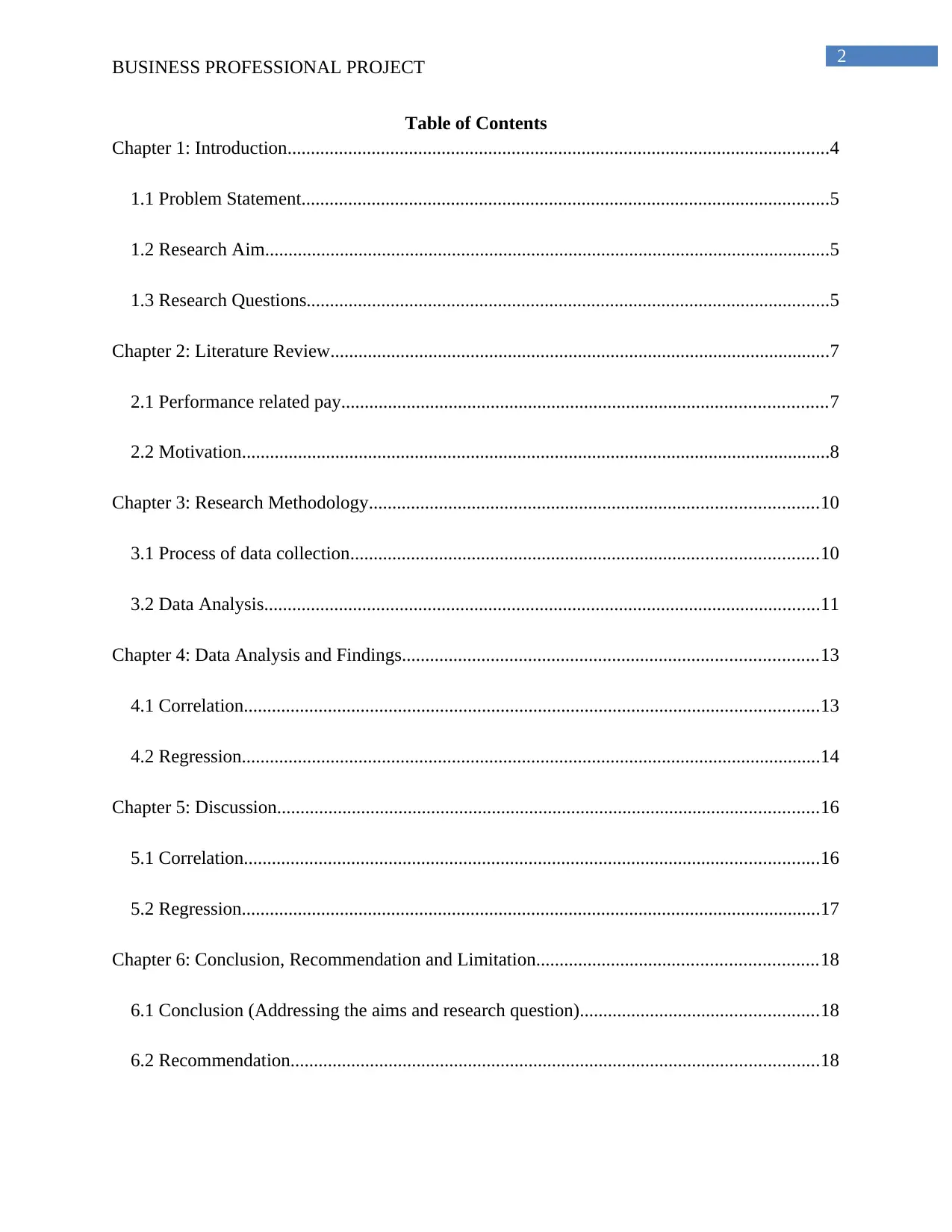
Table of Contents
Chapter 1: Introduction....................................................................................................................4
1.1 Problem Statement.................................................................................................................5
1.2 Research Aim.........................................................................................................................5
1.3 Research Questions................................................................................................................5
Chapter 2: Literature Review...........................................................................................................7
2.1 Performance related pay........................................................................................................7
2.2 Motivation..............................................................................................................................8
Chapter 3: Research Methodology................................................................................................10
3.1 Process of data collection....................................................................................................10
3.2 Data Analysis.......................................................................................................................11
Chapter 4: Data Analysis and Findings.........................................................................................13
4.1 Correlation...........................................................................................................................13
4.2 Regression............................................................................................................................14
Chapter 5: Discussion....................................................................................................................16
5.1 Correlation...........................................................................................................................16
5.2 Regression............................................................................................................................17
Chapter 6: Conclusion, Recommendation and Limitation............................................................18
6.1 Conclusion (Addressing the aims and research question)...................................................18
6.2 Recommendation.................................................................................................................18
BUSINESS PROFESSIONAL PROJECT
Table of Contents
Chapter 1: Introduction....................................................................................................................4
1.1 Problem Statement.................................................................................................................5
1.2 Research Aim.........................................................................................................................5
1.3 Research Questions................................................................................................................5
Chapter 2: Literature Review...........................................................................................................7
2.1 Performance related pay........................................................................................................7
2.2 Motivation..............................................................................................................................8
Chapter 3: Research Methodology................................................................................................10
3.1 Process of data collection....................................................................................................10
3.2 Data Analysis.......................................................................................................................11
Chapter 4: Data Analysis and Findings.........................................................................................13
4.1 Correlation...........................................................................................................................13
4.2 Regression............................................................................................................................14
Chapter 5: Discussion....................................................................................................................16
5.1 Correlation...........................................................................................................................16
5.2 Regression............................................................................................................................17
Chapter 6: Conclusion, Recommendation and Limitation............................................................18
6.1 Conclusion (Addressing the aims and research question)...................................................18
6.2 Recommendation.................................................................................................................18
⊘ This is a preview!⊘
Do you want full access?
Subscribe today to unlock all pages.

Trusted by 1+ million students worldwide

3
BUSINESS PROFESSIONAL PROJECT
6.3 Limitation............................................................................................................................18
Reference List................................................................................................................................20
Appendix........................................................................................................................................25
BUSINESS PROFESSIONAL PROJECT
6.3 Limitation............................................................................................................................18
Reference List................................................................................................................................20
Appendix........................................................................................................................................25
Paraphrase This Document
Need a fresh take? Get an instant paraphrase of this document with our AI Paraphraser
4
BUSINESS PROFESSIONAL PROJECT
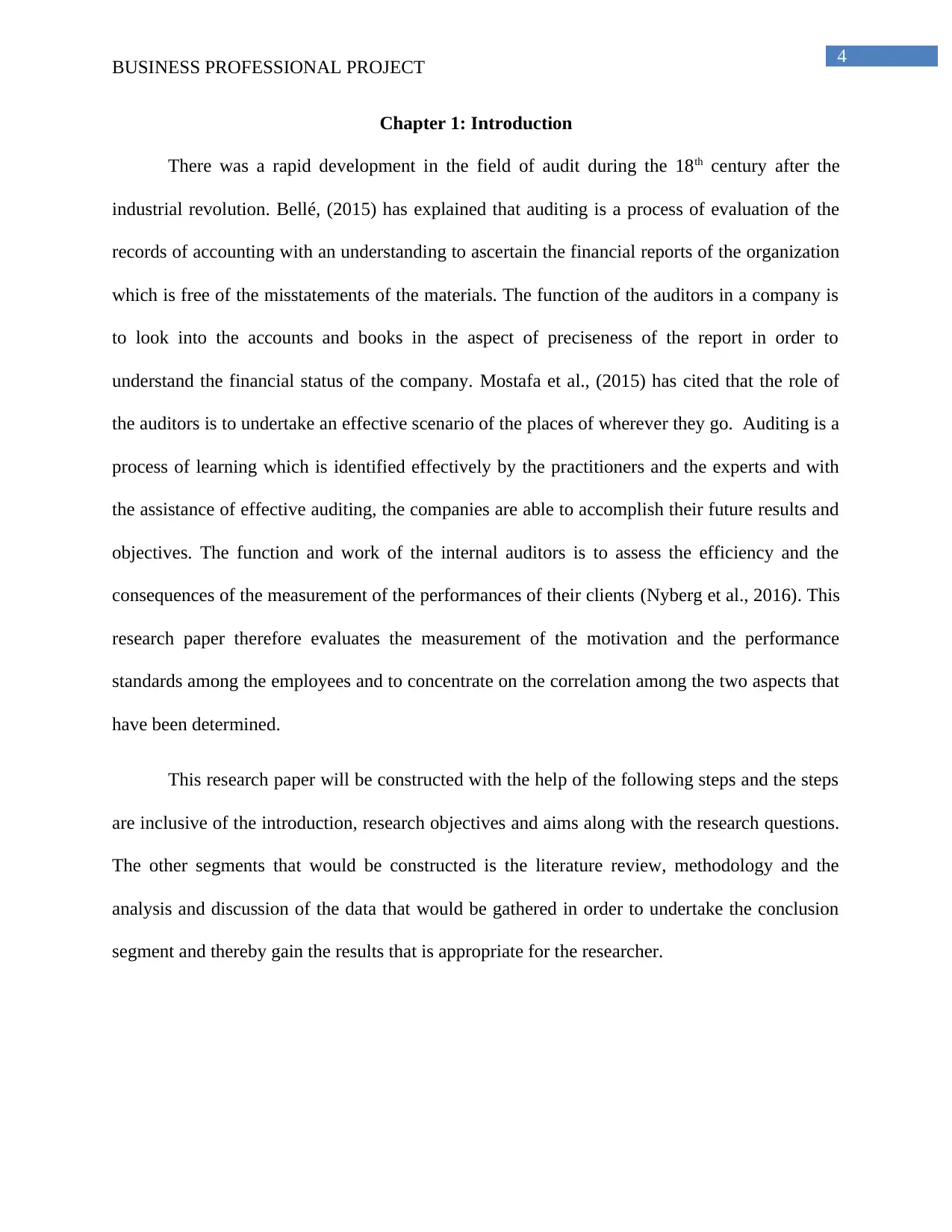
Chapter 1: Introduction
There was a rapid development in the field of audit during the 18th century after the
industrial revolution. Bellé, (2015) has explained that auditing is a process of evaluation of the
records of accounting with an understanding to ascertain the financial reports of the organization
which is free of the misstatements of the materials. The function of the auditors in a company is
to look into the accounts and books in the aspect of preciseness of the report in order to
understand the financial status of the company. Mostafa et al., (2015) has cited that the role of
the auditors is to undertake an effective scenario of the places of wherever they go. Auditing is a
process of learning which is identified effectively by the practitioners and the experts and with
the assistance of effective auditing, the companies are able to accomplish their future results and
objectives. The function and work of the internal auditors is to assess the efficiency and the
consequences of the measurement of the performances of their clients (Nyberg et al., 2016). This
research paper therefore evaluates the measurement of the motivation and the performance
standards among the employees and to concentrate on the correlation among the two aspects that
have been determined.
This research paper will be constructed with the help of the following steps and the steps
are inclusive of the introduction, research objectives and aims along with the research questions.
The other segments that would be constructed is the literature review, methodology and the
analysis and discussion of the data that would be gathered in order to undertake the conclusion
segment and thereby gain the results that is appropriate for the researcher.
BUSINESS PROFESSIONAL PROJECT
Chapter 1: Introduction
There was a rapid development in the field of audit during the 18th century after the
industrial revolution. Bellé, (2015) has explained that auditing is a process of evaluation of the
records of accounting with an understanding to ascertain the financial reports of the organization
which is free of the misstatements of the materials. The function of the auditors in a company is
to look into the accounts and books in the aspect of preciseness of the report in order to
understand the financial status of the company. Mostafa et al., (2015) has cited that the role of
the auditors is to undertake an effective scenario of the places of wherever they go. Auditing is a
process of learning which is identified effectively by the practitioners and the experts and with
the assistance of effective auditing, the companies are able to accomplish their future results and
objectives. The function and work of the internal auditors is to assess the efficiency and the
consequences of the measurement of the performances of their clients (Nyberg et al., 2016). This
research paper therefore evaluates the measurement of the motivation and the performance
standards among the employees and to concentrate on the correlation among the two aspects that
have been determined.
This research paper will be constructed with the help of the following steps and the steps
are inclusive of the introduction, research objectives and aims along with the research questions.
The other segments that would be constructed is the literature review, methodology and the
analysis and discussion of the data that would be gathered in order to undertake the conclusion
segment and thereby gain the results that is appropriate for the researcher.
5
BUSINESS PROFESSIONAL PROJECT
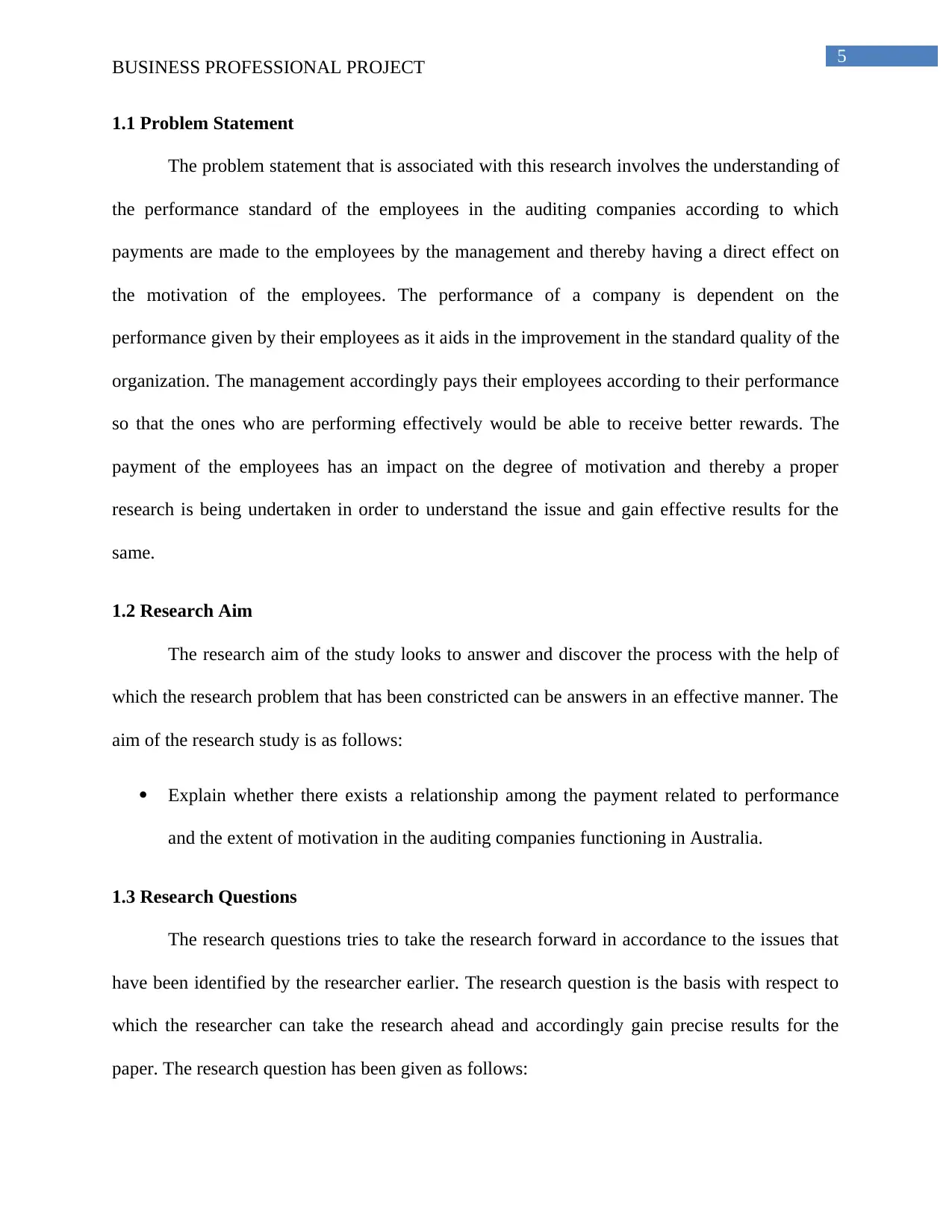
1.1 Problem Statement
The problem statement that is associated with this research involves the understanding of
the performance standard of the employees in the auditing companies according to which
payments are made to the employees by the management and thereby having a direct effect on
the motivation of the employees. The performance of a company is dependent on the
performance given by their employees as it aids in the improvement in the standard quality of the
organization. The management accordingly pays their employees according to their performance
so that the ones who are performing effectively would be able to receive better rewards. The
payment of the employees has an impact on the degree of motivation and thereby a proper
research is being undertaken in order to understand the issue and gain effective results for the
same.
1.2 Research Aim
The research aim of the study looks to answer and discover the process with the help of
which the research problem that has been constricted can be answers in an effective manner. The
aim of the research study is as follows:
Explain whether there exists a relationship among the payment related to performance
and the extent of motivation in the auditing companies functioning in Australia.
1.3 Research Questions
The research questions tries to take the research forward in accordance to the issues that
have been identified by the researcher earlier. The research question is the basis with respect to
which the researcher can take the research ahead and accordingly gain precise results for the
paper. The research question has been given as follows:
BUSINESS PROFESSIONAL PROJECT
1.1 Problem Statement
The problem statement that is associated with this research involves the understanding of
the performance standard of the employees in the auditing companies according to which
payments are made to the employees by the management and thereby having a direct effect on
the motivation of the employees. The performance of a company is dependent on the
performance given by their employees as it aids in the improvement in the standard quality of the
organization. The management accordingly pays their employees according to their performance
so that the ones who are performing effectively would be able to receive better rewards. The
payment of the employees has an impact on the degree of motivation and thereby a proper
research is being undertaken in order to understand the issue and gain effective results for the
same.
1.2 Research Aim
The research aim of the study looks to answer and discover the process with the help of
which the research problem that has been constricted can be answers in an effective manner. The
aim of the research study is as follows:
Explain whether there exists a relationship among the payment related to performance
and the extent of motivation in the auditing companies functioning in Australia.
1.3 Research Questions
The research questions tries to take the research forward in accordance to the issues that
have been identified by the researcher earlier. The research question is the basis with respect to
which the researcher can take the research ahead and accordingly gain precise results for the
paper. The research question has been given as follows:
⊘ This is a preview!⊘
Do you want full access?
Subscribe today to unlock all pages.
Trusted by 1+ million students worldwide

6
BUSINESS PROFESSIONAL PROJECT
RQ: Is there a relationship among the motivation of the employees and the performance related
pay in the auditing companies in Australia?
BUSINESS PROFESSIONAL PROJECT
RQ: Is there a relationship among the motivation of the employees and the performance related
pay in the auditing companies in Australia?
Paraphrase This Document
Need a fresh take? Get an instant paraphrase of this document with our AI Paraphraser
7
BUSINESS PROFESSIONAL PROJECT
Chapter 2: Literature Review
2.1 Performance related pay
It is known that money is one of the most influential motivator. Hameed et al., (2014) has
expressed that pay is linked directly to the employee performance in a company but there are
certain researchers who have debated that payment processes are just a mechanism to motivate
the employees to perform effectively in association with motivational theories. It is even seen
that payment can even lead to demotivation (Barrick et al., 2015). If the payment given to the
employees is lower than what they have been anticipating, then it can lead to the demotivation
towards their level of performance and thereby make it difficult for the companies to recruit and
select skilled employees. Gerhart, & Fang (2014) has debated that employee performance is
interlinked with the rank an employee has in their company.
The external rewards like the increase in pay, benefits and bonuses have the influence to
motivate an employee to perform effectively in a company as money is looked upon as a
significant incentive. Hence, pay is considered as vital employee motivator as it explains the
level of commitment of an employee towards their work. Conversely Gupta, & Shaw (2014), has
debated on this matter and has expressed that the factor of money like the rise in payment can
encourage an employee for a little while but it is not efficient for a long time and thereby is not
able to improve the performance of the employees in a drastic manner. There have been several
studies that have offered variant reviews regarding the payment related to performance but it has
not discovered that the key objective of making use of this process was to motivate or encourage
the employees and even reward them for performing in an effective manner (Olafsen et al.,
2015). Conversely, the performance concept associated to payment has been a challenging issue
and there has been a question that has aroused whether the real intention of this has been
BUSINESS PROFESSIONAL PROJECT
Chapter 2: Literature Review
2.1 Performance related pay
It is known that money is one of the most influential motivator. Hameed et al., (2014) has
expressed that pay is linked directly to the employee performance in a company but there are
certain researchers who have debated that payment processes are just a mechanism to motivate
the employees to perform effectively in association with motivational theories. It is even seen
that payment can even lead to demotivation (Barrick et al., 2015). If the payment given to the
employees is lower than what they have been anticipating, then it can lead to the demotivation
towards their level of performance and thereby make it difficult for the companies to recruit and
select skilled employees. Gerhart, & Fang (2014) has debated that employee performance is
interlinked with the rank an employee has in their company.
The external rewards like the increase in pay, benefits and bonuses have the influence to
motivate an employee to perform effectively in a company as money is looked upon as a
significant incentive. Hence, pay is considered as vital employee motivator as it explains the
level of commitment of an employee towards their work. Conversely Gupta, & Shaw (2014), has
debated on this matter and has expressed that the factor of money like the rise in payment can
encourage an employee for a little while but it is not efficient for a long time and thereby is not
able to improve the performance of the employees in a drastic manner. There have been several
studies that have offered variant reviews regarding the payment related to performance but it has
not discovered that the key objective of making use of this process was to motivate or encourage
the employees and even reward them for performing in an effective manner (Olafsen et al.,
2015). Conversely, the performance concept associated to payment has been a challenging issue
and there has been a question that has aroused whether the real intention of this has been
8
BUSINESS PROFESSIONAL PROJECT
attained. It is not clear which is the more influencing factor; the impact of the level of the reward
system or the process through which is payment is associated interlinked to the employee
performance (Noe et al., 2014). Therefore the employees are not sure about the degree of
performance they require to achieve in order to receive a certain reward process.
2.2 Motivation
Motivation can be explained as an influential mechanism that concentrates on continuing
towards giving their optimum best in the work they perform (Jayaweera, 2015). In other words,
motivation is even known as the intrinsic force in order to fulfil the demand of an employee to
attain their future aim and goals. An employee who has motivation in doing something needs to
perform effectively not only for the company but even for themselves.
Bozeman, & Su (2015) have explained about the two kinds of motivation which are
known as the external motivation and internal motivation. Motivation has even been segregated
into two kinds: the motivators that associates to enhanced performance; development of
responsibility and the degree of accomplishment that provides optimistic satisfaction towards
the work and the other is the factor of hygiene which associates to benefits, working scenarios,
bonuses and interpersonal relationship and in case this does not exist it may lead to
dissatisfaction towards the work but does not motivate an individual in the long run (Gerhart &
Fang 2015). According to Connelly et al., (2016), in accordance to the Civil Service Reform Act
of 1978, it was discovered that the employees functioning in the public sector gets motivated by
a sense of accomplishment from their work rather the amount of payment they are entitled to
receive (Shin, & Konrad 2017). The researchers have debated that rewarding the
accomplishments of the employees with greater identification and high status rather than
awarding them with an increase the payment or the bonuses would be successful to raise the
BUSINESS PROFESSIONAL PROJECT
attained. It is not clear which is the more influencing factor; the impact of the level of the reward
system or the process through which is payment is associated interlinked to the employee
performance (Noe et al., 2014). Therefore the employees are not sure about the degree of
performance they require to achieve in order to receive a certain reward process.
2.2 Motivation
Motivation can be explained as an influential mechanism that concentrates on continuing
towards giving their optimum best in the work they perform (Jayaweera, 2015). In other words,
motivation is even known as the intrinsic force in order to fulfil the demand of an employee to
attain their future aim and goals. An employee who has motivation in doing something needs to
perform effectively not only for the company but even for themselves.
Bozeman, & Su (2015) have explained about the two kinds of motivation which are
known as the external motivation and internal motivation. Motivation has even been segregated
into two kinds: the motivators that associates to enhanced performance; development of
responsibility and the degree of accomplishment that provides optimistic satisfaction towards
the work and the other is the factor of hygiene which associates to benefits, working scenarios,
bonuses and interpersonal relationship and in case this does not exist it may lead to
dissatisfaction towards the work but does not motivate an individual in the long run (Gerhart &
Fang 2015). According to Connelly et al., (2016), in accordance to the Civil Service Reform Act
of 1978, it was discovered that the employees functioning in the public sector gets motivated by
a sense of accomplishment from their work rather the amount of payment they are entitled to
receive (Shin, & Konrad 2017). The researchers have debated that rewarding the
accomplishments of the employees with greater identification and high status rather than
awarding them with an increase the payment or the bonuses would be successful to raise the
⊘ This is a preview!⊘
Do you want full access?
Subscribe today to unlock all pages.
Trusted by 1+ million students worldwide
9
BUSINESS PROFESSIONAL PROJECT
employee performance in the public sector. Belle, & Cantarelli (2015) have explained that there
are three kinds of factors that motivate the employees to perform in an effective manner. They
are based on the norm, rational and affective motivations. The process of rational motives is the
ones where they perform for the intention of their own individual interest, norm-reliant motive
stresses on the public interest and on the other hand affective motives are known as the
motivation to assist others (De Gieter, & Hofmans 2015).
It is seen that external motivation enhances improved performance but most of the
researchers have debated on this topic and have sad that reward can bring a negative effect on the
level of the performance (Oswald et al., 2015). Additionally, it is explained that a rise in
payments, benefits and bonuses can the factor to motivate the employees in order to give out
their best but the job is observed to be less enjoyable.
BUSINESS PROFESSIONAL PROJECT
employee performance in the public sector. Belle, & Cantarelli (2015) have explained that there
are three kinds of factors that motivate the employees to perform in an effective manner. They
are based on the norm, rational and affective motivations. The process of rational motives is the
ones where they perform for the intention of their own individual interest, norm-reliant motive
stresses on the public interest and on the other hand affective motives are known as the
motivation to assist others (De Gieter, & Hofmans 2015).
It is seen that external motivation enhances improved performance but most of the
researchers have debated on this topic and have sad that reward can bring a negative effect on the
level of the performance (Oswald et al., 2015). Additionally, it is explained that a rise in
payments, benefits and bonuses can the factor to motivate the employees in order to give out
their best but the job is observed to be less enjoyable.
Paraphrase This Document
Need a fresh take? Get an instant paraphrase of this document with our AI Paraphraser
10
BUSINESS PROFESSIONAL PROJECT
Chapter 3: Research Methodology
This segment of the research has the idea of explaining the method of gathering the data
that is precise and authentic that would be helpful in discovering the answer demanded by this
paper and thereby addressing the problems that have been recognised by the researcher in the
earlier chapters. In order to have an understanding about performance related pay on the
motivation of the employees, it is essential for the researcher to collect quantitative data (Malik
et al., 2015).
3.1 Process of data collection
The key aim and objective of collecting the data and the process that would be used has
been to disclose the impact of performance related payments on the motivation of the employees
in the auditing companies in Australia. Therefore, in line with the research topic, the researcher
has the idea of making use of the descriptive research design in order to highlight the information
and the data that has been obtained from various researches that are secondary in nature
(Fernandez, & Moldogaziev 2015). The research has looked to collect secondary data from
several sources in order to undertake significant amount of assessments which can be helpful in
providing the results that is desired. The researcher has looked to gather the data from the
general sources that are available to them in accordance to the research topic. The researcher has
taken assistance of the internet websites, annual report of the companies that have been selected,
corporate social responsibility report of the companies, government annual reports and websites,
articles and journals associated with the companies that have been chosen. The researcher has
even looked to go through previous researches constructed by the earlier researchers on similar
topics and thereby connecting them to the current research paper and thereby have an effective
knowledge about the outcome that can lead to answering of the research issues (Kallio, & Kallio
BUSINESS PROFESSIONAL PROJECT
Chapter 3: Research Methodology
This segment of the research has the idea of explaining the method of gathering the data
that is precise and authentic that would be helpful in discovering the answer demanded by this
paper and thereby addressing the problems that have been recognised by the researcher in the
earlier chapters. In order to have an understanding about performance related pay on the
motivation of the employees, it is essential for the researcher to collect quantitative data (Malik
et al., 2015).
3.1 Process of data collection
The key aim and objective of collecting the data and the process that would be used has
been to disclose the impact of performance related payments on the motivation of the employees
in the auditing companies in Australia. Therefore, in line with the research topic, the researcher
has the idea of making use of the descriptive research design in order to highlight the information
and the data that has been obtained from various researches that are secondary in nature
(Fernandez, & Moldogaziev 2015). The research has looked to collect secondary data from
several sources in order to undertake significant amount of assessments which can be helpful in
providing the results that is desired. The researcher has looked to gather the data from the
general sources that are available to them in accordance to the research topic. The researcher has
taken assistance of the internet websites, annual report of the companies that have been selected,
corporate social responsibility report of the companies, government annual reports and websites,
articles and journals associated with the companies that have been chosen. The researcher has
even looked to go through previous researches constructed by the earlier researchers on similar
topics and thereby connecting them to the current research paper and thereby have an effective
knowledge about the outcome that can lead to answering of the research issues (Kallio, & Kallio
11
BUSINESS PROFESSIONAL PROJECT
2014). The data gathering with the assistance of the selected sources will be minimising the
expenses and this process is regarded as cost effective as well. The secondary data even explains
the present issue by nt taking any help of other sources that the researcher has.
The data related to the companies that have been selected have been gathered from the
annual report of the companies and even from the corporate social responsibility report disclosed
by the companies annually (Cerasoli et al., 2014). The data is even available on the company
website and one can download the same from the website with ease and thereby reducing the
cost of attaining it.
3.2 Data Analysis
The process of data analysis is the machismo of planning the process fir undertaking the
researches in order to discover the data that is valid. A quantitative process is utilised in order to
evaluate the data in this study to examine the relationship among the two performance variables
associated to the payment and the motivation of the employees of the top five Australian auditing
organizations (Shaw, & Gupta 2015). In the quantitative research process, the outcome rises
directly from the interpretation of the data of the huge number of population pools. The outcome
is numerical in nature rather than being subjective and the researchers have more authority over
how the information is assessed and gathered. Quantitative research is undertaken in order to
examine the theory and in the conclusion either hypothesis of the research supported or is
rejected (Samnani, & Singh 2014).
The statistics and the data is collected from the annual report of the top five Australian
auditing companies. In this research the dependent variables will be evaluated have an impact on
the individual motivation and affect the relation of work and the independent variables are the
measurement of the performance, evaluation quality and the external and the internal motivation.
BUSINESS PROFESSIONAL PROJECT
2014). The data gathering with the assistance of the selected sources will be minimising the
expenses and this process is regarded as cost effective as well. The secondary data even explains
the present issue by nt taking any help of other sources that the researcher has.
The data related to the companies that have been selected have been gathered from the
annual report of the companies and even from the corporate social responsibility report disclosed
by the companies annually (Cerasoli et al., 2014). The data is even available on the company
website and one can download the same from the website with ease and thereby reducing the
cost of attaining it.
3.2 Data Analysis
The process of data analysis is the machismo of planning the process fir undertaking the
researches in order to discover the data that is valid. A quantitative process is utilised in order to
evaluate the data in this study to examine the relationship among the two performance variables
associated to the payment and the motivation of the employees of the top five Australian auditing
organizations (Shaw, & Gupta 2015). In the quantitative research process, the outcome rises
directly from the interpretation of the data of the huge number of population pools. The outcome
is numerical in nature rather than being subjective and the researchers have more authority over
how the information is assessed and gathered. Quantitative research is undertaken in order to
examine the theory and in the conclusion either hypothesis of the research supported or is
rejected (Samnani, & Singh 2014).
The statistics and the data is collected from the annual report of the top five Australian
auditing companies. In this research the dependent variables will be evaluated have an impact on
the individual motivation and affect the relation of work and the independent variables are the
measurement of the performance, evaluation quality and the external and the internal motivation.
⊘ This is a preview!⊘
Do you want full access?
Subscribe today to unlock all pages.
Trusted by 1+ million students worldwide

1 out of 28


Related Documents


Your All-in-One AI-Powered Toolkit for Academic Success.
+13062052269
info@desklib.com
Available 24*7 on WhatsApp / Email
![[object Object]](/_next/static/media/star-bottom.7253800d.svg)
Unlock your academic potential
Copyright © 2020–2026 A2Z Services. All Rights Reserved. Developed and managed by ZUCOL.